
A Pioneer Thanksgiving by Barbara Greenwood, illustrated by Heather Collins, 1999.
This book is part story, part history, and part craft and activity book. It tells the story of a particular pioneer family’s Thanksgiving celebration in 1841 to explain the sort of Thanksgiving celebrations that pioneer families would have at the time, and there are related activities and recipes to accompany the story.
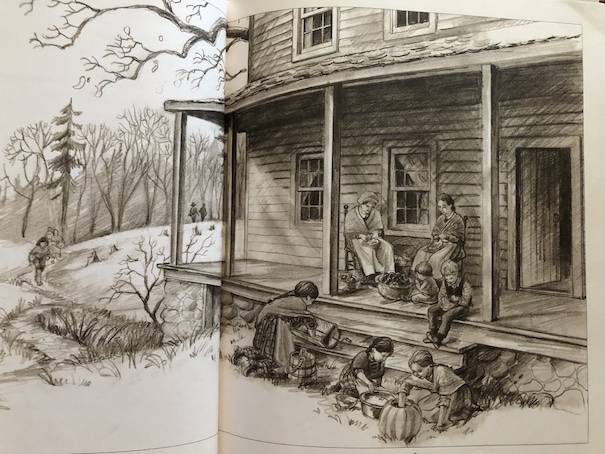
Everyone in the Robertson family helps with preparing the food for the Thanksgiving feast, including the family’s neighbors, who will be joining them. The story is episodic, focusing on different family members and their adventures and activities through the Thanksgiving preparations.
As they begin their preparations, they are worried about Granny, who is unwell. Mrs. Robertson is afraid that she might die because she doesn’t seem to be improving. As Sarah reads to her, Granny expresses a wish to taste her mother’s cranberry sauce one more time.
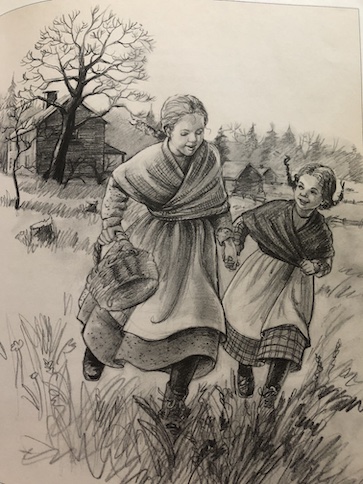

Sarah decides to go out and gather some cranberries for the sauce herself, but her little sister, Lizzie, tags along with her. The cranberry bog isn’t safe. Lizzie falls in and nearly drowns. Sarah manages to save her, but she’s very upset at almost losing Lizzie. However, her brother George finds Sarah’s basket of cranberries and brings it back to the house. The first activity in the book is a recipe for cranberry sauce.

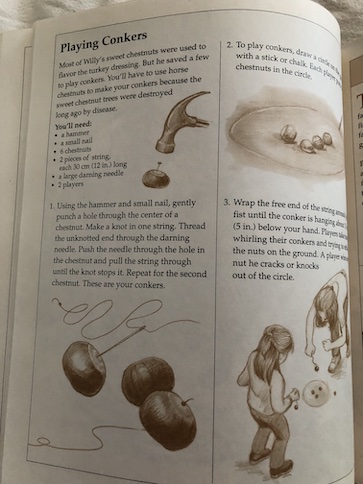
Willie, one of the boys in the family, almost gets lost while looking for chestnuts for his mother’s chestnut stuffing, and he plays a game of Conkers with a Native American (First Peoples) friend, whose family trades foods with the Robertson family. Part of the story explains about Ojibwa and Iroquois thanksgiving ceremonies, and there are instructions in the book for playing Conkers with chestnuts and a Native American game with peach stones.

The younger children go into the woods to gather nuts, and there are instructions for weaving a nutting basket. Meg, the oldest girl in the family, makes bread with interesting designs, and there’s a recipe for bread. Sarah makes a Corn Dolly, and Granny explains the superstition of making a Corn Dolly and then plowing the Corn Dolly back into the soil at the beginning of the next planting season to ensure a good harvest.

Mr. Burkholder, their neighbor, tells them a story about when his family had newly arrived in North America and they had little food. Then, there is a section about weather and now to make a weather vane. Finally, everyone gathers at the table to say grace and enjoy the feast!

In the back of the book, there is a section about the history of Thanksgiving as a holiday in North America, both in the US and Canada. This book is actually set in Canada, and it explains that the date of Canandian Thanksgiving celebrations wasn’t initially fixed. Sometimes, they could be in October and sometimes in November. Canadian Thanksgiving was finally established as the second Monday in October in 1957.
I couldn’t find a copy of this book online, but I did find a copy on Internet Archive of a related book by the same author about the same pioneer family in Canada.
My Reaction
Although the book doesn’t say exactly where this family is other than North America, the other book about the family establishes that they are in Canada, and the references to Native Americans as “First Peoples” confirms it. When I first started reading the book, I thought that the pioneer family was somewhere in the United States or its territories. The lifestyle that the Canadian pioneers lived seems very similar to the way pioneers in the United States lived around that time, so I think the recounting of this family’s holiday would still be of interest to fans of the Little House on the Prairie series and similar books.
Hearing about Canadian Thanksgiving was interesting, and I liked the inclusion of information about the Thanksgiving traditions of the First Peoples and immigrants to Canada. The family in the story was originally from Scotland, and the grandmother in the story talks about how Thanksgiving celebrations remind her of the Harvest Home celebrations back in Scotland.
The book has a good selection of different types of activities for readers to try, from recipes to games to crafts. It seems like there is something here that could appeal to many people with different interests. Each of the activities appears next to a part of the story that references it, so readers can feel like they’re taking part in the activities along with the people in the story. I also really love the realistic art style in the illustrations!
 Jestress's Forgotten Books and Stories