Harlequin and the Green Dress

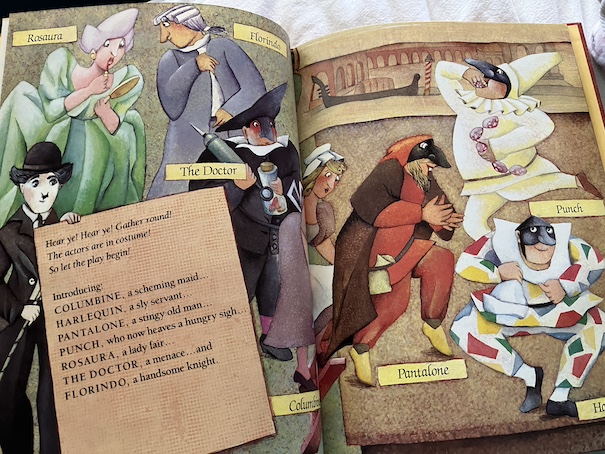
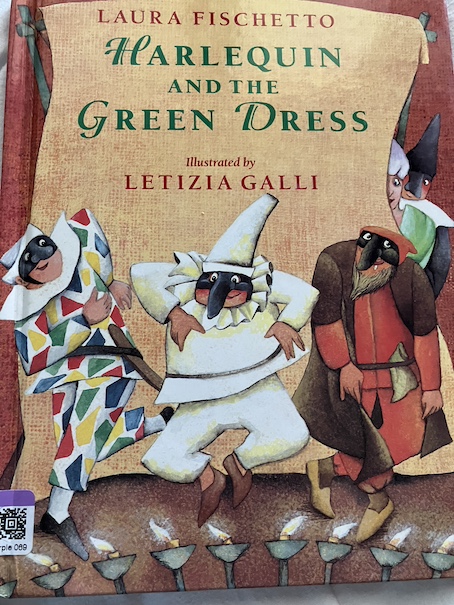
What I love about this book is that it’s a fun introduction to commedia del arte and its stock characters! A figure that looks like Charlie Chaplin holds a card that summons readers like guests to a play and introduces our characters like this:

  • Columbine – “a scheming maid …”
  • Harlequin – “a sly servant …”
  • Pantalone – “a stingy old man …”
  • Punch – “who now heaves a hungry sigh …”
  • Rosaura – “a lady fair …”
  • The Doctor – “a menace … and”
  • Florindo – “a handsome knight.”

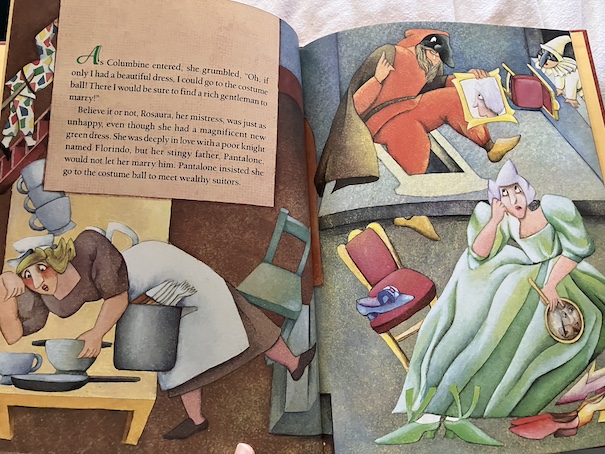
There is going to be a costume ball. Rosaura, a wealthy young lady, has a beautiful green dress to wear, but she is unhappy because her father, Pantalone, refuses to let her marry the man she loves, Florindo. Florindo is a poor knight, and Pantalone hopes that Rosaura will meet a wealthier suitor at the costume ball.

Meanwhile, Rosaura’s maid, Columbine, wishes that she had a beautiful dress so that she could go to the costume ball herself. She thinks that, if she went to the ball, she might also meet a rich man.

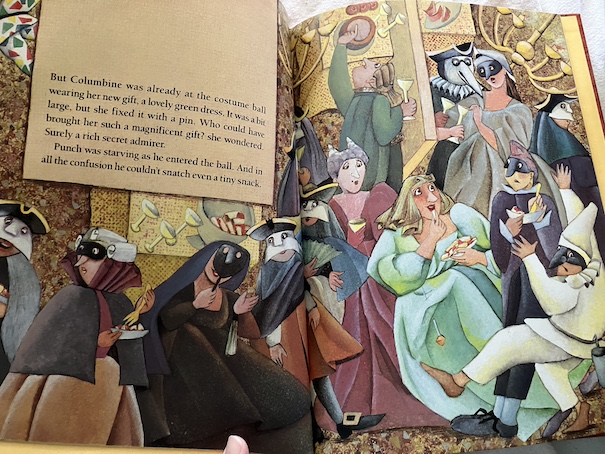
Harlequin is in love with Columbine, and he wants to do something that would impress her. He decides to borrow Rosaura’s dress and give it to Columbine as an anonymous gift so that Columbine can to go to the ball, but unbeknowst to him, Florindo is coming up with a scheme that will allow Rosaura to run away with him and get married. Florindo enlists his servant, Punch, to pretend to kidnap Rosaura, to provide a reason for her sudden disappearance. He tells Punch that he will know Rosaura at the ball because of her magnificent green dress, not knowing that Columbine has already received the dress from Harlequin and is wearing it at the ball.

Chaos ensues when Punch abducts Columbine, thinking that it’s Rosaura and that she’s just playing along with Florindo’s plan. When Punch says that he’s taking her to her suitor, Columbine assumes that he’s taking her to the secret admirer who gave her the dress.

In the meantime, poor Rosaura is having hysterics because she can’t find her dress and can’t go to meet her suitor. When Harlequin discovers what a mess all the scheming has caused, he comes up with another scheme to straighten out everything. Can he reunite Rosaura with Florindo, convince Pantalone to allow their marriage to take place, make her that Punch gets all the snacks he wants, and make things right with Columbine?

I love books that introduce lesser-known topics, and I imagine that few young readers would know anything about commedia del arte. For kids who are old enough to appreciate a little theatrical history and expand their cultural horizons, this is a fun introduction to an art form that they may have never seen before!

My first introduction to the stock characters was in Agatha Christie movies because Agatha Christie was fond of commedia del arte and put references to it into some of her stories, like The Affair of the Victory Ball. There is a section at the back of this book that explains the historical background of this type of theater and more about the characteristics of the stock characters.

I did think that the story in the book jumped around oddly in some places, and the role of The Doctor wasn’t very well explained. I think part of the reason was that the action would be easier to understand if we were watching it on stage rather than reading it in a book. The pictures are also chaotic and a little difficult to follow. I think they’re meant to convey the shifting scenes and the fast and chaotic movements of the characters as they go about their various schemes. The story itself is meant to be chaotic and action-filled because of all the characters’ schemes and counter-schemes. The action and visual jokes would probably make more sense seeing them performed rather than hearing them described.

I did like the part at the end, where we see the actors taking their bows and some of them removing their masks because the story was a play the entire time. The story isn’t meant for readers to see the characters as real people and events that are actually taking place. It’s all been a stage play the entire time. The pictures also indicate that it was always a play, with its flat scenery, objects at strange angles, and characters that seem to be separated from each other by thin walls. It’s all a bit unreal because it is unreal.

To get around some of the chaotic nature of the story and make it more fun for kids, I think this is a good book to read aloud with a lot of enthusiasm and maybe even act out rather than just telling it, encouraging young listeners to get involved in the story and the imaginary world of the theater.

When Aunt Lena Did the Rhumba

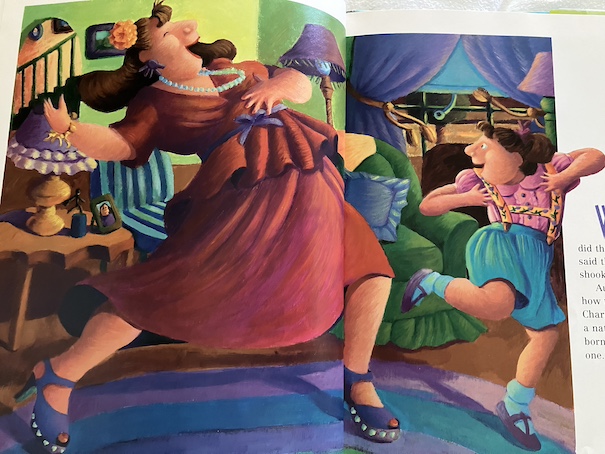
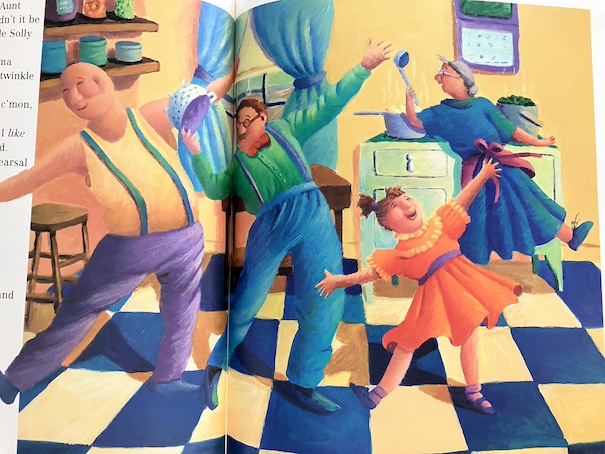
Sophie’s Aunt Lena loves music, dancing, movies, and theater, and she especially loves Broadway musicals. She goes to a musical matinee every Wednesday. After seeing a musical, she comes home, singing and dancing and acting out parts from the play she’s just seen.

One particular Wednesday, when she’s acting out a particularly dramatic dance in the kitchen, she accidentally slips and sprains her ankle. She has to stay home and rest until her ankle gets better, which means that she won’t be able to go to next Wednesday’s matinee.

Aunt Lena is so sad about missing the musicals she loves that Sophie gets an idea to cheer her up. Sophie recruits other members of her family to put on their own musical to entertain Aunt Lena.

Not everyone is enthusiastic about the idea at first, but when Sophie gets her grandmother to help her put together a costume fit for a Broadway musical and choose some music, they begin drawing other family members in.

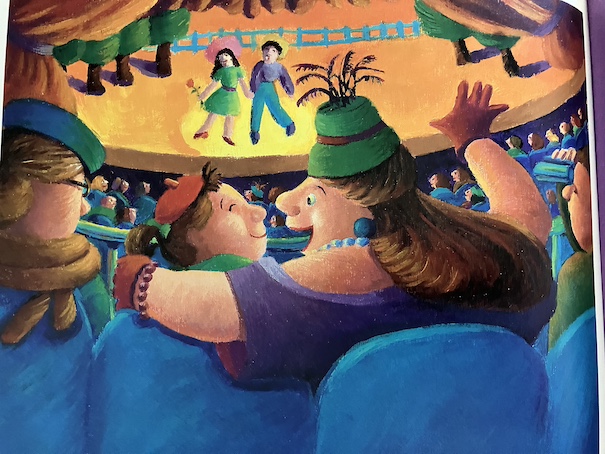
Aunt Lena loves their performance, and when she’s better, she takes Sophie to a matinee so she can see a real Broadway performance, too!

This book is available to borrow and read for free online through Internet Archive (multiple copies). It was also a Reading Rainbow book, and the episode of Reading Rainbow is also available to watch online through Internet Archive.

I didn’t see the original episode of Reading Rainbow that included this book when I was a kid because this book was published after I was too old for that. However, I always liked Reading Rainbow when I was a kid, and later, after I started this blog, I decided to go back and check out some of the books covered by Reading Rainbow after I stopped watching it. If you’re not familiar with Reading Rainbow, it was a children’s television program on public television in the US that encouraged children to read by discussing books and showing children things that were related to the books they were reading. For example, if they were reading books related to animals in an episode, the host, Levar Burton, might take a trip to a zoo and talk to zookeepers about animals in the zoo.

The themes of this particular story and the Reading Rainbow episode are music, dancing, and theater. In the episode, they show a boys’ choir and dancing class and talk about how performing helps the boys and young men develop confidence and maturity. There’s also a comedian who specializes in physical comedy, who talks about how he does his stunts, and an actress who plays one of the cats in the famous Broadway musical Cats.

I love how the aunt in the book shares her love of dancing and theater with her niece. The two of them have similar personalities and interests, so when her aunt is injured, her niece knows how to cheer her up. The ending of the story implies that the niece will now be going to performances with her aunt, or at least, will sometimes go with her. I also liked how the rest of the family participated in the girl’s plans when they saw what she wanted to do, even if they weren’t as enthusiastic about the idea themselves at first. Enthusiasm can be contagious, and I do think that adults sharing their interests with kids can spark lifelong interests in the next generation.

I also noticed that this seems to be an unconventional family, although the family’s living arrangements aren’t the focus of the story. The girl’s parents are never mentioned. She seems to live with just her grandmother, her aunt, and a couple of uncles, and there is no explanation why because it’s not directly important to the story. In any case, it seems to be a happy, close-knit family, with family members caring for each other and supporting each other’s interests.

The pictures in the book are bright and colorful, fitting with the energy, enthusiasm, and theatricality of the story.

Amazing Grace

Amazing Grace by Mary Hoffman, 1991.

Grace loves stories, both hearing them and acting them out. She is imaginative, and likes playing games of pretend and acting out adventures.

When Grace’s teacher tells the class that they are going to perform the play Peter Pan and will be holding auditions for parts in the play, Grace wants the title role of Peter Pan. A couple of the other kids think that it’s odd for her to want to be Peter Pan because she is both a girl and black, which is exactly the opposite of how they usually see the character.

However, Grace still wants to play Peter Pan. When she tells her mother and grandmother what the other kids said, they reassure her that she can get the part if she really wants it and puts her mind to it.

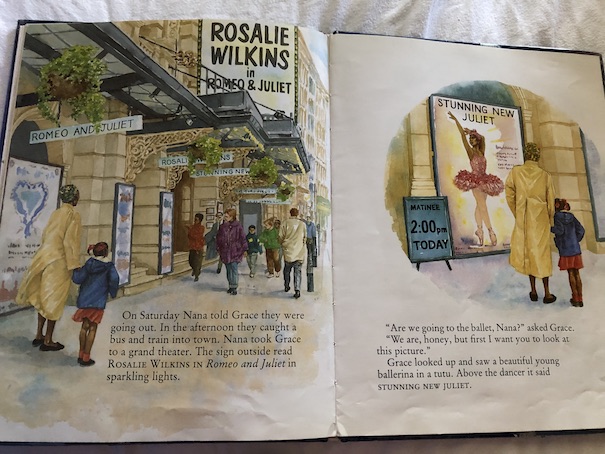
To prove to Grace that a young black girl can get starring roles, her grandmother takes her to see a ballet where the granddaughter of a friend of hers from Trinidad is playing the role of Juliet in Romeo and Juliet.

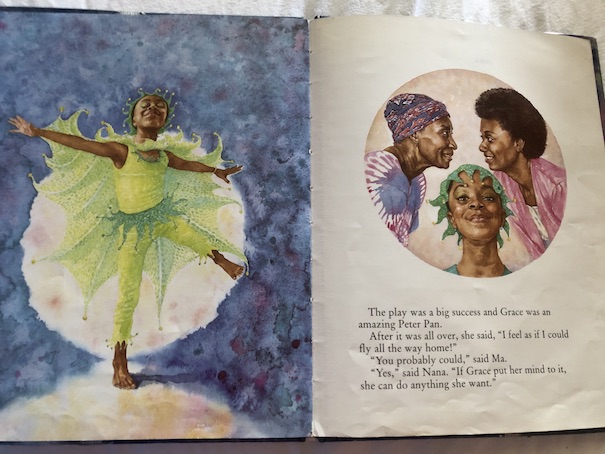
Seeing the performance cheers Grace up and gives her the confidence to audition for the part of Peter Pan. When her classmates see how good she is when she performs, they all agree that Grace should have the role of Peter Pan.

The message that young girls like Grace can do what they set their minds to, even if the roles they want in life aren’t quite traditional, is a good one. As I read the story, I was also thinking that the objection that Grace can’t be Peter Pan actually doesn’t make much sense if you know that Peter Pan, of all roles in plays, is one that is often played by a female. I remember that when I was a kid in elementary school, there was a girl who played the part of Peter Pan, and one of the teachers explained that women sometimes play Peter Pan, especially when the actors are all adults, because women have the higher-pitched voices that the part really needs. I would liked it if the teacher in the story also mentioned that. Also, acting is about capturing the spirit of the character in the story, thinking and feeling like they would think and feel and acting the way they would act. I would have liked it if they had mentioned that. Grace may not look quite the way people might picture Peter Pan, but if she can capture the character in her performance, she’s a good actor.

I liked the pictures in the book for their realism. In a couple of the pictures which show how Grace like to act out fantasies, she is shirtless, but she is very young and it isn’t possible to really see anything, so I don’t consider it inappropriate, but I thought that I would mention it.

This is a Reading Rainbow Book.

Stage Fright

SBStageFright

Stage Fright by James Howe, 1990.

A well-known actress, Michaele, who is also an old friend of Sebastian Barth’s mother, has come to town to be in a play. She’s staying with Sebastian’s family, and Sebastian has a role in the play as Michaele’s son. His friends will be working on the sets for the play, and everyone is really excited. However, Michaele herself is nervous because she hasn’t done live theater for some time. She is also struggling to get to know her nine-year-old son, who has recently come to live with her.

Then, someone begins sending her strange notes. At first, they come in the form of secret admirer notes and are accompanied by little presents. Later, the notes take a nasty turn, and Michaele becomes the victim of suspicious accidents. Someone even calls her son pretending to be his father, who lives in another state, to get him to go off on his own to meet him somewhere. Although nothing bad happens to the boy and no one comes to meet him, his sudden disappearances cause Michaele to worry that he has been kidnapped. Someone seems to be trying to frighten Michaele out of doing the play, but who is it and why?

The theme of the story is the difference between what people imagine is true and what is really true. A lot of the people in the story have unrealistic expectations of others. For instance, Michaele is impatient with her young son, who has had a troubled history of being torn between his divorced parents, who are both busy with their careers. By the end of the story, she has come to understand him better and plans to spend much more time with him.

Michaele, as a well-known actress, also attracts many admirers, most of whom have different illusions about what she is really like and what she really wants. In the end, after Sebastian reveals the culprit, Michaele decides not to let what happened stop her from going for what she knows she really wants, whether her efforts succeed or not. Michaele’s confidence is restored, and she’s looking forward to a brighter future with her son.

The book is currently available online through Internet Archive.

A Samurai Never Fears Death

SamuraiNeverFearsDeath

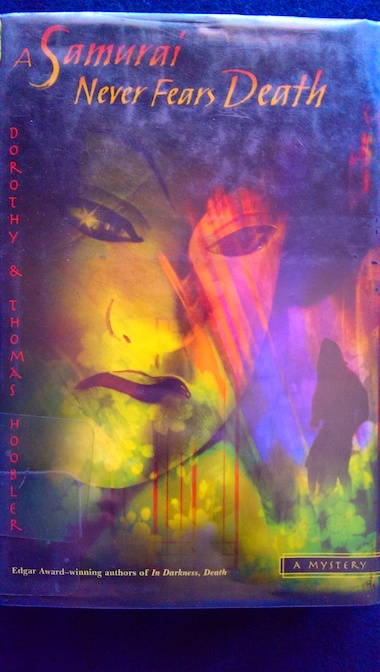
A Samurai Never Fears Death by Dorothy and Thomas Hoobler, 2007.

This book is part of the The Samurai Detective Series.

Sixteen-year-old Seikei returns home to visit his birth family in Osaka while Judge Ooka investigates reports of smugglers in the city.  Seikei is a little nervous about seeing his birth family because he hasn’t gone to see them since he was adopted by Judge Ooka about two years before.  All he knows is that his younger brother, Denzaburo, is helping his father to run the family’s tea business, which is probably a relief to Seikei’s father because Denzaburo was always more interested in the business than Seikei was.

However, things have changed in Seikei’s family since he left Osaka, and his homecoming isn’t quite what he imagined it would be.  Seikei had expected that his older sister, Asako, might be married by now, but she says that Denzaburo is keeping her from her dowry because he needs her to help run the family business.  Although Denzaburo enjoys business and the life of a merchant, it turns out that Asako has a better mind for it than he has.  The two of them have been running the family’s tea shop by themselves because their father is ill.  Also, although the family no longer lives above their shop, having bought a new house for themselves, Denzaburo says that he sometimes stays at the shop overnight to receive deliveries of goods.  Seikei knows that can’t be true because no one ever delivers goods at night in Osaka.  Denzaburo brushes off Seikei’s questions by suggesting that the three of them visit the puppet theater together to celebrate Seikei’s visit.

At the puppet theater, Seikei learns that Asako is in love with a young man who is an apprentice there, Ojoji.  Because Ojoji is only an apprentice, the two of them cannot afford to get married, something that Denzaburo laughs about.  However, before Seikei can give the matter more thought, they discover that one of the narrators of the plays has been murdered, strangled.

They summon an official from Osaka to investigate the scene, Judge Izumo, but Seikei isn’t satisfied with his investigation because it seems like Judge Izumo is quick to jump to conclusions.  Then, suspicion falls on Ojoji.  Asako doesn’t believe that the man she loves could commit murder and wants Seikei to ask Judge Ooka to intercede on Ojoji’s behalf, so Seikei begins to search for evidence that will help to prove Ojoji’s innocence.

The mysterious happenings and murders (there is another death before the book is over) at the puppet theater are connected to the smuggling case that Judge Ooka is investigating, and for Seikei, part of the solution hits uncomfortably close to home.  However, I’d like to assure readers that Asako and her beloved get a happy ending.

During part of the story, Seikei struggles to understand how the villains, a group of bandits, seem to get so much support and admiration from other people in the community, including his brother.  It is Asako who explains it to him.  It’s partly about profit because the outlaws’ activities benefit others monetarily, but that’s only part of it.  In Japan’s society, birth typically determines people’s roles in life, and each role in society comes with its own expectations about behavior, as Seikei himself well knows.  Seikei is fortunate that circumstances allowed him to choose a different path when he didn’t feel comfortable in the role that his birth seemed to choose for him; he never really wanted to be a merchant in spite of being born into a merchant family.  Others similarly do not feel completely comfortable with the standards that society has set for them, and their fascination with the outlaws is that the outlaws do not seem to care what society or anyone else thinks of them.  The outlaws do exactly what they want, when they want to do it, dressing any way they please, acting any way they please, and taking anything they want to use for their own profit.  Denzaburo, who was always willing to cut corners when it profited him, sees nothing wrong with this, and he envies the outlaws for taking this idea to greater lengths that he would ever dare to do himself.

The idea of throwing off all rules and living in complete freedom without having to consider anyone else, their ideas, their wants, their needs, can be appealing.  Asako understands because, although she is better at business than either of her younger brothers, she cannot inherit the family’s tea business because she is a girl.  She thinks that, because the system of society doesn’t look out for her interests, she has to look out for herself, and what does no harm and makes people happy (in the sense of giving them lots of money) shouldn’t be illegal.  At first, Asako sees their activities as victimless crimes. Although she doesn’t use that term to describe it, it seems to be her attitude.  However, do victimless crimes really exist?  Seikei has a problem with this attitude because what the outlaws are doing has already caused harm in form of two deaths and the risk to Ojoji, who may take the blame for the deaths even though he is innocent.  Asako might not care very much about the others at the puppet theater, but she does care about Ojoji.

It’s true that Seikei has defied the usual rules of society by becoming something other than what he was intended to be, and for a time, he struggles with the idea, comparing himself to the outlaws, who were also unhappy with their roles and wanted something different.  However, the means that Seikei used to get what he wanted in life are different from the means that the outlaws use, and Seikei also realizes that his aspirations are very different from theirs.  While Seikei had always admired the samurai for their ideals and sense of honor and order, the outlaws throw off the ideals of their society in the name of doing whatever they want.  Although the outlaws do benefit some of the poorer members of society, paying money for goods that the makers might otherwise have to give to the upper classes as taxes and tribute and trying to stand up for abused children when they can because their leader was also abused as a child, their main focus is still on themselves and what they and their well-paying friends want.  Seikei is concerned with justice and truth, which are among his highest ideals.  Even though he learns early on that, as a samurai, he could claim responsibility for the deaths at the theater himself because, in their society, a samurai would have the legal authority to kill someone for an insult.  Claiming responsibility for the killings would allow Ojoji to go free, and it would be one way to solve the problem quickly and make Asako happy, but Seikei cares too much about finding the truth behind the murders and bringing the real murderer to justice to take the easy way out.  It is this difference in ideals and priorities between Seikei and others around him which set them on different paths in life.

One thought that seemed particularly poignant to me in the story is when Seikei reflects that we don’t always understand the importance of the choices we make in life at the time when we have to make them because we don’t fully understand all the ways in which a single choice can affect our lives.  He thinks this when the leader of the outlaws offers to let a boy who was abused come with them and join their group after they intervene in a beating that the boy’s father was giving him.  They tell him that joining their group would mean that he could do whatever he wants from now on.  The boy, not being sure who they are or what joining their group would really mean for him, chooses to stay with his father.  Seikei wonders then whether the boy will later regret his decision or not.  His father obviously doesn’t treat him well and may not truly appreciate his show of loyalty by remaining, although joining the outlaws comes with its own risks.  It’s difficult to say exactly which two fates the boy was really choosing between in the long run and which would be likely to give him a longer, happier life, which is probably why the boy chose to stick with what he already knew.

There is quite a lot in this story that can cause debates about the nature of law and order, society’s expectations, and the effects of crime on society and innocent bystanders.  I also found Seikei’s thoughts about what makes different people choose different paths in life fascinating.  I’ve often thought that what choices a person makes in life  are determined about half and half between a person’s basic nature and the circumstances in which people find themselves, but how much you think that or whether you give more weight to a person’s character vs. a person’s circumstances may also make a difference.

The story also explains what fugu is, and there is kind of a side plot in which Judge Ooka wants to try some.  A lot of the characters think that the risk involved in eating the stuff isn’t worth it, but well, a samurai never fears death, right?

There is a section in the back with historical information, explaining more about 18th century Japan and the style of puppet theaters called ningyo joruri, where unlike with marionettes or hand puppets, the puppeteers are on stage with the puppets themselves, wearing black garments with hoods so that the audience will disregard their presence (except for very well-known puppeteers, who might reveal their faces).  For another book that also involves this style of puppetry, see The Master Puppeteer.
The Case of the Visiting Vampire

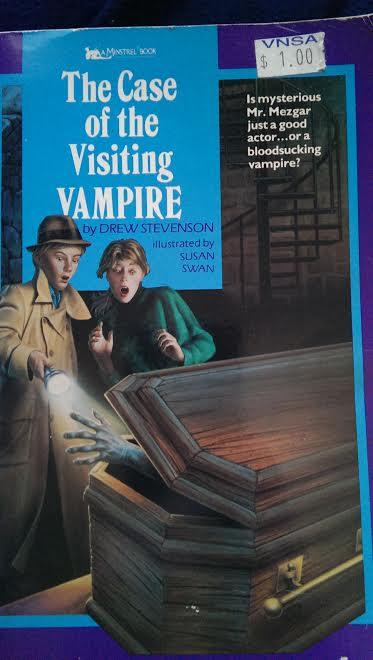
VisitingVampireThe Case of the Visiting Vampire by Drew Stevenson, 1988.

This is the second book in the series about J. Huntley English, Monster Hunter, an extremely intelligent boy who also believes in real-life monsters and is determined to become a monster hunter so that he can find some. Along with his best friend, Raymond (who narrates the books), and Verna, a bossy girl who goes to school with Raymond, he investigates possible monsters around their small Pennsylvania town. The stories are humorous mysteries, and in a kind of Scooby-Doo fashion, there are other explanations besides monsters for the mysterious things that happen.

In this story, the Big Lake Theater in Barkley, PA, is putting on a play called The Count of Castle Dracula, and a visiting actor from Romania working at a local college is playing the part of the vampire. When Verna gets a part in the play, she becomes convinced that the actor, Bela Mezgar, is a real vampire. He behaves strangely and is never seen out during the daytime. Then, Verna overhears him talking on the phone to someone about his coffin and saying that “one heart must die so the other may live.” She tells Raymond and Huntley what she heard, and the monster hunter eagerly begins his investigation. However, a mysterious stranger also seems to be showing an unusual interest in the actor.

This book was written before the end of the Cold War, when Romania was still a communist country. Although things have changed since then, I don’t think that modern kids would have too much trouble understanding the situation. It’s a fun mystery for elementary school kids.

The book is currently available online through Internet Archive.

The Master Puppeteer

masterpuppeteerThe Master Puppeteer by Katherine Paterson, 1975.
Jiro was born during a terrible time in the history of Osaka, Japan, during the 18th century. Around the time he was born, a plague swept the city, killing his other siblings, making Jiro the only child of Isako and Hanji, the puppet maker. His mother resents him for surviving when her other children didn’t and criticizes him for being clumsy when he tries to help his father make puppets. Now there is famine in Osaka, and Jiro’s family is on the verge of starvation. The only way they can support themselves is by making puppets for Yoshida’s puppet theater, the Hanaza.

The Hanaza has been doing well in spite of everything because the rice merchants are still wealthy enough that they can afford to spend money attending the theater. One day, when Jiro goes with his father to bring a puppet to Yoshida, Yoshida comments that the boy has spirit and offers to take him on as an apprentice at the theater. Hanji does not take the offer seriously, but Jiro does. He knows that he will not be able to help his parents by making puppets, and the people at the theater earn money and have plenty to eat. He joins the theater without telling his parents, introducing himself to the old, blind Okada, who chants the words of the plays.

masterpuppeteerpic1Okada was once Yoshida’s teacher, and he accepts Jiro into the theater. Jiro is fascinated with the world of the theater, studying alongside Yoshida’s son, Kinshi, who becomes his closest friend. However, he must first graduate from apprentice to puppeteer before he can begin earning enough money to support his family, and the news from outside the theater is grim. Word has reached him that his father is ill and his mother is starving. The poor people of Osaka, starving and oppressed by the wealthy merchants and tax collectors, begin rioting.

Saburo, the leader of a gang of bandits, has become a hero to the people, taking food and money from rich people in clever and daring raids and using it to feed some of those who are starving. Kinshi in particular admires Saburo and sets off on his own mission to save the poor people of Osaka. Jiro fears for Kinshi’s safety but does not know who to turn to for help until he finds evidence that seems to point to the true identity of Saburo.

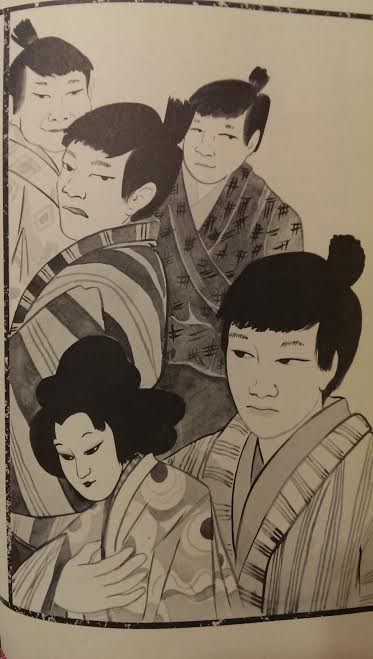
One of the fascinating things about this story is the way the puppets are operated.  Unlike either hand puppets or marionettes, where the operators are never seen, the operators of puppets in Japanese theater are on stage with them.  However, the operators are dressed completely in black with hoods, so the audience will disregard their presence.  Because of the violent episodes in this story, I would recommend it for middle school level.