The Vanishing Pumpkin

An 800-year-old man and a 700-year-old woman live together in a little house. One day, they realize that it’s Halloween, and that means that it’s time to make pumpkin pie. However, when they go to get the pumpkin from their garden, it’s gone! Who could have taken it?

They set out in search of the pumpkin thief. The first person they meet is a ghoul, and they assume he’s the pumpkin thief. They demand to know where the pumpkin is. The ghoul looks all over the place, but doesn’t see any pumpkin. The old man threatens to do him a trick, and the ghoul says he wants to see him do one. The old man turns the ghoul so thin that he can look right though him, but the ghoul doesn’t have the pumpkin.

The old man and old woman set off again to look for the pumpkin thief, and the ghoul comes along to see more tricks. The next person they encounter is a rapscallion. When they ask him where the pumpkin is, the rapscallion looks around and can’t find any pumpkin, so he offers them a mushroom. The old man does another trick, turning the rapscallion upside down, but no pumpkin falls out.

The group, including the rapscallion, sets off in search of the pumpkin thief again. The next time, they encounter a varmint, and the old man turns him into a black cat with fleas. Yet again, the varmint doesn’t have the pumpkin, so they all set off again.

The pumpkin pursuit finally ends with the person who actually has the pumpkin. The wizard has turned the pumpkin into both a jack-o’-lantern and a pumpkin pie!

I remember someone reading this book to me when I was a little kid. I think it might have been the school librarian, but I’m not completely sure now. We don’t really know the story behind the 800-year-old man and 700-year-old woman, who is presumably his wife. They seem to be magical because of their ancient age and the fact that the old man seems capable of magic, but they aren’t described as being a witch and wizard or anything specific. It’s just left to readers’ imaginations. I think, when I was little kid, I assumed that they were witches or something similar.

The story is just for fun. It’s one of those repetition stories, where the characters encounter more people/creatures, similar things happen each time, and each new person/creature joins the group, until they finally figure out who has the pumpkin. Part of the fun of the story is the unusual people and creatures the meet. Most of them are not typical Halloween creatures, like a witch, a ghost, and a monster, although they are Halloween-ish. The words that describe them are real words – ghoul (which is a mythological creature), rapscallion, and varmint – but at the same time, it’s not entirely clear what type of creatures they are, and the book doesn’t explain. We can only go by what they look like in the pictures. The “varmint” looks like a large rat, the “ghoul” is a little green guy in a top hat, and the “rapscallion” is a little guy in a dark robe and hood.

Meg Mackintosh and The Stage Fright Secret

Meg Mackintosh Mysteries

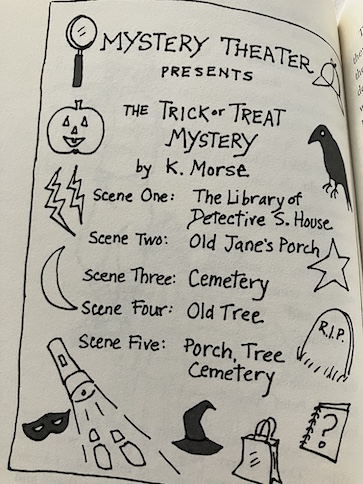
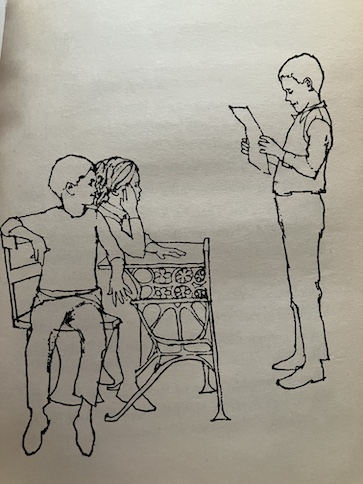
The mystery club at Meg’s school is putting on a play, and Meg’s friend, Liddy, says that they should try out for parts. The play is a Halloween mystery called The Trick or Treat Mystery with a detective called Sureluck House. Meg is nervous during the try-outs and rushes through her lines, so she doesn’t get the part of the detective. However, the club’s advisor, Ms. Morse, gives her the role of announcer. The announcer is like a narrator, introducing scenes of the play. Meg still wishes that she had a regular part in the play, but being the announcer gives her a chance to be involved.

The kids begin assembling costumes and props. Meg creates signs for each scene, including signs to invite the audience to figure out clues during the performance. Once the play gets started, the story takes the form of the play itself. All of the dialogue is presented as part of the play and other information as stage directions, and Meg’s signs invite readers to figure out clues to the mystery.

In the play, Sureluck House gets a letter from Old Jane, a woman who lives in a spooky cottage near a cemetery, asking him to find who stole her stuffed raven. The raven has glowing red eyes, and Old Jane likes to put him on her porch on Halloween to scare away trick-or-treaters.

Sureluck and his friend Witson visit Old Jane, who tells them that three trick-or-treaters have visited her: a witch, a mummy, and a pirate. Then, Old Jane got distracted, chasing one of her kittens, and when she returned to her porch, the raven was gone. She thinks one of the trick-or-treaters stole it. Sureluck and Witson interview the three trick-or-treaters and point out evidence that each of them left at the scene, but they all deny taking the raven.

Then, there is a spooky part of the play where the actors are scared by lightning and thunder, and the lights go out. Readers and the audience can tell that the actors are also confused at this part of the play, and the Ms. Morse sticks her head out from behind the curtain to say that they’re experiencing technical difficulties.

When the lights come back on and the curtain opens again, Sureluck is lying on the ground, having apparently fainted from fright, and only Witson and Old Jane are on the scene. Witson says he thinks he can solve the mystery and invites the audience to guess which suspect stole the raven and where it is. When the audience says where they think the raven is. They guess the correct suspect, but the raven isn’t where it’s supposed to be. Also, Meg has suddenly disappeared, leaving her sign behind. Now, everybody, audience, actors, and Ms. Morse seem really confused.

Has an actual raven theft occurred in the middle of the play? Is Meg the culprit? Where is she?

The book is available to borrow and read for free online through Internet Archive.

I liked the unusual format to this book, having most of the mystery be in the form of a play within the story. Like other books in this series, readers are given the opportunity to spot the clues and solve the puzzle along with Meg. Because of the play format, we are also like part of the audience, watching the play and trying to figure out where the mystery in the play leaves off and where the mystery that Meg needs to solve begins. The ending is a little unusual because Meg seems to disappear briefly. I didn’t think it was too hard to figure out where Meg went, but I still enjoyed the story, and I though a spooky mystery play was a nice idea for a Halloween story!

Schoolhouse Mystery

The Boxcar Children

It’s June, and the Aldens are trying to decide what to do for the summer. Benny says that his friend Max remarked that the Aldens always seem to find something exciting everywhere they go, but Max doesn’t think anybody could find anything exciting about the little village where his father likes to go fishing. Max says that it’s a tiny and isolated village on an island with little to do, and he doubts even the Aldens would find anything interesting or exciting there. The only people who usually go there are summer visitors going fishing, like Max’s dad. Mr. Alden has been thinking over other plans for the summer, but he says that, if the children want to take a short visit to his village, called Port Elizabeth, to test out Max’s theory of how boring the place is and see if they can find something exciting about the place, it’s fine with him. The Aldens think that purposely visiting a dull town and seeing what they can find there sounds interesting by itself, so they decide to go.

When they arrive, they find that the place is as small as Max described. It doesn’t take them long to explore the town. There is a small store, but it’s well-stocked with all the food they need. There’s a big old house that seems to be abandoned, and there’s a quaint little schoolhouse with a bell and an odd-shaped chimney.

The people of the town seem suspicious of them at first. They don’t get many outsiders coming to their town, and they can tell immediately that the Aldens are rich because of their car and their clothes. However, because the Aldens are friendly and polite visitors, people gradually begin warming up to them.

The Aldens learn that most people in town work for the local sardine factory. There aren’t many other job prospects in the area, and they don’t have access to higher education or even outside sources of information, like television, so the local kids don’t aspire to much more. Local kids work, too.

One day, a pair of twins approach Violent while she’s painting a picture and start talking to her about painting. They’ve never really owned any proper art supplies themselves, only some crayons, but they’ve been interested in learning to paint since a professional artist came to town to paint the seaside. They also tell Violet and her siblings that the town has had trouble keeping teachers. Most people don’t want to stay in the town very long because it’s so small, and there’s so little to do. Because they change teachers so often, the kids never really advance much in their classes. Every teacher basically keeps starting over in their lessons. The last one told them to study this summer to make progress and prevent themselves from forgetting what they’ve learned, but the local kids don’t really know how to study or what to study, and they’ve never had a teacher who taught any of the really fun subjects, like art.

The local kids ask the Aldens if they could help them study this summer, and the Aldens get the idea to set up their own summer school in the local schoolhouse. They speak to the lady who owns the schoolhouse, Miss Gray, and she gives her permission. The Aldens recognize her as a famous author, but now, she lives like she’s a recluse in her big, old house. She also asks the Aldens whether or not they know a blond man who smiles a lot, but the Aldens don’t know who she’s talking about.

The people in town don’t have much money, and they save what they can in cash rather than using a bank. However, something odd has happened recently because a man has bought a couple of coins from some of the locals for more than the face value of the coins. The locals don’t know why he was willing to do this, but they’re always grateful for anything extra they can get. The locals have started calling this blond man “the money man” because he not only buys coins but also various other odd, old things that most of the locals think of as junk. They don’t know why he wants these things, but they’re just glad he’s willing to pay something fro them. Mr. Alden is very interested in this man and wants to know more about him.

The Alden kids buy some art supplies and school supplies so they can get started with lessons for their summer school. Even though they provide some supplies and have some textbooks in the schoolhouse, they find that there are things they need because previous teachers in town haven’t left some of the things they need, like easy reading books. They improvise as best they can, with Benny helping the kids in class write simple stories about themselves and their lives to use for reading lessons. The local children talk more about the “money man” and how he trades them new toys for old ones they’ve had. The children think that’s great, but the Aldens are suspicious about the “money man’s” apparent generosity.

It isn’t long before Mr. Alden and the children have an encounter with the blond “money man.” The man, called Freddie, notices that Mr. Alden has a rare penny on his watch chain and offers to buy it. He explains that he deals in coins and antiques. Mr. Alden can tell that Freddie is knowledgeable but slick when it comes to buying collectible items. Mr. Alden refuses to sell the man his coin or his watch, and after he leaves, the children tell their grandfather what they know about his dealings with the local people.

It has become apparent that Freddie is cheating the locals, buying antiques and collectibles from them while either paying them much less than what they’re really worth or trading them for newer but cheaper items. Because this town is relatively isolated and the people don’t have much money, they’ve spent generations keeping and reusing antique items without knowing how valuable they’ve become. The local children are thrilled when he lives them newer and more colorful toys in exchange for their old ones, because they don’t know how much their antique toys are worth. Technically, Freddie hasn’t done anything illegal because the people he’s been buying from and trading with have agreed to the deals so far and been satisfied with what they’ve gotten, but that’s only because they don’t know that they could have gotten much better deals from someone else. Freddie’s dealings aren’t really fair or ethical, and Mr. Alden and the local author have become concerned that he may take even bigger advantages of the local people than he already has.

When some valuable collectors’ books disappear from the little village’s neglected library, the author, Miss Gray is convinced that Freddie is responsible. How can they catch him and prove to everyone what he’s been doing?

As with many of the earlier Boxcar Children books, there is an element of mystery but more emphasis on the adventure and the kids’ summer experiences than on the mystery. We have an obviously suspicious right at the beginning, and we have a sense of what he’s doing that’s a problem pretty quickly. This is one of those mysteries where the protagonists have an obvious villain and a good understanding of what’s going on, but the mystery is about getting the evidence and proving it. Part of the issue at first is that duping people into trading things with him or selling them to him for less than what they’re really worth is more unethical than illegal because, as long as the participants are satisfied with the trade and willingly agree to it, it’s difficult to prove that they were deceived. It’s when the villain crosses the lines and actually steals something nobody agreed to give him or sell him that they can really start to nail him for what he’s been doing.

Part of the solution felt a little contrived because it turns out that the villain has been hiding his ill-gotten gains in a location that is right under the children’s noses, and there is something special about the place that allows them to watch the villain without being observed. It’s an interesting set-up, but I usually prefer a more traditional style mystery where there’s more for the amateur detectives to figure out.

Meg Mackintosh and The Mystery in the Locked Library

Meg Mackintosh Mysteries

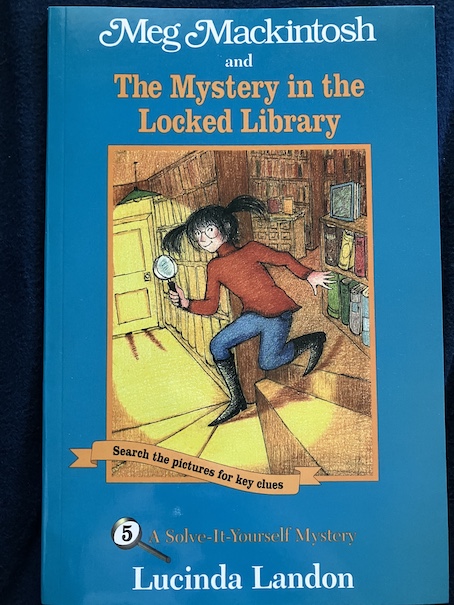
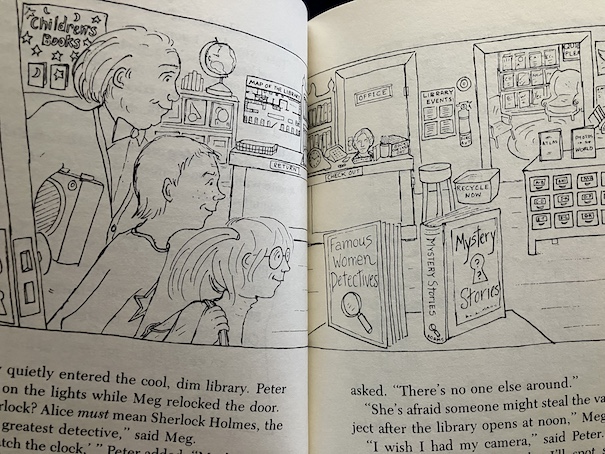
Meg, her brother Peter, and their grandfather are visiting their grandfather’s cousin, Alice, who was introduced in the first book of the series as the one who created the treasure hunt to find his missing Babe Ruth baseball when they were young. Grown up Alice is now a librarian, and she has created another treasure hunt for them.

One morning, she leaves them a note saying that she has a dentist appointment, but she wants them to go to the library and find something valuable that she’s hidden there before the library opens at noon. Readers follow along with the clues that Alice has left for them to solve and the pictures in the book, seeing if they can solve each part of the mystery along with Meg. In keeping with the library and book theme of the story, the clues are based around books, particularly Sherlock Holmes books.

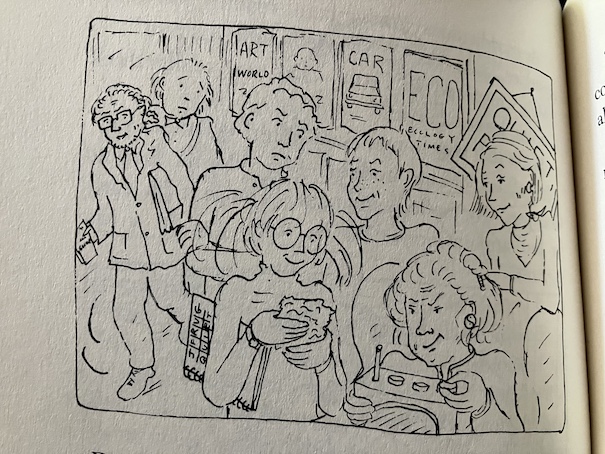
When Meg and her family arrive at the library and begin following the clues, they discover that there are other people in the library, even though the library isn’t officially open yet. Caroline is the assistant librarian, and Gerry also works there. Then, a man named Horace Plotnik shows up, saying that he’s an antiques expert and that Alice asked him to come to appraise something.

They discover that Alice didn’t make it to her dentist appointment because someone locked her in the library’s book repair room. It turns out that the valuable item that Alice hid was a first edition of The Adventures of Sherlock Holmes by Sir Arthur Conan Doyle that recently came to the library in a donation of books, but when Meg and Peter finish the treasure hunt and go to the place where Alice did the book, it’s gone! Was it stolen by the person who locked Alice in the book repair room, and if so, who was it?

The Book is available to borrow and read for free online through Internet Archive (multiple copies).

I always enjoy treasure hunt stories, and like other Meg Mackintosh mysteries, this story gives readers the opportunity to figure out the clues and puzzles along with Meg. The information readers need is in the pictures of the story. When I was a kid, I particularly liked puzzles based around solving a secret code, and there is a secret code puzzle in this book that readers can solve themselves.

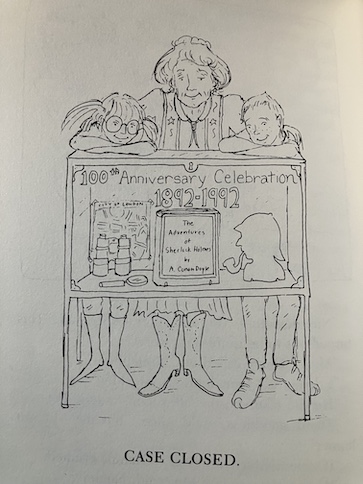
This treasure hunt is fun because it’s based around library and book themes, particularly focusing on Sherlock Holmes. The idea of hunting for a lost copy of a first edition Sherlock Holmes book was timely for when the book was originally written because, as the story indicates at the end, the book was written around the 100th anniversary of the character of Sherlock Holmes!

Meg Mackintosh and The Mystery at the Soccer Match

Meg Mackintosh Mysteries

Meg and her brother Peter play on opposing soccer teams, the Hawks and the Panthers. Peter is brags about how good he is at being a goalie, and Meg hopes that, in this game, she can score a few points off him. There are prizes for this soccer team, and the winning team will get to keep a medal that Coach Lee won playing international soccer until next year’s game. Everybody admires the medal, which is displayed on the awards table.

Meg’s teammate, Alex, is less thrilled about the game. He has an injured leg and can’t play, and his mother is busy campaigning against awarding prizes for children’s soccer. She thinks that giving prizes isn’t fair and hurts the feelings of kids who don’t get prizes.

It’s true that there is some pressure from the parents for their children to play harder to win prizes than the kids really want. Peter accidentally collides with one of his teammates, Heather, and they both end up with scrapes and are temporarily removed from the game for first aid. Heather’s father pressures her to get back in the game as soon as possible and win, but Heather privately admits to Peter that she doesn’t really feel like playing anymore. She only does it because she knows her dad would feel bad if her team doesn’t win.

It starts to rain during the game, and the adults and kids cover the awards table with a blanket. When they remove the blanket later, the gold medal is gone! Who could have taken it? Meg invites Alex to join her detective club and help investigate the mystery while she plays soccer!

The book is available to borrow and read for free online through Internet Archive.

Meg inviting Alex to help her investigate the case and consider motives makes this book a little different from other books in the series, where Meg usually does that herself. The mystery is good because there are several suspects to consider, each of whom was seen near the table and left signs of their presence there. Did Heather’s dad take the medal because he once almost won a similar soccer medal and was jealous that Coach Lee won the prize he didn’t? He certainly seems very prize-oriented. Did Alex’s mother take it because she disapproves of sports prizes and wanted to make a statement about it? Could one of the children have taken it, either because they wanted to claim the prize they didn’t think they could win honestly or because they wanted to impress one of their parents?

As with other books in the series, readers are given the chance to review the evidence Meg and her friends have collected and see if they can spot the clues along with them in pictures taken at the scene. There was a clue that I thought was pretty obvious in one of the pictures but which Meg and the other kids didn’t spot at first. They only notice it when another clue makes them take a second look at one of the pictures. I think many young readers might also spot the clue I did, although if they do, it might make them feel clever for noticing something before Meg and her friends do.

When I first noticed that clue, I was inclined to think the solution to this mystery was too obvious, but there is another twist to the story that makes it more interesting. The medal was actually stolen twice. After the original thief put it back, someone else took it again, so there are two thefts to figure out instead of one.

The Mystery of Castle Croome

Molly Stewart, an American college student attending Oxford, is an orphan who is barely scraping by when she suddenly receives word that she has inherited an ancient castle in Scotland from her great-uncle, who has recently died. Molly’s friends, a pair of twins called Pat and Penny Roderick (short for Patricia and Penelope), go with her to have a look at the place, but right from the beginning, it seems like nobody wants her there.

Although the lawyer, Mr. Harding, is aware that Molly has been attending Oxford, he also knows that she is planning to return to the United States when she finishes her degree. He also knows that her great-uncle, Sir Malcolm, disapproved when her father married an American and moved to the United States himself, so he was surprised when Sir Malcolm’s will left his estate to his nephew or his nephew’s heirs. Mr. Harding had expected that Sir Malcolm would leave the estate to Jamie Campbell instead because Jamie has been the caretaker for years. The estate doesn’t come with much of an income, and the farms attached to it don’t have tenants, so they’re not bringing in rent money. It would take a lot of work to restore the estate. Since Mr. Harding would rather deal with Jamie Campbell anyway, he thinks that Molly would find it a better deal to just sell the castle to Jamie and use the money to finish her degree and go back to the United States. Molly asks why Jamie Campbell would want to buy the castle if it’s not worth much and needs so much work to restore. Mr. Harding says he might buy it out of sentiment, but Molly wants to have a look at the castle before agreeing to sell it. After seeing it, she might decide that it isn’t the kind of place where she could live, but she won’t know for sure until she sees it herself. Mr. Harding agrees and says that he will tell Jamie Campbell that she’s coming.

When Molly arrives with Pat and Penny, they see that the castle is isolated and rather eerie. Inside, it is run down, and living conditions are primitive. Jamie Campbell, an elderly man, isn’t happy that they’re there. There is no other staff, and while Jamie was happy to serve the old laird and nurse him through his final years, he has no intention of serving this young American grand-niece. Although there is an electrical generator at the castle, Jamie says that it hasn’t worked in years, and he and the old laird used oil lamps and candles. If Molly and her friends think he’s going to go to special efforts for their comfort, they can think again. Molly refuses to be intimidated by his disrespect, and she tells him that, because this castle has been his home for years, he is welcome to continue staying there, although Jamie Campbell thinks that she’s only extending that invitation to get a free caretaker.

Molly is studying engineering at college, and her friends think that she could probably fix the generator, but Molly tells them that she would like to wait to look at it. She hasn’t had much practical experience yet, so she wants to take time to study the situation before she does anything. She also tells her friends not to mention to Jamie Campbell that she has any engineering knowledge. She doesn’t trust Jamie, and she thinks it might be better for him to think that they’re more helpless than they actually are.

Molly sees definite signs that Jamie Campbell hasn’t been honest with them about the real condition of the castle and about even the contents of the castle at the time that her uncle died, and she can tell that he’s deliberately trying to make life harder for them to drive them away from the castle. After Jamie Campbell tells them that there is no running water at the castle, the girls notice that soap next to a sink is still wet, indicating that Jamie has very recently washed his hands there. The girls think that he probably shut off the water right before they got there, and they also think there is probably nothing wrong with the generator, that Jamie probably just turned it off. He tries to keep them from even looking at it, and he’s reluctant to hand over the keys to the castle to Molly. Many pictures are missing from the walls of the castle, and Jamie says Molly’s uncle sold them for money, but another painting disappears during their stay, showing the girls that Jamie is the one looting artwork from the castle. Molly realizes that nobody seems to know exactly what was in the castle at the time her uncle died, making it difficult to prove that Jamie is stealing things. When Molly tries to search her uncle’s desk, she finds that it’s been completely cleared of even routine papers, and Jamie admits in a cagey way that he may have tidied up a little.

Things improve for Molly and her friends when they set out to buy some food and make contact with other people outside the castle. Jamie refuses to even feed them, saying that he barely has enough for himself. He says that he might have been able to provide something for Molly if she was alone, but he can’t be expected to feed her friends, too. Fortunately, the girls have some provisions with them that get them through their first night at the castle. When they set out in the morning to buy more food, they can’t take their care because there’s a large nail in one of the tires. They can’t prove that Jamie sabotaged the car, but they all suspect he did. They decide to set out on foot to find somewhere with a telephone or somewhere they can buy some food. They meet up with a scout troop camping nearby, and they save the girls from stumbling into a bog. They share a meal with the girls, and the girls tell them what’s been happening at the castle.

The scout leaders don’t like the sound of Jamie and the things happening at the castle, and they tell the girls that they will send a mobile shop to the castle to sell them food. There’s a van that travels among the farms in the area, selling groceries, sort of like a food truck, and it carries a surprising variety of goods. The scouts also tell the girls how they forage for wild foods, and they offer their services for changing the car’s tire and other things they might need.

That night, Molly has a frightening encounter with a ghostly white figure, although she believes that it’s just Jamie, trying to frighten her away from the castle. The next day, Molly and her friends confront Jamie about the missing painting, and he tells Molly that her great-uncle sold that painting years ago. He tries to convince her that the only reason why she thought she saw it is that she has “second sight.” He says that it was a favorite painting of her great-uncle’s and that she only saw it because she’s a member of his family and has psychically sensed the memory of the picture. Molly knows that can’t be true because her friends also saw the picture. Molly also asks Jamie about a strange roaring noise that she heard at night that sounded like machinery of some kind, and Jamie tells her that it’s the “Roar of the Stewarts.” He says it’s a bad omen, and that Stewarts hear it before something bad happens. Although none of the girls admits to having seen a “ghost” the night before, Jamie also tells them about the “Specter of the Castle”, and he insists that all of these bad omens are signs that Molly and her friends should leave the castle because it’s dangerous for them.

Molly and her friends know that Jamie badly wants to frighten them away from the castle, and part of that might be that he’s been looting objects from it since Molly’s great-uncle died, but what is the real cause of the machine noises in the night? Then, suddenly, Jamie welcomes a pair of unexpected guests into the castle as paying guests. Mr. and Mrs. Smith claim that they’re traveling tourists who think it would be exciting to stay in a real castle. Molly tries to discourage them from staying by charging them more than anyone might expect from staying in a run-down castle with primitive living conditions, but the Smiths insist that they would enjoy an authentic experience. Molly and her friends are immediately suspicious, especially when they realize that the Smiths don’t seem to have a car, and there’s no obvious way they could have even reached this out-of-the-way castle. Who are they really? Are they confederates of Jamie’s? What has Jamie really been doing at the castle, and what is he so afraid that Molly and her friends will discover if they stay?

The book is available to borrow and read for free online through Internet Archive (multiple copies).

I found this book recently at a used book sale, but I recognized the title because I tried to find this book when I was a kid. I wanted it because it was on a list of suggested books in the back of another mystery book I read and liked as a kid. Actually, I think I enjoyed it more as an adult than I would have has as a kid. As a kid, I would have liked the notion of a girl inheriting a spooky old castle that might be haunted, but in this story, it’s pretty obvious right away that Jamie is behind all the mysterious things happening.

This story is not like other mysteries where you have to wonder who among the suspects could be responsible for the mysterious happenings because Jamie is the only suspect from the beginning. The real mystery, for both the characters and the readers is why he’s doing it. It’s a “whydunnit” more than a “whodunnit.” Although it would have been fun and atmospheric if Molly and her friends believed that the castle was haunted and were scared, I have to admit that I loved how unimpressed the girls were when Jamie awkwardly makes up his spooky stories and excuses about “second sight”, the “Roar of the Stewarts”, and the “Specter of the Castle.” They know that he’s just making it all up. They just don’t kick him out of the castle immediately because he’s an old man who’s been there for years, and they also want to know that he’s up to.

It turns out that part of what he’s up to is obvious and part actually resembles the mystery book that had this listed as a recommended book. Readers can figure out the more obvious part themselves, but there’s a revelation later that Jamie is also involved in another crime that he can’t explain away as any misunderstanding. There’s a suspenseful part of the story where the girls are trapped in the castle with Jamie and his confederates and need to figure out how to escape or summon help. I thought that the ending part wrapped up a little quickly, but overall, I liked the story. I think I enjoyed the book more now than I would have if I’d found it when I was a kid.

The Castle Mystery

The Boxcar Children

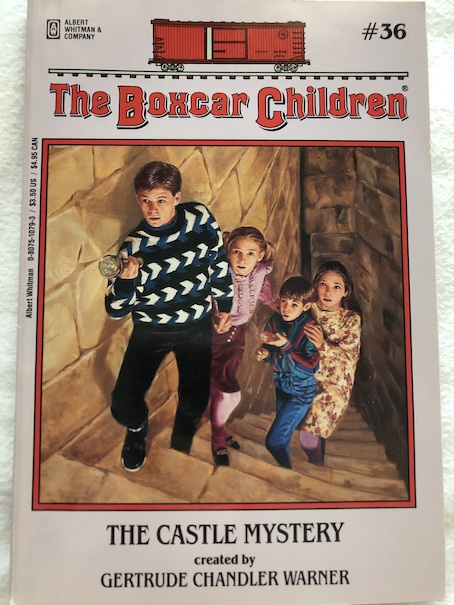
Mr. Alden takes his children to Drummond Castle because an old friend of his is helping to clean and organize the place before it becomes a museum. The Drummond family used to live there, and they had the castle built to look like a castle in Germany. However, the last of the Drummond family has died, so turning the mansion into a museum will give the place new life. When the Aldens first arrive, they think the castle looks more like something from a scary story than a fairy tale, but Mr. Alden’s friend, Carrie, shows them some of the more whimsical elements of the place.

However, Carrie’s assistants aren’t happy about the Aldens helping. None of them really seem like team players, even with each other, and they’re not sure how much help the Alden children can be. There are a lot of things that the assistants won’t let the Aldens do when they try to help. They also seem a little suspicious of each other because a valuable Stradivarius violin that once belonged to the Drummond family has disappeared. Carrie insists that they don’t know that the violin has been stolen. The last of the Drummonds may have just hidden it somewhere, and they will find it when they’ve finished cleaning and organizing the place.
Then, the Alden children begin to notice strange things happening in the castle. They see lights in parts of the castle where no one is supposed to be and hear violin music coming from somewhere. Sometimes, the furniture covered in dust sheets gives them the feeling that someone is hiding under the sheets. When it seems like the kids are poking around the castle too much, the assistants all suddenly find tasks for them to do.

The kids catch one of the assistants, Mr. Tooner, looking for something under the floorboards in their grandfather’s room. He claims that he was fixing the floor, but Mr. Alden says that nothing was wrong with the floor. Sandy, another assistant, seems to know her way around the castle better than the others, but she’s oddly defensive about why she knows the place so well. She also makes an odd comment about how it would be nice to hear the Stradivarius “again”, but she dodges questions about when she heard it the first time. Tom is the antiques expert, and he insists that his work is highly specialized and that he wants to work alone.

The Aldens explore the spooky castle, the girls get trapped in the cave under the castle, and they find a secret, hidden room that brings them closer to the solution of the mystery. Each of these assistants has a previous connection to Drummond Castle that they don’t want to discuss, but only one of them is a thief.

I remember liking this book as a kid, although I’d forgotten what the solution of the mystery was until I reread it. It holds up pretty well, and I enjoyed how everyone associated with the castle has their own secrets and past connections to the place. It makes them all really great suspects and also gives readers some subplots to figure out along with deciding who the violin thief is!

The castle setting is also great! Technically, I suppose that it’s really more of a castle-like mansion, but it has all the trappings of a castle, some fanciful, some whimsical, and some spooky. There is also a cave under the castle, which features in a part of the story where Jessie and Violet get locked inside the cave because there is a gate that closes it off. One of the best parts of the book is the discovery of a hidden room because what castle would be complete without one!

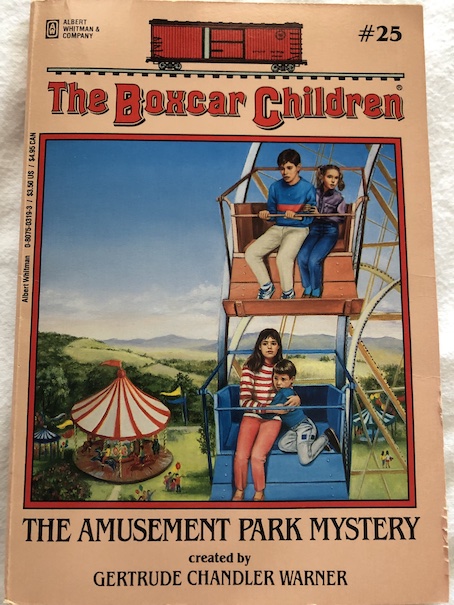
The Amusement Park Mystery

The Boxcar Children

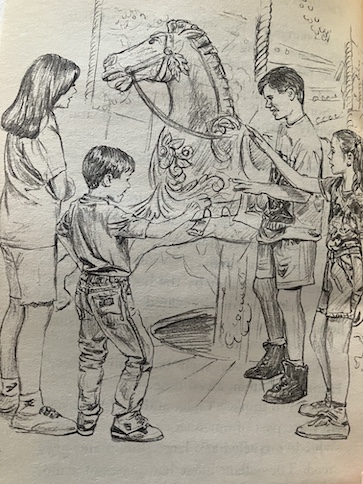
The four Alden children go to visit their cousin Joe and his wife Alice. They work at a museum, but one of the best parts of visiting them is the amusement park nearby. The amusement park has a charming, antique carousel with hand-carved horses. The horses are valuable antiques, and Alice says that they are wonderful examples of Americana (American folk art).

The Aldens, especially Benny, think the carousel is wonderful, but not everyone feels the same away about it. When they talk to the owner of the amusement park, Joshua, they learn that he loves the antique carousel but his daughter, Karen, who works with him, thinks that they should get rid of old rides like that and add newer, more modern ones. What she really wants to do is add a roller coaster to the park, something that would appeal to older kids and adults rather than young children. The Aldens don’t see how she can add a roller coaster because the park isn’t very big, and a roller coaster would take up about half the park. They hear Karen later talking about it again with her boyfriend, who is a golfer. They notice the boyfriend doing some sketches of horses that he doesn’t seem to want to let them see.

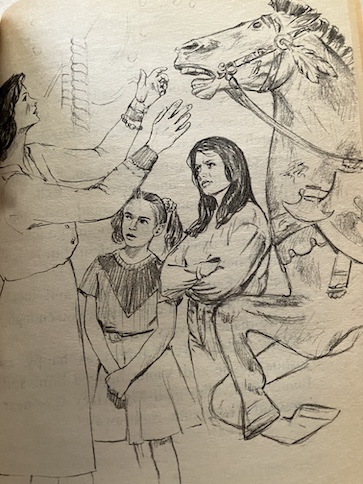
The first time the Aldens ride the carousel, they have a great time, and Benny chooses a dappled gray horse as his favorite. However, when they return to ride the carousel again later, it seems like something is wrong with the horse. It used to bob up and down during the ride, but now, it doesn’t move. When they return again, a couple of days later, the dappled gray horse moves but now has a long scratch on its side that wasn’t there before. The Aldens also begin to notice problems with other horses. Another gray horse has stopped moving, and a chocolate brown one oddly has an unpainted stomach when they were sure it was painted before.

They talk to Joshua about the horses, and he becomes concerned. He has an expert examine them, and the expert assures him that these are the authentic antique horses that were always there, but the Aldens are sure that something suspicious is going on.

If someone has been taking the original horses and substituting fakes, why did the so-called expert say that they were the original horses? Who could be behind it? Is Karen trying to sabotage the carousel to get the roller coaster she wants? Her boyfriend seems to need money, so he could be selling off the horses. What about the cotton candy seller and his disagreeable wife or the man who actually runs the carousel ride?

I thought the book did a good job of providing readers with multiple suspects to consider. We know Karen isn’t fond of the carousel and wants more exciting, modern rides, so she could be selling off antique carousel horses to fund her ideas. Her golfer friend also needs money, and his sketches of horses might be for planning how to create counterfeits of the originals. Then again, the cotton candy seller and his grumpy wife are always around and acting suspiciously, and the man who runs the carousel ride has obvious access to the horses. I like mysteries where there are multiple suspects to consider!

The concept of the antique carousel reminded me of the Nancy Drew computer game The Haunted Carousel, but that computer game was based off of a Nancy Drew book, not this one. It’s interesting to notice some themes that appear in different children’s series. Not every kids’ mystery series features an antique carousel, making it a charming and uncommon theme. However, amusement parks are common themes in children’s books, and a mysterious, antique ride offers that element of both quaint nostalgia and spookiness together.

Meg Mackintosh and The Case of the Curious Whale Watch

Meg Mackintosh Mysteries

Meg and her brother, Peter, are going on a whale watch trip with their grandfather. As they board the boat, their grandfather tells them that the captain is well-known as a treasure hunter, looking for pirate treasure.

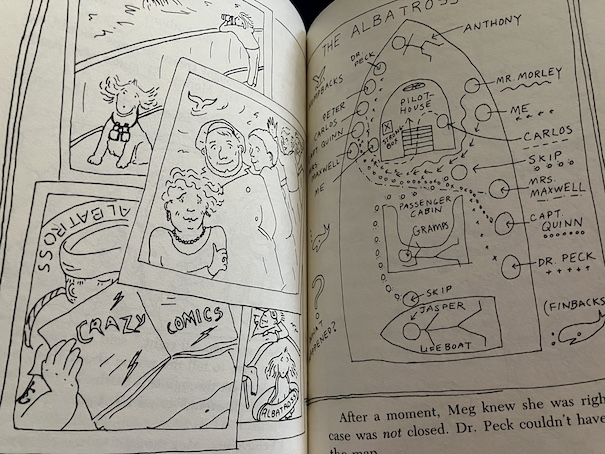
On board the Albatross, they are greeted by Captain Caleb and meet his mate Jasper, and the other whale watch guests. The guests are Mrs. Clarissa Maxwell and her nephew Anthony, who seems to like gambling; a man named Oliver Morley, who likes stamps; a college student called Carlos de Christopher; and a marine biologist, Dr. Susan Peck.

Meg asks Captain Caleb about his treasure hunting, and he shows everyone an old map that’s been in his family for many years. The sailor who gave it to them also gave them a whale’s tooth with a scrimshaw carving of a whale on it. It’s supposed to help explain where the treasure is hidden. Some of the members of the expedition debate about how much money the treasure of the map would be worth, but Dr. Peck is completely opposed to treasure hunting because it’s disruptive to the environment.

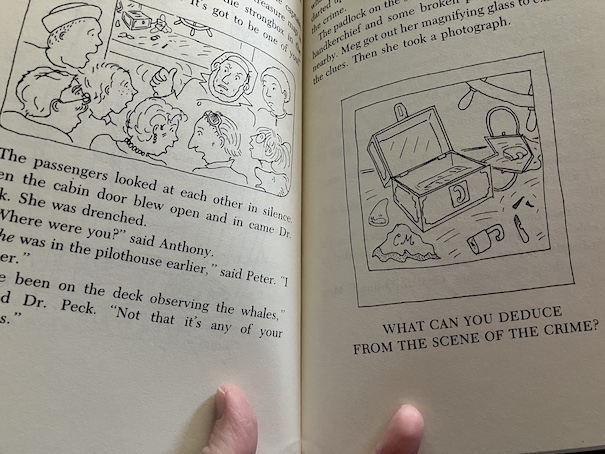
The group enjoys watching the whales, although Meg’s grandfather has to go lie down for a while because he’s seasick, and lazy Jasper spends his time reading comic books in the lifeboat. When they encounter a storm, and everyone goes into the cabin to get out of the rain, they discover that the map is missing!

Who could have taken it? Various members of the whale watch have talked about their need for money, and Dr. Peck said that she thought the map should be destroyed to prevent damage to the environment. Meg goes over the pictures she’s take to find the thief!

The book is available to borrow and read for free online through Internet Archive (multiple copies).

I like the Meg Mackintosh books because it’s fun to solve the mystery along with the heroine. Like other books in the series, readers are supposed to use the story and the clues in the pictures to solve the mystery. At various points in the story, the story pauses for readers to figure out something about what’s happening, and these are good points for readers to check that they’re on track and to review the information they know so far. The story isn’t very long, but there are multiple points for readers to figure out something about what’s going on.

I did figure out the answer to this one very quickly. It’s partly because I’m an adult and this is aimed at children, but more importantly, I’ve seen the movie Charade with Audrey Hepburn, which used a similar plot device. The story did a good job of making all the suspects look like they had a motive, but when you figure out what the thief’s real goal was, there’s only one person who qualifies. Kids in early elementary school would probably find the mystery more challenging.

The Mystery of the Goldfish Pond

Three Cousins Detective Club

Timothy’s father wants him to sing at his boss’s retirement dinner. The boss’s wife heard Timothy sing once with his choir, and she wants him to sing a special song for her husband at the start of the dinner. His cousins are invited to come along so he won’t be the only kid there. Timothy doesn’t really want to do the singing, but his parents convince him to do it anyway because the boss’s wife is so fond of him and his singing.

Timothy’s father hopes that the dinner will go well because the boss has been worried about the possibilities of competitors getting their hands on information about their new product. Earlier, the boss temporarily misplaced an important memo about it, and he was worried that someone else got their hands on it.

Timothy’s song goes well, and after the dinner, the kids are allowed to walk outside in the garden while the adults listen to a series of speeches. The gardens outside the banquet hall are beautiful, and the kids start to enjoy themselves. Then, they accidentally overhear a couple of adults talking. They can’t quite catch everything they say, but something strange is going on, and something secret is hidden somewhere in the garden.

The theme of this story is Proverbs 11:13, “No one who gossips can be trusted with a secret, but you can put confidence in someone who is trustworthy.”

The book is available to borrow and read for free online through Internet Archive.

The crime that the adults were plotting involves the theft of information. The kids have to figure out the parts of the conversation they couldn’t hear clearly to figure out where the information is hidden. I thought that the clue the children try to figure out was fairly easy. Part of the conversation the kids try to figure out sounds like “-ake -urtle”, and there aren’t many words that sound like “-urtle.”

The boss’s wife seemed eager for the children to go outside, into the garden, and tell her about it later. The kids wondered why she seemed so eager for them to go outside and what she was hoping that they would tell her afterward. It sets the stage for the kids to expect that something unusual or mysterious might happen, which proves to be the case when they overhear the important conversation. The boss’s wife says later that she suspected something might happen because she knew her husband was worried about people stealing company information, and she realized that this dinner would be a convenient place to hand it off to someone.

We never learn exactly what kind of information or new company products the adults were concerned about. We also don’t know exactly who was trying to steal the information or what happens to that person later. The part that the children care about is that they were able to stop the hand-off of the information.