
Under Copp’s Hill by Katherine Ayres, 2000.
This book is part of the American Girl History Mysteries series.
The year is 1908, and eleven-year-old Innocenza Moretti lives with her relatives in Boston. They are immigrants from Italy. Innie, as her family calls her, is an orphan. According to the story that her grandmother told her, she was the only one of her parents’ children to survive infancy, her siblings being born prematurely and dying shortly after birth. Innie’s mother was so grateful that Innie survived that she promised her to the Holy Mother at her baptism. Then, Innie’s parents died in a fire in their tenement building when she was about two years old. Innie and her grandmother, Nonna, survived the fire only because little Innie had started crying in the night, and she took her outside to walk her around so that she wouldn’t wake her parents. Because of that experience, Nonna is deathly afraid of fire and also has become convinced that the Holy Mother must have spared Innie (as well as herself). She thinks that Innie is destined to become a nun and has continued to promise her to the Holy Mother in prayer, repeating the promise regularly. Although Nonna thinks that the miracles surrounding Innie’s life are signs of a future life in the Church for Innie, her grandmother’s promises in prayer terrify Innie.
Innie feels trapped by her grandmother’s expectations for her, expectations that the rest of her family don’t even know about. She doesn’t want to be a nun, but her grandmother is sure that she will be. Because of her fears that her grandmother may force her to become a nun when she grows up, Innie is never on her best behavior. She thinks that if she gets a reputation as a trouble-maker, the Church will decide that she is unsuited for a religious life. Unfortunately, Innie’s long-practiced habit of ignoring rules and her problem child reputation lead her to be suspected of something worse than just minor misbehaving.
Innie’s family owns a boardinghouse where they provide food and lodging for young immigrant men. Innie and Nonna live on the ground floor, and Innie’s aunt, uncle, and cousins live above them. Innie spends a lot of time with her cousins, especially Teresa, who is about her age. Her older cousin, Carmela, persuades both Teresa and Innie to join a library club at a new settlement house with her. The settlement house helps girls and young women from immigrant families by teaching them work skills and aspects of American culture that they can use as they become American citizens in exchange for some of the work that the girls do on behalf of the settlement house. Carmela has taken a new job as a pottery painter there and tells her parents that it will be good for Teresa and Innie to go there as well because they will receive help with their schoolwork and they will also have classes to teach them skills like sewing, knitting, and pottery, that they can use to make money later. However, the real attraction of the club for the girls is that they get to listen to music, have dancing lessons, read books, and socialize with other girls about their age. The prospect of sewing classes isn’t appealing for Innie, but she loves books and looks forward to borrowing some from the settlement house library.
At the settlement house, Innie meets a variety of girls from other immigrant families, not just Italian ones. In particular, Innie makes friends with a girl named Matela, who is a Jewish girl from Russia. As the girls talk about a recent, large fire in town, Matela talks about the czar’s soldiers burning things back in Russia and how she misses her grandfather, who is still there. Innie understands Matela’s feelings because she knows what it’s like to miss someone. She doesn’t really remember her parents, but she feels the lack of them in her life. Teresa also becomes friends with Matela, but the three girls agree to keep their friendship secret because each of their families prefers them to associate with girls from backgrounds similar to their own. Innie’s uncle wants the girls to spend time with other Italians, and Matela admits that her father prefers her to spend time with other Jewish girls. The adults don’t really understand the cultural mix at the settlement house.
However, from the very first day that the girls begin going to events at the house, strange things start happening. Things disappear or are oddly moved about. Food disappears. A silver teapot belonging to the ladies who run the settlement house is stolen. Then, someone steals some pottery and a shawl.
To Innie’s horror, she ends up becoming the prime suspect for the thefts because she was caught snooping in an area of the house where she didn’t belong and because she accidentally broke one of the pieces of pottery that the others girls made and tried to sweep it up without telling anyone. When she and her friends snoop around and try to find the missing objects, Innie discovers one of the missing pottery pieces. However, instead of being happy for the clue, the ladies who run the house just think that Innie must have broken more of the pottery and tried to cover it up, like she did before, by hiding the rest of the set. After all, if she was doing some things she shouldn’t have been doing, it’s plausible that she could be a thief, too.
If Innie is going to remain a member of the library club (and continue to have access to books that she can read), she’s going to have to prove her innocence. In fact, proving her innocence may also be important for Carmela, who is supposed to have a citizenship hearing soon. If Innie’s bad reputation causes problems for her at work, she may lose her job and be denied American citizenship!
Matela thinks that the thief could be a ghost from the nearby Copp’s Hill graveyard, but Innie is sure that it must be a human being. There are secrets at the settlement house that even the ladies who run it are unaware of and someone who desperately needs help and can’t ask for it.
Teresa and Matela continue to help Innie, and in the process, Innie confesses to Matela her fears about becoming a nun. It is Matela who helps Innie to find the solution to her problem, urging her to step outside of the small community of Italian immigrants that her family clings to and to seek advice from a priest in the Irish area of the city. As a priest, he has the knowledge that Innie needs to understand her faith, and because he doesn’t know Innie’s family personally, he has the objectivity to help Innie to see her grandmother’s promise in a new light and to understand that her future destiny is still in her own hands. No one can speak for another person or make important promises on their behalf. A religious vocation is a serious decision that only a mature adult can make for herself, or not make, as the case may be. The priest tells her that, as young as she is, Innie should focus on learning to be a good person, and then she will see what direction life leads her. With that knowledge, of course, Innie realizes that she will have to put more effort into behaving herself, but it’s a relief to her to realize that she doesn’t need to purposely misbehave in order to control her life.
Eventually, Innie’s aunt also learns about the grandmother’s promise and Innie’s worries and reassures her that, although her grandmother can be an intimidating woman with what she wants, Innie’s family loves her and that she shouldn’t be afraid to come to them with her questions and concerns. Innie has thought of herself as parentless, at the mercy of her grandmother’s wishes and expectations, but her aunt says that she loves Innie like she does her own daughters and that Innie is as much a part of their family as they are. If Innie has problems, her aunt will be there for her, helping her find whatever answers she needs.
There is also a subplot about how girls in immigrant families (at least, in ones like Innie’s family) aren’t as highly-regarded as boys. When the family is discussing important matters, Innie often tries to comment on what she thinks, but her grandmother keeps telling her to be quiet because it isn’t a girl’s place to comment on business that men should handle and her male cousins sneer at her because they don’t think she knows anything. However, when Innie’s uncle is worried about the legal papers he has to sign in order to open his new grocery business because his English still isn’t good enough to understand them, Innie points out that Carmela’s English is the best of the family because of all the books she had to read and the paperwork she had to complete when she was applying for citizenship and that she would be the best person to study the paperwork. At first, her grandmother makes her try to be quiet and her male cousins laugh, but Carmela speaks up and says that she can help her father, if he wants her to, and her father agrees, on the condition that she act as translator and adviser and let him make the final decisions about the business. Carmela is happy because the arrangement allows her to use her skills without taking her away from the pottery painting that she loves. The point of this part of the story is about acknowledging the talents that people possess and not disregarding them because they are outside of the usual roles and expectations. It fits in with the subplot about the grandmother’s expectations for Innie’s future, which are not really in keeping with either her talents or character. The young people in the story are growing up under different circumstances than their parents, and they will have to learn to find their own way in life, using the abilities they have and the education they can find.
In the back of the book, there is a section with historical information about Boston in 1908. The fire that happens around the time that the story takes place was a real event. The settlement house with its library club was also real, and the ladies who run the settlement house, Miss Brown and Miss Guerrier, were also real people. The book explains more about what life was like for immigrant families like Innie’s and about what the future held for girls like her. Many of the girls who attended the library clubs later became librarians and teachers themselves, which may be Innie’s eventual destiny when she grows up. The book also mentions that the area of Boston where Innie’s family lived still has many Italian restaurants and groceries that were started by immigrant families like Innie’s, so we can imagine that the grocery store that Innie’s uncle wants to open will be successful.
The book is currently available online through Internet Archive.

 This book was originally written in German. It was written in Germany during the
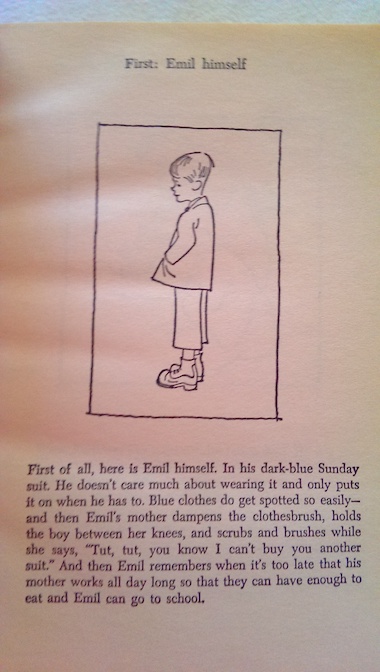
  At the beginning of this story, it explains that Emil Tischbein’s father died when he was very young and that his mother works hard as a hairdresser to support the two of them. When she can, she saves a little money for Emil’s grandmother as well. When the story begins, Emil is preparing for a train trip to Berlin to visit his relatives. Emil will be traveling by himself and will meet his relatives near the station when he arrives. His mother gives him some money to take to his grandmother and warns him to be careful. Emil pins the money inside his pocket for security.
 Determined to get the money for his grandmother back, Emil searches for Herr Grundeis and spots him getting off the train. It’s too soon for Emil’s stop, but he follows Grundeis off the train anyway, tracking him to a café.
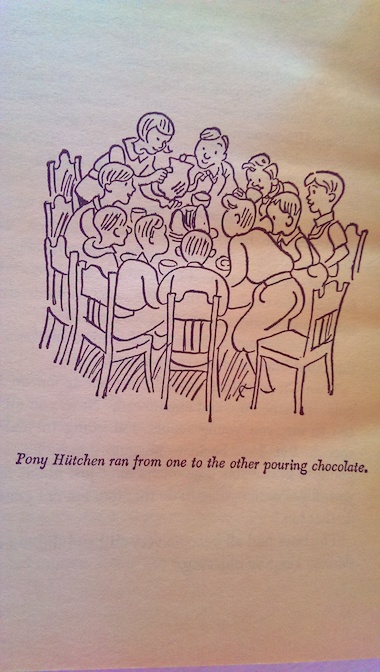 Gustav recruits a bunch of other boys from the neighborhood, and they continue tailing Grundeis through the city to his hotel. The boys call another friend at home, who keeps track of their progress and gives them reports about what others have said. Emil gets one of the other boys to tell his relatives that he has been delayed on important business, causing his cousin, Pony Hutchen, to come and tell him that everyone is worried and that he’s going to be in big trouble with his relatives if he doesn’t show up soon. However, they still have the problem of deciding how to confront Grundeis and get him to return the money. In this case, the detectives don’t need to solve the mystery of who the thief is. The real problem is how to prove it.
 There was a note in the beginning of my copy of the book that says that many of the character names in the book are actually jokes on the part of the author. It’s not as obvious in English because the forms of the names sound reasonable for German names, but anyone who knows German would spot that they aren’t real names. For example, Emil’s last name is Tischbein, which means “table-leg,” and the thief’s alias, Grundeis, means “ground-ice.”
 Eagle-Eye Ernie Comes to Town by Susan Pearson, 1990.




 The Master Puppeteer by Katherine Paterson, 1975.
 Okada was once Yoshida’s teacher, and he accepts Jiro into the theater. Jiro is fascinated with the world of the theater, studying alongside Yoshida’s son, Kinshi, who becomes his closest friend. However, he must first graduate from apprentice to puppeteer before he can begin earning enough money to support his family, and the news from outside the theater is grim. Word has reached him that his father is ill and his mother is starving. The poor people of Osaka, starving and oppressed by the wealthy merchants and tax collectors, begin rioting.

 Scared Silly by Eth Clifford, 1988.
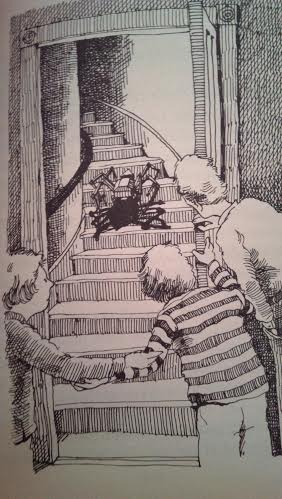 While the Onetree family is visiting the museum, a pair of shoes that once belonged to a Chinese emperor disappears. Like the two Onetree sisters, Gus considers himself the sensible brother and doesn’t take Razendale, the dreamier sibling, very seriously. He thinks Razendale ran off with the shoes as a prank. But, Erik, who seems more sensible than either of his uncles, says that they can’t just accuse him without proof. Gus provides them with an invention that could settle the whole matter, but that depends on whether or not they can trust Gus.
 Jestress's Forgotten Books and Stories
