Mystery of the Melted Diamonds

Mystery of the Melted Diamonds by Carol Farley, 1986.

This is the last book in the Kipper and Larry mystery series.

This time, Larry has come to visit Kipper and his family on their farm in Kansas while his father attends a police convention in Florida and will be spending Christmas with them. At first, Kipper thinks that Larry probably regrets this visit because Kansas isn’t very exciting, and it’s snowing while Larry’s father is in sunny Florida.

The situation gets worse when Kipper gets into a fight with his friend Scooter when Larry and Kipper were supposed to be spending the night at Scooter’s house. Scooter apparently cheated at a game, and Kipper got so mad that he said that he and Larry would just go home. The problem is that the boys have to walk a couple of miles to reach the farm where Kipper’s family lives, and the snow has turned into a blizzard.

The boys start to get scared that they might freeze to death when Larry spots a light from a house nearby and heads toward it. Kipper thinks that it’s a dangerous mistake because the house with the light is the old Morgansterne house, and it’s been empty for years. However, when the boys reach the house, there are oil lanterns burning in the windows and a fire in a wood-burning stove. Out of desperation, the boys let themselves into the house to warm up, but then they start to wonder who lit the fire and the lanterns. They search the house to see if there’s anyone there, but they don’t find anyone. The only thing they find upstairs is an old box of Christmas ornaments.

The boys spend the rest of the night in the house without seeing anyone and continue to the farm in the morning. When they explain to Kipper’s mother what happened and where they spent the night, she’s concerned, both because the boys were out in the snowstorm and because nobody should be in the old Morgansterne house. Old Miss Morgansterne, who owns the house, has been living in a retirement home, and no one else is supposed to be there. Kipper’s mother decides to call the sheriff and have him look into it.

The sheriff comes and questions the boys about what they saw in the house, and they ask him about a robbery at a jewelry store in town that the family heard about on the radio while waiting for him to arrive. Larry wonders if there’s a connection between the robbery and the supposedly empty house that seemed to be occupied by someone before they arrived. The sheriff doesn’t see why there would be a connection between the two events, but Kipper’s younger brothers think that maybe the robbers were in the house the whole time, hiding in some kind of secret passageway, like in books and movies. The sheriff thinks that the boys have overactive imaginations.

However, there is more to the theory that the house and the robbery are connected than the sheriff thinks. Soon, the sheriff is alerted that the car that is believed to belong to the robbers has crashed into a pond near a dangerous curve in the road and the two men inside the car are dead. When they search the car, they find some of the jewelry from the robbery, the less expensive costume jewelry, so it seems that they were correct that these men were the robbers, but strangely, the most expensive jewels from the robbery, diamonds, are still missing. The sheriff says that it’s almost like they melted away, like the diamond-like snow that Larry commented on earlier.

It makes sense to the boys that the robbers were in the Morgansterne house before they were. They remember seeing a car like the robbers’ car along that road before the snow storm got bad, and it would explain why the house was empty all that night. The robbers accidentally saved the boys’ lives by lighting the stove in the house for them, but they never returned to their hideout in the empty house because they had their car accident. But, somewhere along the way, the diamonds they stole seem to have vanished. Can the boys figure out how?

The book is available to borrow and read for free online through Internet Archive.

My Reaction

Overall, I liked the story. I had more than one theory about where the diamonds were, and one of them turned out to be correct, but there was enough doubt in my mind to keep the story interesting until the end.

Mystery in the Old Cave

Mystery in the Old Cave cover

Mystery in the Old Cave by Helen Fuller Orton, 1950.

Mystery in the Old Cave nut gathering

Andy and Joan Draper are excited about spending the fall and winter in the country. Usually, they live in an apartment in New York City and only go to their family’s vacation home in Vermont during the summer. However, this year, some friends of their father will be moving to New York, and they’ll need a place to stay because they are having trouble finding an apartment of their own. The children’s father has decided to rent their apartment to his friends while his family stays in Vermont. That means that the children will have to go to school in Vermont, but the children like the idea because they will be able to do things that they normally can’t do when the seasons change, like gathering nuts. When the first frosts come, the hickory nuts on the trees fall to the ground, making it easy to collect them.

After Andy and Joan collect nuts for the first time, they decide to store them in the old sugarhouse on the property. Normally, the family doesn’t use the sugarhouse for anything, but it used to be used during the times when their vacation house was a working farm and people tapped the maple trees for their sap to make maple syrup. They would process the sap in the sugarhouse. Sometimes, farm hands also used to sleep there during the harvest.

Soon, the children begin to suspect that there’s a stranger hanging around the property. Their dog, Ponto, barks at someone the children don’t see and comes running back to them, acting like someone kicked him. Later, a strange man approaches them and asks them if they know anything about a cave in the area. Andy and Joan don’t know anything about a cave. The man tells them that it’s supposed to be near the old sugarhouse, but if the children haven’t seen it, it might have caved in or something. He seems very secretive and doesn’t want the children to tell anyone that he’s been asking questions, and the children wonder if he could be the one who kicked their dog earlier. Later, someone (perhaps this strange man) steals many of the nuts that the children gathered and even some cookies. The children change their minds about storing things in the sugarhouse and decide to keep their gathered nuts in an unused room in the main house. The only clue to the identity of who’s been sneaking around is a red pencil that the person dropped.

Mystery in the Old Cave store

The children make friends with a boy named Phil who lives nearby. Phil is an orphan who lives with his Cousin John (who he sometimes calls Uncle John because he is so much older), a mean and stingy old man who doesn’t treat him very well and makes him work hard around the house instead of going to play after school with the other kids. He doesn’t even replace Phil’s clothes when they get old and torn. Phil gets a job at the local store to earn some money for a new sweater, but Cousin John even confiscates Phil’s earnings.

Mr. Lane, who owns the local store, is nice, and he tells Andy and Phil about how maple syrup and maple sugar are made, something that everyone in town used to participate in so that it was like a community party. The boys think it sounds like a lot of fun, and while they are talking about the old sugarhouse, Mr. Lane mentions that, once, some thieves joined in when they were making making syrup. Nobody knew they were thieves at first; they were just a couple of strangers who came along with everyone else and started helping out. Later, there were some robberies in the area, and the thieves were found hiding in a cave near the sugarhouse. Mr. Lane says that he and his friends used to play in that cave when they were young, and Andy and Phil decide that they want to find it.

Mystery in the Old Cave bones

The boys take some tools with them while they’re looking for the cave, in case the entrance has been covered over, which turns out to be the case. Once they dig through the entrance, the rest of the cave appears intact. They find some old bones inside that probably belonged to a bear. They can’t look around much more because the cave is too dark, so they decide that they’ll return later with some lanterns. Mr. Lane tells the boys that there still might be stolen loot around because they never did find everything that the thieves took, including a pearl necklace that belonged to Andy’s grandmother, who was living there back then. Could these things be what the mysterious stranger is looking for?

Mystery in the Old Cave stove in store

During the course of the book, Mr. Lane begins to notice that Phil’s cousin isn’t giving him enough food. Cousin John denies Phil food when he refuses to turn over the extra money that he’s been earning to him. Mr. Lane gives Phil food from the store to eat. While Phil is at the store, he overhears the stranger, who calls himself Joe Williams, talking to Mr. Lane. Joe Williams admits that he’s looking for treasure in the area. Mr. Lane says that he doesn’t have high hopes that Joe Williams will find anything around the cave because the whole area was searched thoroughly years ago.

Phil tells Mr. Lane that he can’t stand living with his cousin anymore and wants to run away. Mr. Lane tries to persuade him not to go, saying that he can deal with Phil’s cousin, but Phil has had enough and worries that his cousin will make life hard for anyone who tries to help him. When Phil hides out in the old sugarhouse, he meets up with Joe Williams, who explains to him more about how he knows about the treasure that may be hidden in or around the cave. He’s about ready to give up the search, but Phil finds something that everyone else has overlooked.

In the end, Andy and Joan’s parents decide to take Phil in. Phil’s cousin agrees to sign over custody to the Drapers, provided that he gets to keep the money from Phil’s job that he took and the money that Phil’s mother left for Phil’s upkeep. I’m pretty sure that’s illegal and that the courts and social workers would have something to say about that if this story happened in real life in the 21st century, but in the story, Mr. Draper accepts the deal and basically uses the money that was meant for Phil to pay off his cousin to surrender custody of the boy. The story ends at Thanksgiving, with Phil sitting down to Thanksgiving dinner with his new family, who will really love him and treat him much better than his cousin did.

Mystery in the Old Cave hiding

This is one of those older mystery stories that’s really more adventure than mystery. There’s really only one suspect for the odd person sneaking around, and his reasons for sneaking around turn out to be exactly what he said they were. There is no other hidden purpose or secret past behind that man other than what he said, and in the end, he just kind of leaves the story. The kids don’t have many clues to the location of the stolen items, and in the end, Phil finds them more by accident than anything else.

Sometimes, when I’m unsatisfied by the ending of a story, I like to make up an alternate one of my own. If I were writing this, I’d have had Phil’s nasty cousin be involved in the robbery and the hunt for the hidden loot. For example, maybe he was actually one of the original thieves and had a falling out with his partners, and he’s secretly searching for the rest of the loot they hid for years. Maybe he’s had to redouble his efforts recently because they’re getting out of prison soon, and he wants to get to the hidden loot before they do. Cousin John is money-hungry enough that it could be plausible, and that would allow the story to end with him being sent to prison, which seems fitting.

This isn’t important to the story at all, but I just wanted to say that the copy I have of this book is damaged in a very odd way. On some of the beginning pages, someone has cut out a few of the words, ransom-note style. I don’t know why that happened. There aren’t enough missing for a real ransom note, and some of the cut-out words are still stuck in the pages, but since this is a mystery book, I kind of like the image of someone using it to write some kind of mysterious secret message.

I haven’t been able to find an online copy of this book yet, but Internet Archive has others by the same author.

Rasmus and the Vagabond

Rasmus and the Vagabond by Astrid Lindgren, 1956.

Disclosure: I am using the 2015 edition of the book, published by Plough Publishing House.  Plough sent a copy to me for review purposes, but the opinions in the review are my own.

The Swedish author Astrid Lindgren is best known for her Pippi Longstocking series, but she also wrote other excellent books for children. This particular book is about a nine-year-old orphan boy and his adventures with a traveling vagabond (tramp) after he runs away from an orphanage.  There is an element of mystery, which pleased me, as a life-long mystery fan.

The dullness and unfairness of life at the orphanage gets to nine-year-old Rasmus. While the other children in the village get to play and go swimming, he and the other orphans are expected to work, doing chores like digging up potatoes in the garden or pulling nettles.  Mrs. Hawk, who is in charge of the children, doesn’t like them goofing off when they could be doing chores.  The work is necessary because orphanage sells produce and eggs to help support the children, and the children know that when they’re thirteen years old, they will have to start taking regular jobs to support themselves.  Mrs. Hawk doesn’t see much benefit in letting the orphans play, like other children do.

One day, while Rasmus is pulling nettles by the chicken coop, he finds what, to him, amounts to wonderful treasures: a single five-cent coin and a seashell!  He has no idea how they got there, but he has never found anything so wonderful before.  He rushes to tell his friend, Gunnar, about them. Gunnar tells him that someone is going to visit the orphanage and pick out a child to adopt. All of the children hope to be the one chosen for adoption, and Rasmus wonders if his lucky finds might be an omen that he will be the one chosen.

Unfortunately, he isn’t the one chosen. As Gunnar predicted, the couple who visit the orphanage pick a girl with curly hair, Greta, and Rasmus embarrasses himself by accidentally breaking the lady’s parasol.  Rasmus thinks that he’ll never get adopted, and he suggests to Gunnar that maybe they should try to strike out on their own and find parents. His reasoning is that, if they didn’t have to compete against the other children at the orphanage (especially the cute, curly-haired girls), they might have better luck at finding families.  Gunnar thinks that Rasmus’s plan is crazy, but Rasmus also knows that he has punishments ahead for his earlier escapades, and he’s decided that tonight is the best time to get away.

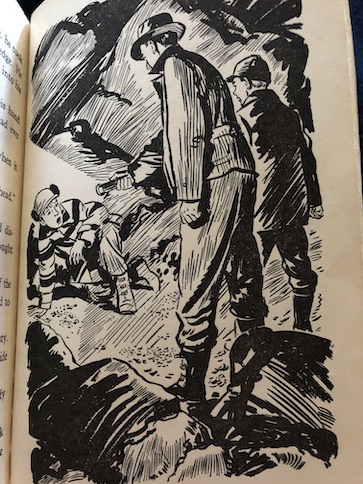
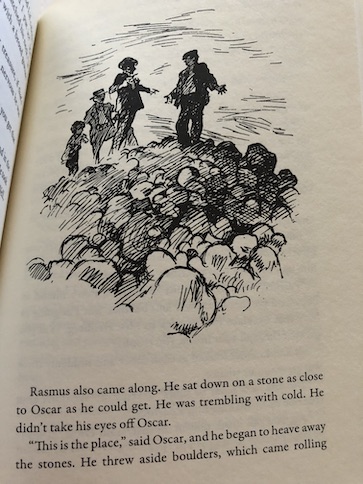
That night, Rasmus sneaks out alone, taking his five-cent coin with him and leaving the seashell for Gunnar to remember him by.  At first, Rasmus is terrified on his own, and when he gets hungry, he actually starts to miss the orphanage.  Fortunately, he soon meets a tramp who goes by the name of Paradise Oscar.  Oscar actually turns out to be pretty nice, sharing his food with Rasmus.  Rasmus asks if he can be a tramp like Oscar, and Oscar says that boys should really be at home with their parents.  When he learns that Rasmus doesn’t have parents, he takes the boy under his wing.  Rasmus starts to like the free life of a tramp.  They work when they want to and don’t when they don’t.  Sometimes, they make money by singing in the street.  They can sleep anytime they want, and they spend Rasmus’s coin on butterscotch candies.

However, trouble looms when Oscar is taken in for questioning by the police about a robbery.  Two masked men robbed the Sandhoe factory before Rasmus ran away from the orphanage, and the police think that Oscar may have been one of them.  Rasmus believes in Oscar’s innocence.  The police aren’t so certain, but they release him for lack of evidence.

Shortly after that, Rasmus witnesses another robbery.  At first, they’re afraid to go to the police, but they leave an anonymous note so that the robbery victim gets help.  One of the miscreants involved actually accuses Oscar of being one of the robbers, but some of what Rasmus witnessed points to the real villains.

Rasmus and Oscar are colorful characters, and their journey through the Swedish countryside is full of adventure, with Oscar running from the law and Rasmus still searching for the home and family he desperately wants.  There are some moments of suspense in the story, but it all ends happily, and Rasmus does find a home that’s just right for him, although it’s not quite what he had originally pictured. Rasmus’s experiences on the road change him and his ideas of what he wants in life and a family. When he started his journey, he wanted to be chosen by someone else, but in the end, it’s the choice that he makes that determines his future.

One part of the story that particularly fascinated me was when Rasmus and Oscar hide in an abandoned village, and Oscar tells Rasmus that the reason that the village is abandoned is because, years before, the people in the village all decided to emigrate to America together, specifically Minnesota (a popular destination for Scandinavian immigrants).  I remember from my first degree in history that mass emigrations of that sort also took place in other countries.  The Library of Congress has more information about Swedish immigrants and the major periods of immigration.  I think that the event that Oscar referred to was during one of the periods of high population and famine in Swedish history. I love books with interesting historical details!

As a fun fact, this book is also one of those books that appears in Swedish on Ikea shelves, just to help demonstrate bookcases or dress up one of their mock rooms. I spotted it there once. If you look for the name “Rasmus,” you’ll recognize it. The next time you see it, you’ll know what it’s all about!

This book is available to borrow for free online through Internet Archive, but it’s also back in print and available for purchase through Plough. If you borrow the book and like it, consider buying a copy of your own. This one’s a keeper!

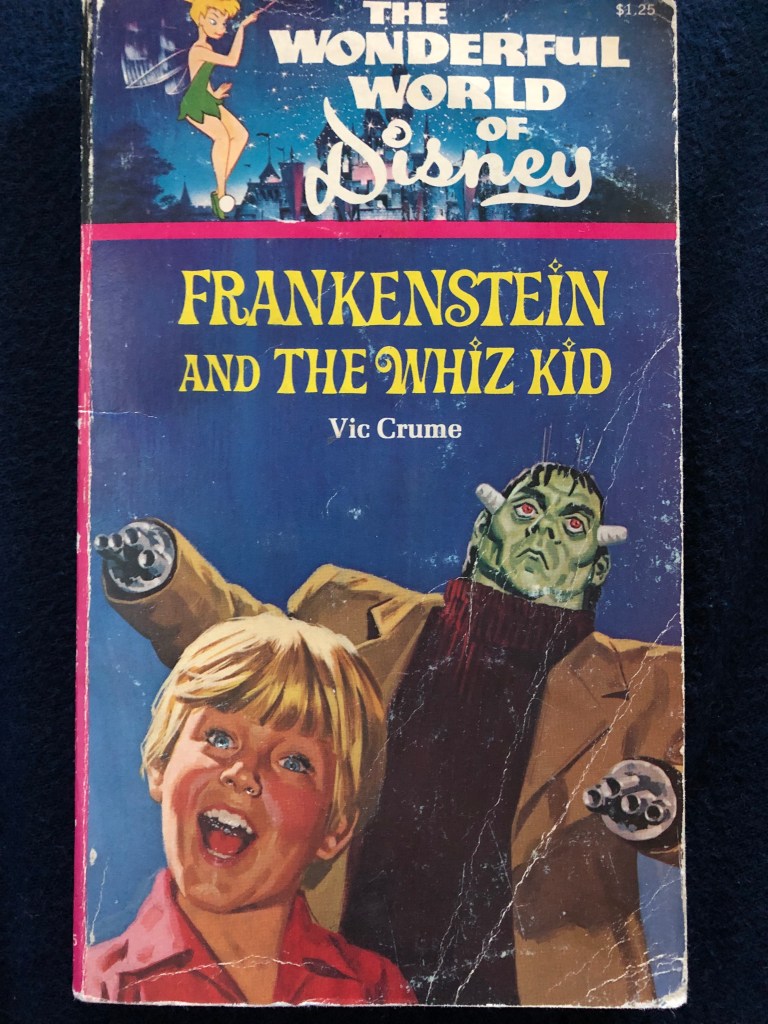
Frankenstein and the Whiz Kid

Frankenstein and the Whiz Kid by Vic Crume, 1975.

This book is a novelization of a made-for-tv Disney movie called The Whiz Kid and the Carnival Caper (some editions of this book also use that title).  There was also an earlier movie with the same characters called The Whiz Kid and the Mystery at Riverton.  I haven’t been able to find either of these movies for sale or on YouTube.  Both of the movies are based on a character created for a series of books by Clifford B. Hicks.

The “Whiz Kid” is Alvin Fernald, a boy who is always creating amazing inventions.  He has quite a reputation in his town.  Sometimes, people also call him “The Magnificent Brain.”

One day, his sister, Daphne (called “Daffy”), borrows one of Alvin’s rockets, showing a friend how they work.  However, the rocket ends up falling down a storm drain, and Daffy climbs in to retrieve it.  Alvin comes along as Daffy has trouble getting out and gives her directions to the storm drain’s opening.  Daffy follows the directions and gets out, but while she’s still walking around in the storm drain, she sees a mysterious man with a gun.  Fortunately, he doesn’t spot her, but she wonders what he was doing in the storm drain with a gun.

The place where the storm drain comes out is near a carnival that has come to town.  Alvin, Daffy, and Alvin’s friend Shoie want to go to the carnival, but they need some money.  To get some, Alvin brings out one of his earlier invention, a car-washing machine.  The others are dubious about that invention because it has caused problems before, but Alvin says that he’s fixed it.

Their first prospect for a car wash is the person who has moved into a spooky old house in their neighborhood.  It turns out to be a beautiful young woman named Cathy Martin.  Alvin is eager to impress her, but unfortunately, his invention goes haywire and ends up making a mess that the kids have to clean up (as well as making apologies to other people affected by the chaos).  However, Cathy agrees to go to the carnival with Alvin.

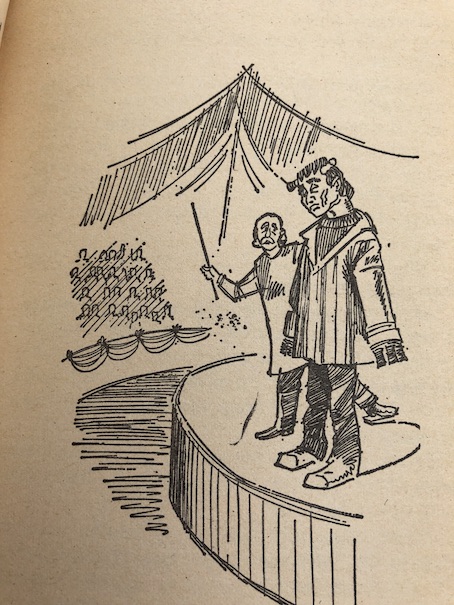
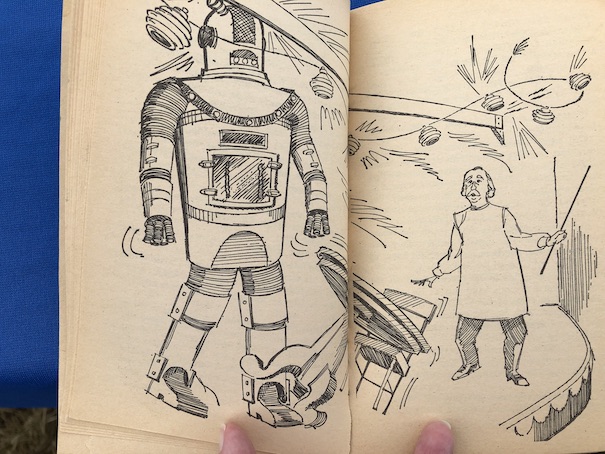
The carnival turns out to be an opportunity for another of Alvin’s inventions when the automaton that they’re using as Frankenstein’s monster in a carnival show breaks down.  Alvin also has a robot that he has built, and he offers the use of it to the man who works on the carnival’s automaton, so the show won’t have to close down.  The man accepts Alvin’s offer, and Daffy volunteers to help with the robot’s costume.

Cathy meets them at the carnival, and to Alvin’s annoyance, suggests that the four of them have fun together, instead of just her and Alvin.  The four of them do have fun, but they stumble onto something strange about Cathy.  They spot a man who Alvin and Shoie met at Cathy’s house.  Cathy said that he was her younger brother, on leave from his base, and that he had to be heading back there soon.  But, Alvin and Shoie wonder what he’s doing at the carnival if he’s supposed to be back and his base.  Then, Daffy recognizes him as the man she saw in the storm drain with a gun!  Who is he really?

The kids decide to spy on Cathy’s house, and they learn that the man, called Ernie, and the magician from the carnival, Moroni, are planning a bank robbery and that Cathy is in on their plans.  It’s a terrible disappointment to Alvin because he liked Cathy, but he thinks that they have a duty to tell Police Chief Moody about their plans.

Chief Moody is somewhat skeptical about what the kids overheard, but he and he deputy stakeout the bank.  When nothing happens, he thinks that the kids raised a false alarm, but it turns out that the robbers’ plan is more complicated than they know.

Kate’s Camp-Out

Sleepover Friends

#6 Kate’s Camp-Out by Susan Saunders, 1988.

Kate’s family is spending the weekend at a cabin at Spirit Lake, and Kate is allowed to bring her Sleepover Friends with her.  However, what promised to be a fun and exciting weekend soon comes with complications.  First, Kate discovers that the Norwood family will be in a cabin nearby.  Dr. Norwood is a colleague of her father’s, but his two sons, Sam and Dave, are pests who like to play practical jokes.  When they arrive at the cabin, there is also no electricity (a problem that they fix the next day), and they learn that the reason the lake is called Spirit Lake is because there are some scary stories about the place.  Kate’s father tells the girls a story before bed about an old fur trapper who murdered another fur trapper for his money.  The ghost story is interrupted by Dr. Norwood, who comes over to see if everything is all right because there have been some break-ins in the area recently.

The girls are spooked by the ghost story, but the next day, they also encounter the Norwood boys and realize that they’re every bit as awful as Kate remembers them.  First, Sam and Dave trick a couple of the girls into wading out into a deeper area of the lake so that they’ll fall in and get wet.  Then, when the families meet for a barbecue, the boys give a couple of the girls worms in a bun instead of sausages.

Because of their bad experiences with the boys, the girls are allowed to go back to their cabin while the others finish the barbecue.  While the girls are at the cabin, they accidentally find a secret hiding place in the fireplace with a pouch of old coins inside!  The girls wonder if that could be the stolen money from the ghost story, but Stephanie, who has been reading a book about ghost stories from the area, says that the dates on the old coins are later than the story took place.  According to the book, a ghost child was once seen around their cabin, but the girls can’t figure out why a child would have hidden so much money.

While the girls wait for the adults to return from the barbecue, they fix dinner for themselves and decide to hold a séance to contact the spirits.  They don’t really believe that the séance will work when they try it, but without any tv or radio, they don’t have anything else to do, and they can’t get their minds off the ghost stories. 

To the girls’ surprise, they actually hear strange knocks in reply to the questions that they ask the spirits.  Then, a child’s giggle convinces them that it’s just the Norwood boys, spying on them and trying to scare them again.  It’s the last straw, and the girl plot how to get even with the Norwood boys!

The book is currently available online through Internet Archive.

My Reaction and Spoilers

This is one of those stories that has a somewhat ambiguous ending. When the girls try to catch the Norwood boys playing ghost, they instead discover the identities of the people behind the recent break-ins at the cabins. Later, they learn that Sam and Dave actually have alibis for the time that they heard the ghost noises, leaving them wondering if the knocking and giggling could have actually been a ghost. The girls do manage to play a prank on the boys before the end of the story, but they never learn the story behind the old coins.

I liked the part where they never firmly establish whether or not there was a ghost because it’s fun to leave people wondering. People who like ghost stories can imagine that the girls did hear a ghost, but if you don’t like the scary explanation, you can imagine that there’s another explanation for the noises. However, I found the lack of resolution behind the presence of the coins a little disappointing. The owner of the cabin they were using lets each of the girls keep a single coin as a souvenir (and the coins really are valuable collectors’ items) and gives the others to a local museum. I think I would have liked the story better if the girls found an explanation for the presence of the coins at the museum, so at least part of the story would be resolved.

There are two main theories that I have behind the events in the story. One is that the thieves in the area hid some stolen coins in the cabin for some reason and they were the ones trying to scare the girls during their seance. The other is that the mystery of the coins ties in with the child ghost in some way, hinting at dark unknown deeds from the past. Alas, there is no confirmation about which of these theories, if any, is true.

The Snowy Day Mystery

Cam Jansen

CJSnowyDayMystery

The Snowy Day Mystery by David A. Adler, 2004.

One snowy day, Cam Jansen and her friends are on the school bus outside of their school.  Because of the snow, a lot of parents have decided to drive their kids to school, and with all the extra cars, it’s difficult for the bus driver to pull up and let the kids out.  Cam and her friend, Eric, pass the time while they’re waiting with a memory game.

Their game proves useful later, when one of their teachers discovers that someone has stolen three computers from one of the classrooms.  There are footprints in the snow outside the classroom window, but the window was locked from the inside after the theft.  Whoever took the computers must have actually entered the school and passed them to someone outside.  But, computers are big and heavy.  How did they get them away without anyone seeing them?

Cam and Eric begin to investigate, and Danny, a classmate with a habit of telling really bad jokes, tags along.  Part of the solution to the mystery has to do with all of the extra cars in front of the school that morning.  The thieves’ car would have blended in with all of the others, except that they were doing something that none of the other cars were doing, something that Cam realizes that no car would have had a reason to do.  Cam saw the thieves leave herself and is later able to describe the car to the police, but the unusual thing about it doesn’t occur to her until she thinks about where the thieves parked their car.

The book is currently available online through Internet Archive.

Cam Jansen and the Ghostly Mystery

Cam Jansen

CJGhostlyMystery

Cam Jansen and the Ghostly Mystery by David A. Adler, 1996.

CJGhostlyMysteryGhostCam Jansen’s Aunt Molly takes her and her friend Eric to buy tickets for a Triceratops Pops concert.  Triceratops Pops is a singing group that dresses up like dinosaurs, and many of the fans buying tickets also wear dinosaur costumes.  While they’re standing in line, someone dressed as a ghost starts sneaking up behind people and scaring them by yelling, “Boo!”  At first, it seems like a mildly annoying prank, but then one old man standing nearby seems to have a heart attack when he is startled.

The guards standing near the ticket booth rush to help the man and call for an ambulance for him.  However, while they are distracted, the person in the ghost costume robs the woman selling tickets, taking all the ticket money and her own money from her purse.

Cam is convinced that the old man who collapsed was part of the thief’s plan and that his “heart attack” was just an act to distract the guards.  She noticed that he seemed to be wearing a wig to make himself look older.  But, there are two other clues that are important: the magazines that the man dropped when he fainted, and the fact that the ghost costume was found in the ladies’ restroom.  Once again, Cam helps the police with her amazing memory!

The book is currently available online through Internet Archive.

Cranberry Halloween

CranberryHalloween

Cranberry Halloween by Wende and Harry Devlin, 1982.

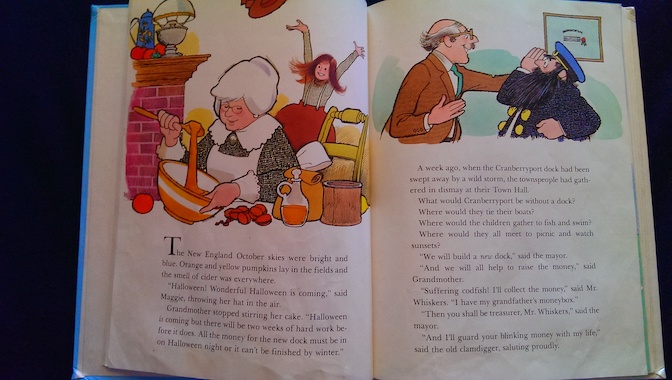
The citizens of Cranberryport need to raise money to build a new dock after theirs was destroyed in a storm. Almost everyone in town volunteers to help, and Mr. Whiskers volunteers to keep the money they raise in his grandfather’s old moneybox.

CranberryHalloweenRaisingMoney

Mr. Grape, a rather cranky old man, not only refuses to donate money to the cause but he insists that it is a mistake to trust Mr. Whiskers with the money because he is a sloppy and careless person. However, Maggie’s grandmother speaks up for Mr. Whiskers, and he gets the job of treasurer for the fund.

CranberryHalloweenSpookyHouse

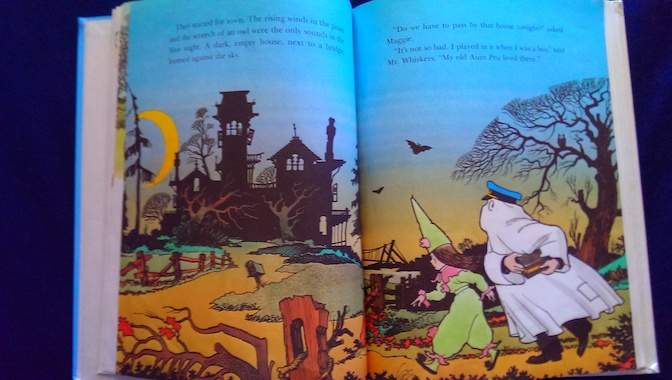
On Halloween night, Mr. Whiskers and young Maggie make their way to the town party, where Mr. Whiskers will present the money for the dock at the town hall.  As they pass by the spooky old house where Mr. Whiskers’s aunt used to live, two men in pirate costumes try to steal the money from them.

CranberryHalloweenPirates

Mr. Whiskers and Maggie hide in the spooky old house, but the pirates are still waiting for them outside. What are they going to do?

CranberryHalloweenTrapped

Mr. Whiskers uses his memories of the old house to find a way out, and it isn’t long before they uncover the villain who put the pirates up to the attempted theft.

The book includes a recipe for Cranberry Dessert in the back.

CranberryHalloweenRecipe

Old Black Witch

OldBlackWitch

Old Black Witch by Wende and Harry Devlin, 1963.

OldWitchChimneyA boy called Nicky and his mother are looking for a new place to live somewhere in New England.  The mother wants to buy an old cottage with the idea of turning it into a tea room.  At first, they have trouble finding a place, but finally they buy an old house that badly needs fixing up, not knowing that there is an old witch living there.
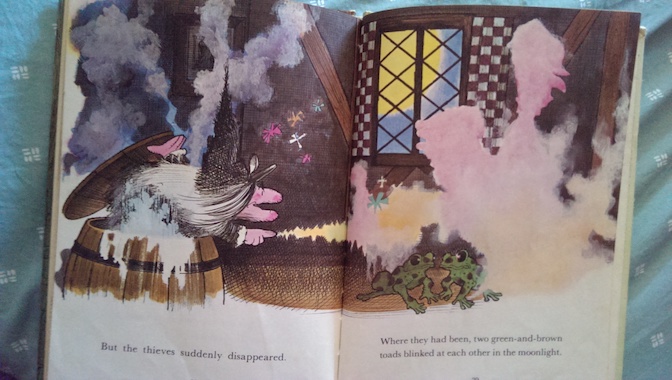
The witch (whom they call Old Black Witch, since she’s dressed all in black and sooty and doesn’t seem to have any other name) has been sleeping in the chimney of the house for about a hundred years, and they wake her the first time they try to start a fire in the fireplace.

The witch is furious to discover that the house has new owners and worried about where she’s going to live because she needs an old house to haunt.  Nicky and his mother invite her to stay and live in the attic, which has enough dust and cobwebs to satisfy her tastes, while they clean up the lower part of the house for the tearoom.

The locals have heard stories about the house being haunted, but the nice tearoom soon becomes popular with ladies in the area, especially after Old Black Witch decides to help out Nicky’s mother in the kitchen.  Old Black Witch’s blueberry pancakes are wonderful and win many fans for the tearoom.

Then, one night, a couple of burglars break in.  Since Old Black Witch is kind of evil herself, she can’t really fault them for wanting to rob the place . . . until she suddenly realizes that they’re stealing from her, too, and uses her magic to fix the burglars for good and give herself the pet toads that she’s been wanting.

This book is available to borrow and read for free online through Internet Archive.

OldWitchToads

My Reaction

One of the things that I like about this story, which was a favorite of mine when I was a kid, is that Old Black Witch isn’t particularly evil although she isn’t too nice, either.  She’s as bad and disagreeable as a cranky old witch who’s lived in a chimney for over 100 years ought to be, but not so bad that she can’t make some new friends and help them out once in a while.  Friendly enough for the kids, but not too sweet to be a real witch.  It’s part of a short series, although I haven’t managed to find any of the other books yet.  Some of the pictures are in full color and some are in black and white.  Don’t ask me why she has a spoon in her hat because I’ve never been completely sure, either.  Somehow, on her, it looks good.

The back cover of the book has the recipe for the blueberry pancakes.

OldWitchPancakeRecipe

There was a short film version of this story from 1969 called Winter of the Witch.  It follows the book fairly well, but with some variations (there were no burglars).  In the film, the pancakes have the power to make people happy, and that’s what gives Nicky’s mother the inspiration to open a pancake parlor in their house.  The witch finds a new sense of purpose, although she still plans on going back to her old, wicked ways once the world is happy enough to need a good, old-fashioned scare.  I don’t think that it was ever released on dvd, but it is possible to see it on YouTube and Internet Archive.

Meg and the Disappearing Diamonds

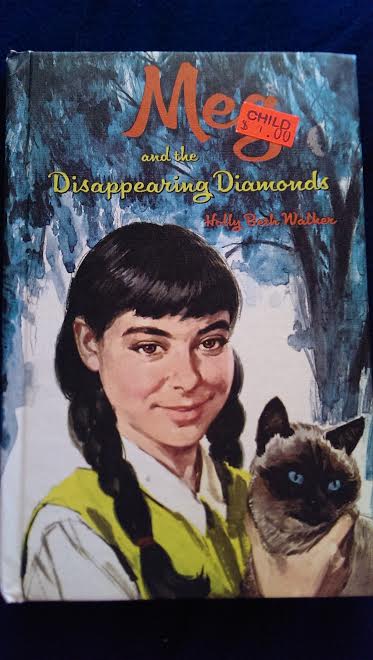
MegDisappearingDiamondsMeg and the Disappearing Diamonds by Holly Beth Walker, 1967.
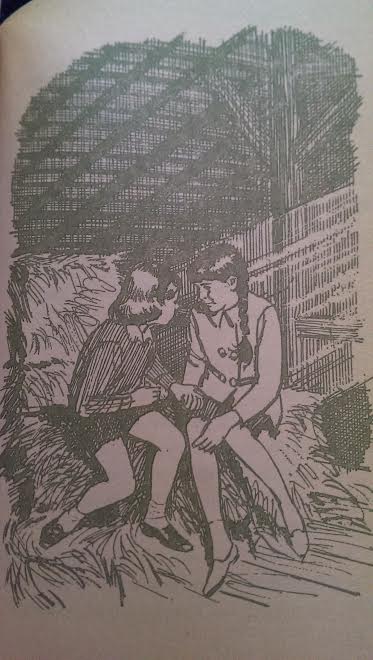
Margaret Ashley “Meg” Duncan lives in a small town called Hidden Springs in Virginia, not too far away from Washington, D.C., where her father works.  Her mother is dead, and she has no brothers or sisters. When her father is away in Washington, working, Mr. and Mrs. Wilson, the gardener and housekeeper, take care of her.  For company, Meg has her beloved cat, Thunder (who doesn’t like anyone but Meg), and her best friend, Kerry.

People in Hidden Springs have been talking lately about Mrs. Partlow and her diamond jewelry.  Mrs. Partlow is the wealthiest, most important woman in town.  Usually, she keeps her jewelry in a vault at the bank, but recently, she brought it to her house so that she can wear it at her niece’s wedding.  Then, someone attempts to break into Mrs. Partlow’s house.  Nothing is taken, but everyone can guess what the thief was after.

MegDisappearingDiamondsPicMrs. Partlow invites a few friends to her house for tea to show them her jewelry and thoughtfully invites Meg and Kerry to join the women.  Meg and Kerry are excited at the chance to attend a grown-up tea party and to see Mrs. Partlow’s fabulous jewelry.  However, the party is crashed by Mrs. Glynn, a new woman in town.  Mrs. Glynn has three trained dogs that she dotes on.  She dresses them up in fancy costumes, and she can’t resist the opportunity to show them off when she wanders into the gathering in Mrs. Partlow’s garden.  The dogs cause a disruption, and after it’s over, everyone realizes that Mrs. Partlow’s diamond jewelry is missing!

Could the dogs have been an intentional distraction?  What about the person who tried to break into Mrs. Partlow’s house earlier?

Kerry’s much younger cousin, Cissie, is visiting her family and has a habit of taking things that catch her eye and hiding them in her secret “playhouse” which changes locations from time to time.  So far, the girls know that she’s taken Meg’s ballet slippers. Cissie also slipped into Mrs. Partlow’s party, uninvited and unnoticed by the other guests.  The girls don’t know for sure that Cissie took the jewelry, but the theft is a serious crime, and they don’t want to see little Cissie get into trouble.  They have to either find Cissie’s new “playhouse” and search it for the jewelry or to discover who else might have taken the diamonds before anyone else realizes that Cissie might be the thief.

My edition of the book has drawings that are done in kind of a gray green color.

The book part of the Meg Duncan Mysteries.  It is available to borrow and read for free online through Internet Archive.