The Root Cellar

RootCellarThe Root Cellar by Janet Lunn, 1981.

Rose Larkin is an orphan, living with her grandmother, a stern businesswoman.  Her grandmother travels frequently on business, so from the time Rose came to her when she was three years old, she just took Rose with her wherever she traveled, tutoring her in school subjects in the evening after work.  Rose’s early life is largely one of travel to strange places and isolation.  When her grandmother is working, Rose is pretty much left to her own devices, often either reading alone in their hotel rooms or exploring strange cities by herself.  Not going to school, she has no friends her own age and doesn’t really know how to behave around other children or live as part of a normal family.

When her grandmother dies suddenly of a heart attack in Paris when Rose is twelve years old, her remaining relatives have to decide what to do with her.  She temporarily stays with aunts who are into fashion and high living before goes to live with another aunt and uncle and their boys on an old farm.  Aunt Nan (Rose’s father’s sister) and her husband are better suited to caring for Rose and can give her a more settled family life, but Rose’s other relatives don’t seem to think much of Aunt Nan, who is an author of children’s books.  Rose has heard that Aunt Nan has no sense and that the family has just moved to a shabby little farm house in Canada.  Rose is prepared not to be happy there, on a dumpy little farm, miles from anywhere, with a bunch of strange people.

Her new life gets off to a bad start when there is no one to meet her at the house when she arrives.  As she waits for her aunt and uncle to return, a strange old woman appears who seems to know her.  She calls herself Mrs. Morrisay and acts like she belongs to the house.  But, when Rose’s relatives arrive home, Mrs. Morrisay suddenly disappears, and none of them seem to know anything about her.  Later, Rose sees a girl making a bed upstairs, but her relatives just laugh when Rose asks them about the maid, which is who Rose thought the girl was.  There is no maid in this house, and Rose is the only girl.  To Rose’s annoyance, her relatives think she imagined the whole thing.

Actually, life in her aunt and uncle’s house in the country isn’t as bad as her other aunt has lead her to believe, but becoming part of their household isn’t easy because Rose is used to a very different kind of life.  The house is definitely old and in bad need of repair, and her relatives are noisy and disorganized, at least more so than Rose is accustomed to.  Rose isn’t used to the chaotic life of a family with a lot of children, and Aunt Nan has another on the way.  Also, tourists who are fans of Aunt Nan’s books sometimes stop by the house, and Rose doesn’t like dealing with their scrutiny and questions.  Sam, one of the older boys in the family, seems to resent Rose’s presence in the house, and Rose overhears him saying a lot of bad things about her to her aunt, calling her snobby and criticizing her appearance.  Rose takes his attitude as further evidence that she doesn’t really belong in their house and that she’ll never fit in.  If they think badly of her, why should she think any better of them?

Rose also becomes increasingly aware that there is something not quite normal about her relatives’ house, especially the old root cellar, and the people she saw on her first day in the house are part of it.  Sam thought that he might have seen a ghost in the house one day, an old woman, and Rose recognizes his description as that of the Mrs. Morrisay she saw on her first day there.  She sees Mrs. Morrisay in her bedroom later, suddenly walking through a wall.  Rose thinks Mrs. Morrisay is a ghost, but Mrs. Morrisay tells her that she’s not dead, just “shifting” through time and that she wants Rose to stay in the house and help restore it to its former glory.  Rose doesn’t know why or how she can possibly help Mrs. Morrisay.

Rose learns that her aunt’s house was once an old farm house that belonged to the Morrisay family, and there is still an old root cellar on the property, a relic from the time when people had to store certain kinds of food underground to keep them cool and prevent them from spoiling.  One day, Rose goes down into the root cellar and meets a mysterious girl dressed in old-fashioned clothes, the same girl she saw earlier, making beds.  Although Rose and the other girl don’t realize it immediately, Rose has gone back in time.  The girl was someone who lived on the farm in the past, during the 1800s.

Rose and the girl in the past, Susan Anderson, become friends, and Rose is grateful for another girl to talk to.  Susan is an orphan herself, living with the Morrisay family as a servant girl.  She and Will Morrisay, old Mrs. Morrisay’s son, are friends, and both of them are sympathetic to Rose when she tells them about her new life with her relatives and the problems she has. Rose finds herself wishing that she could stay in the past with them forever.  However, once they realize that Rose is traveling through time when she goes in the root cellar, they also discover that it isn’t reliable about exactly when Rose will reappear in the past.  Although at first there are only days between Rose’s visits from her perspective, months or years pass in her friends’ lives between her visits.  They eventually manage to solve this problem through a friendship pact where they exchange favorite objects.  It’s at a good time, too, because soon Rose’s friends need her help as much as Rose needs them.

After a terrible fight with her relatives in which her aunt slips and falls and Rose worries that her aunt and the baby might die, Rose runs away to the root cellar and goes to see her friends, discovering that in their time, Will has gone away to fight in the American Civil War alongside his favorite cousin and has not returned.  It’s been awhile since Susan has heard from him, and she fears the worst.  Rose suggests that they go to look for Will at his last known location, but it’s a difficult, perilous journey. At first, they’re not sure whether they’ll find Will alive or not.

When they finally find Will, he is a changed man from the war, and Rose and Susan have to help him to remember who he really is and where he really belongs.  In helping Will to remember where he comes from, his life before the war, and how much Susan needs him, Rose comes to realize some important things about herself and where she really belongs.

The book is available to borrow and read for free online through Internet Archive.

My Reaction and Spoilers

As difficult as the choice is, Rose realizes that she must return to her own time, face the consequences of her earlier actions, and do what she can to become a real member of her new family.  After she returns home and the root cellar is destroyed in a storm, it seems as though she might never see her friends from the past again, but friendship can transcend many boundaries, including time.

I didn’t realize this the first time I read the book, but it’s actually part of a loose trilogy.  I say loose because none of the main characters from each story appear in the others (except, perhaps, for one who is in both the second and third books), which also take place in different time periods.  What binds the stories together is the location where the stories take place and also some distant family relations, particularly focusing on the Anderson and Morrisay families.

It is something of a spoiler, but it seems that the time travel in this story may not be so much a matter of the house being special or magical, but because Susan is special.  It is revealed in one of the other books, Shadow in Hawthorn Bay, that her grandmother was psychic.  Will and Susan briefly refer to Susan’s grandmother and her stories about ghosts when talking to Rose.  Susan seems to have little control, especially later in life, over her ability to shift through time, but it may be her special attachment to the Morrisay house and her need for Rose’s friendship and help that makes Rose’s time travel possible.  It’s never explicitly stated that Susan inherited her abilities from her grandmother, but I think that it is implied during the course of the books.

Magic Elizabeth

MagicElizabeth

Magic Elizabeth by Norma Kassirer, 1966.

Young Sally’s parents are away on a business trip, so she’s been staying with Mrs. Chipley, but now Mrs. Chipley has a family emergency to tend to. Mrs. Chipley’s daughter is ill, and Mrs. Chipley needs to go and help her with her children. While Mrs. Chipley is gone, there is only one other person for Sally to stay with: her Aunt Sarah, an elderly woman who Sally doesn’t really know. Aunt Sarah moved to California when Sally was just a baby, and the only reason why she has returned is that she has decided to sell her old house.

MagicElizabethArrival

Sally is a rather shy girl. She’s uneasy around Aunt Sarah, who is obviously unaccustomed to spending time with children, and Aunt Sarah’s creepy cat, Shadow. The house is old, chilly, and filled with strange things. However, Sally is enchanted with the bedroom that Aunt Sarah gives her and the portrait of a girl and her doll that hangs on the wall. The girl looks very much like Sally herself, and Aunt Sarah tells her that the girl was also called Sally and lived in that bedroom as a child, many years ago.

MagicElizabethKitchen

Fascinated by this earlier Sally and her beautiful doll, modern Sally decides to try to find the doll. Although her aunt tells her that she shouldn’t go poking around in the attic, Sally can’t help herself. She finds a trunk with Sally’s name on it full of girls’ clothes, just the right size for modern Sally to wear. There is a doll in the trunk also, but it’s not the same doll as the one in the portrait. When Sally reads the diary in the old trunk she learns the reason why. The doll in the picture, Elizabeth, was lost many years ago, when the earlier Sally was still young. As modern Sally plays dress up with the earlier Sally’s old clothes and studies herself in the mirror, she finds herself taken back in time, seeing the house through earlier Sally’s eyes. In the past, it was a busy and happy household with parents, an elderly aunt, earlier Sally, Sally’s little brother, and Sally’s pet cats.

A short time later, Aunt Sarah wakes modern Sally on the floor of the attic, and they assume that it was all a dream, but this look into the past changes Sally’s feelings about the house and her aunt’s cat, who suddenly seems friendlier and reminds her of the mother cat she saw in the past. Aunt Sarah also seems a little less stern as they discuss earlier Sally and her lost doll. Aunt Sarah says that no one ever saw the doll again after it disappeared on Christmas Eve all those years ago.  Earlier Sally had put the doll on top of the Christmas tree, like an angel, and after the family finished singing Christmas carols, the doll was gone.  They could never figure out what happened to her.  Modern Sally thinks that sounds very sad and wants to investigate the mystery of the missing doll, although Aunt Sarah isn’t very enthusiastic. She says that if the doll could be found, it would have been found long ago, and the earlier Sally has long since grown up and no longer needs it. Although, oddly, Aunt Sarah remarks that the earlier Sally had always thought that Elizabeth was “a little bit magic.”

Modern Sally continues to look for the doll anyway and also continues having moments when she sees the past as the earlier Sally did many years ago, especially when she looks into the mirror in the attic. One day, she invites a neighbor girl named Emily over, and while the two of them are looking around the attic, Emily finds Elizabeth’s old doll bonnet. The girls are excited because they now know for certain that Elizabeth is still in the house, waiting to be found. The girls are running out of time to find her. If Aunt Sarah agrees to sell the house, it will be torn down to build apartments. But, Sally falls ill with the flu, and it isn’t until Shadow gives her an important clue that Sally realizes where Elizabeth must be.

This book is currently out of print, but it’s one that I’d dearly love to see in print once more!  It is available to borrow and read for free online through Internet Archive.

My Reaction and Spoilers

Adults reading this story will probably realize before the children do (spoiler) that Aunt Sarah herself was the earlier Sally, the one who lost her favorite doll many years ago. “Sally” is a nickname for Sarah, like “Molly” can be for Mary and “Peggy” can be for Margaret, although any of those names can also be used by itself.  (In the Middle Ages, it was common for popular names to get different variations of nicknames by changing one sound in the original name and then changing one more sound in the first nickname to get another one, and sometimes even moving on to change one more sound to get yet another nickname that was very changed from the first. Those nicknames that look significantly different from their original names are a holdover from that practice, having lasted even into modern times.  John/Jack works on the same principle.  Fun fact!)  When Aunt Sarah grew up, she stopped using her childhood nickname, but the name was passed on to modern Sally.

At first, modern Sally sees her stern aunt as being witch-like, all dressed in black and fussy, but gradually, the memories of the past, her new relationship with young Sally, and the finding of her slightly-magical doll soften her. There are hints of Aunt Sarah’s youth in the attic, although Sally at first dismisses thoughts that some of the lovely things there could have belonged to her cranky old aunt because she has trouble thinking of her aunt as once having been young, pretty, and sweet. However, part of the theme of the story is that everyone was young once. Aunt Sarah is is bent and achy from arthritis, giving her the witch-like appearance and making her short-tempered at times. She also hasn’t been around children much for years, and part of her fussiness comes from forgetting what it was like to be young herself. Modern Sally, with her resemblance to her elderly aunt, and Elizabeth the doll both work their magic on her, reminding her what it was like to be a young girl and helping to revive a more youthful spirit in her.

I was happy that (further spoiler) Aunt Sarah decides not to sell the house after all, not just because she and Sally will get to spend more time together, but because old houses like that are rare these days. I like the idea that the old family heirlooms in the house will now be preserved, like the sleigh out in the old barn and the melodeon, a type of small organ.  I liked the way the book described the melodeon making musical sounds as people walk past it because of the way the floor boards move.  I also loved the description of the gas plant that Sally sees in earlier Sally’s memories.  If you’d like to see what a gas plant looks like when it’s lit, have a look at this video on YouTube.MagicElizabethMelodeon

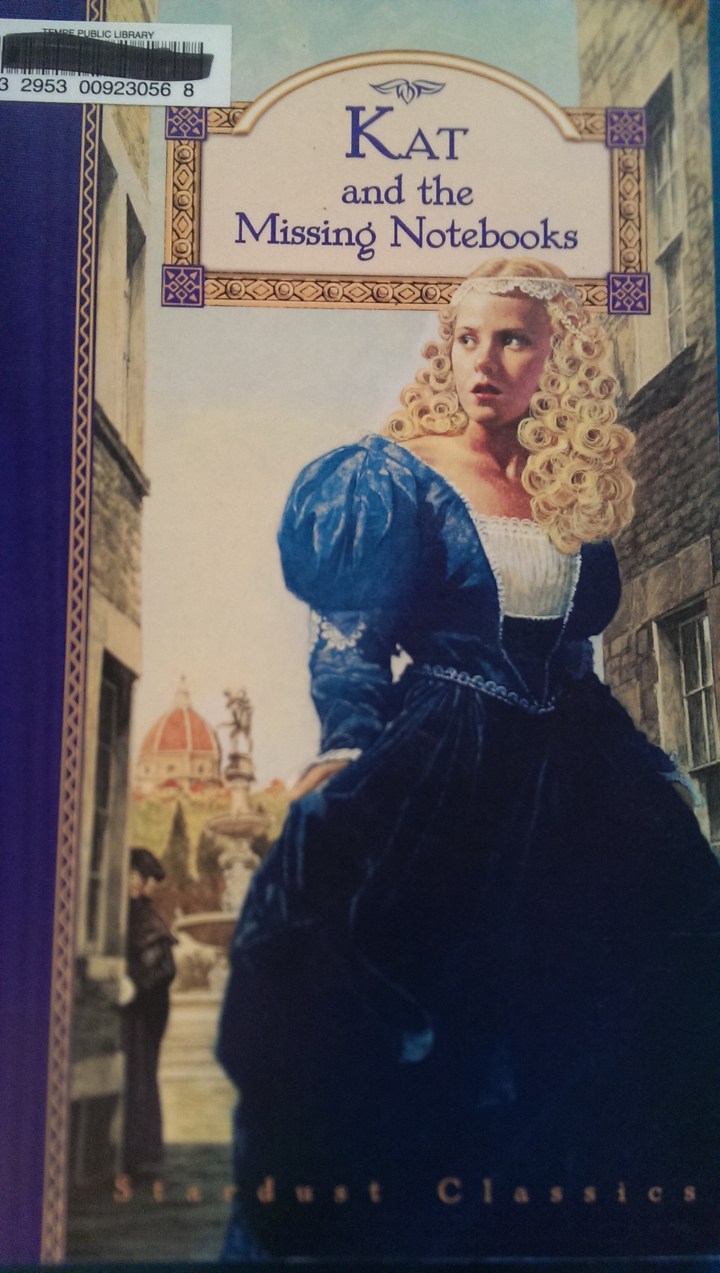
Kat and the Missing Notebooks

KatMissingNotebooks

Kat and the Missing Notebooks by Emma Bradford, 1999.

KatMissingNotebooksDaVinciThis book is part of the Stardust Classics series.

This time, Kat and her aunt, Jessie, find themselves in Florence during the Renaissance. They appear shortly before someone attempts to steal some very important papers belonging to the Florentine City Council from Signor Millori. Kat and Pietro, Signor Millori’s son, both run after the thief, and Kat helps to get the papers back. To thank Kat for her help, Signor Millori invites her and Jessie to stay with him and his family in their palazzo during their stay in Florence.

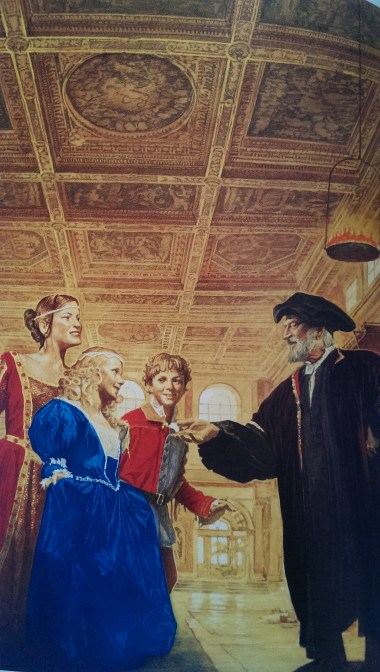
Signor Millori is a wealthy banker, and the palazzo is a grand place. Kat and Pietro become friends, and he confides in her how much he loves art. Pietro’s father wants him to become a banker, but Pietro’s dream is to study painting with Leonardo da Vinci. In fact, he takes Kat and her aunt to see Leonardo painting a mural at the Palazzo del Vecchio.

Leonardo notices Kat’s aunt and thinks that she has an interesting face. When he asks her to come to his studio to pose for some sketches, she eagerly accepts. Kat hopes that she can use the opportunity to show Leonardo Pietro’s artistic talent and convince him to take Pietro on as a student. However, although Leonardo likes the sketch of Pietro’s that he sees, he says that he has enough apprentices at the moment. Pietro cannot resist the opportunity to study Leonardo’s work, however, and borrows a couple of his notebooks to study.

KatMissingNotebooksFlightBesides being a great artist, Leonardo da Vinci is also a scientist, and along with his notes on art, there are sketches and plans for possible inventions in the notebooks. Kat and Pietro go to return the notebooks the next day, but before they can get to Leonardo’s studio, the same thief who tried to steal Signor Millori’s papers steals the notebooks.
Florence has been at war with Pisa for some time, and the Florentine City Council has consulted with Leonardo da Vinci to see if he can come up with some inventions that would give them the upper hand. They know that the thief must be a spy for Pisa who is trying to see what Leonardo has been working on. However, Kat knows that if they do not retrieve the notebooks, history may be changed. Soon, it becomes obvious that the spy has an accomplice who is living in the Millori’s palazzo. Can Kat and Pietro find the notebooks and stop the spies before it is too late?

Although this is a fantasy story that involves time travel, it is based on historical events, and there is a section in the back that explains more about the Italian Renaissance and Leonardo da Vinci.  At the time of the story, Italy was not a united country.  The Italian peninsula was covered with many small city-states which frequently fought each other.  In 1494, Pisa broke away from Florence, and Florence fought for several years to bring it back under their control, until they eventually succeeded in 1509.  This conflict was the basis for the story, and the artist and inventor Leonardo da Vinci was consulted by the Florentine Council during the struggle.

Also in the back of the book is an explanation of mirror writing, which Leonardo da Vinci used in his notebooks.  There are also instructions for making fresco ornaments and a recipe for Nutty Biscotti.

Kat the Time Explorer

KatTimeExplorer

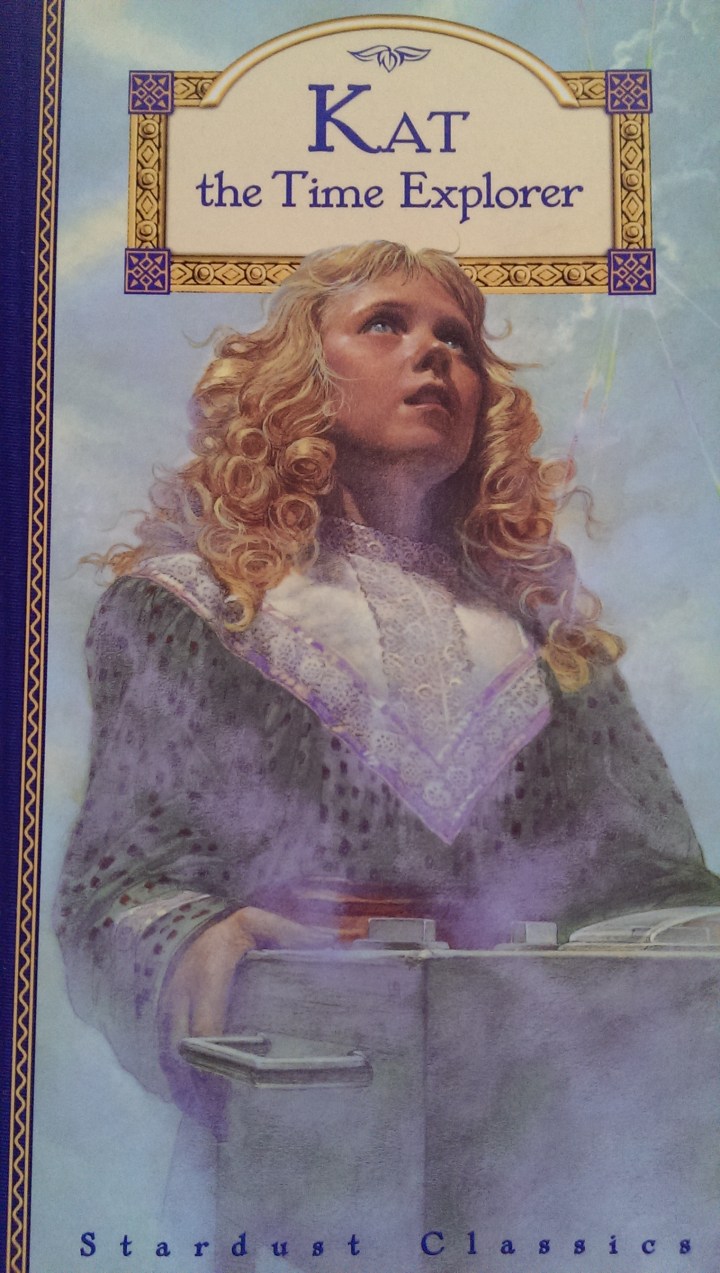
Kat the Time Explorer by Emma Bradford, 1998.

KatTimeExplorerTrain.jpgTen-year-old Kat is going to be living with her Aunt Jessie for the next year.  Her parents are botanists, and they are spending a year in South America, studying rain forest plants.  Aunt Jessie lives in a house in the same town as Kat and her parents so, by staying with her, Kat can continue going to the same school and see her friends.

Like Kat’s parents, Aunt Jessie is also a scientist and teaches physics at the same college where her parents teach when they’re not doing research abroad.  She inherited her house from their Great-Uncle Malcolm, who was an inventor.  Malcolm never invented anything that made much money or got much attention, but Jessie has been going through his things and discovered something interesting among his unfinished projects: a time machine.  The time machine seems to be nearly complete, although Jessie isn’t quite sure how to operate it or what should power it.  There is a drawing of a strange medallion in Malcolm’s notes, and Jessie found one with the same markings among Malcolm’s belongings, but it’s unclear whether this medallion is supposed to play any role in the time machine’s function or if it’s completely unrelated.

Then, Kat discovers another medallion in Malcolm’s old room, one with identical markings but made out of a different type of metal.  There is a space on the time machine for each of the medallions to fit.  When Kat experiments with how the medallions can fit into the machine, she activates it, transporting herself and Jessie back in time to England in 1851.

They find themselves on a train with other travelers heading to The Great Exhibition in London where people from around the world will be displaying new developments in industry and technology.  No one notices Jessie and Kat’s sudden arrival because the train is packed with people and the time machine has somehow altered their clothing and other small objects in their possession to ones that are appropriate to the period.  They also seem to be able to understand people speaking other languages neither of them knew before.  The time machine itself is packed into an ordinary-looking bag.  The two of them decide that they can’t use the time machine on the train where everyone will see them, and besides, they are both curious about the time they find themselves in.  After a temporary mix-up where they are separated at the train station, they find each other again and manage to locate a woman who will rent a room to them for a couple of days.

Unfortunately, when they start unpacking in their room, they discover that their bag was accidentally switched at the station for an identical one.  They no longer have the time machine and can’t get home!  Inside the bag they have, they find articles of men’s clothing, a small spring of some kind, an incomplete sketch of some kind of invention, a ticket to the Exhibition, and a letter written to someone named Edward from his brother Sidney about the Exhibition and the invention they plan to demonstrate there.  The brothers are very concerned about the success of their demonstration and are depending on results to make some money and save their family’s estate.  With those clues, Jessie and Kat must track down these inventors and find their time machine, saving not only themselves from being stuck in the past but the future of the two brothers!

There is an educational section in the back that explains about the Victorian Era and the Great Exposition.  It also discusses Victorian manners and tea parties.  There are tips for making little sandwiches of the kind people would eat at tea parties.

This book is part of the Stardust Classics series.

Trapped in Time

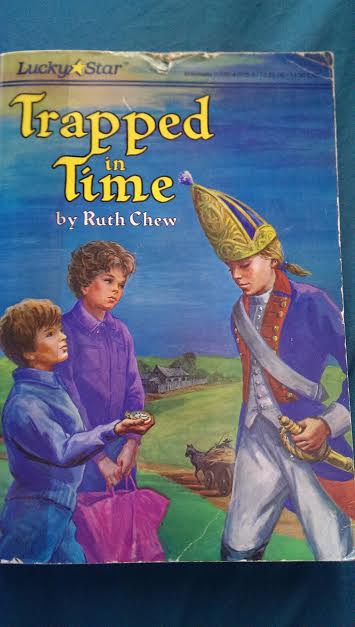
TrappedTimeTrapped in Time by Ruth Chew, 1986.

Audrey (called Andy) and her younger brother Nathan are having a picnic in Prospect Park in Brooklyn, New York, when Nathan falls and knocks over an old tree stump. They spot something shiny in the deep hole under the old stump, and Nathan climbs down to get it.  It turns out to be an old pocket watch, the kind that needs to be wound with a key.  Nathan has a small key in his pocket, made for a toy, and decides to try it on the watch.  He manages to wind it, but suddenly, the hands of the watch move backwards, the children feel strange, and everything around them seems different.  Although it takes the children a little while to realize it, they’ve traveled back in time about 200 years, back to the Revolutionary War.

They meet a boy named Franz and become friends with him.  Franz is a drummer boy for the Hessian soldiers, Germans hired by the British to help them fight against the rebelling colonists.  Franz’s superior orders his men to commandeer food and supplies from the people living in the area.  Franz is supposed to take a family’s cow, but the family desperately beg him not to because they have nothing left and will need the cow to support themselves.  Andy persuades Franz to leave the family and their cow alone.  However, disobeying the order means that Franz will be in trouble with his superior.  He decides that the only thing to do is to desert the army.

TrappedTimePicFranz had only joined the army in the first place because his parents were dead, and he didn’t know what else to do.  Now, he has to find a new place to live, somewhere where there won’t be other Hessians who would recognize him as a deserter.  Andy and Nathan also have problems because they’ve now realized what time they’re in, and they don’t know how to get home.  The watch no longer seems to work.

The children travel together, meeting others who help them and seeing the effects that all of the armies, British, Hessian, and American, have on the ordinary people as the war continues around them.

When they finally find a place where Franz can stay safely and someone he can call family, who can also use Franz’s help, Andy and Nathan realize who the watch really belongs to and how they can return to their own time.

The watch’s real owner is the person I thought it would be, and it took the kids unexpectedly long to realize it.  There is a hint of what happened to Franz when the kids finally return to their own time, but I kind of wished that they learned more about what Franz’s life turned out to be like.  From what the kids see, it seems that things went well for Franz and that he continued living in the house where they left him.

The book is currently available online through Internet Archive.