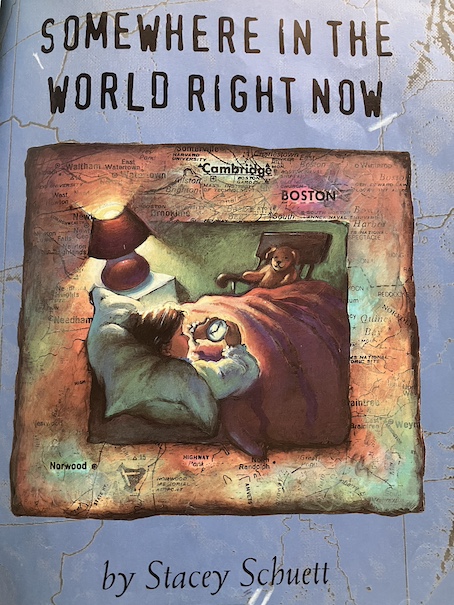
Somewhere in the World Right Now

This picture book explains time zones by showing what people and animals all over the world are doing at the same time, reminding children that, somewhere in the world right now, it’s a different time of day.

The book begins with A Note to the Reader, explaining that it takes 24 hours for the Earth to make one full rotation on its axis and that the Earth is constantly turning. This rotation is what makes the sun seem to move across the sky and creates our periods of day and night. Then, it explains how, in 1884, our formal system of time zones was established to standardize how times of day are expressed around the world. There are 24 time zones, roughly equal in size, with a few adjustments for geographical boundaries. Within each time zone, it is the same time, and it is one hour different from the time zones on either side of it. It also explains that the international date line is an imaginary boundary drawn through the middle of the Pacific Ocean that marks the point at which new days begin. There is a map in the book that illustrates all the time zones we will be traveling through and the International Date Line. The places we see in the rest of the book are also labeled on the map.

The main part of the book shows what people and animals around the world are doing “right now”, compared to a child in the United States. We don’t see the child in the United States until the very end of the book, but everything else is based around her “right now.” The text doesn’t specify where each of the places are, but each picture has a map in the background with labels that indicate the location to readers.

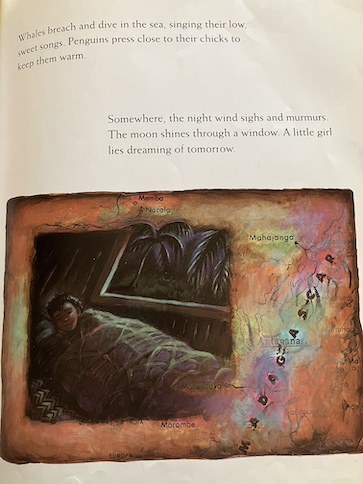
The first place we see is London, England. It’s the middle of the night (or possibly very early in the morning, after midnight but the sun isn’t up – according to the map at the beginning of the book, it’s 1 am), but a baker is preparing fresh bread to sell in the morning. Meanwhile, there are elephants sleeping in Uganda, whales swimming in the sea, penguins protecting their chicks in Antarctica, and a little girl sleeping in Madagascar.
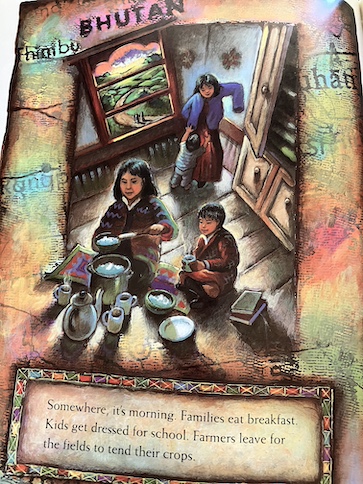
It’s dawn in India, and people there are waking up. People are eating breakfast in Bhutan, and people are on their way to work in the morning in China. At the same time, it’s lunch time in Siberia, and there are kangaroos and koalas eating their own lunch in Australia.

Meanwhile, it’s afternoon on the western coast of the United States. There’s a fishing boat returning to port in Alaska, and a girl on a farm in California. As we move further east, it gets later and later. When we reach Chicago, it’s evening, and people are heading home. In Guatemala and Honduras, children who have been playing outside head for home, and families are having supper.

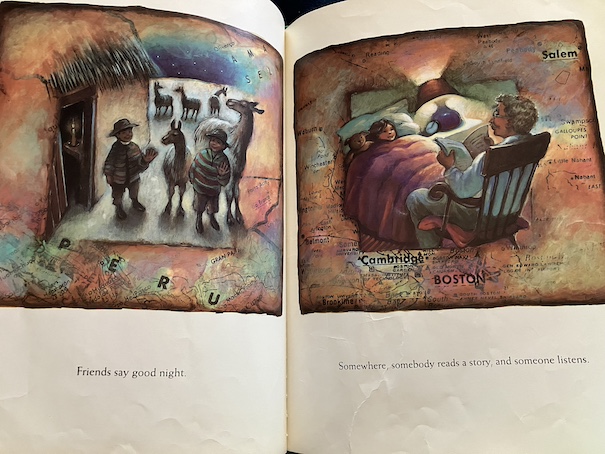
Eventually, we reach Boston, Massachusetts, where someone is reading a story book to a little girl before bed. It’s 8 pm, according to the time on the map at the beginning and the clock next to the little girl’s bed. All the things that we’ve seen in the book are happening, somewhere in the world, right now, as she is going to bed.

The book is available to borrow and read for free online through Internet Archive (multiple copies).
This book is educational, showing children how time and time zones work around the world, but it’s also a good, gentle bedtime story. Although we don’t really know it until the very end, it’s framed around a girl who is going to bed and is hearing a bedtime story. It is relaxing to think about how different things are happening in different places, to people and animals around the world, almost counting them off like counting sheep. No matter when it is or where you are, there’s someone, somewhere in the world, going through a different point in their day.

I found the human parts of the story more interesting than the animal portions, but I think children would enjoy hearing about the animals and seeing the animal pictures. It’s also relaxing to think about animals just going about their routines, like people go about theirs. There’s nothing stressful happening to any of the people or animals in the story.

I remember, when I was younger, I sometimes pictured things happening around the world when I had trouble sleeping. I can’t remember why I started doing this, if it was because I read this book or one like it. Somehow, though, I found it reassuring to think that, somewhere, it was daytime for someone else and that there were always people awake somewhere. It might be just me, but somehow, I found that idea reassuring because it meant that there were other people taking care of things, and it was their turn to be awake and do things, so I could have my turn to relax and rest.

All in a Day is a picture book on a similar theme, but instead of just showing what’s happening around the world at one particular moment, All in a Day follows children in various countries through the course of an entire day.

All In a Day

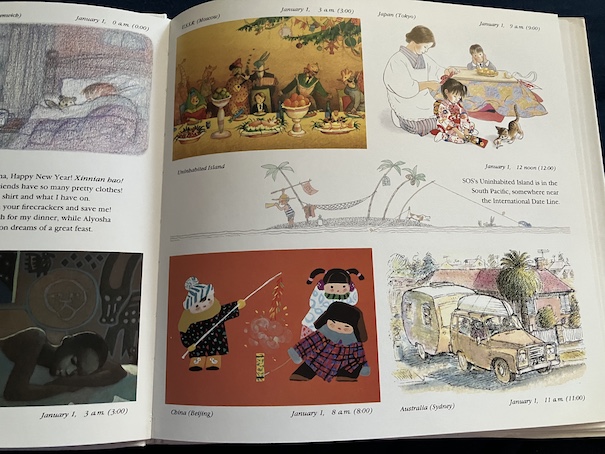
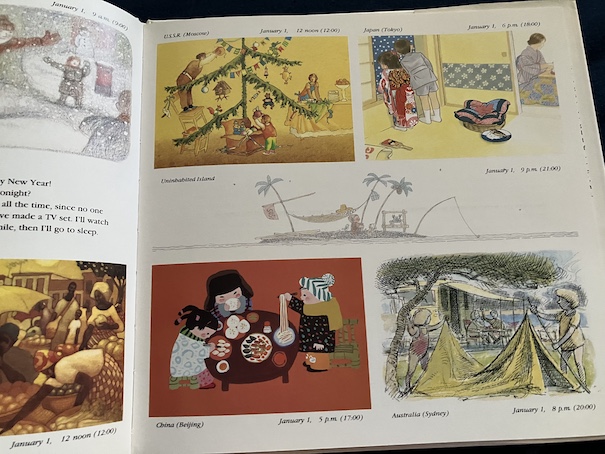
The format of this book is a little unusual. The book was a cooperative project among authors and illustrators from different countries to show children what is happening around the world at the same moment in different time zones.

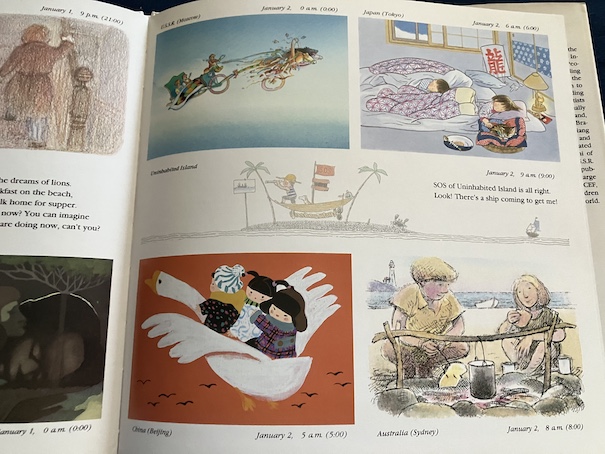
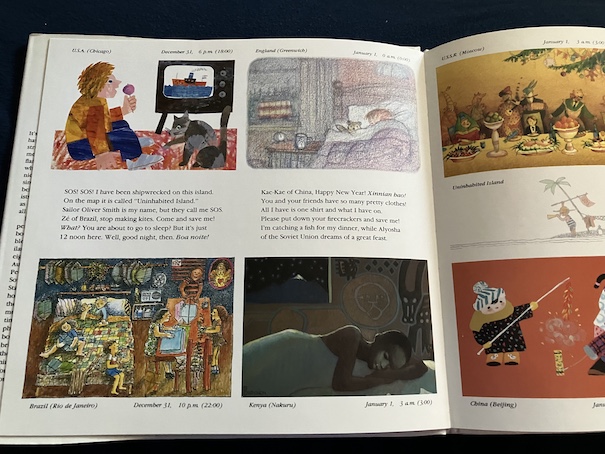
Mitsumasa Anno, the primary author of the book, is from Japan, but he writes as a boy called Sailor Oliver Smith, or “SOS”, who has been shipwrecked with his dog on an uninhabited island near the International Date Line in the Pacific Ocean at noon on January 1 (which is also midnight on New Year’s Eve, Greenwich Mean Time). He is on the island for a full day before he is rescued, sending out appeals for help and thinking about what other children around the world are doing at every hour of the day as they celebrate the New Year.

As you read through the book, the small pictures of the children in different countries tell a complete story for each child in each country. The little mini-stories within the main story are presented almost comic book style. They contain no text themselves, but the boy on the island offers commentary on what’s happening with the children in other countries. During the time when SOS is asleep on his island, his dog, Matey, takes over the narration.

Children in Brazil are making and flying kites with their family and going swimming at the beach. People in Australia also go to the beach because it’s summer there in January, and they camp out overnight. A boy in the US sneaks out of bed to get a look at the party his parents are having at midnight, and is woken by his cat the next morning. The boy in England wakes up his too parents early in the morning by playing his trumpet. People in Kenya go a busy market and have dinner as a family. Children in China set off firecrackers, watch fireworks, and eat special foods. The story in Japan is about a little girl whose toy is stolen by a dog, and her cat chases after the dog to get it back. At first, they worry because the cat doesn’t return home for dinner, but the cat eventually comes in late with the toy, eats its fish, and goes to bed. Because this book was written in the 1980s, the book refers to Russia as the Soviet Union. The boy in the Soviet Union goes sledding with his friends and tries to ride his bike in the snow, which doesn’t work well. Children in various countries watch tv and read books during the day, and readers get to see their dreams when they sleep. At the end of the book, SOS sees a ship coming to pick him up at 9 am on January 2.

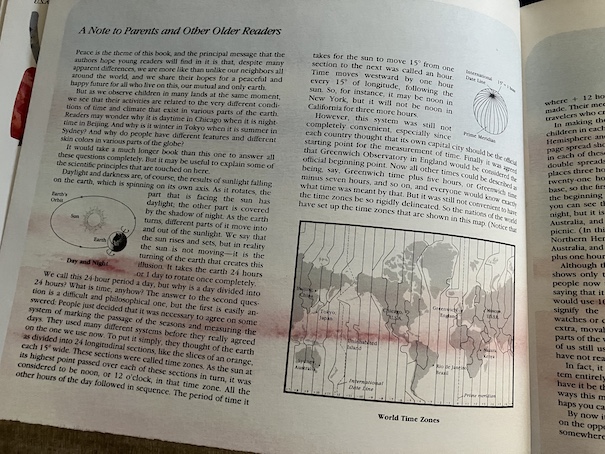
There is a message at the beginning of the book from all of the authors and illustrators who participated about children around the world, encouraging children to think about children in other places and what they might be doing throughout their day. Because it’s a different time of day in different places, some children are asleep in bed while others are awake and playing. However, it reminds readers that, no matter who we are, where we live on Earth, or what we look like, we’re all human beings on the same planet with the same sun and moon looking down on our days and nights. It’s a call for empathy and unity among nations and the people who live everywhere on Earth. In the back of the book, there is more scientific information about the movement of the Earth around the sun and the rotation of the planet and what makes different time zones. There is also information about the different authors and illustrators around the world who contributed to the project.

The book is available to borrow and read for free online through Internet Archive (multiple copies).

I have a vague memory of reading this book when I was young, but I can’t remember exactly when I read it. I think I was an older child because I already understood the concept of different time zones. I do think that kids who are a little older would get more out of the story and the concept of different time zones than very young children.

Older children would also probably find it easier to follow the different story lines of the children in each country. The format of the story may be a little difficult for very young children to follow because it does feel a little disjointed, getting just a snippet of each child’s day and night per page. However, the book is interesting to reread multiple times, following each child’s day, and I remember being fascinated by the notion of what everyone around the world was doing at different times.

The call for people to think about other people in other places and the call for international understanding is a nice, peaceful message for the New Year. As an adult, I was interested in seeing which authors and illustrators contributed to the book. Each set of illustrations for different countries has a different style. The illustrator for the boy in the US is Eric Carle, known for The Very Hungry Caterpillar. Not all of the illustrators are actually from the countries they illustrated, but more are. The two exceptions were for Brazil and Kenya, but the illustrator who did the pictures for Brazil did live there for a time, and the the couple who did the pictures for Kenya wrote and illustrated other books about Africa.

Somewhere in the World Right Now is a picture book on a similar theme, but instead of following children around the world through an entire day, it just shows what’s happening around the world at one particular moment. I think that makes Somewhere in the World Right Now a little easier to follow for younger children.