
You Wouldn’t Want to Be a Pirate’s Prisoner by John Malam, 2002.
This picture book, which is part of a series, explains what it would have been like to be a pirate’s prisoner in the 18th century. It sets the stage by casting the reader in the role of a Spanish ship captain in 1716.
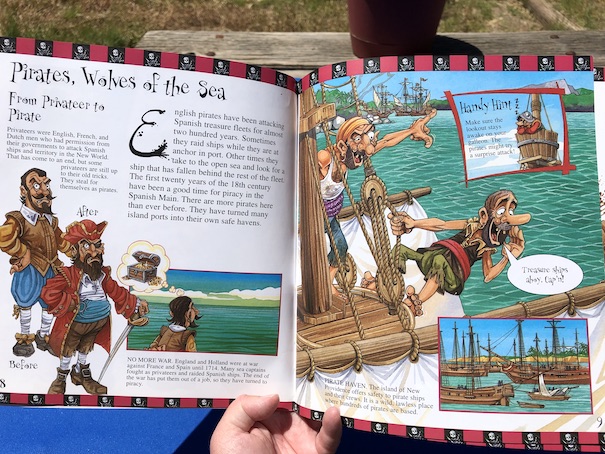
The reason why the reader is cast as a Spanish captain, captured by English pirates, is because England and Holland had been at war with Spain until 1714. During the war, the government of England (as well as Holland and France) authorized some ship captains to act as privateers, conducting raids on Spanish ships and outposts. When the war ended and the privateers were dismissed from service, some of them continued to act as independent pirates.
The book explains the geography of the “Spanish Main,” the area between the southern coast of North America and the northern coast of South America – basically, the Caribbean Sea and its islands and the Gulf of Mexico. Spanish galleons in the 18th century carried gold and treasures from the Americas to Spain as well as timber from the rainforests and goods that were transported to the Americas across the Pacific Ocean, such as spices and silk. All of these goods made Spanish treasure ships tempting targets for English pirates.
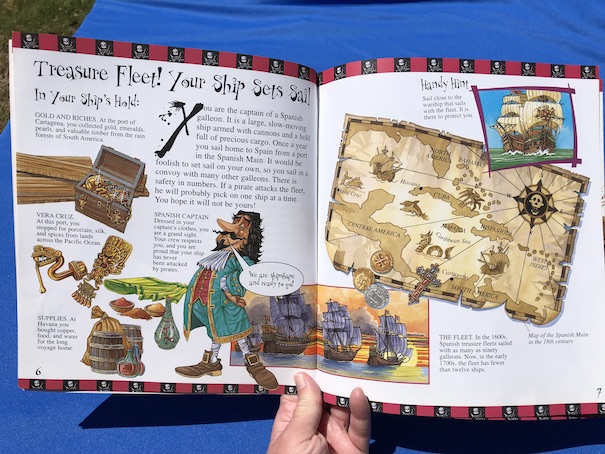
As a Spanish ship’s captain, there were a few precautions that you could take against pirate attack. One of the most basic was traveling as part of a convoy because pirates would be more likely to attack a lone ship than one that was part of a group. A fleet of ships would have a warship traveling with them for protection, and the closer your ship sailed to the warship, the less likely a pirate ship would try to separate you from the group and attack.
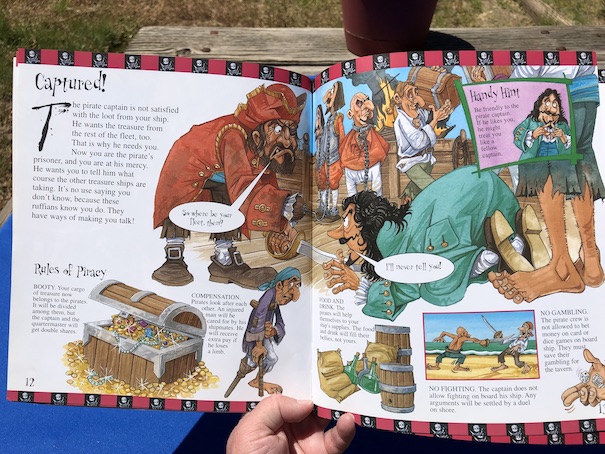
If the worst situation happened and the ship was taken by pirates, a captain could try to dress like other members of the crew to disguise his rank, but that didn’t always work. The captain of the ship was in danger of being taken captive because he might have information that the pirates would find useful, like the exact route of other ships in a convoy.
The gruesome part of this book (and the source of the title, because this series basically focuses on the gruesome parts of history) is the part where they describe different forms of torture that pirates might use on a ship’s captain to convince him to tell them what they wanted to know. Besides the direct physical abuse, pirates could also keep a captive in squalid conditions to make him weaker, more vulnerable, and exposed to disease. In the end, they might simply decide to maroon the captive somewhere, even if they got the information they were after.

However, pirates could also face gruesome fates if they were caught. They could be hung and their bodies displayed publicly, as a warning to others.

 Jestress's Forgotten Books and Stories