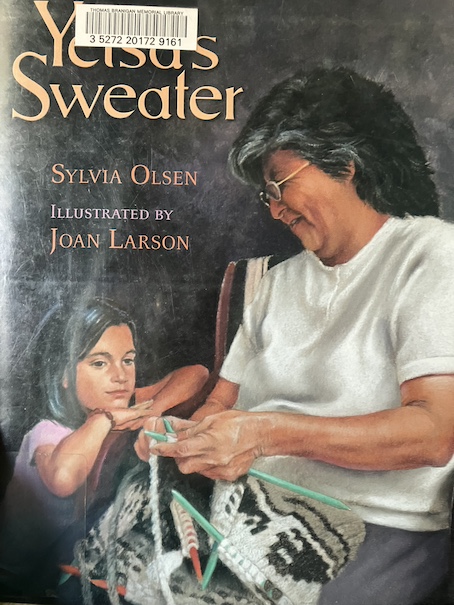
Yetsa’s Sweater

Yetsa and her mother go to her grandmother’s house to help her prepare wool for making a sweater. Yetsa is getting too big for the sweater she’s wearing, but she still loves it because her grandmother knitted designs in it that have personal significance to her and her family.

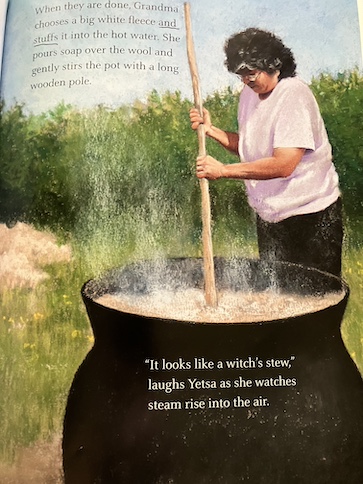
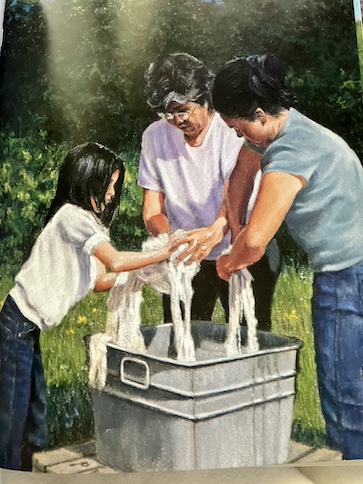
Yetsa’s grandmother builds a fire and brings a large pot for the wool. They have to sort through the fleeces they received from Farmer McNutt and remove any little twigs or hay or anything that doesn’t belong. Yetsa yells when she finds some sheep poop stuck in the fleece. After they’ve removed the debris as best they can, they wash the fleece in hot water over the fire. Then, they rinse it in cool water and wring it out.
While the wool dries on the clothesline, they take a break and have some bread and blackberry jam.

The following week, they begin pulling apart the fibers of the wool, making it fluffier, a process called “teasing.” Then, Yetsa’s grandmother runs the wool through a carding machine, and they begin spinning it into yarn with a spinning machine.
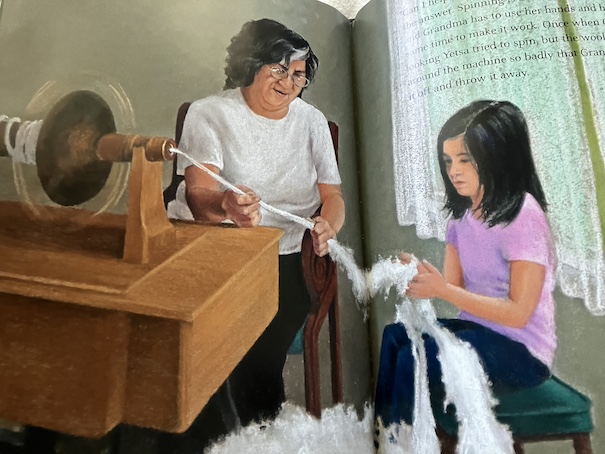
When the spinning is finished, Yetsa’s grandmother has enough wool to make many sweaters.

In the back of the book, the author explains that Yetsa is her own granddaughter and that knitting is a traditional skill for Coast Salish women. They learned knitting from Scottish settlers who came to British Columbia, and the sweaters they made came to be called Cowichan sweaters, after the largest tribe in the region. Children like Yetsa begin learning how to prepare wool and knit at a fairly young age.

The book is available to borrow and read for free online through Internet Archive.
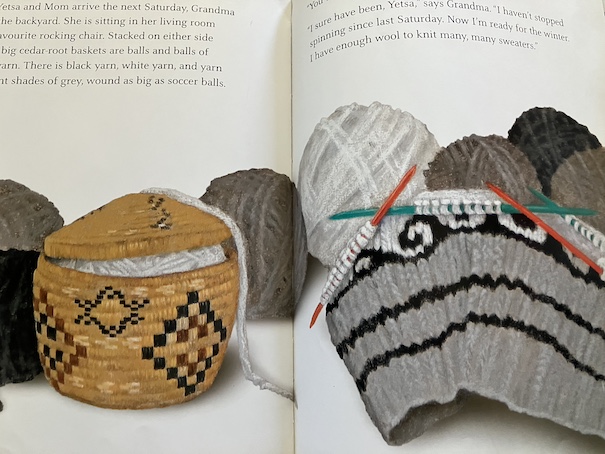
I love books that show people making traditional crafts, and I enjoying following this one from beginning to end! Readers get to see each step in the process of making the sweater, starting with the wool and ending with the finished sweater. I’ve been knitting from a young age, but I’ve never tried spinning my own wool, and I liked seeing the intricate patterns of the sweater.

When I was a kid, I often ignored authors’ explanations because my focus was on the story, but as an adult, I like the added details of author’s explanations. This is a family story because Yetsa in the story is based on the author’s own granddaughter.

The Cuckoo Clock

CuckooClockStolz

The Cuckoo Clock by Mary Stolz, 1987.

Erich was a foundling, taken in by the Goddhart family as a baby after he was found on their doorstep. Frau Goddhart has a reputation for kindness, but sadly, that reputation is really all she has. She is outwardly kind, participating in local charities, only to enhance her reputation. At home, she is selfish and cruel, ruling the house with an iron fist and having tantrums when things don’t go her way. She sees Erich as an unwanted responsibility, only grudgingly raising him along with her own children because if she refused, it would ruin her reputation. Her husband is kind to Erich, but Frau Goddhart treats him more like a servant.

Erich only comes to know real love when he becomes Ula’s assistant. Ula is the town clockmaker, a master in his craft. Ula teaches Erich his craft and how to play the violin.


When Ula dies, leaving Erich his carving tools and his violin, the selfish Frau Goddhart tries to take them away, thinking that such things are too good for a mere foundling, a charity case. Before she can get these precious things, Erich runs away to seek his fortune elsewhere, but he leaves behind something that convinces the town that, although he may be the ungrateful wretch that Frau Goddhart says that he is, he has a talent that will lead him on to greater things.


One of the fascinating things about this book is the pictures, which are charming pencil drawings in a realistic style.  There is also a note in the back about the unusual typeface of the book.

CuckooClockStolzType

The Little Indian Basket Maker

BasketMaker

The Little Indian Basket Maker by Ann Nolan Clark and illustrated by Harrison Begay, 1957.

By “Indian,” the author means Native American.  This book specifically focuses on the  Papago (Tohono O’odam) who live in the Southwestern United States, specifically Arizona.  The story is about a young girl who is starting to learn the traditional art of basket-making, and the book goes into the process involved in making baskets, step by step.   Although the use of “Indian” instead of Native American is somewhat antiquated, and Tohono O’odam is really the proper name for the Papago people, the book has something of an interesting history and the picture it provides of the practice of traditional crafts is fascinating. There is a section at the beginning of the book which explains a little about the history of the Papago (Tohono O’odam) people and where they live.

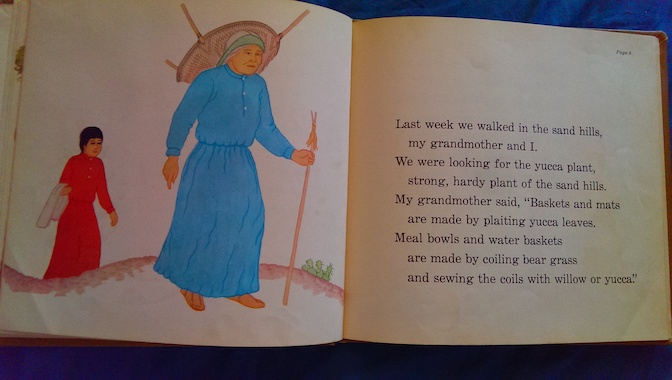
BasketMakerGrandmother

A young girl explains how her grandmother teaches her the traditional craft of making baskets.  They start by gathering the types of plants that they are going to use.

BasketMakerPlants.jpg

They also need special plants for the dye they will need in order to decorate the baskets.  The girl’s grandmother explains about the different types of decorations they traditionally use.

BasketMakerDesigns

Making baskets is a long process that includes cleaning the plants and tearing them into long strips, bleaching them, soaking them to soften them, dyeing strips used in the design, and weaving them together.

BasketMakerSoftening

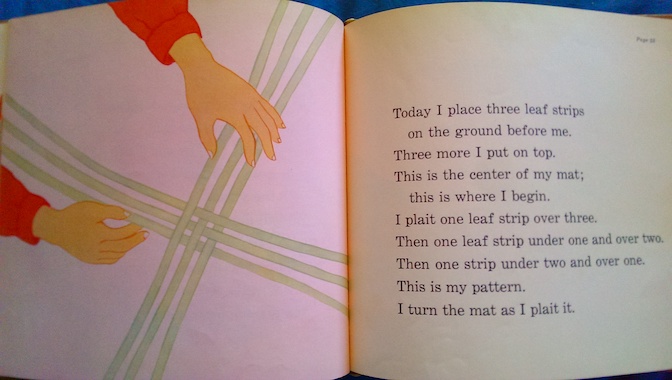
The girl weaves a mat that takes days to finish.  It is the first one that she’s made herself.

BasketMakerWeaving

She is very proud of herself when the mat is finished, and she is pleased with the quality of her work.

BasketMakerFinishing

I’ve owned this book since I was a young child, and it was my introduction to traditional crafts.  Later, I found a related book at a thrift store, The Little Indian Pottery Maker.  Until then, I hadn’t realized then just how old the books were and that there were more of them by the same author.

The book, which was written in the 1950s, was one of a group of stories (not exactly a series because they didn’t have a specific set of characters in common and the themes varied somewhat) written by a woman who was a teacher with the United States Indian Service.  The other books that she wrote, including The Little Indian Pottery Maker, focus on members of different Native American tribes.  She was not Native American herself, and the modern view of Indian schools is not favorable (for good reasons), so one might be a little suspicious of a book written about Native Americans by an Indian school teacher. However, these books interest me because of their explanation of traditional crafts. There are no white people in the stories at all, and they have a timeless quality to them.  Reading them, it’s hard to get a sense of exactly when the stories take place because it’s never mentioned, and there aren’t many clues (no mentions of modern technology, it’s all about the crafts).  I haven’t found any of the other books that the author wrote, but these two are very respectful in their tone, and they begin with explanations of the history of the tribes involved in the stories.  According to Andie Peterson in A Second Look: Native Americans in Children’s Books, the author was deliberately trying to write books that her Native American students could relate to.

The art style of the books vary because they had different illustrators.  The illustrator for this particular book was a Navajo painter.

The book is available to read for free online through Internet Archive.

The Little Indian Pottery Maker

PotteryMaker

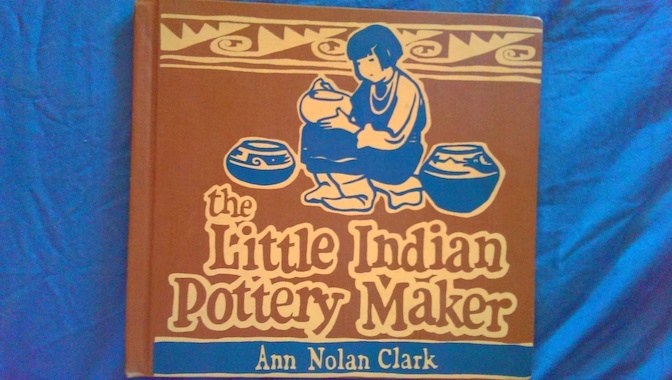
The Little Indian Pottery Maker by Ann Nolan Clark and illustrated by Don Perceval, 1955.

By “Indian,” the author means Native American.  This book specifically focuses on the Pueblo Indians who live in the Southwestern United States, specifically New Mexico and Arizona.  The story is about a young girl who is starting to learn the traditional art of pottery-making, and the book goes into the process involved in making pottery, step by step.   Although the use of “Indian” instead of Native American is somewhat anitquated, the book has something of an interesting history and the picture it provides of the practice of traditional crafts is fascinating. The beginning of the book explains a little about Pueblo Indians, their history, and where they live.

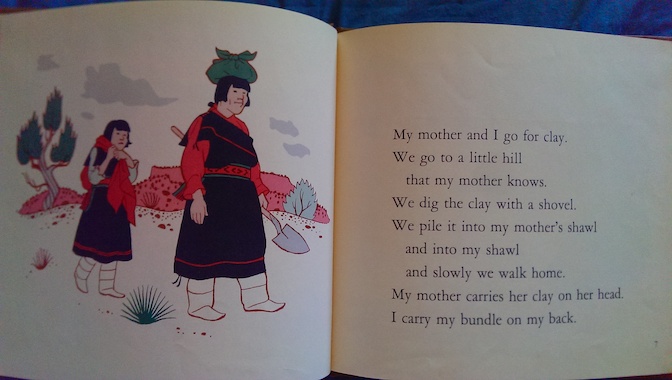
PotteryMakerGettingClay

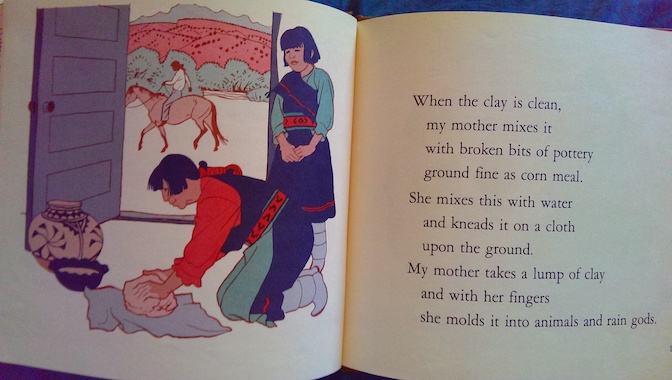
The young girl tells the story of how her mother introduces her to the traditional craft of making pottery and teaches her how to make her first pot.  She describes every step in the process, from when they collect the clay themselves from a hillside until the pot is finally complete.

PotteryMakerMixingClay

The girl’s mother explains about the different methods used to make pots, and pictures show how pots are shaped.

PotteryMakerRollingClay
PotteryMakerMakingPots

Making pottery is a long process that takes days to complete, including shaping, scraping and smoothing the sides, drying, decorating, and finally firing the pottery.  The girl is proud of the first pot she has ever made.

PotteryMakerFiringPots

I found this book at a thrift store a number of years ago and recognized it because I already owned a related book, The Little Indian Basket Maker, that I liked when I was a young child.  I hadn’t realized then just how old the books were and that there were more of them by the same author.

The book, which was written in the mid-1950s, was one of a group of stories (not exactly a series because they didn’t have a specific set of characters in common and the themes varied somewhat) written by a woman who was a teacher with the United States Indian Service.  The other books that she wrote, including The Little Indian Basket Maker, focus on members of different Native American tribes.  She was not Native American herself, and the modern view of Indian schools is not favorable (for good reasons), so one might be a little suspicious of a book written about Native Americans by an Indian school teacher. However, these books interest me because of their explanation of traditional crafts. There are no white people in the stories at all, and they have a timeless quality to them.  Reading them, it’s hard to get a sense of exactly when the stories take place because it’s never mentioned, and there aren’t many clues (no mentions of modern technology, it’s all about the crafts).  I haven’t found any of the other books that the author wrote, but these two are very respectful in their tone, and they begin with explanations of the history of the tribes involved in the stories.  According to Andie Peterson in A Second Look: Native Americans in Children’s Books, the author was deliberately trying to write books that her Native American students could relate to.

The art style of the books vary because they had different illustrators.  The illustrator for this particular book was not Native American (unlike some of the illustrators of other books), but he was adopted into a Hopi tribe, apparently as an adult because of his accomplishments in representing Hopi culture in art.