Charlie the Tramp

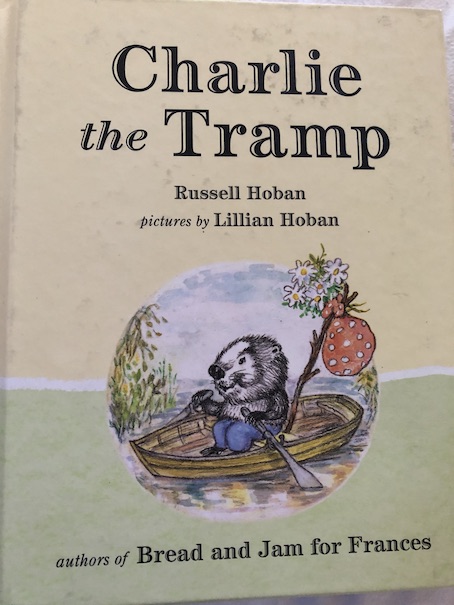
Charlie the Tramp by Russell Hoban, illustrated by Lillian Hoban, 1966.

Disclosure: I am using a newer edition of the book, published by Plough Publishing House.  Plough sent a copy to me for review purposes, but the opinions in the review are my own.
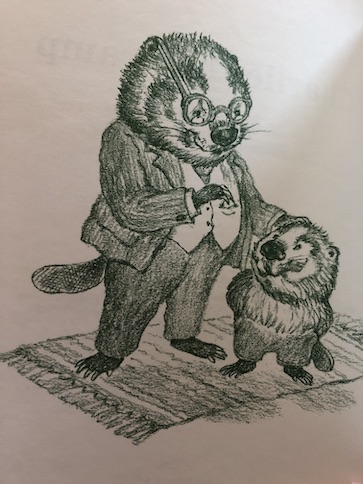
One day, when Charlie Beaver’s grandfather comes to visit, his grandfather asks him what he wants to be when he grows up. The grandfather assumes that he knows the answer to the question because everyone in the family is a beaver, and beavers naturally do beaver work. (Beaver is apparently both species and profession in books where beavers talk and wear clothes.) However, Charlie stuns his family when he declares that he wants to be a tramp.

Few families would be happy to hear a child say that he wants to be a tramp. Charlie’s grandfather says that he’s never heard a child want to be tramp, and his mother says that she doesn’t think he means it. However, Charlie thinks that being a tramp would be good because he wouldn’t have to learn how to chop trees or build dams or other routine jobs. Charlie thinks that tramps have a lot of fun and just work now and then at little jobs when they need something to eat. Charlie thinks that the little jobs would be much more fun than the ones his father really wants him to do. Charlie’s grandfather says that kids these days just don’t want to work hard.

However, Charlie’s parents decide that if he wants to be a tramp, they’ll let him try it out. Charlie makes himself a little bundle with some food, and his parents let him sleep outside, telling him to come back for breakfast. Both the father and grandfather quietly admit that they both wanted to be a tramp when they were his age, so it’s not just kids these days.

Charlie has some fun, roaming the countryside, sleeping under the stars, and enjoying his freedom. In the morning, he comes home and does some chores to earn his breakfast, lunch, and dinner. In between, he goes out to roam the countryside again.

Charlie begins to notice that something keeps waking him up in the night, an odd sound that he can’t identify at first. Eventually, he realizes that it’s the sound of a nearby stream. For some reason, the trickling sound of the stream seems nice but makes him feel restless. It inspires him to swim in the stream and begin building his own dam, working through the night.
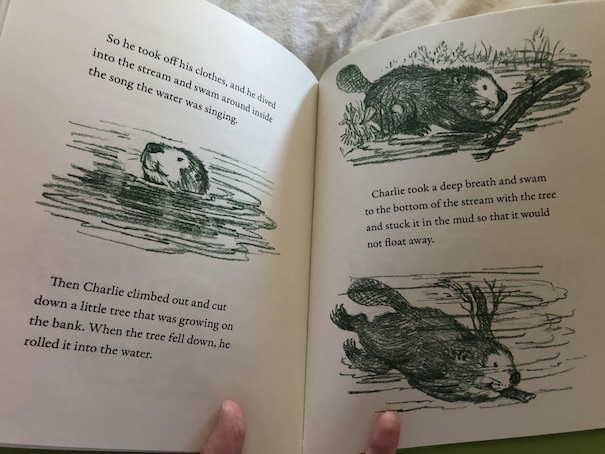
When Charlie sleeps through breakfast, his family comes looking for him and admires the good job that Charlie did on his dam and the pond that he has created. When they ask him about why he was making a dam when he was trying to be a tramp, Charlie says that he likes doing both and can do either sometimes. His family is satisfied that Charlie is a good worker, and his grandfather says, “That’s how it is nowadays. You never know when a tramp will turn out to be a beaver.”

It isn’t that Charlie expects to go through life without doing work because he insisted on working to earn his meals even when he was being a tramp. It was more that Charlie wanted the freedom to decide when he wanted to work and what kind of work he was going to do. However, he is a beaver and has a beaver’s instincts. In the end, he sees the appeal of doing a beaver’s work, building dams, enjoying it because he made the dam himself in the way he wanted to make it. I think it shows that when a person has the knowledge and ability to do something and the interest in doing it, they will eventually use their skills, perhaps in surprising ways. I remember reading some advice to writers that said that people write because “they can’t not do it,” and that’s true of many aspirations in life. Sometimes, when people know what they really want to do with their lives, they can’t resist doing it, and sometimes, people realize what their aspirations are when they find something that they can’t resist doing. Charlie is a beaver because it’s a part of who he is, and he can’t not do it. As he grows up, he will continue growing into that role, just as human children eventually grow up to be the people they are going to be.

This book is available to borrow for free online through Internet Archive, but it’s also back in print and available for purchase through Plough. If you borrow the book and like it, consider buying a copy of your own!

Rasmus and the Vagabond

Rasmus and the Vagabond by Astrid Lindgren, 1956.

Disclosure: I am using the 2015 edition of the book, published by Plough Publishing House.  Plough sent a copy to me for review purposes, but the opinions in the review are my own.

The Swedish author Astrid Lindgren is best known for her Pippi Longstocking series, but she also wrote other excellent books for children. This particular book is about a nine-year-old orphan boy and his adventures with a traveling vagabond (tramp) after he runs away from an orphanage.  There is an element of mystery, which pleased me, as a life-long mystery fan.

The dullness and unfairness of life at the orphanage gets to nine-year-old Rasmus. While the other children in the village get to play and go swimming, he and the other orphans are expected to work, doing chores like digging up potatoes in the garden or pulling nettles.  Mrs. Hawk, who is in charge of the children, doesn’t like them goofing off when they could be doing chores.  The work is necessary because orphanage sells produce and eggs to help support the children, and the children know that when they’re thirteen years old, they will have to start taking regular jobs to support themselves.  Mrs. Hawk doesn’t see much benefit in letting the orphans play, like other children do.

One day, while Rasmus is pulling nettles by the chicken coop, he finds what, to him, amounts to wonderful treasures: a single five-cent coin and a seashell!  He has no idea how they got there, but he has never found anything so wonderful before.  He rushes to tell his friend, Gunnar, about them. Gunnar tells him that someone is going to visit the orphanage and pick out a child to adopt. All of the children hope to be the one chosen for adoption, and Rasmus wonders if his lucky finds might be an omen that he will be the one chosen.

Unfortunately, he isn’t the one chosen. As Gunnar predicted, the couple who visit the orphanage pick a girl with curly hair, Greta, and Rasmus embarrasses himself by accidentally breaking the lady’s parasol.  Rasmus thinks that he’ll never get adopted, and he suggests to Gunnar that maybe they should try to strike out on their own and find parents. His reasoning is that, if they didn’t have to compete against the other children at the orphanage (especially the cute, curly-haired girls), they might have better luck at finding families.  Gunnar thinks that Rasmus’s plan is crazy, but Rasmus also knows that he has punishments ahead for his earlier escapades, and he’s decided that tonight is the best time to get away.

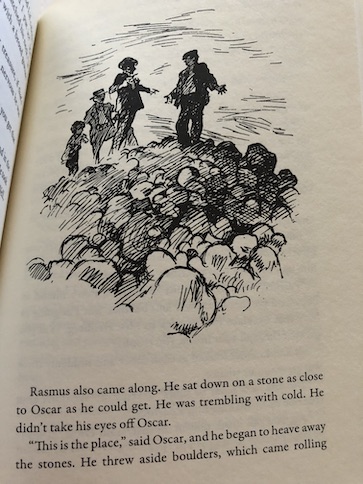
That night, Rasmus sneaks out alone, taking his five-cent coin with him and leaving the seashell for Gunnar to remember him by.  At first, Rasmus is terrified on his own, and when he gets hungry, he actually starts to miss the orphanage.  Fortunately, he soon meets a tramp who goes by the name of Paradise Oscar.  Oscar actually turns out to be pretty nice, sharing his food with Rasmus.  Rasmus asks if he can be a tramp like Oscar, and Oscar says that boys should really be at home with their parents.  When he learns that Rasmus doesn’t have parents, he takes the boy under his wing.  Rasmus starts to like the free life of a tramp.  They work when they want to and don’t when they don’t.  Sometimes, they make money by singing in the street.  They can sleep anytime they want, and they spend Rasmus’s coin on butterscotch candies.

However, trouble looms when Oscar is taken in for questioning by the police about a robbery.  Two masked men robbed the Sandhoe factory before Rasmus ran away from the orphanage, and the police think that Oscar may have been one of them.  Rasmus believes in Oscar’s innocence.  The police aren’t so certain, but they release him for lack of evidence.

Shortly after that, Rasmus witnesses another robbery.  At first, they’re afraid to go to the police, but they leave an anonymous note so that the robbery victim gets help.  One of the miscreants involved actually accuses Oscar of being one of the robbers, but some of what Rasmus witnessed points to the real villains.

Rasmus and Oscar are colorful characters, and their journey through the Swedish countryside is full of adventure, with Oscar running from the law and Rasmus still searching for the home and family he desperately wants.  There are some moments of suspense in the story, but it all ends happily, and Rasmus does find a home that’s just right for him, although it’s not quite what he had originally pictured. Rasmus’s experiences on the road change him and his ideas of what he wants in life and a family. When he started his journey, he wanted to be chosen by someone else, but in the end, it’s the choice that he makes that determines his future.

One part of the story that particularly fascinated me was when Rasmus and Oscar hide in an abandoned village, and Oscar tells Rasmus that the reason that the village is abandoned is because, years before, the people in the village all decided to emigrate to America together, specifically Minnesota (a popular destination for Scandinavian immigrants).  I remember from my first degree in history that mass emigrations of that sort also took place in other countries.  The Library of Congress has more information about Swedish immigrants and the major periods of immigration.  I think that the event that Oscar referred to was during one of the periods of high population and famine in Swedish history. I love books with interesting historical details!

As a fun fact, this book is also one of those books that appears in Swedish on Ikea shelves, just to help demonstrate bookcases or dress up one of their mock rooms. I spotted it there once. If you look for the name “Rasmus,” you’ll recognize it. The next time you see it, you’ll know what it’s all about!

This book is available to borrow for free online through Internet Archive, but it’s also back in print and available for purchase through Plough. If you borrow the book and like it, consider buying a copy of your own. This one’s a keeper!