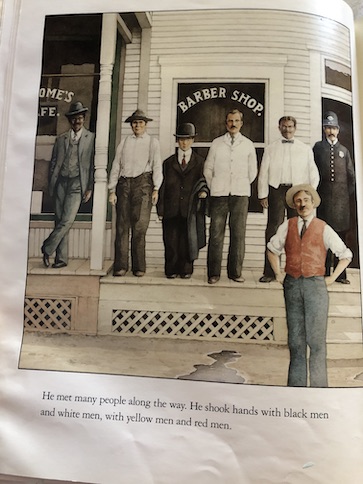
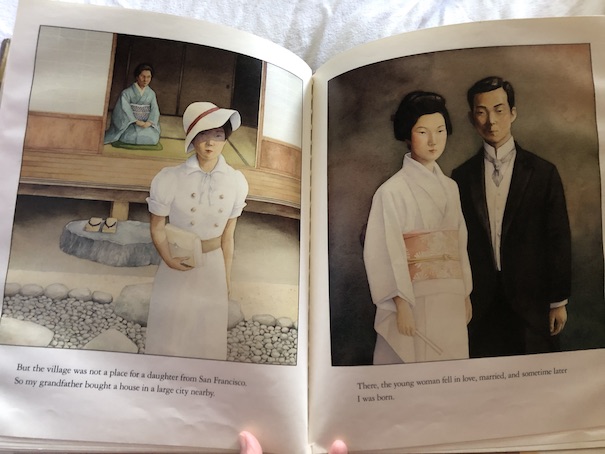
When Jessie Came Across the Sea

Jessie and her grandmother live in a small, thatched cottage in a small village. The little village is poor, and so are Jessie and her grandmother. Jessie’s parents died when she was a baby. Jessie’s grandmother raised her, and she insists that Jessie have lessons with the village rabbi, like the boys in the village. Jessie can read and write, and she also tries to teach her grandmother. Her grandmother makes a little money by sewing lace, and she teaches Jessie how to sew. Although they don’t have much, they are basically content with their lives.

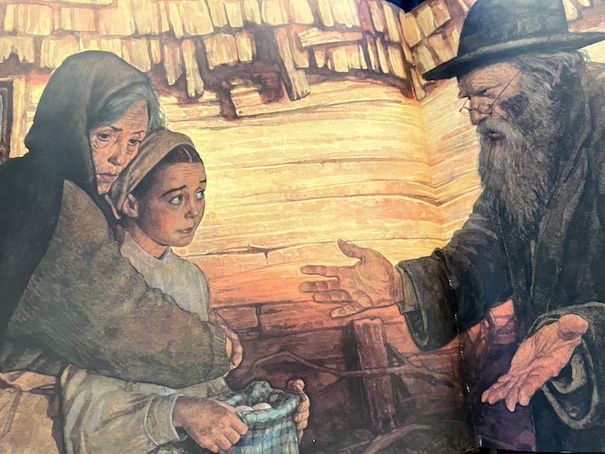
Then, one evening, the rabbi makes an important announcement. His brother, who was living in America, has died. Before his death, he sent a ticket for a ship traveling to America to the rabbi, asking him to join him in America. Now that his brother is dead, there is no need for the rabbi to go to America, and he would rather stay in the village with his congregation. However, he thinks that someone else should use the ticket his brother sent.

Various villagers ask rabbi if they can use the ticket, offering reasons why each of them would be the best person to go. They brag up their best qualities, boasting about how strong, smart, and brave they are. The rabbi knows that they’re boasting, so he just tells them that he will pray about it and let them know his decision tomorrow.

The next day, he goes to see Jessie and her grandmother and tells them that Jessie should be the one to go to America. His reasoning is that his brother’s widow owns a dress shop in New York City. Jessie can work there, and she would be a comfort to a lonely widow. Jessie doesn’t really want to leave her grandmother, and her grandmother fears to send her, but her grandmother can see the rabbi’s logic. She knows that this is an important opportunity for Jessie.

So, Jessie leaves her village and sets sail on a crowded ship for America. On the ship, Jessie is scared, lonely, and seasick. As Jessie spends time with the other passengers, she makes a few friends, and she sews a few small items for them. A boy named Lou, who is a shoemaker’s son, makes a pair of small shoes for a baby, and he and Jessie also become friends.

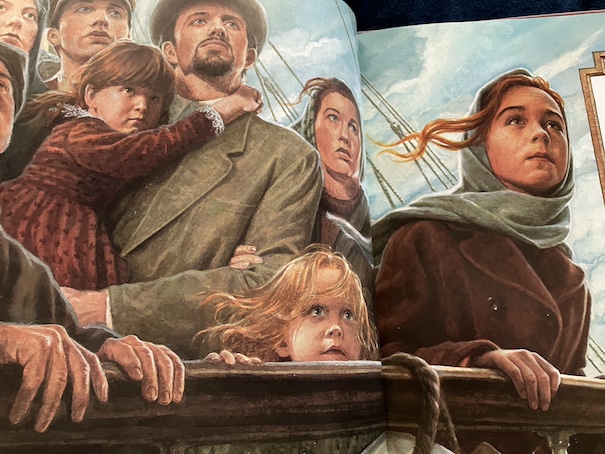
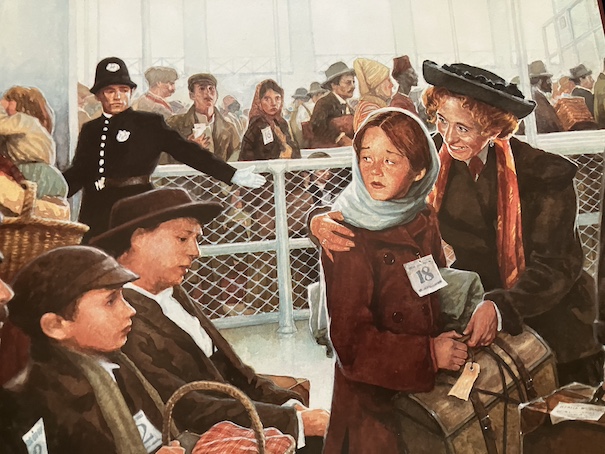
Finally, their ship arrives at New York. Everyone crowds around the rails of the ship to see the Statue of Liberty and their first glimpse of America. The ship docks at Ellis Island, and the passengers disembark to be inspected and questioned by immigration officials.

The rabbi’s brother’s widow comes to meet Jessie. She is a friendly woman, and she asks Jessie to call her Cousin Kay. Cousin Kay shows Jessie around the city. It’s a crowded, confusing place with fascinating sights, although the streets aren’t paved with gold, as Jessie has heard. Cousin Kay runs the dress shop out of her home, and she pays Jessie to sew for her. Jessie likes watching the busy street outside while she sews, and she saves the money she earns in a jar.

When Jessie puts some lace on a plain white dress, turning it into a lovely bridal gown, the shop becomes popular with young women who are getting married and looking for similar gowns.

Cousin Kay also insists that Jessie go to school and learn English. It isn’t easy, but Jessie learns. She likes walking around the city and going to the local library. Gradually, Jessie begins feeling more at home in New York, and she builds a new life for herself there. One day, she runs into Lou again in the park, and they begin meeting there regularly. Lou proposes to Jessie, and Jessie uses the money she has saved to buy a ticket so her grandmother can come to America for their wedding.

The book is available to borrow and read for free online through Internet Archive.

I remember reading this book when I was young! I was really older than the target audience when it was first published, but I enjoyed the story. It’s one of those books that I think takes on more significance when you’re older and understand more of the history behind the story. We don’t know exactly where Jessie is from because the book never says, but her journey resembles the kind of journey that many people made during this same period of history. We don’t know the year, either, but it appears to be set in the late 19th century or early 20th century.

Although coming to a strange country, alone and unable to speak the language, is a scary experience, Jessie is fortunate because there is a friendly and caring person waiting there for her, and she has a job lined up that suits her skills. In real life, not everyone was so fortunate, and it was more of a struggle for them to get established in their new home. Jessie still has to struggle with homesickness and missing her grandmother, but her life changes for the better because she took the chance to go to a new country and start a new life. Readers can emphasize with Jessie’s fears and uncertainty as she starts out on her journey and celebrate with her when things work out for the best.

The pictures in the book are beautiful! Readers really get the sense that they’re seeing another time, with Jessie’s tiny village, the crowded ship in the rain, and busy New York City, more than 100 years ago. Even when the environment and circumstances are harsh, the pictures are charming.

There is a note in the beginning of the book for parents and teachers about how they can use this book to spark discussion with children. They can use the opportunity to invite children to learn how their own families arrived in America, because this book was originally intended for an audience of young American readers, and most people who live in the United States (with the exception of Native Americans) are descended from people who came from somewhere else. It’s an opportunity for children to learn their family’s history and to see how it compares with that of other people, whose families also made a decision to come here and start over, going through their own struggles along the way. There is also some general advice about sharing books with children, and making a point of surrounding children with books and reading aloud to them.

Anno’s Journey

This picture book is unusual because there are no words in it at all until the very end. It’s all pictures, except for the part that explains the inspiration for the story. The author/illustrator, Mitsumasa Anno, depicts himself as a traveler, traveling through the countryside and towns of Europe. The “story” is the story of his journey, but it’s all in the pictures.

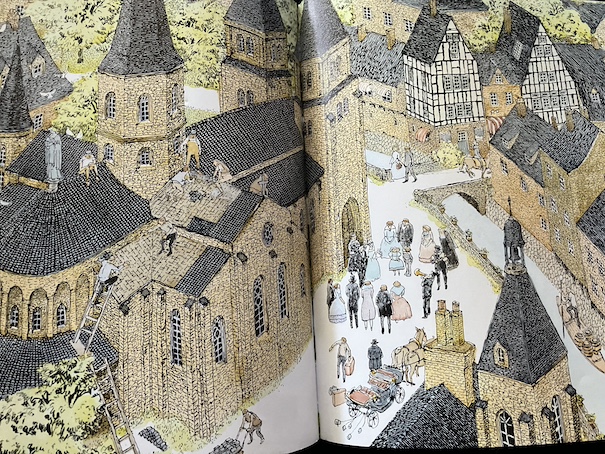
In the first pages of the book, we see Anno arriving by rowboat and either buying or renting a horse. The following pages are a little like the Where’s Waldo/Wally books, showing Anno’s travels. Anno appears somewhere on every page, riding his horse, but readers have to look for him. There are also other things to look for, but readers don’t get that explanation until the very end.

The scenes start out in the countryside, and as Anno goes through towns and cities, they can be very busy, with many people and lots of things happening. Toward the end of the book, Anno goes through the countryside again, and it ends with him riding off toward the horizon.

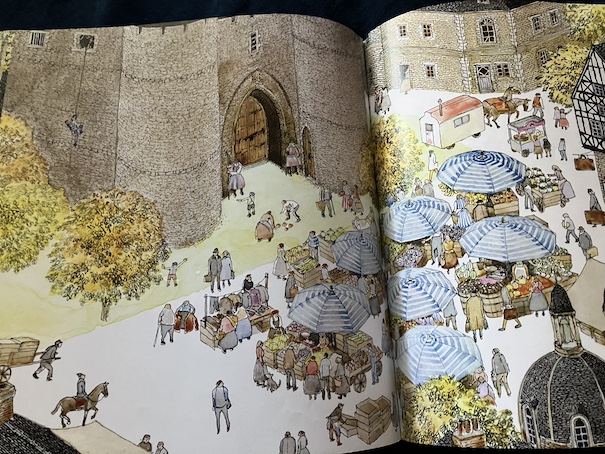
Along the way, there are interesting, detailed scenes that show various aspects of countryside and town life. There are people working in farm fields, people packing up to move house, some men carving tombstones for a churchyard, some children playing and running a race near their school, and a busy market square.

There are also special occasions and very busy scenes, from a wedding in front of a town church to a circus scene and a parade through a city. Aside from the main event in each scene, there are also other things happening in the background, from people working to repair a roof to a prisoner escaping from a castle. Through it all, Anno is always somewhere in the scene, riding the horse.

There is hidden depth to the pictures. There is a section at the back which explains the story behind the book. The author and illustrator, Mitsumasa Anno, is from Japan, but he has always been fascinated by European culture, art, and architecture. Twice, during the 1960s and 1970s, he visited Europe, taking in the sights and producing his own art. This book is based on his travels, and the pictures incorporate the types of towns, fields, and churches he saw. However, they also include many hidden details, including details from famous paintings, characters from books and folktales (and also Sesame Street), and the stories of some of the characters in this book, carried across multiple pages, for readers to notice.

The book is available to borrow and read for free online through Internet Archive, along with a couple of other books by the same author, in a similar format, Anno’s Italy and Anno’s Britain.

I enjoy books with detailed pictures, especially ones that contain details for readers to notice, like a game. I didn’t see many of the details that are hidden in plain sight until after I read the explanation of what to look for, but there is quite a lot to see in this book. It’s the kind of book that you can look at many times and notice something new every time! Although this is considered a children’s picture book, I think that there are many things that adults might see in it that would go over the heads of children. Children wouldn’t be likely to get all of the art references, for example. It’s a book that can appeal to a variety of people of different ages!

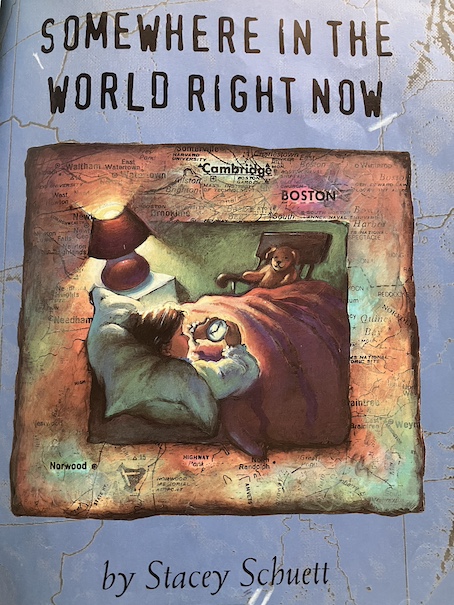
Somewhere in the World Right Now

This picture book explains time zones by showing what people and animals all over the world are doing at the same time, reminding children that, somewhere in the world right now, it’s a different time of day.

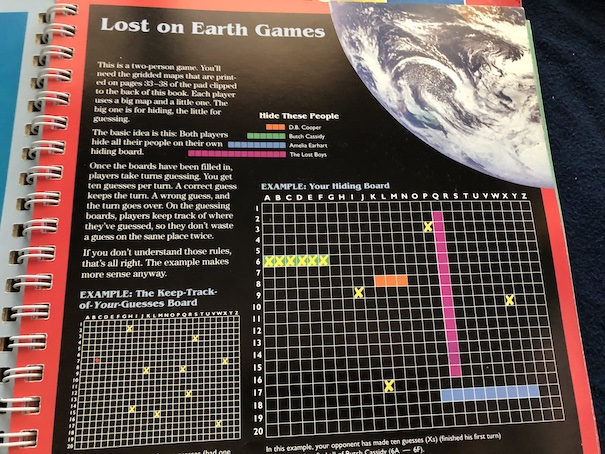
The book begins with A Note to the Reader, explaining that it takes 24 hours for the Earth to make one full rotation on its axis and that the Earth is constantly turning. This rotation is what makes the sun seem to move across the sky and creates our periods of day and night. Then, it explains how, in 1884, our formal system of time zones was established to standardize how times of day are expressed around the world. There are 24 time zones, roughly equal in size, with a few adjustments for geographical boundaries. Within each time zone, it is the same time, and it is one hour different from the time zones on either side of it. It also explains that the international date line is an imaginary boundary drawn through the middle of the Pacific Ocean that marks the point at which new days begin. There is a map in the book that illustrates all the time zones we will be traveling through and the International Date Line. The places we see in the rest of the book are also labeled on the map.

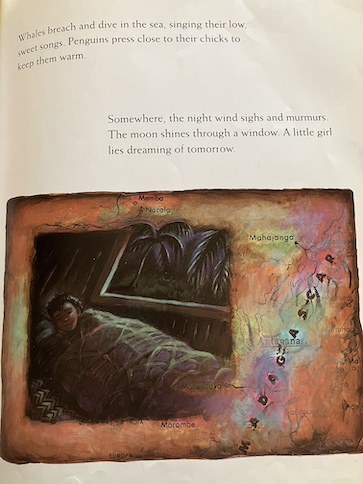
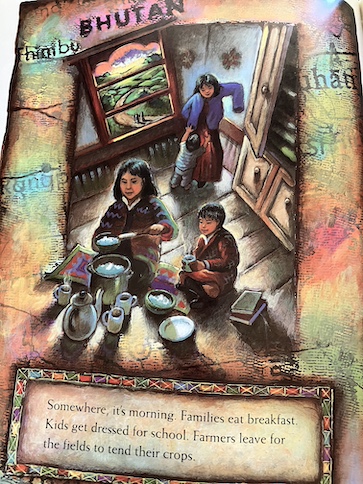
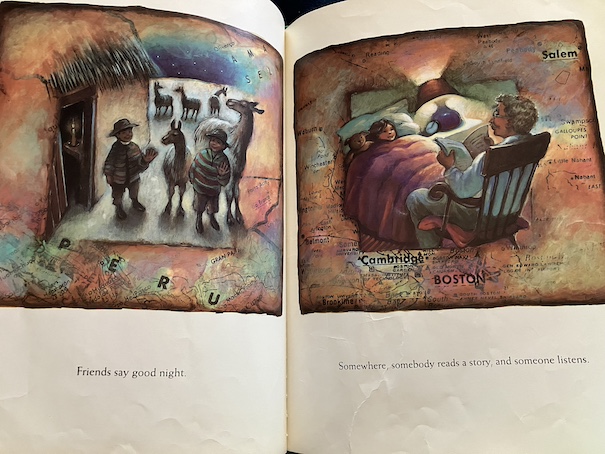
The main part of the book shows what people and animals around the world are doing “right now”, compared to a child in the United States. We don’t see the child in the United States until the very end of the book, but everything else is based around her “right now.” The text doesn’t specify where each of the places are, but each picture has a map in the background with labels that indicate the location to readers.

The first place we see is London, England. It’s the middle of the night (or possibly very early in the morning, after midnight but the sun isn’t up – according to the map at the beginning of the book, it’s 1 am), but a baker is preparing fresh bread to sell in the morning. Meanwhile, there are elephants sleeping in Uganda, whales swimming in the sea, penguins protecting their chicks in Antarctica, and a little girl sleeping in Madagascar.

It’s dawn in India, and people there are waking up. People are eating breakfast in Bhutan, and people are on their way to work in the morning in China. At the same time, it’s lunch time in Siberia, and there are kangaroos and koalas eating their own lunch in Australia.

Meanwhile, it’s afternoon on the western coast of the United States. There’s a fishing boat returning to port in Alaska, and a girl on a farm in California. As we move further east, it gets later and later. When we reach Chicago, it’s evening, and people are heading home. In Guatemala and Honduras, children who have been playing outside head for home, and families are having supper.

Eventually, we reach Boston, Massachusetts, where someone is reading a story book to a little girl before bed. It’s 8 pm, according to the time on the map at the beginning and the clock next to the little girl’s bed. All the things that we’ve seen in the book are happening, somewhere in the world, right now, as she is going to bed.

The book is available to borrow and read for free online through Internet Archive (multiple copies).

This book is educational, showing children how time and time zones work around the world, but it’s also a good, gentle bedtime story. Although we don’t really know it until the very end, it’s framed around a girl who is going to bed and is hearing a bedtime story. It is relaxing to think about how different things are happening in different places, to people and animals around the world, almost counting them off like counting sheep. No matter when it is or where you are, there’s someone, somewhere in the world, going through a different point in their day.

I found the human parts of the story more interesting than the animal portions, but I think children would enjoy hearing about the animals and seeing the animal pictures. It’s also relaxing to think about animals just going about their routines, like people go about theirs. There’s nothing stressful happening to any of the people or animals in the story.

I remember, when I was younger, I sometimes pictured things happening around the world when I had trouble sleeping. I can’t remember why I started doing this, if it was because I read this book or one like it. Somehow, though, I found it reassuring to think that, somewhere, it was daytime for someone else and that there were always people awake somewhere. It might be just me, but somehow, I found that idea reassuring because it meant that there were other people taking care of things, and it was their turn to be awake and do things, so I could have my turn to relax and rest.

All in a Day is a picture book on a similar theme, but instead of just showing what’s happening around the world at one particular moment, All in a Day follows children in various countries through the course of an entire day.

Linnea in Monet’s Garden

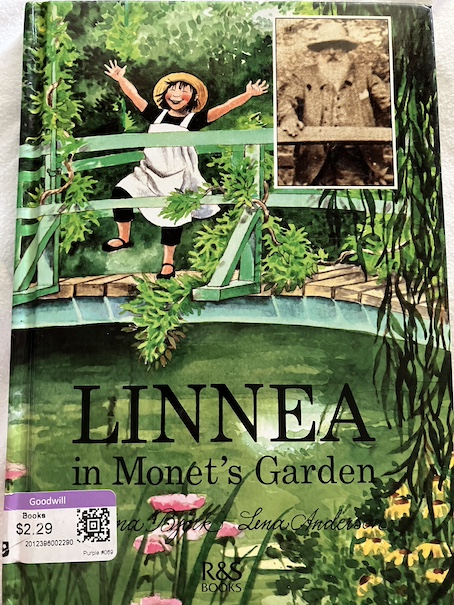
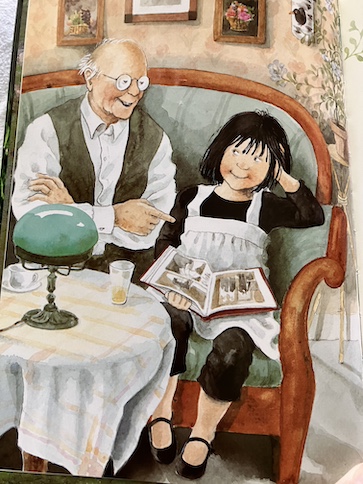
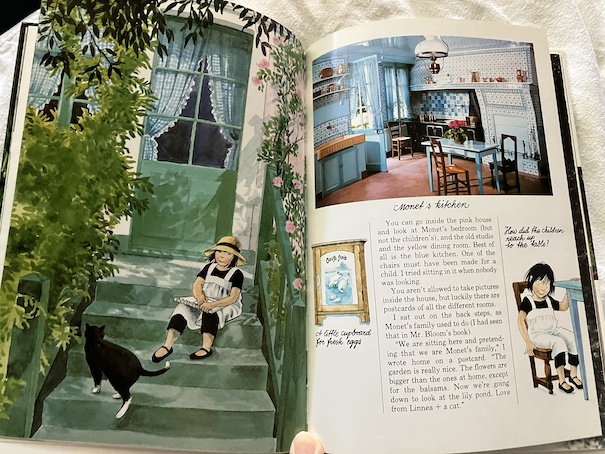
Young Linnea loves plants and flowers. Linnea’s upstairs neighbor, Mr. Bloom, used to be a gardener before he retired. He knows all about plants, and she likes to talk to him about them. Mr. Bloom has a particular book that Linnea likes about the French artist Claude Monet and his garden. Monet was famous for his paintings of the flowers and water lilies in his garden, and the book also has photographs of him, his wife, their children, and their garden. When Linnea looks at that book, she likes to imagine that she really knows the Monet family and that she’s visiting their garden.

One day, Mr. Bloom tells her that it’s possible to really go visit the garden because it still exists. Monet’s house had become run down and the garden was overgrown, but they have since been restored and turned into a museum. They could visit the garden if they go to Paris. They live a long way from Paris, but Mr. Bloom arranges with Linnea’s family for her to go on the trip with him.

Linnea and Mr. Bloom stay at a tiny, old hotel on the River Seine in Paris that was built in 1640. They can see the Notre-Dame Cathedral from the hotel, and it reminds Linnea of The Hunchback of Notre-Dame.

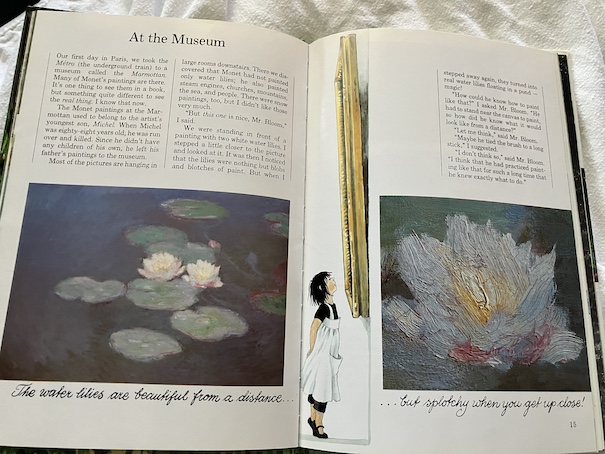
On their first day in Paris, Linnea and Mr. Bloom go to the Marmottan Museum to see Monet’s paintings. Monet’s youngest son left his father’s paintings to the museum when he died because he had no children of his own to inherit them. Mr. Bloom explains to Linnea that Monet painted in the impressionist style, which means that he tried to capture the rough images and impressions of the moment rather than creating detailed, completely realistic paintings. (I’m nearsighted, so impressionist paintings always look to me like what I see when I’m not wearing my glasses. I see colors and rough shapes, but everything is fuzzy with no sharp lines or fine details. I can still tell what objects are without my glasses, but nothing is distinct. I have impressions of things.) Mr. Bloom says that Monet particularly liked to show how light reflects off water and other objects in his paintings.

The next day, they take a train to the town of Vernon, and from there, and from there, they take a taxi to Giverny, where the Monet house and garden are. Along the way, they also buy some food for a picnic. Then, they go to see Monet’s garden.

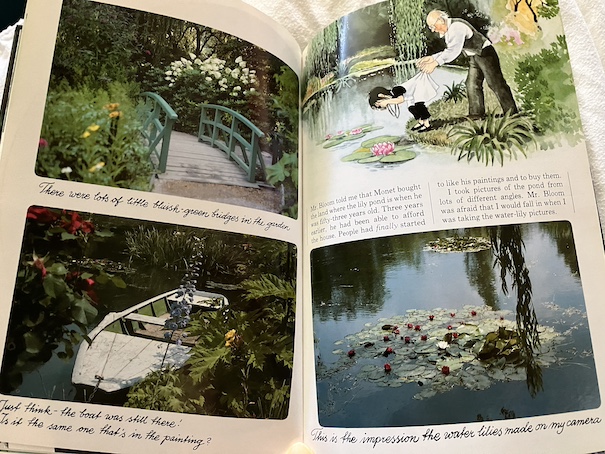
When Linnea sees the garden in person for the first time, it’s much bigger than she had imagined from the pictures in the book. Mr. Bloom tells Linnea all the names of the different flowers, and they take pictures of them. Then, they go inside Monet’s house. They’re not allowed to take pictures inside the house, but they get some postcards of the house’s interior.

One of the best moments for Linnea is that she is able to stand on the Japanese bridge in the garden, over the lily pond, as she always imagined she could do when she looked at the pictures in Mr. Bloom’s book! Monet painted pictures of that bridge multiple times. Each painting looks different because he painted them at different times and in different weather, so had different impressions of the bridge each time. The book shows Monet’s paintings of the bridge and how different they are from each other, and Linnea tries to capture her own impressions of the bridge.

They aren’t allowed to have their picnic lunch inside Monet’s garden, so they have lunch by the nearby river. Then, they return to Paris.

Back in Paris, they visit the Jeu de Paume museum to see more impressionist paintings. At the Orangerie, they try to see Monet’s giant water lily painting in the Water Lily Rooms. At first, they are told that the exhibit is closed for repairs, but when Mr. Bloom explains that they have come a long way to see them and Linnea starts to cry, the museum staff decide to make an exception.

For the last day of their trip, Linnea and Mr. Bloom decide that they want to return to Giverny. When they make their second visit, a man recognizes them as return visitors, and he turns out to be a member of Monet’s family, his step-great-grandson, Jean-Marie Toulgouat. He lives nearby, and he is also an artist, although his art style is very different from Monet’s. He talks to them about Monet’s life and family, and it also turns out that his wife was the author of the book about Monet that inspired Linnea and Mr. Bloom to take this journey!

When they return home, Linnea and Mr. Bloom go through all the pictures they took in France, and Linnea puts up a bulletin board with postcards and pictures from their trip. She also has a little wooden box with other souvenirs.

In the back of the book, there is a family tree for the Monet family and a timeline of events from Monet’s life. There is also a section of information about museums and sites in Paris and a list of books about Monet.

The book is available to borrow and read for free online through Internet Archive (multiple copies, including one in Chinese). The book was originally written in Swedish and published in Sweden in 1985. The English translation was published in 1987.

This is a lovely book about travel, art, and the beauty of nature and plants. Initially, Linnea becomes interested in Monet because of her love of plants and flowers, and when her neighbor says it’s possible to visit the garden Monet painted, she becomes interested in Monet’s life and work. I grew up learning about art and famous artists because my mother used to teach art lessons through a special program at my school. I don’t remember seeing this book at that time, although it is old enough that I could have. I found it by accident at a thrift store, and it reminded me of the art books that my mother kept around the house when I was a kid.

I enjoyed how the book brought a historical person to life, explaining Monet’s life story as well as his art and showing child readers that it’s possible to see the setting of his paintings in person. The book shows pictures of Monet’s art and photographs of the garden and flowers he painted so children can see the connection between the artwork and the real places and objects. Although not everyone can go to France just on a whim, the book does show what such a trip would be like, and it also shows kids how they can delve deeper into subjects that interest them and even go to places connected with their passions. The journey in the book is a magical trip that even adult armchair travelers can enjoy!

Stories of Rainbow and Lucky: Selling Lucky

This is the fourth book in the Stories of Rainbow and Lucky series. I’ve already started covering this series, and I have to do all five books in a row because the series is set up like a mini-series. That is, none of the books in the series can stand alone; they are all installments of one, longer story. They only make sense together.

It’s an unusual series from the mid-19th century, written on the eve of the American Civil War, by a white author with a young black hero. Rainbow is a teenage black boy who, in the previous installments of the story, is hired by a young carpenter, Handie, who is just a few years older than he is to help him with a job in another town, working on renovating a farm house that Handie has inherited. The rest of the series follows the two young men, particularly Rainbow, through their adventures leaving their small town for the first time, learning life lessons, and even dealing with difficult topics like racism. Lucky is a horse who belongs to a neighbor of Handie’s new farm, and Rainbow has befriended him.

The story is unusual for this time period because it was uncommon for black people to be the heroes of books and for topics like racism to be discussed directly. It’s also important to point out that our black hero is not a slave, he is not enslaved at any point in the series, and the series has a happy ending for him. People don’t always treat him right, but he does have friends and allies, and he manages to deal with the adversity he faces and builds a future for himself. Keep in mind along the way that there are a lot of pun names in this series and that people’s names are often clues to their characters.

This particular installment in the series focuses on the horse, Lucky. Lucky’s owner has decided to sell him, and she asks Handie and Rainbow to take Lucky from the town of Southerton to Boston to sell him. Along the way, they have encounters with thieves and further trouble with racism. However, the story ends happily for both Rainbow and Lucky.

This book is easily available to read online in your browser through NINETEENTH-CENTURY AMERICAN CHILDREN & WHAT THEY READ, I’m going to do a detailed summary below. If you’d rather read it yourself before you read my review, you can go ahead, but some people might want to know what it’s like in more detail.

The first three books in the series focused on Handie’s inheritance of the Three Pines farm, how he hired Rainbow to help him fix it up, their travels to the farm, and their adventures with their new neighbors there. Now, the summer is over, and they have returned to their own small town, but the adventures aren’t over yet.

It’s October, and since his time working for Handie over the summer as a carpenter’s apprentice, 14-year-old Rainbow’s own carpentry skills have improved, and he has bought himself a set of his own tools. Although Rainbow has faced his share of racism, even from people in his own small town, he is generally well-liked by most people because he is kind, friendly, and a good worker. He is still friends with a little white boy named Solomon, who lives nearby. Solomon looks up to Rainbow like an older brother because Rainbow spends time with him, especially since young Solomon’s father died. Solomon has started helping Rainbow with some of his work projects, as a kind of junior assistant. That’s what they are doing when Handie comes with a letter that he has just received from Southerton, the town where the Three Pines farm is.

During the course of the previous book, they befriended a difficult neighbor named Mrs. Blooman, who is the owner of the spirited colt called Lucky. Rainbow, who loves horses and has a talent for handling animals, made friends with Lucky, and he is still the person who is best able to handle him. Mrs. Blooman has had difficulty handling Lucky herself (which is partly her own fault, as the previous book explains), and she has now decided that she wants to sell Lucky. Since nobody handles Lucky as well as Rainbow does, she wants to hire Rainbow to take Lucky to Boston, find a buyer for him, and arrange the sale.

Rainbow is amazed at the job offer. The trip to Southerton was pretty momentous for him, and Boston is farther than he’s ever been, and he has never handled a horse sale before. Still, the money is good, and Rainbow really does like Lucky. Handie suggests that Rainbow think it over and talk to his mother about it. Rainbow is still a minor under the law, but his mother consents for him to take the job, and Handie accompanies Rainbow to Southerton again to pick up Lucky.

In the second book in the series, Handie and Rainbow traveled to Southerton by stage coach, and now, they’re making the same trip again with the same driver, Trigget. Since Trigget is a friend of theirs, they once again ride on top of the stage coach with him, so they can talk along the way, instead of riding inside. Trigget says that they have to stop to pick up another passenger, a young man who is bound for college. Trigget is disparaging of college-educated young men because he thinks that college makes them conceited. However, when college-boy William joins them, he turns out to be more friendly and personable than Trigget thought. Instead of sitting inside the coach, he decides that he would also like to ride on top and chat with them. The author/narrator uses this opportunity to point out that pre-conceived notions about what people are like are often wrong, and you can’t entirely depend on another person’s assessment of what someone else is like:

“Indeed, I think it may be laid down as a general rule, that if you hear a specially unfavorable account of any person whom you do not know, you will find, when you come to get acquainted with him, that he does not more than half deserve the ill account which was given of him. On the other hand, when you hear any one who is a stranger to you very extravagantly commended for certain excellent qualities which he is supposed to possess, you will find, if you come to know him intimately, that he is, after all, not so remarkable as you had been led to expect. People are very prone to exaggerate both the faults and the excellencies of those of whom they speak, by way of making what they say more striking and interesting to those who hear it.”

As they start their journey, Handie and Rainbow catch up with the changes in Trigget’s life since they last saw him. Trigget has gotten married and bought a house. He tells them about the house he bought, which used to belong to another person they also knew. The house needs some fixing up, but Trigget considers it a good deal that was beneficial to both himself and the selling. 

William protests that no deal can be beneficial to both the buyer and seller at the same time because, to his way of thinking, what defines a beneficial deal is the price of what is being sold. If the price is lower than the value of the product, the deal is beneficial to the buyer, and if the price is higher than the value of the product, the deal is beneficial to the seller. Since the price can’t be both higher and lower than the value of the product at the same time, William can’t see how the deal could benefit both the buyer and seller at the same time. (My first thought was, what if the price is neither higher nor lower but simply is the value of the product? However, there are other logical fallacies in William’s argument, as the narrator and the character point out.) The other characters debate the general idea of what makes a deal beneficial, putting forth the idea that the value of anything for sale can be difficult to pinpoint because value may be based on non-tangible aspects of the deal. For example, the same house may be worth more to one person than to another because, aside from the value of the physical aspects of the house, the house may be better suited to the circumstances of the buyer than to the seller, making the buyer view the house as being worth more than the seller might think of it. Rainbow listens to this discussion with interest because he will soon be arranging the sale of Lucky, and he wants the deal he makes to be beneficial to everyone involved.

After they get to Southerton, Rainbow receives instructions for how he can find a buyer and arrange a sale. It will take about four days of travel to reach Boston from Southerton, and Mrs. Blooman is providing money for his traveling expenses. Rainbow will go there on horseback, riding Lucky, and after he sells Lucky, he will return by train. (Unless he fails to sell Lucky, in which case, he is to ride Lucky back to Southerton.) When he gets to Boston, Rainbow is to present Lucky to the owner of a particular stable, Mr. Miles, and this stable-owner will help him to find a buyer for Lucky, if he doesn’t want Lucky himself. Rainbow also has the option to sell Lucky before reaching Boston, provided that he can find a suitable buyer who is willing to pay an acceptable price. 

Handie also gives Rainbow a letter of introduction to present to Mr. Miles, verifying his identity and that he is working for Mrs. Blooman and arranging the sale of Lucky on her behalf. Handie also presents Rainbow with a “certificate”, which he obtained on Rainbow’s behalf from the selectmen of their town before they left home. The “certificate”, as Handie describes it, is a “sort of universal letter of introduction.” This story is set long before drivers’ licenses and other, modern forms of identification, so from a modern standpoint, it performs the functions of an ID card with an added statement on the nature of the subject’s character. The certificate verifies Rainbow’s identity, the fact that is a citizen of his town, that he is known to his town’s leaders, and that he has a good character and can be considered trustworthy, for the benefit of everyone who needs to know any of that. It is signed by the selectmen (the town’s leaders) and says:

“This may certify that the bearer of this, commonly called Rainbow, colored boy, is well known to us, and to all the people of this town, and that he is a boy of excellent character. He is honest, truthful, and trustworthy. He speaks the truth and keeps his promises, and he needs no watching. He is accordingly hereby recommended, as a safe and reliable boy, to all who may have any dealings with him.”

Rainbow puts these important papers in his wallet. Then, he and Handie further discuss the arrangements with Mrs. Blooman. Rainbow wants to know if he needs to arrange a contract or memorandum in writing about their arrangements, but Handie says that this is unnecessary for this type of job. He says that women acting on their own don’t like to arrange contracts in writing like that, but he will act as a witness of the agreement between them, in case there is any dispute later. Handie is a good witness because, while he does care about Rainbow’s welfare and success as a friend, he has no legal or financial claims on the business between him and Mrs. Blooman. Neither of them thinks that there will be any difficult over the arrangement, but it’s important to consider these things, just in case.

Before they leave on the trip to Boston, Rainbow talks to Lucky about how he is going to be sold. Rainbow is sad about that because he likes Lucky and doesn’t expect to see him again after the sale. He thinks these few days that they’ll have together while they’re traveling will be their last time together.

Rainbow says that he wishes Handie would buy Lucky and let Rainbow train him and rent him. Trigget has told Rainbow that, if he can get a horse, he will hire Rainbow to carry mail, so if Handie bought Lucky, Rainbow could pay to rent him out of the wages he would earn as a mail carrier. Handie says that he wishes he could buy Lucky, so they could have that arrangement, but the problem is that Handie doesn’t have enough money to buy him and can’t borrow any more right now. He’s already working off a loan from the first book in the series, and he doesn’t think he can take on such a large expense right now. If Handie and Rainbow can’t buy Lucky themselves, they’re just going to have to let someone else buy him.

Rainbow sets out with Lucky the next day. Because he is riding Lucky to Boston, Handie is not going with him, and he is traveling completely alone for the first time. When they first start out, Lucky assumes that they are just going on one of the routine errands around the town, and as they keep going further and further, he starts getting more uneasy. He keeps wanting to turn back and looks for an opportunity to run away and go home. He almost gets away from Rainbow when they stop to eat, but Rainbow stops him and manages to calm him enough that he can get control of Lucky again.

As Rainbow continues his travels, he gets some questions about his horse from curious people he meets. A couple of them make offers to buy him or suggestions about where he might find a buyer, but none of them leads to anything. Some people make jokes or call him names, but Rainbow ignores them. At one point, he helps a boy with an injured foot, and the boy’s grateful mother gives him supper. She offers to let him spend the night, but he says that he wants to get further before the day ends.

Eventually, he stops at a cheap tavern and asks for a room. They say that he can stay the night, and he puts Lucky in their barn for the night. A black woman working in the kitchen gives Rainbow dinner and says that she will make up a bed for him, but Rainbow says that he would rather sleep in the barn to be near Lucky. It’s a good thing that he does because he overhears a couple of suspicious men he saw earlier talking about stealing his horse (and using some derogatory language about him while they do it). At first, they consider taking Lucky out of the barn that night, but then, they think about how people at the tavern have seen them and might identify them. Instead, they talk about waylaying Rainbow and Lucky further down the road, in the woods. After the men leave, Rainbow talks to Lucky, reassuring him. He also makes a pun about their use of the word “black” to describe him, saying to Lucky that these men seem like the real “black fellows.” (I think he’s referring to “black” in the old-fashioned, literary sense of “evil or sinister”, in this case. These sinister men are “black” in different way than Rainbow is, and it’s a much worse way.) Forewarned of their plans, Rainbow takes steps to make sure that the men can’t get into the barn again that night, and he foils their plans to steal Lucky the next day.

After this experience, Rainbow decides that traveling through smaller towns and country roads is too risky. He thinks that he might be safer from thieves if he sticks to better-traveled roads and bigger towns. When he comes to a larger town, he rents a room at a tavern for the night, and he is approached by a man who calls himself Mr. Truman. Mr. Truman is interested in buying Lucky, and he invites Rainbow to come to his room later to discuss it. The author/narrator informs readers immediately that Mr. Truman is a criminal, so there is no suspense about that, but there is some suspense about how or whether Rainbow will realize it in time to avoid being cheated by him or turning Lucky over to him.

When Rainbow meets with Mr. Truman later about Lucky, Mr. Truman agrees to the price that Mrs. Blooman wants for Lucky. Rainbow is pleased about finding a potential buyer who is willing to pay the right price, and he shows Mr. Truman the papers he has to prove that he is authorized to sell the horse. Mr. Truman asks Rainbow if he will return to Southerton immediately after selling Lucky, and Rainbow says that his plan is to take the train back. Mr. Truman suggests that they meet the next morning at the local train station, shortly before the train to Southerton will leave, to carry out the sale of Lucky, and Rainbow agrees.

However, after leaving Mr. Truman’s room, Rainbow begins to have some doubts about the deal and Mr. Truman himself. On the one hand, he was pleased to get an agreement to buy Lucky so easily, but on the other hand, he realizes that he doesn’t really know anything about Mr. Truman. Maybe Mr. Truman won’t show up to the train station at all to buy Lucky, or if he does, maybe he won’t bring the amount of money he agreed to pay or the money could be counterfeit. Because they agreed to meet shortly before the train will leave, Rainbow realizes that he won’t have much time to count the money or verify that money is real before the train leaves. Maybe that’s part of Mr. Truman’s plan.

Rainbow decides to ask the staff at the tavern what they know about Mr. Truman, but nobody there is able to tell them much. He’s just a man who arrived at the tavern recently and rented a room. Nobody there knows much about him, his background, or his business. Rainbow feels a little more uneasy, and he decides that, when they meet at the train station, he will ask the man who runs the ticket office to help him count the money and verify that the money is good because he figures that the person who sells the train tickets is accustomed to handling money and will know if there’s anything wrong with Mr. Truman’s payment.

When Rainbow arrives at the train station the next day, he finds the ticket seller, shows him his identification papers, and explains to him about the sale of Lucky and that he would like him to observe the sale and verify Mr. Truman’s payment to him. The ticket seller, Mr. Jones, seems intrigued by his request. He and some other men in the station’s freight office discuss Mr. Truman, and none of them know of anyone by that name in this town. Mr. Jones asks Rainbow some further questions about where he met Mr. Truman and what he knows about him. Although Rainbow doesn’t know it, there has been talk in this town about counterfeiters, and there has been some bad money found in the town. What Rainbow says about Mr. Truman awakens some suspicions that Mr. Jones and the other men have had about the origins of the bad money. Mr. Jones and the other men explain to Rainbow what they know about counterfeit money being spread in the town. They agree to witness the sale of Lucky, but they give Rainbow specific instructions about what to do and say so that Mr. Truman won’t sense their suspicions about him too soon and run away before they have evidence against him.

When Mr. Truman comes to buy Lucky, he seems unsettled when Rainbow calls Mr. Jones over to count and verify the money. Mr. Truman tries to make an excuse about wanting to talk to someone so he can leave, but the other men stop him, and he is arrested by an officer. Rainbow is astonished that his vague suspicions about Mr. Truman were correct and that Mr. Truman is an even worse criminal that he thought. He is also relieved that he didn’t go through with selling Lucky to this man. Rainbow offers to pay Mr. Jones for his help in observing the sale and stopping him from making a bad deal, but Mr. Jones says that isn’t necessary. After all, Rainbow has also provided a service by helping to expose the counterfeiter who has been spreading bad money all over town. As a reward for helping to catch the counterfeiter, Mr. Jones provides Rainbow with a pass for himself and a place for Lucky in the horse-box on the next train to Boston, saving them time and money on their journey. He even makes Rainbow’s ticket a round-trip ticket so that he can return to Southerton by train when his business in Boston is concluded.

Lucky, being a horse, finds the train ride upsetting and disorienting. At first, Rainbow isn’t sure which car he should enter or where he should sit on the train, but the brakeman tells him he can sit wherever he likes because “they don’t pay any attention to color on this road, except it be the color of their money.” In other words, this train isn’t racially segregated; all they care about is whether or not the passengers have bought tickets. The brakeman explains more about how hard his work is as a brakeman, which is very hard for the money is paid. Nobody pays him enough to care about passengers’ race as well. Rainbow asks him why he stays in the job, since it sounds pretty demanding, and the brakeman says that it was hard enough to just get this job; getting another, different job would be even harder.

Since the train is about to leave, Rainbow gets on and looks around for an open seat. There are some ladies on board who have filled up some vacant seats with their parcels. Rainbow doesn’t want to disturb them, but a well-dressed young man, looking for a seat himself and seeing Rainbow’s difficulty in finding a place to sit, says that he will find a place for them both. Because the young man is handsome and charming, he is able to convince a young lady to allow him to put her parcels in the upper rack so that he and Rainbow can have the seats she was using for them. When the young man tells a story about how it is wrong to take more than a person has paid for, such as taking up multiple seats when she has only paid for just one, he tells it so charmingly and not in a directly accusing way, that the lady isn’t offended by it. The young man indicates that he thinks that men do this less often on trains than ladies because they are more acquainted with the transactional nature of train travel.

When Rainbow says that this is his first time traveling by train, the man lets Rainbow have the window seat so he can enjoy the view. Rainbow finds the view whizzing past the window as disorienting as Lucky does, although he enjoys it much more. As he watches the scenery moving past, he wonders why it seems like objects that are closer to the train move by faster than ones that are further away. He is tempted to ask the young man about it, but before he can think how to ask the question, the young man gets up from his seat.

When the train reaches Boston, Rainbow reclaims Lucky from the horse-box, and they set out to find Mr. Miles’s stables. Rainbow tries to ask a newsboy for directions, but the newsboy makes fun of him instead, teasing him about his race, “Say, Pompey, how came you both to be so black, you and your horse? Did he catch it of you, or did you catch it of him?” Rainbow ignores him and finds someone else to ask.

Getting around in Boston is tricky, especially for a person who has never been to the city before. A butcher tells Rainbow that the full instructions would be too complicated for him to understand and remember all at once, so he advises Rainbow to take it in steps. He gives Rainbow a part of the directions to his destination, the first street he needs to go down and the first turn he needs to make, and then advises him to ask the next person he sees when he has gone that far. Rainbow continues to ask directions of people in this way, and through a series of questions and answers and getting lost a couple of times, he gradually makes progress and finds his destination.

When Rainbow finds Mr. Miles’s stable, he shows Mr. Miles his papers and explains why he has brought Lucky there. Mr. Miles has one of his workers put Lucky in the stables, and he talks to Rainbow about his journey. He is impressed by the story about how he helped catch the counterfeiter, and he shows Rainbow to a restaurant where he can buy some dinner before they take a look at Lucky and discuss finding a buyer for him. When Rainbow returns, Mr. Miles examines Lucky carefully, and he is pleased with Lucky’s condition. He thinks that he won’t have any trouble finding a buyer for Lucky who will be willing to pay the price that Mrs. Blooman requests.

Soon, a man and a young boy come to the stables, and the boy is immediately fascinated with Lucky. The boy, called Johnny, says that he would like to ride Lucky, and Rainbow offers to take him for a ride because he has taken other boys for rides on Lucky before. The man, who is called Colonel Hammond (often simply called “the colonel”), agrees that Johnny can have a ride with Rainbow. While they have their ride, the colonel talks to Mr. Miles about Rainbow and Lucky. 

The colonel agrees that Lucky seems like a fine young horse, and he would consider buying him, but he already owns many other horses and doesn’t need another one. He is impressed with how well Rainbow handles Lucky and how well he works with young Johnny and asks Mr. Miles what he knows about him. Mr. Miles shows the colonel the identification papers that Rainbow provided to him, and the colonel is pleased with the statement about Rainbow’s character. He asks Mr. Miles about Rainbow’s plans while he is in the city. Mr. Miles doesn’t quite know about Rainbow’s plans, although he knows that he will probably be there for another day or two while they’re looking for a buyer for Lucky. Mr. Miles is planning to offer Rainbow a place to stay among the hostlers in the stable. The colonel says that he would like to invite Rainbow to stay at his house.

The colonel asks Rainbow if he would be willing to drive young Johnny home in the chaise and tells him that, if he would be willing to stay at his house while he’s in Boston, he would be welcome. Rainbow is happy to take Johnny home, and the colonel says that he if goes to the side door of the house and asks for Phebe, she will take care of him. Rainbow takes Johnny home and then drives the chaise back to the stable. He asks Mr. Miles if he should accept the colonel’s offer to stay with him, and Mr. Miles says that would be a good idea. The colonel is a wealthy man with a good reputation.

Rainbow returns to the colonel’s house again and asks for Phebe. Phebe is a black woman who works for the colonel, and she is expecting him. The two of them talk about Rainbow’s journey to Boston, and Rainbow also tells her about his home town. Then, Phebe suggests that he visit the colonel’s stable to see his horses. The colonel’s private stable is relatively small, much smaller than Mr. Miles’s stable, and there are two horses there. The colonel owns more horses than these two, but he boards the others with Mr. Miles. Rainbow is pleased with the stable and horses, and he helps the man who works in the stable until it’s time for supper.

Rainbow has supper with Phebe, and Colonel Hammond has another servant deliver the message that he would like to see Phebe in the library after supper. Phebe goes to talk to Colonel Hammond, and then, she tells Rainbow that Colonel Hammond would like to talk to him about Lucky.

When Colonel Hammond speaks to Rainbow, he says that he has an idea about buying Lucky on speculation. He thinks that Lucky is worth the price Mrs. Blooman is currently asking but that he might worth more in the future. Earlier, Rainbow had confided in Phebe that, if he had the money, Rainbow would buy Lucky himself so he could get the job carrying mail. Phebe told Colonel Hammond about Rainbow’s wish, so Colonel Hammond proposes that he buy Lucky on Rainbow’s behalf, with the idea that Rainbow will pay him back later, with interest. That way, Rainbow can have the horse and get the job he wants right now, and the colonel will gain a profit on his investment later. Rainbow is concerned about his ability to repay the debt, and the colonel tells him that he can pay in installments after he has started earning money from his new job. Colonel Hammond believes that it’s a safe investment because he thinks that Rainbow is trustworthy and will repay the debt in time, and if he can’t, for some reason, Colonel Hammond would have the horse, which is a good horse. To further secure the deal, Colonel Hammond says that they should buy insurance for the horse, in case Lucky gets sick or killed in an accident.

Rainbow is thrilled with Colonel Hammond’s proposal, although he is so overwhelmed that he isn’t sure how to respond at first. Colonel Hammond says that he can take some time to think it over, and Rainbow decides to write a letter to Handie Level about the deal, to see if he thinks this is a good arrangement. Colonel Hammond says that’s fine, and since it will take a couple of days to get a reply to the letter, he would be willing to have Rainbow stay in his house until the reply comes. Colonel Hammond provides Rainbow with a written proposal of the agreement between them to study and to describe to Handie.

When Handie’s reply arrives, Handie advises Rainbow to accept the deal with Colonel Hammond. Handie has spoken to Trigget, and Trigget is still willing to offer Rainbow the job of carrying the mail. Rainbow tells Colonel Hammond that he has decided to accept his offer, and they complete the transaction. Since Rainbow still has a return pass to Southerton for the train, he decides to use it for himself and to use some of his remaining money to pay for Lucky to travel by train, which shortens their journey considerably and saves them money finding places to stay on the way.

The return trip to Southerton takes only hours by rail rather than days by the road. In Southerton, he gives Mrs. Blooman the money for Lucky, and the next day, he and Lucky leave for Rainbow’s home town. Once he gets there, he accepts the job from Trigget. The author/narrator tells us that Rainbow performs the job well, although there are difficulties along the way, which we get to hear about in the final installment of the series.

Overall, I liked the story. I was a little concerned for Lucky’s welfare along the way, even though I already knew that Rainbow was going to end up as his owner eventually because I already knew the general course of the series. I just wasn’t sure exactly how that would happen. I was relieved that nothing really bad happened to the horse along the way because I always get upset with stories where bad things happen to animals.

There is a theme in 19th century and early 20th century books that I call “Rich People to the Rescue.” Although themes of hard work and having a good character are prevalent during that period, and the Stories of Rainbow and Lucky have those themes as well, I’ve noticed that the reward that hard-working people often receive in these stories is that some rich person will recognize and reward their hard work and good character. This story follows that same pattern. I liked the part where Rainbow helps to expose the counterfeiter and the kind ticket seller at the train station rewards him with a free train ticket, but I did feel like Colonel Hammond arranging everything for Rainbow at the end was kind of sudden. Colonel Hammond is a wealthy man, and Mr. Miles says that he often makes speculative investments of that kind to promote people or causes he thinks might be worth it. Because Colonel Hammond has plenty of money, it’s a small risk for him to do this, although he is reasonably careful about securing his investment with well-defined terms and insurance. Framing Colonel Hammond’s generosity as a business arrangement rather than pure charity does make it seem a little more realistic to me than those stories where a rich person just automatically buys things for the deserving main characters unconditionally, and I think that’s what the author means when he has Mr. Miles say that what Colonel Hammond does to help people is better than simply giving people money. Colonel Hammond enables people to proceed with useful projects and ventures in a practical and realistic way.

Racism is a constant theme throughout this series because Rainbow is black. It’s a bold choice for a children’s series written on the eve of the American Civil War. However, I was somewhat surprised that there was less racism in this particular installment of the series than I expected. 

This is the first story in the series where Rainbow is traveling alone instead of under the protection of a white employer. I could see that would make him more vulnerable, and the story does say that young black men who leave home feel more uncertain and vulnerable because they don’t know what kind of reception they might receive from people they meet and they’re aware that it can be nasty. In the first book in the series, the lawyer from their home town even says that there are some places that won’t offer food or accommodation to a black person during their time, which is a difficulty when traveling. At first, I expected to see an example of this with Rainbow traveling alone. However, he is never turned away from taverns or inns where he rents rooms for the night, and he doesn’t seem to have any difficulty finding places to eat. He does meet with thieves and con men along the way, but they’re more general criminals, not targeting him specifically because of his race. There are some random people Rainbow meets on his journey who say rude or derogatory things to him, but that’s about it. Also, nobody has used the n-word since Mrs. Blooman did it in the previous book in the series. I’m just surprised that Rainbow didn’t encounter more problems of that kind or that he wasn’t refused service anywhere.

I’m trying to decide whether Rainbow’s difficulties with racism in the story are more low-key than I expected because that’s more in keeping with the usual daily experienced of the times or if it’s because the author decided to put more emphasis on Rainbow’s adventures with the criminals he encounters. I’m leaning toward the idea that the author wants to put the emphasis on the adventure part of the story and on how Rainbow’s hard work and good character are rewarded in the end. If nobody in his time and location refused service to a black person, the concept of that happening wouldn’t have been mentioned earlier in the series. 

The author, Jacob Abbott, likes showing the details of daily life in his time in his stories, and it’s interesting to read about Rainbow’s travels. In this story, we get to see Rainbow take his first train ride, during which we have an interesting observation about the way scenery appears to move thought the train window, and we also get a complaint about ladies with the habit of taking up extra train seats with their parcels and a lesson on why this is a form of theft. I get the feeling that the author has encountered this situation before, and it really annoys him, although he delivers his rebuke as diplomatically as he can.

We also get to see Rainbow eating in a city restaurant rather than the small town or countryside taverns where he has been before. I found the description of the restaurant interesting. It was one of the places where I though that Rainbow might be refused service at first, but he encounters no difficulties there. What particularly fascinated me about the restaurant is that all the food is pre-made and on display for people walking in to select what they want to eat. Foods that don’t need to be kept hot, like pies and sandwiches, are simply laid out on the counter, and hot dishes are kept behind the counter, warmed by “spirit lamps.” It seems almost like modern fast food, being kept warm under heating lamps. Rainbow just tells the restaurant staff what he wants from the foods he sees, and they give it to him. I see the benefits of this system because, especially in an era without microwaves to quickly warm up food, people can’t wait for dishes they just ordered to be cooked from scratch. Things need to be prepared when they come in. I just didn’t expect it to be so similar to the methods we use for modern fast food. I am a little concerned that the foods that are simply laid out on the counter, like sandwiches with cold meat in them are not being kept at a proper temperature, but it may not matter if they are not there for long because customers claim them pretty quickly.

Stories of Rainbow and Lucky: Rainbow’s Journey

Stories of Rainbow and Lucky

This is the second book in the Stories of Rainbow and Lucky series. I’ve covered the first book this series, and I have to do all five books in a row because the series is set up like a mini-series. That is, none of the books in the series can stand alone; they are all installments of one, longer story. It’s an unusual series from the mid-19th century, written on the eve of the American Civil War, by a white author with a young black hero. Rainbow is a teenage black boy who, in the previous installment of the story, is hired by a young carpenter who is just a few years older than he is to help him with a job in another town. The rest of the series follows the two young men, particularly Rainbow, through their adventures, learning life lessons, even dealing with difficult topics like racism. (Lucky is a horse, and Lucky enters the story later.) The story is unusual for this time period because it was uncommon for black people to be the heroes of books and for topics like racism to be discussed directly. It’s also important to point out that our black hero is not a slave, he is not enslaved at any point in the series, and the series has a happy ending for him. People don’t always treat him right, but he does have friends and allies, and he manages to deal with the adversity he faces and builds a future for himself. Keep in mind along the way that there are a lot of pun names in this series and that people’s names are often clues to their characters.

This book is easily available to read online in your browser through NINETEENTH-CENTURY AMERICAN CHILDREN & WHAT THEY READ, I’m going to do a detailed summary below. If you’d rather read it yourself before you read my review, you can go ahead, but some people might want to know what it’s like in more detail.

For most of the last story, the focus was on Handie, his family’s financial problems, the inheritance he receives from his uncle, and how the lawyer who is the executor of the estate arranges for Handie to use the estate to his best advantage. Because Handie is 19 years old, he is still considered a minor. (The legal age is 21 during this time period and would stay the legal age until about halfway through the 20th century.) His uncle’s will specifically stated that Handie cannot take full ownership of the farm that he left to him until he is 22 years old. Uncle that time, the lawyer, Mr. James, will manage the estate on his behalf, using the money provided with the estate to hire someone to fix up the farm to rent it out to a tenant until Handie is old enough to take it. The Level family’s money problems are because Handie’s father is not good at managing his money, and Handie’s uncle knew that if Handie’s father got his hands on his son’s estate, he would probably blow the money and end up having to sell the farm to cover his debts, leaving Handie with nothing.

In the previous book, Mr. James discusses the situation with Handie, and they work out another solution to the Levels’ debt problems. He helps Handie take steps to separate the money he earns from his father’s money, and he hires Handie as the carpenter to work on repairing the farm he inherited on behalf of his own estate. It’s a somewhat odd arrangement because Handie is effectively being hired to work for himself but will be paid by Mr. James on behalf of the estate. Under the circumstances, it’s the best system for solving the family’s money problems and setting Handie up for a better future. 

Because Handie will need a little help while he’s working on the farm, Mr. James also provides money from the estate so he can hire an assistant. Handie offers the job to 14-year-old Rainbow. Rainbow doesn’t have any carpentry experience, but he’s strong for his age and a good worker, and Handie would rather bring someone he knows with him rather than trying to find someone else when he arrives at this new town. At the end of the previous book, Handie offers Rainbow the job as a carpenter’s assistant and tells him that they will be living in the town of Southerton for about 2 or 3 months during the summer while they do the job. The job will involve hard, physical work, but Rainbow can handle it, and this job could give him some good work experience. Rainbow accepts the job offer, with his mother’s permission, and they begin preparing for the journey.

When this story begins, Handie and Rainbow are about to leave the village where they both live. It’s a summer evening with good weather, and they will be traveling by stage coach. When Handie offered Rainbow the job, he didn’t explain that the farm where they will be working actually belongs to him, but word of Handie’s inheritance has spread around town since. Rainbow is astonished at the idea of someone so young having a farm of his own, and he decides that he will ask Handie more about it later, although he knows he should be careful to be polite about asking because he doesn’t want to seem rude by prying. Although these boys are friendly with each other, having grown up in the same small town, they also have a professional relationship now, and Rainbow’s mother impressed on him that he needs to treat Handie respectfully as his employer. They are becoming young men and venturing out into the world for the first time, so they need to learn how to behave professionally with each other, as befits their new, professional relationship. Neither of the young men is experienced with traveling anywhere, and they’re both looking forward to this exciting journey.

Things seem to be going well at the start of the journey, but then, the stage coach driver, while chatting with Handie mentions that he doesn’t like the look of one of the passengers. At first, Rainbow worries that the driver is talking about him because he’s accustomed to people making comments about him, ridiculing him, or telling him that he isn’t welcome among them for being black. Even though they are from a small village, and many people there like Rainbow for his good nature and helpfulness, he’s already seen his share of discrimination. However, the driver is talking about someone else. He explains that there’s a man on the stage coach called Burkill, who is wearing a bright waistcoat. He’s met Burkill before, and he knows that the man is trouble. 

Right now, Handie and Rainbow are riding on the top of the stage with the driver, but when Burkill joined them, he made a fuss to the driver about whether or not Rainbow would be riding inside the coach, objecting to the idea of riding with a black person. The driver, Trigget, who knows Rainbow and doesn’t like Burkill anyway, told him that Rainbow has paid his fare and will ride wherever he wants to: “I don’t pay any attention to the different shades of complexion of my passengers … Rainbow is suitable company for any honest man. You can judge best whether he is suitable company for you or not, and act accordingly.” It’s a bit of a slam. He’s implying that, if Burkill can’t get along with Rainbow, he’s probably not an honest man, and the driver already has reason to think he’s not, so he’d better not make a big deal about it. The other passengers also know Burkill’s reputation, so they get the joke and laugh at Burkill. Embarrassed, Burkill just gets on the stage coach without saying anything else. All of this happens before Handie and Rainbow get on themselves, and they don’t hear any of it, so their choice to sit up with the driver was just by preference, not because they were required to sit there. Trigget just tells them about it later, as they ride along.

(Note: I’m using the term “black”, and so did Burkill when he was speaking, but the driver corrects him, using the word “colored” because “colored” is considered the more polite word at the time this story was written. I’ve explained before that “colored” and “Negro” used to be considered more polite terms prior to the Civil Rights Movement in the mid-20th century. At that point, “black” became the accepted generic word, where it had once been considered somewhat rude, and “African American” became the polite, formal term. I’ve been using “black” in the modern generic sense for the purpose of these reviews because I think the modern audience will find it easier to follow, but this series was meant to be educational for 19th century children, like the author’s other books, so there are points in the story where the characters actually discuss which racial terms are more polite. The general rule they establish is that the best thing to call someone is whatever they would like to be called, and I think it’s a pretty good, general rule. I’m just explaining because it’s a plot point, and the racial words that people use are clues to their characters. Characters who use the wrong racial words are either ignorant or antagonistic, and Burkill falls into the second category. We haven’t know him long, but we’ve already established that Burkill is disreputable and a trouble-maker, and he also uses the wrong racial words and has a racist attitude. Basically, he’s bad news all the way around, and this incident is establishing his character for readers and setting the scene for further misbehavior from him.)

The author of this series likes to include detailed information about daily life in his stories for educational purposes, which is a boon to modern people who like learning about the details of life in the past. Some of what he says might have once been common knowledge to 19th century people, but it’s really helpful for people studying history. In this case, we leave off the racial talk to talk about the trials and tribulations of travel in the mid-19th century. 

While they ride with Trigget, Trigget asks Handie about his journey to Southerton and the inheritance he’s heard about. Handie explains to him about the farm he’s inherited and his arrangements with the lawyer, so Rainbow gets the rest of that story without needing to ask. Trigget explains that the stagecoach needs to be in Southerton by 4 o’clock because there’s a train that leaves Southerton at that time. Some of his passengers will want to be on that train. However, he’s also carrying mail on the stagecoach, and it’s even more important for the mail to make it there on time than the human passengers. 

Handie asks if people shouldn’t be considered more important than letters, and Trigget explains, “the passengers go at their own risk. We get them through if we can, but if we can’t it is their misfortune. We don’t absolutely engage to get them through at such a time. But as to the mail, it is different. We contract with the government to deliver it, without fail, at four o’clock at the station, and if we don’t do it we have a heavy fine to pay.” In other words, there are laws and consequences to guarantee that the mail gets to its destination on time, but nobody’s imposing consequences for delivering people safely to their destination, so the people just have to look out for themselves. That sounds worrying, but Trigget further explains that he can’t wait for people who just have to finish the story they’re telling at a stagecoach stop. The coach has to leave each stop at a specific time to make it to its destination on time for the sake of the mail, so the passengers need to make sure that they’re ready to go, or they’ll be left behind. It’s not much different from missing a bus, a train, or a plane today.

When Trigget says that they will reach Southerton at four o’clock, he means four o’clock in the morning. They set out in the evening, and this stagecoach travels all night. As they pass through the countryside and towns along the way, they notice that lights in houses start going out around 10 o’clock, the usual time for people in the countryside to go to bed, although the author notes that lights in the towns stay on for longer because people stay up later there.

Along the way, they stop at the post offices in various small towns and villages to sort the mail. The post offices are sometimes in buildings by themselves, but in some places, they’re located inside another business, like a store or a tavern. At each stop, they have to leave behind the mail for that particular area. At one point, they change horses on the coach, and Rainbow says that he might want a job like that someday, caring for horses. Each stop only takes a few minutes, but Trigget tries to keep things moving quickly so they can be at the next stop on time. He plans for an extra hour on his journey in case anything goes wrong, and they are about to need that extra time.

After the coach is moving again, Trigget suddenly realizes that the boy who harnessed the horses has accidentally left the reins on the right sides of the horses’ mouths unbuckled on the lead horses. It’s serious mistake because, when Trigget pulls on the reins, he’s pulling the lead horses off to the left instead of evenly on both sides, causing the entire team and coach to turn. When he tries to stop the horses from moving, he loses control of them, and they’re coming to a place where a dangerous turn could wreck the coach!

In desperation, Rainbow decides to try a dangerous stunt. He climbs out over the backs of the moving horses to reach the lead horses to fix the problem with the reins. At first, the horses are nervous with Rainbow climbing on them, but Rainbow is good with horses and manages to calm them. Unfortunately, he doesn’t manage to get the reins completely fixed before disaster strikes. They hit the turn that Trigget feared, and the coach overturns!

Fortunately, Rainbow manages to escape injury. He swings down from the horse he’s riding and manages to calm the horses down. The horses are uninjured, but the coach is on its side, and the passengers are in a panic! Trigget and Handie are also unhurt, and they begin helping the other passengers out of the overturned coach and assessing them for injuries. One of the young women who was in the coach is unconscious. The other passengers fear that she may be hurt very badly and will need a doctor, but Trigget thinks that she has only fainted from the shock. The axle-tree of the coach is broken, so they can’t merely right the coach and continue traveling. Trigget asks Rainbow to take one of the horses and ride back to the last stop and get some help and a wagon to pick up the mail and baggage from the coach. Trigget’s first concern, as he said before, is to keep the mail moving. Once someone comes to take the mail bags on, he turns his attention back to his passengers.

The unconscious girl revives, and she is not badly injured. When Rainbow returns with another wagon, they load all the luggage on it, and the entire party returns to the last tavern they passed, where they stay for the rest of the night. The owner’s wife, Mrs. Norton, gives the young women a room upstairs, but she doesn’t have enough unoccupied rooms for everyone. She suggests that Rainbow stay in the barn with the man who manages the horses, and Handie says that he’ll stay there with Rainbow, too. Mrs. Norton is grateful that they’re willing to take this lesser accommodation, and she gives them both sheets and blankets to use. The man who manages the horses, Hitover, offers his bed to Handie, and he says that Rainbow can use his assistant’s bed because the assistant, Jex, is the one who is currently taking the mail to its next stop. However, the boys decide that they would prefer to sleep on the hay with their sheets and blankets. Handie shows Rainbow how to shape the hay into a more comfortable bed, rolling up some to make pillows. (I thought that part was interesting because I’ve read about people sleeping on hay in other books, but I think this is the first story I’ve read that explains how to make an improvised bed in hay.) Then, they say their prayers and go to sleep.

Rainbow has a more difficult time going to sleep than Handie does, thinking about everything that’s happened and how strange it feels to be away from home. Both of the boys are becoming young men and venturing out into the world without their families for the first time, but in some ways, Rainbow’s position feels more precarious than Handie’s because he never knows how the people he meets might react to him, just because of his race. The book says:

Besides, the going away from home of a colored boy like Rainbow is a much more momentous event for him than such a change is for a white boy. A white boy, if he is of an amiable disposition and behaves well, even if he goes among entire strangers, soon makes plenty of friends. The world is prepared every where to welcome him, and to receive him kindly. But a boy like Rainbow feels that his fate is to be every where disliked and shunned. In every strange town that he enters he expects that the boys, instead of welcoming him as a new companion and playmate, will be ready to deride him, and to point at him, and to call him opprobrious names; so that, when he goes out into the world, there is no bright side of the picture to relieve the regret which he feels at leaving his home. He expects, wherever he goes, and however bright and beautiful may be the outward aspects of the novel scenes through which he may pass, that every thing human will look dark and scowling upon him, and that all who have loved him, or will love him, or care any thing about him, are left behind.

The one point of reassurance for Rainbow is Handie. Handie is kind to him, and he’s also Rainbow’s link to what’s safe and familiar to him. When he falls asleep, Rainbow dreams that he’s riding a wild horse. 

At one point during the night, Rainbow wakes up and sees Burkill sneaking around. Burkill hides a carpet bag under some hay, not seeing that Rainbow is awake and watching. Rainbow tells himself that he’ll have to mention it to Handie, and he goes back to sleep.

The next day, Handie goes to see about breakfast, and Rainbow gives Hitover some help with the horses. While Rainbow is helping with the horses, Burkill comes to the barn again, and he starts hassling Hitover about getting him a horse and wagon so he can get to Southerton faster. Hitover says that Burkill has been giving him a lot of trouble about that since the coach party arrived after the accident, but he keeps telling Burkill that he can’t help him. They only have one wagon, and Trigget will probably need it for handling his passengers and their baggage. When Trigget returns after getting the broken stage coach to a blacksmith, he says the same thing. Burkill tries to persuade him to forget about the other passengers because he’s willing to pay more, but Trigget says that he has a duty to all the passengers. Out of curiosity, Rainbow looks under the hay and sees that the carpet bag is still hidden there.

When Rainbow next speaks to Handie, Handie tells him that everyone’s bags and trunks will have to be searched because some things have been stolen. Handie’s pretty sure that he knows who will be most reluctant to have his bags searched, but he doesn’t say so aloud. (I think we all know at this point who the thief probably is.) While the search is being conducted, Rainbow quietly tells Trigget about Burkill’s hidden carpet bag. Trigget tells him not to say anything to anyone else yet. 

Instead, while Burkill is pressing him again about getting the wagon and leaving, Trigget says that he needs to get John Easterly and Handie to come to the barn with him first to talk about some hay he wants to buy. Burkill, worried about the possible discovery of the bag, goes with them without being invited. Trigget asks Rainbow to move some of the hay with a pitchfork, and Burkill tries to distract them from looking in the spot where the bag is hidden. When Rainbow uncovers the bag, Burkill admits that the bag is his and claims that he put it there to keep it from being lost. He tries to keep everyone from examining the bag, but Trigget says that, if he doesn’t show them what he has in the bag, they’ll all assume that he has the stolen goods, and they’ll fetch an officer to search the bag. For a moment, Burkill pretends that he’s lost the key to the bag, but Trigget finds it and opens the bag. Burkill does have John Easterly’s stolen watch in his bag, and he tries to claim that he just happened to find it and didn’t know who it belonged to, but nobody believes him. They fetch an officer, and Burkill is arrested. They can’t find the money that was taken from the young women on the coach, but everyone assumes that Burkill took that, too. Since the girls lost their money, Handie offers to lend the girls some money so they can continue their journey, and they accept.

Trigget says that he’s having the coach repaired, and any of the men (except for the arrested Burkill) who wants to wait for it can go with him that night. He is arranging for the girls to continue on immediately in the wagon, but if the men don’t want to wait for the coach, he will refund part of their coach fare, and they can make their own travel arrangements. Trigget says that they can continue to Southerton on foot, if they wish, and he’ll bring their baggage later, so Handie decides that’s what he and Rainbow will do. They’re about 20 miles away from Southerton at this point, and Handie says they can walk the distance and get there by five o’clock, maybe around seven o’clock in the evening, if they stop for a couple of hours on the way. That means that they will still get there faster than if they waited for the coach to be fixed. They remove a few things from their bags that they will need until Trigget can bring them their luggage in Southerton. Then, they set off on their way.

While they walk, they pass the place where the coach was wrecked. They look around to see if maybe the girls’ wallet with their money fell out somewhere. They don’t find it, and they consider going by the blacksmith’s shop to see if it’s still in the coach. The problem is that, when they come to a crossroads, they realize that Southerton is one way, and the blacksmith’s shop is another. They have to decide if they’re willing to go out of their way to visit the blacksmith and see if the girls’ wallet is in the coach. Handie doesn’t want to delay their journey too much because he doesn’t have much money. He gave what he could spare to the girls, and a delay in the journey would cause them to have to spend more money for food or accommodation. However, he feels like they ought to try looking for the purse anyway because he wants to feel like he did all he could for the unfortunate girls.

At the blacksmith’s shop, the blacksmith gives them permission to search the coach for the wallet. It doesn’t take them long to find it. When they do, Rainbow says that they ought to check if the money is there and maybe take what they need to pay themselves back what Handie lent to the girls, but Handie doesn’t think it’s right to look in the wallet without the girls’ permission. He thinks that it would be only right to deliver it to the girls intact. In fact, after he thinks about it, he decides that he should show it to the blacksmith, since the coach was in his custody, and that he will also seal it up for security. (The narrator says at this point that he’s not sure himself whether Handie is being truly right in this level of scrupulousness or just being overly particular. Rainbow thought this was going too far, but he didn’t want to say so. The narrator invites child readers who are unsure about the right thing to do in such a circumstance to discuss it with their parents or a trustworthy adult, which sounds like the advice that teachers typically gave us in school when I was a kid and anything came up on which they didn’t want to render an opinion or didn’t think it was their place to discuss.)

Handie shows the wallet to the blacksmith, and they discuss the proper way to handle it. The blacksmith says, in a way, he wishes that Handie hadn’t found the wallet because it does create an ethical quandary about which of them is the best person to handle it, since it doesn’t really belong to any of them, and he doesn’t want there to be any question about whether he might have taken any money from it himself, since it was in his possession. Handie suggests that they wrap the wallet up in paper and seal it, and he’ll write on the outside that they found it but didn’t open it and that they all sealed it up together. Then, the blacksmith can give it to Trigget when Trigget comes for the coach, and Trigget can deliver it to the girls. The blacksmith is satisfied with this arrangement.

After they’ve resolved that matter, Handie and Rainbow talk about how Trigget was wrong that Burkill stole the money, and Handie says, “And it shows us that we ought to be pretty careful how we judge and condemn people, even when we know that their characters are bad.” (I also took the lesson from it that a person like Burkill has made the kind of reputation for himself where nobody believes him on those rare occasions when he is telling the truth, so it’s also his fault when people don’t believe him. I mean, it’s hard to convincingly argue that you haven’t stolen something when people have already caught you with a different thing you just stole, lied about, and tried to conceal in the same 24 hour period, but that’s not where the story puts its emphasis.)

They continue on with their journey, and when they come to the next tavern, Handie decides to see if they will give them dinner in exchange for work instead of money, so he can save the money they still have. The tavern owner, Mr. Dorling, is a little “slack”, as one of his neighbors puts it. He’s not very on top of things, but his daughter, Margery, minds the business, and she can think of some things for Handie to fix around the place. Margery is very pleased with their help and considers that they have paid for their dinner many times over. Handie thinks that they probably still owe some money for dinner, so he asks Margery’s father what he thinks is fair. At first, it seems like Margery’s father still insists on them paying for most of the cost of their meals, which doesn’t seem fair, but then, they realize that they’ve misunderstood what he said. Mr. Dorling means that he will give them not only the promised meals but almost enough to buy two more meals for themselves. In other words, he’s the one who owes them more money, not the other way around. In fact, they’ve done such good work that Margery proposes that Handie and Rainbow stay the rest of the afternoon. There is more work to do, they can have their evening meals at the tavern, and Margery will also arrange for a wagon to take them to Southerton so they will arrive there at about the time they had planned. Handie accepts the offer, and they continue their work.

The boy who will be taking them to Southerton in a wagon, Tolie, says that he can drive them when he’s done bringing the cows in from the pasture, and they can go sooner, if Rainbow will help him finish the task. Rainbow and Tolie go out to the pasture together, and while they’re out there, they decide that they both want some lilies from the pond. Rainbow often helped younger children from his village get pond lilies and a couple of them have asked him to send some lilies from his journey, so he’s happy to help Tolie. When they collect the lilies, Tolie says he doesn’t see how Rainbow can send lilies back to his town without them wilting on the way. Rainbow does his best to get lilies with their roots intact, and he asks Handie if he can think of a way to send them home undamaged. Handie thinks about it, and he remembers that there’s an empty paint keg in the shed that the Dorlings probably don’t want anymore. He says they can ask the Dorlings if they can have it, and then, Trigget can pick up the lilies and carry them home when he passes this way again. Margery says it’s fine for them to have the paint keg, and she’ll make sure that Trigget picks up the lilies. Trigget is happy to do Rainbow the favor of delivering the lilies because Rainbow was so helpful during and after the coach accident.

Tolie is a little later in leaving with Handie and Rainbow than they originally agreed, and Handie talks to him about the importance of punctuality, telling him a little story about some boys trying for a job and how the one who planned ahead against accidents making him late was the one who got the job. They discuss the story a little, and then, Handie asks Tolie some questions about Southerton and what he knows about the Three Pines farm. Tolie says that Southerton is a small town but pretty nice. He is familiar with the Three Pines farm because boys in the area like to go fishing in a stream nearby. The Three Pines farm used to be very nice, but it has become run down. It was originally established by a man name Captain Stanfield, an early settler in the area. There really are three pine trees on the farm. Tolie says that Captain Stanfield deliberately left the three pine trees there when he cleared the land for planting, and there’s supposed to be a story about why he did that, but Tolie doesn’t know what the full story is.

Handie’s plan, on arriving in Southerton, is to get a room for himself and Rainbow at the local tavern. He only plans to stay at the tavern for a day or two, while he and Rainbow check out the farm, see what condition the buildings are in, and arrange a place for them to sleep there while they’re repairing the farm. Handie doesn’t expect to find furniture at the farm, so they stop at a farm on the way and buy some straw that they can use to make beds at the farm, if they can’t find anything else.

This volume of the story ends at this point, mentioning that Handie and Rainbow had other adventures in Southerton before they finally settle at the farm house and make beds for themselves from the straw they bought. The story promises that it will explain what happened in the next volume. It also explains that, when Trigget comes to bring them their luggage, he also brings them the girls’ wallet they found and turns it over to Handie to return to the girls, telling him to write to them about it. When he does, the girls tell him to take the money from the purse to pay himself back what he loaned them (so he might as well have done that in the first place). They say that he can mail the wallet to them, but instead, he arranges to send them the remaining money and purchases the wallet from them, with their permission. He finds a piece of poetry in the wallet along with the money and tries to ask the girls which of them actually owned the wallet, but they refuse to say. Handie keeps the poem as a keepsake.

Meanwhile, Burkill goes to trial for his theft of the watch, and Rainbow is called as a witness in court. We do not get to see the trial in the story, but we are told that Burkill is found guilty and sent to prison, and the rest of the story has to wait for the next installment in the series.

I liked this installment of the series better than the last one because it had more action to it! The last installment established the reasons for this journey and how Handie came to hire Rainbow as his assistant, but much of it focused on the money problems in the Level family and Handie’s negotiations with the lawyer handling their affairs. In this part of the series, we see Handie and Rainbow setting off on their journey by stage coach! We get to see them riding on top of a stage coach, a daring stunt by Rainbow to try to prevent an accident, and the aftermath of the accident when he isn’t successful. Everyone gives Rainbow credit for risking his neck to try to save the situation, and nobody regards it as his fault when the accident happened anyway. He didn’t do anything to cause it, and he was brave to try to save everyone. Fortunately, there were no fatalities or serious injuries from the accident, so it’s exciting without anyone having to feel scared or too sad about the outcome. 

Then, we also have a theft among the stage coach travelers. It’s not much of a mystery who committed it because we have one very definite shady character in the group, and Rainbow sees that person doing something suspicious, which gives it all away. For a while, I was afraid that someone would blame Rainbow for the theft or that our suspicious character might try to claim that the bag he was hiding actually belonged to Rainbow. I half expected it because parts of this series focus on racial issues, so I could see why some characters might be tempted to try to use Rainbow as a scapegoat. Fortunately, that doesn’t happen. It might not have worked even if someone tried because everyone knows who owned which bags because they were loaded on the stage coach in front of everyone, and both Handie and the driver know Rainbow, but I was glad to avoid the stress of a false accusation. Instead, the other characters believe what Rainbow saw, and the real thief is caught with the stolen goods, and we are told that Rainbow is later called as a witness against him in court. There is a definite point where racism enters the story, specifically from the suspicious character, but I want to talk more about racial issues below.

Even the parts of the story that are more educational were pretty interesting. As I said, the author liked to describe parts of daily life and how things work for the education of his young readers, and this is very helpful to people in the 21st century as information about how people lived and worked in the 19th century. In this installment, we really get a look at Handie’s work skills for the first time when he does some work at a tavern to pay for their food. We see him mending a broken door, a window, and a leak in a roof, and before that, we also see him fixing the tavern owner’s tools because they haven’t been well-maintained and Handie’s tools are with the rest of his luggage, waiting to be taken to the next town. The details of Handie’s work are minor details in the narrative, but they’re interesting for people with a fascinating for DIY skills.

When you’re reading the parts about racism and the people who stand up for Rainbow or correct the way that other people talk about black people, I’d like to remind you again that this book was written in the late 1850s. This book is pre-Civil War, not just in its setting, but when it was actually created. It was written about 100 years before the Civil Rights Movement. The author of this book, Jacob Abbott, did not live to see the Civil Rights Movement and never heard the term “woke” in its 21st usage or about Black Lives Matter, with all the emotional baggage those carry.

However, like many 19th-century children’s authors, he was very concerned with children’s education. He specifically wrote children’s books for educational purposes, not just pure entertainment. In his books, he explains to children how the world works around from, from the details about travel and mail delivery to the notes about when people habitually go to bed in the countryside vs. the towns to the ways people look at black people, speak about them, and treat them. These things are all parts of the world his child audiences were growing up in, and he wrote about them both to explain what children were seeing around themselves and also to teach the children some lessons about how he and others wanted them to behave and respond to situations they might encounter. Along with the lessons about the importance of hard work, money management, and prudent living (the main focus of the first installment in this series), there are lessons about the polite ways to address black people, how to treat them, and how to respond to someone who isn’t speaking or behaving well. The language that the author uses as polite racial terms isn’t what we would expect in the 21st century, as I explained above, because he didn’t see some of the cultural shifts that inspired the change in the terms that people use. For his time, “colored” and “Negro” were among the more polite words, and the generic “black” we use today was discouraged. However, I think his attitude that it’s best to call people what they want to be called or what they call themselves is generally in keeping with modern principles.

One of the reasons why I want to emphasize that this story, and its author, are from the 1850s, pre-Civil War, is to make sure that readers keep historical events and attitudes in perspective and in their proper order. People like Jacob Abbott existed before the Civil War. He wasn’t the only one who believed in principles of treating other people, including people of different races, with politeness and consideration. There were always people like that. They may not have always said it or shown it in precisely the same way, but there were people with similar attitudes and similar principles in Abbott’s time and even before that. They were there every step of the way, and it matters that they were because none of what happened next would have happened without them, and we wouldn’t be where we are today without their influence behind us. 

When I said that his principles are generally in keeping with modern principles, I’m not saying that Abbott was a man ahead of his time. The point that I’m really trying to make was that he was very much a man of his time. The Civil War was looming, tensions about slavery and treatment of black people had been building for some time, the country was sharply fractured, it was discussed openly, hostilities had already taken place, and people could see the war coming. This was the atmosphere in which Abbott was writing for children, and that’s why I find it intriguing that he was writing about racial issues. He is writing not to prepare the children for the coming war but for the little, everyday battles of their lives, for the times when they will live and work alongside people of different races and must learn to get along together. It matters because the man who fusses about where the black boy will sit on the stage coach aren’t that much different from the 1950s/1960s issues about who would sit where on a bus. When the stage coach driver says that Rainbow has paid his fare and can sit where he wants, he’s not that much different from people who defied segregation in restaurants by saying that one paying customer’s money is just as green as another’s, and that’s the color that matters. Different day, but same issues. 

The people who stood up against segregation and racism were partly fueled by other people who came before them, people like Abbott and books and magazines with themes like the ones in this story. The children who read this story were children during the Civil War. Their children lived during the second half of the 19th century, through increasing westward expansion and industrialization. Their grandchildren lived through the Jim Crow eras and segregated schools, seeing the popularity of Birth of a Nation in 1915 and the resurgence of the Ku Klux Klan in the 1910s and 1920s. Their great-grandchildren and great-great grandchildren would have been alive around the time of the Civil Rights Movement and the end of segregation, but what may have helped determine how they felt about all of these issues and how they felt about them in their daily lives was how their families felt about these things for all the generations leading up to those points when situations came to a head and whether they passed on those principles, generation after generation. Those children who read stories like this, absorbed the lessons, and believed in the principles probably also passed on those attitudes, even if they didn’t give their kids the same books to read. 

The Rainbow and Lucky Series isn’t well-known today, but I think it’s just one of those little pieces of the bigger puzzle. It’s the little things that add up to bigger ones later on. Even if later generations of the family didn’t read the same books, they might have been told by parents and grandparents not to call people impolite names or things they don’t like to be called. They might have been taught that people who are behaving themselves and paying good money for services should receive good service in return, no matter what they look like. There were white people who were against slavery long before the Civil War, there were white people who were supportive of the Civil Rights Movement in the mid-20th century, and there are still people in the 21st century who are determined to do what they can to help people suffering from forms of discrimination. Stories come and go, but the lessons we learn along the way and see our families and friends acting out in small, daily ways can stay not just for one lifetime, but the ones that follow. Major changes don’t happen overnight, and it can take generations for them to build, but it’s all the steps and all the people along the way who get us there and keep us moving forward. What I’d like people to remember is that this children’s series is one of those steps. You may not remember every step on the staircase as you go up, but each one gets you a little further up than you were before.
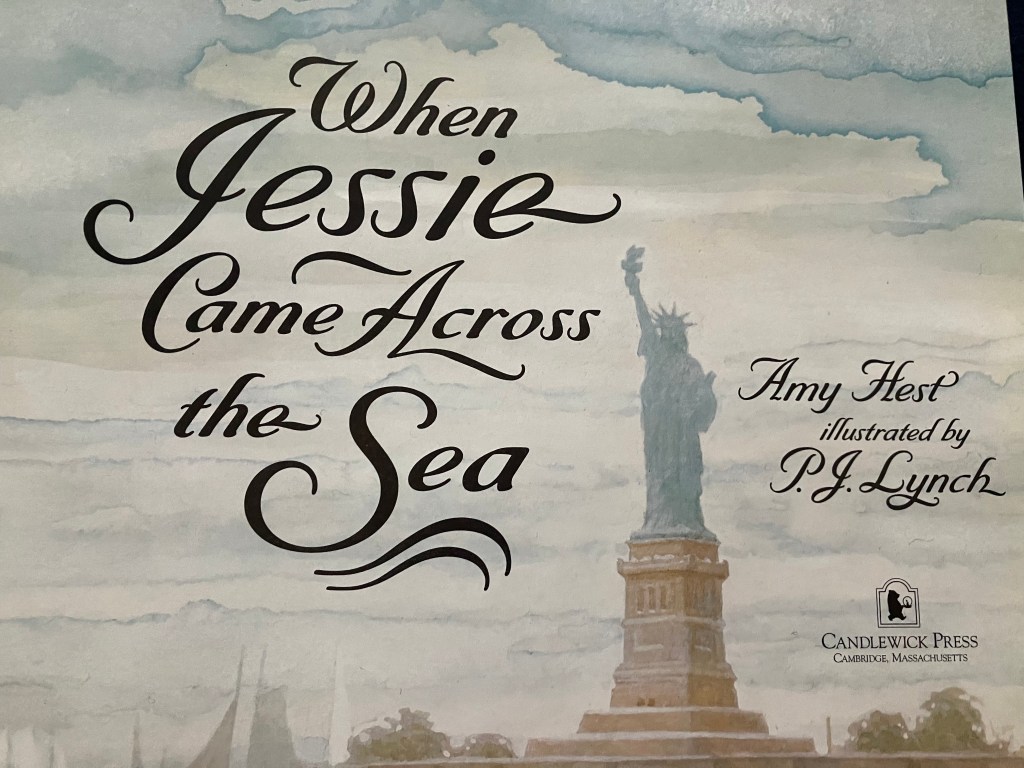
Clifford Takes a Trip

Clifford

Clifford Takes a Trip by Norman Bridwell, 1966.

Emily Elizabeth and her parents don’t usually take long trips during the summer because it’s too difficult to bring Clifford along. He’s just too big to go on trains or buses. One summer, Emily Elizabeth’s parents decide to go camping in the mountains. They can’t take Clifford, so they leave him behind with a neighbor.

However, Clifford misses Emily Elizabeth too much, so he decides to go find her! A gigantic red dog can create a lot of chaos on a cross-country trip.

Along the way, he does help a man with a broken-down grocery truck, and the man is grateful enough to feed him.

He also arrives at the family’s campsite just in time to save Emily Elizabeth after she thought it would be fun to play with some baby bears she found.

The family considers that next year, they may find a way to take Clifford with them somewhere else.

The book is available to borrow and read for free online through Internet Archive (multiple copies, including one in Spanish).

My Reaction

Like all Clifford books, the humor is based around Clifford’s enormous size. Even though the family thought that it would be too far for Clifford to walk to come to the mountains with them, he tracks them down there anyway. Then, after he rejoins his family, he sleeps with Emily Elizabeth, his ear propped up to be her tent. The idea they’re considering next for transporting Clifford is a flat-bed truck. I could well imagine my own dog trying to track me down if I went on vacation without her, but fortunately, when your dog is about the same size as Toto in the Wizard of Oz, traveling with a dog isn’t as difficult.

Five Go Off in a Caravan

The Famous Five

Five Go Off in a Caravan by Enid Blyton, 1946.

The children (Julian, Dick, Ann, George) and their dog, Timmy, are all looking forward to the summer holidays.  They’re not sure what they want to do, but they think that it would be more fun to go somewhere without the adults instead of going home, but they can’t think of anywhere they can go without adults.  They doze off in the sun while talking about it, but Timmy wakes them when a circus procession passes by.

The children are fascinated by the circus and call to a boy traveling with them, Nobby, asking him where they’re going to be performing.  Nobby says that the circus is on a break, and they’re going to be spending some time at a lake that allows them to camp there with their animals.

As the children watch the caravans of the circus going by, they think that it would be great if they could hire a caravan (horse-drawn travel trailer) and travel in it themselves.  They have a horse, Dobby, who could pull one.  The children ask their mother if they can hire a caravan, and she says that she’ll have to talk to their father about it.  It turns out that their father needs to go up north for part of the summer and wants their mother to come with them, so he thinks that it’s alright if the children want to take a caravan and camp out while they’re away.  The parents decide that the children will need to hire two caravans and borrow an extra horse because they don’t think one caravan will be enough for the four children and their dog, and they insist that the children sent them a message every day to tell them where they are and how they’re doing.

As the children discuss their plans in more detail, they decide that it will be fun to go to the lake where the circus is and get to know Nobby better.  Nobby lives with his uncle, who is the chief clown of the circus, and the children didn’t like what they saw of him before because he didn’t seem jolly at all, but they think it would be fun to be friends with Nobby and get another look at the circus animals. 

The children are eager to get started, but their parents make them pack and plan properly.  When the caravans arrive, the girls choose the red one, and the boys get the green one.  The girls take the new horse, Trotter, and the boys take Dobby for their caravan.  The adults give the children a map of places where they’re allowed to camp.  On their way to the lake, the children camp on farms that allow caravans.

When the children arrive at the lake, Nobby is glad to see them, and he introduces them to his chimpanzee, Pongo, and his terriers, Barker and Growler.  Nobby is friendly, but his Uncle Dan (called Tiger Dan) and Lou the acrobat are rough and unfriendly and don’t want the kids around.  When the children camp near the circus that night, Tiger Dan and Lou try to run them out of the campgrounds, but the children send their dog after them.  The campgrounds are public property, and there isn’t any reason why the children can’t be there.  The children think that Tiger Dan and Lou stumbled on their campsite by accident when they were trying to have some kind of secret meeting.

The next day, the children decide to go camp in the hills, as they had already planned because they know it will be cooler in the hills.  Lou takes an interest in where the children are going, but they don’t want to tell him much because they don’t want Lou and Tiger Dan coming after them to harass them again.  They find a nice place to camp up in the hills on some land belonging to a pleasant farmer and his wife, who also provide the children with food.

However, it isn’t long before Tiger Dan and Lou locate the children’s campsite and try to talk them out of camping at that spot also.  Nobby doesn’t know why Tiger Dan and Lou are up in the hills anyway.  The circus people have been buying some of their food from the farmer, but Nobby says that it’s always the women who go to the farm to buy things, not the men.  It seems like Tiger Dan and Lou are up to something suspicious, but the children don’t know what.

Then, suddenly, the men seem to change their views of the children, encouraging Nobby to be friends with them and to bring the children to visit the circus camp.  The children are suspicious and leave Timmy to guard their caravans while they visit the circus camp, just in case the men try to mess with their camp while they’re gone.  When they return to their own camp, the children discover that the men have tried to poison Timmy with tainted meat!  Fortunately, Timmy didn’t eat the meat, but unfortunately, one of Nobby’s dogs eats some and is violently ill.  The children aren’t sure whether the little dog will survive or not, and they don’t know why the bad men want to get rid of them so badly that they would try to kill their dog.  Whatever’s going on is serious, and they need to get to the bottom of it!

The book is available to borrow and read for free online through Internet Archive (multiple copies).

My Reaction

Traveling without parental supervision is the stuff of vintage children’s books and the dreams of children from every era! The kids in the Famous Five series have far more independence that modern children have, and in fact, the authorities might be concerned about children their age traveling without their parents. Actually, I would think that few adults even at the time of the writing of this book would even consider letting their children travel alone like that. That’s part of the appeal of this type of story, children being able to do things that real children never do.

I didn’t like the part about the dog being poisoned because I always hate it when bad things happen to animals in stories, but don’t worry! Nobby’s dog is fine in the end!

Klutz Kids Travel

Kids Travel: A Backseat Survival Kit from Klutz Press, 1994.

This was one of the Klutz Press activity books that I had as a kid! I used to take it on the long road trips we would take across the country during the summer. The reason why this book is called a “kit” is that it came with a pouch with some extra equipment that could be used for the activities in the book and a special activity pad on a clipboard in the back. I don’t have my activity pad anymore, but it had pencil and paper games and puzzles, like mazes, connect-the-dots pictures, and grids for a Battleship style game that they called Lost on Earth, where you would attempt to find famous missing people or things instead of finding your opponent’s battleships.

The Lost on Earth games are especially funny when you know the references for who the missing people or what the missing things are, like who Amelia Earhart or D.B. Cooper is/was. When I was a kid, I didn’t know about D.B. Cooper (this YouTube video from Buzzfeed Unsolved explains), but I think one of the missing people on the activity pad grids was Jimmy Hoffa, and I knew that name (Buzzfeed Unsolved also covered that). The great thing about these references is that, if you’re playing this game with a kid who hasn’t heard of some of these people or things, just explaining who or what they are is activity by itself.

The pouch contained a set of markers for drawing and doing the activities on the activity pad, embroidery thread in different colors for making friendship bracelets and hair wraps, a loop of colorful string for making string figures, a small sheet for the Grown Up Pop Quiz, and some gummy playing pieces and dice for playing Parchesi (a board was included on one of the pages in the book). The gummy pieces would stick to the page, but not so tight that you couldn’t get them off. I think I saw a later edition of this book that used a different style of playing pieces, but I’m not sure now. The gummy pieces do gradually lose their ability to stick over time.

The activities in the book are meant to be done in a car. In the front of the book, there’s a section where you can record which license plates you’ve seen from different states in the US. (A common car activity on US road trips because there are 50 states, and they all have different styles of license plates. In theory, you could see examples of plates from all 50 states in a single, long car trip, but I never did. I’ve seen most of the states during a single trip, but I’ve never been table to check off all of them during a single trip.) There are also rules for playing many classic car games, mostly games that involve talking or hand motions or can be played on paper, like Twenty Questions, Paper, Rock, Scissors, and Hangman. It also describes popular car trip rituals, like holding your breath while passing a graveyard, lifting your feet while going over a bridge, or ducking your head while going under a bridge.

However, even though most of the activities are meant for car trips, many of them would be good for airplane trips as well. When I was a kid, airplanes were quieter, and it was much easier to talk to the person in the seat next to yours than it is now, so the talking games are still better for car trips. However, making friendship bracelets are ok for planes and trains as well as in a car. There are also activities for folding a dollar bill and making a paper fortune teller, making string figures, drawing superheroes, writing things in secret codes, reading palms, and learning some basic sign language.

What I’ve always liked best about this book is the variety of activities. There’s something for everyone in this book, and I’m still amused by some of the games and activities. If there’s an activity that the reader doesn’t like or that won’t work for the current location, there are plenty of others to move on to. Many of the activities in the book are either mentioned in other Klutz books or have entire Klutz books dedicated to them. Also, every part of this book is meant to be used for something. There is a finger maze around the title and copyright page, and when you remove the activity pad in the back, there is a board behind it to use for a game called Penny Hoops, which involves flicking pennies onto target areas on the board to earn points.

Sadly, I don’t think this book and activity kit are being sold new anymore, although there are some copies being sold used (I think most of the used books don’t come with the extra items in the original kit), and the book is available to borrow and read for free online through Internet Archive.

Grandfather’s Journey

Grandfather’s Journey by Allen Say, 1993.

A man describes how his grandfather traveled by ship from his home in Japan to the United States. The time period isn’t specified, but from the context of the story, the grandfather’s original journey would have taken place either at the end of the 19th century or at the beginning of the 20th century.

As a young man, the future grandfather travels all over the United States, seeing the sights and meeting all kinds of interesting people. It’s a bit of an adjustment for him, wearing Western style clothing and getting used to life in a new country, but he enjoys the adventure of it. He decides to settle in California, the part of the United States that he likes the best. He briefly returns to Japan to persuade his girlfriend to marry him and return to the United States with him.

The grandfather and his wife have a daughter in the United States, and they enjoy living there, but as the daughter grows older, the grandfather realizes that he misses Japan and wants to return home. He and his wife move back to Japan with their daughter.

The daughter has to learn to adjust to life in Japan after having lived all of her life so far in America. The family moves to the city because life there is more what their daughter was accustomed to than life in the countryside, where they were originally from.

Later, the daughter grows up, gets married, and has a son, who is the author of the book. The grandson describes being young during World War II and the devastation in Japan during the war. (This is part of what dates the earlier part of the story.)

Toward the end of his life, the grandfather finds himself growing nostalgic about his time as a young man in the United States and wishes that he could return to California one more time. Unfortunately, the grandfather dies before making the trip. Instead, his grandson goes to the United States to see the places that his grandfather told him about.

Like his grandfather, the grandson stays in the United States for a time and has a daughter of his own. He comes to understand how his grandfather felt, missing Japan when he is in the United States and missing the United States when he is in Japan. The world is vast and full of fascinating places to explore, but there is always something to miss and feel nostalgic about, no matter where you are. The grandson continues to travel back and forth between the United States and Japan, enjoying both of them.

The book is a Caldecott Medal winner. It is available to borrow for free online through Internet Archive.