The Puppeteer’s Apprentice

The Puppeteer’s Apprentice by D. Anne Love, 2003.

Poor Mouse works as a scullery maid in a castle in Medieval England.  She has lived there all her life, since someone abandoned her at the castle as a baby.  She has no idea who her parents are, when her real birthday is, or exactly how old she is (the cook once said she was about eleven, but he wasn’t sure).  She doesn’t even have a real name; Mouse was simply the name given to her by the cook, who makes her work hard and beats her if she makes a mistake.  Mouse’s life is hard, but then one day, she makes a big mistake, and the cook gets in a rage and attacks her with a meat hook.  Mouse escapes from him and flees the castle.  She knows that she cannot go back, but she doesn’t know where to go. 

For the first time in her life, Mouse’s fate is in her own inexperienced hands.  For a time, she joins up with a group of travelers, who take her to the city of York.  However, none of them can adopt Mouse, and she must struggle to make a life for herself.  In York, Mouse sees a puppeteer performing, and she is inspired to learn to be a puppeteer herself.  Through a mixture of trickery and pleading, Mouse convinces the puppeteer to take her on as an apprentice. 

Although Mouse makes many mistakes at first, and the puppeteer gets angry and threatens to leave her behind, the two eventually learn to get along with each other.  Mouse gains skill at making and manipulating the puppets, and her confidence grows.  However, danger still lurks in the future, for the puppeteer also has a dark past and dark secrets which pursue the two of them in their travels.

The book is currently available online through Internet Archive.

My Reaction and Spoilers

Stories with abused and neglected children are always sad. Mouse is failed by various adults who are mainly focused on their own lives and securing their own positions in life before she finally becomes independent. We don’t know why Mouse was abandoned as a baby, although it was probably because her parents were poor and maybe unmarried, which would have been a stigma at the time. We can be pretty sure that, whatever happened, Mouse’s parents’ position in life was too precarious to take care of her themselves. The castle cook she lives with is mainly worried about his own job and is more of an unwilling employer to Mouse than a parent. In fact, employment is more of a theme in Mouse’s precarious life than family. Even the puppeteer is more of an employer to Mouse than a parent. Mouse learns from the puppeteer, but it’s as an employee, and Mouse is well aware that she can be abandoned at any time if she fails to please her employer. In the end, Mouse gains an independence that pleases her, but I still found it a little sad because it seems like the one and only person who can’t abandon Mouse is Mouse herself and that there is little or no security in trusting or relying on others. The eventual goal turns out to be employing herself so she doesn’t haven’t to rely on someone who can dump her. I suppose that can be true in real life, too, but it’s one of hard, dark sides of life.

Although, the adult characters’ focus on securing their own lives and positions first is also a testament to the nature of the time when the story is set. Opportunities are limited by social level, and there are few sources of support for those who suffer unfortunate circumstances. Although it seems like the adults in the story are cruel and neglectful, there’s also a desperation to their own situations. The one person in the story who is willing and able to offer more generosity to Mouse than other characters is able to do so because of his privileged position in life. Even the puppeteer, while seeming more free than other characters, is living under danger and threat, and there is genuine risk to sharing in her life that Mouse doesn’t come to understand until later.

The puppeteer always dresses in loose-fitting clothes to cover up the fact that she is a woman.  Although there is no reason why women cannot be puppeteers, she finds it necessary to disguise herself because she is pursued by an enemy from years ago.  Once, her father, who was a master puppeteer, saved the life of a young Duke who was attacked by a man named Ordin.  Ordin was trying to steal some of the duke’s lands.  The old puppeteer and his daughter stood witness against him, and he was thrown into prison.  Later, when he got out of prison, he attacked the party on the road, killing the old puppeteer and his companions.  Only the daughter escaped alive, and she became a puppeteer to support herself.  Ordin escaped, and she was forced to disguise herself to protect herself.  She even refuses to tell Mouse or anyone else what her real name is through most of the book. 

However, Ordin recognizes her one day while she and Mouse are giving a performance.  He and another highwayman follow them on the road and attack them.  The puppeteer kills the other highwayman but is gravely wounded herself.  Mouse fights back against Ordin, knocking him into the fire, and he burns to death.  They are not far from the duke’s castle, so the puppeteer sends Mouse there to get help.  Mouse tells the duke what happened to the puppeteer, and he has her brought to his castle.  The puppeteer, realizing that she will not recover from her wounds, finally tells Mouse her story and offers her name if Mouse wants it for herself.  The duke offers to let Mouse stay at his castle.  Mouse stays the winter, but in the spring, she decides to leave.  She has come to love life on the road, and she promised the puppeteer that she would take care of the puppets.  Mouse decides to take the puppeteer’s name, Sabine, as her own and sets off on a journey to find a place to perform her new puppet play, one telling the puppeteer’s story.

Meet the Men Who Sailed the Seas

Meet the Men Who Sailed the Seas by John Dyment, 1966.

This book is part of a series of historical biographies for children. Unlike other books in the series, the book doesn’t focus on a single person, talking about the lives of many famous sailors and explorers with some historical information about sailors and sailing ships in general.

When I was a kid, I went through a phase where this was a favorite book my mine, and I carried it around and read it constantly. It’s a little surprising that I became so attached to this particular book because I grew up in Arizona, in the middle of a desert, miles from the nearest ocean. I was seven years old before I even saw an ocean and a sailing ship in real life, and even then, it was a matter of years before I saw these things a second time. Because of that, as a child, I wasn’t particularly attracted to boats or interested in ocean travel. I wasn’t even a very good swimmer (liked it, just not good at it because I didn’t get a chance to do it much when I was young), and I was kind of afraid of deep water. We learned about Christopher Columbus in school, but I thought that Columbus Day was the most boring holiday on the calendar (there was no candy and no dressing up in costumes, and I’m not even sure that we got that day off of school, which were my requirements for what made a really good holiday), and Christopher Columbus was not remotely my most favorite historical character. So what was it about this book that caught my attention? Why did I like it so much?

There are a number of things about this book to like. When I was a young kid, I wasn’t fond of nonfiction books because it was a little too much like school, but this book was different. It was one of the first nonfiction books that I really wanted to read. The large, friendly type is encouraging to younger children who are just starting to read nonfiction chapter books, and the detailed drawings are fascinating. Best of all, it’s a journey through time as well as across oceans. I always liked history.

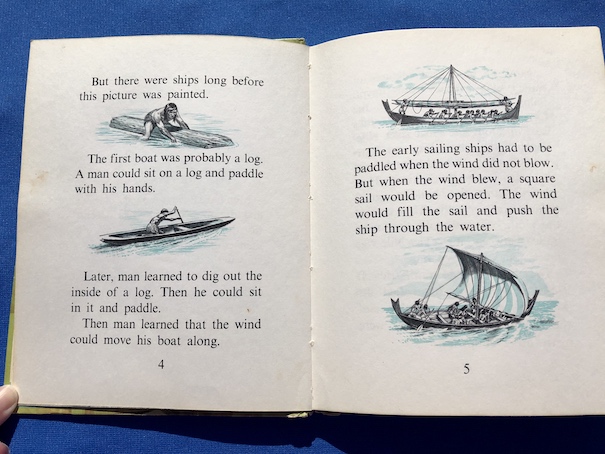
The book starts off by explaining how early sailors might have traveled. It speculates that people first realized that they could travel by water by floating on logs and then realizing that they could carve those logs into canoes and paddle them to move in the direction they wanted to go, eventually adding sails to move even faster with less effort.

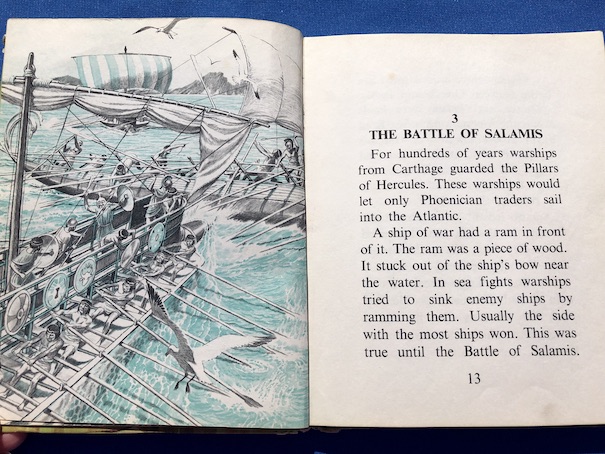
It then describes how ancient civilizations such as the Egyptians and Phoenicians traveled by ship. There is a chapter about Hanno of Carthage, a Phoenician who commanded a fleet of ships and was known for sailing around the coast of Africa. (That section and the next one use the old name for the rocks at the Strait of Gibraltar, the Pillars of Hercules.) The next chapter describes the Battle of Salamis between Greece, led by Themistocles, and Persia, led by Xerxes. This battle is particularly notable because the Greeks defeated the Persians through a clever trick even though they were out-numbered, proving that a good battle strategy could allow even smaller fleets to gain the upper hand in battle. There is also a chapter about Pytheas, a Greek sailor who sailed to Britain in search of tin and “Thule” (it’s not completely clear what he meant by Thule, although it was apparently a place north of Britain) and wrote a book about his travels.

In the early Middle Ages, Viking raiders began attacking Britain. The chapters about Vikings describe Eric the Red and his adventures in Iceland and Greenland, where he founded a colony of people from Iceland. Vikings also established a colony in the Americas that they called Vinland. However, they eventually abandoned Vinland because of conflicts with the people they called Skraelings (Native Americans). (The exact location of Vinland was in dispute for some time, and some people speculated that it might actually refer to multiple locations, but the likely site is at L’Anse aux Meadows in Newfoundland.)

The other explorers and adventurers described in the book are Marco Polo, Christopher Columbus, Ferdinand Magellan (known for sailing around South America to the Pacific), Francis Drake (his section includes an account of the battle with the Spanish Armada), and Captain Cook (known for sailing to Australia and New Zealand and claiming them for England and for insisting that his sailors eat cabbage and onions to prevent scurvy, later killed in Hawaii).

The book also discusses the Mayflower and Pilgrims, and there are chapters about American ships and sailors, like John Paul Jones, and the roles they played in the American Revolution and the new United States shortly after. Because the focus of the book focuses on sailing ships, it ends with Robert Fulton‘s steam ship, the Clermont, and Joshua Slocum, who sailed around the world alone.

So, the reason why I’m still kind of attached to this book, which was old even when I first read it, is that it was my introduction to a world that I wasn’t even really interested in at first, a world that became more interesting after seeing the history and other countries connected to it. I’m still more of an armchair explorer than anything else, but this book added a dimension to my early armchair travels that probably wouldn’t have occurred to me before. As a side note, I don’t think that the book mentions that the navigation instrument that one of the men on the front is holding is an astrolabe, but I now own one of these myself. If you want to try one, you can make a simple version at home yourself. They can be used on land as well as sea!

Bed-Knob and Broomstick

BedKnobBroomstickBed-Knob and Broomstick by Mary Norton, 1943, 1947.

This book is actually two books in one.  The title Bed-Knob and Broomstick is the one used for editions that include both the first book, The Magic Bed-Knob, and the sequel, Bonfires and Broomsticks.  Together, these two books were the basis for the Disney movie Bedknobs and Broomsticks, although the plot of the movie is considerably different from the two books. Because the movie is based on both of the books at once and because I read the combined edition, I’ll explain the plots of both of the books in one post.

There are two major differences between the movie and books that change many other things about the plot. The first one is that there is no mention of World War II in the books, even though the books were written during that time.  Miss Price was not studying magic to help the war effort, and the children were only in the countryside for vacation, not because they were evacuated there. Also, in the books, Emelius Jones (Emelius Brown in the movie) was a man they met when they traveled through time, not a man living in London during their own time.  He was not involved in Miss Price learning magic, although the two of them do end up together in the end.

The Magic Bed-Knob

At the beginning of the first book, the three Wilson children – Carey (who is described as being “about your age”), Charles (“a little younger”), and Paul (six years old) – are spending the summer with their Aunt Beatrice in Bedfordshire. There is never any mention of the children’s father in the books. Probably, their father is dead, although he might have left the family and went to live elsewhere or may be fighting overseas, although there is no mention of that in the book, making me think that it is probably not the case. The children apparently live with only their mother in London, and because she works, she always needs to find somewhere for them to stay during the summer, when they’re out of school. (This is a major plot point in both of the books.  In the Disney movie, the three children are orphans who have no memory of their birth parents, and their guardian was killed in a bombing shortly before they were evacuated to the countryside.  You only get their full backstory if you see the anniversary edition of the movie that includes the deleted scenes.)  While the children stay with Aunt Beatrice, they enjoy playing in the countryside, and one day, they happen to meet Miss Price, who they find with an injured ankle.

Miss Price is a respectable spinster from the village who gives piano lessons and is often seen riding around on her bicycle.  When they find her hurt, Carey says that they should get a doctor for her, but Miss Price insists that she doesn’t want one. Instead, she just asks the children to help her get home. As she starts to lean on Carey and Charles, Paul picks up a broom nearby. The older children thought it was just an old garden broom, but Paul calmly says that it belongs to Miss Price because it’s what she rides around on. The others are shocked, but Paul simply says that that he’s seen her improve in her flying, so Miss Price knows that he’s seen her riding her broom more than once. Miss Price is worried that everyone in the village will know now that she’s a witch, but Paul hadn’t even told his brother and sister what he’d seen.

The children help Miss Price get home, and they allow their aunt to think that Miss Price simply fell off of her bicycle. When the children are able to speak to Miss Price privately, they ask her directly if she’s a witch, and she admits that she’s studying to be one. She says that she’s had some talent for magic since she was young, but she never really had the time to develop it. The children are convinced that, while Miss Price might be a witch, she’s not a wicked one, and she says that’s true, that she started too late in life to be that way and that wickedness doesn’t come naturally to her. However, she’s still worried that the children might tell people about her magic.

Carey is the one who suggests that Miss Price give them a magical object as part of their pledge of secrecy (unlike in the movie, where it was Charlie’s idea), with the idea that, if they ever told anyone that she’s a witch, the magic would stop. Charles suggests that Miss Price could give them a magic ring that would summon a slave to do their bidding, but she says that she couldn’t manage that and that she has a better idea. Miss Price asks the children if they have anything on them they can twist, like a ring or a bracelet. The only thing they have is a bed-knob that Paul twisted off the end of his bed (basically, because he discovered that he could).

Miss Price says that the bed-knob will do nicely, and she casts a spell on it that will allow the children to travel to the destination of their choice when they put it back on the bed and give it a twist. If they turn it in one direction, they can travel in the present time, but turning it the other way can send them to the past. Also, because Paul was the one who had the bed-knob, he’s the only one who can make it work. Miss Price isn’t troubled by Paul’s young age because she thinks that it’s best to learn magic young, although she warns the children to be careful.

Because it’s Paul’s bed-knob, Carey and Charles give him first choice of where to go, but they think the places he wants to go sound mundane. He wants to either see a museum exhibit that the others saw without him once or to go home and see their mother in London. Carey and Charles try to persuade him to go someplace more exciting, but Paul insists that he wants to go home.

The bed whisks the children home to London, but when they get there, their mother isn’t home. Apparently, their mother has gone away for the weekend herself, and the children find themselves alone on their bed, in front of their house, on a foggy night. A policeman bumps into them, and when he demands to know who they are and where the bed came from, he doesn’t think it’s funny when they say, “Bedfordshire.” He takes them to the police station to spend the rest of the night. Fortunately, they find a way to get back to the bed and use the spell to return to their aunt’s house before they’re missed in the morning. It’s not quite the adventure that the children had been hoping for when they started out, but it’s just the beginning of their amazing summer!

However, magic turns out to be more dangerous than they thought. Their next adventure takes them to an island with cannibals (yeah, one of those scenes, sigh – I think that the island of talking animals in the movie was more fun), and they narrowly escape after Miss Price has a duel of magic with a witch doctor. Their magical adventures create problems that the children can’t explain to their aunt without giving away Miss Price’s secret. Eventually, their messes and wild stories cause their aunt to send them home to their mother. Miss Price considers that magic might cause more problems than it solves and tells the children that she’s thinking of giving it up for awhile. However, Paul keeps the bed-knob in the hopes that their adventures aren’t done yet.

BedKnobBroomstickChildren

Bonfires and Broomsticks

In Bonfires and Broomsticks, two years have passed since the children’s first adventures, and Aunt Beatrice has died. Carey and Charles, worried that Paul would talk too much about their magical adventures, tried to convince Paul that it was all just a dream, although they weren’t very successful.

Then, the children see an advertisement in the newspaper that Miss Price is offering to board a couple of schoolchildren in her house for the summer for a fee. The children’s mother works, and she always has to find somewhere for the children to spend the summer, when they’re not in school. They still have the bed-knob, so they tell their mother that they want to visit Miss Price, hoping they can have more adventures with her. At first, their mother doesn’t understand why they would want to visit Miss Price so badly, but since she seems like a nice, respectable woman and an old friend of Aunt Beatrice’s, she agrees.

Miss Price is happy to have the children stay for the summer, but they are disappointed when they learn that she was really serious about giving up magic. The children discover that Miss Price bought the old bed that they had used for their previous adventures at the estate sale after their aunt’s death. She’s been sleeping on it in her own room. They want to try the bed-knob on the bed, but Miss Price takes it from them. She tries to make their summer vacation a normal vacation with normal activities, like picnics and croquet.

But, even Miss Price can’t resist the opportunity to try the bed-knob one last time. One morning, Carey and Charles discover that Paul and Miss Price have traveled somewhere on the bed without them. When the two of them confront Paul about it, he says that they only went to a nearby town, just to see if the spell on the knob still worked. Carey and Charles understand, but Carey thinks that if they got to use the bed once more, she and Charles should have one more turn. She especially wants to try going into the past, which was something they hadn’t had a chance to try last time. Miss Price is reluctant, but finally agrees after Carey pressures her about it.

The children travel to London of 1666 (ending up there accidentally, when they were aiming for the Elizabethan era), where a man named Emelius Jones has been living as a necromancer. When he was young, he studied magic under a mentor who, as he was dying, finally told him that everything he learned was fakery. It was all an act that he used to get money from gullible people, although it paid very well. The old man leaves Emelius his business, but Emelius is always nervous, worrying both because someone might discover that it’s all a fake and because others might believe that it’s real and that he should be hung as a witch. The only reason why he stays with it is because he has no other business to follow.

The children meet Emelius after ending up lost and stopping at his house for directions. The children can see how nervous and unhappy Emelius is, and they ask him about himself, discovering that his home town is actually close to where they’re staying with Miss Price. They reveal to him that they are from the future and invite him to come home with them for a visit.

Miss Price isn’t happy to see that they’ve brought someone back from the past with them, but she ends up liking Emelius. Before sending him home, they learn that Emelius’s aunt, who lived near to where Miss Price now lives, died the same day that Emelius left London in the past, which is coincidentally shortly before the great fire that destroyed a good part of the city. They know that Emelius’s London lodgings will likely be destroyed in the fire as well, but at least he can move into the house that he will inherit from his aunt.

However, after they send him back to his own time, the children and Miss Price learn that Emelius never made it to his aunt’s house because he was executed for practicing witchcraft. Unable to leave poor Emelius to such a terrible fate, they come up with a plan to rescue him.

The combined book edition is available online through Internet Archive.

My Reaction and Spoilers

Changing Emelius’s past also changes Miss Price’s future. Neither of them has ever married, and both of them have been lonely, and they come to the conclusion that the two of them were meant to be together. In deciding that they will live their lives together on Emelius’s aunt’s farm in the past, they put an end to the magical traveling bed. Only Paul can make the magic bed-knob work, and once he sends them into the past (not going with them), they can never return. But, Carey has one final vision of the two of them, being happy together, so she knows that they will be alright.

Overall, I preferred the Disney movie to the original books.  I think the war-based plot was better than the children’s random travels to cannibal-filled islands (I never liked those tropes in children’s stories anyway) and other places.  At one point in the books, Carey did speculate about the use of magic in war, but she rejected the idea because the notion of someone with the ability to conjure a dragon that could breathe mustard gas or who could turn whole armies into mice was just too horrible.  The spell that Miss Price used against the Nazis in the movie was part of their plan to rescue Emelius in the second book, but I think the movie’s ending was much more exciting.

Hitty, Her First Hundred Years

Hitty

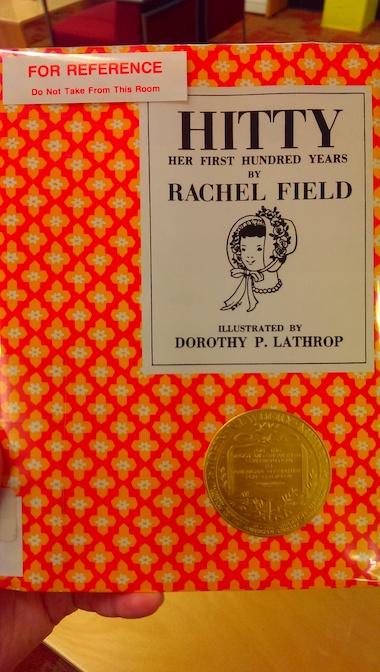
Hitty, Her First Hundred Years by Rachel Field, 1929.

Sometimes, I debate about how much detail I should use when describing the plots of books, but since this is such an old book and a more recently released version has altered the events in Hitty’s life significantly, I’ve decided to cover it in detail.  I do not have the updated version and haven’t read it, so what I describe below is the older version.  The book is episodic in nature, following the life and travels of a small doll named Hitty.  This book is a Newbery Award winner and is currently available online through Internet Archive (multiple copies).

These are the memoirs and adventures of a hundred-year-old wooden doll, which she writes as she lives in antique shop. She doesn’t recall exactly when she was made, but she knows that it was about a century earlier and that she was carved by a peddler in Maine for a little girl named Phoebe Preble.

HittyMemoirsThe peddler did some odd jobs for the Preble family on their farm that winter, while the weather was too bad for him to travel. They named the doll Mehitabel (a Biblical name from the Old Testament), and Phoebe nicknamed her Hitty. At her mother’s insistence, Phoebe made clothes for Hitty and embroidered Hitty’s name on the doll’s petticoat. Phoebe’s mother says that as long as she has her name on her clothes, she’ll always know what it is, whatever happens to her. Phoebe doesn’t see what could happen to Hitty because she wants to keep her forever, but Hitty is destined to live an adventurous life.

Phoebe misplaces Hitty more than once during their time together. The first time, she accidentally leaves her at church (when she wasn’t even supposed to bring her there in the first place). Then, Phoebe takes Hitty out to play one day, but she and her brother are frightened when they see some American Indians. (Phoebe lives in the early 1800s.) When they run away from the Indians, Phoebe accidentally leaves Hitty behind. Then, Hitty is picked up by a curious crow and carried to the tree next to the Preble house. She hangs from a tree branch for awhile before they realize that she is there and rescue her.

HittyShipwreckedThen, Phoebe’s father, who is the captain of a whaling ship, convinces his family to join him on a voyage. Life aboard ship turns out to be both exciting and perilous. One day, the ship catches fire, and the Preble family and all the crew abandon it. Hitty, once again, is unfortunately left behind. Although Hitty sees Phoebe gesture back at the ship and knows that Phoebe wants to return for her, it is too late for that.

However, luck is with Hitty, and instead of being burned, she is washed overboard as the ship goes down. Miraculously, she is washed ashore and found once again by the Preble family, who are now castaways on an island. They hope for rescue but fear the “natives” on the island. (Yep. “Savages”, “natives”, etc. These are sadly a common feature in vintage children’s literature. See Edward Eager’s Magic by the Lake for a funnier spoof version. The scene in this book is the sort of generic “savage natives” or “native savages” scenes he was making fun of, except that nobody tries any silly ooga-booga talk to communicate with them, and they don’t turn out to be cannibals. But, it does occur to me that if this book had been written in modern times, people would have insisted that the author give the proper name for the civilization on this island instead of just calling them “natives” and thoroughly research their actual habits and customs and present them in an informative, realistic way for the education of children reading this book, while writers and parents during this period didn’t seem to care about any of that.  Keep this in mind the next time someone tells you that younger generations are lazier and not as well-educated.)

One day, the natives come to have a look at the castaways, and their leader catches sight of Hitty and demands (through gestures) that she be handed over to him. Phoebe doesn’t want to give up her doll, but her father tells her that she has to. It turns out that the natives think that Hitty might be an idol that gives the castaways power, which is why they want it for themselves. Hitty is taken back to the natives’ village, and they use her as an idol themselves, making a little shrine to house her.

Hitty probably would have remained there if she had not been stolen from the temple by some curious monkeys and once again found by members of the Prebles’ party, who return the doll to Phoebe. Fortunately, the family sees a passing ship and manages to get rescued before the natives can come after Hitty again.

However, Hitty’s adventures are still not over. The ship that rescues them is going to India, and unfortunately, this is where Hitty and Phoebe are permanently separated when Phoebe loses her in a bazaar. Instead of being found by Phoebe or her family again, Hitty is found by a snake charmer, who uses her in his act, positioned near the snake. Even though Hitty is made of wood and not vulnerable to snake bites, she still finds the experience frightening.

From this point on (we’re about halfway through the story), Hitty changes hands repeatedly, gaining and losing owners every few years or so. Most of her new owners give Hitty a change of clothes, but they always keep her petticoat with her name still embroidered on it so, as Mrs. Preble once said, Hitty and her new owners always know her name.

An American missionary couple spot Hitty with the snake charmer and realize that her design looks like dolls in America. They have no idea how she got to India, but they buy her from the snake charmer and give her to their daughter, Thankful. Hitty lives with Thankful for a couple of years, and she enjoys her time with her, even though she really misses Phoebe.
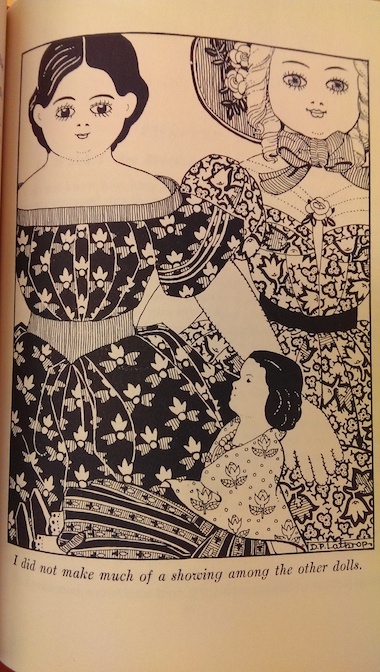
HittyOtherDollsThen, Thankful gets sick, and her parents decide that it might be time to send her home to the United States to stay with her grandparents. Thankful takes Hitty with her when she goes home to Philadelphia. Because Thankful’s early life was spent entirely in India, she has been unaccustomed to spending time with American girls her age, and she doesn’t know how to behave around the American children she meets when she first arrives in Philadelphia.  When the some of these (still 19th century) American girls first meet Thankful and Hitty, they think that Thankful is strange and make fun of her for her unusual habits and the way she dresses, telling her that her doll is ugly, too. Hitty has to admit that she isn’t as fancy as the other girls’ dolls. Thankful is so embarrassed by what the other girls say that she decides to hide Hitty in a sofa. After that, the sofa is taken up to an attic for storage, so Hitty remains hidden for a number of years.

HittyQuakerDuring her time in the attic, Hitty resents Thankful for abandoning her, in spite of all the charitable talk of her missionary parents. However, when Thankful is grown, Hitty is finally found by one of Thankful’s younger cousins, Clarissa Pryce, who really appreciates her. She doesn’t know how Hitty came to be in the attic, but thanks to the name still embroidered on Hitty’s petticoat, knows what to call her. Clarissa is a quiet, conscientious girl in a family of Quakers. She dresses Hitty as a Quaker girl, and Hitty lives with her for many happy years, learning to write as Clarissa goes through her schooling.

By now, the time of the Civil War is approaching, and Clarissa’s family are abolitionists. Hitty doesn’t really understand what the war was about, but she remembers being with Clarissa and watching soldiers march off to war. (This is where the updated version of the book differs greatly.  In the older version, Hitty doesn’t witness the war directly, but in the newer one, she does when she is sent to Charleston.)

Eventually, Clarissa gets older and is sent away to boarding school. Hitty is put into storage for awhile and then sent to the Pryces’ relatives in New York, along with some other things. However, Hitty’s package is misdirected and ends up being delivered to the wealthy Van Rensselaer family by accident. There, she is found by Milly Pinch, a seamstress doing some sewing for the Van Rensselaer family. Miss Pinch makes some stylish new clothes for Hitty, although she still lets her keep the petticoat with her name on it.

The Van Rensselaers’ young daughter, Isabella, sneaks into Miss Pinch’s room one day and finds Hitty, and a debate ensues about who really owns her. Mr. Van Rensselaer, on hearing where Miss Pinch found Hitty, says that rightfully, Hitty belongs to their family but that the clothes she is wearing are obviously Miss Pinch’s because she made them. Miss Pinch is gratified that he is being fair about it, but because Isabella really wants both the doll and clothes together, the family purchases them from Miss Pinch and gives her an excellent employment recommendation for her sewing.

Isabella is rather spoiled and has several dolls already, but she genuinely likes Hitty and takes care of her. Unlike Thankful, she even speaks up for Hitty when others say disparaging things about her plainness. While living with Isabella, Hitty even gets the chance to meet Charles Dickens. However, Hitty is stolen from Isabella by a gang of mean boys.

One of the boys in the youth gang takes the doll home with him and gives her to his younger cousin, Katie. The family is poor, but Katie loves her and gives her plenty of attention. When Katie gets sick and goes to live in the country for awhile, Hitty is accidentally lost in some hay and spends a long time in the barn, living with the mice.

When she is finally found, a pair of traveling artists are staying at the farm, and one of them keeps her to use as an artist’s model. He uses her to amuse children when he paints their portraits and even adds her into still life paintings. Hitty worries about how her painted features have faded, but the artist thinks that she’s much easier to paint than newer china dolls because the light doesn’t glare off of her. She stays with him for many years while he travels around the country, but he eventually leaves her with a pair of spinster ladies, Miss Hortense and Miss Annette, in New Orleans when he rents a room from them.

HittyBrideWhile living with these ladies, Hitty learns that Miss Annette’s fiancé died young, fighting for the Confederacy in the Civil War, and she still feels bitterly toward the North because of it. From her time with Clarissa, Hitty knows that many people in the North could say the same about the South, but of course, she can’t actually say so out loud. The ladies make new clothes for Hitty, dressing her as a bride, with her clothes made from an heirloom handkerchief, and put her on display at the Cotton Exposition (aka the 1884 World’s Fair). From there, Hitty is stolen by a little girl named Sally, whose father is the captain of a riverboat that carries cotton up and down the Mississippi River.

Hitty learns that Sally is a lonely child who travels with her father frequently because her mother is an invalid and cannot always take care of her. Sally knows that it was wrong for her to steal Hitty, but she so badly needs a companion that she is even willing to risk jail if it means that she can keep Hitty. However, after attending a revival meeting where there are warnings against the evils of theft and getting caught in a sudden thunderstorm, Sally panics, thinking that God may be about to strike her down for her sins, and throws Hitty into the river. (I found this scene a little disturbing because, when Sally fears that God will smite her with lightning for stealing, she not only makes a desperate apology but asks if anyone has to be struck, couldn’t it be one of the newly-baptized kids, who are sinless and would know that they were going to heaven? The fearful apology is understandable, but it’s a little disturbing to hear this little girl try to throw someone else under the bus like that.)

From the river, Hitty is rescued by a couple of black boys (the book says “Negro” because it was written in the 1920s) who are fishing. One of them gives Hitty to his sister, “Car’line.” (Her name is probably really Caroline, but Hitty just says the name as she hears it, and the boys have a Southern accent. This is one of those books where they try to give the impression of accents with odd spellings like, “How you come by dat doll?” It’s not the worst example I’ve seen of this, but I have to admit that I’ve never really liked the use of odd spellings like that.) Car’line’s family is the poorest one that Hitty has ever lived with, with a fairly sizable family living in a small cabin. However, Hitty likes the way Car’line treats her and how close her family is, and she loves the music that they sometimes play and the old spirituals that they sing.

At Christmas, Car’line’s family goes to a big party at a house that was apparently once an old plantation. The wealthier owners of the house give presents to the poor children of the area, like Car’line. While they are at the party, one of the women at the house, Miss Hope, recognizes Hitty from a newspaper report that a doll in heirloom clothing had disappeared from the Exposition in New Orleans. Car’line is upset when Miss Hope tells her that the doll really belongs to someone else and should be returned, but Miss Hope understands Car’line’s feelings toward Hitty and soothes her by giving her the doll she had played with as a child, a fancy French doll named Mignonette, as a replacement for Hitty.

As the end of the book draws closer, Hitty changes hands more often than before, and she doesn’t describe her time with new owners in as much detail, partly because her new owners tend to be adults and mostly display her, not play with her. Miss Hope attempts to return Hitty to the ladies in New Orleans, but since the heirloom handkerchief clothes are ruined, they decide that she should really be returned to the artist who had her before. When they try to mail Hitty to his address in New York, it turns out that he has moved without leaving an accurate forwarding address. Hitty spends some time as a package in the postal service, ending up in the dead letter office, where she is sold off, along with other undeliverable packages, to people who are willing to take a chance that there might be something interesting or valuable in them. She doesn’t spend much time with the man who bought her because her package is accidentally left behind at a tobacconist’s shop, where she is accidentally delivered to a house with an order of pipes. The lady of the house has been wanting to try a craft project for turning a doll into a pincushion, so she adds padding to Hitty and puts some pins in her (terrifying but not actually painful for Hitty). From there, Hitty is sold at a craft sale, where she is bought as a present for someone’s great aunt. The great aunt doesn’t think much of the pincushion, but her friend collects dolls and recognizes that Hitty is a collectable. For awhile, Hitty lives happily with the friend as part of her collection, until she is lost out of a car on her very first automobile ride. Then, she lays alone in the countryside, fearful that this is going to be the end for her, until she is found and rescued by some picnickers.
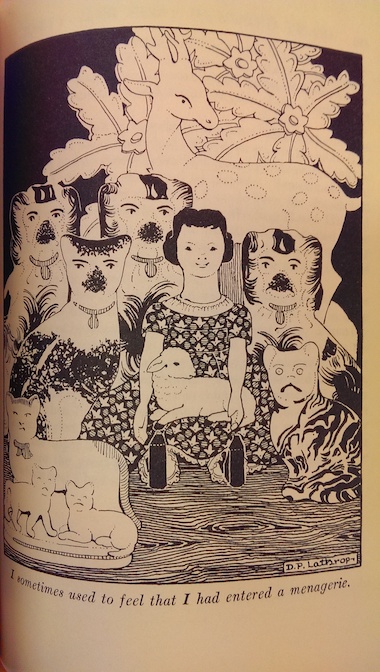
HittyCollectableIt is at this point that Hitty learns something astonishing: not only is she now about a hundred years old, but she has actually managed to make it back to her home state of Maine. To her further astonishment, she even returns to the Preble house where she originally lived, which is now the summer home of an elderly woman. Hitty knows that it’s far too late for her to have any hope of seeing Phoebe Preble again, and she never learns what exactly happened to Phoebe in her later life (which I thought was kind of a shame, bu it fits with the story of a doll, drifting from one owner to the next, unable to control her destiny or ask any questions of the people around her). The elderly lady collects antiques, and Hitty becomes a part of her collection, although the lady has no idea that this is Hitty’s original home.

Eventually, the elderly lady dies (it’s implied, but not stated – one summer, she simply never comes back), and her collection is auctioned off. Hitty is again surprised when she discovers that people view her as a valuable antique now. An Old Gentleman buys her at the auction, and when he takes her with him to New York, he comments that he supposes that it’s probably the first time she’s been outside of Maine and that her travels are about to begin. Hitty is amused.

At the end of the story, it is revealed that the Old Gentleman has purchased her for Miss Hunter’s antique shop, which is where she is now writing her memoirs. Miss Hunter and the Old Gentleman are delighted by Hitty and consider her a “museum piece.” Even though they could sell her, they don’t seem anxious to do so. She has become their shop’s mascot, and many people who visit the shop like to say hello to Hitty. Still, Hitty knows from her experiences that change is a part of life, and she is looking forward to seeing more changes in the world around her and the new adventures she may have with future owners!

My Reaction

In some ways, I was surprised by how much I enjoyed this story.  The length may seem a little daunting at first (262 pages about the adventures of a doll!), but the reading time is faster than you think, partly because of the episodic nature of Hitty’s life.  Books that are episodic can sometimes be a drag because, no sooner are the characters out of one situation, they plunge straight into another.  If it isn’t done right, it can leave the reader feeling like it’s all getting tiresome and repetitive and wondering where it’s all heading.  It’s a little different with Hitty, partly because the writing quality is good and partly because her owners and their lives are so varied.  I didn’t think much of the whole “natives” episode (because I never like “savage native” scenes in anything), but her other owners are a eclectic range of people, young and old, who have different interests and uses for Hitty.  Hitty ends up in some worrying situations, but you can feel reassured that she is going to be all right in the end because you know from the beginning that these are her memoirs that she is writing during the course of the story.

Hitty is unable to move around much on her own, which is part of the reason why she moves from place to place because of accidents or intentionally being carried or shipped by people.  However, she does seem to have the ability to move by herself in some small ways, such as writing her memoirs and when she tries to imitate Isabella’s dancing lessons, only to discover that she can’t quite do it because a doll’s legs aren’t jointed in the same way that human ones are.

Apart from the “savage native” scene, I don’t think the book was too bad, racially speaking.  I can’t recall any really objectionable terms being used.  Black people, when they appear, are called either “black” or “Negro”, and nothing insulting is said about them.  They are not treated cruelly in the course of the story.  Hitty enjoys her time as Car’line’s doll and doesn’t think badly of her or hold her in lesser esteem than other owners because she was poor.  The people in India aren’t described too badly, either, although Hitty thinks that the snake charmer was weird, and she seems to think well of the Indian nurse who took care of Thankful.  Thankful’s parents never discover that the Indian nurse gave her additional herbal remedies when she was ill, but Hitty appreciates the nurse’s devotion to the girl, doing everything she could to help her.  Hitty even says that she doesn’t know which medicines helped Thankful the most or if it was really the combination of all of them that saved her from her illness.

Some of Hitty’s owners are obviously nicer than others, with Thankful being arguably among the worst of them.  Even though Thankful’s upbringing is very religious, she and her new American friends are apparently rather shallow and thoughtless.  Even though her new “friends” in Philadelphia aren’t even nice to her, Thankful still worries about how she looks to them and is ready to chuck her beloved doll to please them.  Even spoiled little Isabella takes better care of Hitty and is more loyal to her, standing up to mean people as best she can instead of trying to appease them.

Mostly, Hitty prefers to be owned by young girls because she likes it when they play with her and carry her around, but she does enjoy being with adults who pay attention to her and treat her as a personality instead of as a mere object.  I was glad that none of the children Hitty lives with dies young, which could have been a risk in real life but would have been tragic.  Even with the elderly owner who presumably died, which was probably why her collection was being auctioned, Hitty never sees her die and doesn’t explicitly know that she is dead.  Whether Hitty will ever be owned as a child again now that she is considered an antique is unknown, but the author leaves the end of the story open, so just about anything could happen in Hitty’s future.

In a way, though, Hitty’s fate is already known.  Great Cranberry Island is the part of Maine where Hitty is supposed to have come from, and the Preble house is based on a real house. The story was based on a real doll that the author found in an antique store.  This doll is now at the Stockbridge Library Museum in Stockbridge, Massachusetts. There is also a cafe that is named after Hitty. There are fan sites dedicated to Hitty, some of which have tips for creating a doll very much like her.

The Return of the Plant That Ate Dirty Socks

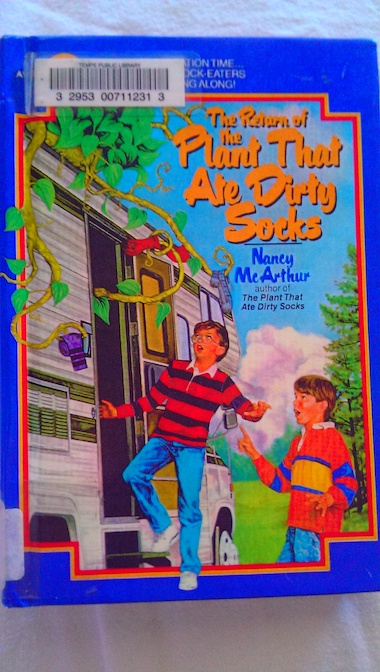
ReturnPlantDirtySocksThe Return of the Plant That Ate Dirty Socks by Nancy McArthur, 1990.

Michael and Norman’s father has finally gotten the chance to take a vacation, but his sons’ weird, sock-eating plants complicate things.  You can board pets or ask someone to come in and feed them, but how can you ask someone to leave out socks for your houseplants?  The boys’ parents still kind of think that the plants are more trouble than they’re worth, but the boys love them like pets and can’t bear to get rid of them.  Instead, they persuade their parents to rent an RV for the family’s vacation.  That way, they can take the plants along.

It seems like a good idea, although before they leave home, the boys notice that the plants are starting to produce seed pods, something that they decide not to tell their parents.  Instead, they simply remove the seed pods from the plants when they find them.  So, the family sets off for Florida and Disney World in their RV with the sock-eating plants sticking out through the sun roof.

At first, it seems like things might be okay on the trip, but one night, when the boys are visiting their grandmother and sleeping in the house instead of the RV, they forget to set out socks for their plants to eat.  When they wake up in the morning, the RV is gone.  The boys worry that the plants somehow got control of the RV and drove it off to find more socks, but it turns out that it was stolen by car thieves.  The police recover the RV but are puzzled when witnesses describe the thieves as abandoning the vehicle, screaming and running away without their shoes on, one of them only wearing one sock.  The family is relieved to get their RV back, not to mention their plants, however their adventures are just beginning.

The family has a good time when they get to Disney World, but the plants start drooping because they feel neglected, all alone in the RV all day.  To get the plants out in the sunshine and supervised more, the boys ask the people at the daycare center at the RV park if they can leave their plants there during the day.  The plants perk up a little more, getting attention from the staff and children, especially when they sing.

But, it turns out that the mother of one of the girls who has seen the plants, Dr. Sparks, is a botanist, and she’s very curious about the origin of these unusual plants.  The boys’ parents think that it might not hurt to get an expert opinion about their strange plants, but the boys worry that if the plants turn out to be very rare, scientists will want to take them away or their parents might decide to sell them.  Their parents still think that the plants are too weird and too troublesome to keep, but Michael and Norman think of them as their friends and pets.  They’ve been trying hard to keep their plants’ sock-eating abilities quiet.  Is it finally time to tell someone?  Can Dr. Sparks be trusted?

They end up asking for Dr. Sparks’ help when Fluffy accidentally eats something he shouldn’t.  Dr. Sparks knows that the plants are unusual, but by the end of the book, she’s still not sure that she believes that they really eat socks.  The boys give her some seeds so that she can experiment without taking their plants, knowing that she’ll eventually discover just how unusual the plants are.  By the end of the book, other people are also growing more plants like Fluffy and Stanley, partly because Michael’s friend Jason stole some of the seeds they were saving and sold them to other kids while Michael and Norman were out of town.  The boys can’t get back the seeds, but they force Jason to at least confess to the other kids that the plants will eventually eat socks.  Jason doesn’t think that they’ll believe him, but the boys know that it’s only right that the buyers be warned because they’ll discover the truth eventually.  Fluffy and Stanley are also starting to acquire the ability to move around on their own.

Mailing May

MailingMay

Mailing May by Michael O. Tunnell, 1997.

Four-year-old Charlotte May lives in a small town in Idaho in 1914. May, as her family calls her, wants to visit her grandmother in another town, but travel during this time is difficult and expensive. With a lack of roads that are easy to travel, the only comfortable way to get to May’s grandmother’s town is by train. Unfortunately, May’s family can’t afford to buy a train ticket for her.

MailingMayParents

May wants so badly to go see her grandmother that she even asks at the local general store if the owner can hire her, but he doesn’t have any work that a little girl could do.  Then, May’s mother’s cousin helps the family to find a more affordable alternative. If May can’t travel as a passenger, is it possible for her to travel as . . . mail?

MailingMayPostOffice

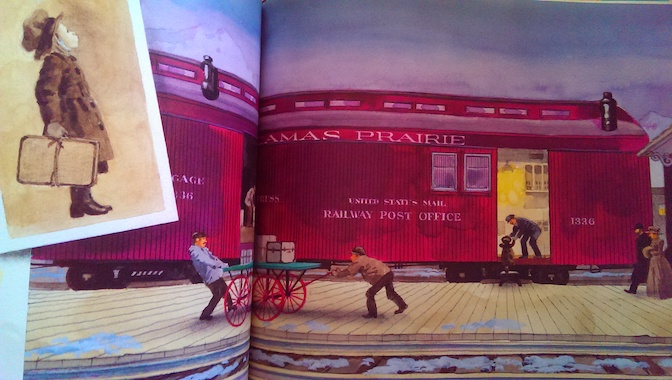
It turns out that the rate for mailing a live package the size of May is much cheaper than the fee for a passenger ticket.  Because May’s mother’s cousin works in the mail car on the train, he could take responsibility for her during the trip.  So, with a label on her clothes, declaring her to be “baby chicks” and the proper postage stuck to her jacket, May undertakes the journey to her unsuspecting grandmother’s house.

MailingMayTrain
MailingMayMailCar

This story was based on a real incident. In fact, May wasn’t the only child to be sent through the mail when their parents couldn’t afford to send them as passengers. I also like the book for its glimpse at travel and mail services over 100 years ago.

The book is available to borrow and read for free online through Internet Archive.

MailingMayGrandmother

Miss Rumphius

MissRumphius

Miss Rumphius by Barbara Cooney, 1982.

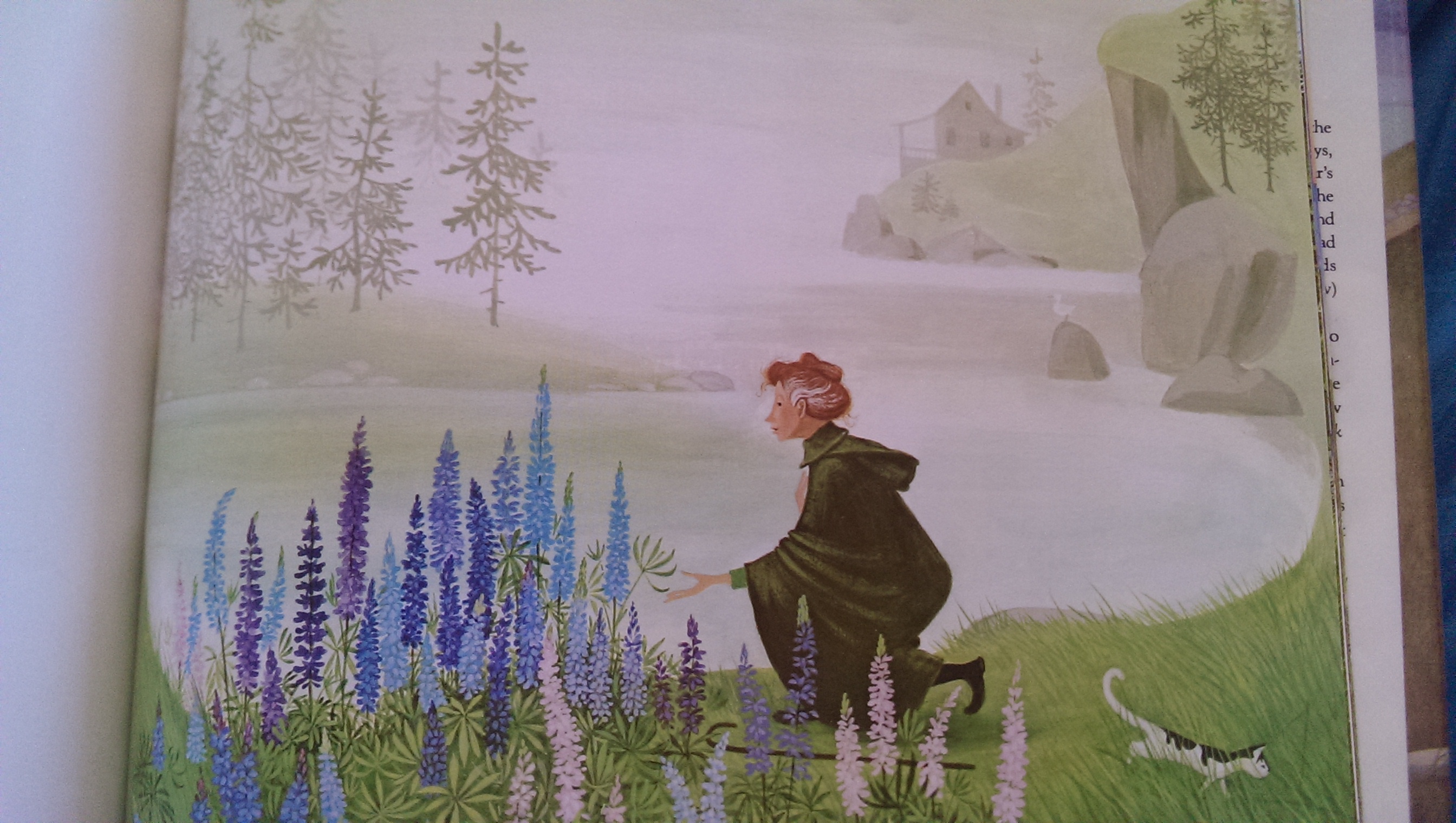
From the time she was young, Alice Rumphius wanted to travel and see the world.  She planned to return home to live by the sea when her travels were over.  However, her grandfather, an artist, gives her one more mission in life: to make the world more beautiful.  Although Alice isn’t quite sure how she will accomplish that, she agrees.

RumphiusPainting

When she grows up, she lives out her dream of traveling, seeing all the places that she read about while she working in a library.  However, she ends up hurting her back while getting off of a camel she was riding, so she decides that it’s time to retire and find a home by the sea, as she planned.

RumphiusCamel

As she recovers from her injury, she thinks about her mission to make the world more beautiful.  At first, she still doesn’t know how to accomplish that, but some flower seeds she planted and her particular love of lupines give her the inspiration for her final legacy of beauty.

RumphiusLupines

Her gift of spreading seeds of beautiful flowers gives her a reputation as an eccentric, the Lupine Lady, but it also inspires a new generation to undertake their own missions to see the world and to create beauty in their own way.

RumphiusChildren2

One of the things that fascinates me about Miss Rumphius and her story is that she leads a very non-traditional life.  She has very definite goals from childhood and sticks to them throughout her life, but they are not quite the common goals of most people, like marriage and career.  She remains unmarried throughout her life (the book never says anything about whether she had any romances in her life because that wasn’t one of her main life goals and therefore not really important to the story), and her only listed career was that of working in a library, which allowed her to have some money and to read about the places where she wanted to travel.  In the end, she is not wealthy and has no husband or children of her own, but she is happy because she has achieved the things that always meant the most to her.  She has had rich life experiences, she has made the world a little better for her presence, and she encourages her nieces and nephews to see the world, to enjoy their experiences, and to leave their own mark of beauty.

Apparently, parts of the story are based on the author’s own life and on the life of Hilda Hamelin, the original Lupine Lady.  The book is currently available online through Internet Archive.

Mystery on Taboga Island

TabogaIslandMystery on Taboga Island by Patricia Maloney Markun, 1995.
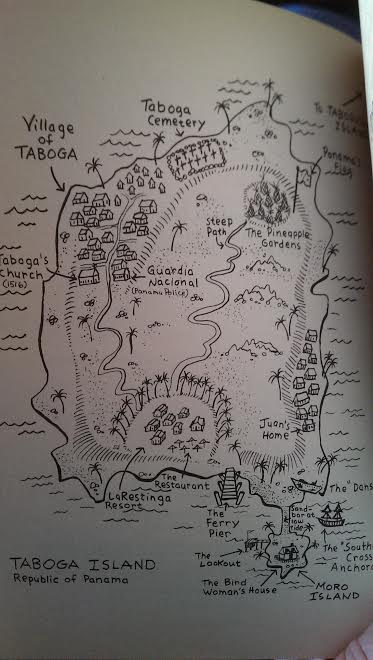
Amy is excited to be spending the summer with her aunt on Taboga Island, off the coast of Panama, near the Panama Canal.  Aunt Rhoda is a curator for an art museum, and she is writing a series of art lectures.  In particular, she has an interest in Paul Gauguin, who painted in Panama in the late 1800s.  She has invited Amy to join her for the summer not only so that she can visit another country but because of their mutual interest in art.  Amy loves drawing and painting and wants to be an artist someday.

The one drawback of going is that Amy is worried that she will be lonely over the summer.  She doesn’t know whether there will be any kids her age close by or if she would be able to talk to them if there are because she doesn’t speak Spanish.  Fortunately, soon after they arrive on Taboga, Amy meets Zoe.  Zoe is from California but she comes to visit her relatives on Taboga every year.  She introduces Amy to her cousin, Juan, as well.  The three of them become friends, and Zoe and Juan even share their special, secret hiding place with Amy: a old lookout point on an old, abandoned pier left from World War II that can only be reached by walking on a narrow beam over the water.

TabogaIslandPicThey also introduce Amy to Madame Odelle, who people call The Bird Woman because of all the birds she keeps around her house.  She is a widow who lives alone and hardly ever sees people, but she invites the children in and when she learns that Amy is interested in art, she shows them a special painting that her family has had for generations.  Madame says that her grandfather bought the painting years ago from a traveling Frenchman who was in need of money.  Amy thinks that it looks like one of Paul Gauguin’s paintings, and she knows that some of his work is unaccounted for.  However, the initials on the painting are PGO.  What could the ‘O’ stand for?

Then, the painting is suddenly stolen, and there’s no shortage of suspects.  A strange woman named Phoebe Quincy has been lurking around Madame’s house and asking questions about her.  There’s also Donald S. Deffenbach, a birdwatcher who doesn’t seem to know much about birds, and Captain Billy, an Australian who owns a sailboat that he sails himself.  Dr. Denis Dobson, who is also a Gauguin expert, also happens to be staying at the resort on the island.  He is visiting places where Gauguin painted while writing a book about him.  Could he be the thief?

I like this book for the pieces of history about Panama and Paul Gauguin, which are important in solving the mystery and understanding the origin of Madame’s mysterious painting.  One of the things I remembered most about reading this book as a child, though, was when Amy and her aunt were eating at the little restaurant on the island and her aunt urged her to try a Panamanian dish so that she could get used to trying new foods when she travels.  Amy tries a tamale for breakfast and loves it, wishing that she had been brave enough to try it earlier since she and her aunt are now planning to do more of their own cooking.  I was familiar with tamales as a kid, but not for breakfast, although I like the idea.

The book is currently available online through Internet Archive.

The Mystery of the Haunted Trail

MysteryHauntedTrailThe Mystery of the Haunted Trail by Janet Lorimer, 1989.

Brian Kelly wasn’t too excited at first when his teacher assigned his class to write letters to students at a school in Hawaii.  He doesn’t really like to write, and the whole thing sounded boring, but it turned out to be pretty fun when his new pen pal, Alani, wrote back.  Brian discovered that he and Alani had a lot in common, and he even got to meet Alani when his family came to California on a trip.  Then, best of all, Alani’s family invited Brian to spend part of the summer with them in Hawaii!

Brian loves Hawaii from the moment he arrives.  Alani’s family lives in a rural area near Kalawa.  All of the families in the area raise their own vegetables and keep animals.  They depend on what they earn from selling food although some of them, like Alani’s mother, who is a nurse, have other jobs as well.  Alani’s father, like Alani’s grandfather, is primarily a farmer.  Alani’s grandfather lives with him on land that the family has owned for generations.

Alani and his family enjoy showing Brian around their island and talking about the history of the place.  Brian particularly likes the stories that Alani’s grandfather, who they call Kupuna, tells them, although some of them are frightening.  At the luau that the family and their friends have to welcome Brian to Hawaii, Brian overhears people talking about the Night Marchers.  They say that the Night Marchers have been seen recently and that bad things have been happening in the area, like crops dying and the nearby stream starting to dry up.  Some people seem to think that it’s a sign of bad luck and that maybe they should move away from the area.

According to Kupuna, the Night Marchers are a ghostly parade of the ancestors of the people who have lived there for generations.  Sometimes, it’s just ordinary people and sometimes it’s the souls of warriors.  Sometimes, Hawaiian gods may even walk among them.  But, when they march, any living person must either flee from them or, if that is impossible, they must lie down and hide their eyes.  At the head of the Marchers is a ghostly spearman who will strike down any living person who sees them, unless that person is related to one of the Marchers themselves.  They spare members of their own families.  People who are struck by the spear of the Marchers appear to have died of a heart attack.

The place where the Marchers supposedly walk is an old trail that leads to a sacred place where Alani’s ancestors are buried.  Brian is curious to see the place, but Alani warns him away, saying that they are not allowed to go there because it’s too dangerous.  However, Brian soon sees the Marchers himself one night in Alani’s family’s fields, and the next day, their crops are dead.  When Brian notices strange footprints in the fields as well, he realizes that some living people may be responsible for the awful things that have been happening in the area, but the only way he can prove it would be to explore the haunted trail himself and track the “ghosts” to their lair.

Janet Lorimer’s books are interesting because they are often a combination of mystery and ghost story.  There are logical explanations and living villains who are responsible for the things that are happening to Alani’s family and their neighbors, but there is also a definite supernatural element to the story as well.  Telling you where one ends and the other begins may be saying too much.  It may be more fun to let you find out yourself.

The book is currently available online through Internet Archive.

The Ghost in the Tokaido Inn

ghosttokaidoinnThe Ghost in the Tokaido Inn by Dorothy and Thomas Hoobler, 1999.

In feudal Japan, more specifically in 1735, the family you were born into determined what you were meant to be in life.  Samurai were born into families of samurai, and merchants were born into merchant families.

This is a terrible disappointment to Seikei, the fourteen-year-old son of a tea merchant, who would love nothing more than to be able to become a samurai.  He has studied the samurais and their ideals and greatly admires their bravery.  He even loves to write poetry, as the samurais do.

One day, Seikei accompanies his father on a business trip from their home in Osaka to Edo (the old name for Tokyo).  On their way, they stay overnight at an inn.  There, Seikei makes friends with the daughter of a paper merchant, and she entertains him with a ghost story.  During the night, Seikei sees a strange figure that attempts to enter his room, which he fears might be an evil spirit (like the one in the ghost story), but he is unable to get a good look at it before it disappears.

The next morning, Lord Hakuseki, a daimyo (lord, nobleman) also staying at the inn, says that a jewel was stolen from him during the night.  The famous Judge Ooka comes to the inn to investigate the crime.  The paper merchant and his daughter are accused of the theft because the jewel is found among their belongings.  Seikei recognizes the jewel as one that Lord Hakuseki showed to both him and the girl the night before when they each went to show him their fathers’ wares, and he also realizes that he saw the “evil spirit” holding it.

When Seikei tells Judge Ooka all of this, his father is angry, saying that Seikei must have imagined the whole thing.  However, Judge Ooka believes him.  He points out that the silent figure was no doubt the thief, who merely looked like an evil spirit to the boy who had just been startled awake, with a ghost story still on his mind.  Judge Ooka is also impressed with Seikei’s bravery when Seikei describes how he got up to try to get a better look at the figure, even though he believed that it was an evil spirit at the time.

Judge Ooka recruits Seikei to help him further investigate the crime, and they realize that the theft is only part of a much larger and more serious plot of revenge.  Judge Ooka, himself of the samurai class, also understands Seikei’s feelings better than his father does.  In the end, he offers Seikei a way of living the kind of life that he’s always dreamed.

This book is the first in a series.  Judge Ooka was a real, historical figure, although Seikei, his adopted son, is fictional.  Because the story contains violence and some religious oppression, I recommend it for middle school level readers.  The book is currently available online through Internet Archive.