Mystery of the Golden Horn

goldenhornMystery of the Golden Horn by Phyllis A. Whitney, 1962.

Vicki Stewart doesn’t mean to get into trouble. However, with her mother in the hospital with a back injury and Vicki in the care of her unsympathetic aunts, she has allowed her schoolwork to slide to the point where she cannot go on to the next grade. Faced with the prospect of admitting her failure to her friends, Vicki decides that she would rather leave school early and skip summer camp. Instead, she will join her father in Turkey, where he has been teaching at a girls’ college. The prospect of going to a new country and facing her father after her humiliating failure isn’t pleasant, either, but Vicki sees it as her only path to a fresh start. Indeed, her life will never be the same.

Vicki’s father rents his rooms from Mrs. Byrne, an American living in a palace that once belonged to a pasha along with her son, Ken, and her distant cousin and ward, Adria. Adria is about the same age as Vicki, and she has problems of her own. Adria’s parents are dead, and she has not been happy living with the Byrnes. Adria is something of a mystery to Vicki. She’s a dreamy, unpredictable girl who believes in magic spells and fortune-telling. A gypsy friend of Adria’s has told her that her fortune is to be found with a mysterious “golden horn,” and Adria’s single-minded pursuit of it has a tendency to get her into scrapes.

Unfortunately, Adria also tends to drag Vicki into trouble, partly because she is convinced that Vicki’s fortune is intertwined with hers. Vicki resents these complications in her life that add to her “problem child” reputation. However, she sincerely wants to help troubled Adria. Strange things are happening in the house, particularly in the spooky, disused haremlik, but not all of the strange things are Adria’s fault. As Vicki puzzles over these strange things and Adria continues her search for the golden horn, the girls gain new perspectives on their lives and their problems. The solutions aren’t as far-away and mystical as they think, but the girls will have to rely on themselves and each other to see them.

Phyllis Whitney’s books are wonderful for their colorful settings and insights on human nature. Vicki’s disappointment and embarrassment over her failure are true-to-life, and her struggle to change and redeem herself is something that everyone has experienced at some point. It’s a touching and reassuring story about how to deal with failure and life’s problems. The mystery is subtle (up until the end, you’re not quite sure how much of the trouble in the house is Adria’s doing and what her motivations are), and the setting is vivid and engaging. Whitney has also included interesting historical details about Turkey and comparisons between the past and present (by 1960s standards) culture.

The book is currently available online through Internet Archive.
Mystery on the Isle of Skye

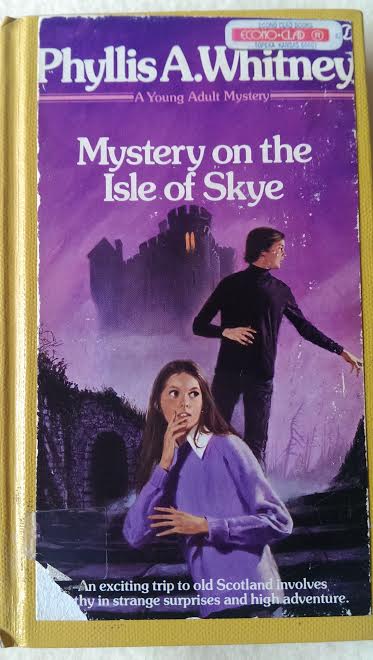
mysteryisleskyeMystery on the Isle of Skye by Phyllis Whitney, 1960.

Cathy MacLeod has lived with her grandmother for years, ever since her parents died when she was very young.  Now, her grandmother is very ill and will probably have to live in a nursing home.  Cathy needs to find a new place to live, and her relatives are debating about who is going to take her.  So far, the only relative who has offered her a home is Aunt Bertha.  Cathy isn’t enthusiastic because Aunt Bertha only has a tiny apartment where she lives alone, and she’s only offering Cathy a home out of duty, not real affection.  Aunt Bertha hasn’t spent much time around children and doesn’t really understand them.

But, there is one other prospect.  Cathy’s other relatives, the Corbins, are taking a trip to the Isle of Skye, where Cathy’s grandmother came from originally, and her grandmother has arranged for Cathy to go with them while Aunt Bertha is on a business trip.  Uncle Jerry (Cathy’s mother’s brother) and Aunt Lila Corbin have two boys of their own, Don (who is about Cathy’s age) and Humphry, who goes by the nickname of Punch.  Cathy is happy about the chance to go with them to visit the island that her grandmother has told her so much about.

At first, Cathy feels a little awkward around the Corbins because she doesn’t really know them, and they don’t know her.  Aunt Lila is warm and welcoming to Cathy, but Uncle Jerry is a tease.  Don is a tease as well and very impatient with the whole idea of the trip.  He doesn’t care about the history or legends of Skye as much as Cathy does.  His only real interest is in photography.  Young Punch is friendlier, sharing the excitement of the trip with Cathy.

Before they left on the trip, Cathy’s grandmother gave her a mysterious box to take with her.  Cathy doesn’t quite understand it at first, but the box contains several smaller packages with instructions to open them at different times during the trip.  Some of the instructions are vague and force her to rely on other people to tell her when to open them and what to do with the contents.  The packages are part present, part “spell.”  Thanks to them, Cathy makes new friends in Skye and goes on an adventure that she will never forget.

My Reaction

There is no real magic in this story, no real magic spells, and there actually isn’t much mystery either, except for the mystery Cathy initially feels about what’s in the packages and what their real purpose is.  Cathy’s grandmother has a love of legend and mystery, and these special gifts are meant to serve special purposes: to acquaint Cathy more with her past on the Isle of Skye and share some special memories, to heal Cathy’s sadness, to help draw her closer to her other relatives, and perhaps, to help her find her way to a brighter future than the one she currently thinks is waiting for her back home.

The packages help Cathy to bond with her aunt, uncle, and cousins.  They’re meant to be a shared activity.  She has to open certain packages with certain relatives, and they have to take her to certain places to do certain things with the contents.  These shared experiences help draw them closer to each other.

Although this story doesn’t follow the traditional mystery format and it can’t even be called fantasy or pseudo-fantasy, it’s enchanting because of the subtle hints of mystery and fantasy surrounding Cathy’s surprise packages.  Readers get to wonder alongside Cathy what’s in them and where they’re going to lead her.  It’s a little slower and more subtle than most modern children’s books, but I find it refreshing and magical for those reasons.

Cousins in the Castle

cousinscastleCousins in the Castle by Barbara Brooks Wallace, 1996.

Young Amelia Fairwick is living a happy life in London with her father and her father’s fiancée, Felicia, when her father leaves on a business trip and word reaches her that he has been killed in a hotel fire. Now, the poor orphaned girl must go live with her deceased mother’s cousins in New York. Amelia leaves behind everything that is familiar to her when she accompanies her stern and gloomy Cousin Charlotte on the ship to New York.

On the ship, she makes only one friend, a young actress and singer named Primrose Lagoon, whom Cousin Charlotte forbids her to see. Although the future looks gloomy for Amelia, there are far stranger and more sinister events in store for her. As soon as they reach New York, Cousin Charlotte abandons Amelia on the docks. A kind woman named Nanny Dobbins and her son offer help her, only to steal her luggage and make her a prisoner in a small cellar in a bad part of town.

When her jailer, the drunken Mrs. Shrike, falls asleep, leaving the door open, Amelia escapes and attempts to find Primrose, her only friend in the city. Throughout Amelia’s adventures, she doesn’t know who to trust, and every step she takes seems to bring her closer to the mysterious Cousin Basil, who is supposed to be her guardian, and his castle-like home.

The time period for this story is never exactly defined, but it appears to take place during the 1800s because of the gaslights in use.  Like many of Wallace’s books, things and people are not what they seem, but in spite of the villain’s sinister intentions, it all ends happily.

Ghosts in the Gallery

ghostsgalleryGhosts in the Gallery by Barbara Brooks Wallace, 2000.
Eleven-year-old Jenny was raised in China by her mother and stepfather, who ran a dance studio. She has no memory of her real father, who died when she was a baby. When her stepfather dies and her mother becomes deathly ill, her mother writes a letter to her real father’s father, a grandfather that Jenny never even knew existed before. In the letter, her mother explains that she is dying and that she will be sending Jenny to live with her grandfather. Then, Jenny starts the long journey from China to the East coast of the United States alone.

Leaving her dying mother to head to a strange country to live with her previously unknown relations is frightening enough, but there is still worse to come. When Jenny arrives at her wealthy grandfather’s home, no one is expecting her or knows who she is. Her uncle, Winston Graymark, insists that her mother’s letter never arrived. Worse still, he believes that Jenny is an imposter, and that her mother merely made up the story about his long-lost brother being her father.

At first, he angrily threatens to send Jenny back to China, but Madame Dupray, a servant who cares for Jenny’s ill grandfather, suggests that she be taken on as a household servant. Jenny is given a dreary little room in the cellar and embarks on the drudgery of household chores. Could the Graymarks really be her relatives? If so, what happened to the letter that Jenny’s mother sent? Something sinister is happening in Graymark House, and Jenny will have to face suspicious servants and attempted murder before she finds the truth.

The “ghosts” in the title are the portraits of Jenny’s ancestors, which hang in the gallery. They appear grim and frightening at first, but when Jenny begins to recognize them as her relatives, they no longer frighten her.  Like many of Wallace’s books, this book contains sinister characters with hidden motives, but ends happily.  The story takes place at some point during the Victorian era.

Abigail

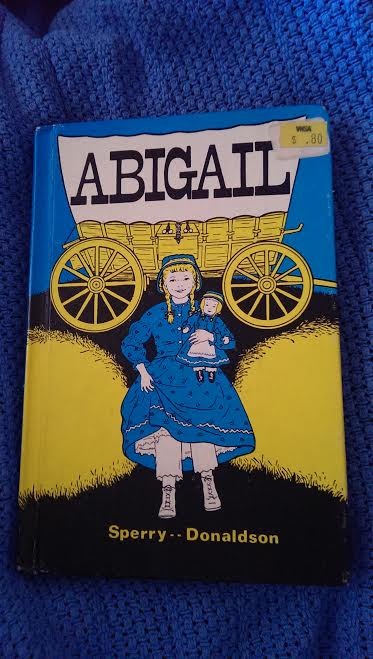
abigailAbigail by Portia Howe Sperry and Lois Donaldson, 1938.

Susan is a little girl living on a farm in Kentucky during the 1800s.  Her family has recently decided to move to Indiana, which is the new frontier of the United States.  Her uncle and his family are already living there, and he has persuaded Susan’s parents of the opportunities that await them.

As the family packs up to leave, Susan’s grandmother gives her a special present that she and Susan’s aunt made for her: a new doll.  Unlike Susan’s old wooden doll, this doll is a soft rag doll that she can sleep with.  They made the doll to look like Susan herself, but Susan names the doll Abigail after her grandmother.

Abigail accompanies Susan on her adventure as the family heads west to Indiana in their covered wagon.  Susan is sad and a little afraid at first, but when she thinks of what Abigail would say to her about her need to be brave and to explain to her all the strange things they will encounter on the journey, Susan regains her courage.

The family does have adventures on their two-week trek to Indiana.  They have to cross rivers, face down a bear, and worry about whether they will encounter unfriendly Indians (Native Americans).  Even after they arrive in Indiana, joining their other relatives, they will still have to get used to life in a new place.

Throughout the book, there are little side-stories, poems, and hymns that the family sings and tells each other.  Through it all, Abigail is Susan’s constant companion, helping her to feel at home in her new home.  I loved this book when I was a child because I always loved dolls.  This book was a bigger part of my youth than the Little House on the Prairie series, but it would probably appeal to Little House on the Prairie fans.

The book is available to borrow and read for free online through Internet Archive.

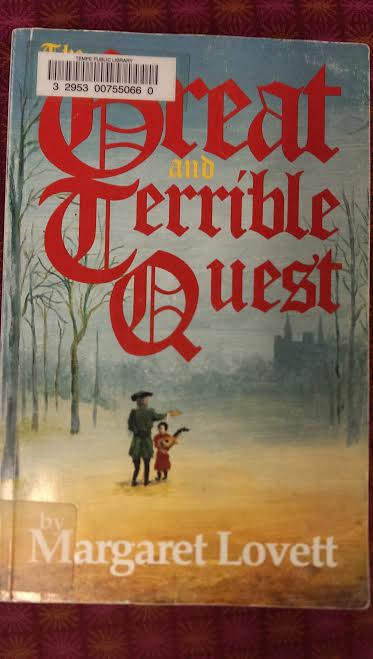
The Great and Terrible Quest

greatterriblequestThe Great and Terrible Quest by Margaret Lovett, 1970.

This story takes place in a fictional kingdom during the Middle Ages. Trad is a ten-year-old boy who has lived most of his life with his abusive grandfather. He barely remembers his parents, who died in a plague when he was only four. This grandfather consorts with robbers and evil men. Trad often pretends to be stupid to avoid their notice and warns travelers away from their territory.

One day, he rescues a man who has been badly wounded and cares for him in a secret cave. This man, whose white hair makes him seem elderly, insists that he is on a mission, a great and terrible quest . . . but because of a head wound, he can’t remember what his quest is. All that he knows is that time is short, and he does not have long to complete his quest to find something very important.

Trad soon learns that his grandfather’s wicked friends are the ones who attacked this mysterious stranger. Taking Trad’s father’s old lute, a couple of coins, and a mysterious ring dropped by one of the robbers which seems to have once belonged to the stranger, Trad and the stranger embark on a journey across the land, making friends and pursued by enemies as they go. While the stranger struggles to remember his identity and the nature of his mission, Trad begins to learn a few things about his own forgotten past and the nature of his family. Nothing is what it seems. Their country is in trouble because of the evil men who have been controlling it. Everything depends on the success of the stranger’s mission, and Trad has a much larger role to play than he had ever dreamed.

It’s a beautiful and fascinating story about good and evil, loyalty, friendship, and determination to do the right thing, even against the odds. There are parts that might frighten younger readers. The fights are violent and bloody, and there are a couple instances of cruelty to animals (partly, it seems, to show how truly evil Trad’s enemies are). Still, it’s a great story for tweens and teens, and readers will want to cheer Trad on as he struggles to help those around him and find his own destiny.

Although the kingdom is fictional and the themes are similar to fantasy stories, there is no actual magic in the story.

The book is currently available online through Internet Archive.

The Red Trailer Mystery

Trixie Belden Series

trixietrailer#2 The Red Trailer Mystery by Julie Campbell, 1950.
This story picks up immediately where the previous book in the series leaves off.  Jim Frayne, although heir to a great deal of money, ran away to keep himself and his fortune out of the hands of his scheming stepfather.  He plans to find work to support himself until he’s old enough to return and claim his inheritance in his own right.

However, his uncle’s lawyer has collected enough evidence that Jim’s stepfather is an unfit guardian that he says he can arrange for Jim to have another guardian.  Trixie and Honey travel in a trailer along with Honey’s governess, Miss Trask, searching for their friend Jim so they can tell him that he’s safe from his stepfather.

Along the way, they meet a family traveling in a red trailer. The family is dressed in ragged clothes, and they look half-starved. They seem to be very upset about something, and the parents discourage their children from talking to Trixie and Honey. For reasons the girls don’t understand, the oldest girl in the family runs away into the woods and her family leaves the trailer camp without her.

Later, the girls meet a state trooper who is looking for a trailer matching the description of the red trailer the family had. Apparently, there have been several thefts of trailers in the area recently. Could the family they met be involved in the thefts?  Will Trixie and Honey ever find Jim?

The book is currently available online through Internet Archive.

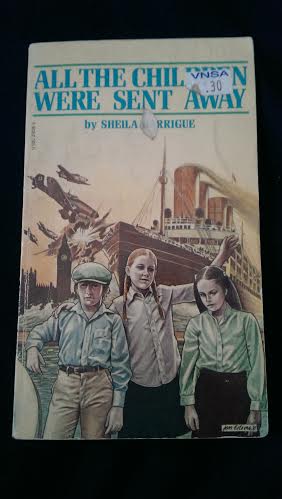
All The Children Were Sent Away

It’s 1940, and Sara Warren’s parents are sending her to stay with her uncle in Canada until the war is over.  With the increasing bombings of England, her parents have decided that it’s just too dangerous for Sara to stay, and her uncle has written, asking them to send her.  Many other British families are sending their children away to escape the bombings, and Sara travels to Canada on a ship with other British child evacuees.  All of them are worried about the families they’ve left behind and what it’s going to be like, living in another country.  They also worry about whether or not they’re ever coming back.

Sara’s escort for the trip is Lady Drume.  She is a bossy, over-bearing woman with very definite ideas about how children should be raised.  She doesn’t like Sara to talk to the sailors on the ship because they can be “impertinent,” and she doesn’t want her to play with the other children because they’re “guttersnipes!”  She even refuses to attend the lifeboat meeting or let Sara go without her!  To Sara’s mind, Lady Drume is as bad as any Nazi.

Sarah still manages to make friends with some Cockney children, Ernie and Maggie, seeing them whenever she can get away from Lady Drume, and an old sailor called Sparky makes sure that she understands safety on board the ship and attends the lifeboat drills.

But, when Lady Drume forces Sara to cut her hair after she’s been waiting so long for it to grow out, Sara decides that’s the last straw!  With the help of her friends, Sara hides from Lady Drume on the ship.  In the process, she learns something about Lady Drume which changes some things for the better, although it takes an outbreak of measles for Lady Drume to really understand and appreciate Sara.

This book is available to borrow and read for free online through Internet Archive.

Part of trouble with Lady Drume and her behavior is that she’s actually very afraid.  She doesn’t like to talk about lifeboats or life jackets because the war and the possibility of sinking frighten her.  She deals with problems by being brusque and trying to ignore frightening things, charging on ahead with whatever seems like a practical course of action to her.  It’s not even just the war but the changing world around her that frightens Lady Drume, a woman who’s used to knowing who’s who and what’s what and getting things done the way she likes them.  But, the rigors of their journey and their mutual vulnerability when they’re sick help lower Lady Drume’s barriers.  Lady Drume isn’t a bad person, and in the end, she arranges a special surprise for Sara to make her exile from England more bearable.

The end of the story is a brief section explaining Sara’s return to England, having been away for a few years, and her feelings at seeing how England and her parents have changed during that time.

There is a sequel to this book that shows what happened during Sara’s time in Canada called The Eternal Spring of Mr. Ito.  It focuses on suspicion of Japanese people following the bombing of Pearl Harbor.  There were Japanese internment camps in Canada as well as the United States during World War II.

Sheila Garrigue’s books about child evacuees from England were partly based on her own experiences as a child evacuee during World War II, as explained in her obituary after her death in 2001.