Mystery of the Silent Friends

SilentFriendsMystery of the Silent Friends by Robin Gottlieb, 1964.

Nina Martin loves her father’s antique store. Although selling antiques is how her family makes their living, there are some that Nina finds it difficult to let go of when someone wants to buy them. Nina especially doesn’t want her father to sell the two automatons that she calls Henri and Henriette. The automatons are beautiful mechanical dolls that each do something special. Nina calls the boy doll “Henri” because he writes the name “Henri Bourdon” on a piece of paper. (Her father points out that it might be the name of the maker, not the doll itself.) The girl doll, Henriette, is a little more complicated and draws a series of different pictures. Most of the pictures seem to be of a little Swiss village, although one of them is oddly of a monkey that looks like the “speak no evil” monkey in the saying “hear no evil, see no evil, speak no evil.”

SilentFriendsAutomatonsFor a time, it seems like there’s no risk of the automatons being sold because no one seems particularly interested in buying them. Then, suddenly, two different men come to the shop and ask to buy the dolls. Weirdly, each of them tells the same story to Nina’s father: that their name is George Ballantine the Third, that their family once owned the automatons, that the dolls are actually part of a set of three, that they own the third doll (a girl doll that plays the spinet), and that they want to purchase the other two in order to reunite the set. Nina’s father is bewildered by these two men with identical stories and identical names and refuses to sell the automatons because of his daughter’s attachment to them and because he doesn’t know which of the two men to believe and doesn’t trust either of them.

Nina comes to think of the two men as “Red Ballantine” and “Brown Ballantine” because of their different hair colors. Brown Ballantine seems to be the more credible of the two. He invites Mr. Martin and Nina to his home in order to show them the third automaton and, hopefully, persuade Mr. Martin to sell him the other two. They visit Brown Ballantine’s apartment in an old brownstone, and he shows them the beautiful, spinet-playing doll as well as the rest of his collection of mechanical toys. However, Mr. Martin still refuses to make the sale.

SilentFriendsMechanicalToys

Nina tells her friend, Muffin, about the two mysterious Ballantines. The two girls are curious about which of the men is the genuine George Ballantine the Third and decide to investigate. When “Red Ballantine” comes to the shop again, trying to persuade Mr. Martin to sell the automatons, the girls ask if he would consider showing them the automaton he owns as a test. At first, the red-haired man is hesitant, but then he agrees that they can come and see his doll. Mr. Martin is embarrassed at the girls’ forwardness in asking, but he admits that he is also curious about the two Ballantines.

SilentFriendsSpyingAt first, they all expect that Red Ballantine won’t be able to show them the third doll and will give up trying to buy the other two, but to their astonishment, he takes them to the same apartment where Brown Ballantine said that he lived and shows them the exact same doll they saw before. Instead of clearing things up, the identities of the two men seem to get all the more confusing. However, Muffin notices something strange about the tune that the doll plays on the spinet that gives them a clue as to why the three dolls are so important.  Later, someone breaks into the antique store and uncovers a hidden secret about Henri as well.

Together, the three automatons are hiding a secret, and only by considering the message that each of them offers can the girls discover what it is.

The book is currently available online through Internet Archive.  There is also a sequel to this book called Secret of the Unicorn, which involves a secret message hidden in a tapestry.

My Reaction

Although I was pretty sure which of the two Ballantines was the genuine one, I was never completely sure until almost the end.  In a way, I was a little disappointed by the dolls’ final secret because I though it was something that was especially old, from when the dolls were first created, but the secret messages were actually a more recent addition to the dolls’ repertoire by an eccentric man with a treasure to hide and a taste for practical jokes and riddles.  Muffin is a habitual practical joker, and that partly figures into the solution of the mystery.

I thought it was kind of interesting, too, that Mr. Martin has the habit of walking around with a cigarette in his mouth that he never lights, like Inspector Cramer in the Nero Wolfe mysteries.
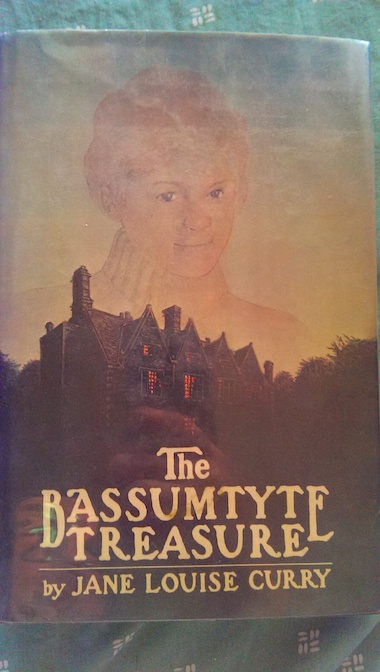
The Bassumtyte Treasure

BassumtyteTreasureThe Bassumtyte Treasure by Jane Louise Curry, 1978.
When young Tommy Bassumtyte’s parents died, he went to live with his grandfather. However, his grandfather is now dead, and he is living with his 92-year-old great-aunt, who is in a wheelchair, and her 72-year-old daughter, who has recently had her driver’s license revoked due to her poor eyesight. Although the pair of them have taken good care of Tommy, neighbors have become concerned that they will not be able to do so for much longer because of their age and failing health. Rather than see Tommy sent to a foster home, they decide that he must go to the man who Tommy learns should really be his legal guardian, a distant cousin also named Thomas who lives in the family’s ancestral home, Boxleton House, in England.

The elder Thomas Bassumtyte, who should have taken Tommy when his grandfather passed away, has also since died, but his son, also named Thomas, agrees to take him. Tommy is quickly shipped off to England before there can be a custody hearing in the United States about him because the relatives fear that some official might try to prevent Tommy from being sent out of the country. Tommy is eager to go because he remembers fantastic stories that his grandfather told him about Boxleton House. The current Thomas Bassumtyte also lives there, although the place has become rather run-down, and he fears that he will not be able to keep the place much longer. Thomas was a mountain climber, but he was injured in a fall and hasn’t been able to work much since. He tells Tommy that the two of them might have to move when he is fully recovered and can do more work for the Foreign Office, but Tommy loves Boxleton House from the first moment he sees it and wants to stay.

According to the lore of Boxleton House, a distant ancestor of theirs hid a treasure there, but no one has been able to find it. If young Tommy and Thomas can find it, it would solve many of their problems, and they would be able to keep the house and restore it. All young Tommy has is the mysterious rhyme that his grandfather told him and the strange medallion that his great-grandfather brought with him when he went to the United States in the late 1800s. Thomas tells him that the treasure was supposedly hidden by a distant ancestor of theirs who was fond of riddles, called Old Thomas.

The Bassumtytes were secretly Catholic during the reign of Elizabeth I. Old Thomas was alive then and had a son called Tall Thomas. Tall Thomas traveled frequently and was mysterious about the places he went. One night, he returned to Boxleton House with a young baby, who he said was his son. He had married in secret, and his young wife had died shortly after giving birth. Tall Thomas also brought her body back to Boxleton for burial. However, that wasn’t Tall Thomas’s only secret. Although he remarried, giving his son a stepmother, and lived on for a number of years, he was eventually executed for smuggling messages for the captive Catholic queen, Mary, Queen of Scots. The family was stripped of its noble title and only barely managed to hang onto their house and land. If there was a treasure hidden during this time, it was probably something that the Bassumtytes were afraid would be confiscated by the queen’s soldiers as punishment for the family’s disloyalty or something that Mary had given to Tall Thomas to hide for her.

As Thomas tells Tommy more about the house and the family’s history, he points out Tommy’s uncanny resemblance to Small Thomas, Tall Thomas’s son, as shown in an old painting. Tommy feels a strange connection to Small Thomas, and begins seeing and hearing strange things. An older woman comforts him in the middle of the night, having him recite the same rhyme that his grandfather taught him. A small painting later reveals that this woman was Small Thomas’s grandmother. She appears to Tommy other times, giving him a glimpse back in time and clues to solve the puzzles of Boxleton House.

It is only when Thomas accepts the advice of a family friend who works for a museum that they come to understand the full significance of their family’s heirlooms and the hidden treasure. The treasure may not be quite what the Bassumtytes have always believed it was, but then, the Bassumtytes themselves aren’t quite who they always thought they were, either.

The book is available to borrow and read for free online through Internet Archive.

Meg Mackintosh and The Case of the Missing Babe Ruth Baseball

Meg Mackintosh Mysteries

MMBaseball

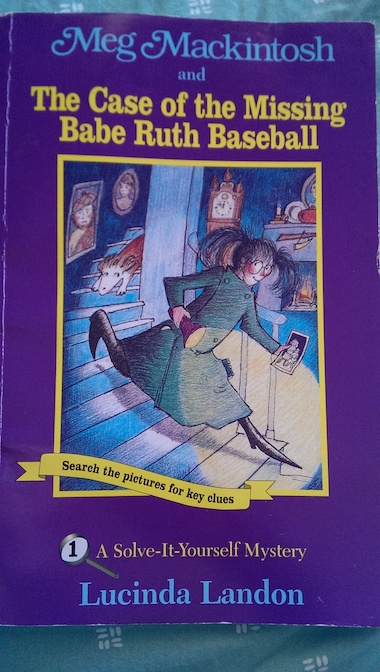
Meg Mackintosh and The Case of the Missing Babe Ruth Baseball by Lucinda Landon, 1986.

MMBaseballAlbumThis is the first book in the Meg Mackintosh series, and it was the first mystery story that I ever read, when I was about seven years old.  It started a life-long love of mysteries!

Meg’s grandfather shows Meg and her friend Liddy some old family photographs and tells them about the time when his cousin Alice took his prize possession: a baseball autographed by Babe Ruth.  Alice was a bossy girl who always liked to tease him, and so she created a kind of treasure hunt, challenging him to solve it in order to get the baseball back.  Unfortunately, he could never figure out the clues and still doesn’t know what happened to the baseball.

Meg’s brother, Peter, has a Detective Club, but he refuses to allow Meg to join, saying that she needs to prove that she can solve a mystery.  Seeing this as her chance, Meg decides that she’s going to solve this old puzzle and find the Babe Ruth baseball!  However, she also has competition from Peter, who thinks that he’s the better detective and tries to send Meg off in the wrong direction.

The book is currently available online through Internet Archive.

My Reaction

All of the books in the Meg Mackintosh series allow readers to try to solve the mysteries along with Meg, stopping periodically to ask them if they’ve noticed a clue that Meg has noticed or if they know what the significance of a clue is.  There are pictures to help, and readers are invited to stop and study the details before moving on. I think this is a good way to introduce children to puzzle-solving and help them develop critical thinking skills and an ability to notice details. I would recommend adults reading these books, or at least the first one or two along with children, so they can discuss the stories and clues with them, helping them spot clues as they begin to get used to the format of the books.

This is an excellent series for introducing children to the mystery genre for the first time! When I was young and just learning what mysteries were, I was fascinated to discover that I already had all of the knowledge I needed to solve this mystery along with Meg because all of the clues to Alice’s treasure hunt had to do with nursery rhymes. If you can recognize the rhymes in the book, you’re well on your way to solving the mystery!

Pirate Island Adventure

pirateislandPirate Island Adventure by Peggy Parish, 1975.

The Roberts kids must solve another family treasure hunt! This time, they are staying with their grandparents at the family’s vacation home on Pirate Island. It has been many years since the family has been able to go there during the summer. For years, they rented the house out to a couple who lived there most of the time, and the grandparents could only go there when the couple left to visit relatives at Christmas. Now, the house is vacant again, and the grandparents have decided to take the Liza, Bill, and Jed there for the summer.

The last time that their grandfather spent the summer there as a child, his older brother decided to take something from every member of the family and make a treasure hunt just like the old family treasure hunt that the kids solved in Key to the Treasure. Just like that treasure hunt, other circumstances arose that kept the treasure hunt from being solved, so no one ever got back what grandfather’s brother hid. The only clue they have to the treasure now is a picture that grandfather’s brother drew. Since the children were able to solve the last treasure hunt, their grandfather is hopeful that they will be able to solve this one, too.

Unlike other treasure hunts that the Roberts kids solve, this treasure hunt does not involve codes and word games.  The clues are given in the form of drawings, most of which (unfortunately) are not shown to the readers.  The readers wouldn’t have a chance to solve the puzzles anyway because the objects in the drawings are things which the children’s grandfather has to recognize, places where he and his brother went as kids.  This book also introduces Hermit Dan, who appears in another book.

This book is part of the Liza, Bill, and Jed Mysteries series.

The Haunted House

hauntedhouseThe Haunted House by Peggy Parish, 1971.

The Roberts family is moving to a different house across town because they want a bigger place to live. Liza, Bill, and Jed are not very happy about moving, at least at first, because they will be farther away from their friends, especially Jimmy and Mary, who have been their best friends and next door neighbors. Liza is also worried because the house they will be living in is the old Blake house, which is rumored to be haunted. A couple of past caretakers have left because they claimed to hear ghostly noises.  The boys tease her about it, and their father insists that there is no such thing as ghosts.

The house is definitely much bigger than their old one, and there is a barn, a garden, and a large wooded area on the property. When they actually move in, the kids become fascinated with the old things in the attic, which the children are allowed to go through.  The kids also plan to start building a tree house.  The boys become excited about the house, but Liza is still nervous about the ghost stories.

Then, strange notes and coded messages appear for the children, starting with a note taped to Liza’s window in the middle of the night. Little presents are left for them in a hollow tree with promises of bigger surprises later. Who is sending these messages? Could it be the ghost?

Like other books in this series, there are coded messages and word games that the readers can solve alongside the children.  Some of them are easily recognizable, like word scrambles and Pig Latin, and others are a little harder.  The kids walk readers through their solutions, but readers can attempt the puzzles on their own first.

The book is available to borrow and read for free online through Internet Archive.

Key to the Treasure

keytreasureKey to the Treasure by Peggy Parish, 1966.

When twins Liza and Bill and their older brother Jed visit their grandparents for the summer, their grandfather tells them the story of a treasure hidden somewhere on their farm. Over a hundred years ago, their great-great-grandfather was friends with an Indian (Native American) woman. When she died, she left her belongings to him, including a feathered bonnet, a leather shield, a mask, and a doll.

When he grew up, he went away to fight in the Civil War. Before he left, he hid three of the items (the shield, the mask, and the doll) and made up a series of clues to help his children find them.  Unfortunately, the first clue was lost, and he never returned to tell his children where he hid the treasure. The only clue that was left was a picture of the feathered bonnet, a little pot, and a strange-looking key.  From then on, each generation in their family has tried to solve the puzzle. Since so many generations of their family have failed to find the treasure, Liza, Bill, and Jed don’t have much hope for success until they accidentally stumble on something that gives them their first clue.

keytreasurepic1Together, the three children quietly work on the clues, following each to the next.  They hope to surprise their grandfather with the solution to this old family mystery.  But, can they?

The clues to the treasure take the form of word games and codes (the first is a simple substitution code, and the other two are word games). Young readers will find it challenging to solve the codes along with the children in the book (Liza, Bill, and Jed walk readers through their solutions as they work on the puzzle, even showing how they correct for mistakes along the way), although older readers may find them rather easy.  It’s a good book for introducing children to codes and word games if they haven’t really encountered them before.  For the challenge of it, you can stop reading at each new puzzle and attempt to solve it before the kids do!

This is the first book in the Liza, Bill, and Jed Mysteries series.  It is currently available online through Internet Archive.

Mystery Up the Winding Stair

Harry Hunter and his mother have been living with his grandfather in his big mansion while his father is in Japan doing work for the government. His family has owned the mansion for a long time, and it has a small museum in it containing Native American artifacts and things relating to pioneer life, including a small log cabin built in a large room up a winding staircase.

When Harry’s mother goes on a trip to see his father, Harry and his grandfather invite Harry’s cousins to visit them: Ned and his sister Lou, and Carol, whose family has only recently moved to the area.  When the children try to decide what they would like to do together, Carol suggests a treasure hunt.  Their grandfather sends them on a treasure hunt to find something that he hid himself a long time ago: a set of silver spoons made by Paul Revere and a diamond. The explanation is that the grandfather is rather absent-minded and has forgotten where he hid the treasure, although he knows that it’s somewhere in the house.

A storm leaves them all snowbound in the mansion, but they are not alone. There are mysterious footsteps, someone using a secret staircase to the attic, and signs that the bed in the cabin has been slept in. The children begin to realize that someone else is in the house with them, and this person wants the treasure for himself!

This book is out of print, but you can borrow and read it online for free through Internet Archive.  Internet Archive requires you to sign up for an account to borrow books, but the account is free, and you read the books directly in your browser.  There are no overdue fees because the books simply disappear from your virtual loan list when your time is up.  You are allowed to re-borrow books as long as copies are available (not being “borrowed” by other people).

The house the mansion in the book was based on was the old summer home of Governor Washington Hunt, located in Lockport, New York. (I learned about the house from an article about the story behind the book and an event related to the book that was held at the library in Lockport, but the site that had the article doesn’t have it up anymore. I think I saved a copy somewhere, but I’m having trouble finding it right now.)  It was called Wyndham Lawn and later became a children’s home. It’s now a private school called the Henrietta G. Lewis Campus School.  When the author, Helen Fuller Orton, was young, some of her relatives rented Wyndham Lawn from its owner, and she lived with them for a time.  In the article, the author noted that the house had been changed somewhat since the time when she lived there in the 1880s in order to accommodate the needs of the children’s home.

When I first read this book, I thought that the part about the grandfather simply forgetting where he hid an important treasure was a little cheesy, but the treasure hunt in a mansion with its own museum is fun. It’s a little spooky when the kids realize that there’s an intruder in the house with them while they’re snowbound, although it’s pretty obvious to readers of the story who the intruder was. The house really makes the story because it is a fantastic setting! It’s a very cozy mystery for winter.

I enjoyed the story and learning about the history of the real house. I also considered what Harry’s father is doing in Japan because this book was published just after WWII. I don’t think they ever explain why Harry’s father is in Japan on government work, but I’m sure he’s involved with the occupation and reconstruction of Japan after the war. It’s a subtle reference to current events at the time this story was written that’s not part of the main story but is used as part of the reason why the main story is happening.