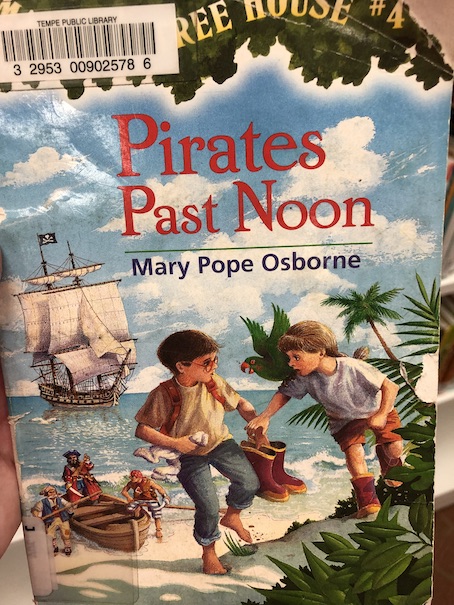
One rainy afternoon, Annie urges Jack to go to the tree house with her because she has a feeling that they will soon meet its mysterious owner. When they arrive, no one is there, so the kids start looking at the books. The day is cold and wet, and Annie shows Jack a picture of a sunny beach, saying that she wishes they were there. Soon, they find themselves on the beach.
They have fun at first, but then some pirates come to the beach, looking for a treasure buried by Captain Kidd. The evil pirate, Cap’n Bones, makes the kids prisoners aboard his ship until they figure out where the treasure is hidden from the clue written on the captain’s map.
The clue says that the treasure is hidden underneath the whale’s eye, and from the ship, Jack and Annie realize that the island is shaped like a whale with a big boulder for its eye. The kids make the pirate captain take them back to the island in exchange for telling him where the treasure is. While the pirates are digging for the treasure, a parrot flies over, saying, “Go back!” The pirates take that as a sign of an approaching storm and flee, leaving the kids behind.
A storm does come, but Jack still has difficultly tearing himself away from the treasure that they’ve uncovered. Finally, the parrot convinces him to leave, and he and Annie use the tree house to go home again.
Once they’re back in Pennsylvania, the parrot appears and turns into a woman and says that she’s Morgan le Fay. She is the owner of the tree house and the amulet. Besides being King Arthur’s sister and an enchantress, she is also the librarian of Camelot. She has been using the tree house to travel to other times to collect books that the scribes in Camelot can copy for their library. She put the spell on the tree house so that she can travel to some of the places in the books herself. The kids can use the spell only because Annie truly believes in magic and Jack really loves books. She and the tree house disappear as the kids head home, but Jack discovers that she left her amulet with him as a sign that she will come back.
I was surprised that the owner of the tree house turned out to be Morgan le Fay, both because an Arthurian character didn’t seem to quite fit with a magical children’s tree house and because Morgan le Fay wasn’t one of the good characters in the Arthurian legends. The exact nature of the character of Morgan le Fay changed through different retellings of the Arthurian legends, and she wasn’t always an adversary or villain, but she does do things in some of the stories that wouldn’t make her a good heroine for children’s literature. However, none of that matters in this series because, here, she’s just an enchantress from Camelot who is interested in books.
The book is currently available online through Internet Archive.
The Secrets of the Pirate Inn by Wylly Folk St. John, 1968.
One day, Jack, Amy, and Sally’s mother receives some surprising mail for her deceased father. The children never met their grandfather, who died before they were born, but the letters concern their grandfather’s Uncle Will. Uncle Will is an 88-year-old man, and one of the letters is from Miss Dibble from the Welfare Department in Port Oglethorpe, Georgia, the seaside town where Uncle Will is living. Miss Dibble is concerned that Uncle Will is no longer in his right mind and not capable of taking care of himself, and she is hoping that his family will persuade him to go live in a retirement home.
The children’s mother says that Uncle Will was an adventurer and a wild character even in his younger years, always playing games and doing eccentric things, so the situation may not be as bad as Miss Dibble thinks it is. The mother has never met Uncle Will, either, because her grandmother disapproved of him and discouraged him from hanging around the rest of the family years ago. She knows that her father always thought of him as being a fun uncle and that he used to own some land in North Georgia, where he found a priceless diamond.
The
second letter comes from Uncle Will himself.
It contains a strange rhyme and a letter to his deceased nephew, saying
that he sold his land and that the money from that sale and his diamond will go
to him upon his death. Uncle Will says
that Miss Dibble is pressuring him to turn over his money to the state and to go
live in the old folks’ home. He’s been
resisting her efforts, but he admits that he has gotten absent-minded and has forgotten
where he hid his money and diamond. He
knows that the rhyme he wrote down is a clue that he made to remind himself of
the hiding place, but now he’s confused, and he’s hoping that his nephew can
help him figure it out because it’s based on a game they used to play years
ago. Because it’s been so long since he
last spoke to the family, he has no idea that his nephew has died. Uncle Will also says that he is currently
living in an old pirate’s inn near Port Oglethorpe that has its own secret
passage where pirates used to shanghai sailors.
The children think that Uncle Will and his pirate’s inn sound exciting, and they’d like to go meet him. Their mother says that she’ll have to talk to their father about it, but she thinks that it might be a good idea for them to go and check up on Uncle Will and talk to Miss Dibble. She makes up her mind when Miss Dibble sends an urgent telegram in which she says that Uncle Will is under the delusion that someone is now hiding in his house and trying to kill him for his money. The mother and the children decide to go see Uncle Will, although the father of the family can’t go because he has a business trip.
Of course, Uncle Will isn’t delusional, and there is someone after his hidden money. The old inn where Uncle Will lives is called The Bucket of Blood. When the children and their mother arrive, Uncle Will pretends to be an old pirate parrot, calling out “Pieces of eight! Pieces of eight!” (Yes, he’s definitely an eccentric, and it’s a little more understandable why Miss Dibble thinks he might not have all of his faculties.) They introduce themselves to Uncle Will, and Uncle Will is sorry to hear that his nephew is dead, but he is pleased to meet his nephew’s daughter and her children. The children tell him that they want to help him to solve the rhyme and find his money.
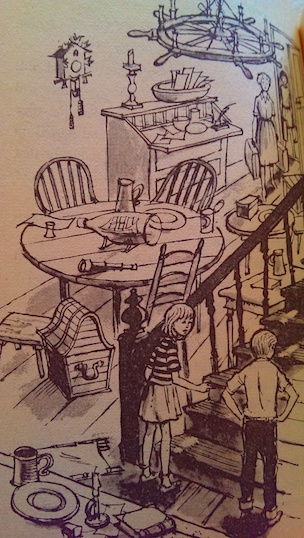
The inn is full of fascinating things, although it’s lacking in modern conveniences. The mother asks Uncle Will if they can stay there, saying that they’ve brought sleeping bags with them. Uncle Will tells them that they can use the bedrooms upstairs but warns them that he’s worried that someone might be hiding somewhere upstairs (as Miss Dibble had said earlier). Uncle Will rarely goes upstairs these days because he finds it difficult to climb up there. However, the children realize that Uncle Will is not deluded when they notice footprints in the dust on the stairs, meaning that someone has been there recently. However, the footprints seem to be only going up, not down. When the search upstairs, they don’t find anyone. Where the footprints left by a ghost? Was someone really hiding in the inn, and if so, how did they leave?
There is a live action made-for-tv Disney movie based on this book. You can see the entire movie online at Internet Archive. The movie is different from the book in a number of ways. In the movie, there are three children, but it’s two boys and a girl (a brother and sister and the brother’s friend) instead of two girls and a boy (all siblings), and none of them are related to the old Irish sea captain living in the old inn. (Note: The child characters in the movie, Scott, Tippy, and Catfish, also appeared in another made-for-tv Disney movie called The Strange Monster of Strawberry Cove, which was also based on a book for children, The Mad Scientists’ Club, but that book was written by a different author, and none of those children actually appeared in either this book or that one.) The old captain in the movie has recently inherited the inn from his brother. The location was moved to Louisiana instead of Georgia, and the treasure they’re looking for was hidden by the pirate Jean Lafitte. There are rhyming clues to the treasure’s location, but they’re not the same as the rhymes in the book. The money and the diamond are also hidden in separate locations in the book. In fact, although the bulk of the money is in one place, some of it is hidden in other places.
In the book, there are also extra characters, a man named Miles who is staying with Uncle Will while he’s working on writing a book and a young runaway nicknamed Hop who is afraid that he will be sent to another foster home like the one he ran away from if Miss Dibble catches him. At first, I suspected one of these characters of being the villain of the story, trying to steal Uncle Will’s money. However, the real villain is someone we don’t really know until the end, although he has connections to other people in the story. This is different from the movie, where the villain is a suspect we meet and see often before his guilt is established. Because of this, I think that the movie was playing more fair with the readers about the mystery.
Near the beginning of this book, the characters reference The Joyous Season by Patrick Dennis (also the author of Auntie Mame), which was published only a few years before this book was. Sally thought that the book was hilarious, but Jack thought that it was boring because the boy in the story, who was his age, “didn’t have a thing to do every day but listen to grownups talking.” I think this is meant to be a sign that the children’s parents are pretty modern and progressive, letting their children read a book about divorce and mixed-up family life in the 1960s. At one point, the mother tells Jack not to use euphemistic swear words like “Cripes!” just because characters in books to it. It gets on the mother’s nerves because she thinks that “They sound even worse than the words they’re being used to avoid.” She actually tells Jack, “When you’re old enough to swear by any words you like, I hope you’ll manage without euphemisms.” I mentioned in my page of 1960s children’s books that the 1960s were a turning point both in society and children’s literature, and this is an example of people’s changing attitudes. Sally, the oldest of the children, is allowed to wear lipstick, and Amy, who is twelve, is also allowed to wear it, although she thinks of it as being too much trouble to bother most of the time. (I can relate. I still sometimes throw out old make-up that I just plain forgot that I had because I’m too busy and preoccupied most of the time to think about it.)
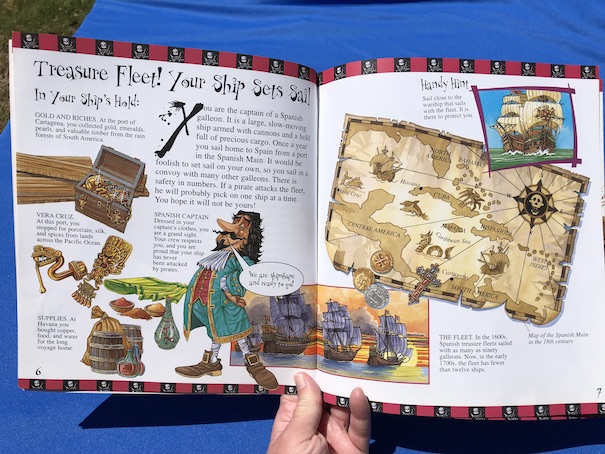
You Wouldn’t Want to Be a Pirate’s Prisoner by John Malam, 2002.
This
picture book, which is part of a series, explains what it would have been like
to be a pirate’s prisoner in the 18th century. It sets the stage by casting the reader in
the role of a Spanish ship captain in 1716.
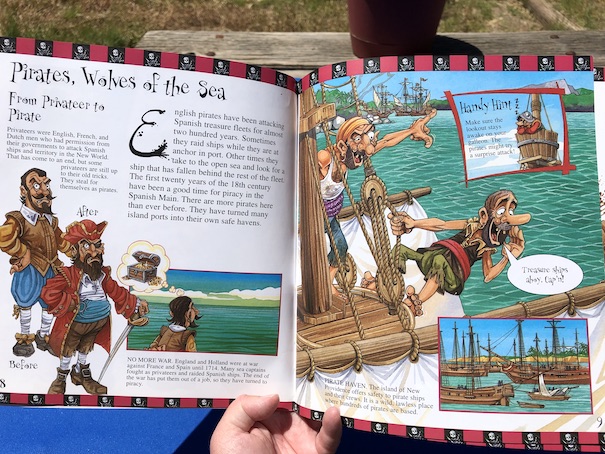
The reason why the reader is cast as a Spanish captain, captured by English pirates, is because England and Holland had been at war with Spain until 1714. During the war, the government of England (as well as Holland and France) authorized some ship captains to act as privateers, conducting raids on Spanish ships and outposts. When the war ended and the privateers were dismissed from service, some of them continued to act as independent pirates.
The book explains the geography of the “Spanish Main,” the area between the southern coast of North America and the northern coast of South America – basically, the Caribbean Sea and its islands and the Gulf of Mexico. Spanish galleons in the 18th century carried gold and treasures from the Americas to Spain as well as timber from the rainforests and goods that were transported to the Americas across the Pacific Ocean, such as spices and silk. All of these goods made Spanish treasure ships tempting targets for English pirates.
As a Spanish ship’s captain, there were a few precautions that you could take against pirate attack. One of the most basic was traveling as part of a convoy because pirates would be more likely to attack a lone ship than one that was part of a group. A fleet of ships would have a warship traveling with them for protection, and the closer your ship sailed to the warship, the less likely a pirate ship would try to separate you from the group and attack.
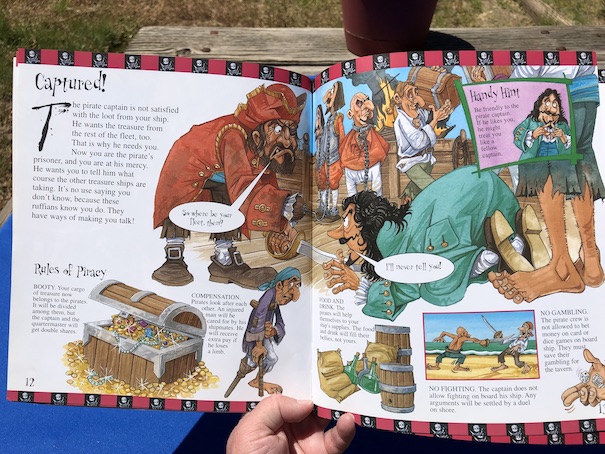
If the
worst situation happened and the ship was taken by pirates, a captain could try
to dress like other members of the crew to disguise his rank, but that didn’t
always work. The captain of the ship was
in danger of being taken captive because he might have information that the pirates
would find useful, like the exact route of other ships in a convoy.
The gruesome part of this book (and the source of the title, because this series basically focuses on the gruesome parts of history) is the part where they describe different forms of torture that pirates might use on a ship’s captain to convince him to tell them what they wanted to know. Besides the direct physical abuse, pirates could also keep a captive in squalid conditions to make him weaker, more vulnerable, and exposed to disease. In the end, they might simply decide to maroon the captive somewhere, even if they got the information they were after.
However, pirates could also face gruesome fates if they were caught. They could be hung and their bodies displayed publicly, as a warning to others.
Kate’s family is spending the weekend at a cabin at Spirit Lake, and Kate is allowed to bring her Sleepover Friends with her. However, what promised to be a fun and exciting weekend soon comes with complications. First, Kate discovers that the Norwood family will be in a cabin nearby. Dr. Norwood is a colleague of her father’s, but his two sons, Sam and Dave, are pests who like to play practical jokes. When they arrive at the cabin, there is also no electricity (a problem that they fix the next day), and they learn that the reason the lake is called Spirit Lake is because there are some scary stories about the place. Kate’s father tells the girls a story before bed about an old fur trapper who murdered another fur trapper for his money. The ghost story is interrupted by Dr. Norwood, who comes over to see if everything is all right because there have been some break-ins in the area recently.
The
girls are spooked by the ghost story, but the next day, they also encounter the
Norwood boys and realize that they’re every bit as awful as Kate remembers
them. First, Sam and Dave trick a couple
of the girls into wading out into a deeper area of the lake so that they’ll
fall in and get wet. Then, when the
families meet for a barbecue, the boys give a couple of the girls worms in a
bun instead of sausages.
Because
of their bad experiences with the boys, the girls are allowed to go back to
their cabin while the others finish the barbecue. While the girls are at the cabin, they
accidentally find a secret hiding place in the fireplace with a pouch of old
coins inside! The girls wonder if that
could be the stolen money from the ghost story, but Stephanie, who has been
reading a book about ghost stories from the area, says that the dates on the
old coins are later than the story took place.
According to the book, a ghost child was once seen around their cabin,
but the girls can’t figure out why a child would have hidden so much money.
While
the girls wait for the adults to return from the barbecue, they fix dinner for
themselves and decide to hold a séance to contact the spirits. They don’t really believe that the séance will
work when they try it, but without any tv or radio, they don’t have anything
else to do, and they can’t get their minds off the ghost stories.
To the girls’ surprise, they actually hear strange knocks in reply to the questions that they ask the spirits. Then, a child’s giggle convinces them that it’s just the Norwood boys, spying on them and trying to scare them again. It’s the last straw, and the girl plot how to get even with the Norwood boys!
The book is currently available online through Internet Archive.
My Reaction and Spoilers
This is one of those stories that has a somewhat ambiguous ending. When the girls try to catch the Norwood boys playing ghost, they instead discover the identities of the people behind the recent break-ins at the cabins. Later, they learn that Sam and Dave actually have alibis for the time that they heard the ghost noises, leaving them wondering if the knocking and giggling could have actually been a ghost. The girls do manage to play a prank on the boys before the end of the story, but they never learn the story behind the old coins.
I liked the part where they never firmly establish whether or not there was a ghost because it’s fun to leave people wondering. People who like ghost stories can imagine that the girls did hear a ghost, but if you don’t like the scary explanation, you can imagine that there’s another explanation for the noises. However, I found the lack of resolution behind the presence of the coins a little disappointing. The owner of the cabin they were using lets each of the girls keep a single coin as a souvenir (and the coins really are valuable collectors’ items) and gives the others to a local museum. I think I would have liked the story better if the girls found an explanation for the presence of the coins at the museum, so at least part of the story would be resolved.
There are two main theories that I have behind the events in the story. One is that the thieves in the area hid some stolen coins in the cabin for some reason and they were the ones trying to scare the girls during their seance. The other is that the mystery of the coins ties in with the child ghost in some way, hinting at dark unknown deeds from the past. Alas, there is no confirmation about which of these theories, if any, is true.
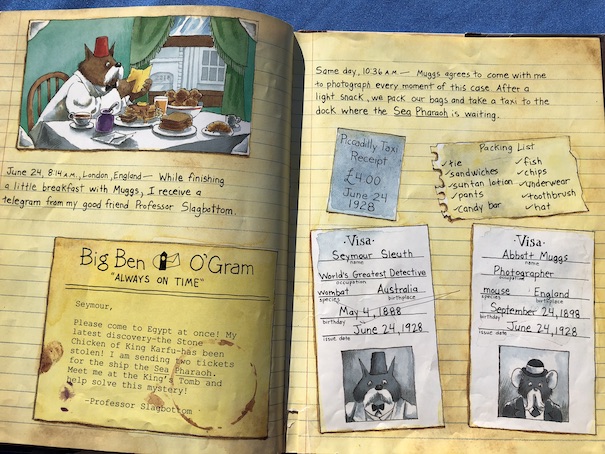
Seymour Sleuth, an Australian wombat living in London, introduces himself as “the greatest detective in the world.” His friend, Abbott Muggs, a mouse, is a photographer who assists him in his cases and documents them. When the story begins, Seymour receives a telegram from his friend Professor Slagbottom, who is working on an archaeological site in Egypt. Someone has stolen one of their finds, the Stone Chicken of King Karfu, and he needs Seymour’s help to find it! Seymour and Muggs head for Egypt!
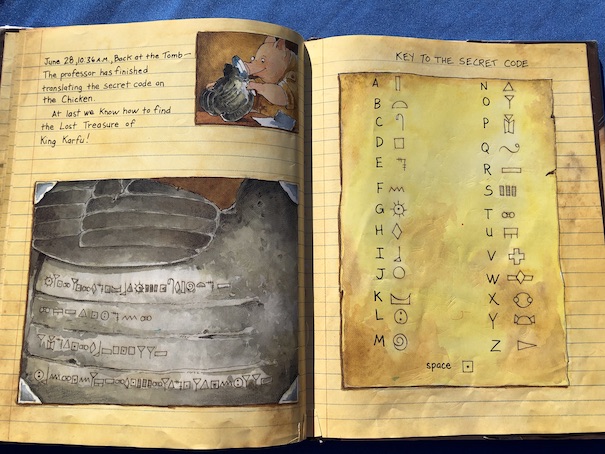
King Karfu was a wealthy pharaoh and a wonderful cook, and the Stone Chicken may provide clues about the Lost Treasure of King Karfu, the nature of which is unknown. When they reach the dig in Egypt, Professor Slagbottom explains that he was researching a message in code on the outside of the Chicken when it was stolen. The suspects are the other people on the dig, who may be trying to steal King Karfu’s Treasure.
Seymour interviews the suspects one at a time and considers their connection to clues found at the scene of the crime. As an adult, I figured out who the culprit was pretty quickly, but for the benefit of child readers, Seymour provides notes about the clues and suspects to help them understand the connections. The pictures in the story also provide important clues. After Professor Slagbottom’s decoder is stolen, Seymour realizes who the thief is.
After they get the Stone Chicken back, readers can use the decoder provided to solve the code and learn where the Treasure is. It turns out that the Treasure is actually a recipe, written in the same substitution code – for peanut butter and jelly sandwiches!
I always like mysteries that involve codes and puzzles, and this cute animal mystery would be fun and challenging for young kids. With the key provided, it would be a good introduction to substitution codes for kids who have never seen them. There is one other book with Seymour Sleuth, The Mystery of the Monkey’s Maze. The author, Doug Cushman, is also the author of the Aunt Eater Mysteries.
The book is currently available online through Internet Archive.
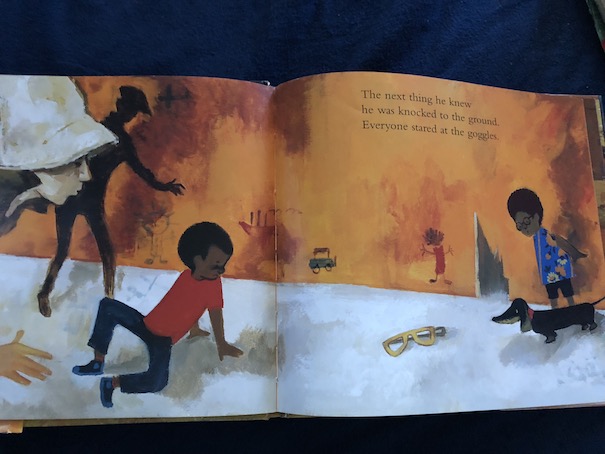
Peter and his best friend, Archie, live in a big city (probably New York City), and they often play in empty lots between the apartment buildings. One day, Peter and Archie are playing in a lot filled with old, discarded junk, when Peter finds a special prize: a pair of motorcycle goggles!
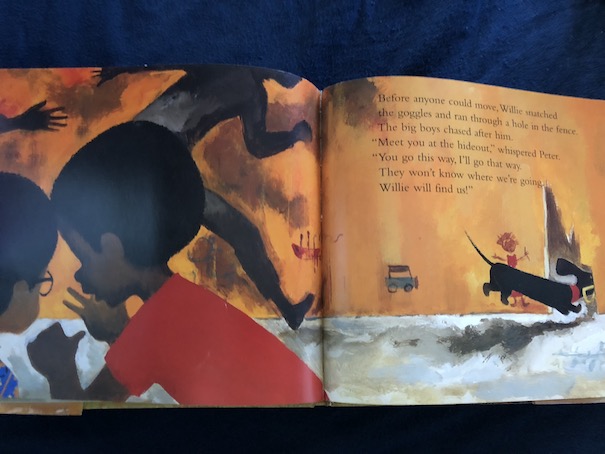
The boys have fun playing with the goggles, but then they’re spotted by a gang of bigger boys. The bigger boys try to make Peter give them the goggles, one of them even knocking him to the ground when he attempts to take them.
Peter’s dog, Willie, runs off with the goggles, and the boys split up to get away from the bullies, meeting back at their “hideout” in the vacant lot.
However, the big boys are still looking for Willie and the goggles. What can Peter and Archie do to get rid of them?
The Secret of the Floating Phantom by Norma Lehr, 1994.
Kathy Wicklow is going to be staying with her grandmother in Monterey for a while, helping her while she recovers from a twisted knee. Kathy is disappointed about it because she only just got home from visiting her Aunt Sharon, and she was looking forward to some time at home with her dog, Snuggles. Snuggles can’t even come with her to her grandmother’s house because of her grandmother’s allergies.
Kathy’s grandmother is a dance instructor, but someone else has to teach her classes until she’s better. Her friend, Loretta, owns a Spanish restaurant and sometimes visits and brings dinner with her. (The grandmother describes it as a “Spanish” restaurant, but they serve things like tacos and burritos with salsa, which is what people where I live think of as Mexican food.) Kathy’s grandmother is sure that Kathy will like Loretta’s granddaughter and grandnephew. However, she is strangely secretive about what she and Loretta have been doing during her visits, saying that their meetings, which they hold with a mysterious man called Mason, are financial discussions and are “not for children.”
Kathy learns that her grandmother and her friend are really holding séances. Loretta’s husband is dead, and Loretta fears that she might lose her property unless she can produce the original deed to it. She thinks her husband knew where the deed was, and she hopes to contact him so that he can tell her. When Kathy spies on them during a séance, she sees a mysterious fog that seems to be trying to tell them something. No one else can see it but her. It appears to Kathy several more times, and it seems to be leading her not only toward the deed but toward a lost treasure from the early days of California.
Kathy is suspicious of Mason’s motives and the fact that he doesn’t seem to like her. It turns out that he is not really trying to help Loretta and her family but trying to find a treasure that was hidden by an ancestor of Loretta’s over a hundred years ago. At that time, the area where they now live in California was attacked by pirates. Loretta’s ancestor, Ambrose, was given the task of hiding the treasures from the local mission. He buried them under a tree and marked the tree with a cross. However, during the attack, he was badly injured and blinded. He was unable to find the spot where he buried the treasure himself, and the others who went to find it couldn’t locate the tree.
The fog-like spirit that Kathy sees is Ambrose. Lisa, Loretta’s granddaughter and Kathy’s friend, is spooked by Kathy’s visions, but she helps Kathy to follow the clues that the ghost provides to the treasure. In a hole in the trunk of the tree, Kathy also finds the deed that Loretta has been searching for. Mason tries to take the treasure himself, but he can’t move the heavy bricks on top of it by himself. Mason leaves before anyone can confront him. Digger, Lisa’s cousin, feels especially betrayed because Mason had seemed like such a good friend to him. Kathy notices that Mason seems to share some characteristics with one of the pirates from the attack in Ambrose’s time, which might be a hint that Mason is a descendant of the pirates, but it’s never fully explained.
The book is currently available online through Internet Archive.
Jane, Mark, Katharine, and Martha are finally going to spend the summer at a lake with their mother and their new stepfather! The children were never able to do that before because their widowed mother always had to work during the summer. When they arrive at the cottage by the lake that their stepfather, Mr. Smith, has rented, there is a sign that says, “Magic by the Lake.” The children think that it could just be the name of the cottage because sometimes cottages are giving interesting or amusing names, but having had experience with magic before (this being the second book in the series), they consider the idea that they could be headed for more adventures. Of course, they are correct, but it turns out to be the lake that’s really magical, not the cottage.
The children are playing by the lake when they wish for more magic, and a talking turtle comes up to tell them that, because of their wish, the entire lake is magic. That sounds amazing, but too much magic all at once can be overwhelming. Fortunately, the turtle is also magical, and he has some ability to influence magic in the lake. The children make a deal with him that he can arrange for them to have adventures with magic in the lake, but only one at a time, because that’s what they feel that they can handle. Also, the adventures won’t happen every day, so they can have a chance to rest in between. The grown-ups around them won’t notice any of the magical happenings, and little Martha insists that nothing truly scary will happen to them. Jane protests at that request because she thinks that it will make their adventures as boring as overly-tame children’s books, but the turtle says not to worry because what he thinks of as “not scary” isn’t necessarily what Martha would think of as “not scary.” The turtle tells the children that when they’re ready for adventure, they should think about what they wish for and then touch the lake, and if the time is right for it to happen, it will.
That sounds simple enough, but what they consider the right time and what the lake considers the right time aren’t always the same thing, and just as before, their wishes and adventures don’t go quite as planned. In their first adventure, a mermaid takes them to an island of pirates, the stuff of high adventure. The children are delighted when they discover that the pirates, being adults, can’t really see them, as per their earlier wish for adults not to see their magical activities. It opens the potential for playing dirty tricks on rotten pirates, who seem to perceive them as some sort of ghosts. It’s all fun and games until the pirate captain decides to see if he can make ghosts walk the plank. Their turtle friend saves them by turning them into turtles, which, while magical, makes the rest of the day rather difficult for them because they have to go home and on errands with their mother. Walking on land can be difficult for turtles, and their mother has no idea that they’ve changed at all, still seeing them as children. Whatever magic the children get during the day seems to last until the sun sets, even when they wish it would end sooner.
Then, while watching their mother and Mr. Smith at a dance, Jane and Katharine wish that they were old enough to join in, about age sixteen. Suddenly, the two of them are teenagers in evening dresses, getting attention from some teenage boys. The girls seem to enjoy the romance of it, but Mark and Martha follow them around, trying to convince the boys that the girls are really younger than they seem to be and dreading the moment when they will inevitably change back to themselves.
The children discover that they don’t even need to be at the lake in order to make the magic happen as long as they’re touching water from the lake. On a rainy date, when the roof of their cottage is leaking, the children realize that the rain water is also lake water. By making a wish on that, they end up at the South Pole in time to save a lost explorer and help him make an important discovery.
The children enjoy their adventures, but they become worried about Mr. Smith, who has been making the commute back and forth from the lake to his bookshop, and it seems that business hasn’t been good at his bookshop this summer. They consider the idea of using the magic of the lake to solve Mr. Smith’s problems, perhaps by going back to the island where they saw the pirates bury a treasure chest. They figure that if they could bring Mr. Smith an entire chest of pirate treasure, he wouldn’t have to worry about money anymore.
But, of course, that idea doesn’t go as planned. When Martha argues with the others and goes to the island by herself to get the treasure, she breaks all the rules associated with the magic. Because the rules that previous protected her and her siblings are gone, there is nothing to prevent her from being captured by the cannibals that live on the island. When her brother and sisters try to save her, they are also captured. It’s only the sudden appearance of Martha’s future children and Katharine’s future daughter (although they don’t know it yet), who are on a magical adventure of their own, in a cross-over from another book in the series, The Time Garden.
The children make one more attempt to get treasure for Mr. Smith in a kind of Arabian Knights adventure, but that doesn’t work, either. However, although the children seem to have used up their wishes on the lake, they have the feeling that the magic might allow them one last opportunity to get what Mr. Smith needs. It does in a way that may or might not be magical, although the buried treasure that they find and get Mr. Smith to dig up may be a representation of the pirates’ treasure and not of the old miser (now deceased) who was said to have lived at the old, abandoned cottage by the lake that the children decide to explore. It does seem like quite a coincidence that the old miser’s initials would match those of the pirate captain, and they are carved on the stone over the buried treasure, just like the marker the pirate captain left.
In the scene with the cannibals on the island, the cannibals are stereotypical “savage natives” (or “native savages”, or something generic of that sort, since the terms are used pretty interchangeably in the story). You find things like this pretty commonly in old children’s books, especially prior to the 1960s. But, what made this more palatable for me was that the entire scene is written as a joke on the usual stereotypical books that children of the era would have read. The cannibals speak kind of like American Indians in cheesy old Westerns, using words like “heap” for “very” and randomly adding “-um” to end of words. You know that it’s not really how anybody, even cannibals living on some remote island in an indeterminate ocean, would talk, but it might be how children raised on adventure stories and movies from the 1920s might imagine they would (adding to my earlier theory from the last book that at least some of the children’s adventures might actually take place in their own minds, not in their “real world”). It may also be a reference to things in tv shows from the 1950s, the time period when the story was written. The best part for me is when the children try to remember what shipwrecked explorers do when confronted with cannibals in some of the stories they’ve read. They start throwing out random words that are meant to sound impressive combined with some gobbledy-gook in an effort to communicate/impress the cannibals. Then, Mark tries to convince them that he’s a powerful god with the ability to control fire. The cannibal chief is unimpressed, telling him that he recognizes what Mark has as an ordinary safety match, which he blows out. So much for the old adventure stories.
The book is currently available online through Internet Archive.
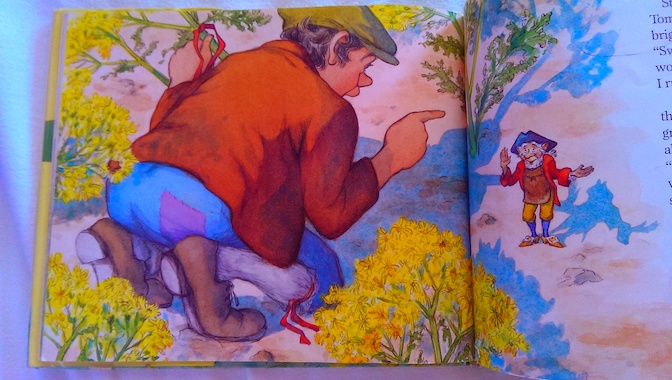
Tom Fitzpatrick thinks that his fortune is made when he is lucky enough to catch sight of a leprechaun one day. If a person can manage to catch hold of a leprechaun and frighten him, the leprechaun will hand over his gold. Tom thinks of himself as a clever man, so he doesn’t see how he could fail.
Tom does capture the leprechaun, and the leprechaun does promise to show him where his treasure is buried. The leprechaun directs Tom to a field of boliauns (a kind of weed, also known as ragwort or ragweed) and points out the plant which marks the place where he buried his treasure.
Tom needs to get a shovel to dig for the treasure, but he worries about whether he’ll correctly remember the spot when he gets back. He takes off one of his red garters and ties it on the plant so he’ll be able to find it again, making the leprechaun promise not to touch it while he’s gone.
The leprechaun promises not to touch the garter, but Clever Tom isn’t quite as clever as the leprechaun. When Tom gets back to the field with his shovel, he’s in for an unpleasant surprise.
Clever Tom might not have his fortune made after all, but he has a great story to tell to the younger generation.
In the back of the book, there is a section with more information about the folk tale, Irish legends and leprechauns, and Irish culture and history. One of the things I found interesting was the explanation that the leprechaun in the picture book is wearing a red coat because that’s how they are described in Irish folklore. It’s usually the Trooping fairies who are described as wearing green, like we often see leprechauns depicted in St. Patrick’s Day decorations. The stories of buried gold left by leprechauns may also may also be based on treasure hoards left by Viking raiders during the Early Middle Ages. The leprechaun in this story also has ale made from heather, which is something that only Danish Vikings were said to know how to make.
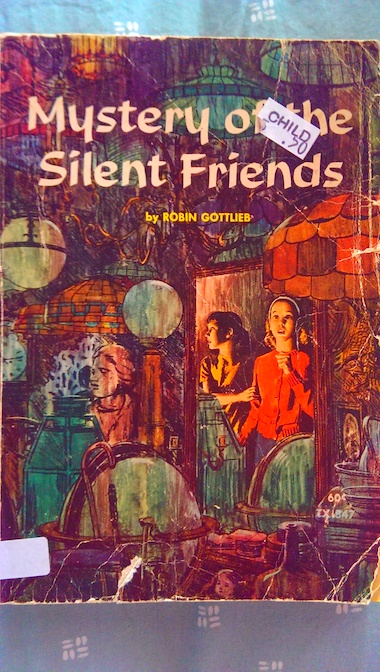
Mystery of the Silent Friends by Robin Gottlieb, 1964.
Nina Martin loves her father’s antique store. Although selling antiques is how her family makes their living, there are some that Nina finds it difficult to let go of when someone wants to buy them. Nina especially doesn’t want her father to sell the two automatons that she calls Henri and Henriette. The automatons are beautiful mechanical dolls that each do something special. Nina calls the boy doll “Henri” because he writes the name “Henri Bourdon” on a piece of paper. (Her father points out that it might be the name of the maker, not the doll itself.) The girl doll, Henriette, is a little more complicated and draws a series of different pictures. Most of the pictures seem to be of a little Swiss village, although one of them is oddly of a monkey that looks like the “speak no evil” monkey in the saying “hear no evil, see no evil, speak no evil.”
For a time, it seems like there’s no risk of the automatons being sold because no one seems particularly interested in buying them. Then, suddenly, two different men come to the shop and ask to buy the dolls. Weirdly, each of them tells the same story to Nina’s father: that their name is George Ballantine the Third, that their family once owned the automatons, that the dolls are actually part of a set of three, that they own the third doll (a girl doll that plays the spinet), and that they want to purchase the other two in order to reunite the set. Nina’s father is bewildered by these two men with identical stories and identical names and refuses to sell the automatons because of his daughter’s attachment to them and because he doesn’t know which of the two men to believe and doesn’t trust either of them.
Nina comes to think of the two men as “Red Ballantine” and “Brown Ballantine” because of their different hair colors. Brown Ballantine seems to be the more credible of the two. He invites Mr. Martin and Nina to his home in order to show them the third automaton and, hopefully, persuade Mr. Martin to sell him the other two. They visit Brown Ballantine’s apartment in an old brownstone, and he shows them the beautiful, spinet-playing doll as well as the rest of his collection of mechanical toys. However, Mr. Martin still refuses to make the sale.
Nina tells her friend, Muffin, about the two mysterious Ballantines. The two girls are curious about which of the men is the genuine George Ballantine the Third and decide to investigate. When “Red Ballantine” comes to the shop again, trying to persuade Mr. Martin to sell the automatons, the girls ask if he would consider showing them the automaton he owns as a test. At first, the red-haired man is hesitant, but then he agrees that they can come and see his doll. Mr. Martin is embarrassed at the girls’ forwardness in asking, but he admits that he is also curious about the two Ballantines.
At first, they all expect that Red Ballantine won’t be able to show them the third doll and will give up trying to buy the other two, but to their astonishment, he takes them to the same apartment where Brown Ballantine said that he lived and shows them the exact same doll they saw before. Instead of clearing things up, the identities of the two men seem to get all the more confusing. However, Muffin notices something strange about the tune that the doll plays on the spinet that gives them a clue as to why the three dolls are so important. Later, someone breaks into the antique store and uncovers a hidden secret about Henri as well.
Together, the three automatons are hiding a secret, and only by considering the message that each of them offers can the girls discover what it is.
The book is currently available online through Internet Archive. There is also a sequel to this book called Secret of the Unicorn, which involves a secret message hidden in a tapestry.
My Reaction
Although I was pretty sure which of the two Ballantines was the genuine one, I was never completely sure until almost the end. In a way, I was a little disappointed by the dolls’ final secret because I though it was something that was especially old, from when the dolls were first created, but the secret messages were actually a more recent addition to the dolls’ repertoire by an eccentric man with a treasure to hide and a taste for practical jokes and riddles. Muffin is a habitual practical joker, and that partly figures into the solution of the mystery.
I thought it was kind of interesting, too, that Mr. Martin has the habit of walking around with a cigarette in his mouth that he never lights, like Inspector Cramer in the Nero Wolfe mysteries.
















 Mystery of the Silent Friends by Robin Gottlieb, 1964.
 For a time, it seems like there’s no risk of the automatons being sold because no one seems particularly interested in buying them. Then, suddenly, two different men come to the shop and ask to buy the dolls. Weirdly, each of them tells the same story to Nina’s father: that their name is George Ballantine the Third, that their family once owned the automatons, that the dolls are actually part of a set of three, that they own the third doll (a girl doll that plays the spinet), and that they want to purchase the other two in order to reunite the set. Nina’s father is bewildered by these two men with identical stories and identical names and refuses to sell the automatons because of his daughter’s attachment to them and because he doesn’t know which of the two men to believe and doesn’t trust either of them.
 At first, they all expect that Red Ballantine won’t be able to show them the third doll and will give up trying to buy the other two, but to their astonishment, he takes them to the same apartment where Brown Ballantine said that he lived and shows them the exact same doll they saw before. Instead of clearing things up, the identities of the two men seem to get all the more confusing. However, Muffin notices something strange about the tune that the doll plays on the spinet that gives them a clue as to why the three dolls are so important. Later, someone breaks into the antique store and uncovers a hidden secret about Henri as well.
 Jestress's Forgotten Books and Stories