The Bassumtyte Treasure

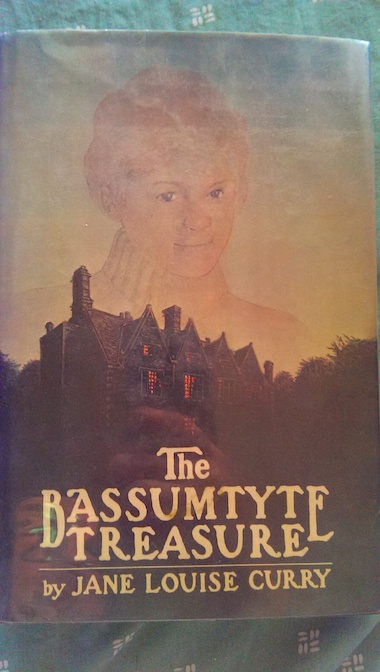
BassumtyteTreasureThe Bassumtyte Treasure by Jane Louise Curry, 1978.
When young Tommy Bassumtyte’s parents died, he went to live with his grandfather. However, his grandfather is now dead, and he is living with his 92-year-old great-aunt, who is in a wheelchair, and her 72-year-old daughter, who has recently had her driver’s license revoked due to her poor eyesight. Although the pair of them have taken good care of Tommy, neighbors have become concerned that they will not be able to do so for much longer because of their age and failing health. Rather than see Tommy sent to a foster home, they decide that he must go to the man who Tommy learns should really be his legal guardian, a distant cousin also named Thomas who lives in the family’s ancestral home, Boxleton House, in England.

The elder Thomas Bassumtyte, who should have taken Tommy when his grandfather passed away, has also since died, but his son, also named Thomas, agrees to take him. Tommy is quickly shipped off to England before there can be a custody hearing in the United States about him because the relatives fear that some official might try to prevent Tommy from being sent out of the country. Tommy is eager to go because he remembers fantastic stories that his grandfather told him about Boxleton House. The current Thomas Bassumtyte also lives there, although the place has become rather run-down, and he fears that he will not be able to keep the place much longer. Thomas was a mountain climber, but he was injured in a fall and hasn’t been able to work much since. He tells Tommy that the two of them might have to move when he is fully recovered and can do more work for the Foreign Office, but Tommy loves Boxleton House from the first moment he sees it and wants to stay.

According to the lore of Boxleton House, a distant ancestor of theirs hid a treasure there, but no one has been able to find it. If young Tommy and Thomas can find it, it would solve many of their problems, and they would be able to keep the house and restore it. All young Tommy has is the mysterious rhyme that his grandfather told him and the strange medallion that his great-grandfather brought with him when he went to the United States in the late 1800s. Thomas tells him that the treasure was supposedly hidden by a distant ancestor of theirs who was fond of riddles, called Old Thomas.

The Bassumtytes were secretly Catholic during the reign of Elizabeth I. Old Thomas was alive then and had a son called Tall Thomas. Tall Thomas traveled frequently and was mysterious about the places he went. One night, he returned to Boxleton House with a young baby, who he said was his son. He had married in secret, and his young wife had died shortly after giving birth. Tall Thomas also brought her body back to Boxleton for burial. However, that wasn’t Tall Thomas’s only secret. Although he remarried, giving his son a stepmother, and lived on for a number of years, he was eventually executed for smuggling messages for the captive Catholic queen, Mary, Queen of Scots. The family was stripped of its noble title and only barely managed to hang onto their house and land. If there was a treasure hidden during this time, it was probably something that the Bassumtytes were afraid would be confiscated by the queen’s soldiers as punishment for the family’s disloyalty or something that Mary had given to Tall Thomas to hide for her.

As Thomas tells Tommy more about the house and the family’s history, he points out Tommy’s uncanny resemblance to Small Thomas, Tall Thomas’s son, as shown in an old painting. Tommy feels a strange connection to Small Thomas, and begins seeing and hearing strange things. An older woman comforts him in the middle of the night, having him recite the same rhyme that his grandfather taught him. A small painting later reveals that this woman was Small Thomas’s grandmother. She appears to Tommy other times, giving him a glimpse back in time and clues to solve the puzzles of Boxleton House.

It is only when Thomas accepts the advice of a family friend who works for a museum that they come to understand the full significance of their family’s heirlooms and the hidden treasure. The treasure may not be quite what the Bassumtytes have always believed it was, but then, the Bassumtytes themselves aren’t quite who they always thought they were, either.

The book is available to borrow and read for free online through Internet Archive.

Mandie and the Cherokee Legend

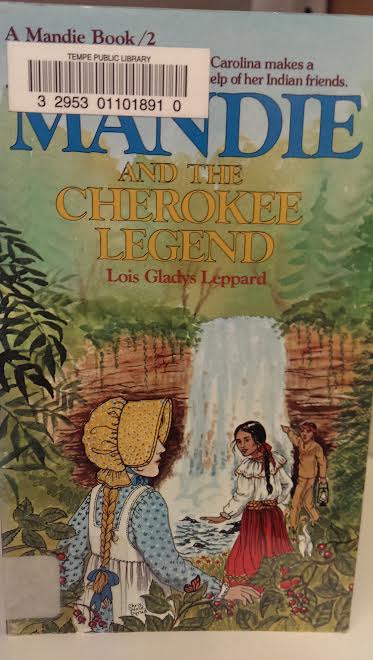
MandieCherokeeLegend#2 Mandie and the Cherokee Legend by Lois Gladys Leppard, 1983.

Mandie is going to visit her Cherokee relatives with her mother and Uncle John. Mandie is eager to meet her relatives, and she hopes that they all like her. The Cherokees all knew her father well, and most of them are eager to meet her. All except for her cousin, Tsa’ni, that is.

Tsa’ni knows the stories of how white men have oppressed the Cherokees and forced them to move off of their land years ago, and he resents all white people because of it. The others tell him that he is wrong to hate all white people because of what some of them did in the past and that Mandie and her Uncle John are good people. However, Tsa’ni doesn’t listen to them, and he plays a mean trick on Mandie, Joe, and Uncle Ned’s granddaughter, Sallie. He offers to show them a cave, but then he abandons them inside.

The three kids have to find their own way out, but they discover a fortune in gold nuggets in the process. First, the children have to make it back to Uncle Ned’s house after a frightening night in the woods. Mandie, Joe, and Sallie accidentally stumble onto a still (machinery for making alcohol) that belongs to a white couple while they are wandering around in the woods after leaving the cave. The couple are worried that they will tell people about their illegal still, so they hold the kids prisoner.

Although the kids manage to escape, they must return to the cave to find the treasure again (while dodging Tsa’ni’s tricks to foil their efforts) and keep it safe (from the still operators and anyone else who might want to steal it) until they can decide what to do with it. As far as Uncle Ned and the other Cherokees are concerned, gold is bad luck because it was the discovery of gold which forced the Cherokees out of their old homeland. However, the origin of this gold may help to change their minds.

This book is one of the Mandie Books.  It is currently available online through Internet Archive.

Secret of the Tiger’s Eye

tigerseyeSecret of the Tiger’s Eye by Phyllis A. Whitney, 1961.
Benita Dustin’s father is a writer, just like she hopes to be one day. When her father announces that they will live for a year in South Africa with his Aunt Persis so that he can do research, it sounds like a grand adventure. The trouble is that her father’s editor has given permission for her son, Joel, to accompany them because she thinks the experience would be good for him, too. Benita’s little brother, Lanny, gets along well with Joel, but Benita and Joel fight and tease each other almost constantly. Benita gets annoyed with Joel’s obsession with facts and information, and Joel thinks that Benita’s stories and flights of fancy are silly.

Aunt Persis’s house is wonderful with a beautiful tower room where Benita is allowed to stay. There is even a fantastic story about the ghost of a tiger that Aunt Persis’s husband shot years ago in India haunting the grounds of the house and the little cave in the garden. Although Joel scoffs at the idea of a tiger ghost, Benita is captivated by the story, especially when strange things begin to happen around the house. Benita learns about the tragic death of Aunt Persis’s adopted son, Malcolm, and the strange theft of the emerald diadem that Aunt Persis received from the rajah that her husband saved from the tiger years ago. However, she will need Joel’s help to make sense of the situation, a difficult prospect at the best of times but almost impossible to ask for after Joel plays a cruel joke on Benita and tries to get Lanny to help gang up on her.  Then, Benita’s father tells her something that changes everything, and all the time, someone with sinister intentions is watching and waiting . . .

The book is available to borrow and read for free online through Internet Archive.

My Reaction

Besides the mystery, there is also a subplot about the nature of hate and prejudice. In South Africa, at the time the story was written, apartheid was still in force. Benita makes friends with a girl of mixed race called Charis, and they talk about racial issues in South Africa and the U.S. during the 1960s. Although Benita wouldn’t think of being prejudiced against anyone on the basis of race, she finds it harder to understand people with different personalities, like Joel.  Although the story focuses on Benita and the lessons she learns, I personally found Joel and his mistakes harder to accept.  Both Joel and Benita need to learn to be more understanding of each other, but in a way, I think Joel is worse because of his deliberately cruel pranks and because he already knows a couple of things that Benita doesn’t which should have influenced his behavior. Joel is deliberately trying to pick fights, and the book never really explains what he expected to accomplish by that.  Everyone needs a motivation, and Joel never really explains his, so he comes off seeming like he’s just there to be a mean character for no real reason.

I also wish that the parents in the story had more frank and straight-forward discussions with the kids.  As a professional writer and a professional editor, they should have been able to settle the kids’ arguments about imagination vs. facts or at least put the situation into perspective by explaining what they do in their jobs.  After all, Benita’s father is going to South Africa specifically to do research.  In other words, even fiction writers need to have a nonfiction background and real facts to use as a basis for their fictional stories.  Realistic backgrounds give stories the grounding they need in order to feel real to readers.  (Although that does depend somewhat on the type of story.  Fantasy stories don’t need to be based on real life, although they do have to have a consistent logic within the story so readers feel like they can understand the world in which the stories take place and the rules by which the magic in the story works.  If the story is meant to be surreal, the internal logic can be more loose.)  Editors, like Joel’s mother, fact check stories as well as ensuring that they are compelling for readers, helping to make decisions about where fictional stories need to be factually correct and where the author can depart from the facts for the sake of the story.  I think that Benita and Joel really should have had a better grasp of their parents’ professions and the balance between fact and imagination in fiction.  Of course, if they did, there would be less conflict in the story.

Fortunately, Benita and Joel work out their differences while confronting the mysterious situation and become friends when they learn to allow each other to be themselves and to appreciate each other’s good points.

The Curse of the Egyptian Mummy

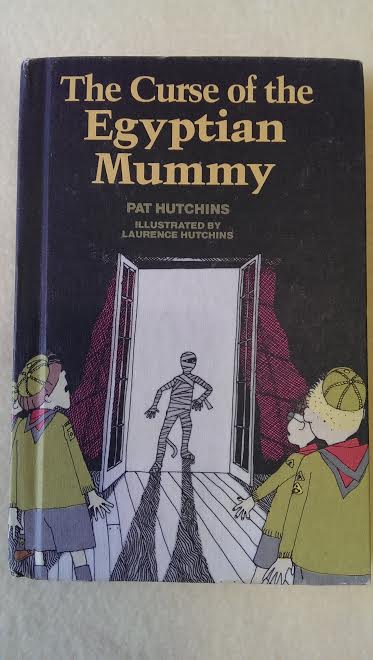
cursemummyThe Curse of the Egyptian Mummy by Pat Hutchins, 1983.

The 15th Hampstead Cub Scouts are looking forward to their camping trip. Miss. Hylyard, who runs a guesthouse for retired people, lets the scouts camp on her land and enjoys having them visit her house and entertain her guests. Mr. and Mrs. Webb are coming along to do the cooking, and their daughter, Victoria, will be there, too. She’s one of their friends from school.

Things start to get interesting pretty quickly when they hear that a man died from a poisonous snake bite not far from where they are camping. The boys are eager to show off their tracking skills by helping the police find the missing snake.  But, strangely, no one can figure out where the snake came from because none of the zoos in the area have reported one missing.  That’s only the beginning of what becomes a very strange trip for the scouts.

Sam finds a strange bird statue in a public wastebasket and decides to use it as the scouts’ new mascot. Then, someone trashes the campsite, and strange figures are seen running around the woods at night.  When Albert makes copies of the bird statue to earn his art badge, the first one is broken, and the second is stolen after some adult shoves Albert into the river near the camp.  Some of the guests at Miss Hylyard’s look suspicious, and when Victoria unexpectedly stumbles into an evening’s entertainment there still wrapped in bandages from the scouts’ first aid practice, a guest who was supposedly unable to speak suddenly blurts out, “The Curse of the Mummy’s Tomb!” in Arabic (which Miss Hylyard knows from her travels with her father).

Who are these mysterious people?  What is the importance of the statue?  And, is there really a curse?

The book is currently available online through Internet Archive.

Pirate Island Adventure

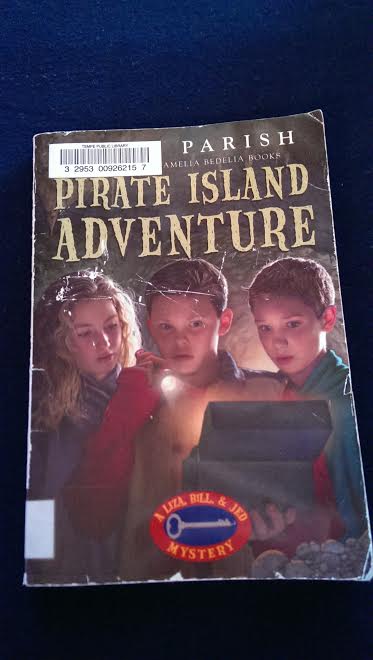
pirateislandPirate Island Adventure by Peggy Parish, 1975.

The Roberts kids must solve another family treasure hunt! This time, they are staying with their grandparents at the family’s vacation home on Pirate Island. It has been many years since the family has been able to go there during the summer. For years, they rented the house out to a couple who lived there most of the time, and the grandparents could only go there when the couple left to visit relatives at Christmas. Now, the house is vacant again, and the grandparents have decided to take the Liza, Bill, and Jed there for the summer.

The last time that their grandfather spent the summer there as a child, his older brother decided to take something from every member of the family and make a treasure hunt just like the old family treasure hunt that the kids solved in Key to the Treasure. Just like that treasure hunt, other circumstances arose that kept the treasure hunt from being solved, so no one ever got back what grandfather’s brother hid. The only clue they have to the treasure now is a picture that grandfather’s brother drew. Since the children were able to solve the last treasure hunt, their grandfather is hopeful that they will be able to solve this one, too.

Unlike other treasure hunts that the Roberts kids solve, this treasure hunt does not involve codes and word games.  The clues are given in the form of drawings, most of which (unfortunately) are not shown to the readers.  The readers wouldn’t have a chance to solve the puzzles anyway because the objects in the drawings are things which the children’s grandfather has to recognize, places where he and his brother went as kids.  This book also introduces Hermit Dan, who appears in another book.

This book is part of the Liza, Bill, and Jed Mysteries series.

Key to the Treasure

keytreasureKey to the Treasure by Peggy Parish, 1966.

When twins Liza and Bill and their older brother Jed visit their grandparents for the summer, their grandfather tells them the story of a treasure hidden somewhere on their farm. Over a hundred years ago, their great-great-grandfather was friends with an Indian (Native American) woman. When she died, she left her belongings to him, including a feathered bonnet, a leather shield, a mask, and a doll.

When he grew up, he went away to fight in the Civil War. Before he left, he hid three of the items (the shield, the mask, and the doll) and made up a series of clues to help his children find them.  Unfortunately, the first clue was lost, and he never returned to tell his children where he hid the treasure. The only clue that was left was a picture of the feathered bonnet, a little pot, and a strange-looking key.  From then on, each generation in their family has tried to solve the puzzle. Since so many generations of their family have failed to find the treasure, Liza, Bill, and Jed don’t have much hope for success until they accidentally stumble on something that gives them their first clue.

keytreasurepic1Together, the three children quietly work on the clues, following each to the next.  They hope to surprise their grandfather with the solution to this old family mystery.  But, can they?
The clues to the treasure take the form of word games and codes (the first is a simple substitution code, and the other two are word games). Young readers will find it challenging to solve the codes along with the children in the book (Liza, Bill, and Jed walk readers through their solutions as they work on the puzzle, even showing how they correct for mistakes along the way), although older readers may find them rather easy.  It’s a good book for introducing children to codes and word games if they haven’t really encountered them before.  For the challenge of it, you can stop reading at each new puzzle and attempt to solve it before the kids do!

This is the first book in the Liza, Bill, and Jed Mysteries series.  It is currently available online through Internet Archive.

Mystery Up the Winding Stair

Harry Hunter and his mother have been living with his grandfather in his big mansion while his father is in Japan doing work for the government. His family has owned the mansion for a long time, and it has a small museum in it containing Native American artifacts and things relating to pioneer life, including a small log cabin built in a large room up a winding staircase.

When Harry’s mother goes on a trip to see his father, Harry and his grandfather invite Harry’s cousins to visit them: Ned and his sister Lou, and Carol, whose family has only recently moved to the area.  When the children try to decide what they would like to do together, Carol suggests a treasure hunt.  Their grandfather sends them on a treasure hunt to find something that he hid himself a long time ago: a set of silver spoons made by Paul Revere and a diamond. The explanation is that the grandfather is rather absent-minded and has forgotten where he hid the treasure, although he knows that it’s somewhere in the house.

A storm leaves them all snowbound in the mansion, but they are not alone. There are mysterious footsteps, someone using a secret staircase to the attic, and signs that the bed in the cabin has been slept in. The children begin to realize that someone else is in the house with them, and this person wants the treasure for himself!

This book is out of print, but you can borrow and read it online for free through Internet Archive.  Internet Archive requires you to sign up for an account to borrow books, but the account is free, and you read the books directly in your browser.  There are no overdue fees because the books simply disappear from your virtual loan list when your time is up.  You are allowed to re-borrow books as long as copies are available (not being “borrowed” by other people).

The house the mansion in the book was based on was the old summer home of Governor Washington Hunt, located in Lockport, New York. (I learned about the house from an article about the story behind the book and an event related to the book that was held at the library in Lockport, but the site that had the article doesn’t have it up anymore. I think I saved a copy somewhere, but I’m having trouble finding it right now.)  It was called Wyndham Lawn and later became a children’s home. It’s now a private school called the Henrietta G. Lewis Campus School.  When the author, Helen Fuller Orton, was young, some of her relatives rented Wyndham Lawn from its owner, and she lived with them for a time.  In the article, the author noted that the house had been changed somewhat since the time when she lived there in the 1880s in order to accommodate the needs of the children’s home.

When I first read this book, I thought that the part about the grandfather simply forgetting where he hid an important treasure was a little cheesy, but the treasure hunt in a mansion with its own museum is fun. It’s a little spooky when the kids realize that there’s an intruder in the house with them while they’re snowbound, although it’s pretty obvious to readers of the story who the intruder was. The house really makes the story because it is a fantastic setting! It’s a very cozy mystery for winter.

I enjoyed the story and learning about the history of the real house. I also considered what Harry’s father is doing in Japan because this book was published just after WWII. I don’t think they ever explain why Harry’s father is in Japan on government work, but I’m sure he’s involved with the occupation and reconstruction of Japan after the war. It’s a subtle reference to current events at the time this story was written that’s not part of the main story but is used as part of the reason why the main story is happening.

The Secret of the Mansion

Trixie Belden Series

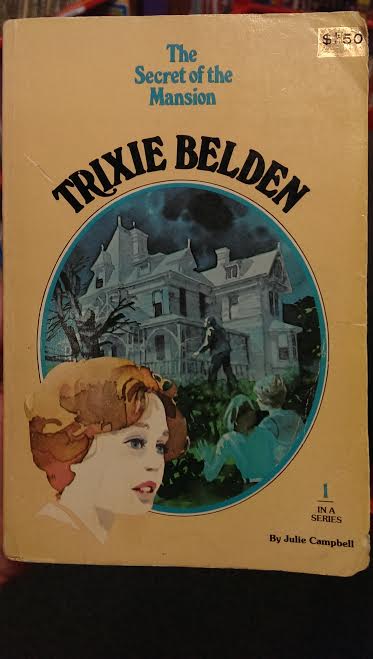
trixiemansion#1 The Secret of the Mansion by Julie Campbell, 1948.

Trixie Belden, a thirteen-year-old girl who lives with her family on a small farm near a town called Sleepyside, is sure that her summer vacation is going to be boring. Her older brothers have gone away to be camp counselors, and she’s stuck helping her mother with chores and watching her little brother.

However, Mr. Frayne, the strange old hermit who lives down the road from Trixie Belden and her family, is suddenly taken ill. Trixie’s father finds him passed out by the side of the road and takes him to the hospital. It doesn’t look like he’s going to survive, and rumor has it that there is a fortune hidden in his big, old, boarded-up mansion.

Then, another girl Trixie’s age moves into a mansion called the Manor House near Trixie’s farm. Her name is Honey Wheeler. Her family is rich, but she has lived a very sheltered life and has not had many friends. She has been unwell recently, and her family is hoping that living in the country will help her to get better. The two girls become friends, and Trixie convinces Honey to come with her to take a look at Mr. Frayne’s mysterious old mansion.

While looking around the property, they meet Jim Frayne, who is Mr. Frayne’s nephew. Jim has run away from his abusive stepfather and is now hiding out in Mr. Frayne’s old house. He had been hoping to find a home with his uncle, but he arrived after his uncle became ill. Jim is next in line to inherit Mr. Frayne’s property if he dies, but his stepfather Jonesy is looking for him and will take control of anything he inherits. Is there really a treasure hidden somewhere in the old house, and if so, can the girls help Jim find it before Jonesy finds him?

This is the first book in the Trixie Belden series.  It is currently available online through Internet Archive.

The Treasure of Kilvarra

TreasureKilvarraThe Treasure of Kilvarra by Elizabeth Baldwin Hazelton, 1974.

Christie and Kevin MacAlistaire go to Ireland with their mother to visit a family friend, Padraic O’Flaherty, and their visit turns into a terrifying treasure hunt!  Christie is fascinated by the gypsies living nearby and asks to visit them.  It’s her birthday, and the oldest gypsy, Sorcha, tells her fortune.  She says that Christie is fated to discover a treasure during her visit to Ireland, but there will be great danger involved, and she will need her brother to protect her.  Sorcha also gives Christie an amulet filled with holy ashes to help keep her safe.

Christie is eager to find the treasure Sorcha spoke of, although she doesn’t know what kind of treasure she is supposed to find or what kind of danger she will face along the way.  Their new friends tell them the history of the region with stories of ancient kings, fairy folk, and haunted castles.  Christie and Kevin visit some of these supposedly haunted ruins with their new friend Colum (a gypsy boy) and his pet crow, Ben.  Colum tells them the history of the castle ruins and the legends associated with it, and they discover that Christie has the ability to see and hear things that the boys can’t: spirits of the past.  Unfortunately, Ben is fascinated by Christie’s amulet and takes it, losing it in a nearby river.

KilvarraWithout the amulet to protect her, Christie continues her search for the treasure.  An accidental injury takes her to the place where it is hidden, but it’s a dangerous place.  Caught in a terrible storm, the children explore an ancient stone tower.  There, Christie sees the ghost of a long-dead monk, gesturing to her, begging her to follow him to the treasure that she seeks.  The monk died protecting it, and it’s a very unexpected but wonderful treasure indeed.  But, getting out of the place is going to be even more dangerous than getting in.

The book is currently available online through Internet Archive.

This is actually the second book in a series about Christie MacAlistaire and her brother Kevin.  Unfortunately, I don’t have the first one and haven’t read it.  I do know that the first book in the series is called The Haunted Cove.  Christie and Kevin spend the summer in a cottage by the sea in Oregon, where they investigate a cove haunted by the ghosts of sailors and a woman who may be a witch.

Candleshoe

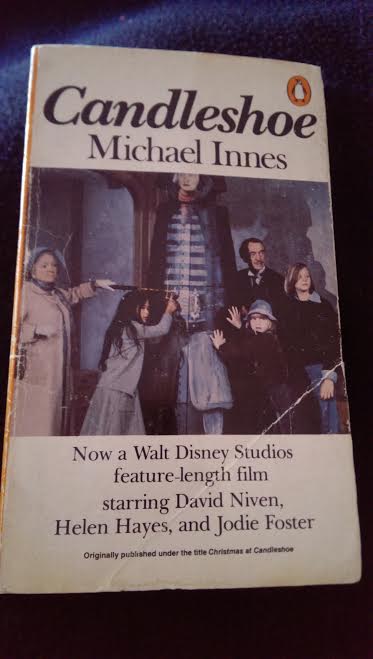
candleshoeCandleshoe by Michael Innes, 1953.

I own the movie version of the book, which was originally named Christmas at Candleshoe (although it’s not about the holiday).  It contains the text of the original story, but the picture on the front cover is from the movie.

The Disney movie is very different from the original book.  For one thing, the hero of the story is a boy (Jay), not a girl (Casey/Margaret), and unlike the movie version, the child’s identity is established for certain by the end of the book. The book has a happy ending, and so does the movie, but part of the movie’s point was that the idea of family isn’t dependent on blood relations alone, so it isn’t important whether Casey is really Margaret or not (although there are strong hints that she is).

The book is a bit hard to follow at first because it jumps back and forth between different places and different sets of characters, although it all takes place during the course of a single day and night.  Actually, I’m not sure this can really be called a children’s book, but I included it here because of the movie tie-in.  Because of the difficulty level of the book, I’d really recommend it for older children or adults.  Personally, I have to admit that I liked the movie better.

The story takes place in the mid-twentieth century, after WWII. There are two manor houses involved, Benison Court and Candleshoe. Benison Court, the newer of the two, is owned by the Spendloves, and Candleshoe, the older one, is owned by the elderly Miss Candleshoe. The two families are related, and neither one of them has as much money as they used to. The Spendloves take in some extra money by offering tours of Benison Court and showing people paintings and antiques owned by the family for generations. To raise some additional money, they decide to sell a couple of the paintings by Titian. To their surprise, the expert they call in to evaluate the paintings tells them that the paintings are forgeries.  Archdeacon, who cares for the antiques and library at Benison, reminds the Spendloves that during the war, the paintings were sent to Candleshoe for safekeeping.

Meanwhile, a couple of American tourists, the wealthy Mrs. Feather and her son Grant, having seen Benison, stop by Candleshoe. Mrs. Feather is fascinated by the old place, in spite of its state of disrepair, and Miss Candleshoe invites them to have dinner there and spend the night. Mrs. Feather has an interest in purchasing Candleshoe for herself and fixing it up.  Miss Candleshoe and her longtime friend, the retired chaplain, Armigel, know that there is not enough money for them to fix up Candleshoe, and they like the idea of traveling, so they are willing to consider selling the manor house. This plan does not sit well with Jay, the orphaned son of Miss Candleshoe’s housekeeper, Mrs. Ray.

After Mrs. Ray died, Miss Candleshoe cared for Jay, and now, with Miss Candleshoe and Armigel showing signs of senility, Jay has been handling much of the practical running of Candleshoe. On this particular evening, Jay is worried about more than the possible sale of the property. He has been noticing strange people paying unusual attention to the house. He suspects, correctly, that they intend to break into the house that night, and he has assembled a small army of local children, armed with antique weapons, to defend the place. Grant, befriending Jay, admires the boy’s practical turn of mind but worries that they are not up to the task of handling the siege that is coming to this isolated country house. As the danger presses closer, the Spendloves, Archdeacon, and the art expert are heading toward Candleshoe in search of the missing paintings.

The answer to all of these problems may lie in the strangest feature of the house: the Christmas box, a stone monument in the gallery made by Gerard Christmas and dedicated to the memory of an ancestor of the Candleshoes, who may have been a pirate. According to the lore of Candleshoe, the box will open at a time when Candleshoe is in crisis and will save the day.

The book is available online through Internet Archive.

But, is Casey Really Margaret?!

I think so. I want to say, “yes, she is,” but “I think so” is about as definite as I can be because the movie changed the story from the original book.

Whether or not Casey is actually Margaret, the lost heir to Candleshoe, is the burning question everyone is left with after watching the Disney movie Candleshoe. The movie deliberately left Casey’s true identity unresolved at the end, probably because they wanted to have the people at Candleshoe decide to accept her into their family on her own merits, not just because they had to because she’s the heir to the place. In the beginning, the audience is told that missing heir of Candleshoe, Margaret, was kidnapped as a young child by her own father, apparently in some kind of marital/custody dispute, and that she disappeared after his death in a car accident and has not been located although attempts to find her were made in the ten years that have passed since her disappearance. Casey is a teenage girl who was apparently an abandoned child with an unknown past and no memory of her early life who bears an odd resemblance to Margaret, including a couple of distinctive scars that are like ones Margaret was known to have. She is recruited as by con artist to play the part of Margaret, returning to Candleshoe as the lost heiress in order to gain access to the house and find a hidden treasure. Although Casey initially came to Candleshoe under false pretenses as part of a con with the promise of a share of the Candleshoe treasure and a red Ferrari as her payment, she eventually becomes fond of the people there and decides that she can’t let them be cheated by the real villain. Casey proves herself to be part of the Candleshoe family through her loyalty to them, and in the end, they would accept her whether she really was Margaret or not. It’s a nice sentiment, but viewers still have the urge to ask who Casey really is.

Casey is legitimately an orphan or abandoned child, found at about the right time and the right age and in the right place to really be Margaret. She has no memory at all of her early childhood, her parents, or where she came from, and she also bears some telltale scars that match ones that young Margaret was known to have. That’s what we’re told about Casey. Casey’s history is never explained in detail in the movie (we never find out under what circumstances she was found and entered into the Los Angeles foster care system), but from what we do know, her history meshes well enough with Margaret’s known past that it would seem plausible for her to actually be Margaret. Is she really Margaret, and Harry Bundage, the con man, just persuaded her that she was only pretending in order to use her for his own ends? Or, is the real Margaret still out there somewhere? If Casey actually is Margaret, did she lose her memory in the car crash that killed her father, or did he abandon her somewhere before his death, even though he had kidnapped her from her mother and took her to a completely different country?

When Harry Bundage is briefing Casey about Margaret’s background, he poses the theory that Margaret was in the car when her father crashed it and that she may have wandered off in a state of shock after the accident. That explanation might be partly for the benefit of the viewers, helping to explain how Casey could be Marget and not remember it. A young child suffering from shock might be unable to tell anyone who she was or what had happened to her. An accident may even have left some bruising that might have obscured the telltale scars that could have identified her, but again, the matter is never fully settled, and we just don’t know enough of Casey’s background to make a full connection. There are enough pieces to make it possible, maybe even probable, but nothing that definitively settles the matter.

In the final scene of the movie, Casey asks Margaret’s grandmother what will happen if Margaret is ever really found and comes home, and the grandmother says cryptically that maybe she already has. It’s a brief hint that the grandmother thinks Casey might really be her kidnapped granddaughter, even though she accepts that Casey was lying to her earlier about things she said she remembered and knows that Casey herself thought that she was just an imposter. Casey does have those telltale scars, and it does seem like quite a coincidence that two random girls of the same age and similar circumstances would have identical sets of scars. However, the movie stops short of declaring that Casey really was Margaret all along, and the unanswered questions still rankle viewers. So, some of us turned to the original book to get more detail, but it turns out that it doesn’t completely help.

As I said, the original book was different from the movie. Not only was the child hero in the book a boy instead of a girl, he wasn’t kidnapped and taken to America the way that Margaret was. In the book, Jay definitely knows who his mother was, and it’s the question of who his father was that establishes his identity as the heir to Candleshoe. It turns out that Jay’s father was the nephew of the lady of Candleshoe, making her his great-aunt rather than his grandmother. Her nephew had been a ne’er-do-well, and although his family didn’t know it, he had married an American woman before his death. He died not too long after the marriage, but by that point, he had fathered Jay. Jay’s mother knew about her husband’s family, but she wasn’t sure yet whether or not she wanted to tell them about Jay. She took the job as housekeeper so she could observe the family and decide whether or not to reveal their relationship. Unfortunately, she died in an accident before she made up her mind. By the end of the book, Jay’s identity is established, and he is definitely proven and recognized to be the heir to Candleshoe, and because of that, I believe that Casey really is the missing Margaret. At least, that’s as close to confirmation as we’re likely to get. If the child in the book was the rightful heir to Candleshoe, it would make sense if the child in the movie was, too, even if it’s not really the same child.

Of course, that’s not full proof, and it doesn’t answer the questions about Margaret’s kidnapping or her father’s accident or how Casey was found and placed in foster care in California without anyone else connecting her with the missing Margaret when Margaret’s disappearance was reported to the authorities and newspapers. I have a theory that Harry Bundage was right that Margaret was in the car during the accident and that she did wander away from the scene of the accident in shock and possibly suffering injuries that covered up her identifying scars, but that’s still just a theory. There’s nothing in the movie or book that I could use to prove it. We don’t even know exactly why Margaret’s father in the movie kidnapped her in the first place or why Margaret’s mother died not long after she disappeared. (A convenient accident or illness for story purposes so there’s one less person to try to identify Casey/Margaret, or did she kill herself out of despair at the loss of her husband and daughter? The movie doesn’t say, so those are just guesses, too.) There’s a lot of backstory missing, and the book doesn’t clarify these points because of the differences between the book and movie. I guess it’s not really important to the story in the movie, but inquiring minds still want to know.