The Spookster’s Handbook

The Spookster’s Handbook by Peter Eldin, 1989.

This is a fun book of jokes and tricks for Halloween or just having some spooky fun with friends, possibly at a sleepover. The book is divided into the following sections:

Making Monsters – How to make costume pieces and turn yourself into a bug-eyed monster, a warty witch, and more! There are also tricks, like making a ghost image appear on a wall, casting a glowing face on someone else’s shadow, and making Bigfoot footprints.

Screamingly Funny – A chapter of ghost jokes.

Ghostly Tricks – Magic tricks that look somewhat ghostly, like making a friend “float” in the air and making magical symbols appear on blank cardboard.

Monster Pranks & Practical Jokes – Tricks that produce ghostly illusions, like how to take ghostly pictures, produce taps with no obvious source, and cause ghostly flashes of light in a dark room.

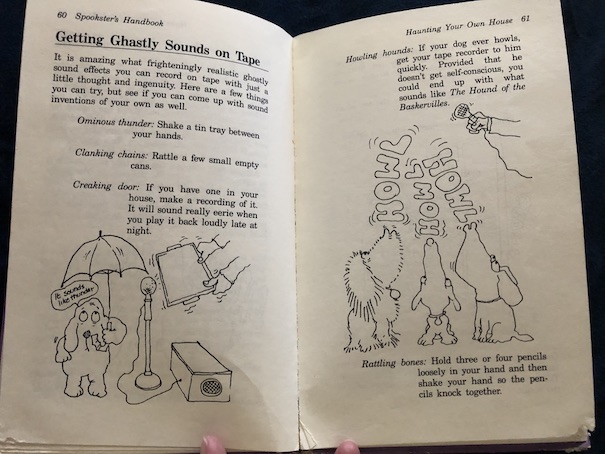
Haunting Your Own House – Describes typical do-it-yourself haunted house tricks for producing scary noises.
Monster Laughs – A chapter of monster jokes.

Scare Your Friends – Tricks and pranks for spooking your friends with a finger in a box, strange noises, or a glowing skull.

Terrible Trivia – Fun facts about superstitions and telling the future.

Fang-Tastic! – A chapter of jokes about vampires.

My favorite parts of the book are the superstitions and the ways to make scary haunted house noises. I haven’t actually tried the noise tricks yet, but at some point, I’m planning to try a few!

The book is available to borrow and read for free online through Internet Archive.
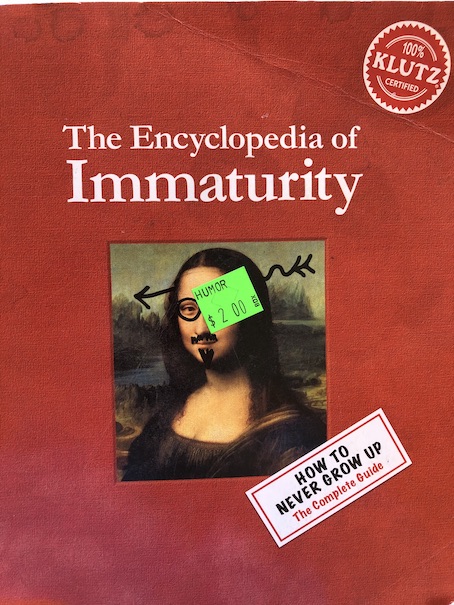
The Encyclopedia of Immaturity

The Encyclopedia of Immaturity by the Editors of Klutz Press, 2007.

This book is part of the classic children’s hobby and activity series from Klutz Press. It’s a collection of pranks, stunts, and fun things to do. There is too much in this book to describe everything in detail, so I’ll just explain some general themes and highlights.

The stunts and activities are in no particular order, and the book isn’t divided into any special sections. Most of activity or stunts just takes up a page or two of explanation, but some are longer, about three or four pages. None of them are very long.

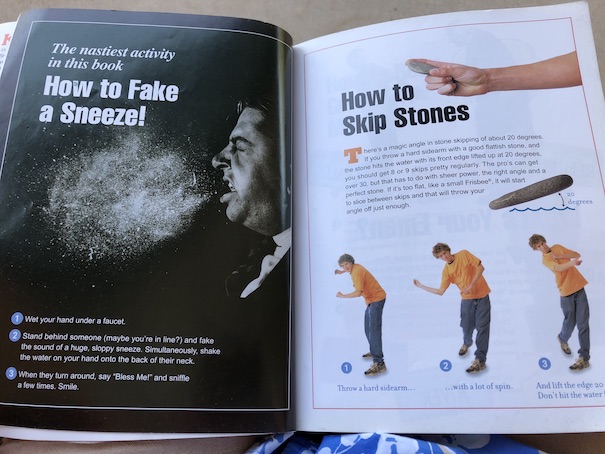
Some of the activities are classic kids’ activities or pranks, like skipping stones, hanging a spoon from your nose, and Peep jousting (a more modern classic – the book points out that you can do it with regular marshmallows, too, but I like Peeps for the imagery). I remember the one about how to blow a bubble gum bubble from your nose instead of your mouth (found on p. 271) being mentioned in Amber Brown Goes Fourth, when Amber’s new friend, Brandi, teaches her how to do it.

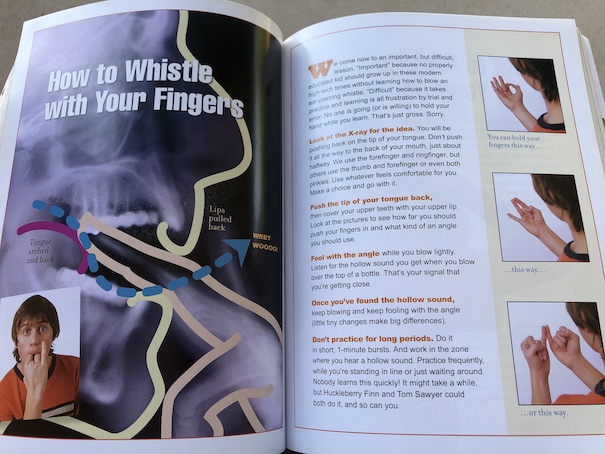
There are also some more difficult tricks to master, like how to do an ollie on a skateboard and how to do a wheelie on a bike. (At least, I consider things like that difficult because I’ve never been able to master them.) I also don’t know how to whistle with my fingers, although the book shows multiple ways to do it.

Some of the pages are designed to be cut out and made into things, like the page that provides a pattern for a paper fortune teller and the page where you cut a square of paper so that it’s possible for a person to go through it.

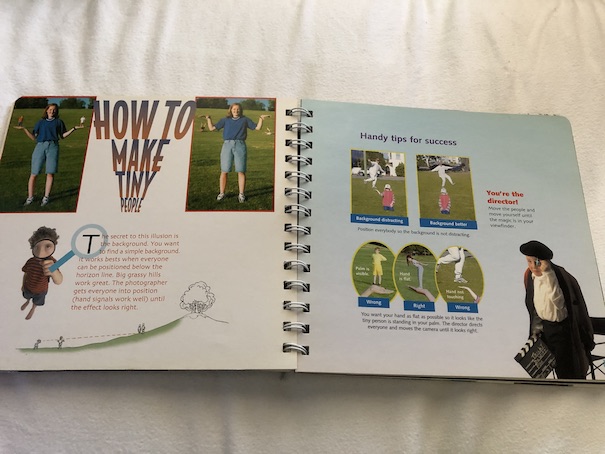
Some of the activities in the book were also in previous Klutz books, like juggling and how to use trick photography to take pictures that make people look like they’re small enough to pick up. I also remember the backseat rituals for long car trips being part of the Klutz Kids Travel book.

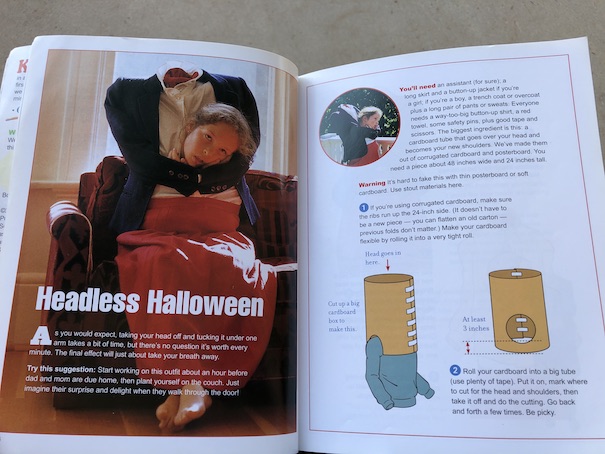
My two favorite sections in the book are the part about how to be a headless person for Halloween and how to sneak around. I never dressed as a headless person as a kid, but I like the idea, and might still do it. I did a lot of sneaking around as a kid because I always loved hide and seek.

There’s quite a variety of activities in this book, including some indoor activities and outdoor activities, and things that can be done on car trips. Some of these activities look kind of gross to me (and still would have when I was a kid because I wasn’t one of the kids who was into gross outs), like how to make fake dog barf, but there’s such a wide selection of activities, I’d say that there’s plenty here for anybody to find fun things to do!

The book is available to borrow and read for free online through Internet Archive (multiple copies), along with the sequel to the book, The Encyclopedia of Immaturity, Volume 2.

Tricky Pix

Tricky Pix: Do-It-Yourself Trick Photography by Paula Weed and Carla Jimison, 2001.

This book is part of the classic children’s hobby and activity series from Klutz Press and explains how to perform trick photography. Originally, this book came with a real camera that could be used to take trick pictures. The camera was a film camera instead of a digital camera, using 35mm film, but the film was not provided.

Now, digital cameras have almost entirely replaced film camera for popular photography, and film is actually much harder to come by, and not as many places offer film development services. In the very early 2000s, when this book was first published, digital photography was just starting to take hold, and digital cameras were more expensive, so a kid’s first camera was still likely to be a film camera. In just a few more years, that shifted abruptly with the increasing popularity of cell phone cameras and further developments that made digital cameras increasingly affordable for general use. The beginning of the book explains how the camera works and how to load the film.

The fact that this book was designed to be used with a film camera is important because this style of trick photography relies on physical illusions, not images that are digitally altered with Photoshop or similar software. In a way, this makes the pictures more interesting because they are largely unaltered from their original form. That is, you’re seeing what the camera saw at the moment that the picture was taken. The tricks involve using different perspectives and camera angles to achieve the illusions.

Strategic poses and the use of physical objects to block part of the scene can be used to create illusions like disembodied heads, people with extra limbs, or people with really long legs or bodies.

An often-used trick for making people look tiny enough to be picked up or stepped on by another person involves forced perspective – strategic positioning the subjects so that there is physical distance between them but no visual cues to indicate just how much distance there is between them so relative sizes are difficult to gauge.

When images in this book are altered, it’s with the old-fashioned method of literally cutting and pasting them onto each other, something that is now done digitally.

Personally, I enjoyed the fact that there was less of a reliance on software and digital technology in the production of these photographs. I think that learning how to do things without relying on technology to do most of the work can encourage creativity, and in particular, the use of physical illusions like forced perspective is also educational. Artists need to understand the use of physical space, perspective, and lighting, and these photographic tricks demonstrate these concepts well. Even though this book doesn’t make use of digital photography, any of the tricks in this book could also be performed when taking pictures with a digital camera.

The book is available to borrow and read online through Internet Archive.

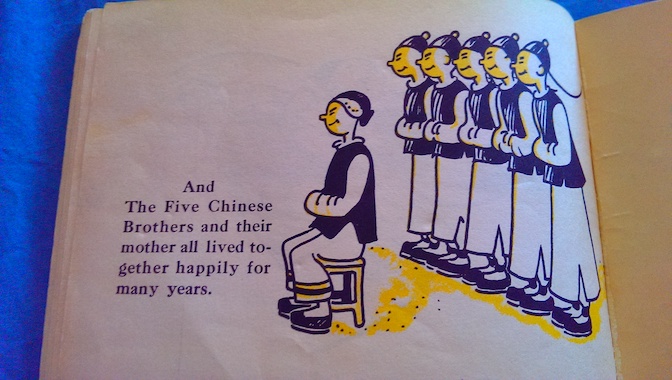
The Five Chinese Brothers

FiveBrothers

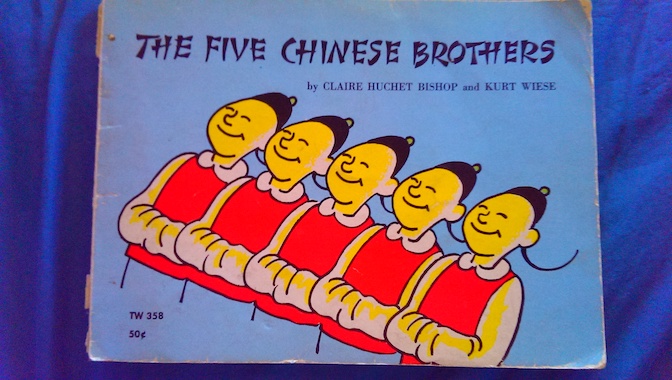
Although this picture book has faced some criticism for promoting Asian stereotypes (largely about the way the characters are drawn), it has nostalgic appeal for some people and is still in print.  What I find interesting about it is that it is actually based on an old folktale, Ten Brothers.  Folktales of this type, where people with different types of super-human powers must help each other to overcome obstacles, can be found throughout the world.  Another story on this theme is How Six Made Their Way in the World.

In this story, there is a family in China with five brothers who look alike, except that each brother has a unique super power (listed by birth order):

  • One can swallow the entire sea, although only for a limited amount of time.
  • One has a neck as strong as iron.
  • One can stretch his legs extremely far.
  • One is impervious to fire.
  • One can hold his breath for an unlimited amount of time.

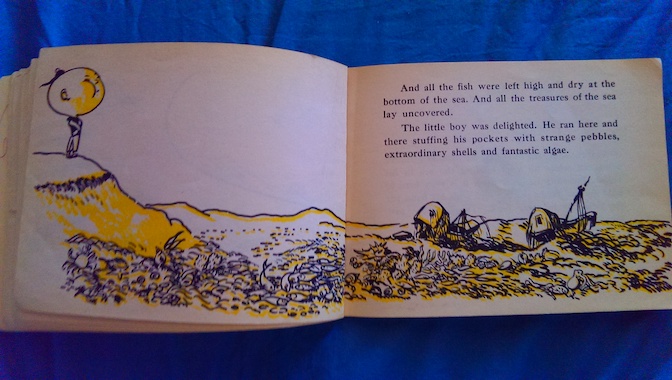
They live in a village by the sea and make at least part of their living by fishing.  One day, a young boy asks to go fishing with the brother who can swallow the sea (they don’t have names in the story, they’re just referred to by ability or birth order).  At first, the brother is reluctant to allow it, but when the boy begs, the brother agrees only on the condition that the boy obey him and return to his side as soon as he gives the signal.  The brother swallows the sea and allows the boy to collect as much fish as he likes from the empty sea bed.  However, the boy gets too wrapped up in all the amazing things he finds on the empty sea bed and ignores the brother’s frantic signals to return.

FiveBrothersSeaSwallow

Finally, the brother cannot hold back the sea any longer and releases it.  The boy drowns, and the brother is arrested for the boy’s death.  The judge decrees that the brother will be executed by having his head cut off.  Before the execution, the brother has a last request: that he be allowed to return home to say good-bye to his mother.  The judge allows it, and the brother switches places with his brother who has a neck like iron.

FiveBrothersHead

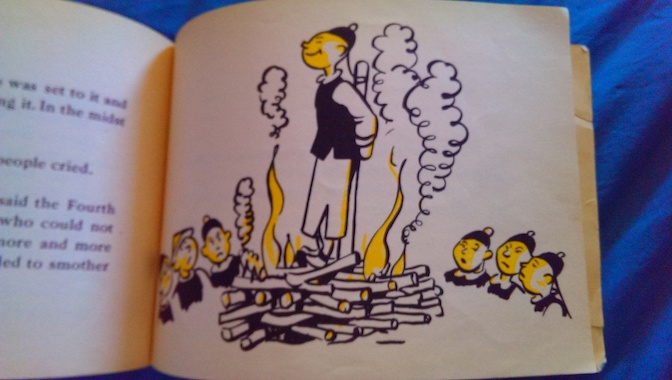
Needless to say, the execution doesn’t go as planned, and everyone is astonished when the executioner cannot cut off the brother’s head.  The judge decrees that he will be executed by drowning instead.  However, he does grant the brother’s request to say good-bye to his mother once again, giving him the chance to switch places with another brother who can safely face the next ordeal.

FiveBrothersBurn

The process continues through one form of execution and another as each of the brothers survives, using his own special power.  Finally, the judge decides that if the man (he doesn’t know there’s more than one, apparently) cannot be killed, he must be innocent and pardons him.

The book is currently available online through Internet Archive (multiple copies).

FiveBrothersFamily

Totally Useless Skills

uselessskills

Totally Useless Skills by Rick Davis, 1994.

The name of this book is intentionally deceptive, but only partly.  What I mean by that is that the little tricks and stunts in the book may not have much of a practical application except for just having fun and amusing your friends, but the techniques for learning them can be applied to learning just about anything.

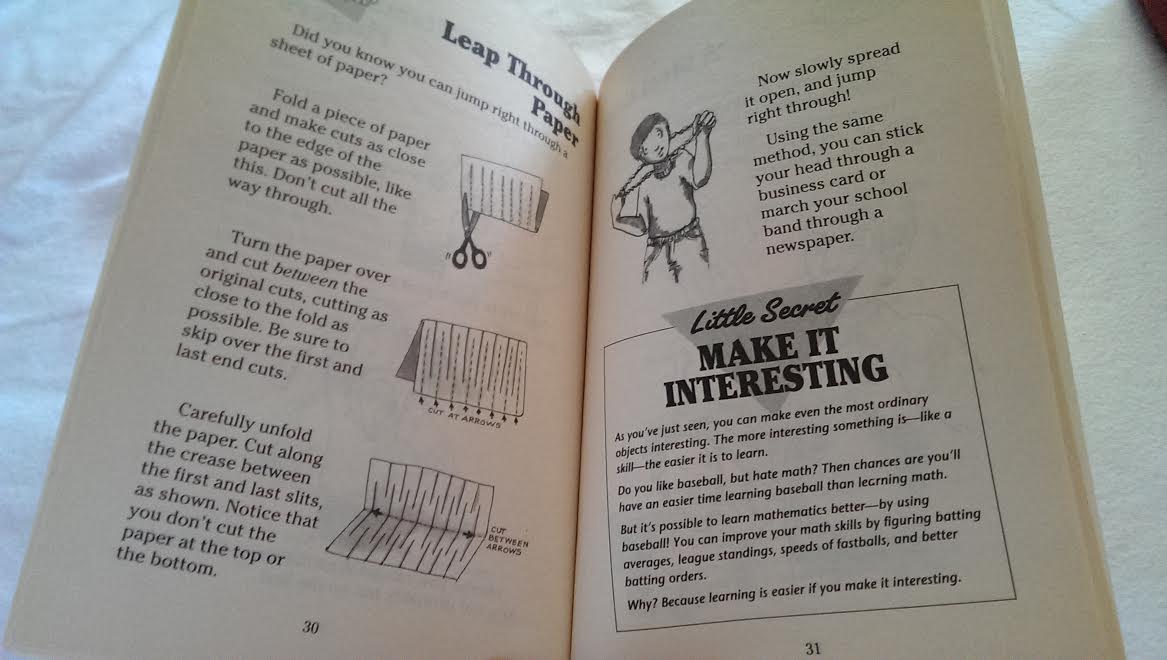
This book describes how to do fun tricks that don’t require any special equipment and are mostly based upon knowing things work, like the blind spot in the human eye (such as using the blind spot in your eye to make it look like your teacher’s head has vanished) and where your center of balance is (used in the trick showing how a girl can pick up a chair when a boy can’t). The tricks include making it look like your arms are lengthening or shrinking, making it look like you’ve broken your nose, how to hang a spoon from your nose, how to jump through a single sheet of paper, how to make a pencil float, how to make your leg disappear, and how to pronounce the longest word in the English language.

uselessskillspic1

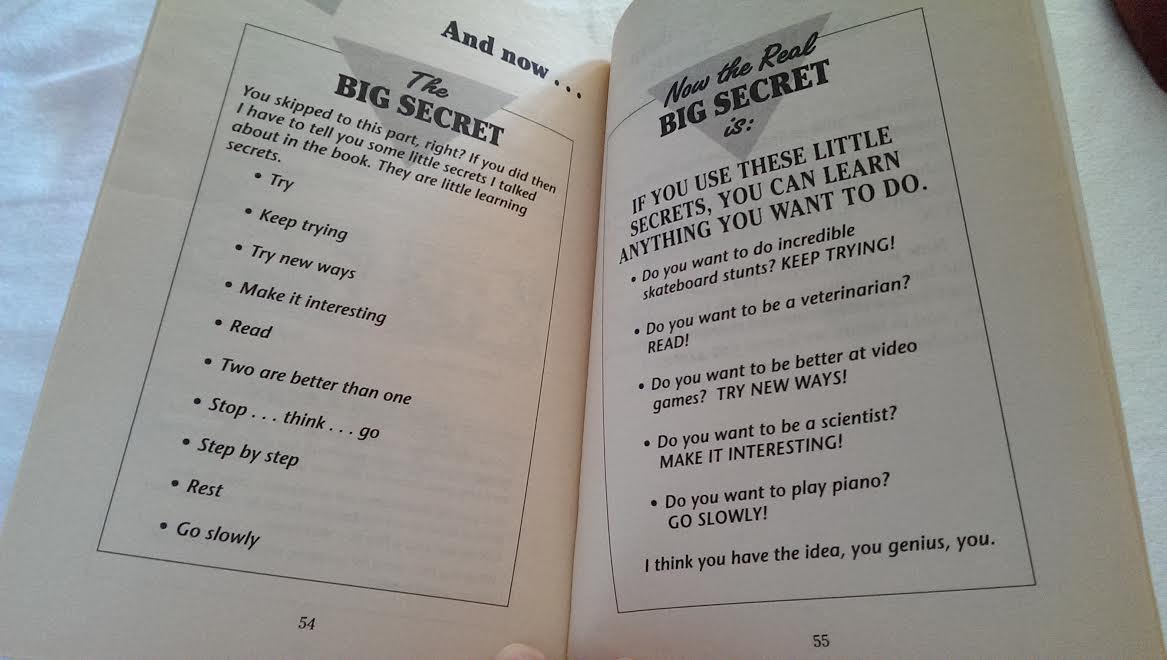
Kids will enjoy learning these little tricks to entertain their friends. However, the book also contains useful tips for learning these skills that can be used to learn anything you want to learn. The author emphasizes the importance of trying new things, practicing what you’ve learned, going slowly and dividing big tasks into smaller ones when trying to master something difficult, and making tasks interesting so they will be easier to learn. Aside from the fun of learning these little tricks, the book’s main purpose seems to be helping kids to develop self-confidence and new learning skills.

The book is currently available online through Internet Archive.

uselessskillspic2