Tales of a Fourth Grade Nothing

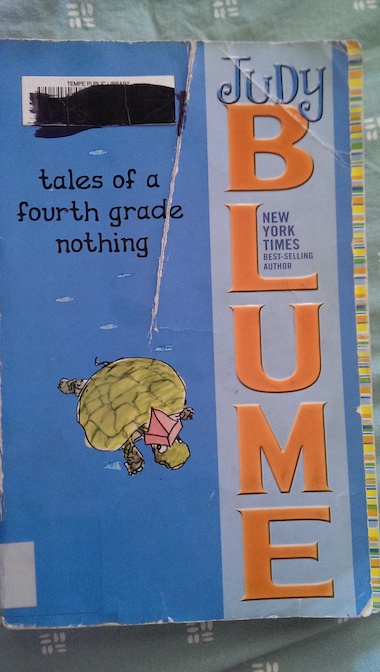
FourthGradeNothingTales of a Fourth Grade Nothing by Judy Blume, 1972.

Fourth-grader Peter Hatcher is being driven crazy by his younger brother, Farley, who everyone calls Fudge because he hates his name.  People think that two-year-old Fudge (he turns three during the book) is cute, and his mother sometimes spoils him or gives in to his tantrums.  To Peter, Fudge is a little terror, and he feels like his parents don’t care as much about him as they do about Fudge.

Most of the book is kind of like a series of short stories about Fudge’s antics which take place over the course of several months.

When Fudge goes through a phase of refusing to eat unless he gets to eat on the floor under the table, like a dog, their mother allows Fudge to get away with it, even patting him like a dog.  Peter thinks that his mother would be better to let Fudge not eat until he gets hungry, and Fudge’s doctor gives her the same advice, but his mother lets Fudge’s behavior continue until their father gets tired of it and dumps a bowl of cereal on Fudge’s head, declaring, “Eat it or wear it!”

Fudge sometimes gets Peter into trouble, too.  Peter’s mother takes them to the park along with Peter’s friend Jimmy and Sheila, a girl they know from school who also lives in the same apartment building as Peter.  Their mother has to run back to the apartment for a moment, so Sheila volunteers to baby-sit Fudge.  Mrs. Hatcher only allows it on the condition that Peter help her.  Of course, Sheila, who is a pest, decides to chase Peter and tease him about having cooties, so no one is watching Fudge until he falls off the playground equipment and knocks out a couple of teeth.  Peter can’t help but notice that he gets more of the blame for that from his mother than Sheila does, even though she was supposed to be the main baby-sitter.

Fudge’s third birthday party is a disaster, with other little kids as messy and troublesome as Fudge himself.  He gets into Peter’s room and messes things up, including a project Peter was working on for school.  For many of Fudge’s antics, Peter is able to laugh about them in the end, but there is frequently frustration at his mother’s inability to stop Fudge from doing some of the things he does or her willingness to put up with them and her seeming favoritism at times for the cute younger sibling.

Then, Fudge does the worst thing he could possibly do and eats Peter’s pet turtle, Dribble, the one he won at his friend Jimmy’s birthday party.  Peter loved Dribble, talking to him throughout the book when he didn’t want to talk to his parents, and while everyone else is concerned for Fudge’s health and giving him presents for getting better, Peter is angry that his pet is now dead and no one seems to care about him . . . or about Peter himself.  Or so Peter thinks.

There is one more present from Peter’s parents and grandmother: a pet that Fudge would never be able to eat, and it’s for Peter alone.

Peter’s parents do care about him, even though they can get so caught up in Fudge’s antics and rescuing Fudge from them that it can be difficult to show it.  Most of the time, Peter is able to laugh with his parents at Fudge’s antics, which are pretty funny, but once in awhile, he also needs them to understand how the things that Fudge does affect him, too.

Reading it again as an adult, I sometimes find myself getting a little annoyed with the mother in the story.  Being a mother of a young child isn’t easy, but Mrs. Hatcher does take out her frustrations on Peter (something she even admits to at one point when he confronts her about blaming him for Fudge’s playground accident and she apologizes), and I take issue with some of her priorities and assumptions about Fudge’s behavior.  Sometimes, it seems like she doesn’t know her own child as well as his brother does and she doesn’t take take pragmatic steps in dealing with him and preventing problems before they start.  At times, I found myself thinking, “She’s making a mistake here.  Does she really not see this coming?”  Admittedly, I’ve read the book before, so I have an advantage, but putting a three-year-old into a suit he hates for his birthday party with other three-year-olds?  Seriously?  Suits are things adults are interested in, not three-year-olds, and many adults try to avoid wearing formal wear whenever they can.  She was trying to dress him up like a doll, not a real small child, and it was more for her sake than for his.  Sometimes, Mrs. Hatcher is reluctant to punish Fudge (admittedly, he is pretty young for most punishments), although she does spank him once when he ruins Peter’s school project, showing that she can stand up to him when it’s important.

Possibly, Peter was a different, calmer child when he was young, and Mrs. Hatcher sometimes expects Fudge to be the same way when he isn’t.  That might also explain the episode when Mr. Hatcher invites a business associate to stay with them for awhile, not considering that not everyone is used to putting up with a young child and some of the chaos that goes with it.

The age difference between Peter and Fudge is also important to the story.  Fudge looks up to Peter and wants to do a lot of the things he can do and have things like the stuff Peter has.  Having two kids with very different ages also makes family life a little harder because the children are in different phases of life and have different needs and interests.

Magic by the Lake

MagicByLake

Magic by the Lake by Edward Eager, 1957.

Jane, Mark, Katharine, and Martha are finally going to spend the summer at a lake with their mother and their new stepfather! The children were never able to do that before because their widowed mother always had to work during the summer. When they arrive at the cottage by the lake that their stepfather, Mr. Smith, has rented, there is a sign that says, “Magic by the Lake.” The children think that it could just be the name of the cottage because sometimes cottages are giving interesting or amusing names, but having had experience with magic before (this being the second book in the series), they consider the idea that they could be headed for more adventures. Of course, they are correct, but it turns out to be the lake that’s really magical, not the cottage.

MagicByLakeTurtle

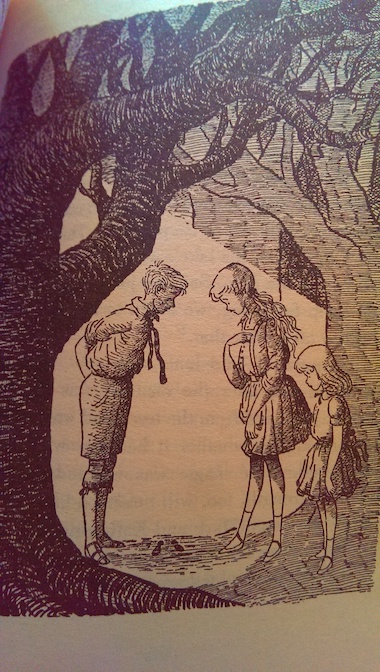
The children are playing by the lake when they wish for more magic, and a talking turtle comes up to tell them that, because of their wish, the entire lake is magic. That sounds amazing, but too much magic all at once can be overwhelming. Fortunately, the turtle is also magical, and he has some ability to influence magic in the lake. The children make a deal with him that he can arrange for them to have adventures with magic in the lake, but only one at a time, because that’s what they feel that they can handle. Also, the adventures won’t happen every day, so they can have a chance to rest in between. The grown-ups around them won’t notice any of the magical happenings, and little Martha insists that nothing truly scary will happen to them. Jane protests at that request because she thinks that it will make their adventures as boring as overly-tame children’s books, but the turtle says not to worry because what he thinks of as “not scary” isn’t necessarily what Martha would think of as “not scary.” The turtle tells the children that when they’re ready for adventure, they should think about what they wish for and then touch the lake, and if the time is right for it to happen, it will.

That sounds simple enough, but what they consider the right time and what the lake considers the right time aren’t always the same thing, and just as before, their wishes and adventures don’t go quite as planned. In their first adventure, a mermaid takes them to an island of pirates, the stuff of high adventure. The children are delighted when they discover that the pirates, being adults, can’t really see them, as per their earlier wish for adults not to see their magical activities. It opens the potential for playing dirty tricks on rotten pirates, who seem to perceive them as some sort of ghosts. It’s all fun and games until the pirate captain decides to see if he can make ghosts walk the plank. Their turtle friend saves them by turning them into turtles, which, while magical, makes the rest of the day rather difficult for them because they have to go home and on errands with their mother. Walking on land can be difficult for turtles, and their mother has no idea that they’ve changed at all, still seeing them as children. Whatever magic the children get during the day seems to last until the sun sets, even when they wish it would end sooner.

MagicByLakeGrownUp

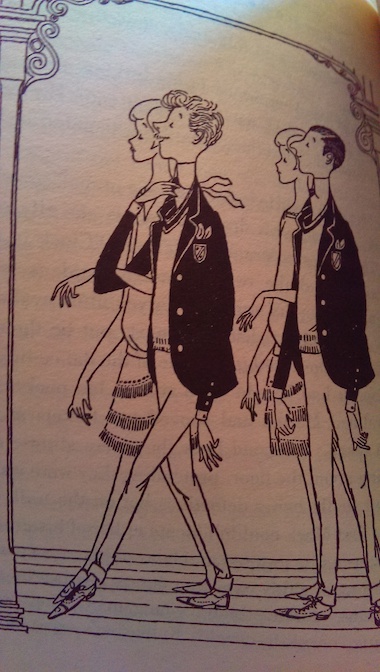
Then, while watching their mother and Mr. Smith at a dance, Jane and Katharine wish that they were old enough to join in, about age sixteen. Suddenly, the two of them are teenagers in evening dresses, getting attention from some teenage boys. The girls seem to enjoy the romance of it, but Mark and Martha follow them around, trying to convince the boys that the girls are really younger than they seem to be and dreading the moment when they will inevitably change back to themselves.

The children discover that they don’t even need to be at the lake in order to make the magic happen as long as they’re touching water from the lake. On a rainy date, when the roof of their cottage is leaking, the children realize that the rain water is also lake water. By making a wish on that, they end up at the South Pole in time to save a lost explorer and help him make an important discovery.

MagicByLakeDisappearance

The children enjoy their adventures, but they become worried about Mr. Smith, who has been making the commute back and forth from the lake to his bookshop, and it seems that business hasn’t been good at his bookshop this summer. They consider the idea of using the magic of the lake to solve Mr. Smith’s problems, perhaps by going back to the island where they saw the pirates bury a treasure chest. They figure that if they could bring Mr. Smith an entire chest of pirate treasure, he wouldn’t have to worry about money anymore.

But, of course, that idea doesn’t go as planned. When Martha argues with the others and goes to the island by herself to get the treasure, she breaks all the rules associated with the magic.   Because the rules that previous protected her and her siblings are gone, there is nothing to prevent her from being captured by the cannibals that live on the island. When her brother and sisters try to save her, they are also captured. It’s only the sudden appearance of Martha’s future children and Katharine’s future daughter (although they don’t know it yet), who are on a magical adventure of their own, in a cross-over from another book in the series, The Time Garden.

MagicByLakeTreasure

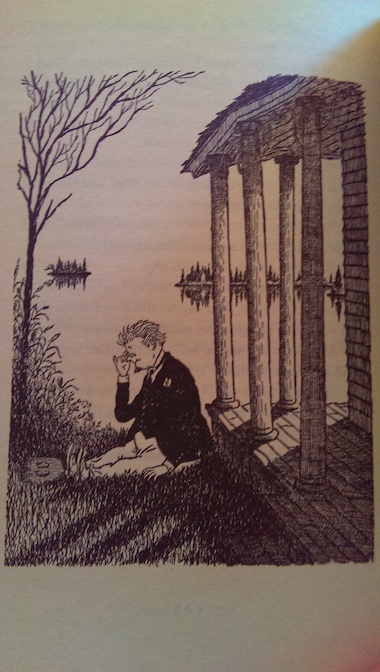
The children make one more attempt to get treasure for Mr. Smith in a kind of Arabian Knights adventure, but that doesn’t work, either. However, although the children seem to have used up their wishes on the lake, they have the feeling that the magic might allow them one last opportunity to get what Mr. Smith needs. It does in a way that may or might not be magical, although the buried treasure that they find and get Mr. Smith to dig up may be a representation of the pirates’ treasure and not of the old miser (now deceased) who was said to have lived at the old, abandoned cottage by the lake that the children decide to explore. It does seem like quite a coincidence that the old miser’s initials would match those of the pirate captain, and they are carved on the stone over the buried treasure, just like the marker the pirate captain left.

In the scene with the cannibals on the island, the cannibals are stereotypical “savage natives” (or “native savages”, or something generic of that sort, since the terms are used pretty interchangeably in the story). You find things like this pretty commonly in old children’s books, especially prior to the 1960s. But, what made this more palatable for me was that the entire scene is written as a joke on the usual stereotypical books that children of the era would have read. The cannibals speak kind of like American Indians in cheesy old Westerns, using words like “heap” for “very” and randomly adding “-um” to end of words. You know that it’s not really how anybody, even cannibals living on some remote island in an indeterminate ocean, would talk, but it might be how children raised on adventure stories and movies from the 1920s might imagine they would (adding to my earlier theory from the last book that at least some of the children’s adventures might actually take place in their own minds, not in their “real world”).  It may also be a reference to things in tv shows from the 1950s, the time period when the story was written. The best part for me is when the children try to remember what shipwrecked explorers do when confronted with cannibals in some of the stories they’ve read. They start throwing out random words that are meant to sound impressive combined with some gobbledy-gook in an effort to communicate/impress the cannibals. Then, Mark tries to convince them that he’s a powerful god with the ability to control fire. The cannibal chief is unimpressed, telling him that he recognizes what Mark has as an ordinary safety match, which he blows out. So much for the old adventure stories.

The book is currently available online through Internet Archive.