Ruth Fielding of the Red Mill

Ruth Fielding

#1 Ruth Fielding of the Red Mill or Jasper Parloe’s Secret, by Alice B. Emerson (The Stratemeyer Syndicate), 1913.

In the first book of the Ruth Fielding mysteries, one of the older series produced by the Stratemeyer Syndicate, young Ruth Fielding has recently lost her parents and is traveling by train to New York state to live with her Great Uncle Jabez. She has never met him before, but she knows that he lives in a red mill outside of a small town. She meets the town doctor on the train when he notices how sad she looks and explains to him why she’s traveling to her great uncle’s home. Her old home was in a poor area, and although she would have liked to stay with her friends there after her father’s death, no one would have been able to keep her. Then, the train unexpectedly stops when the engineer sees what looks like a warning light.

It turns out that the light is a red lamp tied to a large mastiff, who seems very upset. Ruth, who is good with dogs, is the only person who is able to calm the dog enough to get a look at the dog’s tag. It turns out that the dog belongs to Tom Cameron, who doesn’t live too far from where her Great Uncle lives. Tom Cameron comes from a wealthy family, and he has a reputation for being a wild boy. The lamp tied to the dog appears to come from his motorcycle, and there is a note tied to the dog that appears to be written in blood and only says, “Help.” Ruth is very upset, thinking that the dog’s owner must be badly hurt somewhere. The adults around her aren’t so sure because they think Tom could be playing a prank, but they take the dog aboard the train. The town doctor says that it’s possible that Tom could have had an accident on his motorcycle, and when they get to town, the town doctor, some of the other men, and Ruth set out to see if the dog will lead them to where Tom is. Ruth needs to come because the dog behaves better for her than for the men.

When they find Tom, he really is hurt, having had a motorcycle accident. He is barely conscious and muttering, “It was J. Potter. He did it!” They don’t know what it means, although it sounds like he’s accusing Ruth’s great uncle of causing his accident. By the time they get Tom to safety, it is late, and it turns out that Ruth’s uncle visited the train station at the wrong time, before the train even arrived and not seeing Ruth, assumed that she wasn’t on the train and left. Because her uncle lives outside of town and it’s rather late, the station master, Mr. Curtis takes Ruth to stay the night at his house with his family. Mrs. Curtis is very nice, but Mercy is a young invalid. She doesn’t like other children because they stare at her because of her disability, and she can’t play the games other children play.

The next day, Helen Cameron, Tom Cameron’s twin sister, comes to the Curtis house to give Ruth a ride to her great uncle’s house. Ruth likes Helen, but Helen tells her that her great uncle is a good miller but has a reputation as a miser, and she’s surprised that he decided to take her in. That worries Ruth, but Helen assures her that there will be others in town who would be willing to have her if she can’t stand living with her great uncle. In fact, Helen’s father even told her that he would be interested in having Ruth come to stay with them because she would be a good companion for Helen. Tom and Helen’s mother died when they were babies, and Helen would appreciate having another girl in the house. It’s a generous offer, but first, Ruth needs to meet her great uncle and see what he’s like.

Great Uncle Jabez is very much like Helen described. He is a hard worker but an impatient, hard-hearted, and self-centered man who doesn’t do much of anything without analyzing what he can get out of it for himself. He makes it clear that if Ruth wants to stay with him, he’ll expect her to work and make herself useful to the household. There is only one other person who lives with Uncle Jabez, the housekeeper, who likes to be called Aunt Alvira, although she is no relation to either Jabez or Ruth. Aunt Alvira tells Ruth that her uncle is a good man for giving her the position of housekeeper when she had nowhere else to live and no family of her own. She is more warm and affectionate than Ruth’s great uncle, making Ruth feel more at home. Ruth sees that she can be helpful to Aunt Alvira by assisting her with household chores. Aunt Alvira is getting older and has aches and pains that cause her to often exclaim, “Oh, my back, and oh, my bones!” She appreciates having a strong young person to help her. Uncle Jabez becomes appreciative when he sees that Ruth knows how to do chores and make herself useful, and Aunt Alvira’s affection makes Ruth’s new home bearable for her.

One day, when Tom is feeling better, he and Helen come to see if Ruth wants to take a ride with them. Aunt Alvira says it’s okay for her to go, and while they’re out in the Camerons’ car, they witness the breaking of the mill’s dam. The young people realize that they need to warn others who are in danger. They drive around, shouting warnings for people to get out of the way, and they finally take refuge at the red mill, which is soon cut off like an island. The mill’s office is partially destroyed in the flood, but the mill itself is undamaged. Uncle Jabez makes it safely back to the mill, although he has to drive his mules hard to make it through the waters. Unfortunately, there are two major losses: Ruth’s trunk, which Jabez was bringing to the mill from the train station and was lost out the back of his cart in the water, and Uncle Jabez’s money box, which was in the mill office and contained his life’s savings, all of the cash he had in the world. Uncle Jabez hasn’t trusted banks since the last time he lost money when the town’s bank failed. Everyone thinks that the money box was swept away when the office was partly destroyed by the flood, but Uncle Jabez has other suspicions when he learns that Jasper Parloe, a disreputable man, was near the mill office around the time when it was destroyed.

The book is now public domain and available to read for free online in several formats through Project Gutenberg. There is also an audio book version on Internet Archive.

My Reaction

As one of the earlier Stratemeyer Syndicate books, there are elements of adventure and general fiction as well as mystery. In fact, there is more of these elements than there is of mystery. There are the disasters that Ruth and her friends must confront, the motorcycle accident and the flood caused by the breaking of the dam, but they don’t really seem to try to investigate any further into these for much of the book. They also don’t really try to investigate the disappearance of Uncle Jabez’s money box, thinking that it just washed away in the flood, even though Jasper Parloe suspiciously ran to where he knew it was and then ran away immediately after. I don’t think it’s even that much of a spoiler to tell you that Jasper Parloe did indeed take Uncle Jabez’s money box. The fact that he has a “secret” is right in the title of the book, there are no other suggested secrets about him, he was right on the scene to take it at the time it disappeared, and there are absolutely no other suspects other than the flood.

Ruth has legitimate complaints about her uncle. Insisting that Ruth help out around the house isn’t bad, but at first, he resists the idea of sending Ruth to school, asking basically, “What’s in it for me?” Uncle Jabez never does anything for anybody without seeing what’s in it for him. Even though Aunt Alvira credits Uncle Jabez with giving her a home, Jabez got a free servant out of it, so it’s not like he was really doing Alvira a favor as a Good Samaritan. In fact, in places where slavery and indentured servitude are illegal, most people would pay a live-in housekeeper a salary as well as providing them with a place to live as part of the job. Jabez isn’t even doing that. His “favor” gets him free services most people would pay for.

I don’t fault him too much with not trying to immediately get Ruth some new clothes after he lost her trunk in the flood. While he should replace the clothes as soon as possible, his money was missing, so he might not have had the funds. Still, he is not the least bit sympathetic to Ruth about her loss and even seems to take some pleasure in telling her that he lost her trunk, which is awful. Uncle Jabez does get better, though, especially after he gets his money back.

A fun, expected part of the story is the fondness that unexpectedly develops between Uncle Jabez and Mercy Curtis. From the beginning of the book, Mercy is bitter about her physical condition and the fact that she has to use a wheelchair. The book makes it clear that Mercy’s bitterness is poisoning her chances of making friends in her community. She thinks that other people are mocking her or looking down on her for her disability. A major part of that exists only in Mercy’s own mind because she herself is upset about being disabled, so she exaggerates what she thinks other people are thinking about her or saying about her behind her back, and she’s often wrong. One thing that she’s not wrong about is that people pity her, and even if they’re not being mocking of her, they are sometimes overly sweet or pitying in their tone. She takes that as mockery, although it’s really meant to be a kind of sympathy. Mercy ends up liking Ruth because Ruth doesn’t do that around her. Ruth feels pity for Mercy, both because of her physical problem and because of her bitter attitude that’s making her more unhappy, but she purposely doesn’t show it because she knows that would only annoy Mercy more. Instead, she just speaks calmly and nicely to Mercy about things that she’s experiencing and finds pleasant, and that draws Mercy out of her shell. When Ruth describes her life at the mill while visiting Mercy, Mercy admits that she’s often admired the red mill and the grounds around it from a distance, the first time she really admits to liking anything. Most of the time, Mercy has a sharp tongue and is full of criticism. However, she expresses an interest in seeing the red mill up close and meeting Uncle Jabez. Uncle Jabez fascinates Mercy because he is ugly. Because Mercy is physically imperfect, she is drawn to other people who are also physically imperfect, and the fact that Uncle Jabez is blunt and biting in his speech also fits well with Mercy’s personality. She knows that Uncle Jabez won’t talk to her with any of the pitying sweetness that she can’t stand. In return, Uncle Jabez is pleasantly surprised that Mercy honestly likes him for being the crotchety old coot he is and enjoys letting her come for a visit at the mill. The twins take her to the mill in their car, which is a treat for Mercy, and the visit with other people who accept her for who she is does her good.

Stories about invalids getting better through improving their attitude and outlook on life were a common trope in children’s literature in the late 19th and early 20th centuries. The Secret Garden was only published two years prior to this book. However, I was pleased that they chose to make it clear that Mercy has a genuine physical disability, not one that’s all in her head and vanishes as soon as she starts thinking pleasant thoughts. It makes the book more grounded in reality. Mercy did have a real problem that would be genuinely upsetting to have, and while making new friends and getting a new perspective on life did help her feel better, it takes real medical intervention to bring about improvement in her physical condition. Before the end of the book, the local doctor brings a specialist surgeon to see Mercy, and Mercy gets an operation that restores some of the use of her legs, giving her improvement that she can genuinely feel glad about. She doesn’t get completely better, which also is true to life with serious physical conditions. She still has to walk with crutches, so it’s not like they gave her an unrealistic, magical cure. However, Mercy accepts the marked improvement in her condition for the blessing it is. No longer being dependent on a wheelchair means that she can do more things than she was previous able to do, and in the next book in the series, she is even able to attend boarding school with Ruth and Helen.

Twin Spell

This book was originally called Twin Spell but was renamed Double Spell in reprintings.

Elizabeth and Jane Hubbard, a set of twelve-year-old twins, can’t really explain what made them stop to look at the little wooden doll in the window of the antiques shop.  Ordinarily, they probably wouldn’t have noticed it at all, but something seemed to draw them to it while they were supposed to be going home to look after their little brother.  The woman in the shop wasn’t going to sell the doll to them, either, but for some reason, she said that she felt that she ought to do it because it seemed like the doll belonged with them.

Buying the old doll starts off a chain of mysterious events in the twins’ lives.  On impulse, still forgetting that they’re supposed to go home and baby-sit, the girls decide to visit their Aunt Alice and show her the doll.  Aunt Alice had been living in England, but she had recently moved back to Toronto to live in the girls’ grandmother’s old house.  Aunt Alice doesn’t know what to think of the doll, except that it might be worth something as an antique.  She shows the girls around their grandmother’s old house, but Elizabeth has a sudden fall down the stairs, breaking her leg.  Strangely, a week later, Aunt Alice suffers a similar accident, breaking her hip.

Because of her accident, Aunt Alice decides that the big old house is a bit much for her to handle, and she tells the twins’ parents that they can have it to live in instead.  With five children in the family, including the twins, they could really use the larger house, and the children are excited about going to live there.

The twins find themselves thinking of odd things, as if they were old memories.  They suggest taking a “sick basket” of goodies to their aunt, thinking that maybe their mother had done something like that for someone before or maybe they had dreamed something like it.  Their brothers can’t remember any such thing happening, and it would be pretty weird for both of the girls to have the same dream.

However, the children think that a basket of goodies for their aunt would be a good idea.  They put together some stuff from their kitchen and what they can buy with their money, and they decide to include a book that she can read while she’s recovering.  Unfortunately, the book they choose from their shelves turns out to be a rare copy of a book about the history of Toronto that their father was using for a research project, so they have to get it back.  They do, and Aunt Alice tells them that she enjoyed it and that she had forgotten that an uncle had written it.

As the family moves into Aunt Alice’s old house, the twins keep thinking that there is something strange about their doll, that it seems to be influencing them, giving them visions of the past.  Besides the “sick basket” dream they both had, they have visions of a house and a blonde girl in old-fashioned clothes.  They start to think that the doll, which they both have the impulse to call “Amelia,” might be magic or something.  Jane is the more sensible of the two, and she insists that there must be some other explanation, like imagination or coincidence.  Elizabeth, the dreamier twin, insists that it’s the influence of Amelia, that they’re somehow seeing Amelia’s memories of the past.

After the girls argue about the doll and the source of their odd visions, Jane starts ignoring Elizabeth.  Elizabeth continues thinking about what they’ve seen, and the blonde girl, who she is sure is called Hester and was the former owner of Amelia.  Eventually, Jane starts agreeing with Elizabeth about Hester being the doll’s former owner, but she is dubious when Elizabeth says that Amelia wants to find the house where she once lived with Hester.  Jane doesn’t know how the two of them can do that.

They ask their father for his advice, and he suggests that they start at the museum.  There, they learn by studying the styles of old clothes that Amelia is from the 1840s.  They find an area of town with houses similar to the one they’ve seen in their minds, where Amelia once lived, but they have trouble finding the exact house they’re looking for.

Jane becomes increasingly afraid, though.  More and more, she begins to feel like something is trying to take the doll away from them.  Something that is mean and doesn’t like her is in their attic.  Something like a ghost.  Jane has an awful feeling that something horrible is about to happen.

When the Jane looks at the history book her father has been reading, the one written by her great-great-uncle, Jane suddenly has a startling revelation. The house they have been seeking in actually their house, changed over the years by new additions. Amelia came from their house, and that is where she really belongs. Through the visions, they see an old tragedy in their family reenacted, a tragedy that puts Jane’s life in danger.

The book is available to read for free online through Internet Archive. There is no need to borrow this copy and no time limit; you can just read it in your browser.

The girls had made a mistake when they first started receiving their visions.  They had assumed that Hester was Amelia’s original owner, but she wasn’t.  The glimpses they got of Hester weren’t through the doll’s eyes, but those of the doll’s real former owner.  The doll was one of a set of two that originally belonged to another set of twins in the girls’ family, Anne and Melissa.  Hester was their cousin, and she was not a nice girl.  Both Jane and Elizabeth sensed it pretty early.  During an argument with Anne years before, Hester accidentally lit Anne’s dress on fire with a candle she was holding, causing Anne to die.  Hester hadn’t actually meant to harm Anne.  The whole thing was just an accident, but Hester’s guilt and Melissa’s anger and grief at her twin’s death had caused Hester’s spirit to linger in the house.  By learning the circumstances of Anne’s death and assuring Hester that they understand that she had not meant to kill her cousin, that it was all an accident, and that she couldn’t save Anne because she was just too frightened and didn’t know what to do, they help Hester’s spirit to finally rest and to reunite Amelia with her doll twin, which Hester had hidden years before.

The scene where the girls see Anne’s death is a little scary, but mostly sad.  Hester lived on after the incident, but it was not a happy life.  She ended up having to live in Anne and Melissa’s old room, where Anne died, because she never married and had to live with family.  Aunt Alice remembers knowing her as a young child, when Hester was a bitter old woman.  Perhaps if Hester hadn’t been carrying that guilt around for so many years, her life would have been much happier, although being a nice person had never particularly been her nature.  However, the twins’ acceptance of Hester’s tragedy and assurance that they understand and forgive her for what happened set her spirit at peace.

The genealogy in the story is a little confusing, partly because certain family names repeat through the generations, but there is a chart in the back of the book to help.  There are some other loose ends in the story which are also never completely clarified.  The girls admit that they will probably never know how the doll Amelia came to be in the antiques store, but it doesn’t particularly matter because Hester, Anne, Melissa, and Amelia all seem to be at peace now.

Who Stole the Wizard of Oz?

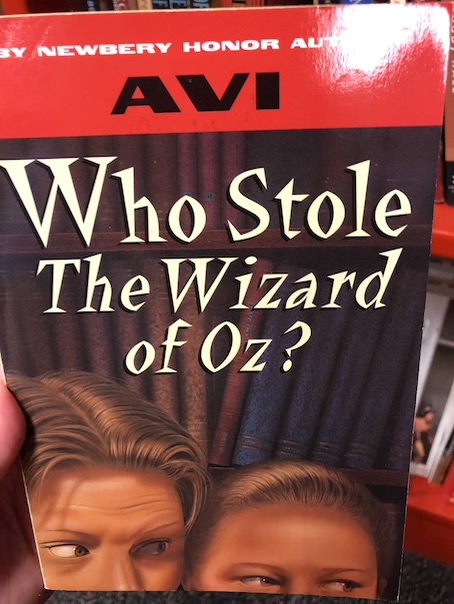
One summer, Toby and his twin sister Becky see the police go to their local library. To the children’s surprise, Mrs. Brattle, the librarian, phones their house and asks Becky to come down to the library and bring one of her parents.  The children’s parents aren’t home, so Becky and Toby go.  Mrs. Brattle doesn’t seem to want to say much over the phone, only that The Wizard of Oz was stolen, and they need to talk to Becky.

As Becky and Toby walk down to the library from their house, which isn’t far, Becky says that shortly before school let out for the summer, Becky’s teacher for sixth grade next fall handed out a summer reading assignment.  The kids have to write two book reports over the summer, and the books can’t be mysteries, fantasies, or romantic adventures.  Miss McPhearson, the sixth grade teacher, believes in only factual books.  However, Becky decided that the best thing to do was to get the book reports over as soon as possible, so she went to the library.  (Toby wasn’t involved because he has a different teacher.)  While she was there, she decided that she’d check out The Wizard of Oz for Toby, knowing that he likes fantasy books, but she was told that it was already checked out.  Mrs. Brattle told her that there would be a book sale at the library tomorrow and that she had a copy of The Wizard of Oz that Becky could buy for five cents, but since the librarian wouldn’t sell her the book that day and Becky didn’t want to make a special trip to the library the next day, she turned down the offer.

When they come to the library, the policeman accuses Becky of stealing the copy of The Wizard of Oz that the librarian showed her as well as some other children’s books.  According to the librarian, the books were actually valuable collector’s copies, worth thousands of dollars.  Becky asks the librarian why she offered to sell her one for nickel if they were so valuable and Mrs. Brattle says that it was a mistake.  The policeman says that if Becky has the books, she can return them now, and there will be no problem, but Becky is insulted and insists that she didn’t take them.  In the face of Becky’s denial, the policeman says that there isn’t much that he can do because there is only the librarian’s word that the books were valuable, and she doesn’t deny that she earlier tried to sell them for five cents each.  Missing children’s books worth less than a dollar isn’t exactly a police problem.  (I’d like to say here that I was very glad that the policeman took that attitude. I hate those children’s books where adults not only falsely accuse children of doing things that they didn’t do but also make petty incidents seem like major crimes. The policeman is correct that there is no proof that the books were as valuable as the librarian says and that this evaluation of their worth comes only after their sudden disappearance and after she was offering to sell them very cheaply.)

Even though the matter seems to be dropped for the moment, it bothers Becky that the librarian still thinks that she might have taken the books.  She suggests to Toby that they could investigate and try to find out what really happened to the books.  The first thing that they decide to do is to look for the original owner of the books.  After inspecting other children’s books at the sale and looking at the names in the front covers, they decide that Gertrude Tobias is the most likely former owner because many of the other books at the sale belonged to her.  Unfortunately, Gertrude Tobias died a few months ago.  However, it turns out that her niece is Miss McPhearson.  Becky hurriedly finishes her book reports so that she and her brother will have an excuse to visit Miss McPhearson and ask her about the books.

When they ask Miss McPhearson about her aunt, she calls her aunt a “foolish woman” who “didn’t know any better.”  However, she refuses to explain any further what she means, and the children see her crying before they leave.

When the children speak to Mrs. Chesterton, they get a very different picture of Miss McPhearson’s aunt.  When Gertrude Tobias was a young woman, she was wealthy. She could have gotten married if she wanted to, but most of the young men didn’t like women who seemed too smart, and Miss Tobias prided herself on her intelligence and cleverness.  She resented the idea that adults seemed to want women to play dumb to get a husband, so she refused to get married and spent most of her time in the company of children.  Mrs. Chesterton remembers her saying, “Children like me smart. Grown-ups want me stupid.”  She liked to read children’s books, and she often volunteered to read books to children at the library.  The children liked her and often confided in her, just like she was their aunt.  She spent a lot of her money buying children’s books for her collection.  Mrs. Chesterton says that Miss Tobias and her niece never really got along well and that Miss McPhearson used to tease her aunt about her love of children’s books.  However, Miss Tobias was rich, and Miss McPhearson didn’t have much money at all.  Miss Tobias told her that she would leave her all of her “treasure.”  When she died, it turned out that she had left her niece five children’s books – the five that are now missing.  The others were willed to the library.

At first, the picture seems like it’s becoming more clear: Miss Tobias had one last joke on her niece by giving her valuable children’s books that Miss McPhearson thought were worthless simply because they were children’s books, and the person who took them recognized what they were worth as collectors’ items.  However, the situation is actually more complicated than that.  A series of strange break-ins have been occurring around town. Nothing else has been taken, but someone is clearly searching for something.  Miss Tobias was clever, and her books have an even deeper meaning than most people have realized.  To learn Miss Tobias’ secret, Toby and Becky have to learn the secrets of the books themselves.

The book is currently available online through Internet Archive.

I really loved the puzzle in this book! There were parts that I got before the kids did and parts that they realized before I did. It isn’t a kind of puzzle that readers call fully solve before the characters in the book because it requires knowledge of their home town to get the full answer.

As an unmarried, childless adult who also enjoys children’s books, I could kind of sympathize with Miss Tobias. Children’s books, like some adults, are often very clever but go unappreciated by people who underrate them for what they appear to be. For example, Through the Looking Glass, which was one of the books featured in the story, involves a game of chess. The author, Lewis Carroll (real name Charles Dodgson), was a mathematician. His books are full of word games and logic puzzles, and the chess game described in Through the Looking Glass is an actual chess game that can be played with real pieces on a real board with a definite ending square, where Alice the pawn becomes Alice the queen (one of the clues to solving the final mystery in this book). To many adults who only know the basic story of Alice, it might just seem like a silly, nonsense children’s story, but they miss the real, clever puzzles planted in the story, just like Miss McPhearson did with her aunt’s legacy.

In the end of the story, Miss McPhearson never learns the truth about her aunt’s legacy, just as her aunt knew she would miss it. Toby and Becky come to an understanding with the real thief about Miss Tobias’ treasure that allows the library to benefit from the legacy, which is something that Miss Tobias would have appreciated. Miss McPhearson decides to give up teaching and leaves town to find another job, working with computers, a very “adult” field indeed. It’s only a pity that she wasn’t mature enough to behave nicely with her aunt and not tease her, so that her aunt would be more generous with her. People who play childish games are sometimes surprised when they meet a better game player.

Like Miss Tobias, I have little patience for people who try too hard to be “adult” or are too concerned with whether certain things are right for adults to do, especially when they show their immature sides in other ways. In the story, Miss McPhearson makes a point of being “adult” in all situations, but she wasn’t above childishly taunting an older woman about her hobbies, still expecting that woman to leave her all of her money. It reminds me of the kids I knew in elementary school who liked to act really grown up at age ten. Kids go through a phase where they start talking about doing grown-up things like having first boyfriends and girlfriends and wearing makeup and watching adult tv shows and listening to adult music, but in between doing all of that, they still act like childish brats because what they’re doing is trying on the trappings of adulthood without the real substance. Until they get some real maturity and better behavior, they’re just kids playing dress-up. Sometimes, I think that some people never quite leave that phase, which is how I view the character of Miss McPhearson.

I think of this every time I hear some adult my age or older talking about how real adults drink alcohol or real women wear high heels and lipstick. To hear them talk, there are quite a lot of rules to being grown up that very few people I know actually follow. Alcohol is expensive, plenty of people abstain for health or religious reasons, and driving drunk certainly isn’t mature behavior. High heels damage your feet the more you wear them. I’ve forgotten how much makeup I’ve thrown away because, most days, I’m just too busy to even think about putting it on, and they eventually dry out and get gross. It would be a waste of money for me to buy more, knowing I’ll never use it all. To my way of thinking, if you really are an adult and you know who and what you are, you have nothing to prove. If you aren’t mature as a person, things like high heels and lipstick aren’t going to help you, and alcohol just lowers your inhibitions and makes the immaturity more obvious. Maturity is a way of looking at things, assessing situations, and acting accordingly. It can be difficult to define, but you know it when you see someone living it, not just looking the part. Real adults don’t need to “act” like adults at all times because they aren’t “acting”; they’re just being themselves, confident that they are mature enough to handle what life throws at them along the way.

Monster Slayer

MonsterSlayer

Monster Slayer retold by Vee Browne, illustrated by Baje Whitethorne, 1991.

This is a retelling of a Navajo folktale.  An Editor’s Note at the beginning of the book explains a little about the original legend.  It is actually part of a much longer story.  The book only focuses on the Walking Giant part.  The Walking Giant threatened the villages of the Anasazi.  The author and illustrator of this book are both Navajo.

Changing Woman, who created both humans and monsters, had twin sons, but they did not know who their father was until they were twelve years old, when their mother told them that their father was the Sun.

MonsterSlayerAnasaziVillage

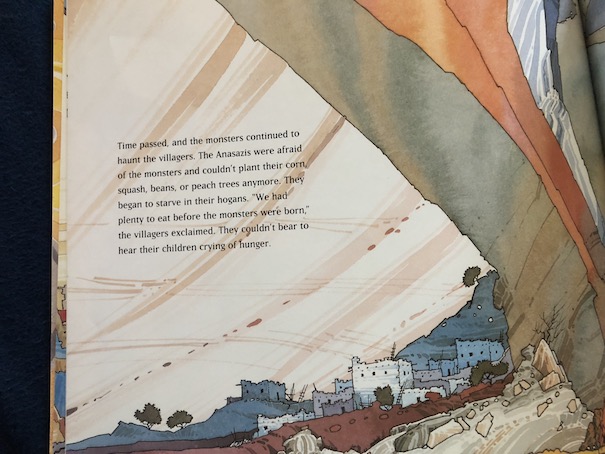
The twins went to see their father, but they were returned to Earth to help their people to fight the monsters which plagued the land.  The monsters prevented the Anasazi from planting their crops, and people were starving.  The people appealed to Changing Woman and her sons for help.  The twins’ father gave them his lightning arrows to use in the fight.

MonsterSlayerVillagers

Hearing the sound of thundering footsteps, Changing Woman told her sons that it was the sound of the Walking Giant.  The twins took their armor, sacred magic feathers, and lightning arrows and set out to find the giant.  Eventually, they found him by a lake.  The twins hid behind a rock, but the giant could smell them.

MonsterSlayerMagicFeathers

As the fight began, the twins let the giant shoot the first arrow at them because their father told them to, since Walking Giant was older that they were.  However, their magic feathers helped them to evade the giant’s boomerang.  Then, one of the twins used a lightning arrow to finish off the Walking Giant.  To commemorate their victory, Changing Woman named this twin Monster Slayer.  (The other boy was already named Child Born of Water.)

MonsterSlayerGiant

This story is interesting but felt a little disjointed to me. That may be because it is a shortened version of the legend.  I wish that the beginning note explained a little more about the context of the story.  This book won the Best Juvenile Book Western Heritage Award from the National Cowboy Hall of Fame.

The book is available to borrow and read for free online through Internet Archive.

Miss Nelson Has a Field Day

NelsonFieldDay

Miss Nelson Has a Field Day by Harry Allard and James Marshall, 1985.

Everyone at school is disappointed in the school’s football team.  Even the team itself thinks that they’ll never have a chance at winning, so they don’t bother to practice.  They refuse to listen to their coach and spend all of their time goofing off.  Finally, the coach starts to crack mentally from the strain, and Miss Nelson decides that something needs to be done.

NelsonFieldDayTeam

Some of the kids mention that if Viola Swamp, the  meanest substitute teacher ever, were there, she’d know how to deal with the team.  Not knowing how to contact The Swamp, the principal tries to turn himself into Viola Swamp, but his outfit is just goofy . . . then the “real” Viola Swamp shows up to coach the team.  As usual, she takes no nonsense from anyone.

NelsonFieldDayFake
NelsonFieldDayCoachSwamp

The Swamp undeniably gets results, however, the principal has started to wonder who Miss Swamp is and how she always knows when to show up.  Unlike in previous books in the series, Miss Nelson is teaching her class as usual while Coach Swamp is out on the field with the team.  Since the previous books pretty well established that Miss Nelson and Miss Swamp are the same person, how is this possible?

NelsonFieldDayTwoPlaces

The book is currently available online through Internet Archive.

My Reaction and Spoilers

The story doesn’t contradict the other books, and Miss Nelson is still Viola Swamp, but there is one more surprising thing about Miss Nelson that nobody knows which can allow her to appear to be in two places at once . . .  she has a twin!

NelsonFieldDayVictory

Stories with a secret twin can sometimes feel like a bit of a cop-out, but this one is funny because this is the first and only time Miss Nelson has called on her twin to help her with her double act as Viola Swamp. Miss Nelson’s twin sister is actually the one who’s teaching the class as the nice teacher while Miss Nelson is out on the field coaching as Viola Swamp. There is a moment at the end of the book where the twins are together and Miss Nelson explains to her sister why Viola Swamp is necessary. Sometimes, students need a little tough love and discipline, but by using her alter ego to dish it out when necessary, Miss Nelson gets to keep her reputation as the nice, sweet teacher she really is.

Even though readers know what’s going on with Miss Nelson and Viola Swamp from the previous books, Miss Nelson’s twin adds a nice twist to the plot. The fun of the Miss Nelson books is watching how Miss Nelson carries out her identity swaps. In this book, I also loved the principal’s hilarious attempt to play the part of Viola Swamp in a Halloween witch costume!

Magic or Not

MagicNot

Magic or Not? By Edward Eager, 1959.

Laura and her twin brother, James, are practical children who are fond of useful facts, but still have imaginations and appreciate fantasy stories. In this part of the Tales of Magic series, all of the previous books in the series are fictional books that the characters have read and enjoyed, and real magic may or may not exist, as the title suggests. All throughout their coming adventures, the children are never quite sure how much of what happens is magic and how much isn’t, but they’re bound for an amazing summer.

Laura and James’s family has recently bought a house in the country, and the story begins with the twins taking the train to their new town while their parents follow in the car with their luggage and their baby sister, Deborah. Laura and James haven’t seen the new house yet, but they know that it’s pretty old, and they speculate if it could be haunted or maybe even magical, like something from a fantasy story. James doesn’t think so.  He thinks that magic, if it existed, is a thing of the past. Then, a strange girl on the train tells them that magic does exist. She insists that her grandmother is a witch and makes a comment about how they should “drop a wish in the wishing well, and wait and see!”

MagicNotWishingWell

Laura and James don’t know what she means, but it turns out that there is an old well on the property of their new house. James ignores it, but Laura can’t resist giving the wishing thing a try. After struggling to come up with something appropriate to wish for, she finally writes a note that says, “I wish I had a kitten” and tosses it into the well. The next day, when they meet the boy next door, Kip (short for Christopher), they find a basket with two kittens in it sitting on the edge of the well. Kip figures that Lydia found the note that Laura wrote in the well bucket and decided to make her wish come true by leaving a couple of stray kittens for her.

It turns out that the girl from the train is Lydia Green. Kip says that she lives nearby with her grandmother. Lydia’s grandmother is an artist, and both of them are eccentrics. Lydia is kind of a wild child who likes to spend her time riding around on her black horse. She’s something of an outcast in the community, and she knows it. When the other children go to see her to ask about the kittens, Lydia seems prepared for them not to like her and for her not to like them, either. However, when she finds out that Laura’s names for the kittens were inspired by the book The Midnight Folk, she warms up to them because she also likes fantasy stories, and Laura offers to share the magic of the well with her.

MagicNotLydia

James is more skeptical about Lydia and insists that she prove that there’s magic around, if her grandmother is really a witch. Lydia is reluctant at first, but then she shows the other children her grandmother’s garden. She insists that one of the plants in the messy garden (which does look like it might belong to a witch) can bring visions when it’s burned and maybe even a visitor from another world. (Sounds trippy.) The others want to see it work, so they decide to burn some. Nothing happens, and when James demands to know how long they have to wait, Lydia gives a vague answer that it might not be the right time or that maybe she just made the whole thing up. James believes the second explanation, but Laura is willing to give Lydia (and magic) more of a chance.

The two girls bond over their shared love of fantasy stories, and Laura invites Lydia to come to their house the next day. The boys admit to Laura that they kind of like Lydia, although she’d be easier to get along with if she didn’t have such a chip on her shoulder. Kip says that she’s always like that, and that’s why kids at school don’t get along with her either.  Even so, Lydia is an interesting person.

When Kip gets home, he finds more of the strange plant that Lydia burned growing around his house, and his mother tells him that it’s an ordinary wildflower. Still, the next day, something happens which makes it seem like Lydia’s notion that it “makes unseen things appear and seen things disappear” has come true – the old lawnmower that came with the house is now missing, and there’s a young tree on the property that wasn’t there before. Coincidence? Maybe, but Lydia had also said that it could “transform people so they’re unrecognizable overnight”, and suddenly little Deborah has a new, weird haircut. When Deborah happily announces that she’s been transformed by magic, James realizes that it’s a trick and that Kip arranged everything. Lydia is angry that Kip was playing a joke, but he says that it isn’t really a joke, that he just wanted to keep the game going. Lydia says that it isn’t really a game to her, although she finally admits that she left the kittens.

Laura turns on the boys and says that it’s obvious that Lydia only did those things because she wanted to make friends. Lydia tries to deny it at first, but then admits that it’s true, but that she is never able to make friends and that she doesn’t know how. Laura says that she is Lydia’s friend, and the boys are, too. James agrees, saying that he just likes “to get the facts straight,” but now that the facts are known, he hopes that they can all start over again. The children each apologize to one another for the awkwardness, and Laura says that she is a little disappointed that there isn’t any real magic.

MagicNotIsabella

This part could be a story all by itself, but, not so fast! Just as the children are making amends with each other, a strange woman comes up to them in a horse-drawn carriage, looking like a visitor from another world in strange, old-fashioned clothing. They ask her if she came because they wished for her, and she says it’s difficult to say, but wonders why they would think so. The children say that they were playing a game and wished for a visitor from another world. The woman says that, in a way, she is from another world. She says that when she lived in this same valley, when she was young, life was very different, so it’s like she has come from the past to the present. The woman, Isabella King, lives in a house by the old silver mine. She invites the children to come and visit her sometime to have some of her silver cake and see the old mine. After she leaves, the children debate whether Isabella was brought to them by magic, but James says that it doesn’t matter because it looks like they’re going to have an adventure, magical or not.

Isabella King really does like to live in the past, maintaining her house and the old, disused silver mine that her father left her in the way that she’s sure he would want them to be maintained. However, her house and mine are threatened when the bank announces that it will foreclose on the mortgage. The children badly want to help Miss King, so they decide to go see the banker, Hiram Bundy, about it and try to persuade him to give her some leniency. Before they go to see him, Laura decides to make another wish on the wishing well because, in spite of Lydia’s earlier confession, she thinks that the well still might be magic.

Hiram Bundy agrees to talk to the children partly because he enjoys Lydia’s grandmother’s paintings, but he tells them that money isn’t the only concern about Miss King. Her family has a reputation for getting “peculiar” as they get older, and people have voiced concerns to him that Miss King is no longer capable of handling her own affairs and that she might be better off living in a nursing home. The children angrily deny that Miss King is mentally incompetent, giving him some of the cake that Miss King had baked for them as proof that she is still capable of doing things. Miss King is an excellent baker, and Mr. Bundy admits that he is impressed. Lydia also finally speaks up about the way the people in town, including Mr. Bundy himself, look at her and other people who are eccentrics. Lydia’s grandmother is allowed to be eccentric because she’s a talented artist and people make allowances for her, but those same people look at Lydia as if she’s terrible just because she likes to spend time by herself, riding her horse around. Adults in town are always saying that she’s a disgrace and that “somebody ought to do something” about her just because she doesn’t like things that other people like and wants to live her own life, doing her own thing. It’s not that there’s really anything wrong with either Lydia or Miss King so much as some of the people in town simply don’t like them and the way they do things. Because they aren’t the town’s little darlings, they are unfairly characterized as being worse than they really are and ostracized. Mr. Bundy admits the hypocrisy, which he is also guilty of, and assures her that he will take responsibility and straighten things out with Miss King.

When the children later see Mr. Bundy having cake and talking with Miss King at her house, Laura remembers that part of her wish at the well had been that Miss King would have Mr. Bundy eating out of her hand, and once again, the wish seems to have come true, literally. Although it still isn’t positive proof that Mr. Bundy’s change of heart was due to the well’s magic, the children think it might have been.  They start considering that perhaps the well came through for them because they were doing a good deed, and perhaps they ought to try to do the same for others, thrilling in the apparent power they have to change people’s lives.

MagicNotLostHeir

Testing out their theory proves difficult at first because they have trouble finding another person with a problem for them to solve. At first, the only person who seems to want their help is the woman downtown who asks them to help with setting up for a local art show to encourage amateur artists. The art show is open to anyone in town, and the kids think that maybe they should enter it, too.  However, the only art supplies that they can afford are paper and crayons, and only Lydia manages to draw something that’s any good.  Lydia doesn’t particularly like her drawing, saying it’s just a doodle, but Laura stops her from throwing it away. Then, the clerk at the store asks them if the small boy in the store is their little brother. It appears that the little boy is lost, so they decide that their good deed for the day will be helping him to get home.

They do find the boy’s home, and he turns out to be the child of a wealthy family who wandered off while his nurse was talking to a friend in town and ignoring him. The nurse at first blames the children for kidnapping the boy when they come to return him. The boy’s father doesn’t believe that, but he does reprimand the children for taking all day to return him because they had wanted to find his house themselves with the help of the wishing well instead of the police and allowed themselves to be sidetracked with something else they had also wanted to do. In the end, the children question how much they really helped the “lost heir”, as they think of him, because he might have been found sooner without their interference. However, one good thing does come out of their adventures: Lydia wins a prize in the art contest because Laura entered her picture on her behalf.

Lydia (as Laura had expected) is at first angry that Laura entered her in the contest without her permission, but Laura explains to her that she’s realized something about Lydia: Lydia prefers to think that no one cares about her or will ever appreciate her because she fears their rejection too much to risk trying to do anything that might earn their approval. Laura points out that their interest in her art proves that people really do appreciate her. Lydia’s grandmother even apologizes for not realizing before that Lydia has artistic talent. Lydia is amazed because she never really thought of her doodles as being anything special before. Kids at school had always made fun of her “crazy pictures,” and her teacher had always insisted that she “paint from nature” instead of drawing what she really wanted to draw.

MagicNotFriends

But, the children aren’t done with the wishing well yet. Mrs. Witherspoon, the head of the local garden club and self-appointed arbiter of all that’s right and what everyone should think and do, has set herself against the new school that is planned for the area. She doesn’t like the idea of more traffic, more kids running around, and the possible risk to property values. However, many families with children live in the area, and they really want the school for their kids. Mrs. Witherspoon has set herself against them because she’s accustomed to people simply agreeing with what she wants (often just out of habit). She’s one of the big voices that enforces conformity in their town. She’s so awful that the kids consider making a voodoo doll of her, but then, it occurs to them that she might be much worse if she were actually in pain instead of just busy being one. They decide maybe she really needs people to be extra nice to her in order to make her more agreeable, but she refuses to accept any of their gestures of kindness because she thinks that they just want money from her, and she calls them juvenile delinquents. Can the power of the wishing well do anything to change her mind? Or, do they really need it?

A surprising friendship with Mrs. Witherspoon’s son, Gordy, leads the children on one last adventure that may (or may not) involve a ghost from the past and answer the question of whether or not the wishing well is really magic (unless there’s another explanation).

All through the book, there are other explanations besides magic for everything that happens. In fact, the wishing well may not do anything aside from acting as a source of inspiration for the children. Mr. Bundy might have been influenced by the children’s arguments even without the well, but the well is what influenced them to become friends with Isabella King and try to help her in the first place. Similarly, Lydia was always talented in art; it was just that no one recognized it until Laura was inspired to enter her drawing in the art show. The strangest episode takes place at the end of the book, when the children supposedly meet the ghost of the woman who may have made the well magic in the first place, but even then, the children realize that the “ghost” may have been the work of someone else, perhaps part of a conspiracy on the part of the people they’ve been helping all summer. However, it’s never established one way or the other, so it’s up to the readers’ imaginations to decide.

Much of the story is about fitting in and finding friends. In the beginning, Lydia was the main outcast in the community, but it turns out that many others, including Gordy, in spite of his mother’s social status, don’t quite fit in, either. In fact, it seems that perhaps more people in town would have liked Lydia more and encouraged her in her art if she had ever felt confident enough before to let people really get to know her. However, here I have to say that it was really the townspeople’s fault for driving her away in the first place. For a long time, Lydia had lost confidence in other people and in her ability to make friends because of the way people treated her. That was why Lydia sometimes purposely acted strange and didn’t try to get people to like her; she was already pretty firmly convinced that they didn’t and never would. It was just the message that everyone seemed to be sending her, and it kind of turned into a vicious cycle that was pushing Lydia further and further away from other people.  Lydia really needed intervention from a third party to end the cycle. When Laura accepts Lydia and convinces the others to accept her as well, it opens up new sides of Lydia’s character and new possibilities for her.

The drive that some people have to assert control over others, enforce conformity within a group, and maintain an “us vs. them” mentality with non-conformists is responsible for many social problems and behavioral issues. Mrs. Witherspoon is an example of this, although it turns out that even our heroes are somewhat guilty in the way that they view Mrs. Witherspoon’s son Gordy at first.

This book taught me a new vocabulary word, purse-proud, which is used to describe Mrs. Witherspoon and her friends. Basically, it means pride in having money, especially if the person lacks other sources of pride. Mrs. Witherspoon and her friends are all wealthier members of the community, which is why they feel that they’re entitled to dictate to others what they should do and how things should be. They think that because they have more, they know best. (I’ve seen this before, but now I have a new word to describe it.) Initially, Mrs. Witherspoon is unconcerned with how local children are educated because she’s wealthy enough to send her son to private schools.  Other people’s needs are of no concern and possibly a source of inconvenience for her. Gordy is the one who changes her mind when he realizes that he has a chance at making real friends with the neighborhood kids if he goes to public school, like they do, and convinces his mother that it’s what he really wants.  Although his family is pretty privileged, Gordy never really made any friends at the private schools that he has attended and has actually been rather lonely. In a way, Gordy receives the final wish of the wishing well (for this book, anyway) in getting the new friends that he has needed and learning that there are other, more imaginative ways to have fun than what he’s been doing.

Gordy is a nice surprise as a character.  At first, he seems to be a kind of clueless trouble-maker, but his friendship with the other kids brings out better qualities in him.  Perhaps a better way to put it is that the others’ acceptance of him encourages him to show more of what he’s truly capable of.   When James and Laura are introduced to Gordy, he doesn’t seem very bright, and he does things he shouldn’t, like swimming in the reservoir instead of the river and throwing rocks at windows to break them just because he can.  In some ways, the other kids are right, that Gordy is thoughtless and doesn’t behave well. However, when they end up agreeing to hang out with Gordy one afternoon after failing to win over Mrs. Witherspoon with kindness, they realize that part of the reason that Gordy acts the way he does is that no one ever suggests to him that he do anything different.  Gordy lacks somewhat for positive influences in his life.  His mother thinks that she knows best in everything but isn’t always aware of what her son thinks and feels.  Other people try to avoid talking to Gordy because they see him as an annoyance or source of trouble, so no one explains to him how his behavior is keeping him from making friends.  However, Gordy does have good points.  Unlike Lydia, Gordy doesn’t seem to hold any grudges in spite of experiencing similar problems with fitting in and making friends.  Even when the other kids are less than enthusiastic about hanging out with him at first, he still keeps trying to be friendly and is quick to forgive their earlier coldness.  Gordy knows that he really wants friends and that part of the key to getting them is to remain open to the possibility of being friends, even when those friends aren’t perfect.  In the end, he is really good at showing the acceptance of others that is part of the theme of this story.  Acceptance of others and willingness to be friendly improves things for everyone.

Another thing that I really liked about this book is the children’s attitudes toward people’s conventional views of art and literature. Many people are eager to tell others what art or writing should be and how it should be done. Lydia said that people had criticized her drawings before for being “crazy” or not from real life. They couldn’t see the imagination and talent that it took to make them because they weren’t what people expected. Even Lydia’s grandmother complains about always having to paint scenes with maple trees in them because that’s what grows where they live. She’d rather paint something else, but people expect maples trees, so that’s what she paints. Kip says that he kind of understands because his teachers always tell him to “write what he knows”, but really, he thinks that the things he doesn’t know well are much more interesting. They all want the freedom to explore new ideas, and that type of exploration is what makes fantasy stories so interesting. There may be magic, and maybe not, but considering the possibilities is half the fun!

The book is currently available online through Internet Archive.

A Clue in Code

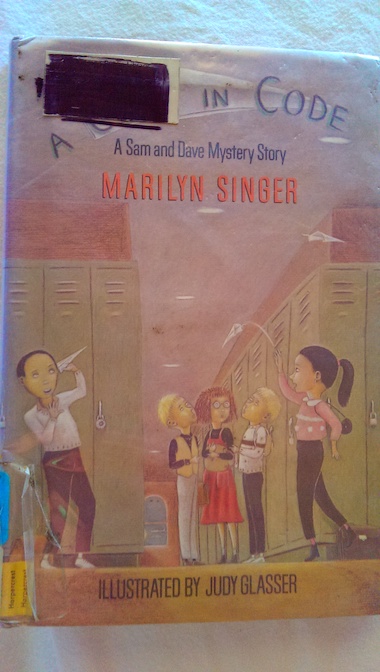
ClueInCodeA Clue in Code by Marilyn Singer, 1985.

This book is part of a series about a pair of twin boys, Sam and Dave Bean, who solve mysteries with their friends.

One day, the boys’ teacher, Ms. Corfein, has one of their classmates, Roger, collect money from the students for a class field trip.  Ms. Corfien tells Roger to put the money in her locker, but later, the money is gone.

Anyone in the class could have taken it.  When Dave went into the classroom to feed the class’s pet gerbil at lunchtime, he saw Willie, the class bully, there as well as his friend Patti, who thought that it was her turn to feed the gerbil.  Of the two, Willie seems like the best suspect for the theft because he’s been in trouble before for stealing, but perhaps there was someone else in the room before any of them arrived.

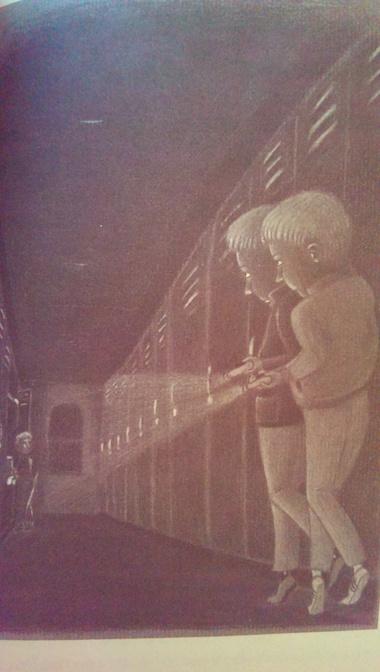
ClueInCodeSneakingSam and Dave decide to begin their investigation with Willie.  His father is the school’s custodian, and Willie has been using a copy of his father’s key to the school to sneak around after hours.  To the twins’ surprise, when they confront Willie, not only does Willie deny stealing the money, but it turns out that he’s actually been scared and upset himself.  After being caught stealing the last time, his parents have been especially strict with him, sending him to bed early, limiting his time with friends, and not allowing him to watch tv or read comic books.  In fact, his father tried to get rid of his entire collection of comic books by throwing them in the trash, but Willie rescued them and has been hiding them in the school, sneaking away to read them when he can.  However, someone has discovered them and stolen them.  Willie wants his comic books back, but he can’t report them stolen because his father thinks that they’re already gone.  Worse still, his parents will be even harder on him if he ends up taking the blame for stealing the class’s trip money.

ClueInCodeMessageIn spite of Willie’s reputation, which he deserves, Sam and Dave think that he’s telling the truth about the thefts.  Then, they happen to find a strange message that appears to be written in code after some of their classmates were throwing paper airplanes.  With the help of Rita, a friend who is very good with codes, they decode the message and uncover a valuable clue that explains why the comic books were taken and leads them to the thief’s identity.
I was pretty sure, from the very first chapter, who had stolen the money, but I wasn’t completely sure of who had taken the comic books until the end.  At first, I thought perhaps Willie’s father had found his stash and got rid of it again, but that wasn’t the case.  The thief who took the comic books was the same person who took the trip money and for the same reason.  This person’s father has been out of work, and they need the money.  It turns out that Willie has a number of comic books that are now collectors’ items, and someone is willing to pay a lot of money for them.

The Mystery of Sara Beth

SaraBeth

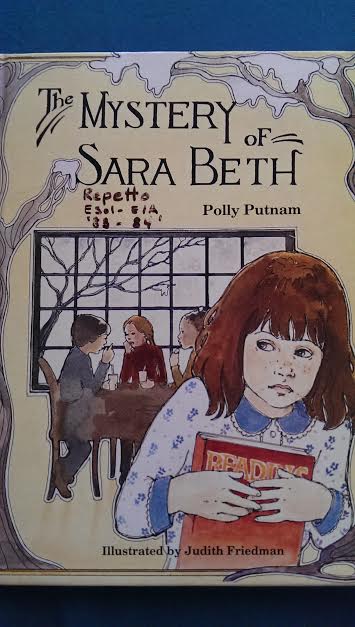
The Mystery of Sara Beth by Polly Putnam, illustrated by Judith Friedman, 1981.

This was one of my favorite books when I was young. It’s a nice mystery story for children in early elementary school.

When a new girl named Sara Beth joins their class, Becky and her friends go out of their way to make her feel welcome. However, Sara Beth barely acknowledges their attempts to make friends with her.

SaraBethPic2

Becky becomes concerned about Sara Beth and her lack of interest in making friends at school. Becky also notices some other odd things about Sara Beth’s behavior, which tends to change unexpectedly.  Sometimes, Sara Beth likes the class’s pet guinea pig, and sometimes she seems afraid of it.  One day, Becky catches Sara Beth taking a reading book home that was supposed to stay in the classroom.  Later, she sees Sara Beth hiding a cupcake from a class party to take home. Could these things help explain what Sara Beth is trying to hide?

The book is currently available online through Internet Archive.

My Reaction and Spoilers:

The solution to Sara Beth’s problem is quite simple, but it may seem bigger to younger children. The story presents a good example of the use of observation and logical thinking when approaching a problem. As Becky tries to determine why Sara Beth acts the way she does, Becky watches her closely and makes a list of her observations before coming to her final conclusion.  Becky is not only compassionate toward Sara Beth in trying to help her solve her problem and make friends at her new school, but she is also a very logical thinker.  I really enjoyed her as a character!

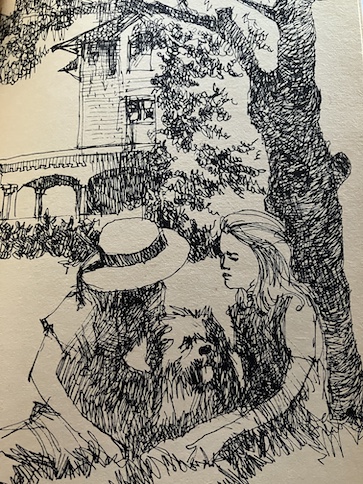
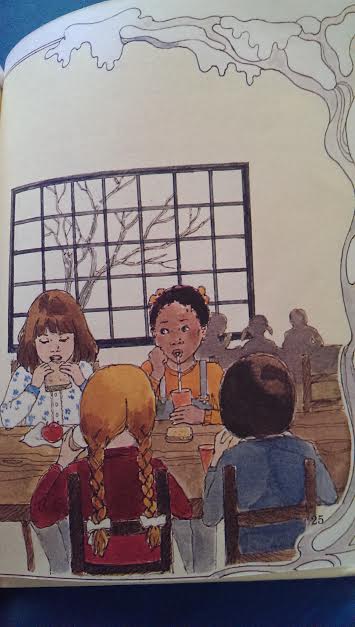
The artwork in the book is nice, and I thought it was clever how the borders of all of the images kind of give a hint to Sara Beth’s problem.  Even when the characters are indoors, the pictures are surrounded by snow-covered trees because it’s important to the story that it takes place in winter.  The snow is the root of Sara Beth’s problem.  The girls live in a cold climate and “Sara Beth” comes from a poor family.

(Spoiler: Becky correctly realizes that “Sara Beth” is actually a set of twins, Sara and Beth, which is why they behave differently each time they switch places.  Their family moved to the area from a warmer climate because the twins’ father is looking for work, but they only had enough money for one warm coat for the girls, so one of them has to stay home while the other goes to school.  They take turns going to school, and the one who goes to school brings the other one books, school assignment, and class treats so she can follow the lessons and not miss out.  When Becky confronts one of the twins, Beth, she admits that they were afraid of making friends at school because they knew that someone would find out the truth.  Becky persuades Beth to talk to their teacher, and the teacher arranges for the twins to receive an extra coat that was unclaimed from the school’s lost and found so that they can both come to school.)

In the back of the book, there’s a list of vocabulary words that appear in the story. It does not provide definitions for these words, though. I think that the most unusual words in the book were guinea pig and tetanus shot.

One more thing I thought that I would mention is that Becky, the main character, is African American. This is not mentioned at all in the text of the book and is not important to the story, but it is shown in the pictures.  I didn’t think about it much when I first read the book as a kid, but looking back on it, I found it interesting because it reminded me of the character of Adam in the Third Grade Ghosthunters series.  It fascinates me that there is something about these characters that people wouldn’t know without looking at the pictures, and I also like it that the characters themselves are not defined by race.  It’s just an interesting detail, not central to their characters.

The Twin in the Tavern

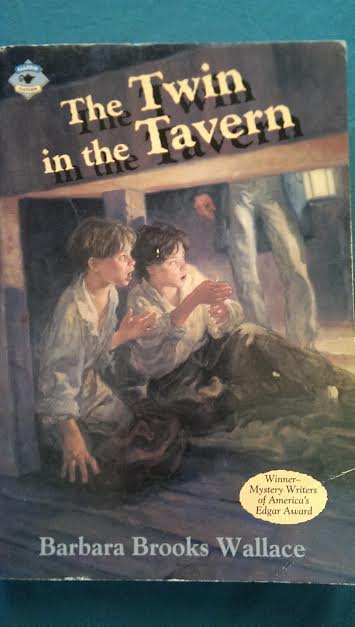
TwinTavernThe Twin in the Tavern by Barbara Brooks Wallace, 1993.
Young Taddy has lived with his Aunt and Uncle Buntz in Virginia ever since he can remember. When they die during an epidemic, he is left completely alone and afraid that he will be sent away to a work house. Before his uncle dies, however, he tells Taddy something that gives him even more reason to be afraid. He tells Taddy that nothing is how it seems and that Taddy is not really their nephew. He says that Taddy will only learn the truth when he finds his twin, but he must beware because he is in danger. Unfortunately, he never says where Taddy’s twin is or what kind of danger he is in.

Before Taddy can decide what to do, a couple of thieves, Neezer and Lucky, come to rob the house because they heard that Mr. and Mrs. Buntz were dead. When they discover Taddy in the house, they bring him with them to Alexandria and make him work in their tavern. Taddy is only given scraps to eat and he must sleep under a table in the kitchen with another boy who works for Neezer called Beetle. However, by coincidence, Neezer and Lucky may have brought Taddy to the very place he needs to be to find the answers about his past and his true identity.

Danger seems to lurk around every corner in the city, and Taddy doesn’t know who to trust. Even when Neezer hires him out to work in the home of the wealthy Mrs. Mainyard and her two daughters, sinister characters surround him, from the suspicious Professor Greevy to the stern John Graves, who visits the family.  At one point, Taddy thinks that he’s found his twin, but the boy mysteriously vanishes. Will Taddy find his twin and the secret of his past, or will the danger that his uncle warned him about find him first?

This book was a BOOKLIST Editors Choice Book in 1993 and won the 1994 Edgar Allan Poe Award.  It is available to borrow and read for free online through Internet Archive.

My Reaction

This was one of my favorite mystery stories when I was a kid!  Orphans with mysterious pasts are staples of children’s literature and make for compelling mystery stories, and the addition of a secret twin makes it even better!  Secret twins can be somewhat cliche in stories, but this one is good because there’s an unexpected twist for Taddy that he never considered until the truth is finally revealed.

Many of Barbara Brooks Wallace’s mystery books involve sinister characters with hidden agendas and children who don’t know who to trust because they don’t fully understand the plot they’re caught up in.  This book is like that because Taddy doesn’t know the real source of danger to him.  Like other children in stories of this type, Taddy frequently depends on the help of other children because he doesn’t know which adults to trust.

The story is set at an unspecified time in the past, although it appears to be sometime in the 19th century.

Which Witch is Which

WhichWitch

Which Witch is Which by Pat Hutchins, 1989.

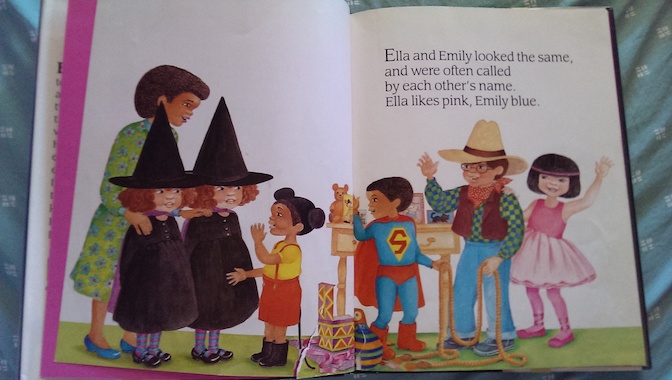
This is a cute picture book/puzzle book.  A pair of twins, Ella and Emily, are invited to a friend’s costume party, but they come dressed as witches in identical (or nearly identical) costumes.  Throughout the party, as the girls play party games, eat the party snacks, and give presents to their host, readers are invited to figure out which twin is which.

WhichWitchIntro

The main clue to the girls’ identities is that Ella’s favorite color is pink while Emily prefers the color blue.  Things that the girls have in those colors or objects that they select give away their identities

WhichWitchPresents

However, there are also other hints, like we are told what each of the girls ate at the party so that we can use the crumbs left on their plates (or the lack of crumbs) to determine which witch is which.

WhichWitchCake

The text of the book rhymes.  The illustrations are cute, and it’s a good book for teaching children how to notice details.

The book is available to borrow and read for free online through Internet Archive.

WhichWitchPlates