 In the Kaiser’s Clutch by Kathleen Karr, 1995.
After their father’s death during World War I (then called The Great War), the Dalton twins’ mother started supporting their family by writing. It’s the summer of 1918, and Dorothy Dalton is now writing the scripts for a silent movie serial starring the fifteen-year-old twins, Nelly and Fitzhugh. Times have been tough for them without their father’s support, but the serial means steady work and salaries for all three of them for the entire summer, enough to support them and buy school supplies for the fall, and maybe even enough to buy back some of the things that their mother pawned to keep their family going when they had to move out of New York to a less expensive town in New Jersey.
The movie serial, called In the Kaiser’s Clutch, is about a pair of wealthy American twins (played by Nelly and Fitz) who find themselves battling German spies. The serial is part adventure story, part American war propaganda. It’s also a subject that hits close to home. The Dalton twins’ father wasn’t killed while fighting overseas. He was in charge of the security force for the piers of Black Tom Island, just off the coast of New York, the port where most of the weaponry destined for the war in Europe was being shipped. However, a massive explosion destroyed the port at Black Tom and killed Mr. Dalton. Fitz wishes that he were old enough to fight directly in the war, but failing that, he wants to find the people who killed his father because he is sure that his father’s death was due to deliberate sabotage, not an accident. However, it’s possible that the saboteur himself is looking for the Dalton family.
Strange things start to happen which the twins realize may have some bearing on their father’s death. Someone has been spying on the family, listening by the window of their apartment. Then, the director of their movie serial hires a new, part-time actor to play one of the villains, and this man is oddly similar to the fleeing figure of the man who was spying on them. This new actor is German, and he seems to have some weird grudge against the twins, muttering insults in German and taking advantage of the stunts they have to perform in the movies to hurt and frighten them. There are plenty of opportunities for the twins to get hurt on the movie set because each episode of the series has to end with a cliff-hanger scene, and there are no stunt doubles. (Early silent movies in real life typically didn’t have stunt doubles, and the stunts were difficult and dangerous for the actors themselves. This YouTube video explain how Buster Keaton, a famous silent film actor, performed his own stunts.) From fist fights to car chases to quicksand to a cave-in to a giant pendulum with a mysteriously sharpened edge to sudden explosions, the Dalton twins are constantly teetering on the edge of disaster, not all of it planned by their writer mother.
Mrs. Dalton admits to the twins that, shortly before their father died, he told her that he was close to uncovering something that would be a much better story than anything she could make up. Unfortunately, he never told her what it was. He did tell her that he was making notes about it, but those notes were never found and may have also been destroyed in the explosion. The only odd thing that Mrs. Dalton found after her husband’s death seemed like an ordinary shopping list: “cigars, eggs, dumplings, coal, pencils.” However, Mrs. Dalton realized later that it has to mean something else because her husband didn’t smoke.
Could this somehow be the clue to what her husband was investigating before his death? Are there real spies operating in the area? Is there some other clue to their identity that they are now searching for, something that the Daltons still have in their possession? Will the Dalton twins manage to find the spies before the spies eliminate them? Will the family finish the serial and collect their salaries? Find out in this exciting installment! (There’s only one installment here because this is just a single book, not part of a series, but you get the idea.)
My Reaction
World War I books aren’t quite as common in children’s literature as World War II stories, so I found this interesting, and movie serials are also a fascinating thing of the past. The movies that the kids are acting in are black-and-white silent films, so there are interesting discussions of the techniques they use to make things show up properly on black-and-white film (makeup, dyeing the water black for Nelly’s near-drowning scene, etc.) and conveying emotion when the actors’ voices will not actually be heard. It’s a fun and fascinating story with spies, government agents, and the kind of movie stunts that I’m sure a lot of kids wish they could do for their summer jobs!
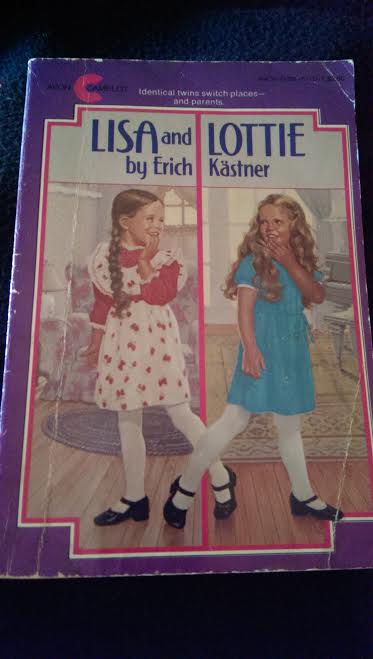 Lisa and Lottie by Erich Kastner, 1969.
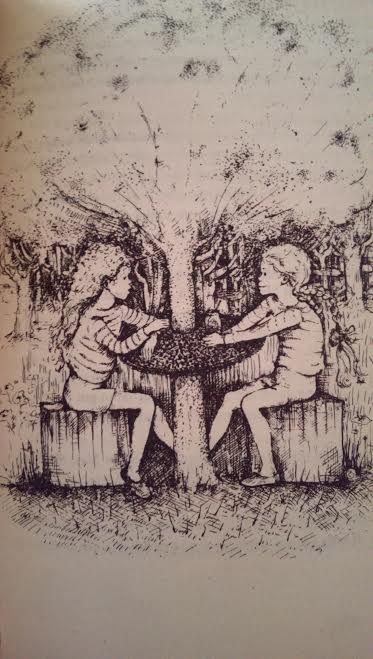 Through the rest of the summer, the girls discuss their lives and parents in great detail and continue speculating about the reasons for their parents’ separation and why they were never told about each other’s existence. They are somewhat angry at their parents for not telling them the truth, but they each also want to know more about the parent that they have never really known and perhaps to learn the truth behind their parents’ separation. They begin hatching a plot to switch places so that Lottie can go to Vienna to meet their father and Lisa can go to Munich to be with their mother. They get little notebooks and fill them with as many details of their lives as they can think of so that each girl can seem to behave like the other, although they know it won’t be easy because they’ve lived very different lives. They don’t like the same foods, and Lottie knows how to cook, but Lisa doesn’t.
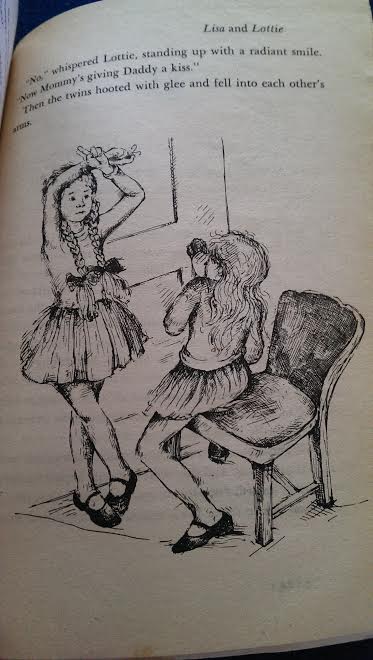 Lisa is overjoyed to finally meet her mother in Munich. But, her mother has to work very hard as a photographic editor for a newspaper, and they don’t have much money. Lisa isn’t as good at cooking or taking care of household chores as Lottie is, so she finds it difficult to help, although she learns quickly.
 The book is much less of a comedy than either of the two Disney movies, although there are some funny parts, like when Lottie (as Lisa) takes over the household accounts to stop Rosa’s stealing and ends up turning her into a much better housekeeper with her practicality. Surprisingly, Rosa actually starts respecting her more and even liking her better because of it.
 Chitty Chitty Bang Bang by Ian Fleming, 1964.
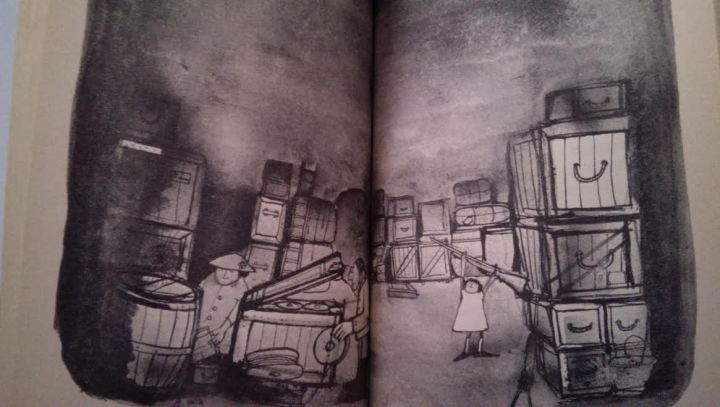
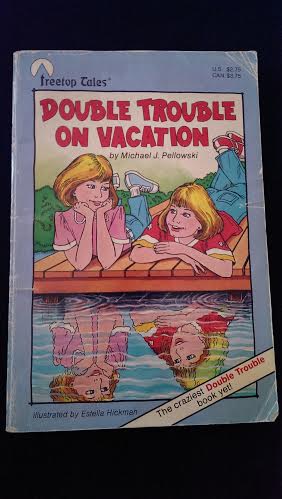
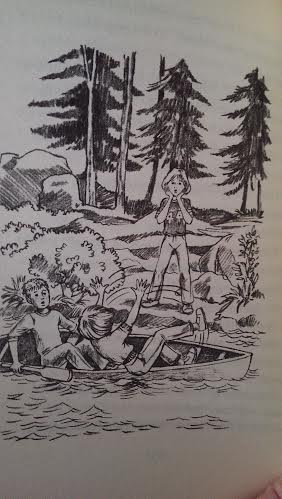 This is the last of the four books I have in this
 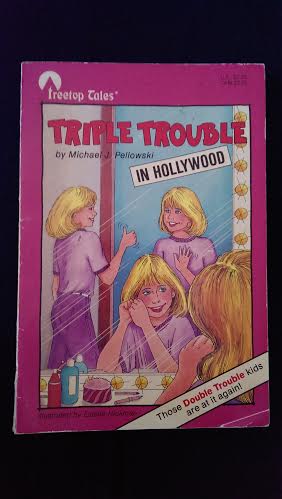 Triple Trouble in Hollywood by Michael J. Pellowski, 1989.
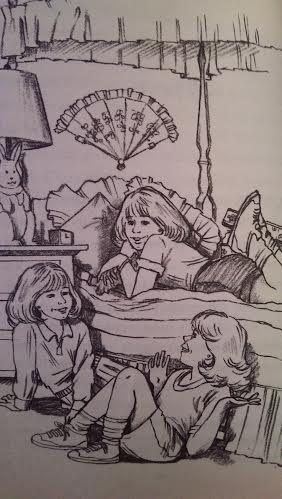 Sandi doesn’t want to do it because it would be dishonest, but Randi and Mandy talk her into it. It’s partly to help Mandy, partly to get back at Tara for her rotten attitude, and partly for the chance to meet the heartthrob Judd Morrison who will also be in the commercial. Of course, as is always the case when the girls switch places, nothing goes as planned. But, to the girls’ surprise, their younger brother Teddy helps to make things better in the end.
 Triple Trouble by Michael J. Pellowski, 1988.
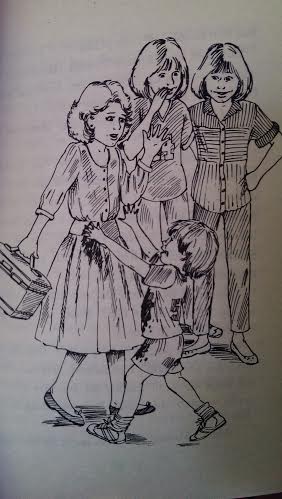 But, Mandy’s snobbish attitude rubs Randi and Sandi the wrong way. Mandy doesn’t want to do anything because she might get dirty or break a nail, and she keeps bragging about how grown up she is compared with her not-much-younger cousins. The twins argue with their cousin, and they play tricks on each other. When Mandy takes advantage of acting skills and her similar appearance to the other girls to try spending time with a boy they like by pretending to be them, Randi and Sandi decide it’s the last straw! They decide to show Mandy that playacting is a game that three can play at.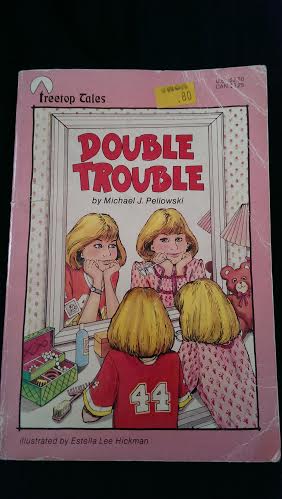
 But, everything goes wrong when Randi’s coach talks to her teacher about the championship game, and it turns out that her teacher is secretly a soccer fan. When Sandi arrives for the tutoring session and the teacher and coach tell her the happy news that “Randi” can play in the championship game, Sandi has no time to tell Randi about it and switch places with her again. Will their hoax be exposed? Will the girls be able to switch places again in time to save the championship?
 Jestress's Forgotten Books and Stories