The Girl Who Loved Caterpillars

The Girl Who Loved Caterpillars adapted by Jean Merrill, illustrated by Floyd Cooper, 1992.

This story is a rendition of a 12th century folktale from Japan.

Izumi is the daughter of an important man, a provincial inspector who serves the emperor in Kyoto. Court life is full of elegance, and Izumi is a pretty and clever girl. Her parents have high hopes that she might become a lady-in-waiting or marry a nobleman, but she is mainly known for one thing: her peculiar love of caterpillars.

A beautiful and elegant woman who lives nearby is known for her love of butterflies, and she is considered to be The Perfect Lady. She has all of the skills that a noblewoman could aspire to, and Izumi’s parents think of her as a great role model for their daughter.
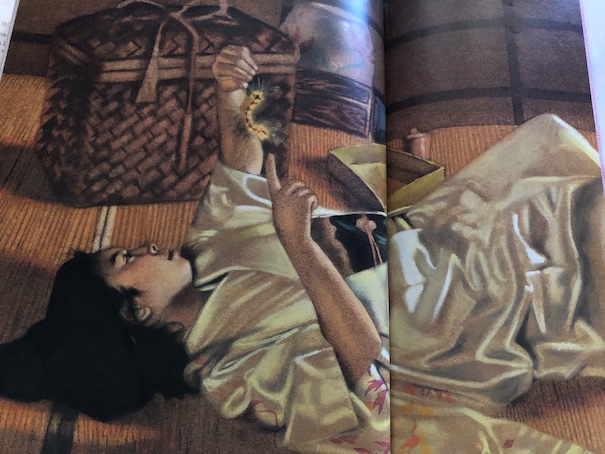
However, Izumi doesn’t see the appeal of beautiful butterflies. After all, they come from caterpillars, and caterpillars are much more interesting. Izumi also loves worms, toads, insects, and other things that most people would find unappealing. She likes to keep them as pets and observe how they live and grow. Izumi’s parents don’t approve of the lower-class boys who bring Izumi new creatures for her collection, and nobody else understands her fascination with these creatures.
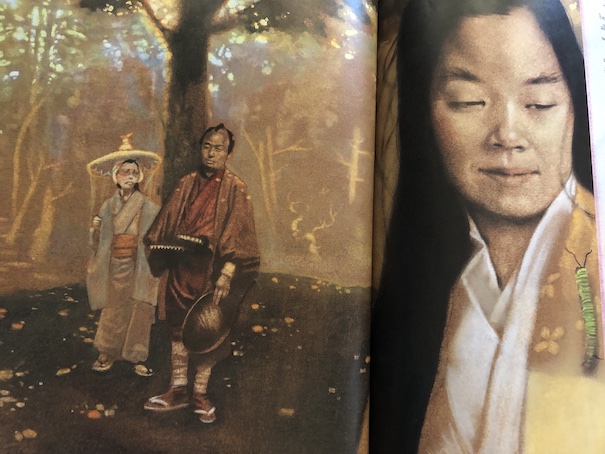
Izumi just loves the natural world. To her, court life and the beauty standards for women there are too artificial. She also believes in reincarnation and the idea that any person might have been one of these unusual creatures in a past life or could be one in the next. Her parents love her, and they understand how she feels when she explains her reasoning to them, but they also worry about her future. If she doesn’t conform more to the standards of the court and develop more “normal” interests, will she ever make a desirable marriage? People at court gossip about Izumi and her odd tastes.

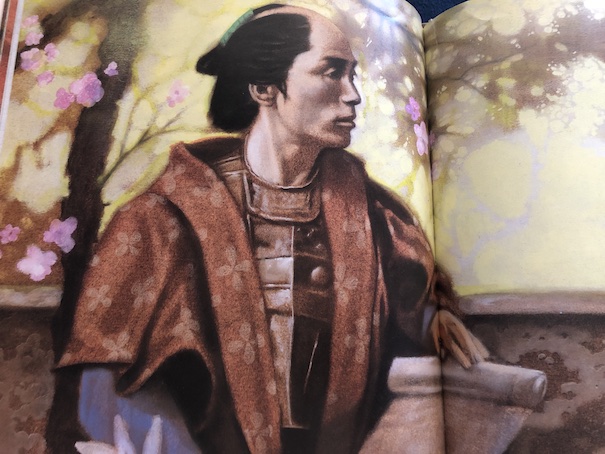
However, the rumors about Izumi reach a young nobleman who is as clever as Izumi, and he is fascinated at the idea of a pretty girl who isn’t afraid of the creeping creatures of the Earth.

The book is available to borrow and read for free online through Internet Archive.
My Reaction

I remember this story from when I was a kid! When I was a kid, I didn’t bother to read the Afterword of the book, which explains more about the origins of the story. Izumi’s story actually seems to be part of a much longer story about court life in Medieval Japan. The original author of the story is unknown, and Izumi’s part of the story is incomplete. It ends with the promise that what happens next will be revealed in the next chapter, but the rest of the story is unknown. We don’t know if she ends up marrying the nobleman who has developed a fascination with her or not.

I have a theory, based on a comment that Izumi made, comparing caterpillars to their adult forms and asking why people are only interested in the adult forms, that Izumi’s love of caterpillars is based both on her young age and perhaps a hidden affinity for children. Perhaps Izumi will grow to love butterflies as well as she grows up and be viewed as more of a butterfly herself, or maybe the nearby lady who loves butterflies will admit to a secret love of caterpillars as well. None of us stay young, and we all evolve as we grow, but part of us always remembers being in those early, awkward stages. Maybe everyone has a secret soft spot for the young, even when they’re fuzzy or grubby crawling things, and a desire to see them become the best form of themselves.

Whatever her future brings, readers get the impression that Izumi is happy and at peace with herself as she is, whether anyone else agrees or not. We can hope that the young nobleman will also love her for the person she is, but Izumi seems to believe that being true to her own nature is the way to achieve inner peace.

In other times and places, as the Afterward observes, Izumi might have been a scientist, naturalist, or philosopher. The traits that make her seem odd for her time and place are actually desirable ones that could make her more successful in other circumstances. In the early 21st century, Izumi’s sense of individualism and her value of the natural world would probably win her many friends. People who enjoy the aesthetic of Goblincore would probably relate to her feelings about caterpillars and other crawly creatures.
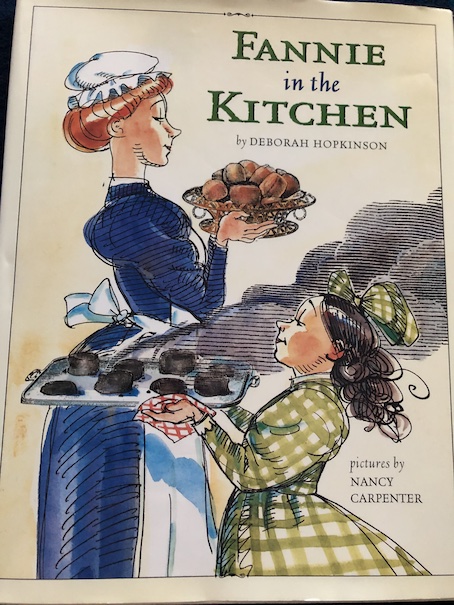
Fannie in the Kitchen

Fannie in the Kitchen by Deborah Hopkinson, 2001.

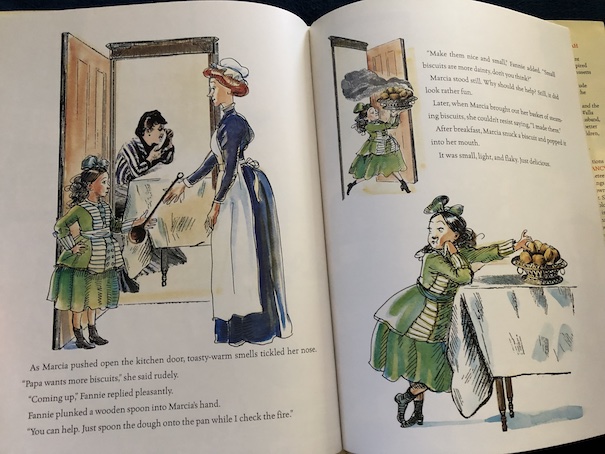
This is the story of Fannie Farmer and her famous and popular cookbook! When I first heard of the Fannie Farmer Cookbook (originally The Boston Cooking-School Cook Book (1896)), I wasn’t sure whether Fannie Farmer was a real person or if that was just a pseudonym or a marketing name for the cookbook, but Fannie Farmer was a real person in the late 19th century, and that was her real name. The story in this picture book is based on her real life, although details may be fictionalized, and the pictures give the story humorous twists.

In the beginning of the story, a little girl named Marcia Shaw prides herself on how many things she can do around the house and how much help she can give to her mother. However, she’s still a little girl, and there are some things she doesn’t know how to do well. In particular, Marcia doesn’t know how to cook. Now that her mother is expecting another baby, Marcia’s mother decides that she needs to hire some extra household help, especially with the cooking.

Marcia is a little offended that her mother considers her inadequate to help by herself, but when the new help arrives, a young woman named Fannie Farmer, Marcia has to admit that she’s a good cook. Even better for Marcia, Fannie doesn’t consider her cooking techniques trade secrets. She enjoys letting Marcia help in the kitchen and teaching her cooking tips.

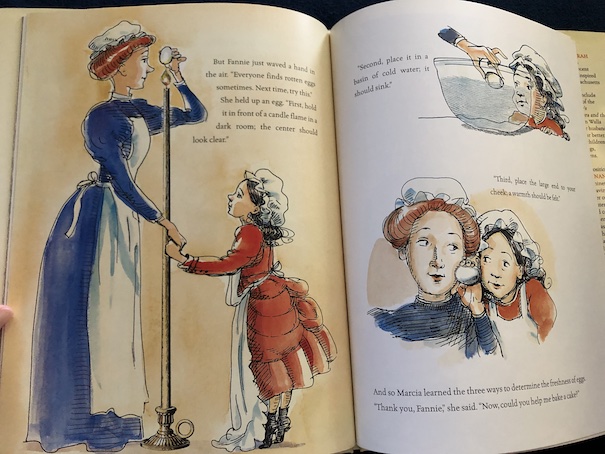
Under Fannie’s tutelage, Marcia’s cooking skills improve. Fannie teaches her many important pieces of information about cooking, like how to measure ingredients and how to tell when ingredients are fresh or if they’ve gone bad.

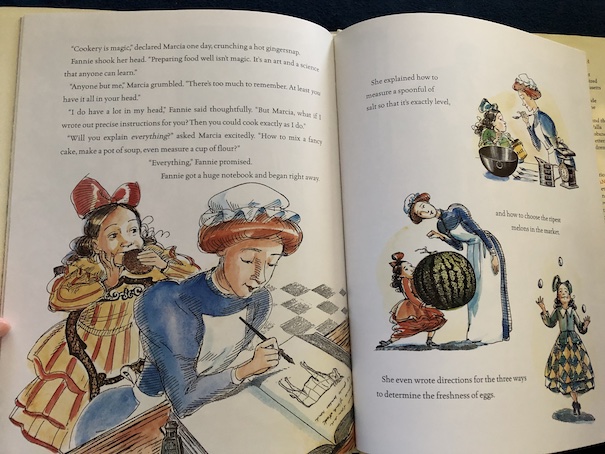
Marcia enjoys learning to cook with Fannie, but she thinks that she’ll never be as good as Fannie because there’s just too much to remember. She doubts that she’ll ever be able to memorize it all. Marcia is amazed that Fannie can keep all of that cooking information in her head. To help Marcia, Fannie decides to write out a notebook with recipes and cooking instructions, including all of the specific measurements for ingredients and detailed information about cooking techniques to make the recipes come out just right.

This is what makes Fannie Farmer and her cookbook so unique for their time period. If you’ve ever seen a very old recipe book or even just old family recipes written down, they often don’t have all of the amounts of ingredients written down, or the amounts are written in very vague terms. Old recipes also offer little to no cooking techniques, like how to tell when it’s time to turn a griddle cake over or how to tell if a cake is done baking. The assumption was that girls (usually girls for this time period) would learn to cook by watching their mothers and by learning from their examples. However, that assumes that their mothers knew all of these cooking tips themselves, that the mothers remembered to tell their daughters what they knew and explained it well enough for them to understand (some people don’t have much of a talent for teaching, even when it’s a subject they know themselves), and that the daughters understood or remembered everything their mothers said. Otherwise, the vague directions in cookbooks and family recipes were of little help, and new cooks had to learn through experimentation or trial and error. Fannie’s approach to cooking, as explained in the story, is an art and a science that anybody can learn if someone explains it well enough, so she puts her focus on recording all of the necessary details of her recipes.

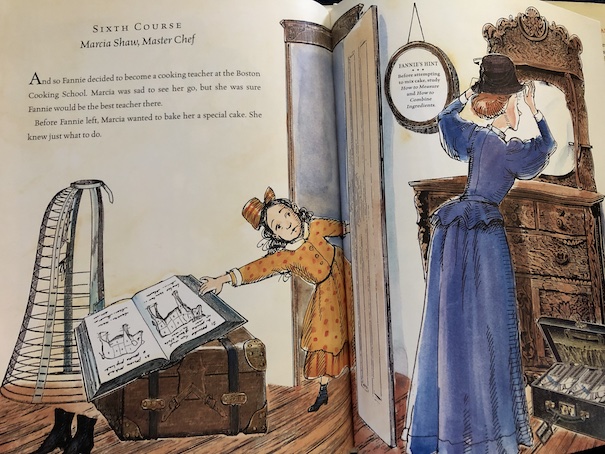
Fannie’s recipe book, started for Marcia, turns out to be very popular with both the Shaw family and their friends and neighbors. As word spreads about it, people start coming by to borrow recipes or get cooking advice. Fannie realizes that there is a lot of demand for better teaching of cooking techniques, and she really enjoys teaching cooking, so she decides to accept a job at the Boston Cooking School.

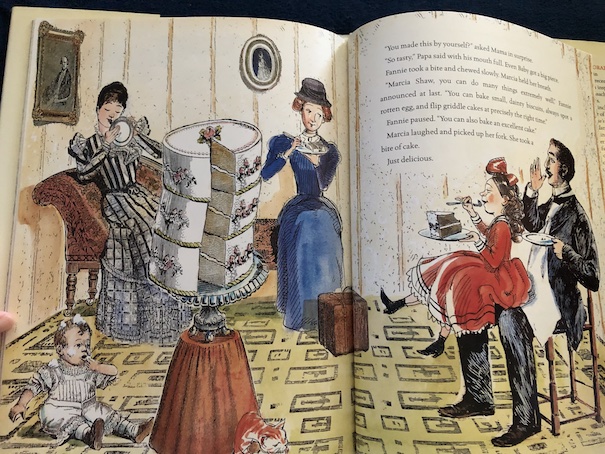
Before Fannie leaves the Shaws, Marcia borrows the cooking notebook and makes a special cake for Fannie to show her what she’s learned. The cake comes out just right because Marcia has followed Fannie’s directions.

There are hints from the Fannie Farmer cookbook throughout the book, and there is a section in the back of the book with historical information about Fannie Farmer. It also includes a sample recipe for Griddle Cakes.

The book is available to borrow and read for free online through Internet Archive (multiple copies). New and used copies are also available on Amazon. You can also buy the original Fannie Farmer Cookbook through Amazon or read it online through Internet Archive (multiple copies).

My Reaction

One of the things I liked about this book is the illustrations. There are eccentric details in the pictures that add humor to the story, like how Marcia stacks a bunch of chairs on top of each other while making candles, so she can make them extra long, and one of her extra long candles appears later, when Fannie shows her how to tell if an egg is fresh by holding it up to a light. For some reason, Marcia’s mother also has a weird habit of licking her dishes when she’s eating one of the yummy recipes, and there is one picture where it looks like she’s lost control of the baby carriage, and it’s rolling away with the baby. I’m sure these aren’t historical details and were just thrown in to be funny.

I think it’s also important to point out that the real-life Fannie Farmer lived an unconventional life for someone of her time period. She was plagued with health problems from a fairly young age. At some points in her life, she was unable to walk, possibly because of a stroke, and when she walked, she had a limp. She never married, but she built a fulfilling career around her talent for cooking. and achieved lasting fame because she wanted to share her knowledge with others. She is credited with establishing exact and level measurements in cooking in the United States, and she was also a strong believer in quality food and proper nutrition, especially for people with health problems.

Chrysanthemum

Chrysanthemum by Kevin Henkes, 1991.

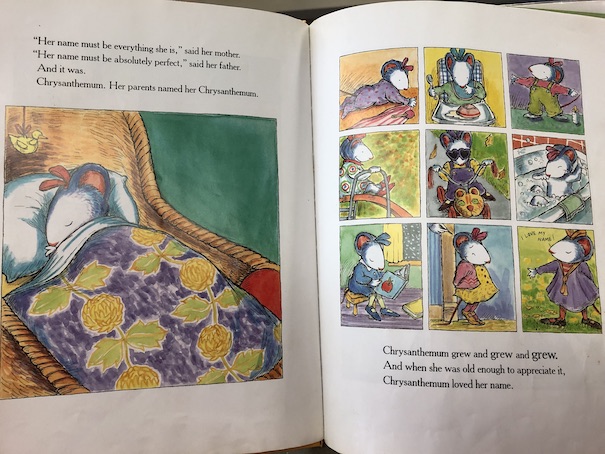
When little Chrysanthemum was born, her parents chose Chrysanthemum as her name because it just seemed perfect, as perfect as their little girl. As Chrysanthemum grew up, she loved her name, and she thought that it was perfect, too.

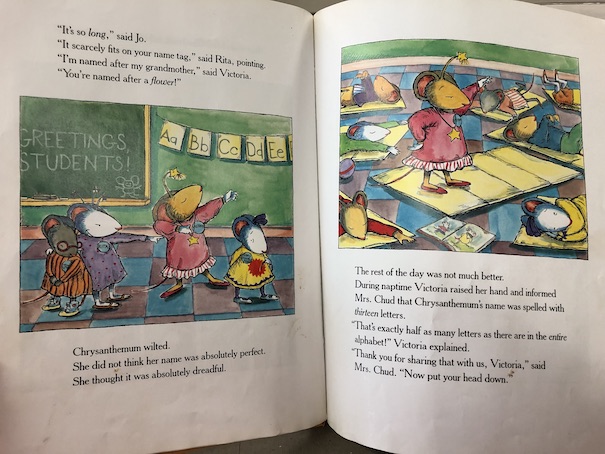
However, when Chrysanthemum starts school, the other kids point out how unusual her name is. Most of them have much shorter names. Chrysanthemum’s name is so long that it doesn’t really fit on her name tag. One girl, Victoria, is particularly mean about Chrysanthemum’s name, making fun of her whenever she can and encouraging other children to make fun of her.

For the first time in her life, Chrysanthemum starts hating her name. She wishes that she had a much shorter name, like Jane. Her parents comfort her and tell her that the other kids are probably just jealous, but their repeated teasing really bothers her.

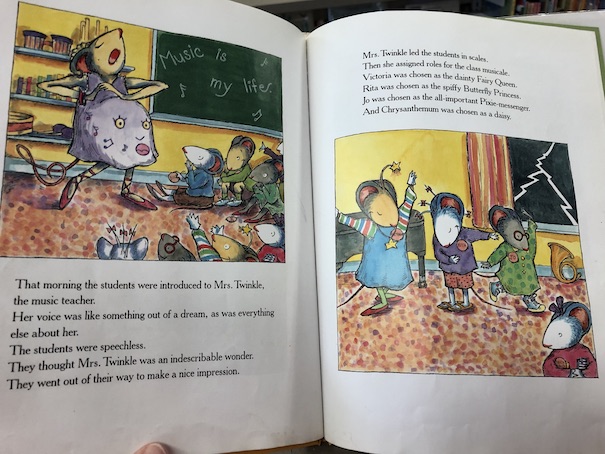
Then, the children have music lessons at school with Mrs. Twinkle. Mrs. Twinkle is a fun teacher, and the kids are excited about her class. She gives the children roles to play in a class musicale, and Chrysanthemum is cast as a daisy. When the other kids laugh about her playing a different type of flower, Mrs. Twinkle asks them what’s so funny.

The other kids explain about Chrysanthemum’s name and that they think it’s funny because it’s so long and weird. That’s when Mrs. Twinkle tells them that her first name is Delphinium – another long, unusual flower name! She says that she really likes the name Chrysanthemum, and since she’s expecting a baby, she might name the baby Chrysanthemum if it turns out to be a girl. Suddenly, the other girls in class envy Chrysanthemum and wish they had flower names, too!

In the short epilogue at the back of the book, the baby does turn out to be a girl, and Mrs. Twinkle names her Chrysanthemum. Chrysanthemum also gets a laugh at Victoria’s expense when the class puts on their musicale, and Victoria completely forgets her lines.

It’s a nice book, and I appreciate some of the messages now even more than when I first read it when I was a kid. Now that I’m an adult, I know that Chrysanthemum’s name isn’t the real reason why Victoria picks on Chrysanthemum. Victoria is mean basically because Victoria is a mean person. Kids who want to bully others make the decision to bully first and then pick something to bully about second. From what I’ve seen, they’re usually out to make fun of someone or make someone mad just to do it, and they don’t really care how or why. Chrysanthemum’s unusual name was just a convenient thing for Victoria to single out and use for her bullying. If she hadn’t had that name, Victoria would have picked on her (or maybe some other, more convenient target) for something else. Maybe it would have been someone’s clothes. Maybe it would have been the way someone walks or the way someone talks or their hair or their eyes or the fact that they have fingernails or breathe air or take up physical space … you get the idea. Victoria is the way she is because that’s what she is and what she wants to be, and she doesn’t see any need to change until the end of the story. (Even then, she may be back to bully again over something different because she hasn’t yet learned not to bully in general, just not over that particular thing.)

My point is that the way Victoria is has nothing to do with Chrysanthemum and her name. I’ve heard parents who are considering names for their children working hard to pick names that can’t be used for teasing, and sometimes, it can help. However, at the same time, bullies are basically going to bully because that’s who they are and what they do, and most importantly, it’s what they want to do. They’ll find something to bully about anyway because they’re always intentionally looking for something to bully about.

For a time, because of Victoria’s meanness and bullying, Chrysanthemum’s enjoyment of her name is ruined. She even feels like Victoria is destroying her sense of identity. At one point, she has a nightmare that she is actually a Chrysanthemum flower and that Victoria plucks her petals, picking at her and picking at her and picking at her until there’s nothing left. That’s the kind of effect that bullies have on people, which is why I have such contempt for them. They ruin things, even really fun and cool things like a colorful name, and make people unhappy just by being the kind of people they are. (If you’ve read my other reviews of books with bullies, you’ve already heard that I have very strong feelings about this subject and absolutely no patience or sympathy for bullies.)

But, fortunately, the book takes a very positive tone and points out that Chrysanthemum’s name is not really ruined by Victoria’s meanness. Chrysanthemum’s music teacher also has a really unusual flower name, and naming her baby Chrysanthemum as well gives Chrysanthemum new status among the kids at school, to the point where some of them, including Victoria, wish that they also had flower names of the kind that might inspire someone to name their baby after them. Mrs. Twinkle is a fun and different kind of teacher, and her fun and different name fits her personality. Although it hasn’t occurred to the other kids yet, the world would be a pretty drab place without colorful and unusual people. The Victorias and Janes of the world may have very proper names and are reassuringly ordinary, but the Delphiniums and Chrysanthemums are the ones who bring color and excitement to life. So, although I wouldn’t deliberately give a child a name that might leave them open to teasing, I don’t see a need to go overboard and reject some of the fun names that are just a bit unusual. Different is good, and it should be appreciated for what it is, not for what a bully may or may not be able to say about it when they’re trying to be mean. (They’ll find something else to bully and complain about two seconds later anyway, so why bother considering them for longer than that?)

The book is currently available online through Internet Archive. It is part of Mouse Books series.

The True Tale of Johnny Appleseed

JohnnyAppleseed

The True Tale of Johnny Appleseed by Margaret Hodges, 1997.

This American folktale was based on the life of a real person, John Chapman.

Johnny Appleseed was born as Johnny Chapman in 1774. His family lived in Massachusetts. There were plenty of apple trees there, and Johnny loved them. When he was grown, he started traveling west with the idea of spreading apple trees.

He carried very little with him, and some people said that he wore the pot that he used to cook his meals on his head as he walked. Everywhere he went, he planted apple seeds.

His reputation spread, and although people thought that traveling around just to plant apple seeds sounded crazy, they sometimes let him stay with them on his travels. Even Native Americans seemed to like him because he was friendly and helpful and interested in learning their languages. His legacy continued long after his death with trees that were enjoyed by generations of families across the Midwest.

There is a section in the back of the book that explains more about the history behind Johnny Appleseed’s story, including the end of the Revolutionary War and the beginning of westward migration in America. One of the things they mention is the effect that the War of 1812 had on relations between pioneers and Native Americans. Because pioneers were already pushing into the territory of Native Americans in the area that later became Ohio, the tribes there sided with the British in the war, hoping to push out the invading pioneers. After the war was over, though, the pioneers continued to come west, and when they did, they retaliated against the tribes that had been on the side of the British. The pioneers could be brutal, and part of the reason that Native Americans liked Johnny Appleseed was that he was different. He wasn’t trying to hurt anyone or take land for himself; he just wanted to plant trees. After he planted trees, he would build fences around them to keep animals from eating them while they were growing.

John Chapman’s life was unconventional.  He never married, and he acted as a Christian missionary in his travels as well as a planter.  Although he could be regarded as something of an oddball in the itinerant way he lived his life, he became a legend.

The book is currently available online through Internet Archive.

Miss Rumphius

MissRumphius

Miss Rumphius by Barbara Cooney, 1982.

From the time she was young, Alice Rumphius wanted to travel and see the world.  She planned to return home to live by the sea when her travels were over.  However, her grandfather, an artist, gives her one more mission in life: to make the world more beautiful.  Although Alice isn’t quite sure how she will accomplish that, she agrees.

RumphiusPainting

When she grows up, she lives out her dream of traveling, seeing all the places that she read about while she working in a library.  However, she ends up hurting her back while getting off of a camel she was riding, so she decides that it’s time to retire and find a home by the sea, as she planned.

RumphiusCamel

As she recovers from her injury, she thinks about her mission to make the world more beautiful.  At first, she still doesn’t know how to accomplish that, but some flower seeds she planted and her particular love of lupines give her the inspiration for her final legacy of beauty.

RumphiusLupines

Her gift of spreading seeds of beautiful flowers gives her a reputation as an eccentric, the Lupine Lady, but it also inspires a new generation to undertake their own missions to see the world and to create beauty in their own way.

RumphiusChildren2

One of the things that fascinates me about Miss Rumphius and her story is that she leads a very non-traditional life.  She has very definite goals from childhood and sticks to them throughout her life, but they are not quite the common goals of most people, like marriage and career.  She remains unmarried throughout her life (the book never says anything about whether she had any romances in her life because that wasn’t one of her main life goals and therefore not really important to the story), and her only listed career was that of working in a library, which allowed her to have some money and to read about the places where she wanted to travel.  In the end, she is not wealthy and has no husband or children of her own, but she is happy because she has achieved the things that always meant the most to her.  She has had rich life experiences, she has made the world a little better for her presence, and she encourages her nieces and nephews to see the world, to enjoy their experiences, and to leave their own mark of beauty.

Apparently, parts of the story are based on the author’s own life and on the life of Hilda Hamelin, the original Lupine Lady.  The book is currently available online through Internet Archive.