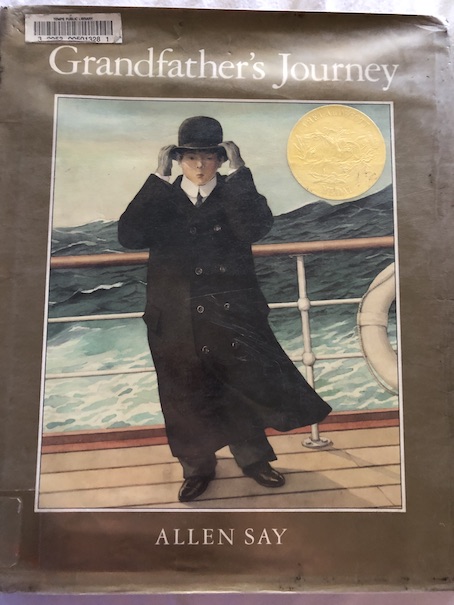
A man describes how his grandfather traveled by ship from his home in Japan to the United States. The time period isn’t specified, but from the context of the story, the grandfather’s original journey would have taken place either at the end of the 19th century or at the beginning of the 20th century.
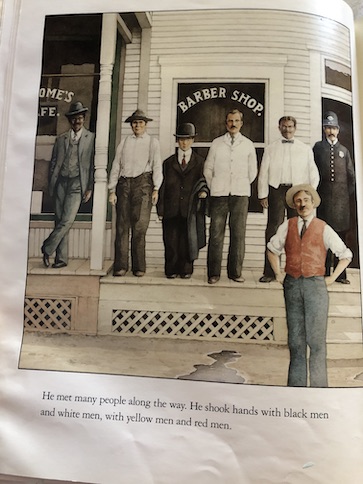
As a young man, the future grandfather travels all over the United States, seeing the sights and meeting all kinds of interesting people. It’s a bit of an adjustment for him, wearing Western style clothing and getting used to life in a new country, but he enjoys the adventure of it. He decides to settle in California, the part of the United States that he likes the best. He briefly returns to Japan to persuade his girlfriend to marry him and return to the United States with him.
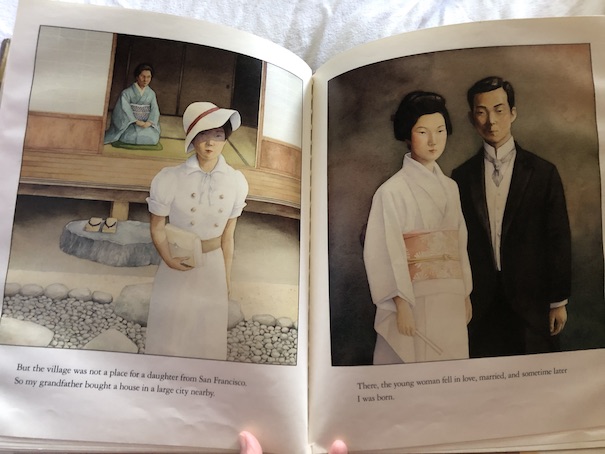
The grandfather and his wife have a daughter in the United States, and they enjoy living there, but as the daughter grows older, the grandfather realizes that he misses Japan and wants to return home. He and his wife move back to Japan with their daughter.
The daughter has to learn to adjust to life in Japan after having lived all of her life so far in America. The family moves to the city because life there is more what their daughter was accustomed to than life in the countryside, where they were originally from.
Later, the daughter grows up, gets married, and has a son, who is the author of the book. The grandson describes being young during World War II and the devastation in Japan during the war. (This is part of what dates the earlier part of the story.)
Toward the end of his life, the grandfather finds himself growing nostalgic about his time as a young man in the United States and wishes that he could return to California one more time. Unfortunately, the grandfather dies before making the trip. Instead, his grandson goes to the United States to see the places that his grandfather told him about.
Like his grandfather, the grandson stays in the United States for a time and has a daughter of his own. He comes to understand how his grandfather felt, missing Japan when he is in the United States and missing the United States when he is in Japan. The world is vast and full of fascinating places to explore, but there is always something to miss and feel nostalgic about, no matter where you are. The grandson continues to travel back and forth between the United States and Japan, enjoying both of them.
The book is a Caldecott Medal winner. It is available to borrow for free online through Internet Archive.
In 1944, everyone is concerned with finding ways to help the war effort. In Molly’s third grade class at school, her teacher announces that their class is invited to participate in the Lend-a-Hand contest. The class will be divided in half, and each half will compete against the other to find the best way to help the war effort. The class decides to make the contest boys against girls, and Molly immediately starts trying to figure out a spectacular idea that will impress everyone. Unfortunately, one of the other girls says that the girls in class should knit socks for soldiers, and the teacher accepts that as the goal for the girls’ team, before Molly can say anything.
Molly is appalled at the idea of knitting socks. It’s partly that she had wanted to be the one to come up with the best idea, and it’s also partly because she has tried knitting before, and she knows that socks are difficult, time-consuming projects, especially for beginning knitters. Molly is sure that the other girls are going to find it too difficult and that, in the end, they’ll have nothing to show for their project. Her friend Susan doesn’t think that the project sounds so bad, but Linda also dreads the idea of knitting because she’s not very good at it. Talking it over in their secret hideout in the storage area of Molly’s garage, the three girls decide that they’ll work on a secret project by themselves, something that will save the day when the other girls’ project falls through.
At first, the idea of doing something in secret sounds exciting. However, coming up with a good secret project and seeing it through turn out to be more difficult than they expected. All they can think of to do is to collect bottle tops for scrap metal, and as they go door to door in the rain, asking for them, they learn that most people have already given theirs to the Boy Scouts who were collecting scrap metal. Tired, wet, and discouraged, the Molly and her friends decide to look in on the other girls and see what progress they’re making.
The other girls are certainly a lot more comfortable, knitting inside. However, as Molly predicted, they are finding their project harder than they thought it would be. None of them has completed an entire sock yet; all they really have are the square shapes at the top of the sock, and they’re getting discouraged. That’s when Molly gets a better idea: why not take the squares they’ve made and turn them into a blanket? Simple squares are much easier to make than socks, they can make a lot of them quickly with everyone helping, and the girls who can’t knit well can sew the squares together. A blanket is still a good war effort project because Molly’s father has told her that the hospital where he works is always in need of blankets for the wounded soldiers. With this new idea, the other girls become much more excited, and they make more progress.
The theme of this story is that working together and sharing ideas benefits everyone more than working alone or trying to be too competitive. Molly’s first ideas weren’t very good by themselves, and neither was the sock-knitting idea. However, when Molly and her friends join the other girls, Molly finds a way to help them build on the idea that they already had (knitting) and take it in a better direction. Molly and her friends also explain to the other girls about the bottle tops they were trying to collect, and some of them think of other places where Molly and her friends didn’t go for their collecting. All of the girls working together manage to finish the blanket and collect 100 bottle tops in a single day, surprising and pleasing their teacher.
In the back of the book, there is a section with historical information about what it was like to go to school in America during World War II. Discipline was more strict than it was in schools during the late 20th century, and there was also more separation between boys and girls. Sometimes, boys and girls going to the same school and attending the same classes played on completely separate playgrounds, and sometimes, they even had to enter and exit the school through different doors (this is something that was also mentioned in the book Cheaper By the Dozen, which takes place during the late 1910s/early 1920s). Teachers emphasized patriotism and taught the children about the war, why soldiers were fighting, and what life was like in other countries that were involved in the war. It was common for schools to have drives to collect scrap metal or other materials to help the war effort. Special projects like knitting clothing or blankets for soldiers were also popular.
The book is currently available online through Internet Archive.
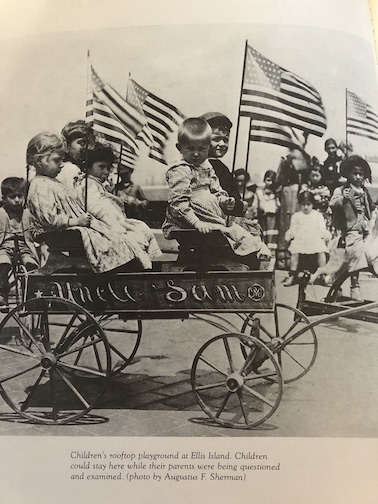
One of the best parts about this book is the pictures. The preface of the book specifically talks about photography at the turn of the 20th century, how cameras were still fairly new technology but growing in popularity. Cameras that were small enough to be held in a person’s hands were an 1880s innovation, and the book mentions that small cameras like that were known as “detective cameras” because they were small enough that they could be used to take pictures without the subjects noticing. Over time, it became easier for amateurs to learn to use cameras, and it became more common for people to take pictures of their ordinary, everyday lives. Pictures like these open up a window on the past. The pictures in this book are of children whose families had only recently arrived in America from countries around the world. The photographer for many of these pictures was Jacob A. Riis, a journalist in New York City who wanted to document the living conditions of poor immigrants. He published a book called How the Other Half Lives in 1890, in which you can see more of his work. Other pictures in this book are by Lewis Hine, who is known for his photographs of child laborers. They are not the only photographers whose work appears in this book, but they are the most famous.
The book is divided into sections, covering different aspects of the lives of immigrant children. In the chapter called Coming Over, the author describes what the journey to America was like. One of the primary motivations for people to come to America around the turn of the century was money and employment opportunities. If a family had little money and little or no chance of getting better jobs in their home country, they would decide to try their luck somewhere else. Because most of the immigrant families were poor, it was common for families to immigrate gradually. Often, the father of the family would come first, find a job, start establishing a life and home for his family, and eventually send for his wife and children when he’d saved enough money. The actual journey was by ship, often in “steerage,” the cheapest form of passage available, in cramped rooms in the ship’s hold.
Although the journey could be harrowing, one of the most nerve-wracking parts was the immigrant processing that took place at immigrant ports like Ellis Island. There were routine questions that immigrants were expected to answer and exams for them to take, and if the questioners weren’t satisfied, the immigrants could be sent back to the country they came from. Doctors would examine the immigrants to evaluate their health and look for signs of possible mental defects. They were particularly concerned about signs of infectious diseases. Sometimes, it was difficult for immigrants to answer all the questions because of language barriers and the immigrants’ own nerves at being interrogated. If an immigrant seemed too agitated, the examiners would typically let them rest for a while before trying again.
The other chapters in the book are At Home, At School, At Work, and At Play, which give more details about the lives of immigrant children as their families settled in America. They often settled in large cities because those were where the most employment opportunities were to be found. Because they didn’t speak much English and needed help learning how things worked in America, such as how to find jobs and places to live and how laws worked, they tended to settle in neighborhoods with others from similar backgrounds who could help them. That is why, even to this day, there are certain areas of large cities, such as New York, Boston, or Chicago, which are known for people of a particular nationality (like the Irish neighborhood, the Jewish neighborhood, Chinatowns, etc.). New arrivals often joined friends or relatives who had already been living in the US for a while, seeking help in getting themselves established. These ethnic neighborhoods were located in poor parts of town because the people there didn’t have much money. People lived in small, crowded apartments called tenements, sharing water and toilet facilities with other families because the apartments were not provided with individual facilities. However, once these groups of immigrant families became established, they remained established for a long time, and they gave these neighborhoods their own distinctive style.
School was often difficult for new arrivals because the children had to learn English before they could study other subjects. There were some special English language learning classes for them at larger schools with enough demand for them. At smaller schools which didn’t have these classes, they often had help from other children who had arrived in America earlier and could act as translators. They were also frequently put into classes for children who were younger than they were, studying easy subjects, until they had learned enough English to move up to classes with children their own age.
Typically, immigrant children aimed to stay in school until they were fourteen years old because that was the age when they could officially get full-time work. However, because their families were poor, the children might have to leave school early to find jobs and help their families make ends meet. The book describes how rules were frequently bent or broken because the laws were not well-enforced, and children often worked at younger ages, even under harsh conditions. For immigrant children, the most important education was that which taught practical, vocational skills that would help them find jobs quickly. Some agencies, like the Children’s Aid Society (known for the Orphan Trains), would help them with vocational training.
However, immigrant children still like to play. Boys and girls usually played separately. Boys frequently played games like baseball in the street, or stickball, which was a variant that could be played in smaller spaces. In stickball, the “bat” was a stick or the handle of an old broom, and the ball was rubber and allowed to bounce before it was hit. Girls would play other games, like “potsy,” which was a version of hopscotch.
Because of the lessons they were taught in schools and because the immigrant children mixed with children outside of their immigrant groups in school, the children absorbed the local culture and became Americanized faster than their parents. Many of them experienced the feelings of being torn between their parents’ traditions and wanting to fit in with society around them.
In each of the chapters in the book, there are anecdotes from people who had arrived in the US as children around the turn of the century, telling stories about different aspects of their lives.
The book is currently available online through Internet Archive.
The Little Indian Basket Maker by Ann Nolan Clark and illustrated by Harrison Begay, 1957.
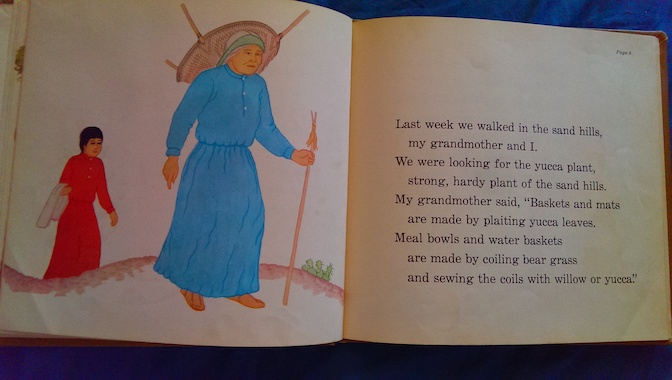
By “Indian,” the author means Native American. This book specifically focuses on the Papago (Tohono O’odam) who live in the Southwestern United States, specifically Arizona. The story is about a young girl who is starting to learn the traditional art of basket-making, and the book goes into the process involved in making baskets, step by step. Although the use of “Indian” instead of Native American is somewhat antiquated, and Tohono O’odam is really the proper name for the Papago people, the book has something of an interesting history and the picture it provides of the practice of traditional crafts is fascinating. There is a section at the beginning of the book which explains a little about the history of the Papago (Tohono O’odam) people and where they live.
A young girl explains how her grandmother teaches her the traditional craft of making baskets. They start by gathering the types of plants that they are going to use.
They also need special plants for the dye they will need in order to decorate the baskets. The girl’s grandmother explains about the different types of decorations they traditionally use.
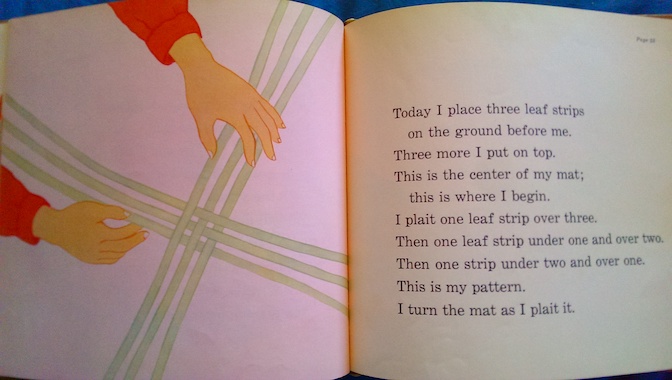
Making baskets is a long process that includes cleaning the plants and tearing them into long strips, bleaching them, soaking them to soften them, dyeing strips used in the design, and weaving them together.
The girl weaves a mat that takes days to finish. It is the first one that she’s made herself.
She is very proud of herself when the mat is finished, and she is pleased with the quality of her work.
I’ve owned this book since I was a young child, and it was my introduction to traditional crafts. Later, I found a related book at a thrift store, The Little Indian Pottery Maker. Until then, I hadn’t realized then just how old the books were and that there were more of them by the same author.
The book, which was written in the 1950s, was one of a group of stories (not exactly a series because they didn’t have a specific set of characters in common and the themes varied somewhat) written by a woman who was a teacher with the United States Indian Service. The other books that she wrote, including The Little Indian Pottery Maker, focus on members of different Native American tribes. She was not Native American herself, and the modern view of Indian schools is not favorable (for good reasons), so one might be a little suspicious of a book written about Native Americans by an Indian school teacher. However, these books interest me because of their explanation of traditional crafts. There are no white people in the stories at all, and they have a timeless quality to them. Reading them, it’s hard to get a sense of exactly when the stories take place because it’s never mentioned, and there aren’t many clues (no mentions of modern technology, it’s all about the crafts). I haven’t found any of the other books that the author wrote, but these two are very respectful in their tone, and they begin with explanations of the history of the tribes involved in the stories. According to Andie Peterson in A Second Look: Native Americans in Children’s Books, the author was deliberately trying to write books that her Native American students could relate to.
The art style of the books vary because they had different illustrators. The illustrator for this particular book was a Navajo painter.
The book is available to read for free online through Internet Archive.
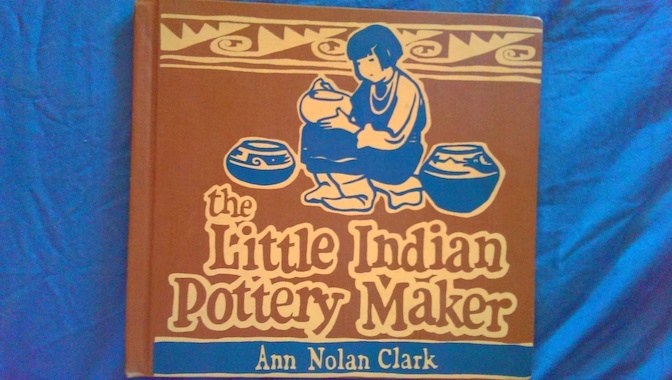
The Little Indian Pottery Maker by Ann Nolan Clark and illustrated by Don Perceval, 1955.
By “Indian,” the author means Native American. This book specifically focuses on the Pueblo Indians who live in the Southwestern United States, specifically New Mexico and Arizona. The story is about a young girl who is starting to learn the traditional art of pottery-making, and the book goes into the process involved in making pottery, step by step. Although the use of “Indian” instead of Native American is somewhat anitquated, the book has something of an interesting history and the picture it provides of the practice of traditional crafts is fascinating. The beginning of the book explains a little about Pueblo Indians, their history, and where they live.
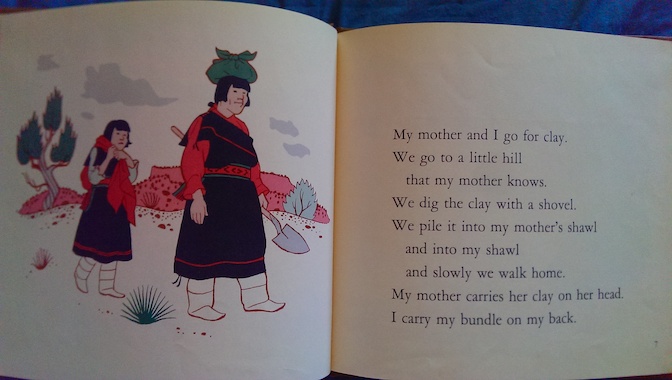
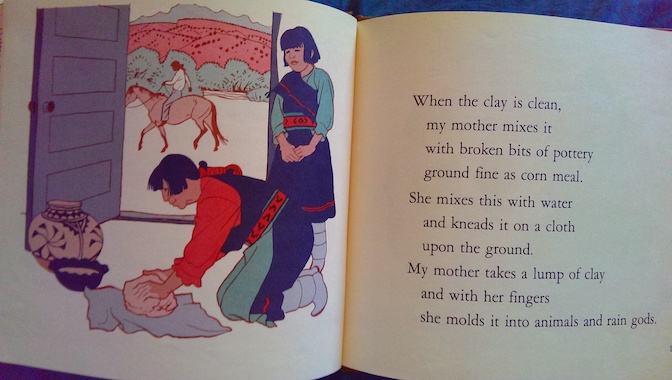
The young girl tells the story of how her mother introduces her to the traditional craft of making pottery and teaches her how to make her first pot. She describes every step in the process, from when they collect the clay themselves from a hillside until the pot is finally complete.
The girl’s mother explains about the different methods used to make pots, and pictures show how pots are shaped.
Making pottery is a long process that takes days to complete, including shaping, scraping and smoothing the sides, drying, decorating, and finally firing the pottery. The girl is proud of the first pot she has ever made.
I found this book at a thrift store a number of years ago and recognized it because I already owned a related book, The Little Indian Basket Maker, that I liked when I was a young child. I hadn’t realized then just how old the books were and that there were more of them by the same author.
The book, which was written in the mid-1950s, was one of a group of stories (not exactly a series because they didn’t have a specific set of characters in common and the themes varied somewhat) written by a woman who was a teacher with the United States Indian Service. The other books that she wrote, including The Little Indian Basket Maker, focus on members of different Native American tribes. She was not Native American herself, and the modern view of Indian schools is not favorable (for good reasons), so one might be a little suspicious of a book written about Native Americans by an Indian school teacher. However, these books interest me because of their explanation of traditional crafts. There are no white people in the stories at all, and they have a timeless quality to them. Reading them, it’s hard to get a sense of exactly when the stories take place because it’s never mentioned, and there aren’t many clues (no mentions of modern technology, it’s all about the crafts). I haven’t found any of the other books that the author wrote, but these two are very respectful in their tone, and they begin with explanations of the history of the tribes involved in the stories. According to Andie Peterson in A Second Look: Native Americans in Children’s Books, the author was deliberately trying to write books that her Native American students could relate to.
The art style of the books vary because they had different illustrators. The illustrator for this particular book was not Native American (unlike some of the illustrators of other books), but he was adopted into a Hopi tribe, apparently as an adult because of his accomplishments in representing Hopi culture in art.
Abigail by Portia Howe Sperry and Lois Donaldson, 1938.
Susan is a little girl living on a farm in Kentucky during the 1800s. Her family has recently decided to move to Indiana, which is the new frontier of the United States. Her uncle and his family are already living there, and he has persuaded Susan’s parents of the opportunities that await them.
As the family packs up to leave, Susan’s grandmother gives her a special present that she and Susan’s aunt made for her: a new doll. Unlike Susan’s old wooden doll, this doll is a soft rag doll that she can sleep with. They made the doll to look like Susan herself, but Susan names the doll Abigail after her grandmother.
Abigail accompanies Susan on her adventure as the family heads west to Indiana in their covered wagon. Susan is sad and a little afraid at first, but when she thinks of what Abigail would say to her about her need to be brave and to explain to her all the strange things they will encounter on the journey, Susan regains her courage.
The family does have adventures on their two-week trek to Indiana. They have to cross rivers, face down a bear, and worry about whether they will encounter unfriendly Indians (Native Americans). Even after they arrive in Indiana, joining their other relatives, they will still have to get used to life in a new place.
Throughout the book, there are little side-stories, poems, and hymns that the family sings and tells each other. Through it all, Abigail is Susan’s constant companion, helping her to feel at home in her new home. I loved this book when I was a child because I always loved dolls. This book was a bigger part of my youth than the Little House on the Prairie series, but it would probably appeal to Little House on the Prairie fans.
The book is available to borrow and read for free online through Internet Archive.
Sarah Morton’s Day: A Day in the Life of a Pilgrim Girl by Kate Waters, 1989.
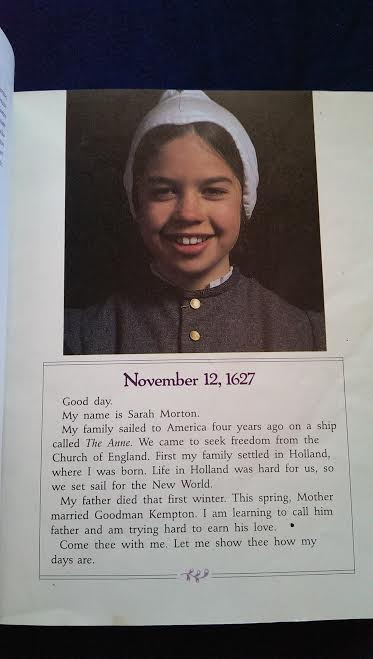
This book is part of a series of historical picture books. It features a young girl who was an historical interpreter at Plimoth Plantation, a living history museum, playing the part of a real pilgrim girl who lived in 17th century Plymouth. The pilgrim girl’s name was Sarah Morton, and she was nine years old in 1627, the year that Plimoth Plantation reenacts.
As Sarah Morton, the girl takes readers through a typical day in her life. She demonstrates the chores that a pilgrim girl would have to perform. She explains the clothes that a pilgrim girl would wear and what people ate. There is a recipe for 17th Century Indian Corn Bread, a simple recipe that readers can make at home, but it warns that modern people wouldn’t think that it tastes very good. It’s basically just water and cornmeal grits.
Although much of Sarah Morton’s day is taken up with chores, she also discusses her relationship with her mother and her new stepfather. The death of a parent was something that pilgrim children often experienced. After her father’s death, Sarah’s mother remarried, and Sarah is concerned about whether her new father likes her.
However, her stepfather is a good man who cares about her. He gives her lessons in reading and writing, something that not every pilgrim girl would have. He also gives her a special toy: a knicker box, which is a wooden box with arches for rolling marbles through as a game. She gets to play with her friend, Elizabeth.
The two girls are also excited about a ship that has been sighted out at sea. Soon, new people will be coming to their colony, and they wonder if the ship is also carrying letters from England or special goods that they would like, like a new bolt of cloth.
In the back of the book, there are sections explaining a little about the Plimoth Plantation living history museum, the real Sarah Morton, and the girl portraying Sarah Morton, Amelia Poole. The Plimoth Plantation site has more information about the real Sarah’s Morton’s life, including what happened to her when she grew up. If you’re curious about what Amelia Poole is doing today, she is a fiber artist and lives in Maine.
The book is available to borrow and read for free online through Internet Archive.



 In 1944, everyone is concerned with finding ways to help the war effort. In Molly’s third grade class at school, her teacher announces that their class is invited to participate in the Lend-a-Hand contest. The class will be divided in half, and each half will compete against the other to find the best way to help the war effort. The class decides to make the contest boys against girls, and Molly immediately starts trying to figure out a spectacular idea that will impress everyone. Unfortunately, one of the other girls says that the girls in class should knit socks for soldiers, and the teacher accepts that as the goal for the girls’ team, before Molly can say anything.
 Molly is appalled at the idea of knitting socks. It’s partly that she had wanted to be the one to come up with the best idea, and it’s also partly because she has tried knitting before, and she knows that socks are difficult, time-consuming projects, especially for beginning knitters. Molly is sure that the other girls are going to find it too difficult and that, in the end, they’ll have nothing to show for their project. Her friend Susan doesn’t think that the project sounds so bad, but Linda also dreads the idea of knitting because she’s not very good at it. Talking it over in their secret hideout in the storage area of Molly’s garage, the three girls decide that they’ll work on a secret project by themselves, something that will save the day when the other girls’ project falls through.
 The other girls are certainly a lot more comfortable, knitting inside. However, as Molly predicted, they are finding their project harder than they thought it would be. None of them has completed an entire sock yet; all they really have are the square shapes at the top of the sock, and they’re getting discouraged. That’s when Molly gets a better idea: why not take the squares they’ve made and turn them into a blanket? Simple squares are much easier to make than socks, they can make a lot of them quickly with everyone helping, and the girls who can’t knit well can sew the squares together. A blanket is still a good war effort project because Molly’s father has told her that the hospital where he works is always in need of blankets for the wounded soldiers. With this new idea, the other girls become much more excited, and they make more progress.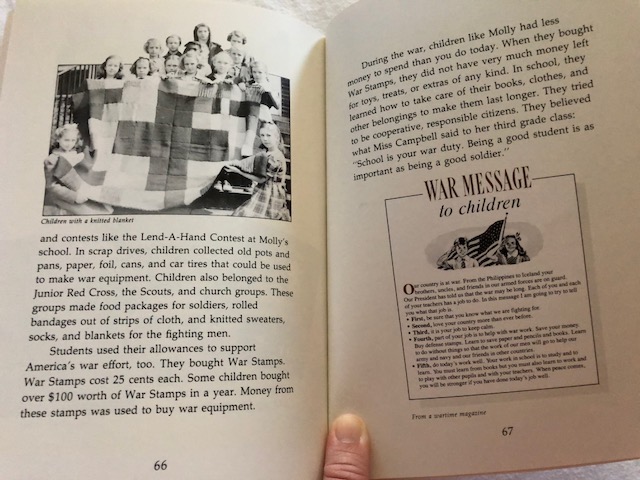








 Abigail by Portia Howe Sperry and Lois Donaldson, 1938.

 Sarah Morton’s Day: A Day in the Life of a Pilgrim Girl by Kate Waters, 1989.
 Although much of Sarah Morton’s day is taken up with chores, she also discusses her relationship with her mother and her new stepfather. The death of a parent was something that pilgrim children often experienced. After her father’s death, Sarah’s mother remarried, and Sarah is concerned about whether her new father likes her.


 Jestress's Forgotten Books and Stories