Megan’s Island

School will be out soon, and eleven-year-old Megan and her best friend, Annie, are making plans for the summer. Megan’s family doesn’t have much money because her father died when she and her brother, Sandy, were very young, and her mother struggles to find a job that will pay enough to support the three of them. They’ve moved around multiple times in the last several years while her mother looks for better work, and they get by with some help from Megan’s grandfather. This summer, Megan’s family is planning to visit her grandfather at his cottage by the lake. Her grandfather is already staying there, recovering from an injured foot, and Megan’s mother agreed that Annie can come with them on the trip.

However, before school lets out for the summer, something happens that suddenly changes their plans. One evening, while their mother is in the kitchen, clearing up from dinner, she suddenly drops her favorite salad bowl, cutting herself on the glass. Megan and Sandy help her clean up the mess and bandage her cut, but they can tell that it wasn’t just clumsiness that made their mother drop the bowl. She really seems to be upset and even afraid of something. Since they didn’t have any phone calls or mail that could have given her upsetting news, they can only think that it must have been something she heard on the tv news. Their mother had been listening to the news on the small tv in the kitchen before she dropped the bowl, and she quickly turned it off when the children came to see what was wrong.

Their mother refuses to explain what upset her, and she tries to pretend that nothing is wrong, but she quickly tells the children to pack their things because she’s taking them to their grandfather at the lake early. Megan protests that school isn’t out yet, but their mother says that they’ve already finished their tests, so they won’t be missing anything important. Megan also worries that they’re leaving without Annie or even telling Annie that they’re going early, but their mother says it can’t be helped. Then, Sandy overhears their mother asking a friend of hers on the phone, asking her to put their things in storage for her while they’re gone, making the kids worry that they’re leaving for good and not just for vacation. Refusing to answer any more questions from the children, their mother hurries them through their packing and out of the house that very night. She drives them all through the night to get to the lake.

When they get to their grandfather’s cottage at the lake, he is surprised to see them, showing that their early arrival wasn’t something he had arranged with their mother. Later, Megan overhears them talking. Her grandfather urges their mother to tell them the truth about what’s happening because kids are more resilient than they seem, and whatever they’re imagining might be worse than the truth. However, their mother says that the truth really is upsetting, and while she knows that she has always insisted that her children tell the truth, telling them the truth now would mean admitting that she has already lied to them.

Megan is shaken by what she hears. What has their mother lied to them about? Is it something to do with her father? Megan barely remembers him, and their mother gets upset when she asks questions about him. Her mother seems to be hoping that this whole matter will just blow over, but her grandfather comments about how what happened eight years ago didn’t just blow over. He implies that whatever secret their mother is hiding is the real reason why the family has moved around so much, that it wasn’t just because she needed to find new jobs. Megan worries about what her mother could be hiding and what terrible thing could have happened eight years ago that would affect her family today. Then, Megan remembers that eight years ago is about when her father died.

Megan tells Sandy what she overheard and that their mother is hiding a secret, something that might have to do with their father’s death. Before either of the children can talk to their mother and ask her what’s going on, she tells them that she’s leaving them with their grandfather at the lake for a few days because there’s something she has to do. She won’t say where she’s going or what she needs to do, but she says that they’ll be safe there with their grandfather. Megan finds it disturbing that her mother made it a point to say that they’ll be safe because it implies that the reason why they left home so suddenly was that, for some reason, they weren’t safe at home. Megan also begins to wonder whether whatever danger there was at home might find them at the lake.

Sandy seems to find it easier than Megan to put aside whatever worries and secrets are following the family and just enjoy being at the lake, going fishing with their grandfather and exploring the area with Megan, although he later admits that he tried to ask their grandfather some questions while they were fishing that he refused to answer. Megan can’t stop wondering and worrying, though. She and Sandy agree that coming to the lake wasn’t just a vacation. Their mother brought them there to hide from something … or someone.

Megan remembers that, every time they’ve moved before, their mother refused to let them even write letters to friends they were leaving behind. Sandy says that she didn’t tell them not to write any letters this time, and with no phone at the cottage, there’s no other way for Megan to tell Annie what happened and to apologize for their ruined summer plans. Megan decides to go ahead and write to Annie. That letter to Annie changes everything for Megan and her brother.

Megan and Sandy go rowing out on the lake and find an island with a beautiful hiding place beneath an overhanging rock that’s almost like a cave. It becomes a special place for Megan, and she goes there to think. Then, one day, they meet a boy named Ben who’s also staying at the lake for the summer with his divorced father and has been exploring the island that Megan has started to think of as hers. Megan doesn’t like Ben at first because he’s bossy, but he proves to be someone she and Sandy can confide in when the adults won’t give them answers, and he become a useful ally in their troubles.

Ben tells the Megan and Sandy that his father said that someone in the nearby town is looking for a couple of kids with red hair, matching Megan and Sandy’s description. This man claims to be their uncle, but Megan and Sandy don’t have an uncle. Then, Megan spots a strange man prowling around the outside of their grandfather’s cottage. A letter that Megan receives from Annie says that people have been asking about them since they left town, and Ben correctly realizes that someone has traced them through Megan’s letter to Annie. Whatever trouble their mother has been hiding them from has found them. With their mother still away and their grandfather having gone to town for some x-rays on his injured foot, Megan and Sandy hide out with Ben in a tree house they’ve built on the island. The island seems to be their last safe place to hide while they wait for their mother and grandfather to return. But, when they do, will they finally get the answers they need? What terrible secret has their mother been hiding from them all these years?

The book is a winner of the Edgar Allan Poe Award.

I didn’t read this book when I was a kid, but I did read others by the same author, The View From the Cherry Tree and Baby-Sitting is a Dangerous Job. I really liked this book. I think one of the author’s strengths is her ability to create suspense. This story is very compelling. Right from the beginning, readers as well as Megan know that her mother is behaving oddly and that what she is doing has sinister or troubling implications. There isn’t a wholesome or happy reason why anybody decides to skip town suddenly in the middle of the night. I could hardly put the book down, wanting to get into the details of the situation. It was hard for me not to skip to the end to see what happened and what it was all about, but I made myself slow down a little to appreciate the journey.

I guessed, at the beginning, that this was going to turn out to be a case of a non-custodial parent kidnapping their own children after a messy divorce. We are told that Megan’s father died when she was very little and that she barely remembers him, and then, we are told that the family moves frequently because the mother has trouble getting work as a single parent. That, by itself, isn’t necessarily sinister, but after we see the mother rush her children away in the middle of the night and we learn that she has never allowed them to keep in touch with old friends after any of their other moves, it starts to look like a suspicious pattern. I had guessed that what upset her mother while she was watching the news was that there was an announcement about the father looking for his missing children. My other thought was that maybe they were in the Witness Protection Program, possibly because their father was murdered and the mother needed protection from the people who killed him, and that what alarmed the mother on the news was that his killer was being released from prison. That second theory of mine was way off. The first one was closer, but that’s still not quite the situation, although elements of that are close to what happens in the story.

Because the suspense in this was so good, I don’t want to spoil the ending entirely. The custody of the children is the reason for the mother’s panic, but there’s a twist on it that I wasn’t quite expecting, and as the story goes on, it becomes apparent that there are two sets of people hunting for the children instead of one. One set of searchers is who the mother was expecting, but the other set is someone else who has different motives and is an even bigger threat.

I thought it was interesting that the story brought up the question of a person’s right to disappear and whether that disappearance can sometimes be justified. The fact is that it’s not a crime if an adult decides to go voluntarily missing. It’s only a crime if the adult has committed a crime prior to disappearing or in the process of their disappearance or if the person is missing because they’re the victim of a crime. Otherwise, any adult has the right to walk away from their old life, cut off old relationships, change their name, and reestablish their identity somewhere else. People can do this for a variety of reasons, but it usually has something to do with overwhelming problems in the person’s life, mental health issues, and/or abusive relationships. It occurred to me that the mother in the story might be afraid of her ex-husband because he was abusive, and she was afraid of what he might do to the kids if she had to either give him custody of them or share custody with them. Again, that’s not quite the case here, although I was thinking about it through a good part of the story because it would explain the mother’s behavior.

If the mother was a non-custodial parent or had violated custody arrangements with the children’s father, then she would have committed a crime by taking the children. However, that doesn’t turn out to be the case here. The mother hasn’t committed any crime, but the fact that she has the children with her is the reason why someone is looking for them. Missing children is a matter of legal concern and can be a matter of humanitarian concern, although even then, the issue can be complicated. Not all runaway children are “saved” by being found or returned to legal guardians, and some of them have had very good reasons for leaving toxic or abusive home environments. The sad fact of real life is that, sometimes, the people who are searching for missing children can be the very threats those children are escaping. People who disappear have reasons for doing so, but giving them the type of help they need means discovering what those reasons are.

To be honest, I’m not completely sure of the legality of the person looking for the particular children in the story or publicizing their search for them, but it is telling that this individual is using a private investigator to look for them, not the official police. The official police are not looking for the family because the mother hasn’t committed a crime. She is their real mother and has legal custody of the children. The person who is searching for the children does not. When their mother reveals the truth to the children, Megan is forced to consider that a person might have good reasons or at least a compelling motive for wanting to get away from their past and not be found by people who are looking for them.

Part of the issue related to that is that Megan and her brother Sandy were never consulted about whether or not they wanted to separate from their old life or to live the kind of lifestyle they’ve been living. Up to this point, they’ve taken for granted that they’ve had to move and lose contact with friends repeatedly because their mom needed to look for work and had trouble finding jobs as a single parent. When they realize that what’s been happening to their family isn’t normal, that their lives have been disrupted, and that their mother has lied to them about important pieces of their past and even their own identities, the children are understandably shocked and upset. Megan is angry with her mother for the position she’s put them in, and she is right that she needs answers.

Fortunately, things do work out for the best for the kids and their mother in the end. It is a relief that the mother has not actually committed a crime because of what she’s doing. She apologizes to the kids for not explaining things to them sooner, but she explains that, when the whole thing started, they were only little toddlers and couldn’t understand the seriousness of what was happening or what was at stake for them. When Megan learns the full truth, she does come to understand her mother’s motives, and she realizes that it has also changed the way she’s always felt about her father, whose life and death turn out to be very different from what she’s always assumed. Perhaps, if she had found out the truth earlier, when she was much younger, it would have been harder for her to take. Now that she and her brother are old enough to speak up for themselves and the situation they were running from has changed somewhat, things are likely to be much better for them. We’re not entirely sure at the end how things will be for their family or where they will be living, but it seems like their days of hiding and running are over.

The addition of Ben as a character not only gives Megan and Sandy an ally during their worries and evading the people searching for them, but he also provides a different perspective on their situation, in more ways than one. While Megan struggles to come to terms with her family’s secrets and the idea that both she and her family are not quite what she’s always believed they are, she also considers how her situation compares to Ben’s situation with his family.

Ben isn’t a happy kid. He’s been in trouble at different schools and behaves badly because he’s deeply troubled about his parents’ divorce and his mother’s remarriage to a man who isn’t thrilled to be his stepfather. Part of Ben’s troubles with his parents and stepfather are because he’s been acting out, and they don’t know how to deal with him, but deep down, he feels like his parents don’t love him. In fact, he admits that he’s been getting into trouble at school on purpose to get his parents’ attention. He had hoped that things would be better while he was staying with his father over the summer, but his father is a writer and absorbed in his work. He doesn’t seem to care much about what Ben does as long as he doesn’t disturb him while he’s writing. Ben feels like neither of his parents really loves him or wants him.

One thing that Megan has always been sure of is that her mother loves her, and even though her mother hasn’t told her the truth about everything before, Megan can tell that she still cares about her, takes time for her, and does things to ensure her safety. Megan’s family has their problems, but they are still a family. Even though Ben still has two parents and a stepfather, he doesn’t feel like he’s part of a family or that he can really rely on his parents. Megan’s realization that she feels very differently about her mother is part of what convinces her to listen to her mother and understand her side of the story.

Things start working out for Ben by the end of the story, too. He admits that he knows the way his dad acts is because he’s also upset about the divorce. He hadn’t really wanted to divorce his wife, but Ben’s mother wanted to marry someone else. He also hasn’t meant to neglect Ben. He’s just been preoccupied. Before the end of the story, he finishes the book he’s been working on and apologizes to Ben about being so busy. He’s not a bad father, and he and Ben usually get along better with each other. Now that he’s finished with his project and has more time to concentrate on Ben, Ben will get more attention. Ben also reassures Megan and Sandy, who are worried about how other people will look at them when the truth about their family’s past gets out, that he doesn’t see them any differently because of what he knows and that real friends will know and like them for who they are, not judge them for what their family members did.

Time of Wonder

Time of Wonder by Robert McCloskey, 1957, 1985.

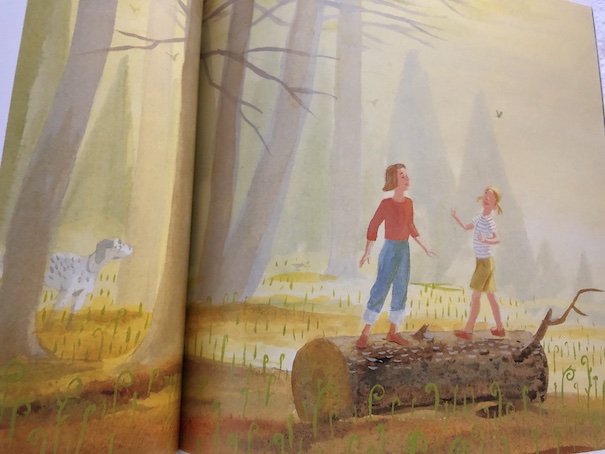
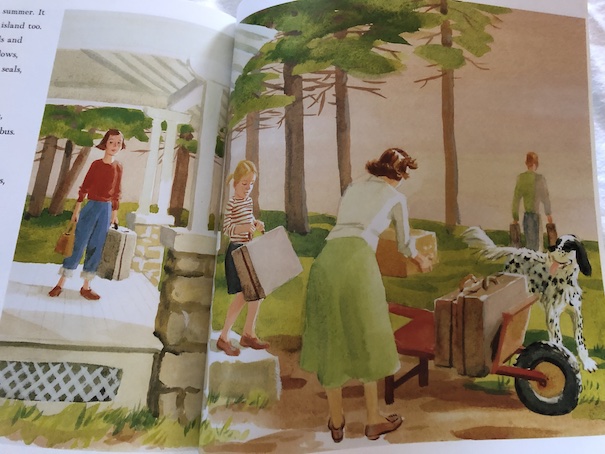
This is a beautiful, very relaxing picture book about a family’s summer vacation on an island off the coast of Maine. Although you can see from the pictures that the main characters are a pair of sisters, the entire story is told in the second person, from the point of view of “you.” Readers are meant to feel like they’re part of this magical summer trip!

“You” feel like you’re spending the morning walking in the fog along the bay, enjoying the plants and birds in the forest nearby, and sailing in the bay with seals and leaping porpoises.

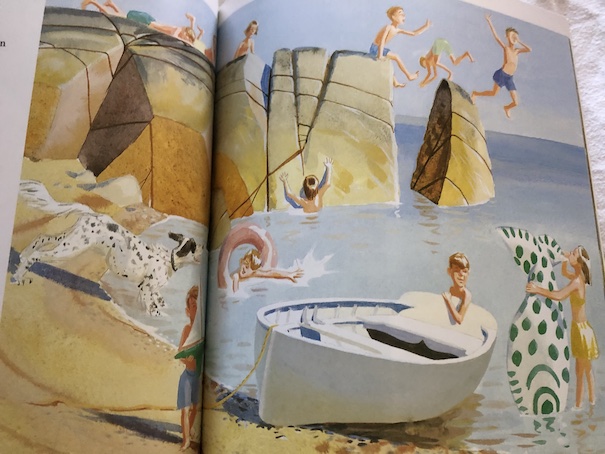
During the day, there are other children playing on the beach, diving from the rocks, and swimming. In the evening, “you” row a boat out into the quiet water and use a flashlight to look at the crabs.

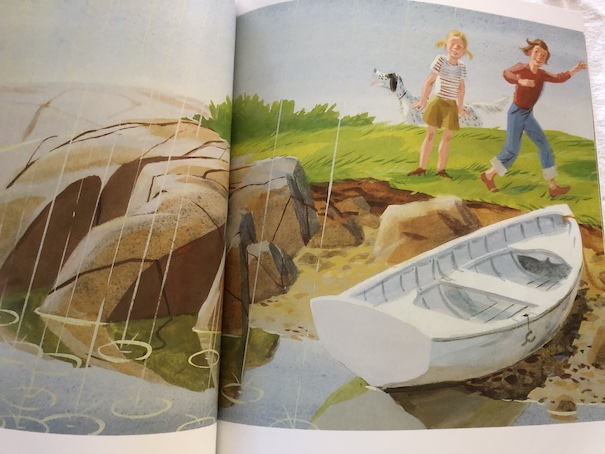
When it rains, “you” feel it! Most of the time the weather is peaceful, but there is a storm approaching, and people know they have to get ready for it. When it comes, it brings a strong wind that blows through the house!

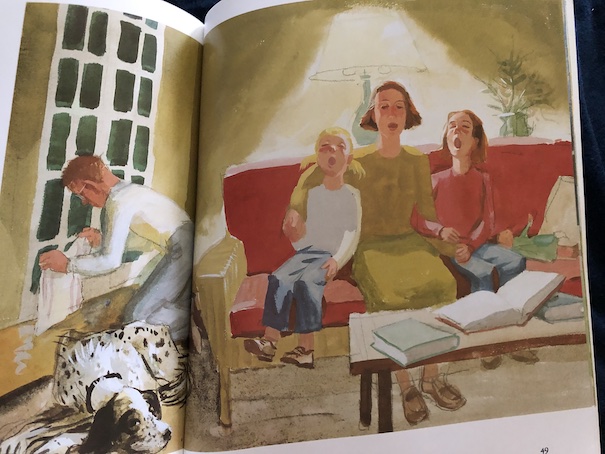
The family reads together and sings songs until the storm is over and it’s time to go to bed.

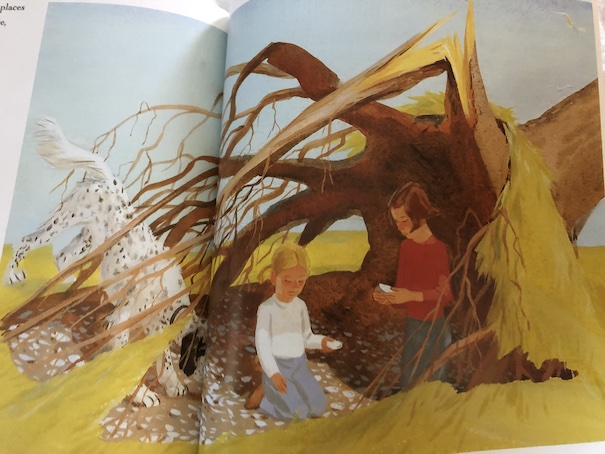
The next day, trees are uprooted, and “you” get to explore what’s beneath their roots.

When it’s time to go home because school will be starting again, you’re a little sad to leave this place, although you’re also glad to go home again.

The book is available to borrow and read for free online through Internet Archive (multiple copies). It’s a Caldecott Medal winner!

My Reaction

This is a great book when you want something calm and relaxing or you feel like you need to take a mental vacation, whether you’re a kid or adult! Nothing stressful happens in the story. It’s just a lovely memory of a peaceful vacation. Even the storm that comes doesn’t do anything worse than blow things around the room and knock over some trees and plants. The girls in the story help clean up after the storm, find ancient seashells under the roots of a fallen tree, and are happy that the sunflowers are looking toward the sun again.

When the girls are looking at the shells under the fallen tree, they think about the Native Americans who lived in the area before white people came and before the tree grew there. They call them “Indians” instead of Native Americans, but that’s the only thing I can find to nitpick about the story.

I think this would make a great, calming bedtime story for kids, especially during the summer! It reminds me a little of the song Verdi Cries, about someone’s memories of a special vacation.

The setting for the story, on an island off the coast of Maine, is based on the author’s family’s summer home, and the two girls in the story are based on his own daughters. They are not named here because the story is about “you”, but the older girl is Sarah (called Sal) and the younger girl is Jane. They appear in and are named in Blueberries for Sal and One Morning in Maine, where they are much younger.

Clifford Takes a Trip

Clifford

Clifford Takes a Trip by Norman Bridwell, 1966.

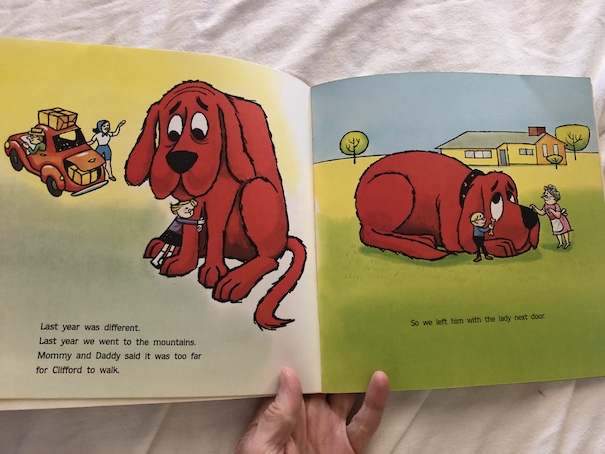
Emily Elizabeth and her parents don’t usually take long trips during the summer because it’s too difficult to bring Clifford along. He’s just too big to go on trains or buses. One summer, Emily Elizabeth’s parents decide to go camping in the mountains. They can’t take Clifford, so they leave him behind with a neighbor.

However, Clifford misses Emily Elizabeth too much, so he decides to go find her! A gigantic red dog can create a lot of chaos on a cross-country trip.

Along the way, he does help a man with a broken-down grocery truck, and the man is grateful enough to feed him.

He also arrives at the family’s campsite just in time to save Emily Elizabeth after she thought it would be fun to play with some baby bears she found.

The family considers that next year, they may find a way to take Clifford with them somewhere else.

The book is available to borrow and read for free online through Internet Archive (multiple copies, including one in Spanish).

My Reaction

Like all Clifford books, the humor is based around Clifford’s enormous size. Even though the family thought that it would be too far for Clifford to walk to come to the mountains with them, he tracks them down there anyway. Then, after he rejoins his family, he sleeps with Emily Elizabeth, his ear propped up to be her tent. The idea they’re considering next for transporting Clifford is a flat-bed truck. I could well imagine my own dog trying to track me down if I went on vacation without her, but fortunately, when your dog is about the same size as Toto in the Wizard of Oz, traveling with a dog isn’t as difficult.

The Secret in the Sand Castle

The Bobbsey Twins

#4 The Secret in the Sand Castle by Laura Lee Hope (Stratemeyer Syndicate), 1988.

Before I begin, I’d like to acknowledge Sean Hagins, for supplying me with photos of this book! Usually, I take pictures of books myself, but I just couldn’t find a physical copy of this one. Sean is a big fan of the Bobbsey Twins, particularly the New Bobbsey Twins mysteries, and you can see some of his video reviews as well as videos about his photography work on his YouTube channel, SJHFoto. Thanks, Sean!

The two sets of Bobbsey Twins and their parents are spending a few weeks in an old house at Beachcliff Bay. It’s sort of a working vacation for their parents. Mr. Bobbsey owns a lumber yard, and he’s helping a local builder, Jim Reade, to either find some antique Victorian wooden gingerbread house trim or make new ones to match a home restoration project. Meanwhile, Mrs. Bobbsey is planning to write a travel article about the area for their local newspaper.

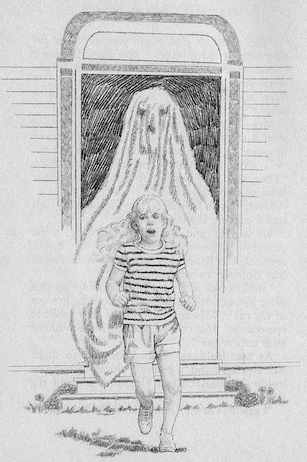
The house where the family will be staying is called the Wilson house, and it’s one of Mr Reade’s recent renovation projects. Flossie is the first in the family to go inside, and she is startled by what she thinks is a ghost. It turns out that it’s only the caretaker, Pete Smedley, taking the old dust sheets off the furniture. It’s not entirely reassuring because Pete says that there are stories about the old Wilson house being haunted by the ghosts of its former owners, who drowned in the nearby bay. He says that he knows when the ghosts have been there because they move things around and leave trails of water, seaweed, and seashells. Mr. Reade thinks that Pete’s stories are nonsense and that the strange things he’s observed are due to windows in the house being left open or something like that.

The inside of the Wilson house is as elaborate as the outside. The Bobbsey twins unpack their things and claim rooms for themselves upstairs. Flossie is quick to claim the biggest room with the best view for herself, and she asks Bert to help her move a mirror she likes into her room. They don’t have anything to hang the mirror, so they set it on Flossie’s bed. Strangely, they later find the mirror still on the bed but broken, and they don’t know how that happened.

Nan is curious about the Wilson family and the history of the house, so she and Freddie take a trip to the local library. There, Nan learns that the last two members of the Wilson family were a brother and sister, called Clay and Jennie. They were both artists, but they never made much money. Badly in need of money, they apparently robbed an armored car and stole gold bars. They tried to escape in a boat, but it was lost in a storm. The Wilsons apparently drowned, although their bodies were never found. The police thought they might have hidden the gold somewhere before getting on the boat, but nobody ever found the gold they stole.

Mr. Reade tells the children that his son, Jimmy, is entering a local sand castle contest, and the Bobbsey twins decide that they would like to enter the contest, too. Nan thinks they should try to build a replica of the Wilson house in sand. Unfortunately, Jimmy turns out to be a troublemaker, and it doesn’t look like he wants to be friends with the Bobbsey twins.

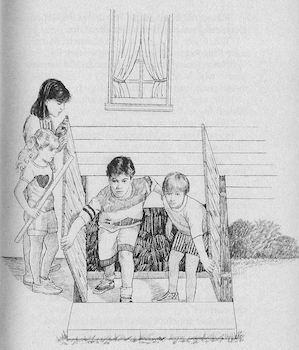
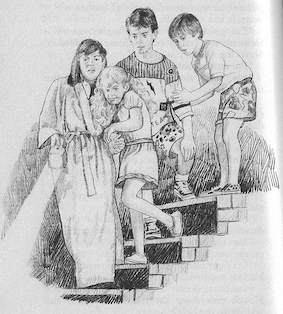
While the girls go to the store, Bert and Freddie decide to check out the old root cellar at the house, and someone traps them inside. The girls let them out when they get back. Then Flossie finds a secret passage and hidden stairs. Mr. Bobbsey says that it was once a servants’ entrance that had been sealed off. Later that night, a ghostly figure tries to enter Nan’s room! Could it have been Jimmy. playing a nasty prank, or is it someone looking for the lost gold? Could it even be a real ghost?

The book is available to borrow and read for free online through Internet Archive.

My Reaction

From the beginning of the book, I had a favorite suspect. However, this is one of those mysteries where there is more than one person involved, and they’re not working together. In the end, I was right about my main suspect, but having a second person doing suspicious things made the mystery more interesting. The title is a little misleading because the story is really about the search for the hidden gold from the robbery, not about the sand castle contest. The sand castle contest is more of a side issue, although studying the design of the house to build the sand castle version leads the kids to the solution of the mystery.

Because this book is from the late 1980s, there are things in the story that were more a part of my childhood than the lives of 21st century children, like renting videotapes. I was about the age of Freddie and Flossie when this book was first published, so it’s a bit of a fun nostalgia trip for me, both because I read books in this series when I was young and because some of the things the kids do in these stories are similar to things I did at their age.

Ruth Fielding at Lighthouse Point

Ruth Fielding

Ruth Fielding at Lighthouse Point or Nita, the Girl Castaway by Alice B. Emerson (the Stratemeyer Syndicate), 1913.

When this story begins, Ruth’s friend Helen is finally being initiated into the society that Ruth and some of their friends founded at their boarding school, Briarwood Hall. In the second book of the Ruth Fielding series, when the girls started attending Briarwood, they found themselves caught between two rival social groups. One of them had the reputation for being led too much by the school faculty instead of the students themselves. Ruth, Helen, and some of the other girls craved more independence from the teachers. However, the other main social group, which was more student-led, was led by a sly bully of a girl named Mary Cox. That group had basically turned into a cult of personality centered around Mary Cox, where everyone else had to do whatever she said. The initiation into Mary Cox’s group was a mean trick, and Mary Cox, known as “the Fox” to many girls at school because of her slyness, used bullying tactics to dominate the other girls.

For awhile, Helen was a member of Mary Cox’s group, finding it exciting, but Mary Cox took exception to Ruth very soon after they first met because Ruth is more independent-minded and not easily led or intimidated by Mary. Although Ruth was one of the new girls at school and one of the youngest, she decided to assert her independence and create a new society without some of the problems that plagued the older ones. She found other interested girls who felt the same way she did, and they soon attracted more members who were similarly tired of the old groups. Ruth’s group is called the Sweetbriars, or S.B.s for short, although Ruth frequently reminds people that the group is not hers exclusively. To avoid the problem with Mary’s group, having everything monopolized by one person, Ruth established in the rules that leadership of the Sweetbriars will rotate, with no member serving as the club president for more than one year. That way, no one will have total control, and there will be opportunities for new people with fresh ideas to get more involved.

Helen, who eventually figured out what kind of person Mary was, stuck with her group for awhile anyway, out of loyalty to the membership, but since then, Mary’s group has fallen apart. Helen was one of the last to leave it, but Mary is still resentful that many of her old members have joined the Sweetbriars, including Helen.

Shortly after Helen’s initiation, Ruth and her friends are talking about taking a summer trip to a friend’s beach house. They started talking about their summer plans over the winter break, and now, they’re making the final arrangements. Mary, still looking for ways to cause trouble for Ruth and the Sweetbriars and regain her social dominance, tells Helen that the only reason she’s being invited to the beach house is because she’s now a Sweetbriar, implying that the other girls wouldn’t have wanted her around if she hadn’t joined their club. Frankly, Helen is a bit of a sucker and falls for Mary’s manipulation. She confronts the other girls about what Mary said.

The other girls all remind her that, first of all, they started planning this trip well before her initiation. Second, they are inviting people who aren’t part of the Sweetbriars. They’ve invited Madge, who is the student leader of the faculty-led social club, and she’s coming. They’ve also invited some boys, brothers of girls at the school and their friends, who attend the nearby boys’ boarding school. Helen says that Madge is also an honorary Sweetbriar, even though she’s in another club, and the other girls correctly realize that Mary’s comments to Helen were a manipulation to secure her own invitation. The girl whose family owns the beach house, Jennie Stone (nicknamed “Heavy” by the other girls because she’s “stout”), is actually one of Mary’s roommates at school, and she reminds Helen that she also invited Mary but that Mary was non-committal about accepting.

The girls debate among themselves whether or not Heavy should renew the invitation and encourage Mary to come with them. It’s pretty obvious to the girls (except maybe Helen) that Mary is being manipulative and probably has a trick up her sleeve. (They don’t call Mary “the Fox” for nothing, and if the reader has any doubts that this is a ploy, Mary is listening to this whole conversation through the keyhole.) Mercy, known for her outspokenness, thinks they should all just forget about Mary because her meanness will spoil the fun. Ruth doesn’t like Mary, either, but she can see that Helen will feel bad if they act exclusionary, and Mary will try to use that against them. Ruth tells Heavy that it’s only right for her to invite her roommate, and not only does Ruth want her to invite Mary, she insists on it.

So, Mary will be going to the beach house with the other girls, but before their trip even gets started, the situation is rocky. When the girls get on the boat that will take them from the school to the train station, Mary goofs off, teasing one of the other girls, and she ends up falling overboard. Since Mary can’t swim, Ruth has to jump in and save her. This is the second time that Ruth has saved Mary’s life since she arrived at the school. The first time, Mary credited the rescue to Helen’s brother, Tom, who also helped, but this time, Ruth gets the credit alone, and everyone witnessed it. One of the other girls says that Mary will have to change her attitude toward Ruth now, but Ruth knows that isn’t likely. Just because Mary might owe her some gratitude for the rescue doesn’t mean that Mary will like her, and Mary is the kind who would resent “owing” a person she doesn’t like.

Worse still, Ruth learns that her Uncle Jabez has lost a considerable amount of money in a bad investment, and he might not be able to afford to sent her back to Briarwood Hall! It’s a heavy blow because she’s finally settled in there and has a good group of friends. He’s become so paranoid about money again that he might also stop the money he was contributing toward Mercy’s education, which would be a double blow.

Ruth is an ambitious girl and determined not to give up on her education so easily. Raising the money for her next year’s tuition would be difficult all on her own, but Ruth knows that she has to find a way to do it over the summer. At first, she isn’t sure that she should go to the seaside with the others as planned, but Uncle Jabez surprises her by giving her some money and telling her to go. As the girls set out on their trip, Heavy also tells Ruth that Mary Cox’s family is having trouble. Mary’s father died a year ago, leaving the family with money problems, and her brother left college to tend to his father’s business affairs. Now, her brother has disappeared on a business trip, and she and her mother are worried about him. With the girls’ problems hanging over their heads, they all set off for Heavy’s family’s seaside bungalow at Lighthouse Point.

When the party arrives at Lighthouse Point in Maine, there’s a storm, and they hear that there’s a shipwreck on a nearby reef. The young people all go down to the seaside to watch the rescue efforts. At first, they think it’s all very exciting, but then, the destructive power of the storm and the real risk to the rescuers makes them realize the seriousness of the situation. They watch, horrified, as a lifeboat overturns in the storm. It seems like there won’t be any survivors of the wreck, but some people are saved.

Among the survivors is a girl who calls herself Nita. Nita, who is about the same age as Ruth and her friends, admits to being a runaway, but she is evasive about where she came from and what her situation is. The ship captain’s wife, Mrs. Kirby, is also rescued, and she says that it’s her impression that Nita was not well cared for when they first met and that Nita was trying to go to New York, possibly to stay with some relatives there. Nita says that she wants to go to New York, but she is still evasive about why, what she plans to do there, or if she knows anyone there.

In spite of her recent traumatic experience, Nita is very self-controlled, mentally sharp, and even a bit sly. The party of young people and Heavy’s Aunt Kate take Nita with them to the bungalow where they give her a bed and question her more about her past. She lets a couple of things slip, referring to a man named Jib Pottoway, who was a “part Injun” (that’s how Nita puts it, she means that part of his family is Native American, saying that “Jib” is short for Jibbeway, which is apparently either an older version or slang corruption of Ojibwe) “cow puncher” who lent her books to read. Nita apparently came east from somewhere in the western United States, having romantic notions from books about how poor girls can make friends with wealthy families in the east who can help them with their education and help them rise up in society. She’s been finding out that the realities of the east are very different from what she’s read in books, but she still has her stubborn pride. Nita says that she can move on if the others don’t want her around or if they’re getting too nosy about her past, but Aunt Kate is reluctant to let her go until she knows whether Nita is going to be able to manage on her own or has somewhere to go.

Since Nita has only the clothes she was rescued in and those are ruined, the part gets her some new clothes to wear. They notice that a somewhat disreputable man named Jack Crab seems strangely interested in Nita, as if he recognizes her from somewhere. There is an explanation later when Tom picks up a newspaper clipping that Jack Crab drops about a girl named Jane Ann Hicks, who has run away from her wealthy uncle who owns a ranch in Montana. Nita certainly first the description of the missing Jane Ann. In her uncle’s and the reporter’s words, “‘Jane Ann got some powerful hifalutin’ notions.’ She is now a well-grown girl, smart as a whip, pretty, afraid of nothing on four legs, and just as ignorant as a girl brought up in such an environment would be. Jane Ann has been reading novels, perhaps. As the Eastern youth used to fill up on cheap stories of the Far West, and start for that wild and woolly section with the intention of wiping from the face of Nature the last remnant of the Red Tribes, so it may be that Jane Ann Hicks has read of the Eastern millionaire and has started for the Atlantic seaboard for the purpose of lassoing one–or more–of those elusive creatures.” They’ve got her pegged, although the “or more” part of lassoing millionaires makes her sound more like a gold-digging adventuress than an overly-romantic teenager who’s read too many novels. However, if Nita really is Jane Ann Hicks with a wealthy, ranch-owning uncle, why would she need to find a wealthy benefactor to buy her the piano she says she wants and fund her education?

Nita runs away from the beach house, but unfortunately, she trusts the wrong person and is soon in need of Ruth and her friends to rescue her again.

The book is now public domain and is available to borrow and read for free online through Internet Archive (multiple copies) and Project Gutenberg.

My Reaction and Spoilers

Racial Language and Other Issues

I think I should start with a warning that there are some issues with racial language in this book, which is pretty common with early Stratemeyer Syndicate books. I already mentioned the word “Injun” and the newspaper article that mentions “Red Tribes” above. I also noticed that in the article that describes Jane Ann’s disappearance, it is mentioned that she was raised by her uncle alone at his ranch “for a woman has never been at Silver Ranch, save Indian squaws and a Mexican cook woman.” I’m sure they’d be thrilled to find that they don’t count. The Stone family’s cook at their beach house is a black lady called “Mammy Laura” who speaks in a stereotypical way with phrases like “lawsy massy.” (Although, to be fair, Mr. Hicks the rancher also speaks like a stereotypical cowboy, so stereotypes are being used in a very general way and not directed at any group in particular. I know, it’s still not great.)

It’s also a little uncomfortable how they keep referring to Mercy as “the lame girl” or “the cripple.” They don’t seem to mean it as an insult, more as a general description, and it’s true that it’s one of Mercy’s characteristics and a major part of her storyline in the first book. Her health has improved since then, although it’s established that she’s never going to be able to walk as well as other people and will always need some assistance, like crutches. It’s just that it feel like we’re being beaten over the head with it when they keep repeating that she’s “lame.” I think they’re trying to do it as a descriptor, trying to make the writing a little more colorful by referring to characters by some part of their appearance and not just by name, like how they keep calling Ruth “the girl from the Red Mill”, but it falls flat because it seems insensitive and shallow. First of all, this isn’t something that readers are likely to forget and need to be constantly reminded about Mercy. Second, it gives the impression that this is Mercy’s main characteristic. Mercy is the most blunt and sarcastic character among the girls, and she has quite a lot of personality, so she does have characteristics beyond her disability. Third, in the first book, they establish how much Mercy hates her disability and how bitter she was about it until she found a way to improve her situation, make friends, and move forward with her life and education. It doesn’t seem like she’d enjoy people constantly calling her “cripple” and “lame”, and it would be completely in character for her to bluntly say so if asked, so it’s a little uncomfortable when the invisible narrator of the book keeps doing it.

Heavy’s nickname is also a little irritating. She doesn’t seem to mind it, but this is a good opportunity to point out that older Stratemeyer Syndicate books do have a tendency to use characters’ weights as one of their defining characteristics. Even up through later series, like Nancy Drew, characters are often specifically described in terms like “slender”, “slim”, “stout”, etc. Typically, in Stratemeyer Syndicate stories, the slimmer characters are either the main characters or the nicer or more talented ones, while the fatter ones are either more comic relief, socially awkward, or villains. Actually, one of the things I like about Heavy is that she doesn’t fall into this pattern. Heavy is pleasant, cheerful, practical, and generous.

The Runaway

As Ruth considers Jane Ann’s position and why she would run away from her uncle, she remembers that she also considered running away from Uncle Jabez when she first came to live with him. Both Ruth and Jane Ann are orphans who depend on their uncles, who control the family finances and their education. Jane Ann’s uncle is far richer than Uncle Jabez, but he also has firm ideas about the kind of life Jane Ann is going to live as the future heiress to his ranch and what kind of education she’s going to need. He rejects the kind of education a girl would have on the east coast of the US as being too “effete” for a young woman who will someday have to manage a ranch with tough “cow punchers.” However, Jane Ann wants some of the refinements of east coast culture, like her own piano, an education, and the company of other girls her own age who share her interests, none of which are available at her uncle’s ranch. It’s true that Jane Ann has a lot of unrealistic notions about life from the books she’s been reading, but that’s largely because cheap romantic novels have been her main source of information about life outside of her uncle’s ranch. Getting an education and more interaction with the outside world would do her some good. Actually, I think Jane Ann’s problem does reflect a problem that exists even in modern education, when parents and instructors are so focused on job training and the roles they think the young are going to fill in life that they neglect the subjects that give students a broader view of life and how the world works, their roles as human beings outside of career roles, and their relationships to other human beings in the world.

When Mr. Hicks comes to the beach house later, looking for his niece, Ruth talks to him about what she knows about Jane Ann/Nita and what Jane Ann really wants. Mercy also adds some criticism because she has “a sharp tongue and a sharper insight into character”, pointing out to Hicks in no uncertain terms what a young girl needs and how she feels about things. Her criticism of the name “Jane Ann”, which seems as dull and plain to the other girls as Jane Ann thought it was herself, seems a little overdone. Jane Ann’s uncle picked that name because it was his grandmother’s name, and it is traditional for certain names to be reused in families. It’s not as romantic and modern as the girls think it should be, but it’s also simple and classic and could really belong to just about any time period, so I don’t think it’s as old-fashioned as they’re implying. I do appreciate Mercy’s straightforward talk and how she speaks her mind without being intimidated by either Hicks’s age or wealth. Mercy really is a character with a personality, which makes her different from some of the other cookie-cutter characters in Stratemeyer Syndicate books with little variation in their personalities, and she’s one of my favorites in this series.

Like other books in the series, there is an element of mystery, but the book tends to lean more toward adventure. However, as the series goes on, the stories are becoming more mystery, and this one is more mystery than previous books. There is first the question of who Nita really is. The newspaper clipping provides a clue, although it’s not a firm answer until Jane Ann’s uncle shows up, looking for her. Then, there is the question of where Jane Ann went after she left the beach house. Ruth is sure that Crab had something to do with her disappearance, but she and her friends have to do some intentional investigating and searching for Jane Ann to rescue her. In spite of some of the problematic language, I like the direction this series is heading.

At the end of the story, there is still something unresolved, and that’s how Ruth is going to pay for her boarding school. Jane Ann’s uncle offers a reward for rescuing her, but Ruth can’t bring herself to accept it because she doesn’t want it to appear that she was only helping Jane Ann for the sake of the money. Instead, she and her friends will be rewarded with a trip to the ranch where Jane Ann and her uncle live.

Odd Piece of Trivia

When Jack Crab tries to pester Nita about what her name is, Mercy bluntly tells him off using a children’s retort:

“Puddin’ Tame!” retorted Mercy, breaking in, in her shrill way. “And she lives in the lane, and her number’s cucumber! There now! do you know all you want to know, Hardshell?”

I not only appreciate that she pokes fun at Crab’s name, calling him “Hardshell“, but she brings up an interesting piece of children’s lore. The “Puddin’ Tame” retort was old-fashioned when I was a kid in the 1980s and 1990s, but it was a popular playground retort for decades, maybe over a hundred years, although I’m not sure of its actual age, and it’s possible that it’s still circulating in schools and playgrounds somewhere. When kids say it, the quick rhyme is more important than the meaning, although there are theories that “Pudding Tame” or “Pudding Tane” (as some people say it) is a reference to a devil character called Pudding of Thame.

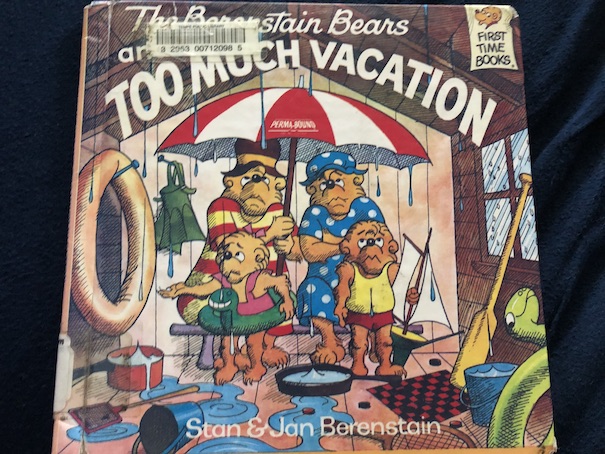
The Berenstain Bears and Too Much Vacation

The Berenstain Bears

The Berenstain Bears and Too Much Vacation by Stan and Jan Berenstain, 1989.

“Can a bear’s vacation
with more rain than sun
end up being
the one that’s most fun?”

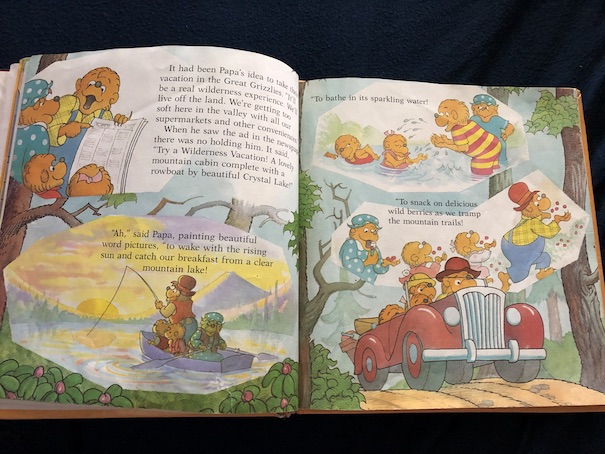
The Bears are looking forward to their family vacation! The vacation was Papa’s idea because he saw an ad in the newspaper for a rental cabin the mountains. Papa likes the idea of a wilderness vacation and living off the land. He describes to his family how much fun it will be to swim and fish in the lake and eat wild berries.

However, when they arrive at the cabin, it soon becomes apparent that their vacation is not going to be as it was advertised. The cabin is run-down and messy. The water from the pump is brownish, and the lake is too.

From the very beginning, nothing on their vacation goes right. Papa’s “wilderness stew,” made from plants that he gathered, is terrible, and the wild berries are sour. Their rowboat sinks, and fishing is a disaster!

When it starts to rain, their cabin leaks, and Papa falls down in the mud. By then, everybody has decided that they’ve had enough and that it’s time to go home.

So, what did they get out of their worst vacation ever? Memories! The experiences were pretty awful, but Mama’s pictures of everything that happened turn out to be hilarious! This is a fun story about how even disappointing situations can have a humorous side.

The book is available to borrow and read for free online through Internet Archive (multiple copies).

Terror By Night

PFTerrorNight

Terror By Night by Vic Crume, 1971.

This book is part of the Partridge Family book series, based on the The Partridge Family tv show.

Shirley has been thinking that she and her children could use a vacation, and her family band’s manager, Reuben Kinkaid, suggests a place where they could have a little vacation and do some rehearsing.  Reuben arranges for the family to rent a large house with several acres of land attached in a small New England town not far from Salem, Massachusetts.  That should have been their first clue.  That, and the fact that the town’s name is Haunt Port.

At first, the Partridges are just thinking about how they can rehearse without disturbing anyone on such a big place, and Danny and Chris want to try camping out.  However, when they arrive in town, they learn that the name of the house they’ve rented is Witch’s Hollow and that it’s close to a place called Hangman’s Hill.  Soon after the family arrives at the house, Keith and Laurie also find a dummy hanging from a tree with a note that says, “Welcome! The Hangman.”  It’s pretty disturbing, but Keith and Laurie decide to hide the dummy and not scare the others.  They don’t know who is behind this awful joke, but they don’t want to give that person the satisfaction of seeing them react to it.

However, the disturbing things don’t end there.  The family’s dog, Simone disappears.  Also, people in town seem to have a strange attitude toward the house’s cook/housekeeper, Mrs. Judbury, and her daughter, Prudence.  Prudence is sullen and anti-social with a habit of catching toads for fun.  Keith has to admit that he can see how Prudence might have gotten a reputation for being a witch, but there’s more behind the strange happenings at Witch’s Hollow than that.

Simone eventually returns, although it’s clear that she’s frightened and hasn’t been fed well, and Mrs. Judbury tells the family the story of her family’s history in Haunt Port.  One of Mrs. Judbury’s husband’s ancestors was one of the accusers at the Salem witchcraft trials, but later, when people began to realize that they had executed innocent people, some of the accusers themselves found public opinion turning against them.  This ancestor decided to leave Salem and go to Judbury Port (the old name for Haunt Port) because he had family there, but he and his wife were never really accepted there, either.  This man later hanged himself in despair (at the place called Hangman’s Hill), and his wife later died alone, also shunned by the town.  Although some of the townspeople might feel bad about how things ended up with the Judburys, the old uneasy feelings about the family have remained, and Prudence’s stand-offish attitude, combined with her mother’s apparent psychic premonitions, has fueled some of the old stories.

At one point, Keith tells Prudence that he knows why she acts the way she does, because it’s much easier for her to keep her distance from people and behave strangely than it is for her to try to learn to get along with them and make friends.  Prudence isn’t responsible for what the townspeople did in the past, but she isn’t helping things in the present.  Jane Parsons, whose family owns the local store, also helps in a way because she and Prudence are cousins, and Prudence joins her in welcoming a cousin of their and his friend when they visit town.  As Prudence becomes friendlier, she and her mother become allies in trying to figure out the mysteries of Witch’s Hollow, which turn out to have less to do with past wrongs than current crimes.

The book is available to borrow for free online through Internet Archive.

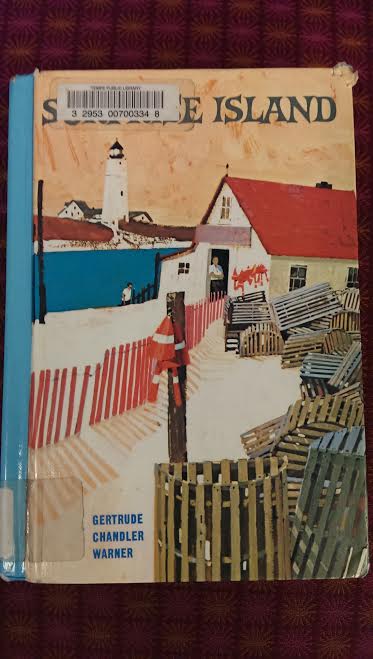
Surprise Island

The Boxcar Children

Surprise Island by Gertrude Chandler Warner, 1949.

Mr. Alden has promised his grandchildren a special surprise for their summer vacation. He tells them that, years ago, his father bought a small island because he kept horses and wanted a quiet place for them.  The island has only one little yellow house, a barn, and a fisherman’s hut where Captain Daniel lives.  Captain Daniel operates the motorboat that can take people to the island.  Mr. Alden plans to take his grandchildren to the island to look over the house, and if they like, they can spend the summer there.  The children think that it sounds like fun.

When they get to the island, the children decide that they want to stay in the barn instead of the house.  Captain Daniel also tells them that he has a young man staying with him, a friend who hasn’t been feeling well.  The Aldens’ old friend, Dr. Moore, has come to see the island with them, so he looks in on the young man.  It turns out that the young man was in an accident and had lost his memory for a time, although he has been gaining it back.  He says that he used to live with an uncle but that he didn’t want to go home again until he was sure that he was completely well.  He is going by the name of “Joe”, which is short for his middle name, Joseph.  Captain Daniel says that he’s known the young man all his life, and Dr. Moore also seems to know him, but Joe doesn’t seem to want to talk about himself to Mr. Alden.

The kids enjoy setting up housekeeping in the barn.  It reminds them of when they used to live in an old boxcar.  They use old boxes for furniture, dig for clams, and eat vegetables from the garden that Joe and Captain Daniel have tended for them.  Their grandfather allows the children to stay on the island in Captain Daniel’s charge, but they are mostly allowed to take care of themselves.  Joe sometimes brings them supplies that they ask for from the mainland.  (One of the themes of the Boxcar Children Series is self-sufficiency.  At one point, Jessie comments about how much better things seem “when we have to work to get it.”)  For fun, they go swimming, and Joe spends time with them, telling them about different types of seaweed.  They are surprised at how knowledgeable Joe is.

Henry gets the idea that they can set up a kind of museum of interesting things that they find on the island, like samples of different types of seaweed, shells, flowers, pictures of birds that they’ve seen, etc.  The other children think that it sounds like fun, and they begin thinking about the different types of things that they can collect.While they’re searching for things to collect and add to their museum, the children find a cave and an old arrowhead and ax-head.  They are authentic Indian (Native American) relics!  When they show Joe what they’ve found, he gets very excited, especially when they tell him that they saw a pile of clam shells, too.  Joe explains to the children how Native Americans used to use shells as money called wampum.  He thinks that what they saw was wampum, which the people who used to live there might have made after drying the clams to eat later.  Joe explains to the kids some of the process they would have used to turn the shells into wampum.  He’s eager to go to the cave and look for more Native American artifacts with them, but he urges them not to say anything to anyone else about it because other treasure hunters will probably show up if they do.  The children agree to keep their find a secret until their grandfather returns.

When they return to the cave with Joe, they make an even more incredible find: a human skeleton with an arrowhead inside.  It looks like they’ve found the bones of someone killed by an arrow!

The book is available to borrow and read for free online through Internet Archive.

My Reaction

As with some other vintage children’s mystery series, the early books in the series were more adventure than mystery.  The most mysterious part of this book concerns the real identity of the young man they call “Joe.”  The truth begins to come out when a strange man who calls himself Browning comes to the island in search of a young man who disappeared the year before while doing some exploring for him.  The young man he’s looking for worked for a museum.

This is the book where Violet first learns to play the violin.  This is a character trait that stays with her for the rest of the series.

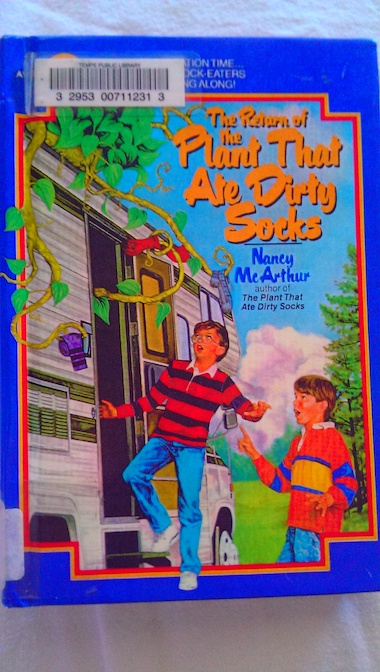
The Return of the Plant That Ate Dirty Socks

ReturnPlantDirtySocksThe Return of the Plant That Ate Dirty Socks by Nancy McArthur, 1990.

Michael and Norman’s father has finally gotten the chance to take a vacation, but his sons’ weird, sock-eating plants complicate things.  You can board pets or ask someone to come in and feed them, but how can you ask someone to leave out socks for your houseplants?  The boys’ parents still kind of think that the plants are more trouble than they’re worth, but the boys love them like pets and can’t bear to get rid of them.  Instead, they persuade their parents to rent an RV for the family’s vacation.  That way, they can take the plants along.

It seems like a good idea, although before they leave home, the boys notice that the plants are starting to produce seed pods, something that they decide not to tell their parents.  Instead, they simply remove the seed pods from the plants when they find them.  So, the family sets off for Florida and Disney World in their RV with the sock-eating plants sticking out through the sun roof.

At first, it seems like things might be okay on the trip, but one night, when the boys are visiting their grandmother and sleeping in the house instead of the RV, they forget to set out socks for their plants to eat.  When they wake up in the morning, the RV is gone.  The boys worry that the plants somehow got control of the RV and drove it off to find more socks, but it turns out that it was stolen by car thieves.  The police recover the RV but are puzzled when witnesses describe the thieves as abandoning the vehicle, screaming and running away without their shoes on, one of them only wearing one sock.  The family is relieved to get their RV back, not to mention their plants, however their adventures are just beginning.

The family has a good time when they get to Disney World, but the plants start drooping because they feel neglected, all alone in the RV all day.  To get the plants out in the sunshine and supervised more, the boys ask the people at the daycare center at the RV park if they can leave their plants there during the day.  The plants perk up a little more, getting attention from the staff and children, especially when they sing.

But, it turns out that the mother of one of the girls who has seen the plants, Dr. Sparks, is a botanist, and she’s very curious about the origin of these unusual plants.  The boys’ parents think that it might not hurt to get an expert opinion about their strange plants, but the boys worry that if the plants turn out to be very rare, scientists will want to take them away or their parents might decide to sell them.  Their parents still think that the plants are too weird and too troublesome to keep, but Michael and Norman think of them as their friends and pets.  They’ve been trying hard to keep their plants’ sock-eating abilities quiet.  Is it finally time to tell someone?  Can Dr. Sparks be trusted?

They end up asking for Dr. Sparks’ help when Fluffy accidentally eats something he shouldn’t.  Dr. Sparks knows that the plants are unusual, but by the end of the book, she’s still not sure that she believes that they really eat socks.  The boys give her some seeds so that she can experiment without taking their plants, knowing that she’ll eventually discover just how unusual the plants are.  By the end of the book, other people are also growing more plants like Fluffy and Stanley, partly because Michael’s friend Jason stole some of the seeds they were saving and sold them to other kids while Michael and Norman were out of town.  The boys can’t get back the seeds, but they force Jason to at least confess to the other kids that the plants will eventually eat socks.  Jason doesn’t think that they’ll believe him, but the boys know that it’s only right that the buyers be warned because they’ll discover the truth eventually.  Fluffy and Stanley are also starting to acquire the ability to move around on their own.

Fudge-A-Mania

FudgeAManiaFudge-A-Mania by Judy Blume, 1990.

Peter is horrified when he finds out that his family is going to spend their vacation in the same place as bossy know-it-all Sheila Tubman and her family.  Even worse, the two families are going to be staying to be staying right next to each other.  Really right next to each other.  They’re staying in the same house, which has been split into two halves.  As far as Peter is concerned, the only thing that might save his summer is that his friend Jimmy will be coming up to stay with them part of the time.

The arrangement turns out to be a little better than Peter thought it would be at first.  Sheila finds a way to make some extra money by baby-sitting Peter’s five-year-old brother Fudge.  Fudge says at first that he wants to marry Sheila, although it turns out to be mostly because he’s afraid of monsters in his room at night, and he thinks that if he gets married and shares a room with Sheila, it will keep the monsters away.  Then, he decides that marriage may be unnecessary when he makes friends with a little girl named Mitzi, who is staying with her grandparents nearby.  Mitzi’s grandmother makes a special monster spray for her to keep monsters away, so Fudge decides that he might not have to marry Sheila after all.

Peter is happy when he discovers that Mitzi’s grandfather is Big Apfel, his baseball hero, and that he holds baseball games that are open to the public, so he and Jimmy can also play with him.  He also gets a crush on Isobel (“Izzy”), a girl who works at the local library, although Isobel is a few years older than he is.  The baseball game goes well enough, but the crush, not so much.

Then, comes the most shocking news of the summer: Peter’s grandmother and Sheila’s grandfather decide to get married!  If that happens, Peter and Sheila realize that they’ll be related by marriage!

Big Apfel and his granddaughter Mitzi are fictional characters, but the book that Mitzi claims is about her, Tell Me a Mitzi, is a real book.

This book is part of the Fudge Series.  It is available to borrow and read for free online through Internet Archive.