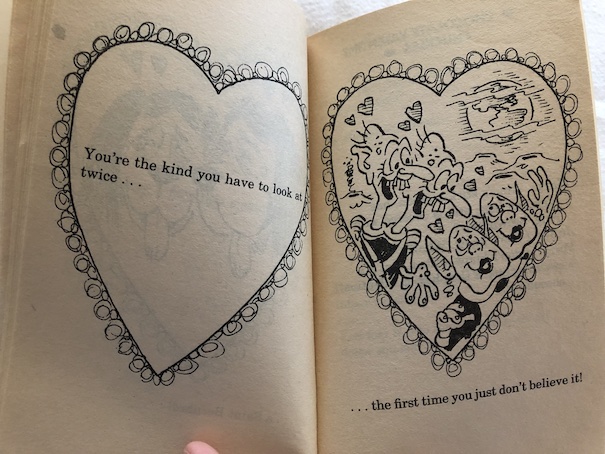
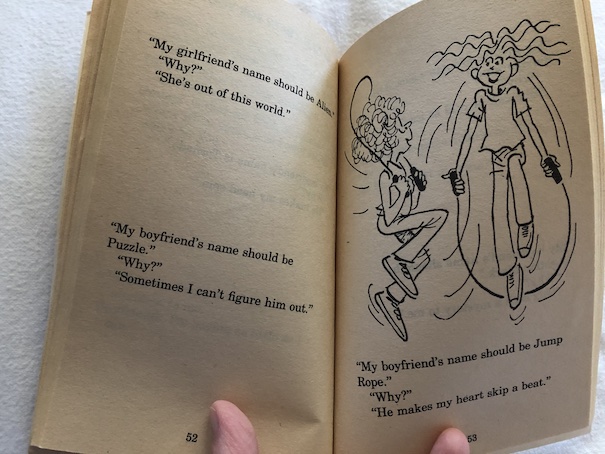
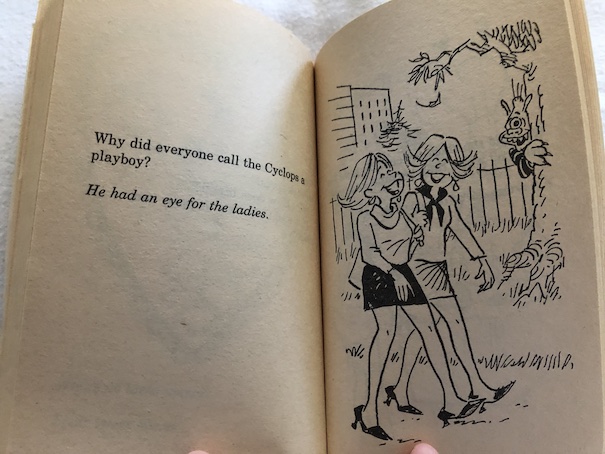
101 Valentine Jokes by Pat Brigandi, illustrated by Don Orehek, 1994.
This is one of those little themed joke books that I used to pick up at school book fairs and used book sales when I was a kid. Most of the jokes are really corny, but I remember finding them fun when I was a kid. Happy Valentine’s Day!
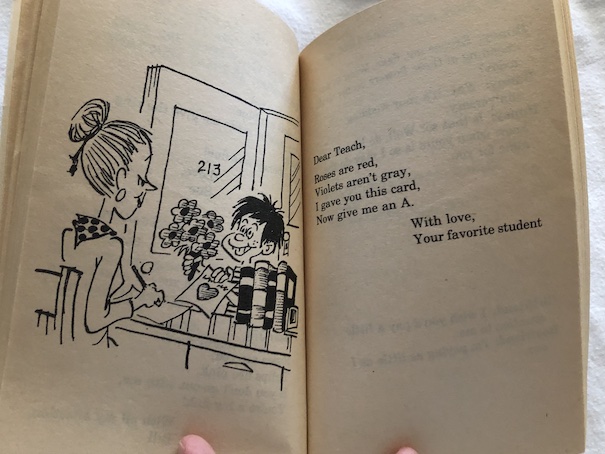
One of the things that surprised me about this book is that some of the jokes are weirdly insulting for a Valentine-themed book. It just struck me as odd that there were jokes with people basically insulting their boyfriends or girlfriends or sending insulting Valentines.
Actually, as I kid, I think I understood the point of the insulting joke Valentine cards because, when you’re a kid in school, there are rules that require you to give a Valentine to every person in class, whether you like them or get along with them or not, so nobody feels left out. Those rules make sense because teachers don’t want to create a situation a situation where somebody in class is being deliberately ignored by other students or the kids are playing one-upmanship about who is more popular than who. But at the same time, when someone else in class has been picking on you all year, that’s the last person you want to give a Valentine. You can’t really give people nasty Valentines like this (at least, not without getting into trouble), but there are times when it can be fun to imagine that you could so you can tell off some jerk who desperately needs it.
But, when it comes to people insulting their boyfriends or girlfriends, I’m just thinking, “If you feel that way about this person, why are you going out with them? Go find someone else!”
Fortunately, not all the jokes in this book are mean. It would have been depressing if all of them were negative in some way. There are the usual knock-knock jokes, jokes based on puns, and a few jokes that are told in story form or silly conversations.
There is one long joke that’s a form letter for “thanking” someone for a present. (Hint: It’s implied that the present wasn’t that great and the person isn’t thankful for it. It reminded me of one of the joke poems in The D- Minus Poems of Jeremy Bloom, and I think the poem was better.)
Overall, I think the best jokes were the kind that I think I kids really could use in class Valentines without getting in trouble. Because of all the insulting ones, though, I felt like there weren’t enough of this kind of joke.
What did the chewing gum say to the show? I’m stuck on you.
This book does have the classic:
Will you remember me tomorrow? Of course I will. Will you remember me next week? Of course I will. Will you remember me next month? Of course I will. Will you remember me next year? Of course I will. Knock, knock. Who’s there? See, you forgot me already!
The book is available to borrow and read for free online through Internet Archive.
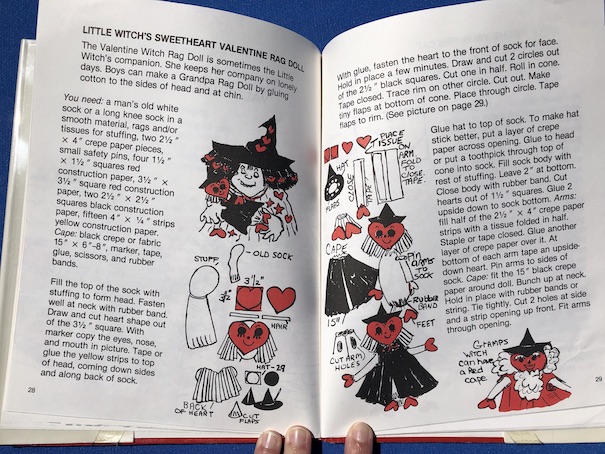
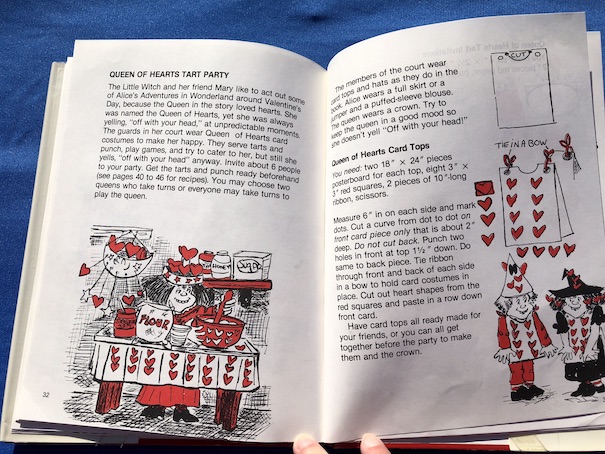
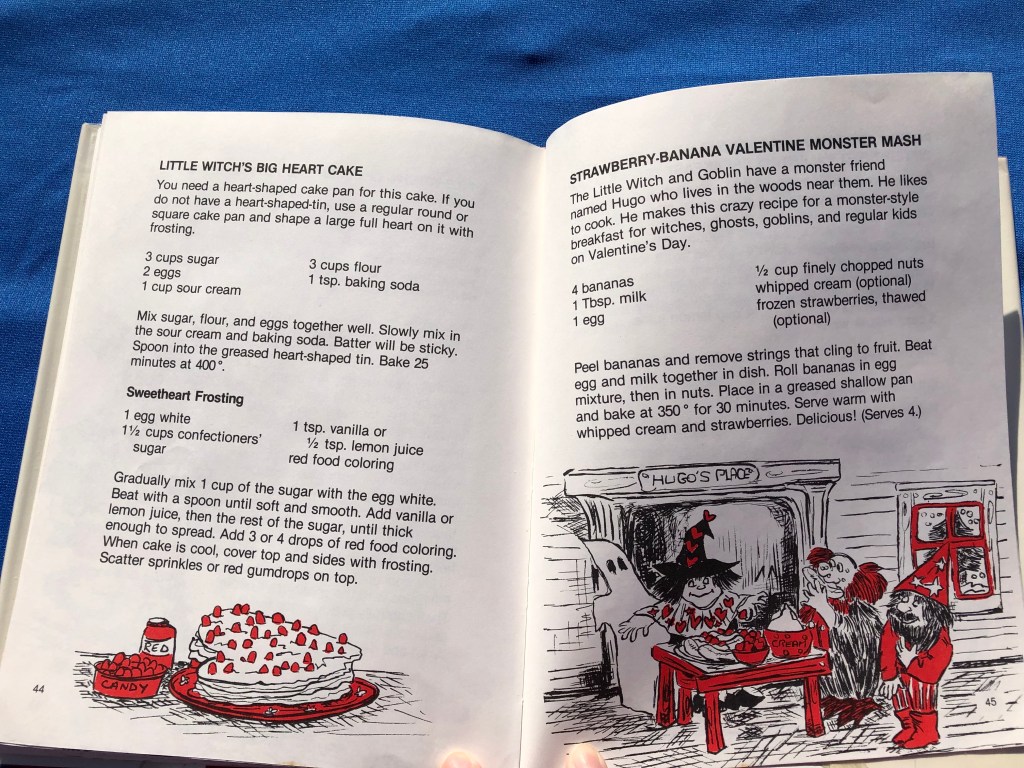
The Little Witch’s Valentine Book by Linda Glovach, 1984.
Like other Little Witch Craft Books, this one gives holiday-themed craft instructions, party tips, and recipes. The book starts out with a brief explanation about the purpose and origin of the Valentine’s Day holiday and then gives a section about Valentine-themed crafts. Some of them also relate back to the witch theme of our craft hostess, like Valentine-themed witch hats, which is a little odd, but fun.
There is a section of crafts that you can make as small gifts for people or prizes for some of the party games given later. The small crafts include finger puppets, a box decorated with an owl with a heart-shaped head, and a butterfly pin with heart wings. There are also instructions for a Valentine-themed rag doll with a witch’s hat, and the instructions recommend that boys make an old man version of the doll by adding a beard. The dolls have heart-shaped faces.
Under the party suggestions, the book recommends having a Queen of Hearts Tart Party for an Alice in Wonderland tie-in. It gives instructions for making playing card costumes that are kind of like sandwich board signs.
There are two party games described in the book, both based on the Queen of Hearts from Alice in Wonderland. One of the games is the “Off With Your Head Hunt” where players have to find missing heart halves with matching symbols on them that are hidden somewhere in the room. The name of the game comes from the person who will be playing the Queen of Hearts, who gives the players their instructions and shouts “Off With Your Head!” while the players hunt for the heart halves to appease the queen. (Yep, really.) The second game is the “Pass the Queen’s Red-Hot Heart Game.” It says that “The Heart is red-hot because it belongs to the queen.” It’s similar to the game Hot Potato. The players stand in a circle, passing a paper heart very quickly from one person to the next while someone plays music. When the music stops, the person who is holding the heart is out of the game. The game continues until only one person is left, and that person wins.
The recipes section offers treats that you can make for your Valentine’s Day party or just for fun, including Queen of Heart Tart Biscuits, Heart Cookies, Strawberry-Banana Valentine Monster Mash, and strawberry pancakes.
The book is currently available online through Internet Archive.
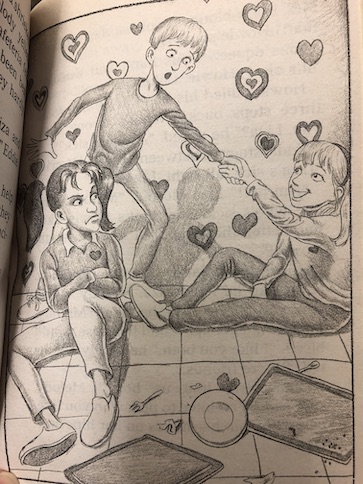
#12 Cupid Doesn’t Flip Hamburgers by Debbie Dadey and Marcia Thornton Jones, 1995.
Valentine’s Day is approaching, and Eddie is annoyed by all of the hearts and girly decorations around the school. However, that’s nothing compared to Mrs. Rosenbloom, the new cook in the cafeteria at school. The first time the kids meet her, she gushes about how much she loves Valentine’s Day. Everything she serves them has a Valentine theme – lots of red foods and heart-shaped foods. Most of the other kids don’t mind the Valentine theme because the food is better than it used to be, but Eddie resolves to do something about it.
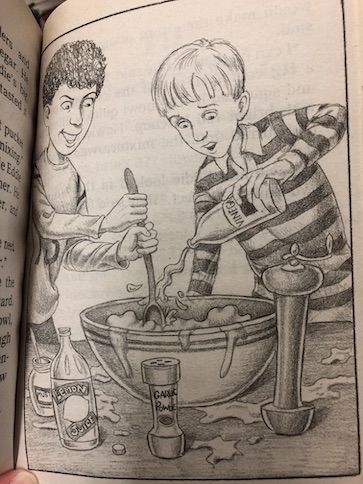
Before Eddie can do anything, Carey, a girl Eddie normally doesn’t like, suddenly develops a crush on him after eating one of Mrs. Rosenbloom’s Valentine cookies. The next day, Ben, the fourth-grade bully, gets a sudden crush on Issy after eating a Valentine cookie. Even Mrs. Jeepers and Principal Davis are falling in love! (Mrs. Jeepers is a widow.) Eddie becomes convinced that Mrs. Rosenbloom has doctored the Valentine cookies with a love potion! He thinks that she’s going to use it to take over the school!
At first, the others don’t believe Eddie, and in any case, what’s wrong with spreading a little love around? The problems start when both Melody and Liza eat Valentine cookies at the same time and both of them fall in love with Howie. The two girls, normally best friends, start fighting over Howie. Howie is embarrassed and worried that this weird love fight will break up their friendship. The two boys find themselves trying to dodge the girls while starting to worry that, if the romance between Mrs. Jeepers and the principal flourishes, Mrs. Jeepers will turn Principal Davis into a vampire. (One of the things I appreciate about this series is how it draws on real folklore and mythology. The boys are right that, assuming that Mrs. Jeepers actually is a vampire, she can’t be in love with the principal without revealing it to him and probably changing him into a vampire, too.)
The boys come up with a plan to change Mrs. Rosenbloom’s cookie recipe for the worst, but before this escapade is over, even Eddie gets a taste of love. As with other books in this series, Mrs. Rosenbloom eventually leaves the school, and things return to normal (or what passes for normal in Mrs. Jeepers’ class).
The book is available online to borrow for free through Internet Archive.
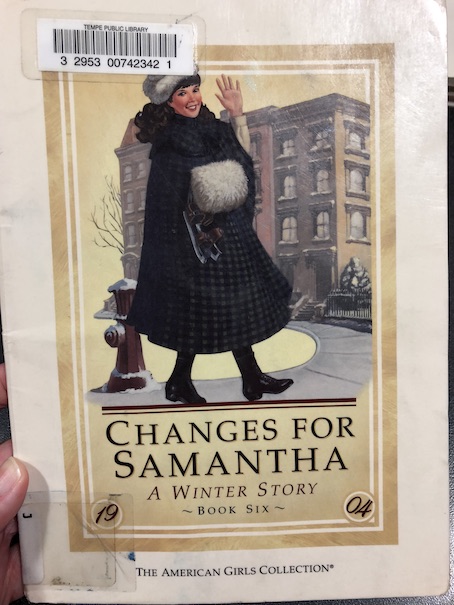
This book is part of the Samantha, An American Girl series. This is the last book in the original series of Samantha’s stories and explains the changes in the lives of Samantha and her friends, especially Nellie. When Samantha met Nellie in the first book in the series, Nellie was a poor girl working as a servant girl in a neighboring house. Later, Nellie and her family moved to Samantha’s town, Mount Bedford, and Nellie and her sisters were able to attend school for the first time.
Now, Samantha has moved to New York City to live with her Uncle Gard and his new wife, Aunt Cornelia. Samantha likes living with them, although their housekeeper, Gertrude, is strict and often makes her feel like she’s doing things wrong. Samantha’s grandmother, a widow, has remarried to her long-time friend, the Admiral. Samantha’s life has changed considerably since the first book. Since her move to New York City, Samantha hasn’t seen Nellie or her sisters, but their lives have also changed, and not for the better.
When the book begins, Samantha and Aunt Cornelia are making Valentines to give to friends and family. Samantha receives a letter from Nellie that says that her parents have died of the flu and their employer, Mrs. Van Sicklen, is sending her and her sisters to New York City to live with her Uncle Mike. Nellie says that she’ll try to visit Samantha in New York City soon. Samantha is upset to hear that Nellie’s parents are dead, but Uncle Gard and Aunt Cornelia reassure her that Nellie’s uncle will take care of her and that she’ll soon be living much closer to Samantha.
After some time goes by and Samantha doesn’t hear any more from Nellie, she begins to worry about her. Uncle Gard decides to call Mrs. Van Sicklen and find out Nellie’s new address, but she doesn’t know where Nellie’s uncle, Mike O’Malley, lives. All Mrs. Van Sicklen knows is that he lives on 17th or 18th Street, but New York City is so big, that doesn’t help much. Uncle Gard and Aunt Cornelia say that maybe Nellie has had to get a job or look after her sisters and that she’s just been too busy to visit, but Samantha is still worried that something is very wrong.
Samantha decides to start asking around 17th and 18th Streets to see if she can locate Mike O’Malley, and she finds a chestnut seller who knows Mike O’Malley. However, he warns Samatha not to get involved with him because Mike O’Malley is a “hooligan.” Samantha worries about that, but it’s just another reason for her to want to check on Nellie. When she reaches the apartment where Mike O’Malley last lived, he isn’t there anymore. His neighbor explains that Mike O’Malley was a drunk who simply abandoned his nieces in his old apartment. The neighbor took the girls in for a while, but she is a poor woman with children of her own to raise, so she had to turn Nellie and her sisters over to an orphanage, the Coldrock House for Homeless Girls.
Samantha tells her aunt and uncle what she’s learned, and they’re upset that she went to such a dangerous part of the city alone. However, Aunt Cornelia agrees to take Samantha to the orphanage to see Nellie. The directoress, Miss Frouchy, is a stern and sneaky woman, but she agrees to let Samantha see Nellie, even though it isn’t a visitors’ day. It is difficult for the girls to speak candidly with Miss Frouchy watching them and monitoring everything that Nellie says. When Aunt Cornelia asks if Nellie and her sisters need anything, Miss Frouchy interrupts and says that they don’t. However, Samantha notes how thin Nellie looks and suspects that there is more going on than Nellie is being allowed to say, and Miss Frouchy even confiscates the cookies meant for Nellie and her sisters right in front of Aunt Cornelia and Samantha.
Aunt Cornelia asks Miss Frouchy for a tour of the orphanage so that Nellie and Samantha can be alone, and so the girls are able to speak openly. Nellie confirms that things are hard at the orphanage and her sister, Bridget, isn’t strong. Miss Frouchy thinks that Bridget is lazy and doesn’t want to work, so Nellie tries to cover Bridget’s chores as best she can. Samantha says that Nellie could come and stay with her and her aunt and uncle, but Nellie says that they probably don’t need any more maids. Samantha offers to hide Nellie and her sisters, but Nellie thinks that plan is too risky. More than anything, Nellie wants to keep her sisters together. She says with a little more training, she could find a job as a maid and support them.
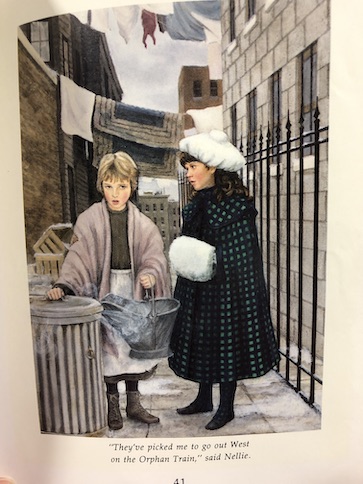
Samantha returns to the orphanage again with her aunt and uncle to visit all three girls, and she and Nellie arrange to meet secretly at the time when Nellie is supposed to take the fireplace ashes out to the alley for disposal. At their next meeting, Samantha finds out that Miss Frouchy took the gloves that they had given Nellie and even punished her for having them because she said that she must have stolen the gloves. However, there is worse to come. Soon, Nellie tells Samantha that she has been chosen to be sent out west on the Orphan Train, but because her sisters are too young to go, they’ll be left in New York alone. With the sisters about to be split up, Samantha’s plan to help the girls run away and hide is looking better.
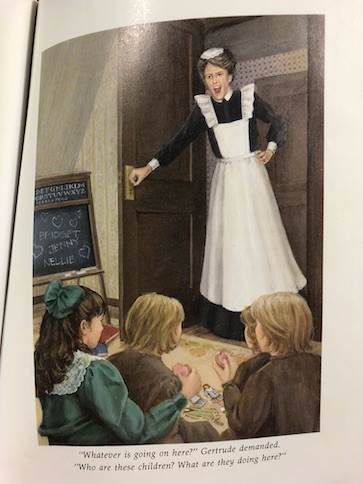
Together, Nellie and Samantha help to sneak the younger girls out of the orphanage, and Samantha hides the three of them in an upstairs room in the aunt and uncle’s house that isn’t being used. She sneaks food and toys upstairs to them, and Nellie sneaks out during the day to go looking for work. However, Gertrude soon gets suspicious about how much food Samantha seems to be eating and how she seems to be sneaking around with it. When the girls are finally caught, Samantha owes her aunt and uncle some explanations, but admitting the truth of what has happened changes things for the better for all of the girls.
In the movie version of the Samantha series, which combined all the stories from the Samantha books into one, the story ends at Christmas, but in the book, it’s Valentine’s Day. The Christmas ending is nice, but Valentine’s Day does make for a nice difference, and love is appropriate to the theme of the story. Uncle Gard and Aunt Cornelia end up adopting Nellie and her sisters, so they officially become part of Samantha’s family. Unlike other characters in the story, who see the orphans as either an inconvenience or a source of cheap labor, Uncle Gard and Aunt Cornelia genuinely love them and want to raise them.
Something that struck me about the book was that both Nellie and Samantha are orphans, but their lives were very different at the beginning of the story because Samantha is from a wealthy family with an uncle who loves her and Nellie is a poor girl with an irresponsible uncle. If Samantha had been poor, she might have been destined for an orphanage or the orphan train herself. Because she wasn’t and because her family looks after children well and is willing to share what they have with others, Samantha has a secure future, and Nellie and her sisters become part of their family.
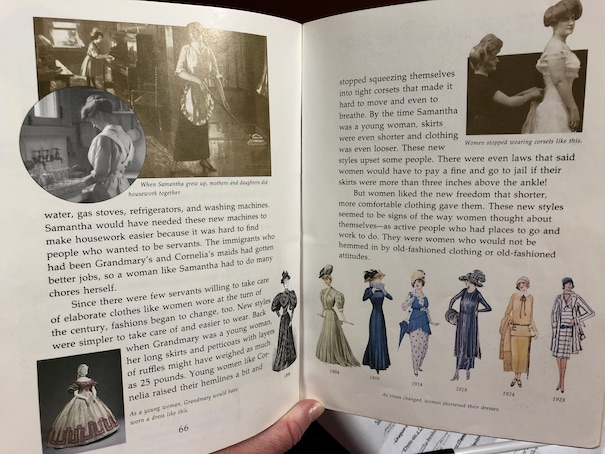
The book ends with a section of historical information about all the changes taking place in Samantha’s time, from technological changes, such as the first airplanes and new cars, to the increasing sizes of cities and new immigrants arriving in the United States.
As girls like Samantha grew up, society continued to change. In earlier books, Samantha’s grandmother talked about how young ladies aren’t supposed to work but learn how to be ladies and take care of a household. By the time Samantha was an adult, in the 1910s and 1920s, it was becoming more common for women to hold others jobs, although they would often stop working when they got married so they could focus on raising their children. The profession of social work evolved to help care for children like Nellie and her sisters. Some social workers also helped immigrants to learn English and train for new jobs when the came to the United States. The book specifically mentions Jane Addams, who founded the settlement house, Hull House.
Change is a major theme of all of the American Girl books, and a girl like Samantha would have seen some drastic changes in the ways that people lived as she got older. Over time, fewer immigrants looked for jobs as domestic servants, and newer forms of household technology, like washing machines, made it easier for housewives to do more of their domestic chores themselves. The section of historical information ends with examples of the changes in styles of women’s clothing through the 1920s, explaining how the changes in clothing styles were part of the changes in the types of lives the women wearing them were leading.
Although the book doesn’t go into these details, I would just like to point out how old Samantha would have been at various points in the 20th century. She was born in 1894, and ten years old in 1904, so that means that she would have been:
23 years old when the US entered World War I in 1917
26 years old when the 19th Amendment granted women’s suffrage in the United States in 1920
30 years old in 1924 (Jazz age and Prohibition)
35 years old when the stock market crashed in 1929, the beginning of the Great Depression
47 years old in 1941, when the attack on Pearl Harbor occurred, and the US entered World War II, and 50 years old in 1944, when the Molly, An American Girl series takes place.
In her 50s during the early days of the Cold War. She would have to live to be 95 to see the end of it.
In her 60s through her early 70s during the Civil Rights Movement.
I like to think about these things because it puts history in perspective, and it gives us some sense of what Samantha’s future life might have been like. When she was a young woman, she may have joined the women’s suffrage movement with her Aunt Cornelia. She probably knew young men her age who went to fight in World War I. (Eddie, the annoying boy who lived next door to Samantha’s grandmother, would have been old enough to fight and may have been a WWI soldier himself.) Perhaps, Samantha’s future husband was a soldier. When she was older, Samantha could have either joined the temperance movement behind Prohibition or visited a speakeasy or at least knew people who did. It’s difficult to say what happened to Samantha’s family during the Great Depression. Depending on their professions and what they may have invested their money in, they may have lost their fortunes in the stock market crash, or they may have ridden out the whole thing in relative comfort. By World War II, Samantha may have had a son who was old enough to fight. One of the things I find interesting about historical novels with children is imagining what their future lives may have been like, and Samantha was born at a time when she would have witnessed many major events throughout her future life. The book shows how women’s fashions changed as Samantha grew up, but I’m fascinated by the events in Samantha’s life that I know must be coming, just because of when she was born. By the end of her life, the world would be a very different place from what she knew when she was young.
The book is available to borrow for free online through Internet Archive.
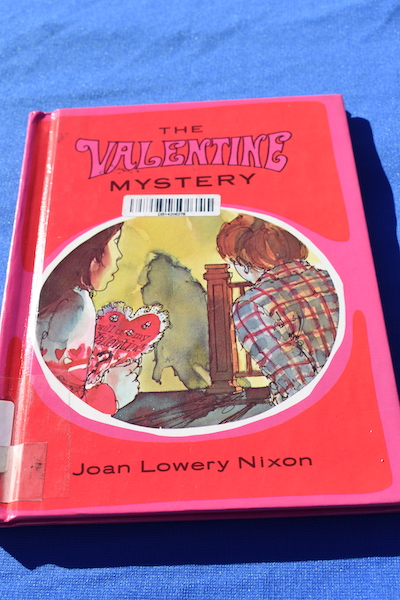
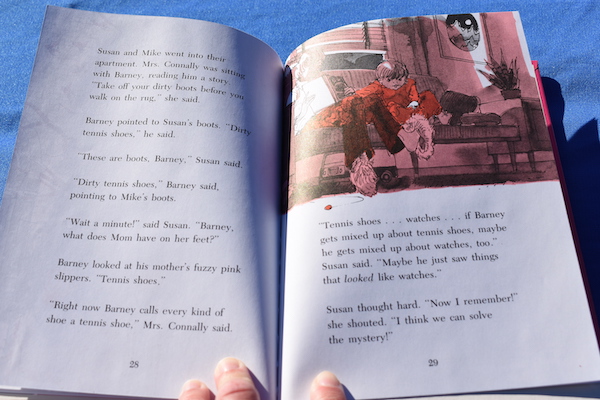
Someone leaves a mysterious, unsigned valentine for Susan Connally at her apartment on Valentine’s Day. Even though everyone was home at the time that the valentine was delivered, the only person who saw the person who brought it was Susan’s little, two-year-old brother, Barney. All Barney can say about this person is that “He had watches on his tennis shoes.”
Susan
and her other brother, Mike, decide to ask some of the other people who live in
their apartment building if they know anything about the valentine or a strange
person who wears watches on his shoes.
Nobody knows a person who wears watches on their shoes. Most people aren’t even wearing tennis shoes. They’re wearing boots because it’s snowing outside. The questions the kids are asking about people with watches on their tennis shoes sound so strange that one of their neighbors, Mrs. Pickett, thinks that the kids are trying to find the solution to a riddle and keeps guessing things like “a spotted dinosaur who has time on his hands?” (Mrs. Pickett is one of my favorite characters in this book. All of her solutions involve a spotted dinosaur, for some reason.)
There is a boy named Pete who lives in their apartment building. His family has only moved there recently, and he’s in Susan’s class at school. Susan thinks it would be nice if the valentine turned out to be from him, but he’s not wearing tennis shoes or watches. He’s also wearing boots with round buckles on them.
The breakthrough comes when the kids discover that their little brother is going through a phase where he calls all kinds of shoes “tennis shoes.”
The book is available to borrow and read for free online through Internet Archive.
I read this book when I was a kid and then spent years trying to remember what book involved a kid who thought someone had watches on his tennis shoes before I found it again. It’s a cute, fun Valentine’s Day mystery story, and I love all of Mrs. Pickett’s guesses about who would wear watches on their tennis shoes.
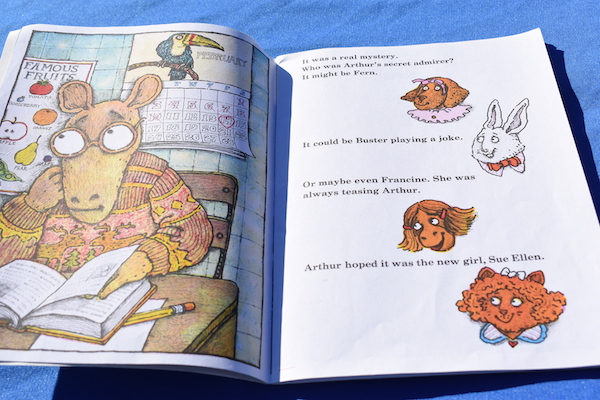
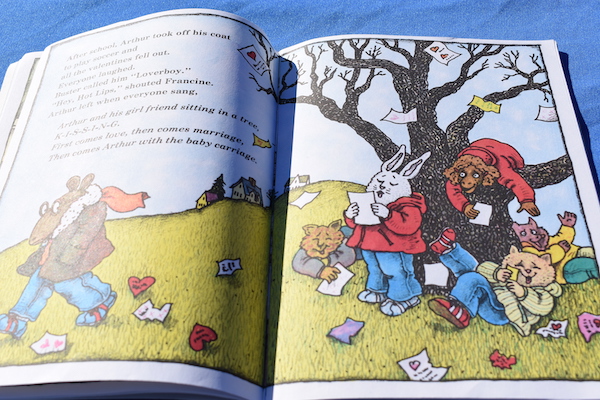
During the week before Valentine’s Day, someone keeps leaving unsigned valentines for Arthur. He wonders who it is, thinking about the different girls in his class at school. On the other hand, maybe someone is just playing a joke on him.
When his friends find out about his secret admirer, Arthur gets a lot of teasing. At one point, he thinks that he knows who the secret admirer is, but when he writes a valentine of his own for her, it turns out that he’s wrong, and it leads to more embarrassment.
However, Valentine’s Day isn’t over yet. Arthur’s secret admirer gives him a movie ticket, saying that she’ll meet him at the theater. With this last message, Arthur realizes who is secret admirer is and arranges a surprise of his own.
#6 The Valentine Star by Patricia Reilly Giff, 1985.
Emily Arrow and Sherri Dent have been fighting ever since Emily refused to play a game with Sherri at recess. It wasn’t because Emily didn’t like Sherri. She was just having too much fun running around with her toy unicorn, Uni. But, Emily made the mistake of running up on top of that huge snow pile near the school fence, the one that the kids aren’t supposed to play on. Then, Sherri told on her to Ms. Rooney. After that, it becomes a game of tit-for-tat, each of the girls telling on the other for little things. While Emily is acting as room monitor while Ms. Rooney is out of the room, Sherri gets out of her seat to get a book instead of doing her work, so Emily writes her name down and tells Ms. Rooney. Sherri promises that she’ll get even.
Around the same time, Ms. Rooney’s room gets a new student teacher, Ms. Vincent. Ms. Vincent is very pretty and nice, and Emily likes her immediately. The kids are making rhyming Valentine’s Day cards for each other because Valentine’s Day is just a few days away, and Emily wants to give a special one to Ms. Vincent.
But then, Emily and “Beast” (Richard Best) make a serious mistake. It was hot inside at lunch, and they couldn’t resist the urge to run outside in the snow for just a couple of minutes without their coats. Then, they got locked out and had to get Beast’s sister to let them in a different door. They thought no one saw them, but a neighbor did and contacted the school. Now, Emily is afraid of what will happen if their teacher finds out that it was her and Beast. Will the school be angry enough to hold them both back a grade or maybe worse? Maybe Emily will be spending Valentine’s Day in the school office instead of at the party, watching Ms. Vincent enjoy her special valentine . . . especially if Sherri happens to know what they did.
Many of the The Kids of the Polk Street School books are about the little problems that kids get into but that seem big because they’re young and inexperienced. Ms. Vincent’s kindness and understanding help Emily and Sherri to work out their differences, and a President’s Day lesson about the honesty of both Lincoln and Washington help Emily and Beast to realize that tattling on yourself makes you a better person than tattling on others.
The book is available to borrow and read for free online through Internet Archive (multiple copies).
This book is part of the Aviva Granger Stories series. (It’s the only one I have in the series right now.)
In the last book, Aviva’s best friend, Josh, came to live with her, her mother, and her step-father. Josh was living in an orphanage before that, and since he and Aviva were close, her mother and stepfather thought that it would be natural to invite him to be part of the family. At the time, Aviva thought that it was a good idea, but being friends with someone doesn’t mean that it will be easy living with them, and Aviva’s family life is already complicated!
Aviva’s parents are divorced, and both her mother and father are already in new relationships. Her mother has remarried, and Aviva not only has a stepfather but a half-sister (college age) and half-brother (baby) living in the same house. Aviva’s father has a girlfriend, Miriam, and Aviva doesn’t get along well with her. Miriam would like it if she and Aviva’s father had a child of their own.
When Josh comes to live with Aviva’s mother and her family, Aviva realizes that sharing a family and house with him makes things even more complicated. He takes too long in the bathroom and makes her late to school. He’s one more person for her mother to pay attention to, so Aviva gets less attention. Even her dog seems to like Josh better now!
Then, shortly after Valentine’s Day, Aviva overhears Josh and his friend Ronnie Cioffi talking about girls and giving them ratings based on their looks. Out of 10 points, Cioffi rates Aviva as a 2, and Josh agrees. Josh has a crush on Louise, a girl they know from school, and she has a much better figure.
It isn’t that Aviva is in love with Josh, who she sees more as a friend/brother, but it hurts that he seems to be taking her place in the family and doesn’t even really appreciate her, joining in with his friend in making fun of her body. With her time divided between two households, two parents who hardly seem to have time for her these days, and Josh moving in and taking over, Aviva worries that maybe she doesn’t really belong anywhere or to anybody.
It takes a night when Aviva sleeps out in the barn without telling anyone where she is to make the people closest to her realize how much she needs them. A sleepover at Louise’s house (where the girls candidly discuss their own ratings for the boys they know) and Aviva’s anonymous question in sex ed class also help to put the rating system into perspective for all the kids.
The book has some Christian themes because the children go to a Catholic school, although this book mostly focuses on family life and girls’ and boys’ perceptions of each other. The kids are eighth graders, and there is also some talk about sex ed.


















 #6 The Valentine Star by Patricia Reilly Giff, 1985.
 But then, Emily and “Beast” (Richard Best) make a serious mistake. It was hot inside at lunch, and they couldn’t resist the urge to run outside in the snow for just a couple of minutes without their coats. Then, they got locked out and had to get Beast’s sister to let them in a different door. They thought no one saw them, but a neighbor did and contacted the school. Now, Emily is afraid of what will happen if their teacher finds out that it was her and Beast. Will the school be angry enough to hold them both back a grade or maybe worse? Maybe Emily will be spending Valentine’s Day in the school office instead of at the party, watching Ms. Vincent enjoy her special valentine . . . especially if Sherri happens to know what they did.
 Valentine Blues by Jeanne Betancourt, 1990.
 Jestress's Forgotten Books and Stories