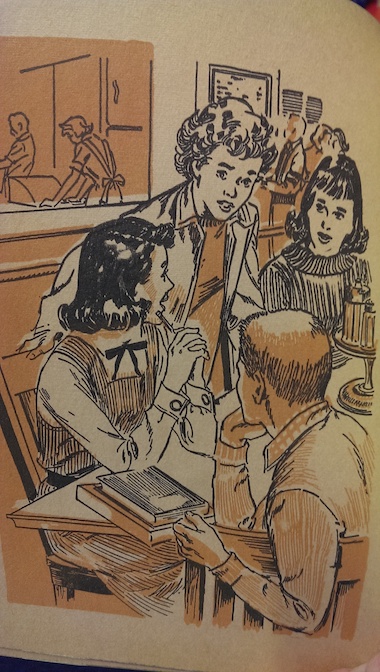
The Mystery of the Haunted Lighthouse

Three Cousins Detective Club

Sarah-Jane’s parents have been planning a trip, and her cousins, Titus and Timothy are coming, too. At the request of an old family friend, Ned, they are going to visit him and take a look at an old lighthouse that he is thinking of buying. He wants to turn the lighthouse into a bed and breakfast.

However, strange things have started happening at the lighthouse. Someone has vandalized the outside, and Sarah-Jane sees a frightening face up in the tower. Could the old lighthouse be haunted?

The theme of the story is faithfulness.

The book is available to borrow and read for free online through Internet Archive.

Since this is a Christian-themed mystery, readers can guess that there won’t be any real ghosts. This is more of a light, pseudo-ghost story, like Scooby-Doo mysteries, with another explanation for what’s happening.

There’s more than one kind of haunting. People can be haunted by memories, and living humans are also attached to the places associated with their happy memories. There is someone who has an attachment to the lighthouse and is unhappy that it’s being sold. This person needs to reconcile their feelings to the situation.

Some Christians don’t like the concept of ghost stories at all. In the book, Sarah-Jane likes hearing ghost stories, although she admits that she doesn’t like remembering them later, when she’s alone at night. She enjoys a little spooky excitement, as long as she knows it’s just a story, and she’s hearing it in a safe setting.

Mystery of the Secret Dolls

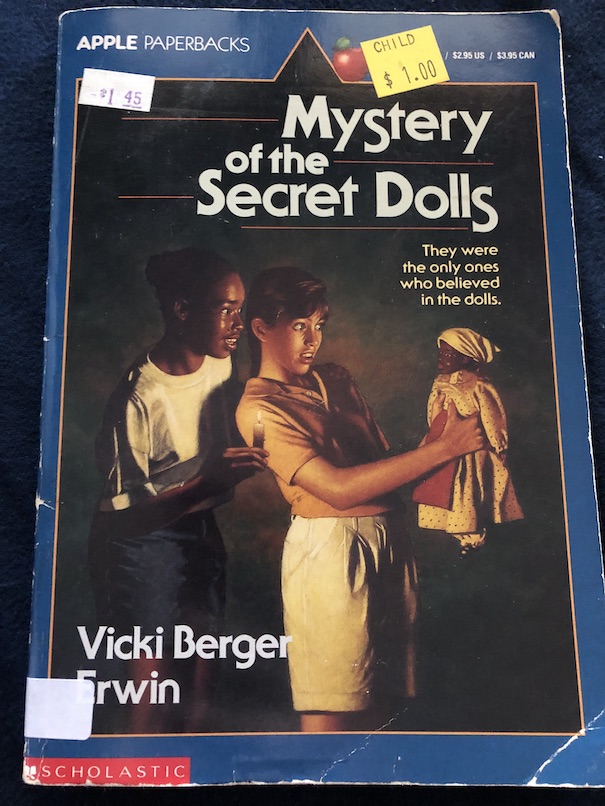
Mystery of the Secret Dolls Cover

Mystery of the Secret Dolls by Vicki Berger Erwin, 1993.

Bonnie Scott is visiting her great-aunts, Nell and Mollie, in Callaway County over the summer. Aunt Nell invited her to come and help set up her new doll museum, but Bonnie also wants to take advantage of the trip to work on a project about family history. Aunt Mollie has a restaurant, and Bonnie wants to talk to her about old family recipes that she uses and make a book about them. Unfortunately, when Bonnie arrives in her aunts’ town, she learns that Aunt Mollie has closed her restaurant and is helping Aunt Nell with her doll museum. From Bonnie’s awkward arrival, when no one comes to meet her at the bus stop and Marc, the grandson of the local doctor, Dr. Allen, has to help her find her way to her aunts’ house, she begins to see that things aren’t quite what she thought they were in her family and in her aunts’ town.

The reason why no one came to meet Bonnie is that Aunt Nell accidentally injured herself when she fell off a table she was standing on in order to change a light bulb. She broke her leg and had to go to the doctor. Now that Aunt Nell is in a wheelchair, she says that she will especially need Bonnie’s help, although Aunt Nell and Aunt Mollie also have a young black girl, Lynette Key, staying with them and helping out. Lynette is the daughter of an old family friend, and her family’s history is intertwined with Bonnie’s family. Through her aunts and Lynette, Bonnie comes to understand a little more about her family’s history with dolls and the relationship between Aunt Nell and Aunt Mollie.

Aunt Nell is the older of the two sisters, and she’s been bossing Aunt Mollie around for years, and she’s apparently the one who convinced Mollie to close her restaurant and help her with the doll museum project. The old family home belongs to both of them, although Mollie lived in another house while her husband was still alive. Now that both women are childless widows and Mollie has moved back into the family home, Nell has gone back to her old ways of bossing Mollie around. Bonnie is alarmed when Mollie reveals that there has been a break-in, vandalism, and a fire, apparently deliberate, at the museum, and she thinks that Nell should put off the opening, but Nell is trying to ignore the situation and charge ahead with the project, dragging Mollie and Bonnie with her. The aunts are going to have a security system installed at the museum.

Aunt Nell says their family, the Scotts, have made dolls for about 150 years. She shows Bonnie her doll collection, including the portrait dolls, startlingly realistic dolls made of every member of their family, including Bonnie’s ancestors, like her great-great-great-grandfather who fought for the Confederacy during the Civil War. Aunt Nell apparently strongly identifies with the South and Confederacy because she keeps trying to blame the troubles at the museum on “some Yankee.” Not in a specific sense and not necessarily with any particular person in mind (although there is one person who is also labeled as a Yankee who is a suspect for awhile), it’s more that she just generally associates Yankees with bad stuff, and she says that she hopes that Bonnie hasn’t turned into a Yankee from living in a big city like St. Louis. Although the dolls belong to both of the sisters, Aunt Nell really thinks of the dolls as being hers, and she’s determined to make Bonnie’s family history project about the dolls, whether Bonnie wants it to be or not. Aunt Nell says that Lynette’s grandmother used to work for her, making dolls, and she’s pleased that Lynette shares her interest in dolls, but Lynette privately tells Bonnie that the situation goes deeper than that.

As you might have guessed, Aunt Nell’s mental version of history, including the history of her own family, isn’t entirely accurate. Marc lends Bonnie a history book about the area written by his grandfather, but Lynette tells Bonnie not to let Aunt Nell see it because she and Dr. Allen have very different views about history, and Dr. Allen is a “Yankee.” Bonnie asks her what she means by that, and Lynette says that the Scotts have never gotten over being on the losing side of the Civil War. Dr. Allen, by contrast, believes that the Civil War turned out just fine with the South losing, which makes him a Yankee. It matters because Aunt Nell’s interpretation and attitude toward the past is affecting life in the present.

Although Aunt Nell is mentally on the side of the Confederacy, she doesn’t say anything in support of the idea of slavery and doesn’t seem to have bad feelings about Lynette being black. Nell is actually very fond of Lynette, treating her almost like a young niece, and I suspect that Nell probably mentally replaces the word “slave” with “servant” in her head, as some of the other characters in the book do until Lynette reminds them that there’s a difference and it matters. Nell’s attachment to her family’s grand history (which may not be quite what she makes it out to be) and her feeling that the doll-making business must pass to a blood relative keep her from fully seeing the potential that Lynette has to continue the doll-making traditions that their families both share, something that Lynette really wants to do.

Lynette says that women in her family have worked for the Scott women for generations, making dolls. They were originally slaves belonging to the Scott family, and they even shared the same last name because slaves were sometimes given the surnames of their masters. (In my home town, I’ve met black people with the surname White, which might seem a little odd and contradictory, but this is the probable reason why they have that last name.) Some slaves changed their last names after Emancipation, but not all. Lynette says that even after her ancestors were freed from slavery, one of her ancestors, Rosa, chose to keep the last name Scott because of her connection to the doll-making business.

Lynette points out a section in Dr. Allen’s history book about the Scott dolls having a connection to the Underground Railroad because some of them seemed to have been used as signals for escaping slaves. Margaret Scott, an ancestor of Bonnie’s, used to make black dolls, each with a distinctive little red heart sewn on the chest, and after she made one, a slave would mysteriously disappear. She eventually had to stop doing it because people in the area were getting suspicious of her and put pressure on her to stop. In fact, Lynette says Margaret’s own father, the Confederate colonel, tried forced her to stop, saying that he’d close down her doll-making business if she didn’t, but that Margaret and Rosa actually continued making the black dolls in secret, something that Aunt Nell doesn’t believe. The history book notes that the dolls are rare and valuable collectors’ items. Lynette says that Aunt Nell only has one of these black dolls, and she keeps it locked up for safe-keeping, denying that there even are others, but Lynette is sure that there are more, possibly hidden somewhere. Lynette wants to find these dolls, not only because they are valuable but because they can help prove her family’s connection to the Scott doll-making business. Lynette says that her ancestors never got the credit for the beautiful dolls they made because they were only ever slaves or employees of the Scotts, and the entire doll business was in the Scott family name.

Lynette wants to become a doll maker herself, but Aunt Nell really wants Bonnie to take over the family tradition, even though Bonnie has never really been interested in dolls and would prefer to talk cooking and recipes with Aunt Mollie. The realistic dolls portrait dolls actually kind of give Bonnie the creeps, but Lynette has a sentimental attachment to them because she’s been around them all her life, since her grandmother was a doll maker. Once Bonnie understands the history between her family and Lynette’s and Lynette’s doll-making ambitions, she sees why Lynette seemed a little cold to her at their first meeting, but she isn’t interested in learning the doll business or competing with Lynette to be Aunt Nell’s successor. Even though Aunt Nell is bossy and doesn’t understand Lynette’s deep desire to be a doll maker and continue the Scott doll-making business, Lynette kind of likes her and wants to show her that she is just as attached to the doll-making traditions as she is. Lynette and Bonnie make a deal that Lynette will help Bonnie get the recipes she wants from Aunt Mollie if Bonnie will talk to Aunt Nell about the black dolls and try to get more information about them.

Bonnie thinks that hunting for the long-lost dolls sounds exciting. It occurs to her that the valuable dolls might be the reason why someone broke into the doll museum. The aunts’ old house is spooky, right next to a graveyard, and on Bonnie’s first night there, someone leaves Margaret’s portrait doll (which looks a great deal like Bonnie) in Bonnie’s room with a note that says, “Don’t believe everything you hear.” What does the note mean? Who left the doll, and is it connected to the other strange things happening around the doll museum? Is someone trying to scare Bonnie? Are the missing black dolls still somewhere nearby, and can Bonnie and Lynette find them? What is the real truth about the dolls and what happened in Callaway years ago?

The book is available to borrow and read for free online through Internet Archive.

My Reaction and Spoilers

Although this story doesn’t quite deal with racism in the sense of people hating other people because of race, there is a lot in here about the nature of prejudice, on several levels. Aunt Nell has many preconceived notions about her family and how things in her family ought to be. She assumes from the beginning, when Bonnie contacts her aunts to talk about family history, that Bonnie will do her project about the dolls and the family’s doll-making history and that Bonnie will help her with her doll museum and eventually take over the dolls from her. Aunt Nell started out their relationship with a lot of assumptions, and her assumptions about Bonnie have blinded her to the possibility that Lynette could be the successor to the doll-making business and doll museum that she really wants because they share a common love of dolls and skill in making them. Lynette has already started learning the doll-making business, first from her grandmother and then from Nell, because she loves it, and she is willing to work at developing her skills. She has a similar vision to Nell about the doll business and museum, and the two of them get along well, in spite of Aunt Nell’s bossy personality. It’s only Aunt Nell’s narrow vision of family and sense that the doll-making business should pass to family that keep her from considering the possibility at first. Meanwhile, Bonnie and Mollie are both being forced to go along with Nell’s plans because of what Nell thinks they should do as family, while they both have very different interests and would like the freedom to pursue them. Aunt Nell also has been assuming many things about her sister Mollie for years.

Over 100 years earlier, Margaret Scott also belonged to a family that did not share her interests and her vision of the future. Although she used slave labor in building her doll-making business, she and Rosa found a way to use their craft to help escaping slaves. The Scott family took pride in the doll-making business for generations, but there were sides to Margaret and the dolls that they didn’t understand and appreciate. Before the end of the book, Aunt Nell comes to understand that their family has more variety than she had ever considered and that her goals might not be everyone’s goals.

The ending of the story makes sense and is realistic, but I’ll admit that there were a couple of points that I might have clarified or done differently if I had written the ending. Sometimes, when I’m not entirely satisfied by the ending of a book, I like to say what I would have changed about it, but it’s difficult to do that here without giving too much away. Part that I can say is that I wished that Nell and Mollie had thought of more creative ways to combine their separate interests, like how Bonnie’s final family history project ends up being a combination of both – a cookbook of family recipes, illustrated with pictures of the portrait dolls that represent the people who invented or enjoyed the different recipes. In fact, a cookbook of historical recipes with pictures of historical dolls sounds like a book that many people would actually be interested in buying if they published it professionally and even sold copies through the doll museum, and I found myself wishing that one of the characters would mention that before the end of the book.

The story ends with the impression that Lynette will keep working with Nell and the dolls because, while Bonnie says that she’ll come back and visit, she doesn’t have the interest in doll-making that Lynette does, but I also kind of wished that they would clarify more definitely that Lynette would be continuing the doll-making business. The girls are young yet, so maybe they didn’t feel the need to decide their futures definitely, and it’s enough just to show that’s how things are looking at the end of the book. I had half expected that it would turn out that Lynette and Bonnie are actually related because sometimes slave owners did have children with their slaves, and I suspected that one of the Scott family secrets might have been that Rosa was actually a blood relative and that was part of the reason why she was so close to Margaret and why she kept the Scott family name. The story doesn’t bring up that possibility, focusing on a different secret relationship instead, but I’m still keeping it in mind as a private theory. I like the idea because, if it was true, then it would strengthen Lynette’s ties to the doll-making business she loves, and I think that Nell would appreciate the idea of bringing her more fully into the business as a relative. But, perhaps it’s enough that they just both share the same interest in life
The Mysterious Code

Trixie Belden

TBMysteriousCode

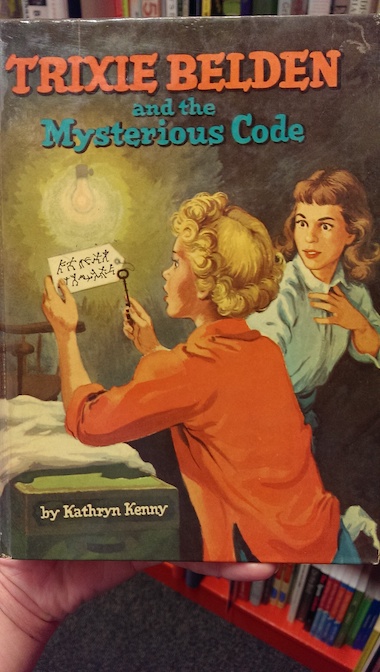
#7 The Mysterious Code by Kathryn Kenny, 1961.

TBMysteriousCodeBobWhites

The title is a little misleading because the code is really only a mystery for a small part of the book.

When the story begins, the existence of the Bob-Whites is threatened because there has been some vandalism at the school and there are fears of gang activity in the area. The school board is considering outlawing all clubs that are not directly supervised by the school and do not serve a specific purpose.

The Bob-Whites explain to their principal that they are a club that supports benevolent causes, but the principal says that they must demonstrate that they support something specific. Trixie suggests to the others that they raise money for UNICEF because it is a good cause and something that the school board would approve of. The Bob-Whites decide that they will hold an antique show to raise money, and they get people to donate items for them to exhibit and sell.  Honey’s mother says that they can have some things that were left in their attic by the former owner of the Manor House.

TBMysteriousCodeSwordIn the attic, Trixie finds a key with a tag on it. The tag is covered with a bunch of little stick figures, which turns out to be a form of code (one that fans of Sherlock Holmes would be likely to recognize). The key opens a box hidden in the attic, which contains a treasure that will raise a considerable sum of money for their cause. However, there is more mystery to come.

While Trixie and her little brother are on their way home from picking up an antique lap desk from a neighbor, they are attacked by three robbers, who steal the desk. A set of samurai swords is also stolen from the Bob-Whites, and someone attempts to burn their clubhouse. Can they find the criminals and recover the missing antiques, or will their antique show be ruined?

Detectives in Togas

detectivestogasDetectives in Togas by Henry Winterfeld, 1956.
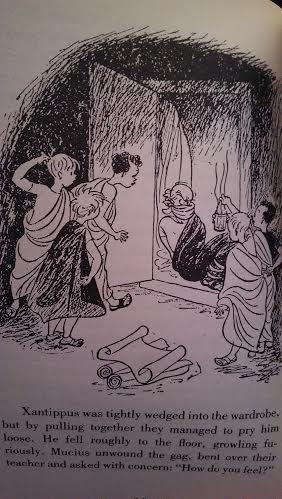
Seven Roman boys, all the sons of wealthy families, attend the school run by the Greek mathematician and scholar, Xanthos. Although the boys are proud of their school, the lessons are sometimes boring, and everyone has given Xanthos the nickname Xantippus, in reference to the wife of Socrates, who was known for her nagging.

During a rather boring lesson on Greek vocabulary, a fight breaks out between two of the students that ends up creating a strange mystery for all of them. Caius was poking Rufus with his stylus, so Rufus wrote “Caius is a dumbbell” on the wax tablet where he was supposed to write his lesson. The boys get into a fight, and when Xantippus breaks it up, he sends Rufus home with the threat that he will expel him from the school.

detectivestogaspicThe next day, when the other boys arrive at school, they discover that their teacher has been attacked and robbed during the night. Worse still, when they go to Rufus’s house to visit him, they learn that someone has written “Caius is a dumbbell” on the side of the Temple of Minerva, which has been dedicated to the emperor. Defacing a temple is a crime, and soon Rufus is arrested and sent to prison (being young and part of an important family does not guarantee him special treatment). Rufus swears that he was not the one who defaced the temple, but who else could have done it?

Rufus disappeared that night, but if he didn’t go to the temple, where was he? Does the vandalism have anything to do with the attack on their teacher?  The key to the mystery seems to be a mysterious soothsayer with ties to some of the highest officials in Rome. Something sinister is happening in Rome, and the boys are the only ones who can discover what it is!

This story was inspired by a piece of graffiti found during excavations of Pompeii in 1936. (This video doesn’t actually show the Caius inscription but similar types of graffiti, including ones done by children. I keep looking for the Caius graffiti, but I can’t find pictures of it. This video of a lecture at the Western Australian Museum about ancient graffiti in Pompeii shows the more graphic adult kind of graffiti with swear words, if you’re interested.) In ancient Pompeii, someone wrote “CAIUS ASINUS EST” on the wall of a temple, which basically means “Cauis is a dumbbell” (or similar type of insult) in Latin.

Although the book was originally from 1956, it was also originally written in German. I have a later reprinting that was translated into English.  The book is available to borrow and read for free online through Internet Archive.  There is a sequel called Mystery of the Roman Ransom.

The Vandemark Mummy

The Vandemark MummyThe Vandemark Mummy by Cynthia Voigt, 1991.

The Vandemark Mummy is an exciting mystery with believable characters. The story includes a bit of history about Ancient Egypt and side plots about the complications of family life, the role of women in society, and the nature of ambition.

Twelve-year-old Phineas Hall and his fifteen-year-old sister, Althea, have recently moved to Maine with their father, Professor Hall, because he got a job working at the small Vandemark College. Moving and starting over in a new place is never easy, but the move is more difficult for the kids because their mother didn’t come with them. Their mother is an ambitious, career-oriented feminist, and when she was offered an important job working for a congressman in Oregon, she could not bring herself to turn it down in order to go to Maine with the rest of the family.

Although the entire family talked the situation over, and everyone agreed to the current arrangements, no one is really happy about it. Althea particularly feels hurt. Even though she has shared her mother’s feminist ideals, she’s hurt by her mother’s apparent selfishness and the seeming ease with which she abandoned the family. Althea believes that her mother should have compromised on her career this time because her husband has made compromises for her in the past. To make herself feel better, Althea spends her time studying one of the oldest feminists, the Greek poet Sappho. Phineas, on the other hand, is just trying to be a normal kid and fight off boredom while waiting for the summer to end and school to start. But, boredom is the last thing on Phineas’s mind when the mummy arrives at the college.

The wealthy patriarch of the Vandemark family dies and leaves his collection of Egyptian antiquities (one of many collections he had) to the college, including a real mummy. The Vandemark family is a little disappointed because they had hoped that the collection might go to a much more prestigious institution, even though Vandemark College is named for their family. To the joy of the Hall family, Professor Hall is put in charge of the collection, which will be put on display in a new addition to the college library. Professor Hall lets Phineas and Althea go through the collection with him and another professor, Ken Simard. Although at first the collection does not seem to be particularly valuable, except for the unusually good condition of the mummy and the funeral wreath, it seems to be a lot more valuable to someone. After a failed attempt to break into the collection, someone later manages to steal the mummy. Then, Althea suddenly disappears. The adults suspect that Althea might have run away because of the troubles in their family, but Phineas knows better and begins a desperate hunt to find his sister.

One of the best things about the book is that it really takes both kids to unravel the entire mystery: Phineas for his persistence and decisive action and Althea for her more mature understanding of the thief’s motives. Although, even at the end, their family’s situation isn’t completely resolved, the kids’ experiences give them a new perspective on things. It would be a great book for middle schoolers.

The book is available to borrow and read for free online through Internet Archive (multiple copies).

Themes and Spoilers

I debated about saying more because I didn’t want to spoil the story too much, but after thinking it over, I can’t give my full opinion of it in this review without talking a little more about what Althea and Phineas learned from their situation.  If you’d rather not know more detail, you can skip the rest of this.

On the one hand, I was a little disappointed at the lack of complete resolution to the family’s troubles because, by the end of the book, I really cared about the characters and wanted to know what would happen to them, but I think the author purposely left the story open at the end so readers could imagine for themselves what the characters are going to do next.  However, there is one thing that is pretty well established at the end of the story: whatever happens to their parents, whether their separation is temporary, as they’d originally planned, or whether they end up divorcing, Althea and Phineas are going to be okay because they still have each other, their father, and their new friends in their new town.

In the beginning, their mother’s absence is worrying because they will now have to cope without her, and they don’t know what is going to happen to their family in the long run.  But, part of the children’s self-sufficiency actually does come from their mother and things that she taught them, whether she is with them or not.  The book does mention little things they learned from their mother.  It’s subtle, but she’s still with them because of the influence she’s had in their lives.  The kids also develop more of an appreciation for their own resources and abilities, which makes them less fearful.  One of Althea’s early characteristics was a long-standing fear of the dark.  After her ordeals, her father and brother expected her fear to be worse, but she tells them that she is actually less afraid now than she was before because she has learned something about circumstances she can control and ones she can’t.  She says, “I think, there’s a difference between being scared and not knowing how you’ll do, and being scared but knowing you’ll do okay.”  As she notes, if she goes to bed at home with the lights off and decides that she really can’t stand it, she can always get up and turn them on again.  She has realized that she has control in her daily life and actions she can take to make things better, which she didn’t have during parts of their adventure.  It gives her confidence.

The kids also learn lessons about the nature of ambition and about their own feelings.  In the beginning, Althea is more vocal about how she feels about her parents’ separation.  She feels betrayed because, although she learned her sense of idealism from her mother and thought that they shared the same views, her mother has now done something which she views as a selfish act, rejecting her family and her family’s needs solely in the name of her personal ambitions.  Phineas, on the other hand, doesn’t seem to know what to feel or is afraid to show his true feelings at first, just trying to keep busy so he doesn’t have to think about it too much because he thinks that his parents’ marriage is only their business.

At the end, the two alter their positions somewhat, coming a little more into agreement with each other.  Althea has the chance to contrast her parents’ marriage and ambitions with that of the villain’s (without naming names), and she sees the difference in the way each of them responds to the same pressures.  Although her father may have been hurt by his wife’s reluctance to make sacrifices in her ambitions for the sake of his and her preference for separation over compromise, he still genuinely cares about her and understands her ideals and what she really wants to achieve.  The fact that it’s only a separation, not a divorce, is a sign that the parents still care about each other and respect each other and hope that they will be able to reconcile eventually.  The villain doesn’t have those feelings, and unlike either of Althea and Phineas’s parents, really is motivated solely by selfish ambition.

Ambitions often require sacrifice in order to achieve them.  Revealing exactly what the villain sacrificed would say too much, but this person does end up losing pretty much everything in the end.  For the sake of her ambitions, Althea’s mother sacrificed her place in the family.  Although she thought that it would only be temporary, the hurt she caused her family members will probably have longer-lasting effects. When she calls them to find out what’s been happening, she learns what she’s been missing and the ordeals her children have faced without her, which leave her feeling both worried and left out, feelings that her husband understands and explains to the children (“One of the things she knew, without knowing how it would feel, is that we’d be able to get along fine without her.”), which shows that he is still in tune with his wife’s feelings.  Toward the end of the story, she is upset and seems hurt that Althea is too tired and busy talking to the police to talk to her much other than to briefly reassure her that she is now safe.  At that point, Althea needs her mother’s comfort less than her mother needs reassurance from her.  Althea feels a little bad about not being able to soothe her mother’s feelings because she is no longer as hurt and angry with her as she was before, but Phineas tells her not to worry if their mother’s feelings are hurt right now because she owes her daughter some hurt feelings.  In other words, Phineas has finally learned that it’s okay for him to have feelings and an opinion about the things happening in his family and to show them.  He recognizes how hurt and confused his sister was at their mother’s apparent betrayal, and he has decided that it’s okay for their mother to see that hurt and feel a little of it herself so that she will understand what’s really happening and what her children are really going through. They have coped without her, but the fact remains that she wasn’t there for her family during their time of crisis.

You’ve probably noticed that I’ve been focusing more on the mother’s ambitions and questioning her motives more than the father’s in the story.  That’s partly because that is the focus of the story.  The children do not see their father as abandoning the family for the sake of ambition because he didn’t.  They make it clear that he has supported his wife’s ambitions in the past, often at the expense of his own.  He mentions that the attraction of this new position that he has accepted is that it’s “the first job in fifteen years that I’m not over-qualified for, and I plan to enjoy it . . .”  He is primarily a scholar and has felt under-challenged intellectually.  Because he’s an academic, his schedule is more in sync with the children’s school schedule, which is why both of the children chose to go with him rather than with their mother.  He also makes time for his children and even involves them in his work when possible, supporting Althea’s interests in history and philosophy, which he shares.

At one point, Althea says to her father, “You and Mom don’t have exactly the same set of values, you know.”  The mother of the family is more concerned with money, climbing the occupational ladder, and achieving higher positions, higher salaries, and more influence.  She sees these things as ways of furthering the cause of feminism, and often works long hours away from her family for her jobs. In the past, she has used the fact that she earns higher salaries than her husband to convince him and the rest for the family to make accommodations for the sake of her jobs.  Althea says that her mother’s arguments aren’t honest and that her lack of support for her husband’s career as well as her own are a betrayal of the “equality” that she supposedly believes in.  It isn’t that Althea is completely opposed to her mother’s ambitions so much as she disapproves of the way her mother goes about achieving them. Her mother is apparently more concerned with status than the intellectualism that her daughter and husband crave.  Much of the conflict in their values comes down to what they think they need to feel fulfilled in their lives.  Because the characters seem to need different things, they are having trouble living a shared family life.  That’s the situation for the Hall family, as the book describes it.

In the end, this book is bound to spark a lot of opinions and discussions about the characters and their views and much speculation about what will happen next for the Hall family.  Will one or both of the parents change their view of the situation, just as Althea and Phineas have?  Will the mother, who admits that the job she took wasn’t what she had expected it to be, decide to quit and rejoin her family?  If she does, what will her role in the family be now that Althea and Phineas have become more independent than they once were?  Another character, who I haven’t mentioned before, is a female reporter in their new town who befriends the family and helps them through their ordeals in the mother’s absence.  In some ways, her values seem more in tune with the father’s than the mother’s are.  Is it possible that she could be the children’s eventual stepmother if the parents separate permanently?  Or will she only ever be just a supportive family friend?  Families in real life experience changes like these as children grow older and begin to forge their own identities and values in the face of changes in their lives, reevaluating their parents’ decisions and making ones for themselves.

Mystery at Camp Triumph

camptriumphMystery at Camp Triumph by Mary Blount Christian, 1986.

A year ago, sixteen-year-old Angie was blinded in a car accident.  It was shocking and devastating for her, especially since she was planning to become an artist.  She loved painting, and she feels like all of her dreams have died since she became blind.  Many of her friends no longer speak to her (partly because she has become angry and bitter and they don’t know how to cope with it), and she refuses to return to her old school, partly because of her fears of not being able to cope and largely because she doesn’t want to be the subject of ridicule or pity because of her new disability.  Her mother has been tutoring her at home, and her parents argue frequently about what’s best for her.

On the advice of a psychologist who has been trying to help Angie during her difficult adjustment, Angie’s parents have decided to send her to a special camp for children with disabilities called Camp Triumph.  Angie makes it plain that doesn’t want to go.  She feels that going to the camp with other disabled kids will just a painful reminder that she’s no longer “normal”, and she can’t imagine that there will be anything fun that she can do at a camp now that she can no longer see.  She knows that she’ll never be able to paint again, so she thinks arts and crafts are out, and how can she possibly ride a horse or go on nature walks?  However, her parents are firm with her, telling her that this is for the best.  There are things Angie needs to learn that they can teach her at camp.

Angie’s first days at the camp are miserable.  The other campers try to make friends with her, although she tries their patience with her bitterness and complaining that she doesn’t want to be there.  Then, someone messes with the guide ropes put up to help the blind children find their way around, sending a frightened Angie plunging into the river on her way back to her cabin.  Although she isn’t hurt, she becomes convinced that the camp is dangerous.  Everyone else thinks it was just a mean-spirited prank by one of the other campers.

Then, while visiting the doctor in town, Angie overhears a conversation between people she whose voices she doesn’t recognize, learning that what happened to her wasn’t just a prank.  Someone is deliberately committing acts of vandalism and sabotage at the camp, trying to get it shut down.  But why?   Angie flees the scene when she realizes that the people who were talking have heard her.  Unfortunately, she drops her cane as she flees.  Her cane has her name and address on it, and Angie later finds it lying on her bed in her cabin at camp.  Whoever these mysterious people are, they know who she is and can find her at any time.  Can Angie convince the other campers of what she heard and find the culprits before something worse happens?

Angie is terrified as she tries to solve the mystery, feeling helpless against her unknown enemies, who can see her while she can’t see them.  But, with the help of her new friends at camp, she comes to realize that she isn’t as helpless as she thinks she is.  Her experiences give her a new perspective on her life.  It’s true that things will never go back to being as they were.  Her life won’t be an easy one, and there are certain things that she can no longer do.  But, she comes to realize that there are still many things she can do, and there are other types of art that are still open to her.  In the end, Angie has friends she can count on, a life that’s worth living, and a better future ahead of her than she thinks.

Along with the story, the book describes some of the techniques that Angie has to learn to cope with her blindness: picturing a “clock” to remember the positions of objects around her (ex. “Your suitcase is at two o’clock.”), following the guide ropes with notches in them to know which path she’s on, listening for clues about her surroundings (she and other blind people recognize the sound of clinking from the flagpole at the center of camp and use that to orient themselves when things get confusing), putting notches in the tags of her clothes so that she knows which pieces of clothing match, using her sense of touch to make clay sculptures, etc.

Besides addressing Angie’s feelings and how she copes with them, the story also touches on how disabilities affect the people who are close to the disabled person.  At first, Angie’s parents don’t know how to help her, struggling themselves with coming to terms with what’s happened.  Her mother feels guilty because she was driving the car when they had their accident, and she wasn’t as badly hurt.  Her guilt leads her to baby Angie more than is good for her.  Angie’s father is a stern businessman with high ambitions, failing at first to understand and accept Angie’s feelings and the way her life has changed, reacting with impatience while Angie struggles.  Angie’s parents also had marital problems before the accident, which only added to the tension between them.  In the end, coming to terms with what has happened to Angie not only helps Angie to improve but helps her parents to improve their relationship with each other.

The book is currently available online through Internet Archive.

The Case of the Haunted Health Club

HauntedHealthClubThe Case of the Haunted Health Club by Carol Farley, 1991.

This is the third and last book in the Flee Jay and Clarice Mysteries.

The story begins with Flee Jay talking about how she fell in love with mystery stories when she was younger after she found a mystery for adults that had accidentally been shelved in the children’s section of the library.  Although the book was about a murder where the body was hidden inside a snow man and was really too scary for a girl her age, she was captivated by it, wondering what was going to happen next.  It was a shame that the librarian caught her reading it, so she never got to find out how it ended.  But, it does inspire her to find part of the solution to this mystery, a part that stumps even Clarice.

The mystery that confronts Flee Jay and Clarice this time concerns a fortune teller and her nephew.  The fortune teller used to live in their town, and the girls’ parents even went to her to have their fortunes told when they were teenagers.  Now, she’s returned along with her nephew in order to revive the health club that her late husband owned when they were living in this town.  When the girls go by the health club to take a look at it, they find the fortune teller unconscious on the floor.  She says that there must have been something in the tea she was drinking and that “the spirits” have been trying to convince her not to get involved with the health club.

HauntedHealthClubPicFlee Jay thinks this is spooky, but Clarice doesn’t believe in spirits.  In order to investigate further, the two girls accept part time jobs helping the fortune teller and her nephew to clean up the building so they can move in new exercise equipment.  “The spirits” continue sending warnings in the form of red dye in the Jacuzzi and threatening messages.  Clever Clarice uses logic to point out how most of these things were accomplished but is surprised when Flee Jay reveals something that she overlooked.

Although I like the first two books in the series better, the ending of this one makes it worth reading.  Clarice may be the genius who usually reveals the solution to the mystery, but Flee Jay is a girl detective after all!

This book is currently available online through Internet Archive.