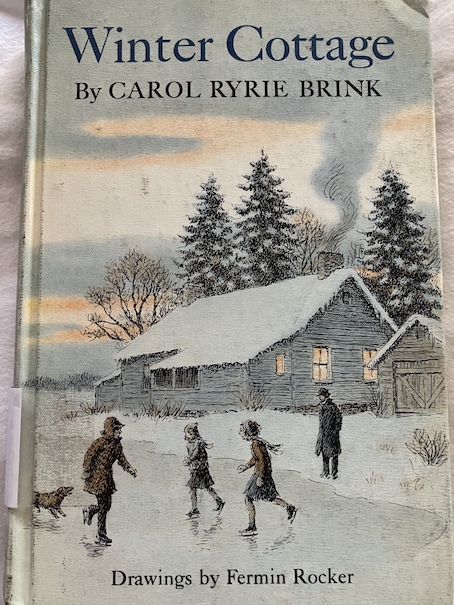
Winter Cottage

The Vincents own a summer cottage in Wisconsin. It was once an old farmhouse, so it is well-insulated and can be heated during the winter, but the Vincents only use it for about 2 or 3 months in the summer. The rest of the time it is empty and used by animals, like mice and woodchucks. However, that’s about to change.
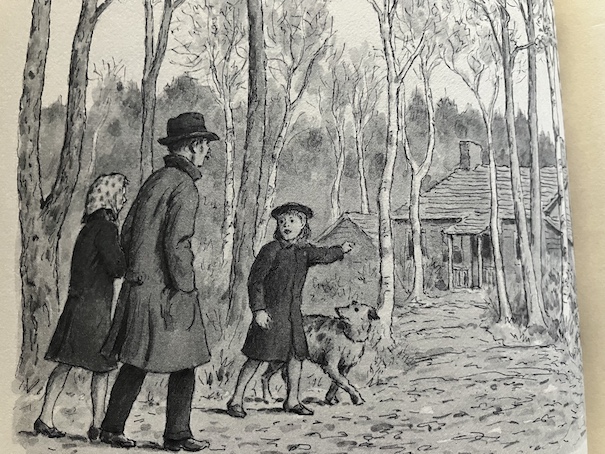
The year is 1930, the Great Depression has started, and many people are out of work and desperate to provide for their families. One such family, a father with his two daughters, happens to be passing near the Vincents’ empty summer house in the middle of October, when the Vincents have already long left the house, when their car suddenly breaks down. They were originally on their way to an aunt’s house to stay with her, but with their car broken down, they’re unable to continue their journey. Mr. Sparkes is a pleasant and easy-going man but impractical and a failed plumber. His eldest daughter, Minty, tends to deal with the practical aspects of things. Minty’s younger sister, Eglantine, called Eggs as a nickname, is the first to notice the empty summerhouse and suggests that, if they could get in, they could make some food. Needing a place to stay for the night and finding a window unlocked, they decide that they’ll go ahead and stay in the house. Although Minty has some reservations about staying in a house that belongs to someone else without their permission, she doesn’t have any better options, and she soon gets caught up in the excitement of exploring this unfamiliar house.
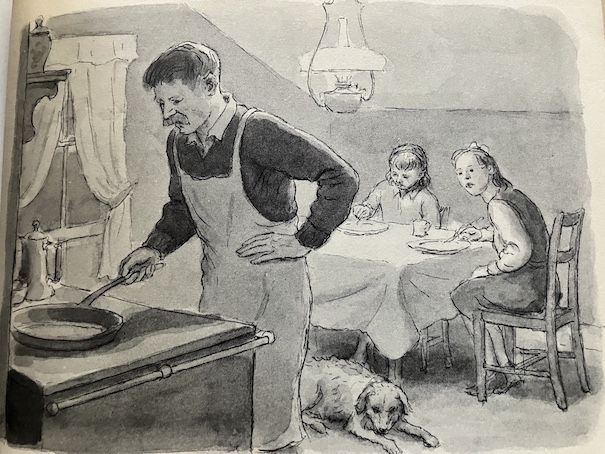
Mr. Sparkes feels like a failure because he’s been in and out of work, and typical jobs just don’t seem to suit him. Their Aunt Amy, the sister of the girls’ deceased mother, thinks that Mr. Sparkes is a failure and a silly, impractical man because he’s always quoting poetry, and his main talent seems to be making his special pancakes. There is some truth to what Aunt Amy says, and Mr. Sparkes acknowledges it. It seems like his only real talent is for making incredible pancakes, although his daughters reassure him that they love him and don’t see him as a failure. They were traveling to stay with Aunt Amy because they have no one else to stay with, but it’s clear from Aunt Amy’s letter that she isn’t looking forward to their arrival, and she also would not welcome their dog, Buster. Eggs says that she wishes they could just stay in this lovely cottage all winter, and Minty wishes the same thing, although she knows it isn’t really right for them to stay in this house without the owners’ permission. Mr. Sparkes likes the cottage, too, because it has a wonderful collection of books, including books of poetry.

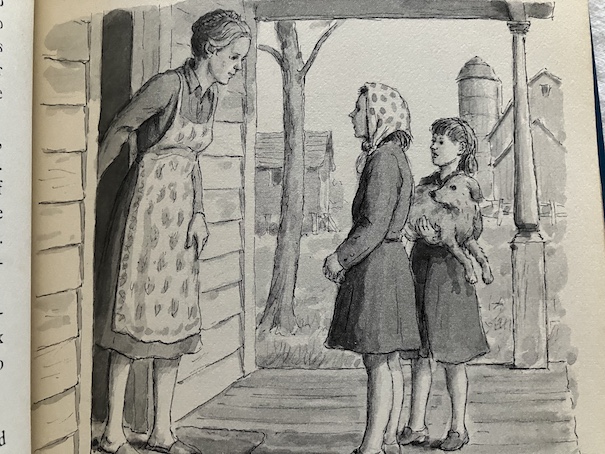
The next day, Mr. Sparkes tries to fix the car, but he’s a terrible mechanic. He takes the engine apart and doesn’t know how to put it back together. The girls go to a neighboring farmhouse and ask if anybody there knows anything about cars. Mrs. Gustafson sends her son Pete with the girls to look at the car, and he manages to put the engine back together again, but he isn’t skilled enough to figure out how to fix the original problem. He says that they had better call a mechanic in town to tend to it and that it would likely cost them about $10. The girls are worried because they know that’s about how much money they have left, and if they spend it all fixing the car, they won’t have enough left to buy more supplies and travel all the way to where Aunt Amy lives.
When they explain the situation to their father, Mr. Sparkes says that he thinks they should just stay in the cottage for the winter. Minty says that isn’t right because the house doesn’t belong to them, but their father says that it isn’t doing the owner any good to leave it empty all winter. To make it right, he suggests that they could rent it, so the owner would profit from their stay. The girls ask where he would get the money to rent the house, and their father says he doesn’t know, but he’ll have all winter to think of something. When they leave the cottage in the spring, he plans to leave the money in the cottage with a note, explaining why they stayed there. The girls are relieved that they don’t have to go to Aunt Amy’s house, but Minty is concerned that, by spring, her younger sister and impractical father will have forgotten all about the rent money for the cottage, and she makes up her mind that she will think of a way to get the money herself.

Eggs comes up with a possible way to make some money when she shows her father a contest magazine that she found at the last place where they camped. There are various contests in the magazine that offer prizes, like prizes for solving puzzles or adding the last line to a limerick. Mr. Sparkes is intrigued by the contests, and he says that they can pass the winter by trying them. He’s particularly interested in the contest to write a poem to advertise butter because he loves poetry and the prize is $1,000, which is an enormous sum to them.

Life in the cottage is idyllic. They have some groceries with them to get themselves started, and their father enjoys fishing in the nearby lake for more food. The girls find nuts and cranberries, and their father cuts wood for the stove in the cottage. Minty takes charge of the house, making sure that they keep it neat for the Vincents. The girls learn that the Vincents are the ones who own the house and that they have a daughter called Marcia when they find some of Marcia’s belongings. Sometimes, Minty and Eggs think of Marcia as a friend, and Minty sort of idealizes her in her imagination. Minty likes to imagine the comfortable life she thinks Marcia lives, wherever her family lives in the winter, and she is determined that they won’t let her down by not taking care of the cottage or finding a way to pay the rent.

Then, Mr. Sparkes gets sick, and the girls are frightened because they don’t have much medicine and don’t know what to do. They try to get help from Mrs. Gustafson, but she’s away from home. As Minty is leaving the Gustafson farm, she happens to meet a boy who’s been hunting partridges, and in her desperation, she begs him for help. At first, he is surly and suspicious with her, but when he begins to understand the situation, he agrees to come have a look at her father. The boy, whose name is Joe Boles, is carrying a professional-looking medical kit and seems to know what he’s doing as he attends to Mr. Sparkes. The girls are grateful for his help, and they invite him to spend the night in a spare room in the cottage.

It turns out that Joe is also down on his luck. His father was a doctor, and the medical kit Joe carries used to belong to him. He gets his basic knowledge of medicine from his father and from his grandmother’s home remedies. Joe also wants to be a doctor, but he’s alone now and doesn’t know how he’s going to manage to get the medical training he really wants. Although he’s initially reluctant to explain how he came to be alone, he explains that his father was killed in a car accident. His mother is still alive, but she remarried to a man Joe can’t stand. Eventually, Joe just couldn’t take living with him anymore, so he ran away from home. Joe tells the family that he’s been camping in the woods. Running away from home may not have been the best decision Joe could have made, but he’s determined not to go back, and the family can’t criticize him too much because they’re also sort of running away and hiding out right now.

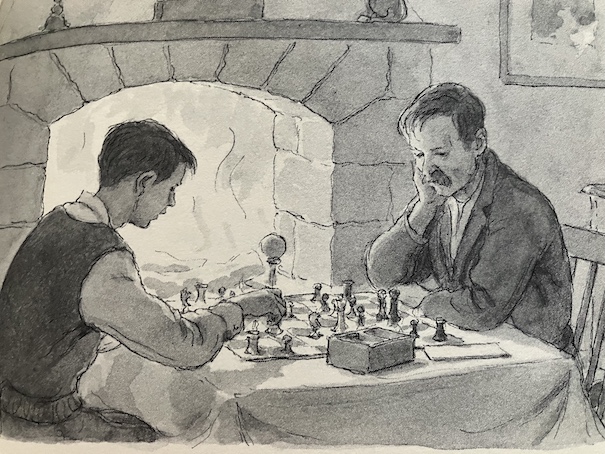
Joe seems to know what to do to help prepare the cottage for winter, and Mr. Sparkes says that they could use his help around the place. However, Mr. Sparkes admits to Joe that he can’t do much more for Joe than just give him a place to say for the winter, and a borrowed place at that. Joe says that’s fine, and he would like to stay with them for the winter, and he would be willing to pay for his room and board with his labor. The Sparkes family is thrilled to have Joe stay with them and help them. The only point that Mr. Sparkes insists on is that Joe write a letter to his mother to tell her that he’s safe so she won’t worry about him. He says that Joe doesn’t have to be specific about where he’s staying right now, but he knows that Joe’s mother will feel better, knowing that he has somewhere to stay for the winter.
With Joe, Minty and her sister explore the area more and visit the nearby Indian (Native American) reservation. Eggs is a little nervous about the Indians (the term the book uses) at first, worrying about scalping, but Joe tells her not to worry and that the locals are just curious about them. Joe worries less about people recognizing him as a runaway in the reservation village than in the town nearby because it’s a little more remote, although they do accidentally meet the local sheriff in the reservation store, who recognizes Minty from an earlier shopping trip to town. Joe does his best to stay inconspicuous.

While they’re in the reservation store, they learn that the reason why the sheriff is there is that the storekeeper’s son is in trouble. The son, who is a young man in his 20s, got drunk, broke into somebody’s house, ate some of their food, and fell asleep in their bed. The young man’s father argues with the sheriff that the son didn’t actually steal anything from the house, but the sheriff says that what he did was trespassing and that it’s illegal to break into someone’s house, stay there, and use their things without permission. He says that, for that charge, the son will have to spend a week in jail. This incident is troubling to Minty because she knows that she and her family also don’t have permission to use the house where they’re staying, and they’ve been there longer than this young man was in the house where he trespassed. When the sheriff points out that the weather is getting bad and offers to take the kids home, Minty panics at the idea of him finding out where they’re staying and tells him that they plan to spend the night at the reservation.

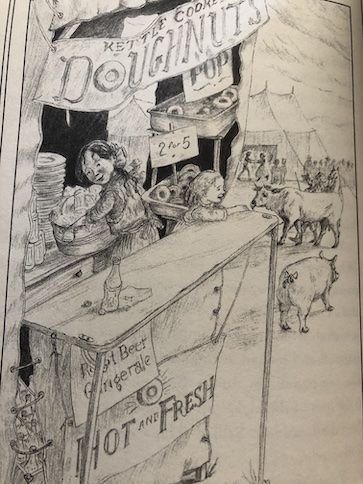
Of course, the kids don’t really have a place to stay on the reservation, and the weather is bad for camping. They are rescued by the village priest, who says that Joe can stay with him, and the girls can stay with Sister Agnes, one of the nuns who runs the mission school on the reservation. (“Indian schools” like this have a rather scandalous reputation these days for reasons I can explain below.) Minty says that they don’t have any money to pay for a place to stay, but Sister Agnes says that doesn’t matter because “God is your host.” In other words, they’re offering the children a place to stay out of kindness and Christian charity and don’t expect payment. There are some Native American children who also board at the school, some because their houses are too far away for them to travel back and forth between home and the school daily and a couple of children who are orphans and live at the school full time.

There is a scene where some of the Indians are playing drums and dancing, but not the ones living at the school. One of the nuns says that the dancers are “heathen Indians” and that “our Christian Indians don’t dance,” although Minty can tell that the Indian students at the school are feeling the rhythm of the song and enjoying it. Joe takes Minty and Eggs to see the dancers, and they find it fascinating. I didn’t like the “heathen” talk (although I think it’s probably in keeping with the historical setting of the story), but I did appreciate an observation that Minty makes, “Indeed it seemed to be a not entirely un-Christian gathering, for here and there among the gaudy beads was the gleam of a cross on the neck of some forgetful dancer.” That observation contradicts the idea that the dancers aren’t Christians because at least some of them seem to be. That and Minty’s observation that the girls at the school were interested in the dancing and drumming but were being careful not to show it hints at more complex feelings and social dynamics in this village. The people who run the school have some strong opinions about how proper Christians should act, but the Native Americans are still maintaining some traditional practices, and some people are walking a fine line in what they practice and believe.

One of the Indian girls at the dance invites Eggs to join in, and she does. Minty finds that amusing, and Joe tells her to let Eggs have fun because she’s enjoying herself. Sister Agnes asks them later if they enjoyed the dance, and Eggs says she did. Eggs later says that it seems like they don’t have much to do on the reservation, with no “picture shows” (movies) to see and not many toys, so she thinks that the dancing is part of their entertainment. Sister Agnes says, “They are heathen, but God will forgive them.” Minty isn’t too concerned about whether or not the dance might be “heathen” or sinful, but what Sister Agnes says makes her think about what God must think of her family for living in someone else’s house. She hadn’t given it much thought before, but she knows God must know what they’re doing, even if nobody else does, so she prays that He will forgive them, too, and thanks Him for being their host. Before they leave the reservation the next day, a girl Eggs befriended gives them a basket of wild rice, and Eggs give the girl her doll in trade.

When the kids return to the Vincents’ cottage, Mrs. Gustafson is there, visiting with Mr. Sparkes. Mrs. Gustafson seems to accept the idea that they’re renting the house from the Vincent family, although Minty is nervous when she mentions that she writes to them sometimes. Mrs. Gustafson also warns them to beware of strangers because, sometimes, gangster and criminals hide out in the isolated cottages in the area when things get too hot for them in Chicago. Joe has heard stories about that, too.
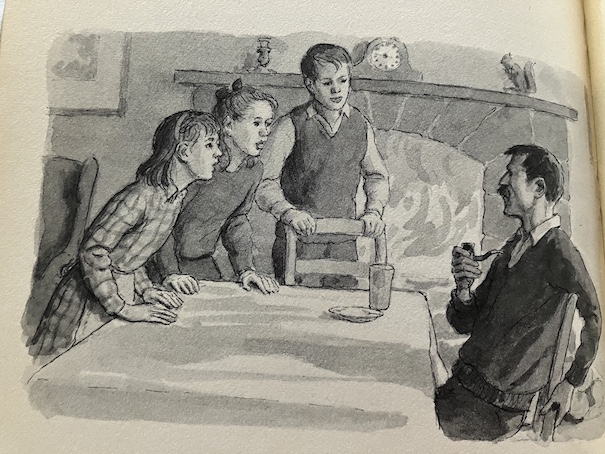
When the family starts getting replies to their contest entries, the results are disappointing. Many of the contests have catches because they expect entrants to buy things or subscribe to things. There is another contest that they hear about on the radio from a flour company, offering a large cash prize for the best breakfast recipe. Minty thinks that sounds better than any of the other contest options because of her father’s wonderful secret pancake recipe, although her father has become disillusioned with contests. They don’t have much time left to enter that contest, and Mr. Sparkes is reluctant to share the secret recipe. The kids end up spying on Mr. Sparkes to learn his recipe so they can enter the contest on his behalf.

Then, one night, they see a man lurking outside the cottage in a blizzard. Minty warns her father not to let the man in, remembering Mrs. Gustafson’s warnings about criminals hiding out in the area and how they shouldn’t open the door for strangers. However, Mr. Sparkes worries about anyone who might be lost in the blizzard, and he has the children invite the man in. The man has a young girl with him, who is half-frozen and dressed as a boy, for some reason. When Minty realizes that the child is a girl and not a boy, the girl asks her not to tell anyone right away. Minty can tell that there’s something strange about this father and daughter pair, and it makes her uneasy. Then, Minty hears a report on the radio about a stolen car and a reward for information leading to the thieves. Is it possible that this man and his daughter are the ones who stole the car? Minty might consider turning them in for the reward money that her family badly needs, but with the blizzard, they’re now trapped in this cottage with this strange man and the girl. The girl, who goes by the name Topper, is fun and good at planning entertainment, but can she or her father really be trusted?

The book is available to borrow and read for free online through Internet Archive.
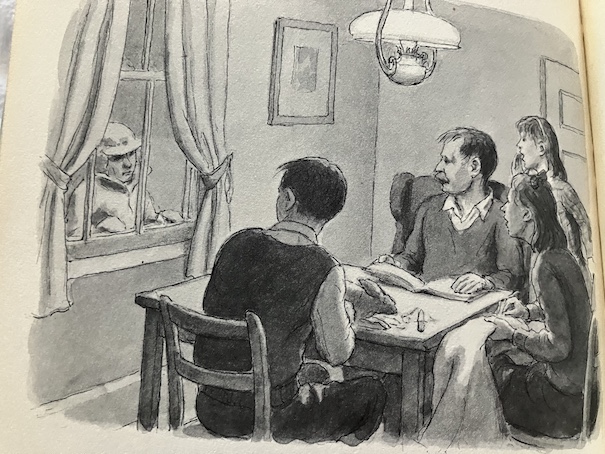
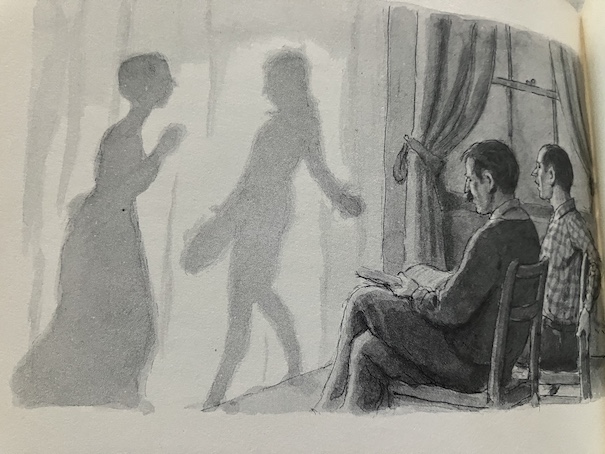
This book isn’t a Christmas story, although the title and some of the themes would have set it up well to be a Christmas story. It fits well with cottagecore themes, with the family, down on their luck, staying the winter in a cozy cottage and getting by as well as they can, enjoying simple pleasures. There’s a line in the story that I particularly liked, toward the end of the book, when the children put on a shadow play for their fathers:

“What a lot of fun you could have, Minty discovered, if you made unimportant things seem important and went about them with enthusiasm!”

I think that sentiment embodies the spirit of cottagecore. To really enjoy some of the simple pleasures of life, you do have to put yourself into the mindset that you’re going to enjoy them to the fullest! I read a book about Victorian parlor games that said something similar. A lot of old-fashioned entertainment and games are quite silly when you analyze them, but if you just throw yourself into them whole-heartedly, they can be great fun!
The family in the story is down on their luck and has their troubles, but their stay in the winter cottage is still an adventure, and they enjoy it. Their consciences do trouble them throughout the story because they’re aware that they’ve been using the cottage without permission of the owners. Minty in particular considers the morality of their actions and has a desire to make things right with the owners of the cottage. Fortunately, the story ends happily for the family, with their lives changed for the better. The people who own the cottage find out about them staying there, but they forgive them, and Minty finds a way to repay them for letting them stay.

The part of the story that I think is most likely to cause controversy for modern readers is the part where the children visit the reservation and the mission school. “Indian schools” have a sinister reputation in modern times because of their harsh treatment of their students and deliberate attempts to eliminate Native American culture. In the book, the nuns at the school make it clear that they don’t approve of traditional Native American practices, like the dance the children watch, because they don’t consider them to be Christian. They call such practices “heathen.” Their focus on discouraging their students from participating in traditional cultural practices is based on religious differences and a desire to convert people strictly to Christianity. However, I appreciated that Minty and the other children see both sides of the story and that Minty observes that some of the Native American dancers are wearing crosses, showing that the actual beliefs among the Native Americans are more nuanced than the nuns’ attitudes suggest.

This part of the story has some use of the word “squaw“, which is problematic because it has vulgar and derogatory connotations. The exact definition of the word varies in different Native American languages, but because it is considered vulgar and derogatory, modern people avoid it. At the time this story was first published, in the mid-20th century, many white people had the idea that “squaw” was sort of a generic word for women among Native Americans and didn’t realize the more vulgar side of the word, which is why it appears in some old children’s books, like this one. The word isn’t meant to be intentionally insulting here, although modern readers should understand that this word isn’t polite or appropriate. Apart from that, I appreciated how the main characters, especially Minty, see some of the prejudiced ways people, especially the nuns at the school, look at the Native Americans and their traditions and their realization that there are sides to their culture and practices that the adults have overlooked.
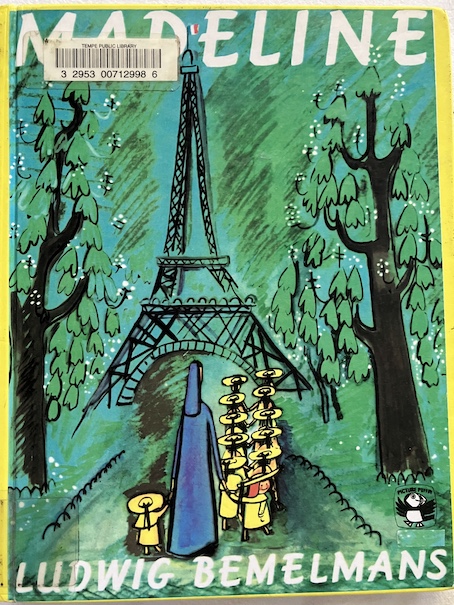
Madeline

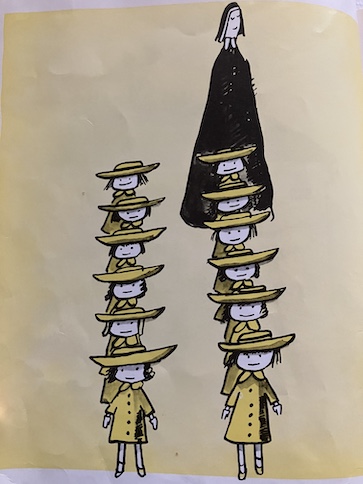
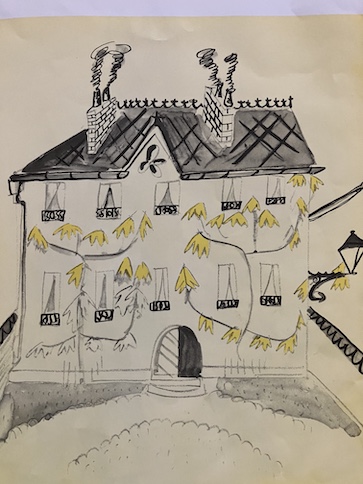
“In an old house in Paris
that was covered with vines
lived twelve little girls
in two straight lines.”

The Madeline stories are considered children’s classics today, and these words, which are the opening lines in other books in the Madeline series, introduce Madeline’s school. Madeline is a little girl who lives in a small boarding school in Paris, tended by Miss Clavel.

Madeline is the smallest girl at the boarding school. She’s a brave girl, who isn’t scared of either mice or lions at the zoo, and she sometimes does daring stunts that frighten Miss Clavel.

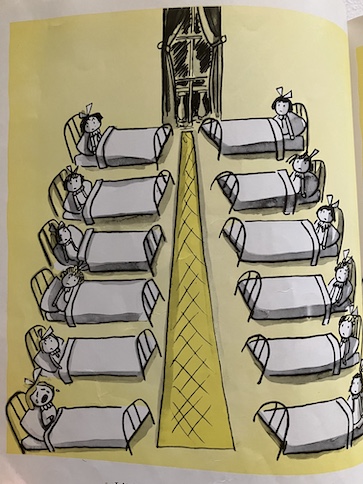
One night, Miss Clavel wakes up because Madeline is crying. She calls the doctor, who examines Madeline and rushes her to the hospital because she needs to have her appendix removed.

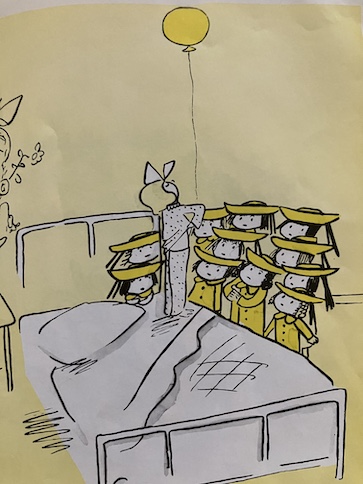
After the operation, Madeline has to stay in the hospital for a while. Miss Clavel brings the other girls from the school to visit her, and they are impressed by all the candy and presents that Madeline has received from her family. Even more impressive, Madeline now has a scar that she shows to the other girls.

After the other girls return home and go to bed, Miss Clavel wakes up to find them all crying. Madeline has made having her appendix out look like so much fun, they all want to do it!

I wouldn’t say that I was a particular fan of Madeline as a kid, but I did read at least some of the books in the series. As an adult, I had forgotten that they were told entirely in rhyme, even though I still sometimes get those opening lines stuck in my head.

I remember thinking as a kid that I wouldn’t want to have my appendix out! Even if you get presents and an impressive scar, having an operation always sounded awful to me. It didn’t occur to me until I was older, but the Madeline cartoons and movie tended to portray Madeline as an orphan, but she isn’t. She’s just a student at a small boarding school. This book is one of the stories that mentions her family, with her papa sending her a dollhouse as one of the presents she receives while she’s in the hospital.
I also didn’t realize, until I was researching this series for the blog, just how old the first Madeline book was. It was originally published in 1939, on the eve of WWII. I don’t think the books ever have anything in them to tie the stories to any particular events, and they seem almost timeless, although I suppose that the girls’ school uniforms are a little old-fashioned. This timeless, idealized portrayal of Paris was popular with the book’s original audience of Americans during WWII.

I was curious about the author, Ludwig Bemelmans. He was born in Austria and grew up in Austria and Germany during the late 19th century and early 20th century. As a young man, he was apprenticed to his uncle, who owned a hotel, but Bemelmans was difficult to manage and got into trouble while working there. He later told a story about shooting and wounding a headwaiter who whipped him, although that might have been just a tall tale. Eventually, however, his uncle decided that he couldn’t deal with him, so he told him he would either have to go to reform school or go to the United States, where his father was living after having left him and his mother years before. He moved to the United States and lived there during WWI. He spent some time working in a series of hotels and restaurants. He eventually joined the US Army in 1917, although they wouldn’t send him to Europe because the US was at war with Germany, and he was German. He became a US citizen in 1918, and he developed an interest in art. He worked as a cartoonist before writing and illustrating children’s books. He wrote the first seven of the Madeline books, and the last one was published after his death. Since then, his grandson, John Bemelmans Marciano has written other Madeline books.

Swallows and Amazons

Roger Walker is staying at a farm near a lake for the summer holidays in 1929 with his mother and siblings. His father is away on a ship, a destroyer, and the family write letters to him. The children are particularly waiting for a reply from their father because they’ve asked him for permission to do something special, and their mother says that they will be allowed to do it if their father agrees. What they want is permission to sail the family’s sailboat, the Swallow, by themselves and to camp out on an island in the middle of the lake. They are all thrilled when their father agrees that they can do it! Roger is especially thrilled because, until their littlest sister, Vicky, was born, he was the baby of the family, and he was often left out of things that the older children were allowed to do.

There are a couple of conditions on the permission for the children to go sailing and camping by themselves. The first is that the two oldest children, John and Susan, are in charge. Roger and their other sister, Titty, will have to follow their orders. Before the children can camp out, their mother also makes them tents to use, shows them how to set up the tents, and takes them on a sailing trip so she can make sure that the children know what they’re doing. The excited children prepare for their sailing and camping expedition, giving themselves sailing roles, working out ship’s articles, and gathering supplies. John will be the captain of their ship, while Susan will be the mate and cook. Roger is a cabin boy, and Titty is an able seaman.

When the children go to the island, they find a nice place to set up their camp and a harbor for their boat. Surprisingly, they also discover signs that someone else has been on the island before them, but they don’t know who that is. They begin to think of the mysterious people who have been there before as “Natives” of the island, and they also start to think of their mother and other adults who help them as “Natives.” Their mother plays along with it, as if she’s part of one of the stories the children have probably been reading. When their mother comes to bring them some supplies, the children also mention seeing a man with a parrot on a house boat. The man helping their mother, Mr. Jackson, says that the man often has his nieces with him, but they don’t seem to be with him this time. The children’s mother tells the children where to go to pick up milk, and she says that she wants the children to talk to her every couple of days so she will know they’re all right and so they can pick up more provisions from her.

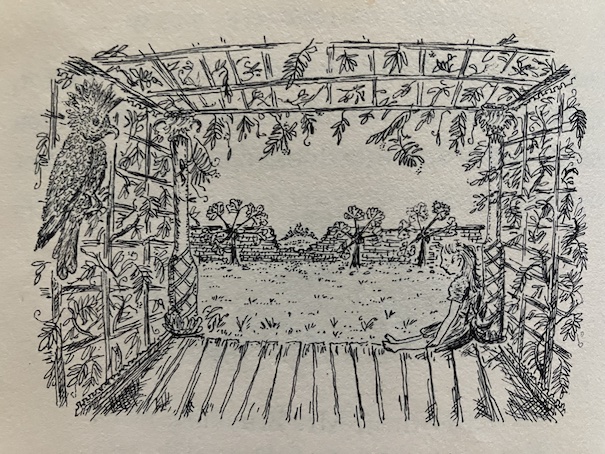
The children continue with their camping and fishing, and they continue to notice the man on the houseboat, who they think of as being like a “retired pirate” with his parrot. They also notice that he has a small cannon on his houseboat. One day, the children spot another boat approaching the island, sailed by a pair of girls. The children hide and watch the boat. Then, it sounds like the cannon on the boat goes off, and the “retired pirate” is on the deck, appearing to shake his fist at the girls in the boat. The children from the Swallow think that the man on the houseboat might be firing at the girls! The girls also run a flag with a skull and crossbones on it up their mast. The girls are being pirates! The children try to follow the girls’ boat, the Amazon, to see who the girls are and where the boat docks, but they lose track of the Amazon.

The lady who gives the children their milk talks to them when they come to get their supplies. She tells them not to bother Mr. Turner, the man on the houseboat. The children realize that Mr. Turner thinks of them as a nuisance, although they don’t know why. The crew of the Swallow takes it as the “retired pirate” stirring up the “Natives” against them. Then, someone steals their boat, the Swallow, and the children are set upon by the pirate girls at their camp!

There is a battle at the camp between the Swallows and the Amazons, but one of the Amazons asks for a “parley.” The crew of the Swallow confronts the Amazons about the theft of their boat, and the Amazons confront the Swallows about the campers trespassing on “their” island. The crew of the Amazon says they’ve been coming to this island for years, and they’re the ones who built the little fireplace the Swallows found when they started setting up camp.

During their “parley”, the children sort of continue their imaginary roles as explorers and pirates in their talk, but they also reveal some of their real backgrounds. The two girls from the Amazon explain that Mr. Turner on the houseboat is their Uncle Jim. At least, they say that sometimes he’s their uncle and is nice to them. They’ve been visiting the island for years, and their uncle is the one who gave them their boat. However, this year, their uncle is a hostile “native” and their enemy. The Swallows say that Mr. Turner has apparently been complaining about them to the local adults, “stirring up the natives” against them, so he is their enemy, too. The Amazons, Nancy (real name Ruth) and Peggy (Margaret) Blackett, suggest a truce between the Amazons and the Swallows and an alliance against their shared enemy, the “pirate” Jim Turner, characterized as a Captain Flint type character. If the two crews are allied, it won’t matter who technically “owns” or controls the island because they have a shared mission against their enemies, particularly Uncle Jim, aka “Captain Flint.” The Amazons admit that they really have wanted to be allies all along. The Swallows agree to this plan, and the two crews sign a treaty with each other.

As the two crews celebrate their new alliance, the Amazons explain how their uncle came to be their enemy. Usually, their uncle likes playing with them when they visit during the summer, sailing and exploring with them and teaching them things he knows about sailing. However, this year, he’s writing a book about his travels, and he doesn’t have time for them. He gets upset when they disturb his work, and the girls’ mother has told them to leave him alone when he’s working. The girls feel betrayed that he isn’t paying attention to them and gets annoyed by them. The day when the crew of the Swallow thought the man on the houseboat fired his cannon at them, the girls say that it wasn’t the cannon. They set off a firecracker when Uncle Jim was asleep as a prank, and that’s why he was shaking his fist at them as they fled in their boat.

It sounds like the Blackett girls have been a nuisance to their uncle because they’re hurt that he’s not spending time with them, and they’re trying to get his attention. Still, the Swallows enjoy their new alliance with the Amazons. Each of the crews has some experience sailing, the Amazons having learned what they know from their uncle and the Swallows having been taught by their father. John is impressed by what the Amazons teach them, but there are a few things that they know that the Amazons don’t. The two crews learn from each other, and they begin planning war games with their two ships to practice for a battle with their sworn enemy. In between, they enjoy their camping and exploring activities.

It turns out that Mr. Turner on the houseboat has been blaming the children from the Swallow for his nieces’ pranks with fireworks, which is why he’s been complaining about them to local people. When Mr. Turner leaves a complaining note at the Swallows’ camp, John realizes why he resents them. John knows that he could tell Mr. Turner the truth about who had the fireworks, but he doesn’t want to tattle on the Amazons because of their alliance and because Mr. Turner is angry and offensive and accuses him of being a liar when he insists that he and his siblings didn’t do what he’s accusing them of doing.

The Swallows and the Amazons start a daring war game with each other, a contest for them to try to capture each other’s ship. The winning crew will have their ship declared the flagship of the fleet! The Swallows attempt to capture the Amazon after dark, but their attempt is foiled because the Amazons sneak out of their house and head for the island that night. Titty, left alone on the island to mind their camp, realizes that the Amazons are on the island and decides on a risky plan to take their ship herself!

However, the children aren’t the only marauders abroad that night. When Titty takes the Amazon, she overhears some men in another boat. Some charcoal burners told the children from the Swallow earlier that Mr. Turner should make sure that he locks up his houseboat securely because they’ve heard some talk that someone might try to break in, but they never delivered the message because Mr. Turner accused John and his siblings of setting off the fireworks, and they forgot they were going to tell him what the charcoal burners said. The men that Titty overhears are suspicious, and they seem to be hiding something. After the Swallows win the mock war, the Swallows tell the Amazons what the charcoal burners said, although the Amazons are reluctant to tell their uncle to lock up his boat because they want to stage their own raid on it.

The Walker family will be heading home in only three more days and bad weather may be coming, so the children have to hurry to make the most of their adventures as Swallows and Amazons. Titty tells her siblings about the men who seemed to be hiding something, and she thinks it’s some kind of treasure. Her older siblings think that she probably dreamed about hearing men hiding something because she fell asleep on the Amazon, but Titty persuades Roger to come with her to find the treasure.

The book is available to borrow and read for free online through Internet Archive. This is the first book in a series, and it’s been adapted for film and television multiple times.

The author of the story, Arthur Ransome, named the character of Roger after Roger Altounyan, who he met when the real-life Roger was a child, visiting grandparents in the Lake District of England with his sisters. (Real-life Roger Altounyan later became a doctor and pharmacologist, known for a pioneering treatment for asthma.) The names of the fictional Roger’s siblings are also based on the real-life Roger’s siblings. The name “Titty” is odd, but it’s actually a nickname. The real-life Roger had a sister, Mavis Altounyan, who was called “Titty” as a nickname after a children’s story, Titty Mouse and Tatty Mouse by Joseph Jacobs. The character of Titty is sometimes called “Kitty” in some adaptions of the story.

Although the story explicitly states the year as 1929 when the Swallows and Amazons sign their treaty with each other, most of the book could take place at just about any time during the 20th century and into the 21st century because the children are dedicated to camping and sailing and don’t use any form of technology that would firmly date the book. The book has a timeless quality, and it’s the sort of independent adventure that many children dream of having!

The books in this series have been popular in Britain since they were first published, and they have also inspired other books for children on similar themes, having outdoor adventures with minimal adult help or interference. Enid Blyton wrote several series for children on these themes after Swallows and Amazons was published, such as The Famous Five Series and Enid Blyton’s Adventure Series, and Elinor Lyon started her Ian and Sovra series in the 1950s, explicitly stating that she wanted to write books with similar adventures for children but with child characters who weren’t as competent as the children in Swallows and Amazons. The children in Swallows and Amazons are very knowledgeable about sailing and camping and seem to do almost everything right, and Elinor Lyon thought it would be more realistic if the children in her stories didn’t entirely know what they were doing but somehow managed to muddle their way through anyway. There are also similar books by American authors written after Swallows and Amazons, like The Invisible Island by Dean Marshall.

The children in the story take their inspiration for their imaginary play from books they’ve read, like Robinson Crusoe and Treasure Island. All of the children in the story seem familiar with sea stories and books about exploration and island adventures, and they make references to aspects of them and use those aspects when they’re playing. For example, they refer to adults and anyone who is unfamiliar to them as “Natives” and “savages”, and they call their bottles of ginger beer “grog”, while tea is “hot grog”, lemonade is “Jamaica rum”, toffee candy is “molasses”, and tins of corned beef is “pemmican”, living out their fantasy that they’re sailors exploring unknown territory. Later, they compare Jim Turner, the man on the houseboat, to Captain Flint and call him that for most of the story. Some of the language that the children use, like “natives”, “savages”, and the phrase “Honest Injun” are racially out of date and can have some offensive connotations. The children probably got those phrases from the books they’ve been reading, and they seem to think of them innocently, as part of their imaginary play, living out the stories they’ve read, but modern readers should be aware.

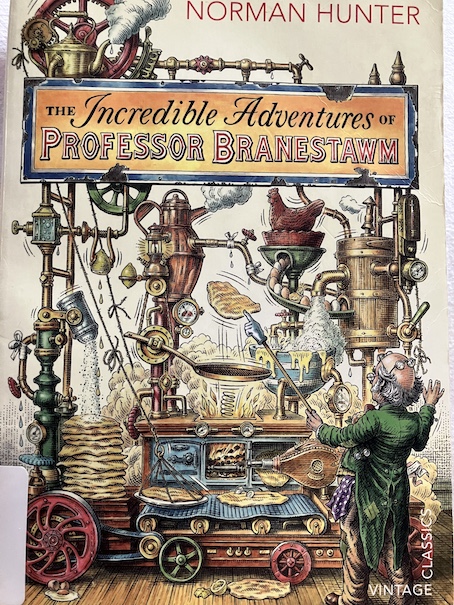
The Incredible Adventures of Professor Branestawm

Professor Branestawm is a classic absent-minded professor. He’s is a balding man who wears several pairs of glasses, one of which is for finding the other pairs of glasses when he inevitably loses them. He’s a very clever man, but everyone knows that his inventions are likely to cause chaos. He’s not an easy person to talk to, so he doesn’t have many friends. His best friend is Colonel Dedshott, who is a very brave man.

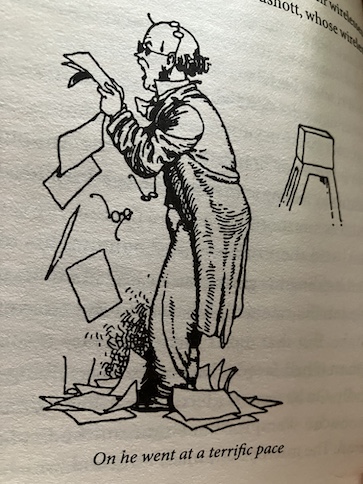
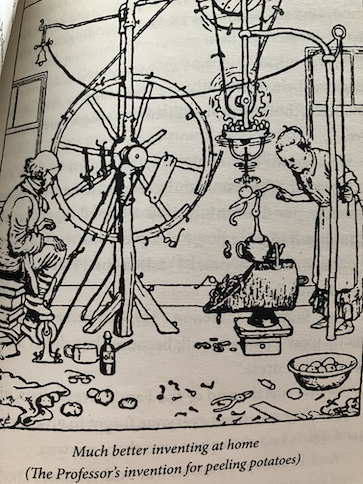
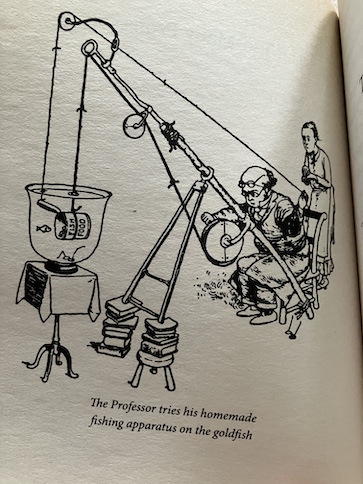
Every chapter in this book is about another of the Professor’s inventions and the adventures that the Professor, the Colonel, and the Professor’s housekeeper, Mrs. Flittersnoop, have with them and with various situations that the Professor creates with his absent-mindedness. The stories are accompanied by pen-and-ink drawings. I love the way almost every picture of the professor shows him shedding one or more of his many pairs of glasses and that the Colonel’s weapon of choice is a slingshot!

One day, Professor Branestawm invites the Colonel to his house to see his latest invention, which he says will revolutionize travel. When the Colonel arrives, Professor Branestawm explains his idea. First, he points out that, if you’re traveling somewhere, you’ll arrive in half the amount of time you ordinarily would if you travel there twice as fast. The Colonel says that makes sense. Then, Professor Branestawm says that, the faster and faster you travel, the sooner you arrive at your destination. That also makes sense. Further, Professor Branestawm says, you eventually start traveling so fast that you arrive before you even start, and if you go fast enough, you can arrive years before you start. The Colonel doesn’t really understand this, but he takes the Professor’s word for it. The Professor has built a machine that will allow them to travel that fast, and the Colonel is eager to try it. He suggests that they try going back in time to a party he attended three years earlier. The Professor insists that they take some powerful bombs with them, just in case of emergencies (don’t try to make sense of it, there isn’t any), and the Colonel has his trusty catapult (slingshot) and bullets with him.

It turns out that, rather than going to the party three years earlier, they arrive at the scene of a battle that took place in another country two year earlier. Although they already know how the battle turned out, the Professor and Colonel can’t resist joining in with their bombs and catapult, and they end up wiping out an entire army and changing the result of the battle in favor of the revolutionaries. The revolutionaries are so grateful to them for their help that they take them to the palace of their former king, put the two men on the enormous throne there, and make them the new presidents of the country. Professor Branestawm realizes that they’ve made a terrible mistake and changed history because the king’s army was the one that was originally supposed to win the battle. The Colonel, however, doesn’t care because he thinks it sounds like fun to be a president and can’t wait to do some ruling.

Of course, the ruling of the two presidents doesn’t go well. Neither one of them really knows anything about running a country. Since they blew up all the country’s troops, there are no troops left for the Colonel to review, and he ends up playing with toy soldiers. Meanwhile, the Professor really just wants to get back to his inventing. Eventually, the revolutionaries get tired of this and tell them that they’ve decided that they don’t want any presidents, so they’re giving them a week’s notice before they’re out of a job. The Professor and the Colonel try not to take any notice (ha, ha) of the revolutionaries’ attempts to dethrone them. This just leads to the revolutionaries trying to imprison them in the dungeon, so the Professor and the Colonel are forced to escape in the Professor’s machine, which takes them back to the exact time and location where they started. They arrive just as the Professor’s housekeeper brings them some tea, so they have their tea, go about their usual business, and leave it to the historians to deal with the complications of the two of them changing history.

When Professor Branestawm’s housekeeper puts a bottle of cough syrup with no stopper into the waste-paper basket, it accidentally creates a waste-paper monster! It turns out that it wasn’t really cough syrup in the bottle. It was a special life-giving formula that the professor invented. He only keeps it in a cough syrup bottle because cough syrup is the only thing that neutralizes the life-giving formula and stops it from bringing everything it touches to life, including the bottle holding it. Now that they’ve accidentally created a waste-paper monster, what can they do to stop it, especially since it seems to have the ability to use tools and is currently trying to saw down the tree where the Professor and his housekeeper are trying hide?

Professor Branestawm accidentally loses a library book about lobsters, so he goes to another library to get the same book. By the time that he needs to return the library book, he has found the first one and lost the second one. For a while, he manages to avoid library fines by continually returning and checking out the same book from both libraries because the libraries don’t notice which library the book is from. Of course, he eventually loses the first book, too. He tries to fix the situation by getting the same book from a third library and then one from a fourth library, when he loses the third book. Where will it all end? How many libraries will have to share this one book, and where on earth are all these books about lobsters going?

Professor Branestawm and his housekeeper go to the movies to see a documentary about brussels sprouts. (The housekeeper doesn’t care about brussels sprouts, but there’s a Mickey Mouse cartoon included with the feature, and she wants to see that.) When they get back, they discover that the house has been robbed! Professor Branestawm decides that he’s going to invent a burglar catcher, but the only burglar he catches is himself.

Professor Branestawm’s clock stops, so he takes it to a clock repair shop. It turns out that the clock has only wound down because the Professor has forgotten to wind it. The Professor decides that he’s going to invent a clock that will go forever and never need winding. (This story is set before clocks that don’t need winding became common.) The Professor does invent a clock that will never stop and never need winding, but he makes a critical mistake: the chimes never reset after they strike twelve. They just continue counting up and up, endlessly, with no way to stop them! Just how many times will they endlessly strike before something terrible happens?

The Professor visits a local fair and invites the Colonel to join him. The Colonel ends up winning most of the prizes for the various games, and the Professor accidentally gets left behind in the waxworks exhibit, being mistaken for a wax statue of himself. When the Professor decides that it’s finally time to get up and go home, the people who work in the waxworks think that a wax statue has come to life!

Professor Branestawm writes a letter to the Colonel, inviting him to tea, but because he is distracted, thinking about potatoes, he accidentally writes a muddled letter and then mails the paper he used to blot the letter instead of the letter itself. The message that arrives at the Colonel’s house is a backward, muddled mess, and he has no idea who sent it to him. Since it looks like it’s written in some strange language he doesn’t know, the Colonel decides to take it to the Professor to see if he can decipher it. The Professor fails to recognize the letter as what he sent and has forgotten that he sent it. Will the two of them figure out what the letter is about, or will they eventually just give up and have some tea?

Professor Branestawm’s housekeeper’s spring cleaning creates some chaos in the professor’s house, and the Colonel suggests that Professor Branetawm invent a spring cleaning machine. Predictably, the spring cleaning machine creates an even bigger mess and far more chaos.

Professor Branestawm invents a very smelly liquid that brings things from pictures to life. The things from the pictures go back to being pictures when the liquid dries. Of course, there are some things that cause big problems when they’re brought to life. Possibly the most chaotic pictures that come to life are pictures of the Professor and the Colonel and the professor’s housekeeper. Who is who and which is which?

Professor Branestawm is invited to give a talk on the radio, and the Colonel helps him to rehearse. However, because he gets mixed up, he almost misses his own talk, and when he finally gives it, he speaks too fast and discovers that the time slot for his talk is much longer than he thought it was. Listeners are confused, but everything is more or less all right when the Children’s Hour comes on.

The Professor and the Colonel are going to a costume ball. Since the Professor doesn’t know what to do for a costume, the Colonel suggests that the two of them dress as each other. This causes some confusion, and neither of them likes each other’s clothes. The Professor’s social skills aren’t even great at the best of times, and the truth is that he’d rather be inventing things at home in his “inventory” (pronounced “invEnt – ory” as in a laboratory where you invent things, ha, ha). Then, the Countess at the ball raises the alarm that her pearls are missing! Everyone is confused when they try to get “the Colonel” to find the thief, and he doesn’t seem to know what he’s doing. It takes a while for things to get sorted out, but at least the Professor and the Colonel develop a new appreciation for being themselves instead of being each other.

Professor Branestawm’s house has gotten so full of his inventions that it’s become difficult to live there, so he’s decided to move to a new house. Moving to the new house is an escapade, and when Professor Branestawm and his housekeeper get there, they discover that the water and gas haven’t been connected up yet. Professor Branestawm’s attempts to remedy the situation render the new house unlivable, so he is forced to move back to his older house.

Professor Branestawm invites his friends and various members of the community to his house for a party, where there will be tea and pancakes. Everyone is happy to go because of the promise of pancakes, but when they’re all there, Professor Branestawm reveals that the party is to unveil is newest invention: a pancake-making machine! As the library man predicts, the pancake-making machine goes wrong (just like the Professor’s other inventions), but it’s all right because the town council comes up with a new purpose for it.

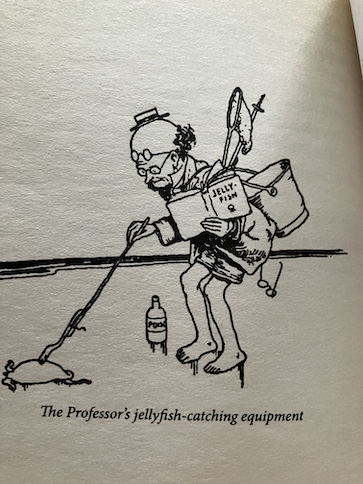
Professor Branestawm takes a trip to the seaside. He asks the Colonel to join him and bring his book about jellyfish, but unfortunately, he neglects to tell the Colonel where he’s staying (partly because he forgot where he was supposed to stay and is actually staying somewhere else). When the Colonel tries to find the Professor, he accidentally mistakes an entertainer dressed as a professor for Professor Branestawm. When the entertainer isn’t acting like himself (so the Colonel thinks), the Colonel becomes worried and decides medical intervention is necessary.

The book is available to borrow and read for free online through Internet Archive (multiple copies). It’s the first book in a series about Professor Branestawm, and it was also adapted for television multiple times.

Kids won’t learn anything about real science from Professor Branestawm, but the stories in the book are funny and not meant to be taken seriously at all. Most of the stories are about some pretty silly things that don’t really mean much in the end, but when you think about it, the Professor’s antics do lead to some pretty serious consequences, from wiping out an entire army just for the fun of it (pretty horrific in real life) and changing the course of history to accidentally blowing up someone’s house with his perpetually-chiming clock. No matter what the Professor does, though, there never seem to be any lasting consequences.

Even when people around him brace themselves for when the Professor’s latest project inevitably goes wrong, everybody still thinks that the Professor is pretty clever. The Colonel always thinks the Professor is clever, and even when he knows that the Professor is bound to do something that’s going to cause chaos, he enjoys the excitement. The housekeeper sometimes goes to stay with her sister, Aggie, when the chaos and excitement get too much for her.

The stories are just meant to be enjoyed for their zaniness, and there’s no point in analyzing them much. You don’t have to worry about whether anything the Professor does makes sense or exactly how he got any of his inventions to work. You can just enjoy seeing how everything develops and watch the craziness unfold! It sort of reminds me of Phineas and Ferb’s summer projects, which cause some chaos but are ultimately funny and always disappear at the end of the day. Enjoying these stories is what they used to say in the theme song for the tv show Mystery Science Theater 3000:

“If you’re wondering how he eats and breathes
And other science facts,
Just repeat to yourself “It’s just a show,
I should really just relax …”

I can promise you that, no matter what happens in any of the stories, the Professor and his friends will ultimately be fine and will probably have a cup of tea (or “a cup of something”) afterward. This book was originally published in Britain the early 1930s, and it was read by children during the Great Depression. I can imagine that it might have given children then a good laugh and some escapism during troubled times.

Strangely, at least one of the Professor’s inventions, the clock that never needs winding, is a real invention that we have every day because time has moved on (ha, ha) since this book was originally written and published. In fact, it’s very unusual to find clocks that need to be wound these days. Of course, the part about the clock perpetually chiming more and more and blowing up when it gets to be too much is just part of the craziness of Professor Branestawm.

Understood Betsy

Elizabeth Ann is an orphan who lives with her Great-Aunt Harriet and her first-cousin-once-removed Frances, who she calls Aunt Frances. Her relatives took her in when she was only a baby, after her parents died, and her life with them is the only one she has ever known. Her relatives love her, and Aunt Frances is particularly devoted to her. Ever since Elizabeth Ann came to live with them, she has devoted her entire attention to the little girl. She reads anything she can find about how to parent a child and makes it a point to know everything that’s going on in Elizabeth Ann’s life at school and sympathize with her over ever difficulty and misfortune she encounters. Elizabeth Ann certainly doesn’t lack for attention and affection, but Aunt Frances’s devotion and sympathy often go a little too far.

Aunt Frances is rather an anxious person, and she has unintentionally transferred many of her worries and anxieties to Elizabeth Ann, making her a rather timid and fearful little girl. She has also made it such a point to shield Elizabeth Ann with so much attention that Elizabeth Ann is never allowed to go anywhere or do anything by herself, making her feel like she can’t do things alone. Aunt Frances tries so hard to shield Elizabeth Ann from anything difficult or unpleasant that any difficulty she does encounter seems unbearable. While Aunt Frances’s intentions are good, and she tries hard to always understand and sympathize with Elizabeth Ann about everything, but there are some things about both Elizabeth Ann and herself that Aunt Frances doesn’t really understand. Then, when Elizabeth Ann is nine years old, something happens that changes her life forever.

When Great-Aunt Harriet gets sick, the doctor says that she must go to a warm climate and that Aunt Frances is going to have to take care of her. However, the doctor is adamant that Elizabeth Ann shouldn’t go with them because he doesn’t want to risk the girl catching Great-Aunt Harriet’s disease. Elizabeth Ann can’t imagine life without Aunt Frances, and Aunt Frances worries about where Elizabeth Ann will stay. Her relatives in Vermont, the Putneys, say that they are eager to have her. They would have taken her when she was a baby, but Great-Aunt Harriet and Aunt Frances never trusted the Putneys. They say that they are not sympathetic enough and that life on their farm would be too harsh for the delicate, sensitive little girl they have decided that Elizabeth Ann is. Instead, they decide that she should go live with some other cousins who live in the same city they do.

However, these relatives aren’t particularly eager to have her, and after Great-Aunt Harriet and Aunt Frances have already left town on their train, they discover that a member of their household has come down with scarlet fever (what strep throat can turn into if it isn’t treated with antibiotics) and that the household must be quarantined. There is a brief moment of panic when they realize that they can’t even bring the girl into their house. Then, they remember the Putneys. If Great-Aunt Harriet and Aunt Frances couldn’t bring themselves to send Elizabeth Ann to these other relatives, these cousins can. In fact, they must, and there’s no way Elizabeth Ann can argue, even though she is afraid of the Putneys because of all the negative things she’s heard her aunts say about them.

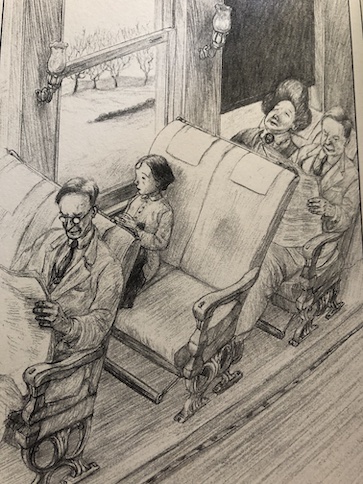
A relative who is traveling on business takes Elizabeth Ann partway by train and then makes sure that she gets on the right train to go to the Putney’s town in Vermont alone. Timid, fearful little Elizabeth Ann finds herself traveling completely alone for the first time to go to a place she’s never been and meet relatives she is sure she won’t like. Fortunately, many of Elizabeth Ann’s preconceived ideas are turned on their head from the first moment she steps off the train and is greeted by Great-Uncle Henry.

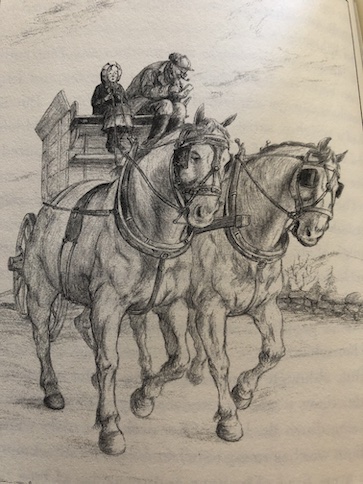
If it had been Aunt Frances greeting her, Aunt Frances would have immediately worried and fussed over her and asked her how she stood the ordeal of traveling. However, Uncle Henry acts like Elizabeth Ann hasn’t been through any ordeal at all. Instead, he just greets her cheerfully and helps her into his wagon. In fact, as they drive along, he unexpectedly gives the horses’ reins to Elizabeth Ann and lets her drive while he does some math. (We don’t know why he needs to do this; he just says he does.) He just tells her to pull on the left rein to make the horses turn left and the right rein to make them go right. Being handed this unexpected responsibility is terrifying for timid little Elizabeth Ann, and she has a moment of panic, worrying that she doesn’t always remember her left from her right. Then, Elizabeth Ann has an unexpected revelation: it doesn’t really matter if she doesn’t remember the names for the directions or which is which because she can just look and see where she wants the horses to go and pull the reins in that direction, no matter what that direction is called. After all, it’s not like horses really understand the words “left” and “right” anyway, just the direction of the pulling. This is an important revelation for Elizabeth Ann, who is usually accustomed to Aunt Frances doing everything for her, including her thinking. She has never really had to figure out things by herself before. When she voices this revelation to Uncle Henry, he simply agrees that she is correct, and Elizabeth Ann feels a rare sense of pride in her accomplishment.

When they reach the Putney Farm, Great-Aunt Abigail and Cousin Ann are glad to see her, but they don’t overly fuss, either. They call Elizabeth Ann “Betsy” and show her the hook where she can hang her cloak. Betsy is a little offended that they don’t help her take it off and hang it up for her the way Aunt Frances did. Their lack of fussing and expecting her to do things for herself makes her feel at first as if they don’t really care about her. Their farmhouse is also fairly small, it’s lit with kerosene lamps, and they do their own cooking instead of having a servant, like Great-Aunt Harriet and Aunt Frances did. These things make Betsy realize that the Putneys are poor, and she has a moment where she is overcome, thinking that she will be miserable in a poor, deprived household. Then, Aunt Abigail hands Betsy a kitten and tells her that, if she likes it, it can be her cat.

Betsy always wanted a kitten, but Aunt Frances would never let her have one because she was afraid that they would carry disease. Betsy forget her worries and misery while playing with the kitten, which she names Eleanor. She is also relieved that her relatives don’t fuss about her not liking certain foods. Aunt Frances always tried to make her eat her beans for nutrition, but the Putneys don’t care when she avoids them because she has a good appetite for everything else on the table. In fact, Betsy eats much more at the Putney farm than she ordinarily does because she is allowed to eat more of what she likes and nobody fusses over how much she’s eating or if she’s eating the right things. For her first night at the farm, Betsy has to sleep with Aunt Abigail because her room isn’t ready yet, but she ends up finding Aunt Abigail’s presence reassuring.

In the morning, her relatives decide to let her sleep in because she’s tired from traveling. When Betsy wakes up, she lies in bed for a while, waiting for someone to tell her to get up. When no one does, she get the idea, for the first time, that she can get up when she’s ready and doesn’t need for someone to tell her to do it. She also dresses herself and does her own hair for the first time. In a way, it’s a little thrilling because Betsy realizes that she can do her hair the way she wants it instead of the way Aunt Frances does it, and she copies a hairstyle she envied on one of her old classmates. However, it does bother her a little that her relatives don’t seem to care about whether or not she needs help and aren’t stepping forward to help her automatically. She does fine, but she’s accustomed to an adult hovering over her as a sign of caring.

Her relatives explain that they were letting her sleep as late as she wanted that day because they knew she would be tired. Cousin Ann gives her breakfast and lets her have as much milk as she wants because, unlike in the city, they produce their own milk from cows rather than buying it in quarts, so they don’t have strict limits on how much they can have in a day. Betsy is pleased by this, but she has another moment of panic when Cousin Ann tells her to wash her dishes after breakfast. Betsy has never washed her own dishes before and doesn’t know how. Seeing Betsy’s hesitation, Cousin Ann offers a view brief instructions, and Betsy accomplishes the task.

On her first day, she also sees Aunt Abigail making butter, something that Betsy has never seen before. She is accustomed to buying butter, not making it, and she didn’t even know before what butter is made from. Aunt Abigail is astonished that Betsy doesn’t know these things, but Uncle Henry points out that city life is different, and Betsy has probably seen things they haven’t, like how roads are paved. Betsy gets excited because roads being paved is a familiar sight to her, but she becomes embarrassed and confused when her aunt and uncle try to ask her questions about how the workmen do it. While she has seen roads being paved before, she took the sight for granted and never really noticed the details. Aunt Abigail suggests to her that she watch the butter making process closely and even take part in it so, if someone asks her later how it’s done, she can tell them all about it. Betsy accepts the lesson and even has fun making butter.

Then, her relatives surprise her by telling her that it’s time for her to go to school for afternoon lessons. They let her miss the morning lessons so she could rest, but now that she’s rested and had some time to look around the farm, she should go to the afternoon lessons. Worse still, they tell her that she should walk there by herself. Betsy panics again because Aunt Frances never let her walk to school by herself, but her relatives just give her a few directions to the school and a sugar cookie to take with her and send her out the door. Betsy could balk at this and say that she can’t do this and won’t, but their expectation that she can and will and her hesitancy to tell them differently make her walk down the road in the direction they say.

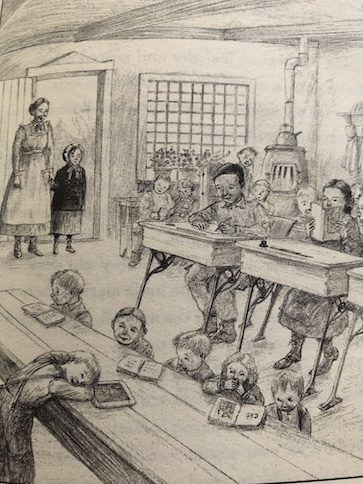
She almost misses the schoolhouse because it’s a much smaller building that she expected. Her school in the city was a multi-story building, but the local school is just a small, one-room schoolhouse. Fortunately, the teacher has been expecting her and looking out for her arrival, so she calls Betsy inside as she passes. Betsy is astonished at how few students there are, compared to her old school, and because there are so few, all the grades are just in that one schoolroom.

Even more confusingly, Betsy learns that this little school doesn’t do grades the way her old school did. Because there are so few students, and they’re all sharing the same room, it doesn’t matter too much what grade each student is studying in which subject. The teacher just moves them up and down as necessary to help them learn at their own, individual levels. At her age, Betsy knows that she should be in the third grade at school, but when the teacher has her read out loud with the other students at the third grade level, Betsy does much better than they do. She loves reading, and she reads all the time on her own, so she has progressed much faster in her reading skills than other children her age. Her teachers at her old school just never noticed because they were trying to keep track of so many students that they couldn’t pay that much attention to individual students’ progress. Her new teacher decides that she can read at a seventh grade level. Betsy is stunned and proud. The idea that she could move up multiple grade levels at once never occurred to her before as an option, but then, she worries that she can’t move up to seventh grade because she isn’t very good at math. She tries to explain this to the teacher, but the teacher isn’t concerned because she doesn’t make students study at one, consistent grade level for every subject. They can move ahead faster in some subjects than in others. When they’re struggling with one subject, she holds them back in that subject alone until they’ve mastered it. She does put Betsy back one grade level in math when she sees that Betsy is struggling, telling her that she can move up later when she’s had some time to review the material and improve.

It’s what Betsy really needs, but Betsy finds it disorienting that she isn’t part of one, consistent grade level at school. She says that she doesn’t know what that makes her, and the teacher replies that she is simply Elizabeth. Before, Betsy’s concept of school was that, every year, the students would simply move up one grade level, and that the goal of school was just for the students to move up through the levels appropriate to their age. Now, she is being introduced to the concept that the goal of education is for her to master the concepts being taught to her, regardless of the grade level, so that she will have the ability to do things like math, reading, and spelling. As long as she can learn to do these to a satisfactory level and keep improving, her specific grade doesn’t matter. In fact, when Betsy is upset later about failing an examination at school because she was nervous and made a lot of mistakes, Cousin Ann tells her that there’s no need to be nervous and that her grade on a single examination doesn’t matter because, regardless of how she did on that particular test, she knows that she actually does know the material and can use that knowledge in daily situations.

Betsy is also unexpectedly given the responsibility of looking out for a younger girl at the school, Molly. Because Molly is so good at reading, the teacher has Betsy listen to Molly read at the first grade level and asks her option of how Molly did and if she seems like she could manage the second grade level reading. Betsy has never had an adult ask her to supervise anyone younger before, and she unexpectedly discovers that she likes it and likes teaching someone younger. Later, Betsy is asked to hold Molly’s hand while they cross a log over a stream because the teacher wants older children to hold the hands of the younger ones and help them. Actually, holding Molly’s hand helps Betsy more than it helps Molly because Molly has walked on this log before and Betsy hasn’t, but being responsible for someone younger makes Betsy more bold. Although she would have been afraid to walk that log if she had to do it by herself, she can’t refuse when she has the responsibility of helping Molly. Later, she also helps to rescue Molly when Molly falls in a hole and needs help to get out. Betsy wanted to run for help at first, but when Molly begged her not to leave her alone, Betsy decides that she should do what Cousin Ann would do and figure out how she can use the things around her to solve the problem, spotting a branch that helps the younger girl climb out. Even though Betsy gets scared, when she has someone smaller than herself depending on her, she finds her courage.

Betsy has other adventures with Molly and her other new friends while living with the Putneys. When Molly’s mother becomes ill and has to go to the hospital, Molly is upset because she will have to move in with some cousins in the city who don’t really want her. Having been in this type of situation before herself, Betsy is immediately sympathetic, and she gets her relatives to agree to let Molly stay with them. Molly becomes like a little sister to Betsy, and they share in other adventures together. Along with some other girls from their school, they form a sewing circle to make some clothes for a poor boy at their school who lives with a stepfather who spends all of his money on alcohol. The book doesn’t shy away from describing how the boy is neglected, and the girls in the sewing circle are moved to tears when they go to the boy’s house to deliver the new clothes and see the circumstances he lives in. The Putneys also become concerned about the boy’s welfare, and they help arrange for him to be adopted by a man they know who has been talking about adopting a boy. Later, for Betsy’s birthday, Betsy and Molly go to the fair with some neighbors, but they are accidentally left behind when the people who were supposed to give them a ride home had to leave to tend to an emergency. Betsy is terrified, but with Molly to look after, Betsy manages to keep her head and think of a way to earn some money so they can buy train tickets home.

Betsy has been living with the Putneys for about a year when she gets a letter from Aunt Frances, who says that she will arrive soon to reclaim her. Aunt Frances thinks that Betsy must have been having a miserable time without her, but Betsy has actually come to think of the farm as home and loves it there. She doesn’t want to hurt Aunt Frances’s feelings or seem ungrateful for all the love and attention that Aunt Frances has lavished on her over the years. It seems like Betsy has to resign herself to returning to her old life in the city … unless Aunt Frances has also been making some changes to her own life since they were last together. When Betsy and Aunt Frances meet again, they truly come to understand each other, and they find a way for them all to live their best lives.

This book is now public domain and is available to read for free online through Project Gutenberg and Internet Archive (multiple copies, including audiobooks).

I really enjoyed this book! I’d heard about it for years and never got around to reading it before. Dorothy Canfield Fisher was an early advocate of the Montessori method of education in the United States, and in particular, this book presents many of the principles of the Montessori method and how it can help children. The educational themes in the story are obvious when Betsy sees the differences between the one-room schoolhouse in the country and her old school in the city.

The benefits of the smaller class size are immediately obvious. Betsy loves reading but she always hated her reading class in school because each student took turns reading, so the most any particular student could read was one or two sentences, and even then, they might not get a turn if the class ran out of time before they got to all of the students. This description feels like an exaggeration of how reading classes might have gone at a bigger school, but there may be some truth in it. When I was at school, my classes typically had about 20 to 30 students in them, and when we took turns reading, we did more than that. It’s difficult to say for sure because I don’t think Betsy ever said exactly how many students were in her class, but I would think they would have to have at least twice as many as that to be as bad as she described. According to Going to School in 1876, some large city schools could have classes of 50 to 60 students during the late 1800s, so that is possible for a class in the early 1900s or 1910s as well. I do take the point that it’s easier for a teacher to keep track of the progress of individual students when the class size is smaller.

I also appreciated what the teacher said about allowing students to progress faster in subjects that are their strengths, even if they have to take extra time for problem areas in other subjects. When I reviewed The Beast in Ms. Rooney’s Room, there is a boy in that book who was held back a year in school because of his problems in reading, and he was embarrassed about not moving to the next grade with his classmates. If he could have moved forward in some subjects, it might not be so embarrassing for him to be held back in the one subject that gave him the most trouble. The problem is that he couldn’t do that because the classes at his elementary school are organized the way the ones at my old elementary school were – one single teacher at a particular grade level teaching all of the subjects for that grade level. Under that system, remaining at a particular grade level in one subject means remaining at that grade level, with that teacher for all subjects.

There is only one teacher at the one room schoolhouse in the story, so there’s no conflict about a student seeing one teacher for some subjects and another teacher for other subjects at a different grade level. All of the students are in just that one room with one teacher all the time, so the only difference when a student moves up or down in level for a subject is the book that the teacher gives them to study. That means that changes in grade level can be done informally for any or all subjects, whenever the teacher decides that a student is ready to move to the next level. The student just turns in their old book and gets a different one to study. If most grade levels were determined that easily for different subjects, I think there would be fewer parents who would be concerned about the prospect of holding a child back a grade temporarily to give them a better grounding for moving forward later, and students would experience less embarrassment about problem subjects if they could receive acknowledgement for better skills in other subjects. However, I can see that this system would be complicated in bigger public schools, and there would have to be a point when the student would have to master their series of subjects at a particular level to know when they could graduate from their school. I think that’s part of the purpose of the examinations Betsy describes in the book, but because the book only covers a single year, we don’t see what happens when a student is ready for graduation.

In the beginning, Aunt Frances, in spite of all of her good intentions and research into psychology and raising children, unintentionally transfers her personal anxieties to Betsy without really giving her the tools that she needs to manage them, so they feel overwhelming to Betsy. The solution to this problem, as presented in the book, seems to be mostly being around people who do not express worries about things (if they’re nervous about anything, they mostly cover it up and don’t talk about it, except for one time, which I’m going to talk about) and who present manageable challenges to Betsy to show her that she can handle more than she thinks she can. I like the part about giving Betsy manageable challenges and some basic instructions for how to accomplish them when she doesn’t seem to quite know what to do. If they had just thrown challenges at her with no instruction at all, in a kind of sink-or-swim fashion, I think she would have been just overwhelmed and more panicky. However, I think there’s a point in the story that could use more clarification.

The differences between Betsy’s sets of relatives is initially presented, particularly by the aunts she’s been living with, as one of understanding and sympathy. Great-Aunt Harriet and Aunt Frances initially don’t like the Putneys because they don’t seem sympathetic enough, especially with people who are sensitive and nervous. Aunt Frances dedicates herself to sympathizing with Betsy about everything and talking to her about everything in her life, and the book presents this as a negative because their sympathetic conversations about the worries they have end up being a way of making each other more nervous. I think, in real life, there’s a happy medium between never talking about worries and wallowing in them.

The first problem with Aunt Frances’s attempts to sympathize with Betsy is that she makes assumptions that things that bother her will also bother Betsy, and this becomes the way that she accidentally transfers her anxieties to Betsy. Second, when Aunt Frances sympathizes with Betsy about worries or problems, she tends to dwell too much on the problem itself and how bad it feels, magnifying the issue and making Betsy feel worse. What I’m trying to say is that Aunt Frances’s attempts to sympathize would have worked much better if she had been willing to listen to Betsy’s concerns and sympathize a little about how certain things can make a person nervous but then move on to offering practical tips to deal with these feelings and different ways of looking at situations to take some of the anxiety out of them.

I didn’t like it when Cousin Ann seemed to shut Betsy down when she was talking about how tests at school make her nervous because I don’t like the idea of shutting people down when they’re talking about something important to them, but what made it better to me was that she did listen to Betsy for a bit before that and had already offered her a different way to look at tests that makes them seem more fun and less scary. When Cousin Ann cuts the conversation short seems to be the point when discussing and sympathizing is about to turn into brooding and dwelling on the negative. My only thought on that conversation is that it might have helped for Cousin Ann to point that out. Rather than asking if Betsy really wanted to keep talking about this, which makes it sound like disinterest in what Betsy’s saying, I think it might have been better to point out that, if she keeps dwelling on the parts of the experience that make her feel bad, she won’t let herself move forward, to see the parts of the experience that could be exciting opportunities and possible triumphs. Perhaps, it would be good to add that one poor test experience doesn’t mean that others will feel the same way or that she can’t do better the next time, especially if she spends her time in between tests focusing on how much she enjoys what she’s learning and how it can be fun to show others what she’s learned and what she enjoys about her lessons, putting herself in a better frame of mind for the next time someone asks her questions about what she’s learned. I just think that approach would help emphasize the lesson that Cousin Ann would really like to teach Betsy about reframing challenges in her mind and also help clarify that she’s not ending the conversation because she’s not sympathetic but because it’s better to give the positive thoughts time to take hold rather than dwell on the worries.

I think it’s also important for both Betsy and Aunt Frances to recognize that it’s okay to feel nervous but that it’s possible to handle situations even though they make them nervous. As someone who has had life-long issues with anxiety, I can also attest that one of the best approaches is learning not to be afraid of feeling afraid of something. That is, learning to recognize that being nervous isn’t a sign that a situation is unmanageable or that the feeling of anxiety itself is necessarily going to be overwhelming, something that Betsy learns through practical experience in the story. There are still times in the story where Betsy is afraid and has to handle difficult situations, but she learns that she can proceed and do what she needs to do even though she’s nervous and isn’t sure at first how things will work out. It isn’t explicitly spelled out in the story, but this is probably the most important lesson that Betsy was missing from her time living with Aunt Frances.

There are no villains in this story. Although readers can see at the beginning that living with Great-Aunt Harriet and Aunt Frances has caused some emotional complications for Betsy because she has taken on their worries and anxieties, they do mean well and have made real efforts to understand Betsy and support her, as best they know how. Great-Aunt Harriet and Aunt Frances just have very different, more timid personalities than the Putneys and don’t find their style of communication reassuring or appealing. However, Betsy discovers, to her surprise, that she does come to appreciate the Putneys and that they are a good influence on her, helping her to come out of her shell, discover new abilities and interests, and develop some self-confidence.

At first, Betsy is a little offended that her Putney relatives don’t fuss over her like Aunt Frances did, and it makes her feel like they don’t care about her, but they do care. They are just more low-key in showing the ways that they care. They are a family that doesn’t like to fuss about anything. Personally, I thought that Cousin Ann should have let Betsy talk a little more when Betsy was distressed about doing badly on her exam, but I do see her point that Betsy’s talking about it seemed to be upsetting her more because she was dwelling on the problem rather than consoling herself and looking for solutions or new ways of thinking about the situation. Cousin Ann points out that exams aren’t always negative, and even when one doesn’t turn out so well, it’s not the end of the world, giving Betsy a new way of looking at the situation and defusing Betsy’s sense that every little setback is a tragedy.

The Putneys show how much they truly care when Betsy and Molly are accidentally left behind at the fair. When Betsy manages to get Molly home, she sees her relatives rattled and upset for the first time when they realized that the girls were lost, and they do some rare fussing over the girls, praising Betsy for her ingenuity in handling the situation. Although the Putneys normally make it a point to deal with things coolly and calmly, they do care about the girls and can get upset if they think there is a serious problem. They are not without feelings. They are also genuinely upset when they think Aunt Frances is going to take Betsy away, each finding their own way to show Betsy how much they care and how much they will miss her.

Fortunately, Betsy is allowed to stay with the Putneys in the end. When Aunt Frances comes to get her, she reveals that, in the year they’ve been apart, she has met a man and fallen in love. She is going to marry him, but marrying him means making some changes to her life, the greatest one being that they are not going to return to their old house. Great-Aunt Harriet has recovered from her earlier illness and has gone to live with another relative, and because her new husband has to travel constantly for business, Aunt Frances won’t be keeping a settled house at all. Aunt Frances, although usually timid, is actually looking forward to doing some traveling. She is still afraid of things like animals and would never be an outdoor/country kind of person, but travel to different cities sounds like her kind of excitement. However, she can see the difficulty of traveling with Betsy. Constantly moving would be difficult for her education, a complication that I was surprised that the characters didn’t spell out when they were talking to each other, given the educational themes of the story.

Betsy and Aunt Frances come to a new understanding of each other and the differences in the lives they want to live when they talk about what these changes would mean for their lives. Aunt Frances doesn’t want to simply abandon Betsy to the Putneys if she isn’t happy with them, but she can see that Betsy does like living there and would be happy to stay. Betsy hadn’t wanted to make Aunt Frances feel abandoned and unappreciated by telling her in the beginning that she wanted to stay with the Putneys, but when she learns that Aunt Frances will be happily married and enjoying the new experience of travel, she is able to tell Aunt Frances that she can see that having her come along would be inconvenient for her and that she would be happy to stay with the Putneys. Neither of them is offended or worried about living apart now because they can see that each of them will be happier with Betsy living with the Putneys. Aunt Frances is now free to get married and go where she wishes with her husband, assured that Betsy is doing fine and living in a stable home with people who care about her, even if it’s not quite living the lifestyle that she would like herself. Aunt Frances also promises to come visit sometimes, so it’s not a permanent goodbye.

The Windy Hill

The original cover is public domain and available through Wikimedia Commons

The Windy Hill by Cornelia Meigs, 1921.

Oliver and Janet are spending the summer with their mother’s cousin, Jasper, who is a wealthier man than the rest of their family. Janet is enjoying the visit and Jasper’s grand house so far, but Oliver is very uneasy there. Oliver doesn’t like the vast, empty house, and he’s noticed that Jasper’s manner seems different from he remembers the last time they saw him. Oliver senses that something is troubling Jasper, something that he doesn’t want to discuss. Jasper is usually a cheerful person who enjoys his cousin’s children, but during this visit, he hardly pays attention to them and never smiles. Janet finds things to do to keep herself occupied, but Oliver is terribly bored and bothered by Jasper’s odd behavior.

Then, one evening, Jasper sees Oliver looking at a nearby house. He says that the people who live in that house are also cousins of theirs, but he’s been too busy lately to see much of them. Jasper apologizes for having neglected Janet and Oliver during their visit so far, and he says that he will invite Eleanor, the daughter of the cousin who lives in that house, to lunch the next day. Eleanor is close in age to Janet and Oliver, and Jasper thinks that they will be friends and that a visit from her will liven up the visit for them. Janet is pleased at the idea of another girl cousin visiting, but Oliver is at that phase where he doesn’t like girls. He can’t imagine that he would have anything in common with this unknown girl cousin, and he thinks he’ll be bored while Janet and Eleanor have fun together. He tries to tell Jasper as much, but Jasper is just amused by his attitude and tells him that, if he is afraid of girls, the sooner he gets over it, the better.

When Jasper orders his car and driver to take Janet and Oliver to see Eleanor, Oliver decides to rebel by going to the train station and trying to get a train home. However, while he is waiting at the train station, he becomes curious about the countryside around him and the nearby river he hasn’t yet investigated. He wanders off to explore a little and encounters a man and a girl at a nearby cottage. The man and the girl ask him to help them with their beehives. Oliver is a little nervous of the bees at first, but he follows the beekeeper’s directions and finds himself enjoying the work. The beekeeper and his daughter, Polly, invite him to join them for lunch afterward. After a lunch of biscuits, honey, and iced cocoa, Oliver feels much better about everything.

Polly thinks that she and her father have somewhere they need to be after lunch, but her father tells her not to worry about that. Instead, he entertains Oliver and Polly with a story about a Native American medicine man, a boy who is curious about what lies beyond the ocean, and their first encounter with white people. By the time the story is over, Oliver realizes that he has missed his train. He decides to return to Jasper’s house, where he is told that Janet didn’t go to see Eleanor because Eleanor was delayed somewhere. (Guess where.)

More and more, Jasper’s odd mood becomes apparent. His servants have also noticed how worried he’s been, and it seems like he’s always more upset after a mysterious and disagreeable man comes to see him. Nobody knows who he is or what his visits are about. Oliver knows how to drive, and Jasper has Oliver drive him out on a mysterious errand one evening to see someone. Oliver doesn’t know who Jasper talks to or what they say to each other, but the visit takes a long time, and it makes Jasper angry.

Oliver’s visit with Jasper gets better because Jasper allows him to use the car by himself from that point on. He takes Janet to visit the Beeman and Polly. Although Oliver is still not enthusiastic about girls, he likes Polly because she is very different from how he imagines that cousin Eleanor must be. The Beeman says that they have to pick up some new beehives that day, and Oliver volunteers to take the girls to get the hives from a man named John Massey. John Massey complains about his landlord, who hasn’t been maintaining the dikes. Massey has had to take it on himself, and the burden is becoming too great for him to bear.

It turns out that Massey’s landlord is Anthony Crawford, the unpleasant man who has been troubling Jasper. Crawford also seems more than happy to let Olive and Janet know that he is also a cousin of theirs. He seems to be under the impression that Jasper has cheated him in some way. Jasper says that he’s already given him what he’s entitled to have, but Crawford says that his share should be more than that. Crawford says that, if Jasper doesn’t give him what he really owes him, he can take everything Jasper has and destroy his reputation in the process. There are secrets in their family’s past that would cause a scandal if the public knew about them, and Crawford says that if people knew that there was one crook in their family, they would all be suspicious that Jasper is much the same way.

Oliver doesn’t know what to think of Crawford’s insinuations or his threats. Not knowing who else to turn to, Oliver explains the situation to the kindly Beeman and asks him what he should do to help Jasper. The Beeman knows far more about everything that’s been happening than Oliver knows, and he say that Crawford has unknowingly been laying a trap for himself. Crawford thinks he’s pretty sharp in his dealings with other people, but he’s been neglecting something very important. Actually, multiple things.

In a series of stories that the Beeman shares with the children, he indirectly tells the children the history of their family and quarrels that go back generations. He tells them about a family with a shipping business that restored their lost fortunes during the War of 1812 by turning to piracy. He tells them about siblings divided by quarrels over money during the Gold Rush. Although the Beeman doesn’t admit to the children that all of his stories are true in the beginning, they soon come to realize that they are and that they are directly connected to the them and the current situation.

Toward the end of the book, the Beeman ties all the pieces of the puzzle together before telling them the final story, the one about three cousins named Jasper, Anthony, and Thomas, who were all raised together and were very close, until they had a falling-out over Anthony’s scheming and his unethical dealings. There are reasons for everyone to resent Anthony for his meanness and greed, but the Beeman is correct that Anthony has set himself up for a fall. He really should have listened when everyone tried to tell him to fix the dike.

The book is available to borrow and read for free online through Internet Archive (multiple copies) and Project Gutenberg. Because it is in the public domain, there is also a LibriVox Audiobook recording.

My Reaction and Spoilers

The Family’s Story

In some ways, the story of the family in the book is also a celebration of American stories. The short stories about different generations in their family are set at turning points in American history. Something that fascinated me about these stories was that they were not all glowing about these points in American history and their associated legends. There are parts of the stories that emphasize the bold American values of adventure and ingenuity, but there are also dark sides and downsides to the stories and flawed characters. The family fortunes were set partly by piracy, but one of the heroes of the family was the man who realized when it was time to stop. Members of their family have been consumed by greed and quarrels, although some have overcome their flaws and misconceptions to come together and be a family again. Again, the Gold Rush story resolves happily when the brothers involved also realize the folly of endlessly pursuing riches at the expense of relationships with the people they love. There is even a slight rebuke against the westward expansion of the United States – portrayed heroically but also as highly costly as people died and killed others over land and gold and promoting an endless, unhappy quest for more and more, with people living their whole lives never feeling satisfied. In short, the family, like the stories and American history itself, is a mixed bag, and they are at their best when they realize their wrongs and make the decision to change. For a book from the early 1920s, a period of heightened patriotism and prejudice after WWI, it seems remarkably insightful and self-aware.

It was Anthony’s decision to forge a relative’s name to get money to cover his unethical dealings that ruined his relationship with his family. It was only by their charity and intervention that he wasn’t charged with his crime and sent to prison. He’s fully aware of that, but he’s been resentful about it rather than grateful. Even from a young age, Anthony had always coveted what other people had. Even if he didn’t really want things for their own sake, he would go through elaborate schemes and bitter fights to get what someone else had, just because someone else had it. Out of greed and spite, he has resurrected old property quarrels in their family. He not only got the old house that was originally willed to Jasper, but he has been scheming to get Jasper’s new house. The Beeman (who is the third cousin in the last story and father of Eleanor, who is called Polly as a nickname) says that Anthony should have headed the lessons learned by their family during the Gold Rush, that always reaching and reaching for greater prizes means never being satisfied with what one has and risking its loss in pursuit of the unattainable.

In the end, when Anthony’s scheming and corner-cutting leave him with no one to turn to but the family members he has harassed and schemed against, he finally experiences a change of heart. I find stories where the villain has a sudden change of heart after long-term villainy to be unrealistic, but the crisis that Anthony realizes he caused is sudden and serious. Because he has neglected the dike and driven away the people who were helping to cover his negligence at their own expense, he suddenly realized that he has endangered many lives, and everyone knows that it’s all his fault. He schemed to get control of that land but didn’t take care of it when he had it. Everyone knows what he did, nobody’s going to cover for him, and while he’s unscrupulous enough to scheme to get others’ property, he doesn’t want to be responsible for killing people. It’s enough to make him swallow his pride and acknowledge the reality of the situation to his cousins. They help him for the sake of the people in danger, and in return, he decides to leave the area.

In the end, Anthony takes a hard look at himself and his life, and he realizes that he and his wife and children were better off when they lived in another community, where he was forced to work for a living instead of by his schemes. He now fully understands his weaknesses and temptations, and rather than continuing to resent the things and people in his life that stop him from furthering his schemes, he has come to welcome them as the guiding forces that keep him from making destructive decisions. The way he phrases it struck me as a little corny, almost like the end of a PSA, but I approved of the sentiment. His family members made him angry because they saw him for who and what he was, but the point is that he now understands who and what he is himself. Although the others are willing to allow him some leniency because of the way he handles the crisis, Anthony realizes that he must give himself the discipline he needs and be the changing force in his own life.

Overall, I thought it was a pretty good story, although there are a few issues with racial language related to Native Americans. I’m not sure if there is a modern revised version of this story or not. The version that I’m reviewing is the original from the 1920s.

Native Americans in the Story

I found the first story the Beeman tells, the one about the Native Americans, fascinating because the story contains the concept that Native Americans arrived in the Americas by crossing the Pacific Ocean and moving eastward across the continent. I know that’s the modern concept of the origins of Native Americans, but I was surprised to find the concept in a book from the early 1920s. I didn’t realize that people in the 1920s had that concept because I thought the older theory was that Native Americans crossed a land bridge.

During the story about the Native American medicine man, the book uses the term “squaw”, which is a controversial term because, although it apparently can mean just “woman” in some Native American languages, it can mean something vulgar in others. Modern books avoid the use of the word, but it appears in some older books, like this one, because white people weren’t always aware of the connotations the word could have. This is the danger of using words you don’t fully understand. It isn’t meant in an insulting way in this book, but be aware that the word appears here and that it isn’t a good word to use yourself. If you’re referring to a Native American woman, just say “Native American woman”, and leave it at that.

The book also uses the word “Indian” instead of Native American, something that also appears in older books. I’ve explained before that this hearkens back to a much earlier misunderstanding about who Native American peoples were, and the nickname has stuck to a certain degree. However, modern convention is just to say “Native Americans” because it’s both a more accurate description and less confusing than explaining American Indians vs. Indians from India. I don’t mind the use of that term too much because it isn’t insulting. However, the book also occasionally uses the term “Red Man” to refer to Native Americans. The characters saying that don’t seem to use it out of malice, but I still think it’s inappropriate. I think that sort of thing went over my head when I was a little kid because I knew people were referred to as “white people” and “black people”, but after I was old enough to understand that there were other connotations to the term it became one of those terms that I think of as “derailing terms.” Even if the characters use it in a non-hostile way or kind of thoughtless way, we (the readers) know that there are hostile or demeaning connotations to the term. It just derails the train of thought of readers like me because we stop to process whether or not the character is trying to be insulting or demeaning, and it just distracts from the rest of the sentence and the thread of the story. I’m generally in favor of reprintings of books like this, with the racial terms updated because, provided that the author and characters are not trying to be demeaning or insulting, a change in the language can clarify attitudes and put the readers’ attention back where it belongs – on the story itself.

Native Americans also appear in the story about the Gold Rush, as risks encountered by westward travelers. Their appearance in the story is minimal, if stereotypical.

The Silver Nutmeg

It’s late summer, and it’s very hot. The well is dry, so Anna Lavinia has to go to the spring whenever they need water, and the paw-paws are falling off the trees even though they’re not ripe yet. Anna Lavinia is spending most of her time outside, singing songs from her favorite book Songs from Nowhere, because her mother is making the green paw-paws into preserves, and it’s a smelly process. Nothing seems like it’s going right, and even Anna Lavinia’s animal friends are grumpy because of the heat.

Anna Lavinia looks at Dew Pond Hill through the hole that her father recently made in the garden wall. He made it because he’s been thinking that Anna Lavinia has been too cooped up, and he wants to “broaden the horizon for her” and give her a new “point of view” in a very literal sense. Anna Lavinia thinks that she already has many points of views on many issues, but she does like the new vista that her father has opened up for her.

Things seem to improve on this very hot day when Uncle Jeffrey comes to visit. Uncle Jeffrey deals in spices, and he brings herbs and spices with him to replenish the family’s supply. Uncle Jeffrey also likes to collect samples of flowers and leaves, which he keeps pressed in a book with labels of their names (if he knows them) and the places where he found them. This time, Anna Lavinia notices a special purple flower in his book that she has never noticed before. There are no notes about it in the book, but she is sure that it is something special.

Then, she notices three men digging for something by the dew pond on the hill and decides to go see what they’re doing. Uncle Jeffrey warns her against going to the dew pond because he says that dew ponds are always bewitched. However, her mother thinks that’s nonsense and sees nothing wrong with Anna Lavinia going to look at the dew pond. When Anna Lavinia talks to the diggers, they joke with her at first that they’re digging a hole to go to exotic places on the other side of the world, but then, they admit that it’s just a ditch for water. They want to drain the dew pond! Anna Lavinia is upset about that, and they explain that they need the water to grow their parsnips. They say that this won’t be the end of the dew pond because they plan to fill in the ditch, and the pond will eventually fill up again. However, they really need the water now.

Anna Lavinia goes to look at the dew pond and enjoy it while she can, thinking how awful it is that it’s going to be drained just when her father created a new view of it for her. While she thinks about it, she tosses a few acorns in the water. Then, suddenly, one of them jumps back out of the water at her! Strangely, the acorn also seems completely dry. Curious, Anna Lavinia tosses in another acorn. This time, when it flies back at her, it has a note pinned to it that says, “Please don’t throw acorns at me.” When Anna Lavinia looks into the water, she doesn’t see her own face reflected back at her. Instead, she sees a blond boy in a green sweater. She looks around, but she doesn’t see anyone else by the dew pond but herself. When she calls out to the boy to ask where he is, he says that he’s on the other side of the pond – the underside!

The boy says his name is Tobias, and he’s playing with a boat on the pond. Anna Lavinia asks if he can come up to her through the pond, and he says he could but he promised his mother that he wouldn’t. However, she can come through the pond to him, if she likes. He says that, for her to get through, the water must be completely still, no ripples, and that she must jump in as hard as she can. Anna Lavinia asks what will happen if she doesn’t do it right, and Toby tells her that she’d probably just get all wet and get a scolding from her mother. Anna Lavinia debates about it because Toby is upside down compared to her, and she’s not sure how gravity will work on the underside of the pond. Toby says that the right side up depends on your point of view and there is no gravity where he is. He shows her a net in a tree where she can jump and teases her about being afraid. Deciding that it’s a small risk, Anna Lavinia jumps in along with her pet lizard, which she calls a thobby.

It works just like Toby said it would, and Anna Lavinia lands safely in the net. Once in Toby’s land, she experiences a strange sensation that they call “the tingle.” (It’s not a dirty thing, although I did raise an eyebrow at first.) This sensation is a kind of force that Toby says flows through the ground in his land, and it’s what keeps objects from just floating around all the time in the absence of gravity. If you lift an object off the ground, it will float around in the air because there is no gravity, but once it’s in contact with the ground or in contact with another object that’s in contact with the ground, it will stay where it is, held in place by this force, until someone or something else causes it to move. Toby describes it as being like a kind of magnetism.

With Toby’s help, Anna Lavinia experiments with this lack of gravity. Toby explains that people can’t fly in his land, although birds can fly through the air with their wings. People do lose contact with the ground if they skip or jump, but it’s usually not a big deal because they can sort of maneuver themselves in the air until they can get back down to the ground or grab hold of something that’s grounded. It’s impossible to fall.

All of Toby’s world is the underside of our world, and the ground they’re walking on is the inside of the ball that is the Earth. Because it’s the inside of the Earth, it’s dimmer than the outside world. The light that comes through comes through bodies of quiet water, like the dew pond. Toby says that, while people from this inside world can go to the surface area through any still pond, they typically don’t. For one thing, they find it difficult to deal with the gravity of the outside world, and it will turn them bandy-legged if they stay too long. For another, people who left used to be banished by their own people if they returned, so those who have gone to the outside world have often stayed. Toby’s Aunt Cornelia still misses the man she had planned to marry. After the two of them quarreled about his desire to see the world, he vanished, and Aunt Cornelia thinks that he probably went to the outside world, never to return. Things have changed now so that people who left are now allowed to return, so Aunt Cornelia hopes maybe her sweetheart will come back, but Toby doesn’t think there’s much hope of that.

When the children hear a baby crying, Anna Lavinia insists on finding the baby and seeing why nobody seems to be tending to him. It turns out that the donkey pulling a gypsy wagon has pulled the wagon over a cliff, which isn’t as dire as it sounds, since nothing in this land can fall. However, the wagon is now stuck sideways on the side of a cliff, and things from the wagon have been tossed around and are hanging in mid-air, including the baby in his basket. Toby and Anna Lavinia rescue the baby, and his grateful mother offers them a reward for their help. She gives Toby a tambourine, and she tells Anna Lavinia’s fortune. The fortune comes out strangely backward because Anna Lavinia is from the outside world, but from what they gypsy sees, it looks like Anna Lavinia is going to do something to make an old man happy.

Anna Lavinia has a lovely visit with Toby and Aunt Cornelia, but then, she suddenly remembers that the men are going to drain the dew pond today! By the time she and Toby return to the dew pond, it’s dry! With the pond dry on her side, Anna Lavinia can’t get home … unless still waters run deep.

This book is the sequel to an earlier book called Beyond the Pawpaw Trees, which first introduced the character of Anna Lavinia.

The book is sweet and would probably appeal to fans of Cottagecore. The characters sing songs and recite rhymes throughout the story, which might appeal to young children. I was a little divided over whether I liked having the story interrupted by the songs and rhymes, but the songs and rhymes really are a part of the story and add to its charm. It’s a little like Alice’s Adventures in Wonderland, where a girl goes to a magical land, where things don’t work as they do in the ordinary world.

In Alice’s Adventures in Wonderland, there’s a lot of random nonsense, and that’s fun, but I liked that this particular story uses a kind of pseudo-scientific focus on magnetism and gravity. Neither the magnetism nor gravity works the way it does in the real world, and it adds a kind of science-fiction twist to the fantasy world in the story. Even with this almost science-fiction twist, we still have that old-fashioned, cottagecore style fantasy atmosphere that’s charming and whimsical rather than technical. I haven’t read the first book in this series, but I understand that it uses similar concepts. Nothing really stressful happens in the story, and it would make a nice bedtime story.

My one complaint is that there are some stereotypical gypsies and comments about gypsies in the book. They are always referred to as “gypsies” and not Romany or any other name, and for some reason, they make a point at the beginning of the story that gypsies always go barefoot. I’m not sure what the point to that was except to establish that gypsies have eccentric habits. It’s not unusual for children’s books from the mid-20th century to have stereotypical gypsies as characters, although it might rub people from the 21st century the wrong way.

The Moon Jumpers

The Moon Jumpers by Janice May Udry, pictures by Maurice Sendak, 1959.

In this pleasant, relaxing children’s picture book, some children enjoy a beautiful summer evening! Some of the pictures are in black-and-white and some are in color, but the best pictures are the full-color, full-page illustrations. The illustrations are by Maurice Sendak, who wrote and illustrated Where the Wild Things Are. The story is told from the point-of-view of the children.

While their parents are in the house, the children go outside to enjoy the relative coolness of the evening. They run barefoot through the grass and play tag.

They climb a tree “just to be in a tree at night.” They set up their own camp, make up songs and poems, and tell each other ghost stories.

The moon is rising, and the children jump in the air, trying to touch it, although they know they can’t.

Eventually, their parents call them inside to go to bed. As the children go to bed, they say goodnight to the moon through their bedroom window.

The book is available to borrow and read for free online through Internet Archive (multiple copies). It’s a Caldecott Honor Book!

My Reaction

This is a nice, calm book that would make a good bedtime story on a summer night! It reminds me a little of Goodnight Moon, Time of Wonder, and The White Marble, which are other calm bedtime stories. It isn’t told in rhyme like Goodnight Moon, but it does show the beauties of summer and evenings spent outside, like Time of Wonder and The White Marble.

The Bobbsey Twins’ Adventure in the Country

Bobbsey Twins

The Bobbsey Twins’ Adventure in the Country by Laura Lee Hope,1907, 1961.

Before I explain the plot of this story, I have to explain that this is one of the early Bobbsey Twins books, originally published in the early 20th century, and like other Stratemeyer Syndicate books that were still in print during the mid-20th century, it was revised from its original form to update the language, culture, and technology in the story and, especially, to remove questionable racial terms and caricatures. The physical copy of the book I read as a kid was the revised version, and I didn’t know about the revisions until I was an adult. When I describe the plot at first, I’m talking about the revised version, but I’m also going to explain some of the differences between the original version and the revised version, so you can see what changed.

The two sets of Bobbsey Twins (Nan and Bert are the elder set of twins and Freddie and Flossie are the younger set) are enjoying their summer vacation at home when their mother receives an invitation for the family to visit the children’s aunt and uncle on their farm and to attend an auction that will be held somewhere nearby. The aunt says that there is something that will be sold at the auction that she thinks will interest the family, but the adults are keeping it as a surprise. The children are excited because they like visiting the farm, and they’ve never been to an auction before.

Mr. Bobbsey has to work at his lumber yard, so the children and their mother take the train to the farm ahead of him, accompanied by their cook/housekeeper, Dinah. (Dinah is black and is a recurring character in the series. The book refers to her as “colored.”) The train trip is a bit chaotic because they nearly forgot to bring their packed lunch, and then, Fred’s cat escapes from its carrier and is nearly left behind when they reach their destination. However, they do get there safely.

At the farm, the children enjoy seeing their cousin, Harry, and visiting all the animals. Freddie loses one of the calves when he tries to take it for a walk, like it’s a dog, and at first, the children fear that it fell in the river and drowned. Fortunately, someone from a nearby farm finds the calf and brings it home. These unrelated misadventures are just the beginning of the children’s summer because there is a mystery that seems to be unfolding at the farm.

On their first night at the farm, Flossie wakes up in the middle of the night because she hears someone playing the piano. She wakes Nan, and the two of them go downstairs, but by the time they get there, whoever was playing the piano is gone. At first, the children’s uncle thinks that it was just a dream, but Nan knows that it wasn’t because a piece of sheet music was knocked off the piano. Later, when they hear the piano at night again, there are smudges on the keys.

The auction is fun. The children each have a little money to buy something small for themselves, just for the experience of bidding on something at an auction. They all find something to buy, and some of the things they find are funny and eclectic. The mystery object that their mother is there to buy is a pony and cart. A neighbor of the aunt and uncle had a pony and cart that his grandchildren used, but they’ve moved away, and the Bobbseys have decided to buy it for their children. The twins’ aunt and uncle are willing to keep them at their farm because they can’t have a pony in the city, and their cousin can use them when the twins aren’t there. The children love the pony, and they have fun with him and the cart with some other kids. However, when they return to the farm after they auction, they discover that the family’s prize bull has been stolen!

The story is somewhat episodic, but there is a thread of mystery that runs through the whole book as the children try to find the missing bull. There’s a boy from New York City who was lost from a group heading to a nearby Fresh Air Camp (part of a charity that has existed since the 19th century to provide poor city children with enriching summer experiences in the countryside – I referred to it before in another vintage children’s book, Ruth Fielding at Sunrise Farm) who witnessed the theft but didn’t realize that the men he saw didn’t own the bull. There’s a Fourth of July celebration and a picnic with other kids, including a local bully. There is some real danger, where Flossie falls over the edge of a cliff and has to be rescued, and the family has to evacuate the farm temporarily when they fear that a nearby dam might break after a fierce storm. Along the way, the Bobbsey twins gather pieces of information that help them find the missing bull.

The book is available to borrow and read for free online through Internet Archive (multiple copies). The original edition of the book is public domain and available online through Project Gutenberg.

My Reaction

The Mystery

The mysteries in the story are pretty simple. The story is pretty episodic, and the nighttime piano-playing is unrelated to the theft of the bull. The reasons for that are partly related to the way the book was written in the original version. Originally, the book was more of a general collection of stories about how the Bobbsey Twins spend their summer on their aunt and uncle’s farm and have little adventures there, and it wasn’t really a mystery story. One of the features of Stratemeyer Syndicate books is that chapters are always supposed to end on cliffhangers to keep the stories exciting and encourage children to keep reading. That format lends itself well to the mystery genre, which is why some Stratemeyer series that originally started as more general fiction or adventure gradually evolved into mysteries, but some of the early books, like this one, kind of end up being somewhere between mystery and general fiction and read almost like collections of shorter, interrelated stories.

The theft of the bull didn’t occur at all in the original story, but there was a thread through the book about the piano playing at night. In both the new and the old versions, they eventually find out why, but there are different explanations between the versions. In both versions, the nighttime piano player is an animal, not a human.

Original Version vs. Revised

Like other Stratemeyer Syndicate books that were in print in the mid-20th century, the early Bobbsey Twins books were revised and reprinted around the time of the Civil Rights Movement, both to update the technology and slang in the stories and to remove inappropriate racial language. The 1960s edition of the book uses the word “colored” to refer to the housekeeper/cook who works for the Bobbsey family and her husband, which was an acceptable term in the early and mid-20th century (as in The National Association for the Advancement of Colored People, or NAACP), but the word “black” became the common accepted informal, generic term and “African American” became the accepted formal, specific term post-Civil Rights Movement because people were trying to distance themselves from racial words that, while they were not meant to be derogatory, had some emotional baggage attached to them. In the case of this particular book, the changes from the original version to the version I have include making Dinah more intelligent and eliminating the use of stereotypical black people speech. In the original book, even though she’s an adult, Dinah seems childlike in her reactions to things and seems to need the children to explain things to her, like the scale they see at the train station. When she speaks, her speech is spelled out with a strong accent (ex. “dat chile” instead of “that child”), and she throws out phrases like, “Lan’ o’ massy!” In the revised version, she acts and speaks more like the other adults.

Something else that changed from the original version is how much emphasis there was on poor people vs. upper middle class people, like the Bobbseys. The older version of the story emphasizes more how poor the kid from the Fresh Air Camp is and how charitable the Bobbseys are toward him. There are also other instances of charity toward the poor, like when Nan lends another girl a dress because they need to wear white dresses for the Fourth of July celebration, and the other girl doesn’t have a white dress. The book is careful to mention that nobody else knows that the other girl was borrowing a dress from Nan, with the implication that it would have been embarrassing or a mark of shame for people to know that it was a borrowed dress instead of one of her own. Things like this appear in many vintage children’s books from the 19th century and early 20th century, but it’s not something you find much in modern modern books, at least not described like that. Even when I was a middle-class kid in the late 20th century, it wouldn’t be assumed that a kid would necessarily have certain types of clothes for a special occasion or that their family would be able to just quickly buy something new for one-time use. It was also normal for people to borrow things from friends, even just on whims, so borrowing a dress for one-time use for a special occasion wouldn’t have been regarded as either an act of charity or anything to cause embarrassment, if other people just happened to know about it.

Even though there are things in the stories that were changed to make the stories contemporary with the time of the revisions, the 1960s, there are still aspects of the stories that would be out-of-date culturally by 21st century standards. One of those issues relates to how the adults in the story handle the children. One of the adults in the story tries to resolve the bully situation by letting Bert physically fight the boy who was picking on him, telling both the boys to wrestle with each other to settle their differences and get it all out of their systems. This is not advice that most modern adults would give to kids, and one good reason for not giving that advice is that it doesn’t work, not even in this book. First of all, the kid being bullied might not be the winner of the wrestling match in real life, and no kid should be forced to fight physically just because some bully wants to beat them up. In the book, Bert wins the wrestling match because he’s had wrestling classes before, but as the case would probably be in real life as well, it resolves nothing. The bully is resentful about losing the fight and continues to bully him and play mean tricks on the other kids. The bully episodes are basically there just to add conflict and excitement to the story, and they don’t do much more than that.

I was a little surprised that they left in the part from the original story where the kids put on their own circus, and they have an act they call the “Sacred Calf of India.” In the revised version, Nan wears an improvised sari for this act, and they teach the calf to do a trick. Animals doing cute little tricks are just fine, but adding in the exoticism seems in poor taste. I suppose that they left this part in the revised version because it’s not trying to be insulting to people from India, more that the kids are trying to play on the concept of circus acts and snake charmers, but it is another example of something that you find sometimes in vintage books but wouldn’t be likely to find in modern ones.

Ruth Fielding in Moving Pictures

Ruth Fielding

One day, while Ruth Fielding is out with her friends, Helen and Tom, they see a film crew working by the river. (Because this is the 1910s, they are making a silent film and using the kind of old-fashioned movie camera that needs to be cranked, like the one shown in the picture to the right.) They talk about whether to not they would like to be in movies themselves. The girls think it sounds exciting, but Tom thinks that they’re too young. The girls say that they are not too young because the actress who is being filmed looks like she’s about their age. As they watch, the young actress accidentally falls into the river, which is freezing cold because it’s winter. Ruth and her friends hurry to help pull her out before she drowns. When they get her out of the river, Ruth is appalled at how unconcerned the director is for the actress’s health while she’s clearly suffering from the cold. Ruth and her friends take the actress, Hazel Gray, back to the Red Mill where Ruth lives, where she can warm up and recover.

While Hazel is resting at the Red Mill, she and Ruth tell each other about themselves. Like Ruth, Hazel is also an orphan. Her parents were actors, and some friends raised Hazel to be an actress after her parents died. Ruth tells Hazel that she has been thinking about writing a movie scenario (script) just for fun, and Hazel offers to show it to the director if she does. Ruth isn’t sure she likes the idea because she didn’t like the director, Mr. Grimes. Hazel explains that, while the director can be callous and abrasive, he is a famous director who really knows his business and can help actors and scenario writers make their careers.

The next day, Mr. Hammond, the manager of the film company, comes to the Red Mill to see how Hazel is and to ask Ruth about how the accident happened. He seems concerned about whether or not Ruth’s description of what happened matches what Mr. Grimes told him. Ruth explains what she saw to Mr. Hammond, and she also tells him what she thinks about Mr. Grimes’s lack of concern about Hazel’s welfare. Mr. Hammond says that it’s impossible to change other people, indicating that he knows how callous and unpleasant Mr. Grimes can be, but he promises to make sure that Hazel gets a fair deal for her acting and the accident she suffered.

While he is there, Mr. Hammond becomes fascinated by the quaintness of the Red Mill. He thinks that it would make an excellent setting for a movie. Ruth says that she would love to write a scenario about the Red Mill herself. Mr. Hammond asks her if she’s ever written a scenario before, and Ruth admits that she hasn’t, but there has to be a first time for everything. Mr. Hammond is amused and says that he would be very interested in any scenario that Ruth might write. However, he suggests to her that, before she writes a scenario about the Red Mill, she write a short story about something else, something exciting, so he can see what her writing is like. Ruth happily agrees, and after she returns to boarding school with her friends, she starts writing.

Ruth and Helen are now seniors at their boarding school, and they are starting to think nervously about their lives after graduation. They know that they want to go on to college, but they find the prospect intimidating, too. Neither of them is quite sure what they want to do with their lives. The idea of growing up in general sounds frightening.

The girls aren’t the only ones showing signs of growing up but feeling awkward about it. Ruth finds herself getting unexpectedly jealous about Tom having a crush on Hazel. Helen says that Ruth simply hasn’t been paying attention to the things the boys are doing. All of Tom’s friends at his school have crushes on actresses, and they’ve been collecting pictures of them from the newspapers and pinning them up in their rooms. At the same time, Tom seems oddly sullen that other people are starting to treat Ruth and his sister as young ladies. It’s one thing for him to have a crush on Hazel, who is a couple of years older than they are, but he doesn’t seem to like the idea of Helen and Ruth seeming too grown up.

These things are in the back of Ruth’s mind as she finishes writing her story. After she sends her story to Mr. Hammond, a fire breaks out in one of the dormitories at the school because of a neglected candle. The dormitory that is destroyed is the one where Ruth lives with her friends. Ruth is tempted to try to save their belongings, but the teachers tell her that it’s just too dangerous. They’re just thankful that all the girls are safe.

After the fire, there is the question of rebuilding the dormitory. At first, they think that the insurance money will pay for a new dorm, but it turns out that the school’s forgetful headmaster accidentally let the insurance policy lapse. Some of the girls at the school are from wealthy families, and they are sure that their parents would be willing to contribute to the building of a new dorm, but Ruth sees a couple of problems with that. First, while the wealthier students’ families would certainly be able to contribute sizable amounts toward the building project, the families of poorer students may hesitate to contribute at all because they may be embarrassed that they cannot possibly match the donations the wealthier families can contribute. Second, the girls are overly relying on their parents. While the parents may be glad to help, Ruth thinks it would be better to find a way that the students themselves can contribute to the building fund. The other students agree that they would all like to find a way for everyone to contribute.

An idea for a group project the entire school can participate in comes to Ruth when Mr. Hammond sends Ruth a check to pay for her first story. He thinks that Ruth has a great talent for writing, and he’s going to make her story into a short, one-reel movie! That makes Ruth realize that, if she can write a short story for a short movie, she can write one for a long, five-reel picture. If she can write a long scenario for a movie, all of the girls in the school can be in the film! She thinks that she can persuade Mr. Hammond to produce the picture and distribute it to the surrounding town, and the royalties from the movie can pay for the dorm reconstruction.

Mr. Hammond agrees to help Ruth and her friends make a movie on behalf of the school, and the school’s headmistress agrees to allow the students to participate in the project. The donations that the school has already received from the parents have paid for the removal of the ruins of the old dormitory and the beginning of the construction of the new one, and the money the girls earn from the movie can pay for the completion of the building project. Ruth already has an idea for the plot of the movie, one about girls at a boarding school, so they can film the movie on their own campus. Mr. Grimes turns out to be the film director, and he is still temperamental, but he shows more patience when dealing with the students than he had before.

There are complications, of course. Hazel Gray is one of the professional actresses helping with the movie, and Ruth is still jealous about how fond she seems of Tom. Then, there is drama when the other girls learn which girl left the candle unattended and vent their wrath on her. The girl, Amy, was already a troubled student with an unhappy home life. Then, Amy gets upset when the boy she likes seems to be getting too friendly with Ruth, and she runs away. Ruth and the other girls have to search for her, and they learn the embarrassing secret behind the dormitory fire and some other secrets that Amy has been hiding from them.

This book is now in the public domain and available to borrow and read for free online through Project Gutenberg.

Not exactly a mystery, but there are some things that Ruth and her friends discover some secrets about their prickly fellow student, Amy, and when she runs away, the other girls have to figure out where she went and rescue her. Although Ruth and the other girls are unhappy with Amy because of the dormitory fire and because Amy frequently has a sour attitude, but they become more sympathetic when they learn more about some secrets that Amy is hiding. The embarrassing secret behind the dormitory fire is that Amy is afraid of the dark. She doesn’t want to admit it to the other girls because she doesn’t want to be teased, but that’s why she left a candle burning in her room; she was afraid of returning to her room after dark. The school has electric lights, but she grew up in a more old-fashioned town and isn’t used to them.

Worse still, Amy is terrified that her father will find out that she caused a fire at school. He is already harsh with her, and it has gotten worse since he remarried. He seems to view the child from his first marriage as a nuisance, and it seems like he sent her to boarding school to get her out of the way as he starts a new life with her stepmother. Actually, Amy’s father’s reasons for sending her to boarding school were not just to get her out of the way. Ruth and the others learn that part of Amy’s difficulties with her stepmother have partly been because Amy behaved badly toward her because her aunts disliked her and were a bad influence on Amy. It wasn’t just that the boy she liked seemed to like Ruth that made her run away; she had gotten an angry letter from her father that not only accused her of doing something bad before she left home but also saying that he has heard rumors about her involvement with the fire. He is coming to the school to find out for himself what she’s been doing there, and Amy is terrified of what he will do when he gets there.

To find Amy, the girls and Curly (the boy Amy likes) have to think of all the things they know about Amy and the places she could have gone. Curly knows more than the girls do because Amy confides in him. I appreciated that Ruth and the other girls are much more active in this story in solving the problem of Amy’s disappearance than they often are in other books. In the earlier books in this series, Ruth and her friends frequently rely on chance and coincidence to reveal hidden information and other people to carrying out the final action, but this time, they use their own reasoning to figure out where to look for Amy and go after her themselves. In some ways, I think that the more active roles that Ruth and the others play in the story are because they are growing up. Amy is younger than Ruth and her friends, and they feel responsible for her. In earlier books, adults and others were looking after them and helping them, but now, they are older than someone else. I’m looking forward to seeing how this develops in other books in the series.

When they find Amy, she has had a bad reaction from poison oak or poison sumac, and everyone feels sorry for her. Amy gets the first sympathy that she’s had for some time. Amy straightens out her relationship with her father when he comes and realizes that she was unfair to her stepmother. The other girls at school forgive Amy for the fire when they find out what she’s been through, and her father makes a generous donation to the building fund.

One of the most unique features of this book is that the characters are growing up, and it’s part of the story. That’s something that doesn’t happen in other, later Stratemeyer Syndicate books. In this book, Ruth and her friends graduate from their boarding school. As the girls think about their graduation and going on to college, they’re a little intimidated because they don’t know what they want to do with their lives, but Ruth discovers her talent for writing movie scripts/scenarios. (These are silent films in her time, so there’s no dialog for the “script.” Any dialog that the audience needs to understand would have been shown in text in the intertitles. I think that’s why they call this form of script a “scenario” in the book.) There is some awkwardness in the way the boys and girls in the story start looking at each other because they realize that they’re becoming young ladies and young men. They’re not used to thinking of themselves and each other in that way, and they’re developing crushes.

You won’t find this sort of thing much in the on-going Stratemeyer Syndicate book series, like Nancy Drew and the Hardy Boys. Those characters are frozen in age on purpose, and the Ruth Fielding series was part of the reason why. In early Stratemeyer Syndicate book series, like Ruth Fielding and the Rover Boys, the characters did age. They grew up, graduated from school, got married, and eventually, had kids of their own. The problem for the Stratemeyer Syndicate was that, when their characters got married and became parents themselves, they were starting to get too old to be teen detectives and young adventurers. Their child audiences wanted to read about kids like themselves or teenagers or young adults, not people who were more like their own parents. So, whenever characters started getting too old for the target audience, they would have to end that series and start a new one. After going through the Rover Boys and Ruth Fielding and some of their other popular series in this way, they realized that they could keep a book series going much longer if they just didn’t let the characters age.

That’s why Nancy Drew and the Hardy Boys are frozen in age somewhere in their late teens or early 20s, and the books typically leave it vague which it is. It’s mostly important that readers know that the characters are young but old enough to travel and have adventures by themselves. Nancy Drew is not going to school, and if she takes any classes in individual books, she isn’t studying for a degree. If she did, her series would eventually end because she would graduate and move on to adult life. Similarly, the Hardy Boys are learning to be private detectives by working with their father, who is a private detective, but they will always be in that apprentice phase, so their series can continue. There are times when the characters date other characters or have crushes, but their romances don’t progress to anything serious because that would also age the characters. Every decade or so, the books in those series get revamped or the characters get a new, updated series that incorporates modern technology and culture, but the characters stay roughly the same age throughout. It’s basically what happens with new Scooby-Doo cartoon series, but with books, and the Stratemeyer Syndicate did it with their characters first.

Part of the reason that I wanted to read the Ruth Fielding books was that I knew the characters would age, and I also knew that she was a kind of prototype for Nancy Drew. The Nancy Drew series started around the time Ruth Fielding’s series ended, as a replacement for Ruth Fielding. Fortunately, we’re not at the end of Ruth Fielding’s series yet. The series doesn’t end with her boarding school graduation. It continues through her time in college and into her career in the movies.