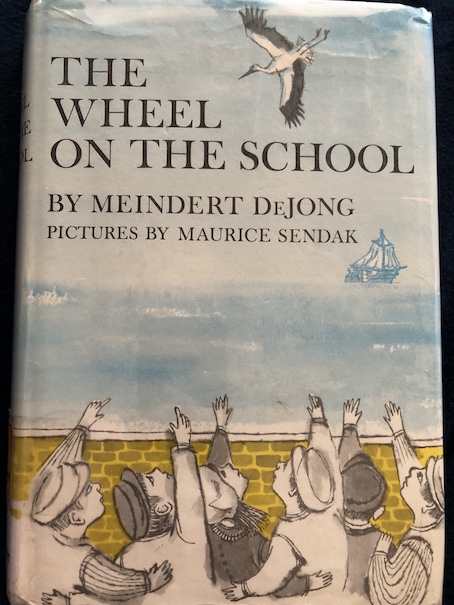
The Wheel on the School by Meindert DeJong, pictures by Maurice Sendak, 1954.
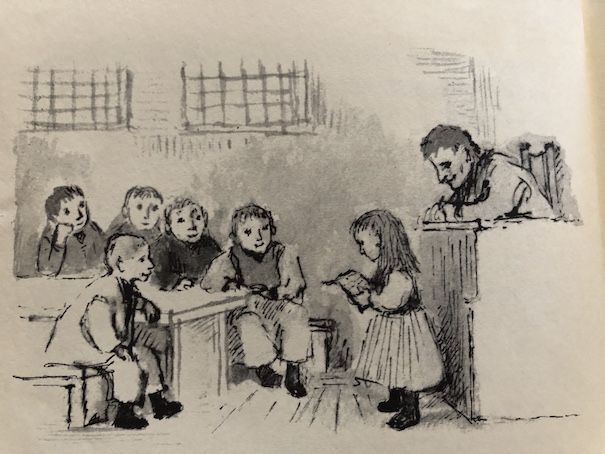
The story takes place in a small fishing village in Holland called Shora. Because the town is small, the local school is also very small, with only six children in the village old enough to attend. Five of them are boys: Jella, Eelka, Auka, and Pier and Dirk (a set of twins). The sixth student is Lina, the only girl. Lina is the one who gets the other students thinking about storks because she writes a story/essay about them. It wasn’t a school assignment. Lina just wrote it because she thinks that storks are interesting. It’s supposed to be good luck if a stork nests on your roof. Lina also notes that, while storks nest in other towns around them, like the one where her aunt lives, they never nest in Shora, for some reason. This starts a class discussion about storks, and the students generally agree that they know very little about storks because storks don’t live in their little village. The teacher says that, even when people don’t know much about a subject, they can still wonder about it, and he challenges the students to wonder about storks and why they don’t nest in their village. He is sure that, if the students wonder about it and think about it, they will learn the reason why the storks don’t come to their village. In fact, he lets the students out of school early so they can spend some time thinking about it. He mysteriously says that their wondering may cause things to happen.
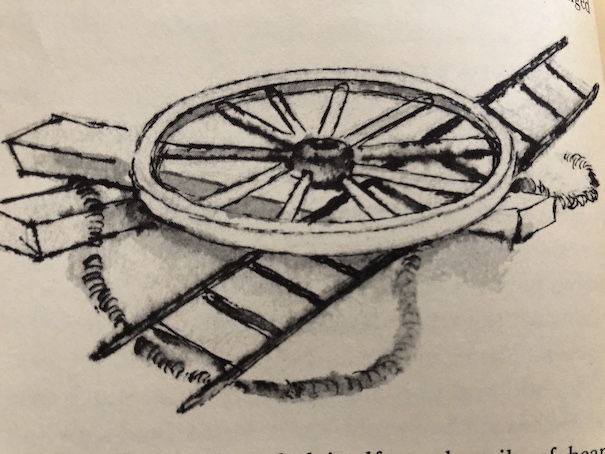
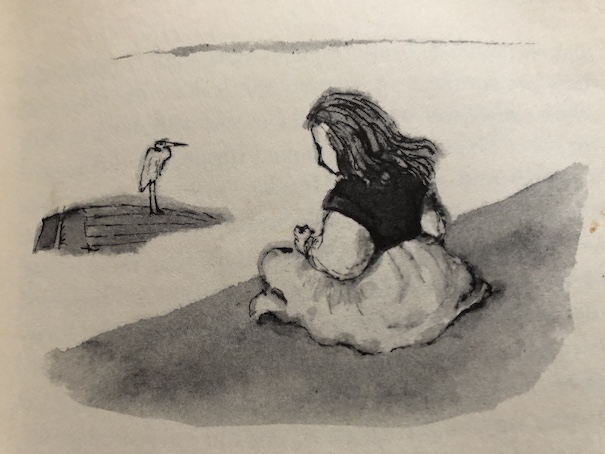
The children are thrilled at being let out of school early, but they feel bound now to wonder about storks and why storks don’t nest in their village. They’re not sure exactly how to begin thinking about this subject or how to figure out the answer, but they take a good look around their village. They find themselves looking at familiar places like they’ve never seen them before, but after a while, some of them become restless. Eventually, the boys all run off to play, leaving Lina to wonder by herself, to her annoyance. However, while wondering by herself, Lina notices something important: that all of the roofs in town are steep and that the school has the steepest roof of all. She realizes that the steep roofs are the reason why the storks can’t nest in Shora. When she realizes that, she also realizes that she knows what to do about it. Her aunt has a wagon wheel on top of her roof, and the storks nest there. Lina realizes that, if they put a wagon wheel on top of the roof of the school, the storks would have a place to nest.
Lina is thrilled that she’s managed to figure out the answer all by herself, but since all the boys ran off, she has nobody to tell about it. Then, an elderly lady who everyone in the village calls Grandmother Sibble sees Lina and asks her what she’s doing. Lina is a little shy about talking to Grandmother Sibble, but she finds herself talking to Grandmother Sibble about the storks and what she’s realized. Grandmother Sibble says that what Lina has realized is true, but she also points out that houses in other towns have trees around them, too. That’s important because Shora doesn’t have trees. Grandmother Sibble says that, if Lina wants to really understand what storks want and need, she has to imagine what it’s like to be stork and consider how a stork would think. Lina likes that idea and starts thinking about what storks would want.
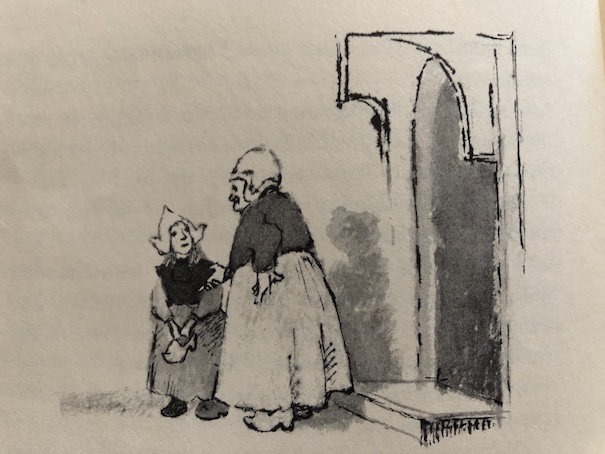
Grandmother Sibble says that, when she was Lina’s age, she was the only girl in Shora, just like Lina is now. Back then, they used to have trees in Shora, and they also had storks there. What changed Shora was that there was a terrible storm that destroyed the trees. Grandmother Sibble says that the storks haven’t returned to Shora since. Lina is surprised about Grandmother Sibble’s story, but it helps explain more about why their village is the way it is. Grandmother Sibble says it’s important to consider the whole picture of the village and everything that’s there and look at it from a stork’s point of view. Grandmother Sibble says that she’s missed the storks ever since they stopped coming to Shora, so she will think about it with Lina and consider what to do. Lina is pleased that Grandmother Sibble is as interested in the storks as she is, and she also realizes that this project has changed the way she looks at Grandmother Sibble. She now sees Grandmother Sibble, not as an unapproachable old lady but as a friend, as someone who used to be a girl very much like herself and who understands how she thinks and what she cares about.
The next day, the teacher asks the students who spent time wondering about storks and what they learned from it. Lina is irritated that the boys say that they thought about storks, too, when they all ran off to play, but the boys tell her and the teacher that they did do some thinking. Jella says that he asked his mother about storks, and his mother says that there were never storks in Shora and that there’s nothing they can do about it. Lina contradicts him, telling the class what Grandmother Sybil said. Jella is forced to admit that his mother was wrong. She probably didn’t know storks had ever been in Shora because she isn’t as old as Grandmother Sibble and wouldn’t remember when they were there. Eelka says that he also thought about trees, partly because he got wet when he was playing with the other boys and wished that there was a tree to hang his clothes on. It made him think that maybe the storks wish there were trees, too. The teacher asks them if that’s their firm conclusion that the lack of trees is the main reason why storks don’t come to Shora, but Lina says that she still thinks that the lack of wheels on the roofs is important because storks nest on the roofs, not in the trees. She thinks that, when the trees in the town died, everyone just assumed that the storks were gone for good and stopped trying to put wheels on their roofs like they used to and like people in other towns do.
As the students argue and debate about the importance of trees and wheels on the roofs, the teacher asks them what they can do to test their theories. The students realize that growing trees would take a long time, and some of them think it might be impossible because their village has too much wind and salt in the air and soil from the sea, which is why the trees they used to have died. Someone points out that one person in town has a cherry tree, but it’s small, and he won’t let anybody near it. He has a fence around it to keep people and animals away, and he scares away birds who try to take the cherries. The teacher says that the cherry tree is evidence that at least some trees can survive in Shora, if they are cared for and protected. He also tells the children that making changes and making dreams come true does take time and work, so they can’t expect results from the theories they test immediately. Still, by trying different approaches, he believes that they will learn more and that they can get storks to nest in Shora again. If they can get even one pair of storks to build a nest in Shora, they will know that they’re on the right track.
Since the idea of putting a wagon wheel on a roof is one that they can do more quickly than growing new trees, they decide to start by testing that theory. The nesting season for storks has already started, so they want to get started right away, or they’ll miss the season. Their teacher agrees to give the students time away from school to work on the project, as long as they’re willing to make up the study time later, and they agree. The teacher helps them to coordinate their search for a wagon wheel they can use. The children are sometimes distracted or tempted to go play instead of working on their project, but they quickly realize that, if they don’t focus on their task, they’ll miss their opportunity.
In the children’s quest to find a wagon wheel they can use, they learn a little more about some of the people in their little community and come to a new understanding and appreciation of them. When a big storm comes, the children worry that all of the storks will be killed and that their efforts have been for nothing, but reassurance and help comes from an unexpected source.
The book is available to borrow and read for free online through Internet Archive (multiple copies).
My Reaction
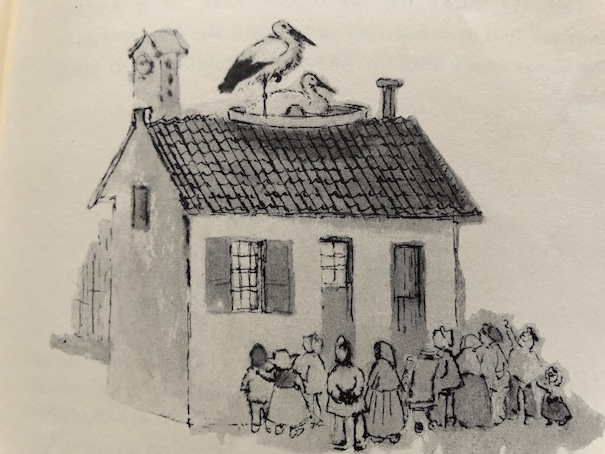
The author of the book, Meindert DeJong, was born in the Netherlands, and the tradition of putting wheels on roofs for nesting storks is real. If you Google it now, it’s difficult to find a mention of it that isn’t also about this book. I have found some pictures of stork nests on wheels (including some in Alsace, where they apparently have a similar practice) and some up on special poles. It’s a fascinating tradition that, admittedly, I wouldn’t have known about or thought to look up if the book hadn’t described it. There is also another children’s book, Wheel on the Chimney by Margaret Wise Brown, that also describes this type of nest for storks.
What I really enjoyed about this book was how the teacher encouraged the students to work through the issue of why there were no storks in their town in their heads, collect observations, brainstorm different possible explanations, and test their theories. Basically, he was teaching them a simple version of the scientific method, although he never calls it that. When Lina raises the question of why there are no storks in Shora when other towns around them have storks, the teacher encourages the students to put their minds to the question, collect some observations about their town, conduct research (like asking the adults what they know about storks in their town), develop a working hypothesis (the storks need a place to nest), and conduct an experiment to test their theory (provide storks with a place to nest and see if they can get a pair of storks to build a nest there).
The teacher provides some guidance as the children go through these steps, but then, he allows the children to approach the project by themselves, only stepping in when they run into problems. In some cases, the children do run into serious problems, even putting themselves in physical danger, which shows the dangers of not drawing some limits ahead of time or providing more direct supervision, but the children do manage to work out their problems, and fortunately, nobody is seriously hurt. By the end of the book, the children have also drawn many other adults in the community into their project, often in ways that help the adults as well and bring the community closer together. In the process, the children also learn a few things about themselves and their own abilities. In some ways, it reminded me of the Christmas story Starlight in Tourrone, where a community comes together to re-create an old ritual that people in a small village have otherwise abandoned.
I appreciated how the children develop some better understanding for the adults in their community by bringing them into the project or approaching them for help, and parts of the story actively encourage the children to be empathetic and look at different situations from someone else’s point of view.
- Grandmother Sibble, the first adult Lina talks to, tells Lina that, to think what would attract a stork, she has to think about the village from a stork’s perspective and consider what a stork would want and need. Lina is fascinated at the idea of thinking like a bird would, but she also comes to think a little like Grandmother Sibble when Grandmother Sibble recounts her memories of how the village used to be when she was a little girl and the great storm that destroyed their trees. Lina comes to realizes that Grandmother Sibble wasn’t much different from herself when she was a girl and that the two of them understand each other better than she thought.
- Jella angers a nearby farmer by taking a wagon wheel without his permission, and the teacher helps to soothe the farmer’s feelings by getting him to remember something he did as a boy Jella’s age, so he can understand why Jella did what he did. It’s a bit eye-opening for Jella as well, to see that adults around him were once very much like himself. The teacher also persuades Jella to give the farmer some help to make up for the inconvenience he caused the farmer, and Jella and the farmer bond over a shared love of archery.
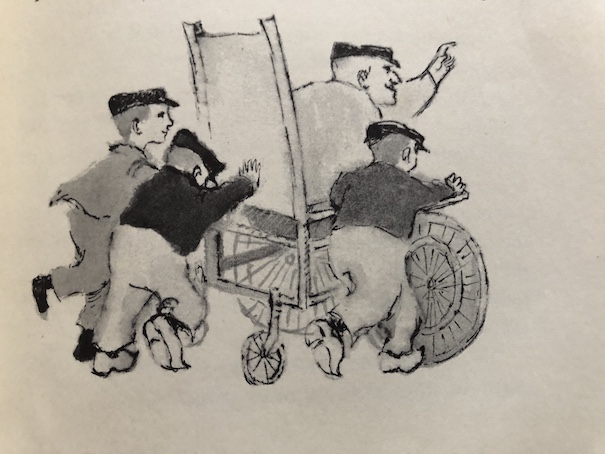
- Later in the story, when the children consider approaching Legless Janus, an intimidating man in a wheelchair who has lost both of his legs and who has a reputation for having a nasty temper, Pier pauses to consider what it must be like to be Janus, how hard it would be to be confined to a wheelchair, and how that might make a person angry and temperamental. When Pier and his twin try to sneak into Janus’s garden to see if has any wagon wheels, there’s a confrontation between them and Janus, and Pier reveals to Janus some of the thoughts he had. Janus is surprised at how the children see him and the stories that they tell about him. He tells them the truth about how he lost his legs and reveals a shared interest in the children’s project that turns them from mutual antagonists into friends.
Besides the children in the story learning to think about situations from other people’s perspectives and getting to know other people better, the children also learn a few things about themselves that give them some different perspectives on their own futures. Lina often feels a little left out of things because she’s the only girl among the children old enough to go to school in their village. The boys don’t always include her with things they do because they say that girls don’t like to get their clothes wet and messy and that they cry or giggle too much. Even Lina at times wishes that, like a boy, she had less of an impulse to cry at times, and modern readers may roll their eyes at some of the story’s old-fashioned attitudes about boys and girls. With the exceptions of Lina and Grandmother Sibble, women in the story often play subordinate roles in the story, and the story refers to a male stork as being his mate’s “lord and master.” However, there are also parts of the story that prove some of those assumptions wrong. Lina does some daring things in her pursuit of the wagon wheel, and isn’t afraid to get wet or dirty while doing it. The women urge their husbands to help the children in their efforts, even in bad weather, and their support proves important and is appreciated, even when they’re not the ones leading the project. There are also times when the boys get a bit emotional or on the verge of tears, showing that the boys also have emotions, even when they try to fight them or hide them. The roles of boys and girls and men and women in the story aren’t what we typical want or expect in 21st century America, but I liked it that all of the characters are shown as being capable and that their contributions are appreciated.
Grandmother Sibble also helps Lina to see herself and her future from a new perspective. She reveals that, like Lina, Sibble was also the only girl in the village at her age. As the eldest girl of her generation in the village, Grandmother Sibble eventually became the eldest woman in the village, the “grandmother” of everyone, and eventually, Lina herself will someday be Grandmother Lina, the eldest woman in the village, telling stories about what used to be and how things have changed to younger generations. Lina isn’t just a girl but a kind of future village wise woman in the making, actively bringing about some of the changes that will later become part of village lore.
Some of the boys learn a few things about themselves, too. Eelka is a big boy who is often slow and clumsy, which is why some of the other boys, like Jella, are reluctant to let him join in games. Part of his difficulty is that he doesn’t always think things through all the way before he does them, which is how he gets into trouble in the story. Another issue is that, as the youngest of all of his brothers, he’s used to the idea that other people can do things that he can’t do. When Eelka rescues Jella from a dangerous situation, partly brought about by Eelka’s impulsiveness and the need he feels to try to tackle big jobs by himself to prove himself and partly caused by Jella’s own impulsiveness, Eelka comes to fully appreciate that he’s a lot stronger than even he knew. When he and Jella talk about it, Eelka says that his family is in the habit of thinking of him as the “baby” of the family who doesn’t know anything and can’t do things, but the truth is that people grow. Eelka isn’t a baby anymore, and he has developed strengths he didn’t know he had until he is forced to use them. He just needs to learn how to use them wisely.
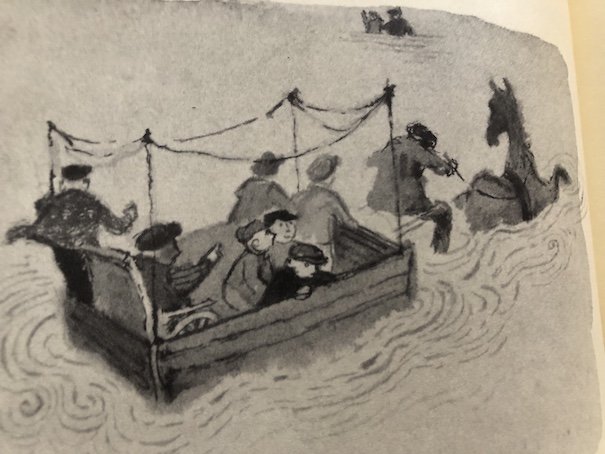
The village’s shared participation in the project and the quest for a wagon wheel also brings out sides of the adults that some of them haven’t shown for years, giving them new confidence in themselves as well as greater appreciation from the village children. 93-year-old Douwa shows Lina that elderly people are sharper and can do more than she thinks they can and gets the opportunity to relive one of the most heroic escapades of his own youth. Legless Janus enjoys the most exciting adventure he’s had in years and shows that, even though he is now disabled, he has nerves of steel and an ability to take charge in an emergency. He also knows carpentry, so he creates the mount for the wheel on the school and later, he begins making new wheels for other roofs, finding a new trade to practice. He is also the one who reassures the children that reports of storks killed by the storm are exaggerated or made up because he has spent years watching birds and knows their behavior. He says that the storm probably scattered them over land, but they have instincts that would have prevented most of them from being over water when the storm was coming and that they will come resume their journey as the weather clears.
A few other concepts in the story are consideration for the environment, problem-solving, and time management. All through the story, the children are confronted with problems of various kinds, and they have to figure out how to solve them, using their own wits and whatever they have to work with. They also learn the importance of time management because they know that they don’t have long before the storks’ nesting season will be over, so they must use their time wisely, putting aside playing or other distractions to accomplish their mission. I was particularly interested in Grandmother Sibble’s description of how Lina needs to look at the whole picture of the village, what it has, and how it has changed over the years in considering why storks no longer nest there. Essentially, what’s she’s describing is the ecosystem of the village, how all of the different elements work together to either make it a hospital place for the storks or an inhospitable one. The wheel on the roof is one of the factors, but the trees (or lack of them) are also a factor, and the windy and salty conditions are further factors in the growth of trees and how friendly the environment is too wildlife. The story doesn’t use the term “ecosystem”, but that’s what this interplay of different environmental factors is. Changes to one part of the ecosystem will bring about other changes, just as the terrible storm that happened when Grandmother Sibble was young radically changed the character of the village.
There are a couple of things that readers might want to be aware of. First, there is some corporal punishment of children in the story. Janus spanks Jella badly when he tries to steal cherries from his tree, and the farmer hurts Jella’s ear when he takes his wagon wheel without permission. In 21st century America, we don’t generally encourage physical punishment, although Jella does get over these incidents and doesn’t hold it against either of them in the end. Admittedly, Jella was doing something he shouldn’t have been doing both times, and they don’t abuse him beyond the immediate incident either time. Each of them also admits after the fact that each of them might have gone a little too far in their punishment, and both Janus and the farmer do Jella favors, helping him with the wheel on the school project and teaching him how to make arrows for his bow, so the negative experiences are balanced with positive ones. Sometimes, adults in the story also use harsh insults to rebuke children, like “idiot” and “lunkhead”, which we also don’t encourage.
The presence of Janus in the story also leads both the children and readers to consider the feelings of people with disabilities and how people with disabilities would like to be treated. The children are afraid of Janus at first because he has a temper and can be pretty fierce in defending his cherry tree, but they later learn that he actually does care more about the children than his defense of his property makes them think. What Janus really wants the most is to feel useful and to show that he is still smart, strong, and capable, in spite of his disability. Later in the story, when the other men in the village get tired of Janus barking orders at them while they’re putting the wheel on the school, and one of them calls Janus a “slave-driver”, saying that he just needs a whip. Janus retorts that he doesn’t need a whip when he has a sharp tongue. He’s only slightly embarrassed at being called a “slave-driver.” It would be a very negative thing to say about someone in the 21st century US, but in some ways, it actually makes Janus feel a little better that the other men see him as being tough and not someone to be coddled or treated too carefully because of his disability. They even feel comfortable enough to joke with him about it. There is a moment when he’s a little unsure how to take a man’s comment that maybe the “shark” that got his legs should have taken his tongue instead, but when Janus sees that the man isn’t serious about it, he responds in the same bantering way, bragging that his tongue was too intimidating for the “shark”. (His legs weren’t really lost to a shark. That’s a kind of joke/village rumor.) Janus is also thrilled when one of the men makes a thoughtless comment that, if Janus isn’t satisfied with the way they’re working, he should come up on the roof and do it himself. It was a thoughtless thing for the man to say, and there’s an awkward moment when everyone remembers that Janus can’t climb up on the roof without legs. However, Janus tells the children that he’s actually pleased because the way the man made that comment shows that, for a moment, he completely forgot that Janus has no legs. Janus thinks that’s a good sign because it means that people are no longer thinking of him only in terms of his disability. He doesn’t want his disability to define him.
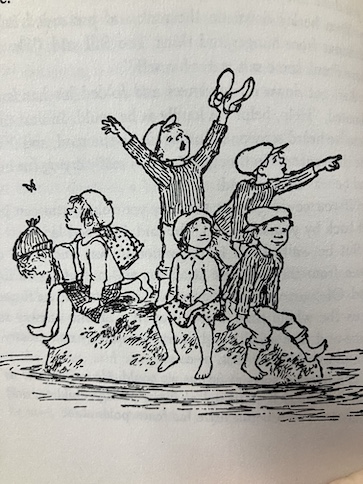
Toward the end of the story, the children do find some drowned storks, showing that an article the children saw in the newspaper about storks being killed in the storm wasn’t all “fake news” as Janus made it sound. At least some storks were killed in the storm. The adults in the story aren’t always right about everything. However, Janus is correct that the storks weren’t all killed. He helps the children to stage a daring rescue of a couple of exhausted storks off a sandbar before the tide comes in, saving them from drowning.
Overall, I though it was a very positive story that provides many things for young readers to think about. Sadly, as of this writing (March 2026), it is out of print. Used copies are still available, although some are a bit expensive, and libraries still have it. There is also an unofficial reading of the story on YouTube.






 Jestress's Forgotten Books and Stories