Ruth Fielding at Sunrise Farm

Ruth Fielding

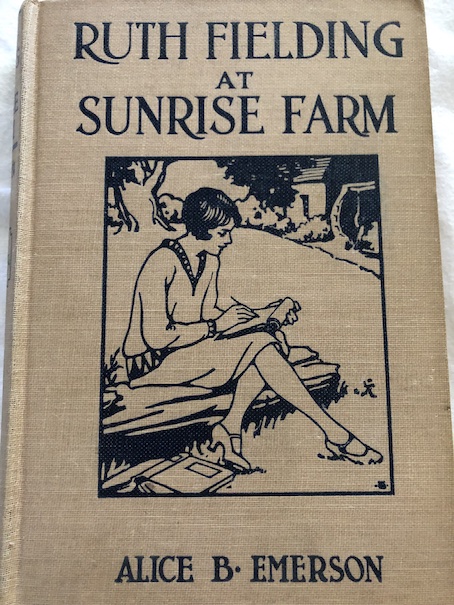
Ruth Fielding at Sunrise Farm or What Became of the Baby Orphans by Alice B. Emerson (Stratemeyer Syndicate), 1915.
When the story begins, Ruth and her friends are at boarding school, and they are having a secret night meeting of their club, the Sweetbriars, to initiate some new members. Their initiation ceremony includes the story about the statue with the harp in the fountain that the girls were told during a scary initiation to another club in an earlier book, but the Sweetbriars are against tormenting and hazing new members. Instead of the scary ceremony, their initiation ceremony involves marching around the fountain while chanting a rhyme about the statue. There is supposed to be a mild prank of splashing the new members as if the fountain did it, but that’s as much hazing as the Sweetbriars will allow.

However, their ceremony is interrupted when one of the girls who is already a member of the club starts screaming. When everyone runs to see what happened, the girl who was supposed to do the splashing of the new members is all wet and says that someone pushed her into the fountain. She doesn’t know who did it, but she saw someone run away afterward. Ruth catches this mysterious lurker, and it turns out to be a younger girl who doesn’t belong to their school at all. The girl says that she had just been at the fountain, getting a drink of water. She says her name is Raby and that she ran away from some people called Perkins, who beat her. Ruth isn’t able to get much of Raby’s story that night, but she can tell that the girl is in trouble, so she says that if Raby will meet her the next morning, she can give her some money and help her.

The next day, Ruth’s friend, Madge Steele, invites Ruth and the other girls to spend part of the summer at a farm that her family bought near Darrowtown, where Ruth used to live with her parents before they died. The farm is called Sunrise Farm, and this trip is also meant to be a graduation party for Madge. Madge is older than the other girls, a senior at Briarwood, so these are her last few months at the school.

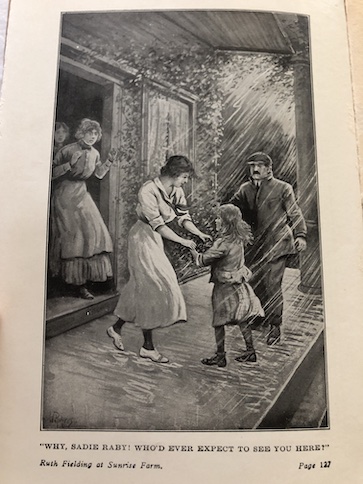
Ruth slips away from the others to bring some food to Raby, and she learns more about the girl’s plight. Raby explains that she’s an orphan. Raby is her last name, and her first name is Sadie. She was at an orphanage with her two younger brothers, a set of twins called Willie and Dickie. However, kids are only kept at the orphanage until about age 12, when they are put to work. Sadie is about 12 1/2 years old, and she was separated from her brothers when they were taken in by another family and she was sent to work for the Perkins family. The Perkins family acted kind in front of the adults at the orphanage, but they started treating her badly as soon as they got her to their home. Ruth is very much aware that she is also an orphan, and if it hadn’t been for her uncle and her friends, she would never have been able to go to a school like Briarwood and might have ended up in a situation very much like Sadie’s.

Ruth gets to see for herself what Mr. Perkins is like. While the girls are talking, he enters the school grounds to find her. Sadie runs away and hides, and Mr. Perkins grabs hold of Ruth. He has a whip with him, and he whips Ruth across the knees, demanding that she tell him where the runaway girl is. Mr. Perkins is interrupted by a stage driver, Mr. Dolliver, who sees what’s happening and yells at Mr. Perkins to leave Ruth alone and not to bother any of the girls at the school. Mr. Perkins claims that he didn’t know Ruth was a student, and Mr. Dolliver makes Mr. Perkins leave. When he’s gone, Ruth explains the situation with Sadie to Mr. Dolliver. Mr. Dolliver tells her that it’s against the law to help runaways. Ruth asks if that means that Sadie will be sent back to the Perkins family if she’s caught, and Mr. Dolliver says that’s probably the case: “Ye see, Sim Perkins an’ his wife air folks ye can’t really go agin’—not much. Sim owns a good farm, an’ pays his taxes, an’ ain’t a bad neighbor. But they’ve had trouble before naow with orphans. But before, ’twas boys.” Ruth says she hopes that the boy orphans also ran away from the Perkins family, and Mr. Dolliver says, “Wal—they did, by golly!” (Oh, surprise, surprise.)

Ruth begs Mr. Dolliver not to turn Sadie in if he sees her, and Mr. Dolliver says that his plan is to not see her, and he advises Ruth to do the same. Ruth tries leaving some food out for Sadie again, but she doesn’t return to the school. She hasn’t been returned to the Perkins family, either. Ruth is glad that she’s not with the abusive Perkins family, but she’s still worried about where Sadie went and what she’s going to do. As the school year comes to an end, Ruth gets a letter from Aunt Alvirah saying that her Uncle Jabez is willing to let her go to Sunrise Farm with her friends during the summer. Aunt Alvirah has hired a “tramping girl that came by” to help with the work around the Red Mill, so Ruth will be free for a relaxing visit. Ruth later learns that the “tramping girl” was Sadie, but Sadie has moved on to find work elsewhere by the time Ruth gets home from boarding school. Ruth hears stories about her from other people who employed her or helped her, and her best friend’s brother, Tom, says that he paid for her to get a ride on a train to a town called Campton.

Soon, it’s time for Ruth and her friends to go to Darrowtown and meet at Sunrise Farm. It’s an emotional journey for Ruth because she has bittersweet memories of Darrowtown from when she lived there with her parents, when they died, and the period when she was an orphan there, before she went to live with her great uncle. While she’s there, she stops to visit with Miss Pettis, a seamstress who looked after her before she went to live with Uncle Jabez. Miss Pettis is happy to see her, and the two of them spend some time catching up on what’s been happening to everyone since Ruth left Darrowtown.

When they all get to Sunrise Farm, Madge’s father is annoyed because he’s discovered that their neighbors, the Caslons, are having a bunch of “fresh air children” coming in the summer. (“Fresh air children” are children who come from the city, usually from unfortunate backgrounds, to experience the fresh air and wholesome activities of the countryside. There are still programs that do this, including the Fresh Air Fund in New York. In fact, I think that might be the program that the Caslons are supposed to be participating in as a volunteer host family during the story because it existed in this time period, and the series is generally set somewhere on the East Coast.) Mr. Steele thinks that the Caslons are bringing in a bunch of children to make noise and annoy him personally, but Madge says that she’s heard that they take in children like this every summer. Madge’s parents see this as a personal inconvenience to them. Ruth knows that Mr. Steele is a wealthy businessman who has always lived in the city. He doesn’t know much about the countryside, doesn’t understand the people who live there, and has little patience for any of it. When he bought Sunrise Farm, he did it with the idea of being kind of a gentleman farmer, but it’s starting to become obvious that he has little idea of what that means.

It turns out that Sadie’s little brothers are among the group of orphans who are visiting the Caslons this summer, and Sadie soon shows up, looking for them. At first, Mr. Steele thinks he should call the orphanage when Sadie shows up at Sunrise Farm, but after she rescues his young son from a runaway horse, Mr. Steele is grateful and decides not to. Instead, he plays host to Sadie and her brothers at Sunrise Farm. Then, they learn that a lawyer has been looking for the Raby family because they have inherited some property in Canada. When the Raby twins and some of the other “fresh air” boys run away and get lost on a prank, Mr. Steele and Mr. Caslon join together to find them and get a new respect for each other.

This book is now in the public domain and available to borrow and read for free online through Project Gutenberg.

My Reaction and Spoilers

This is one of the books in the series that is really more adventure than mystery. There are some moments of slight mystery, when Ruth wonders where Sadie is or where her brothers are, but those are cleared up pretty quickly, just by chance, without Ruth having to go out of her way to investigate. The Raby children’s unexpected inheritance is quite a convenient coincidence, but it still leaves the children’s custody to be decided. At first, I thought that they might stay with the childless Caslons, but Mr. Steele, having been won over by the children, agrees to look after them and manage their inheritance until they’re old enough to manage it themselves. It feels a little classist that rich Mr. Steele gets the children and manages their inheritance, but by the end of the book, the Steeles are getting along better with the Caslons, so I suppose they’ll be seeing each other on a regular basis. The Caslons will also probably continue to invite “fresh air” kids from the city to visit their farm.

I really appreciated the part in this book where Ruth gets emotional about returning to the town where she used to live with her parents before they died. Orphans are common in children’s literature, partly because their orphaned status can be a reason for leaving home and finding adventure. However, I’ve noticed that many children’s series don’t dwell on the loss of the parents for long after it occurs and the adventure starts. Even when a child grieves for the loss of a parent, that grieving doesn’t show up much in sequels in a series as the story focuses more on the orphan’s adventures and new friends, like they kind of got over it. The Boxcar Children, for example, rarely mention their parents at all, and their cause of death isn’t even described in the main series (except for the oldest edition of the first book, which has a really dark first chapter). Ruth Fielding, as a character, was kind of a precursor to Nancy Drew in the Stratemeyer Syndicate, and Nancy Drew also lost her mother, but she never really talks about it. Ruth is usually a pretty happy person, even in difficult circumstances, but I like this acknowledgement that she still feels something from the loss of her parents. Even though she tries to keep cheerful and busy, there are times when she can still get sad about their loss. It’s like that in real life. Even when someone has had a long time to get accustomed to a loss, they can still have moments when they think about it and feel sad. This is the type of character development that I like in the Ruth Fielding series that doesn’t appear much in other vintage children’s series.

This book also addresses the fact that, as orphans go, Ruth has been more fortunate than some. Ruth’s uncle isn’t rich, and he’s kind of a miser, but he still takes care of her, gives her a place to live, and makes sure that she gets an education. Uncle Jabez sometimes says that he doesn’t know what good a fancy education will do for Ruth and that other girls like her stay home to help with chores or go out and get jobs. However, Ruth’s friends are getting an education, so Uncle Jabez decided in earlier books that Ruth should go to the same school and not be left out. Ruth comes to see how other people look at orphans. People accept Ruth because she lives with her uncle and goes to school with girls from better-off families, but would they all look at her the same way if she’d been forced to grow up like Sadie?

Mr. Steele is rather self-centered, thinking only of his convenience in everything. He sees the presence of the young orphans next door as some kind of personal affront to him because he thinks they’re just there to cause noise and mess and make trouble for him. Madge and her mother don’t like that kind of talk, but Madge’s brother echoes everything his father says. Even some of the other guests at Sunrise Farm express similar sentiments about how troublesome the young orphans are or must be, even for the Caslons: “Just think of troubling one’s self with a parcel of ill-bred children like those orphanage kids.” However, when the young people talk to the Caslons, they learn that the Caslons love having the orphans visit them every year. While Mr. Steele tells himself (and anyone who will listen) that the Caslons have only decided to do this out of spite for him, they’ve actually been hosting orphans for years, long before they ever met the Steeles, and it has nothing to do with the Steeles. Their own two children died very young, and they find joy and fulfillment in helping to take care of other children. They know that kids cause a certain amount of noise, mess, and chaos, but they feel like the inconveniences are worth it because they truly enjoy the children and have fun with them.

There is also a theme in the story about neighbors, what makes somebody a good neighbor or a bad neighbor. Mr. Steele thinks that the Caslons are bad neighbors from the beginning, both because they invite the orphans to join them for the summer, which Mr. Steele thinks is going to cause him some kind of personal inconvenience, and because the Caslons refuse to sell their farm to him when he decides that he wants to buy them out, like he’s entitled to their farm and they’re somehow “bad” for not letting him have it when he wants it. From my perspective, Mr. Steele is the bad neighbor because he’s the one who comes in without knowing the things that people in this area do, and he expects everyone to change their plans even sell out to him just on his say-so. Mr. Steele wants everything to be about him, even when it takes place on someone else’s property, and it bothers him that other people’s property belong to them and not to him. It seems to me that various characters in the story rate their neighbors not on how their neighbors behave or what they actually do but on how they happen to feel themselves at that particular moment. Mr. Steele seems to be in a mindset where I would expect that anything a neighbor did on his own property would be some kind affront to him because what he really wants is the neighbor’s property itself. It feels to him like his neighbor is doing things to him because, in his mind, the neighbor’s property is already his, even though it’s not, so the neighbor is already committing a trespass just because they are on their own land and doing what they’ve always done there, which Mr. Steele doesn’t own outside of his own mind. Fortunately, Mr. Steele’s experiences with the Raby children and his acknowledgement that Mr. Caslon is more experienced with this area and better able to find the lost children than he is humble him a little and get him to take a different view of both the Caslons and the “fresh air” children.

Some of the characters seem to have poor priorities when it comes to figuring out who makes the best neighbors, and I think maybe they should take some of their neighbors’ actions under realistic consideration. I don’t know what Mr. Dolliver means when he says that Mr. Perkins “ain’t a bad neighbor.” That’s definitely not the impression I’m getting. When someone storms onto someone else’s property in a full rage and starts randomly grabbing and whipping a girl he’s never seen before, it’s not just a red flag anymore. A red flag would be a warning of potential danger, and this is full-on, uncontrolled physical violence in action in front of a witness! Ruth’s skin is described as having red welts from the whip! If this is part of Mr. Dolliver’s definition of a neighbor who “ain’t bad”, just how does he define a bad one? Honestly, where are the limits? It seems like the only thing Mr. Perkins has going for him is money from his “good farm” and “taxes”, which makes me think maybe the locals are easily bought off. As long as this neighbor seems to be contributing money (through direct or indirect means, through taxes) and there is the option to ignore his behavior, the local people seem content to ignore the behavior and accept the money.

From what Mr. Dolliver says about Mr. Perkins’s problems with other orphans before, his physical violence is repeated behavior. By Mr. Dolliver’s admission, the Perkins family has never had a different result with any orphan they’ve had in their custody. Each time, they mistreat the orphan and the orphan runs away in desperation, unable to return to the orphanage that’s supposed to be caring for them because the adults there seem to think that it’s more important to not say “no” to the Perkins family than to ensure the physical safety of children. I’m pretty sure they’re getting money for this, because otherwise, why in the name of all that is truly good, holy, and sane, would anybody ever let him have access to any other orphans after he’s already gone through multiple orphans in this fashion already? To very loosely quote Oscar Wilde, to lose one might be considered unfortunate, to lose two begins to look like careless, and to lose three or more brings everyone involved in the process into question. Insanity is doing the same thing over and over and expecting a different result each time. How many minors is the orphanage prepared to sacrifice to the Perkins family before they decide it’s enough, and at what point will it dawn on them that the Perkins family is the common element to the disappearance of all of the previous orphans?

I’m just going to say it: Mr. Perkins is a dangerous weirdo. He’s unsafe with vulnerable children or really anyone who gets in the way when he’s angry and is not in a position of authority or able to fight back. I’m sure his neighbors are either being bribed or they’re all in deep denial about it and that’s why they end up being complicit in the continuance and repetition of orphan abuse. I know that, as a character, Mr. Perkins is deliberately set up as a villain and an obstacle in the story to be escaped or overcome, but he’s such an over-the-top violent character, running around with a whip that he uses on total strangers, it just brings the orphanage, the neighbors, and everybody in the community who still calls this wacko a basically decent neighbor into question.
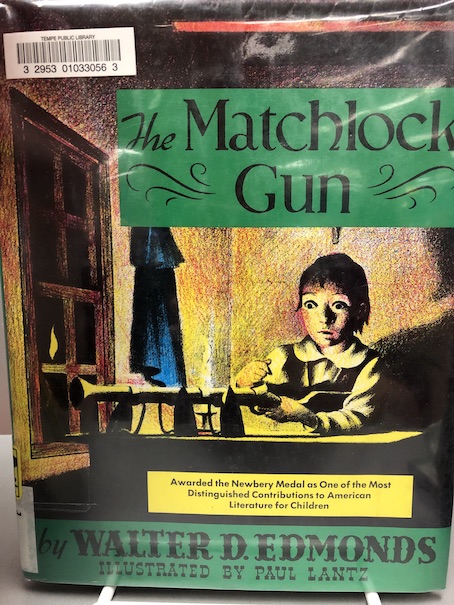
The Matchlock Gun

The Matchlock Gun by Walter D. Edmonds, illustrated by Paul Lantz, 1941, 1969.

Ten-year-old Edward Van Alstyne lives with his family on the mid-18th century American frontier in upstate New York, not far from Albany, during the French and Indian War. His father is captain of the Guilderland militia. Edward has had a long fascination for the large, old matchlock gun that his great-grandfather brought to America from Holland and wonders why his father never uses, preferring his smaller musket. His father shows him the old matchlock gun and explains to him how it works and how it’s old-fashioned, very large, and more difficult to use than his musket.

While Edward’s father, Teunis, prepares to go out on duty, Edward’s mother, Gertrude, worries about what will happen if Indians (Native Americans) attack while he is gone. Teunis doesn’t think that’s likely, but he says that Gertrude can take the children and go to his mother’s house. Gertrude and Edward’s grandmother do not get along because Edward’s grandmother has never approved of her. His grandmother never thought she was good enough for her son because she doesn’t come from a Dutch background, like they do, and because her family is poor. Gertrude would rather not turn to her for help except as a last resort, and Teunis doesn’t blame her.

Gertrude is still nervous after Teunis leaves, and she refuses to let Edward take some butter over to his grandmother’s house, as he often does. She doesn’t want the children going too far from the house, in case there’s trouble. Then, a family friend, John Mynderse, stops by with a message from Teunis, saying that he is fine, but the “French Indians” (the Native Americans aren’t actually French, but they’re allies of the French – I’ll explain below) have burned settlements, and he won’t be home tonight. It’s worrying news. Later, they see smoke on the horizon and worry about how far away it is, unsure of the exact distance.

Although Gertrude tries to be brave, she admits to Edward that she thinks that the fires are close. Edward asks if they should go to his grandmother’s house, but Gertrude would prefer to stay in their own house and wait for Teunis to arrive home. Privately, Gertrude has realized that the old brick house where the grandmother lives is more visible from the main road than their small wooden house. She doesn’t think that there’s anything they can do to help Edward’s grandmother, but she is hoping that she and the children will be overlooked if the Indians come through their area.

Gertrude begins coming up with a plan for defending their house, and she asks Edward if he would be afraid of firing the big, old matchlock gun. Edward wouldn’t mind firing the big gun, but it’s so big, he doesn’t know if he could manage to hold it. Gertrude says that she has a plan for that. Although they are inexperienced, Gertrude and Edward manage to get the gun loaded, and Gertrude chops a hole in the side of their house that they can fire through. Gertrude doesn’t expect Edward to actually aim the gun or hit anything. They just prop it up at the hole, and Gertrude tells Edward that, if she calls his name, he must use a candle to light the powder in the gun. When the powder is lit, Gertrude says that the big gun will go off with a huge bang and might scare off any attackers.

The Indians do come and attack the old brick house, and then, they come for the house where Gertrude and the children are. Gertrude is struck by a tomahawk as she runs for the house as the Indians approach, but she calls out to Edward, and Edward fires the gun. The attackers are killed in by the explosion from the gun, but the family’s house is set on fire. The children manage to drag their injured mother to safety, and Edward rescues the matchlock gun from the burning house.

When Edward’s father and the militia arrive, Gertrude is injured but still alive. The old brick house did not burn, as Gertrude had thought, but the barns were destroyed. The grandmother and her slaves barricaded themselves in the brick house. Edward is praised as a hero for defending his family at such a young age and for killing more Indians by himself than the adults did. (That last part is a little creepy, but they do praise him for that.)

This book is a Newbery Medal winner. It is available to borrow and read for free online through Internet Archive.

My Reaction

The Backstory

This is one of those books where I find the backstory much more interesting than the book itself. This is one of those historical novels for children written and published during World War II that looks back on American history and past conflicts, trying to reinforce historical lessons, instill patriotic feelings, and help children come to terms with the war that was happening around them at the time this book was new. This particular story takes place in the Hudson Valley in New York, not far from Albany, before the American Revolution in a community that’s largely settled by people of Dutch descent.

The family in the story is based on the real Van Alstyne family, and the incident with young Edward helping to protect his family from attackers by firing the family’s old matchlock gun really happened. The story emphasizes the family’s Dutch background. The mother of the family, Gertrude, is described as having a Palatine background, which means that her family was Germanic, but the major emphasis is on the Dutch influences in their background. There are Dutch words and phrases throughout the story.

The Foreword to the story explains the family’s history, but I actually recommend that readers save reading the Foreword last instead of reading it before reading the story. It explains not only the family’s past, but what happened to the family after the incident in the book. Little Trudy grew up and married a man named Hogle, and she became known as an excellent spinner, or spinster, in the professional sense rather that the unmarried sense. Her spinning ability was attributed to having to help her mother from a young age because her mother’s shoulder was permanently damaged from the tomahawk injury she suffered in the story. Trudy is credited as the one who passed on the story about her brother and the matchlock gun to future generations.

When interviewed about his historical novels, which were more for adults than children before he wrote this particular book for children, the author said:

“I want my readers to get out of my books a sense of the relation of history to the present day. History is often taught as a study of dead things and people; or else, and worse, from the debunking angle. What I want to show are the qualities of mind and spirit of plain, ordinary people, who after all carry the burden of human progress. I want to know about people, how they lived, what they hoped for, what they feared. I want to know what it was like to be born into this time or that, and what a man left behind when he died.”

I see the point about focusing on the lives of ordinary people because history is largely made up of daily life. Much of my historical education had this focus as well, not just focusing on the famous people or the major events, which are usually a reflection and extension of what’s happening on the ordinary and every day level. Much historical writing these days also does focus on debunking, which requires prior knowledge of what’s being debunked and why to be really effective, so I don’t think it works too well on level of children.

My personal approach to history, however, is to put things into context. I’ve given you the context of WWII, when this book was written and published, and the author’s view, but to get the full story behind this story, it helps to understand the French and Indian War. In the book, the attacking American Indians are just shown in their role as attackers, attacking innocent women and children and burning their homes. It’s a savage image that leaves a bad taste in the mouths of modern people, but it helps to understand what’s happening in the larger conflict.

In spite of its name, the French and Indian War was not fought between French people and American Indians. Instead, the French and Indian War, also called the Seven Years’ War (1754-1763), was fought between the British and the French, with the French aided by Native American allies. Both the French and the British were claiming territories for colonies in North America to support their empires, and as rivals for territory, each side was trying to assert its authority and control over certain regions. The Native Americans enter into the conflict because each side had Native American allies.

The reasons why Native Americans were willing to ally with these foreign powers and actively fight and risk their lives in the conflict were based on their perceptions of the treatment they were likely to receive from each side and the other tribes that were already allying with each side because of the war and their estimates of how the war was likely to affect their own territories and which side’s victory would be most likely benefit them. When European colonists entered North America, started their colonies, and began instigating these territorial conflicts, they were already entering a land inhabited by groups of people who had their own home territories and their own systems of alliances, relationships, and conflicts with each other. Essentially, the European colonists and this French and British conflict were destabilizing and unsettling Native American groups, and those Native American groups were trying to both work out new alliances with some of these newcomers that would grant them a greater degree of security and to push out groups of newcomers who seemed to represent the greatest threat to them and their territory. What each of these Native American groups wanted most out of this conflict was whatever they thought would best allow them to hold their own territory and put them in the strongest possible position to defend against rivals for that territory. Not all groups were eager to join this fight, but those who did believed that it was their best opportunity to protect themselves. In Walter D. Edmonds’s words, this is “what they hoped for, what they feared,” and this is what they were willing to kill and die for.

The reason why this war is important to American history is not only because it was a territorial struggle between major powers but also because it was one of the events that led to the American Revolution against Britain. The British colonist disputed having to pay Britain’s expenses for this war. The treaty and settlement that ended the war helped shape westward expansion that continued after the Revolutionary War. This war was also part of George Washington‘s early military experience, before he became the famous general of the American Revolution.
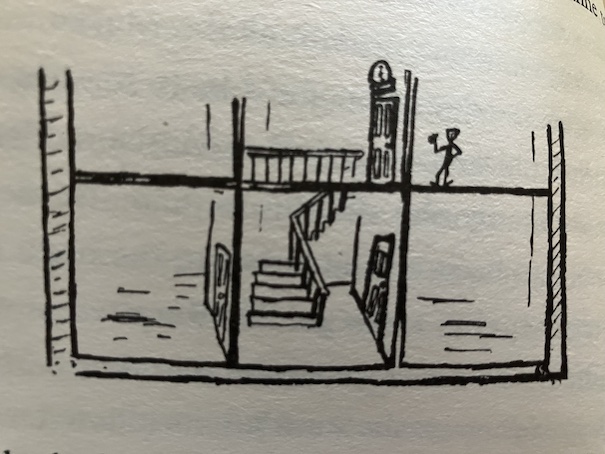
Part of what makes the Van Alstyne family’s experiences of this war both fascinating and tragic are that they belong to neither of the major sides of the war. They are not British or French. They are primarily of Dutch descent. That is emphasized repeatedly in the story. It’s how they think of themselves, and they are living among other colonists and settlers of similar backgrounds. Their misfortune is that they are living in one of the regions that is under dispute by larger powers. I think that’s part of the reason why the concept this story appealed to the author of the book. It’s about ordinary people caught up in larger events, and it shows the effect that larger conflicts have on ordinary people.

However, since the main hero of this story is a ten-year-old boy, I have to admit that it does make sense that the boy probably didn’t understand much about the larger conflict going on around him. The story only takes place over a little more than a day. His father leaves one evening, the children go to bed, the family is nervous the end day, they are attacked that night, and then, the father comes home. From the boy’s perspective, this attack on his family might have been the conflict in a nutshell. The territorial disputes between larger colonial powers was likely beyond him, which is why he doesn’t think about them during the course of the story. I still think that readers should understand it even if the characters don’t, though.

A Slave-Owning Family

One other thing that I think is important to mention is that there is slavery in the story, and Edward’s own family has slaves. In particular, Edward’s grandmother uses slaves. The slaves are not actually shown as characters in the story, but they are discussed. At one point in the story, Edward’s younger sister, Trudy, asks their mother why their grandmother has slaves and they don’t. Their mother explains that the old brick house where their grandmother lives and the land and slaves connected to it actually belong to the children’s father, as his father’s heir. So, technically, the slaves actually do belong to Edward’s father. However, their grandmother is very attached to the old brick house, so their father lets her live there and use the slaves to manage the house and estate.

A major reason why they explain all of this is so readers understand the setting of the story better and the relationship that this family has with the grandmother. Teunis built the wooden house where he lives with his wife and children so they could have some independence from his mother. He is willing to let his mother live by herself in the family’s big, old house with slaves to look after her and run the place, but it’s really better for his wife and children if they don’t live with her because of her attitudes. In particular, it’s her attitudes toward the mother of the family that make life difficult for them and leave them not wanting to get closer to her, not her attitudes about slaves. Teunis and Gertrude are willing to manage their smaller house without the help of slaves because it’s worth it to them to have to do without extra help in exchange for some separation from Teunis’s disapproving mother, which tells readers a few things about the grandmother we never see and the relationship the rest of the family has with her. Edward’s grandmother seems to be an overbearing and disapproving woman. While Teunis cares about her and her feelings, their relationship with her is better when they don’t live together in the bigger house, even though they could, making use of the household slaves themselves.

No one in the story disapproves of the idea of slavery, which also leaves a bad taste in the mouths of modern readers. Modern heroes and people who really believe in the ideals of freedom would have sympathy for enslaved people, not people actively practicing slavery itself. Since the family in the story is based on a real family, and keeping slaves was something that this real family actually did, it’s understandable from an historical viewpoint that the Van Alstynes are being described as they actually were. It’s important to acknowledge the way things actually were, even when they weren’t pleasant. But, there’s nothing that says that modern readers have like it. Just because the Van Alstynes are the main characters of this story doesn’t mean that you have to like everything about them or everything they do.

The focus of the story is a young boy who did a brave thing during an emergency situation and saved both his own life and the lives of his mother and little sister in the process. That’s ultimately what the author wanted the children of his time to take away from this story. His focus is on the boy and his family, and he doesn’t explain anything about larger social issues or even the background of the conflict they find themselves in. This is fairly short chapter book, a little less than 100 pages, and it seems aimed at younger elementary school students, not dealing with anything more complex than the main incident and adventure of the story. However, outside the story, readers can understand the wider context of things that happen in the story, and they can feel any way they want about that. If you understand the broader situation enough to have feelings about it, I think that’s a good thing.

For another review of this book, I recommend trying this one. It’s much shorter than mine, but it also has some thoughts about how people feel about historical aspects of this story.

Five Go to Mystery Moor

The Famous Five

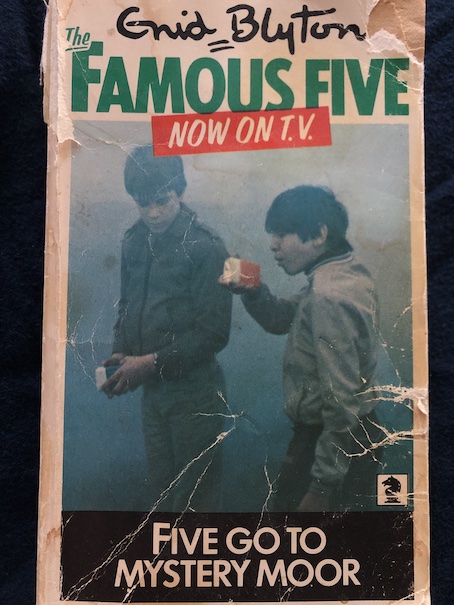
Five Go to Mystery Moor by Enid Blyton, 1954, 1974.

The girls, George and Anne are attending a riding school, and the boys, Julian and Dick, are camping when George receives a letter that her father is ill, and her mother wants the girls to stay on at the riding school for a while longer. The girls are disappointed and think that the boys will probably stay on at their camp, but they soon get a letter that the boys will be coming to the riding school to join the girls. The children are hoping that they will find another adventure when they’re all together again.

At the riding school, George has developed a rivalry with another girl called Henry. Henry’s real name is Henrietta, like George’s real name is Georgina, and like George, Henry likes to dress and act like a boy. However, rather than bonding over their shared interests and styles, George and Henry resent each other. (George makes a big deal of not liking to be a girl and wanting other people to look at her and refer to her as a boy. I’ve wondered whether the implication is that she’s actually transgender, without using that word to describe her, or if she’s merely a tomboy who things girl things are sissy stuff. Enid Blyton’s books are often full of the implication that boys are tougher and braver than girls, and it seems to be a mark of praise for a girl to be like a boy. In this particular book, it seems like both George and Henry are trying hard to be “not like other girls“, and the reason why they resent each other is that they’re both disgruntled to realize that at least one other girl is like them, making each of them seem less exceptional. They each seem to feel like the other is horning in on their shtick.) In spite of the rivalry between George and Henry, the other children like Henry. Eventually, George and Henry settle their differences. Henry joins the other children on some of their rides and explorations.

While the children are still at the riding school, a gypsy boy comes to the stables with an injured horse, asking for help. (They’re referred to as “gypsies” all throughout the book, although that’s considered a kind of insult. The proper name is really Romani, and they’re also sometimes called “Travelers.” The name “Gypsy” comes from an earlier misunderstanding that their ancestors were originally from Egypt, kind of like how Native Americans were mistakenly referred to as “Indians”, and the name stuck. I only use the word “gypsy” here because the author does, and I want to make sure that fans of the original book understand what I’m talking about. This note is here to clarify the difference. Gypsies are stock characters in Enid Blyton books, and they’re all pretty stereotypical.) The boy is told that it will take a few days before the horse is able to walk, let alone pull a caravan wagon. The boy is very upset because his father has a nasty temper, and he’s not willing to wait. The other children soon see how abusive the boy’s father is, and they’re sympathetic to him. Julian and Dick catch the father trying to steal a horse or reclaim his in spite of its injury during the night. When they ask him why he needs a horse so badly and can’t wait until his is properly healed, and he tells them that his group needs to go to Mystery Moor. Seeing that he’s not going to get another horse, the father decides to move on with other members of their party, leaving his son behind to tend to their horse and catch up to them when he can.

Julian, Dick, George, and Anne are intrigued by Mystery Moor, although they can’t imagine what could be there that would make someone so desperate to go there. The name of the place intrigues them, and they are told that it used to be called Misty Moor until some strange things happened there years ago. A wealthy family established a sand quarry there and built a small railroad line that crossed the moor, but they had a dispute with the gypsies who lived on the moor. The gypsies sabotaged the railroad, and when the sons of the family went to deal with the situation, they all vanished and were never seen again. The local rumor is that the gypsies probably murdered the sons, but nothing was ever proven, and to be honest, nobody really misses the sons because they weren’t nice to anybody else, either.

The children think that this is the adventure that they’ve been looking for, and when the riding school becomes crowded because of the arrival of new students, they decide that they want to go camping on Mystery Moor. They look forward to heading out onto the moor to see if they can find any traces of what happened to the missing family. However, there’s a modern mystery on the moor as well. The children spot a plane that flies low and circles the area, seemingly guided by a mysterious light. The children discover that the plane dropped a package, and that package is stuffed with packets of US money! Who would drop that much money from an airplane, and who was supposed to come pick it up?

The book is available to borrow and read for free online through Internet Archive (multiple copies). There is also an audiobook on YouTube. As the cover of the book notes, the Famous Five series was made into a television series, and you can sometimes find clips or episodes on YouTube.

My Reaction and Spoilers

Old and New Versions

I find that many of Enid Blyton’s mystery/adventure stories, no matter which series, are very much on par with Stratemeyer Syndicate books (Bobbsey Twins, Hardy Boys, Nancy Drew, etc.), especially the earlier ones. On the one hand, they contain many of the elements that children love in stories – mystery and adventure, independence from parents and other adults, spooky and mysterious happenings, kids who save the day, and a lovable dog. On the other, both Enid Blyton’s books and the Stratemeyer Syndicate books were revised in later reprintings to update the language and to remove or alter racially-insensitive and offensive terms.

I didn’t know how much some of the Stratemeyer books I read as a kid had changed from their original versions because I was born in the late 20th century, after many of these revisions had already taken place and didn’t read some of the original editions until I was an adult. I was surprised. Since I grew up in the US, I didn’t read any Enid Blyton books as a child at all. They’re available here, but not nearly as popular as the various Stratemeyer Syndicate series, and many American children don’t know about them at all. I’d heard of Enid Blyton books because they were referred in other books and movies I saw, but I didn’t read any until I was an adult. By that time, I wasn’t too shocked at some of the more problematic parts of the books.

“Gypsy” isn’t really a shocking word for me because there’s less emotional baggage attached to that word from the time and place where I grew up than there is attached to certain other racial words that I’d rather not mention. When I was a kid, I thought it was a more neutral, generic word than it really is, although someone did explain to me at some point what the name comes from and that it’s not really the proper name. However, when you find out that something really bothers people or that they don’t want to be called certain things, it’s better to just call them whatever they like to call themselves. I think the later reprintings of this book use the word Traveller (British spelling) instead, like this audiobook on YouTube.

As with Stratemeyer Syndicate books, I think the revised reprintings are fine for modern children, and the earlier versions are best kept for adults with an interest in vintage and nostalgic children’s literature. I find these books interesting particularly because they have the classic setup of a mystery-solving group of children and their dog, just like the Scooby-Doo mysteries, which is something that I grew up loving! The Scooby-Doo mysteries have a similar format to the Famous Five, and the working title for the original concept of the cartoon series was Mysteries Five, which might be an indication that the writers had Enid Blyton’s books in mind.

Interesting Information

One interesting piece of trivia is that the book discusses patrins, signs that the Travellers leave for each other to indicate which way they’re going. During the course of the story, the Traveller boy leaves patrins to help the other children.

The Mystery and spoilers

Like many vintage children’s mysteries, the story leans a little more toward adventure than mystery. The Travellers are definitely the ones who are there to get the dropped packets of money, and that’s why they were so worried about getting out on the moor in time. The real mystery is why they’re doing this and where the money comes from.

Toward the end of the book, the police reveal that the money is counterfeit, and that’s why it had to be smuggled into the country. Henry is helpful to the others at a point when they’re in danger, and that helps George to reconcile with her. Because the Traveller boy’s father is abusive and is about to be arrested for smuggling counterfeit money, he is likely to be sent to a foster home, which is actually good news for him because he was unhappy with his father and afraid of him. He says he would like to live a settled life in a house where he can ride his bike to school, and George promises to give him a bicycle as a reward for helping them when they needed it.

Five Go Off in a Caravan

The Famous Five

Five Go Off in a Caravan by Enid Blyton, 1946.

The children (Julian, Dick, Ann, George) and their dog, Timmy, are all looking forward to the summer holidays.  They’re not sure what they want to do, but they think that it would be more fun to go somewhere without the adults instead of going home, but they can’t think of anywhere they can go without adults.  They doze off in the sun while talking about it, but Timmy wakes them when a circus procession passes by.

The children are fascinated by the circus and call to a boy traveling with them, Nobby, asking him where they’re going to be performing.  Nobby says that the circus is on a break, and they’re going to be spending some time at a lake that allows them to camp there with their animals.

As the children watch the caravans of the circus going by, they think that it would be great if they could hire a caravan (horse-drawn travel trailer) and travel in it themselves.  They have a horse, Dobby, who could pull one.  The children ask their mother if they can hire a caravan, and she says that she’ll have to talk to their father about it.  It turns out that their father needs to go up north for part of the summer and wants their mother to come with them, so he thinks that it’s alright if the children want to take a caravan and camp out while they’re away.  The parents decide that the children will need to hire two caravans and borrow an extra horse because they don’t think one caravan will be enough for the four children and their dog, and they insist that the children sent them a message every day to tell them where they are and how they’re doing.

As the children discuss their plans in more detail, they decide that it will be fun to go to the lake where the circus is and get to know Nobby better.  Nobby lives with his uncle, who is the chief clown of the circus, and the children didn’t like what they saw of him before because he didn’t seem jolly at all, but they think it would be fun to be friends with Nobby and get another look at the circus animals. 

The children are eager to get started, but their parents make them pack and plan properly.  When the caravans arrive, the girls choose the red one, and the boys get the green one.  The girls take the new horse, Trotter, and the boys take Dobby for their caravan.  The adults give the children a map of places where they’re allowed to camp.  On their way to the lake, the children camp on farms that allow caravans.

When the children arrive at the lake, Nobby is glad to see them, and he introduces them to his chimpanzee, Pongo, and his terriers, Barker and Growler.  Nobby is friendly, but his Uncle Dan (called Tiger Dan) and Lou the acrobat are rough and unfriendly and don’t want the kids around.  When the children camp near the circus that night, Tiger Dan and Lou try to run them out of the campgrounds, but the children send their dog after them.  The campgrounds are public property, and there isn’t any reason why the children can’t be there.  The children think that Tiger Dan and Lou stumbled on their campsite by accident when they were trying to have some kind of secret meeting.

The next day, the children decide to go camp in the hills, as they had already planned because they know it will be cooler in the hills.  Lou takes an interest in where the children are going, but they don’t want to tell him much because they don’t want Lou and Tiger Dan coming after them to harass them again.  They find a nice place to camp up in the hills on some land belonging to a pleasant farmer and his wife, who also provide the children with food.

However, it isn’t long before Tiger Dan and Lou locate the children’s campsite and try to talk them out of camping at that spot also.  Nobby doesn’t know why Tiger Dan and Lou are up in the hills anyway.  The circus people have been buying some of their food from the farmer, but Nobby says that it’s always the women who go to the farm to buy things, not the men.  It seems like Tiger Dan and Lou are up to something suspicious, but the children don’t know what.

Then, suddenly, the men seem to change their views of the children, encouraging Nobby to be friends with them and to bring the children to visit the circus camp.  The children are suspicious and leave Timmy to guard their caravans while they visit the circus camp, just in case the men try to mess with their camp while they’re gone.  When they return to their own camp, the children discover that the men have tried to poison Timmy with tainted meat!  Fortunately, Timmy didn’t eat the meat, but unfortunately, one of Nobby’s dogs eats some and is violently ill.  The children aren’t sure whether the little dog will survive or not, and they don’t know why the bad men want to get rid of them so badly that they would try to kill their dog.  Whatever’s going on is serious, and they need to get to the bottom of it!

The book is available to borrow and read for free online through Internet Archive (multiple copies).

My Reaction

Traveling without parental supervision is the stuff of vintage children’s books and the dreams of children from every era! The kids in the Famous Five series have far more independence that modern children have, and in fact, the authorities might be concerned about children their age traveling without their parents. Actually, I would think that few adults even at the time of the writing of this book would even consider letting their children travel alone like that. That’s part of the appeal of this type of story, children being able to do things that real children never do.

I didn’t like the part about the dog being poisoned because I always hate it when bad things happen to animals in stories, but don’t worry! Nobby’s dog is fine in the end!

The Castle of Adventure

Enid Blyton’s Adventure Series

The Castle of Adventure by Enid Blyton, 1946.

Since the children’s last adventures, Philip and Dinah’s mother has used the children’s reward money to buy a home for them, so the children won’t have to continue staying with their aunt and uncle on school holidays.  They’ve also invited their friends, Jack and Lucy-Ann, to live with them, so they don’t have to return to their uncle’s house.  Now, the girls go to the same boarding school, and the boys go to their boarding school, and they’re all together on holidays.

When the children are out of school for the summer again, they and their mother go to stay in a cottage near an old castle on a hill.  The children are fascinated by the castle, but their mother doesn’t want them going near it because local people tell sinister stories about it.  She doesn’t explain about their stories, but she seems to think that it might be dangerous.  However, she does agree that the children can go have a look at an eagle’s nest near the castle, knowing how Jack feels about birds.  The children realize that they can use that to get a look at the castle anyway.

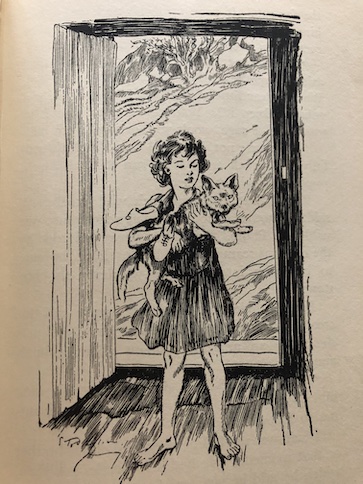
They make friends with a local girl named Tassie.  They call Tassie a “wild girl” because she’s a gypsy, has a pet fox, and runs around in old, dirty clothes and without shoes (she carries shoes with her but doesn’t wear them) and seems uneducated.  She doesn’t seem to know what an eagle is or what a bath is (although the children’s mother insists that she get one).  (No, I don’t believe that she’s ignorant for being a gypsy. I think it’s both a stereotype and a plot device.)  However, Tassie knows the area very well and helps the children find their way around.  Tassie is also afraid of the castle.  When the children ask her what stories people tell about the castle, she says that an evil man used to live there, and people would come to see him and never be seen again.  Still, the children want to explore the castle.

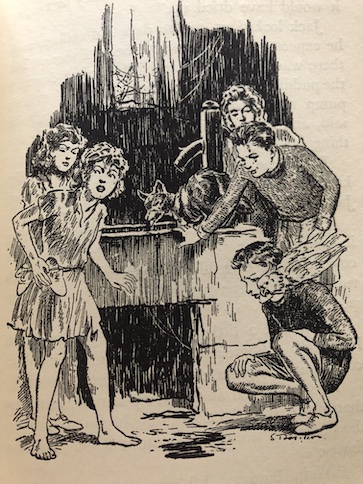
When they explore the castle, they find a water pump with a puddle beneath it, indicating that someone has been there recently to prime and use the pump.  Jack also realizes that the eagles in the next have a young eaglet who looks like it’s about ready to fly.  He persuades the children’s mother to let him build a hide (camouflaged shelter) so he can camp out and watch the birds.

While camping out, he realizes that there’s someone else in the castle besides himself.  At night, he hears someone moving around and using the pump, and he thinks he sees a flashing light, like someone signaling to someone else.  In the morning, he thinks maybe he dreamed it, but Lucy-Ann mentions seeing the flashing light.  Lucy-Ann thought that Jack was signaling to her, but Jack realizes that it was someone else and that he wasn’t dreaming.

Exploring the castle further, he finds a hidden room with old furniture and armor and realizes that someone has been hiding there.  Later, he sees some strange men in the castle and hears them speaking a language that he doesn’t recognize.  Who are they and what are they doing there?  Could they have something to do with the assignment that their friend Bill, an undercover investigator, is doing in a town nearby?

The book is available to borrow and read for free online through Internet Archive (multiple copies). It was also made into a tv movie serial. You can see it on YouTube.

My Reaction

Like other Enid Blyton books, there are racial issues in this book that were changed in reprintings. Enid Blyton books often feature stereotypical gypsies (more politely called Romany or Travelers these days) as characters and plot devices. Tassie is a pleasant and helpful character but still stereotypical.

I like the setting for the story. A supposedly abandoned castle makes an exciting place for our young heroes to explore. Even with the references to spooky stories about the place, the kids never really believe that the castle might be haunted. They very quickly realize that there are living people who have been hanging around the place. The sort of sinister characters using the place as a hideout are the same sort of villain characters as in the first book, which brings the kids’ friend Bill back into the story.

I enjoyed the movie serialization of the book, and I thought that it followed the story of the book well.

Ruth Fielding at Silver Ranch

Ruth Fielding

Ruth Fielding at Silver Ranch, or Schoolgirls Among the Cowboys by Alice B. Emerson, 1915.

In the last Ruth Fielding book, Ruth and her friends met a girl named Jane Ann who had run away from home. In this book, Ruth and her friends go to Silver Ranch in Montana, Jane Ann’s home, which is owned by her uncle, Bill Hicks. Ruth’s best friend, Helen, is surprised that Ruth’s Uncle Jabez let her come on the trip because he’s been very upset about the money he lost investing in a mine. Helen says maybe the investment will turn out fine after all, and Ruth says that the mine he invested in, the Tintacker Mine, is coincidentally nearby. It’s supposed to be a silver mine, although Uncle Jabez now doubts whether the mine is real or some kind of scam. The young man who talked him into investing hasn’t answered Uncle Jabez’s letters for months. So, while they’re staying at the ranch, Ruth plans to ask some questions in the area about the mine and see what she can learn.

On their first evening at the ranch, while they’re playing music, singing, and enjoying themselves, they suddenly get word that there’s a prairie fire up by Tintacker, and a cowboy says that it was probably set by “Bughouse Johnny.” (“Bughouse” is an old-fashioned slang word meaning “crazy”, so this is a descriptive nickname.) Ruth and her friends go to help the cowboys with the fire, and they watch as they slaughter three steers and use the carasses to smother the flames.

Ruth asks some questions about Tintacker, and the cowboys mention a new man who’s been hanging around that area. They don’t know much about him, but he’s pretty young, and they call him “the tenderfoot.” Ruth thinks he might be the young man her uncle has been looking for. She also asks them about Bughouse Johnny, but they don’t tell her much more than he’s a crazy guy who camps out in the area of Tintacker.

Ruth explains her uncle’s situation to Jane Ann’s uncle. Bill Hicks says that, as far as he knows, there’s no more silver left in the Tintacker Mine, and he thinks that Ruth’s uncle has been cheated. Ruth asks him if there’s any way that she can see the official papers associated with the mine, and Bill Hicks introduces her to a friend of his who is a lawyer, Mr. Savage. Mr. Savage confirms that ownership of the mine belongs to a man named John Cox, who bought out the other heirs of the mine’s original owners. Like Bill Hicks, Mr. Savage thinks that the mine isn’t worth anything, but if the young man Uncle Jabez invested with is John Cox, the investment is valid, just not one that’s likely to see a return. Ruth says that she will give the lawyer’s information to her uncle and that her uncle may ask him to act on his behalf later, depending on how he decides to handle this investment.

Ruth and her friends have some Western-style fun and adventures with Jane Ann, the cowboys, and the other locals. Jane Ann gets to show off her riding and ranching skills, and they all attend a local dance, where Ruth and her friends play matchmaker between a shy cowboy and the haughty schoolmistress he admires. They have a hair-raising encounter with a wild bear, and the man who saves them by shooting the bear turns out to be the man from Tintacker who Ruth wants to see.

When Ruth and one of Hick’s men go to see this man later, they find him deathly ill. If the man doesn’t recover, and if the mine turns out to be worthless, Uncle Jabez will lose his money, and there will be no way for Ruth to continue attending the boarding school she loves with her friends! However, the answer to the truth about John Cox’s identity is closer than Ruth and her friends suspect.

The book is available to borrow and read for free online through Internet Archive (multiple copies) and Project Gutenberg (multiple formats).

My Reaction

Like many other early Stratemeyer books, this story contains elements of a mystery but is really more of an adventure. I didn’t like parts of the adventure because there were repeated instances of characters being attacked by animals and then the animals needing to be killed. At one point, Ruth herself beats an attacking wolf to death, and I thought that was a shockingly violent scene for a Stratemeyer Syndicate book! Although, earlier Stratemeyer Syndicate books are quite different from the later ones.

The mystery part of the story focuses on the identity of John Cox, the man who convinced Uncle Jabez to invest in his mine, and the truth about his mine. I actually felt a little silly for not figuring out the true identity of John Cox sooner because he actually shares the same last name as one of the other regular characters in this series, and it’s not a coincidence. John Cox is Mary Cox’s brother.

Mary Cox, nicknamed “The Fox” by her schoolmates for being sly, is along on the trip with the other Briarwood Hall girls, although she is a nasty rival for Ruth in particular. Even though she has gotten along better with some of the other girls in the past, her snooty attitude and bad behavior have finally gotten on everybody’s nerves in this book.

When Mary is temporarily in control of a wagon Ruth and Helen are in, she does something reckless and almost gets them all killed until Ruth takes control of the reins and saves them. Everyone knows that the situation was Mary’s fault and that Ruth saved the day, and this is not the first time that Ruth has saved Mary from something. (By my count, it’s the third time.) However, Mary is ungrateful for her help and in denial that she did anything wrong (as usual). Just when everyone has decided that they’re completely fed up with her, the discovery of her brother changes things. While Mary is unmoved by Ruth saving her life, she is genuinely grateful to Ruth for saving her brother when he was ill and alone, which is astonishing for a girl who has never seemed to genuinely care about anybody else before. John Cox is an honest man, and Uncle Jabez’s investment turns out better than expected, guaranteeing that Ruth will be able to return to boarding school with her friends.

I want to warn readers that this is one of the Stratemeyer Syndicate books that has characters using racial slurs. The Ruth Fielding books were written before the Stratemeyer Syndicate revised its books in the mid-20th century to remove language like that. As in other Stratemeyer books, the use of inappropriate racial language is used to show which characters are crude and antagonistic, and in the case of this book, that character is Mary.

Mary Cox sneers at one of Bill Hick’s men, Jib, because he is of Native American descent, although Helen’s brother Tom stands up for Jib, pointing out that he’s much better educated than most of the men Mary knows, even though he works as a cowboy, and that Native Americans used to own the entire country before white people came, which is nothing to sneer at. Mary still insists on calling him a “savage”, mostly because Mary’s habitual method of communicating with people is to put someone else down so that she can look superior. This entire exchange takes place during an episode when Mary is trying to flirt with Tom, and bringing up racial slurs to put someone down during a flirtation with someone else is a very weird thing to do. It’s mostly a part of the story to show why Mary is such a pain. Tom just ends up being disgusted with her. It’s not the last time Mary uses racial slurs. At one point, she also calls the ranch cook a “fat and greasy Mexican squaw.” It’s pretty bad to see that kind of language in a kid’s book, even though it’s there to show that Mary has a nasty personality and behaves badly, which irritates and embarrasses people around her.

On a lighter note, the story is peppered with all sorts of Western words and slang. Since slang changes over time, and I’m not sure how people said things in the 1910s, I’m not sure how accurate the slang is for the time, but I’d like to call attention to a couple of words in the story that will be familiar to readers, but not in the way that they usually see them. “Cañon” is actually the Spanish word for “canyon”, pronounced the same way that we say in English, but the little tilde symbol over the ‘n’ adds the ‘y’ sound. The word that confused me the most was “kiotes,”, not because I didn’t know what they were talking about, but because that is not the Spanish version of the word. It looks like a phonetic spelling of the way we pronounce “coyotes” in English, but the Spanish word is also spelled “coyotes”, just pronounced a little differently. I didn’t know where the spelling “kiotes” came from, and I’d never seen it anywhere else before. I tried Googling it to find out more, and I saw a few mentions of the word with that spelling. One mention said that it was a Native American word, but it didn’t explain much more than that, so I can’t be sure. The book also uses the plural of “beef”, which is “beeves“, a word that used to be a joke with my brother and my friends the first time we heard it years ago because we thought it sounded funny. It also mentions the girls wearing “furbelow“, a word that I’d never heard before that means ruffles, pleats, or flounces in women’s clothing.

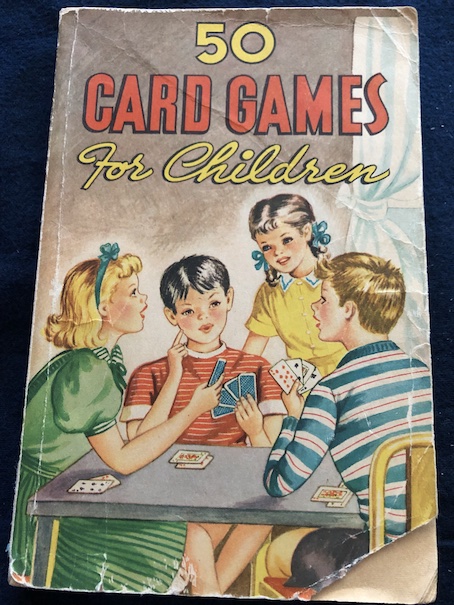
50 Card Games for Children

50 Card Games for Children by Vernon Quinn, 1933, 1946.

I love games of all kinds, and I was fascinated by this vintage children’s book about card games! Along with the card games, there is also a section in the book with card tricks. The vintage pictures in the book are also nice.

If you’re curious about what kind of card games children were playing during the Great Depression and around the time of WWII, this book offers some interesting insights! There were many games in the book that were already familiar to me, but there were some others that I had never heard of before.

The book is available to borrow and read for free online through Internet Archive.

Sections in the Book:

Card Games that Are Fun to Play

That struck me as an odd title for the very first section of the book, like whatever follows is going to be games that are not fun to play, but basically, this section contains multiplayer card games specifically aimed at children. It becomes clear when you study not only the contents but the titles of the other sections, which are about solitaire games, card tricks, and a section about popular card games that adults play.

I recognized a number of popular children’s card games in this section, like I Doubt It, War, Concentration, Hearts, Old Maid, and “Go Fishing” (which is what they call it instead of Go Fish, which is what I’ve always heard it called). There were some other games that I didn’t recognize, like The Earl of Coventry, Rolling Stone, Frogs in the Pond, and My Ship Sails.

Twelve Games of Solitaire

I was familiar with Klondike, Canfield, Pyramid, and Around the Clock (which I always called Clock Solitaire). I had never heard of Pirate Gold, Spread Eagle, Lazy Boy, or Down the Stairs before.

Twelve Card Tricks

These are magic tricks with cards. Some of them sound a bit complex when you’re reading the descriptions, but I think they would be more clean when actually trying them with a deck of cards.

Some Games That Grown-Ups Play

The games in this section are Rummy, Casino, Seven-Up (also known as High-Low-Jack), High Five, Cooncan, and Five Hundred. Actually, I have seen Rummy decks specifically for children, usually Animal Rummy, but that’s still a Rummy version, so that game isn’t just for adults.

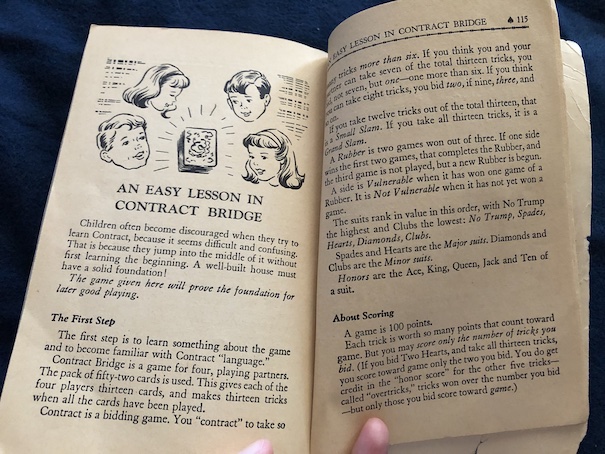
An Easy Lesson in Contract Bridge

I never thought of Bridge as being easy because I’ve always been intimidated by the concept of bidding. I understand trick-taking games like Whist, but I haven’t wanted to try Bridge because of the bidding. Actually, I think this basic description for children is a good tutorial for people like me, who find the bidding concepts confusing.

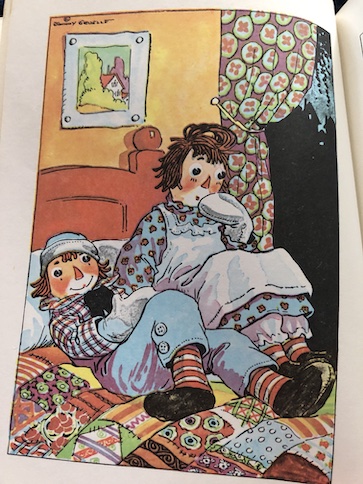
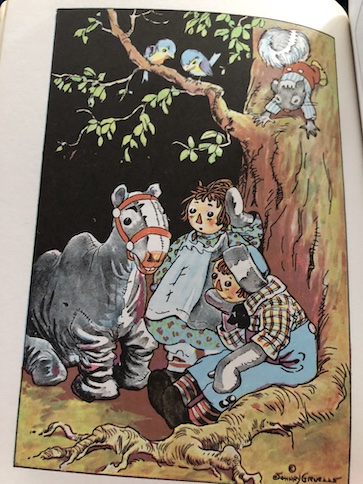
Raggedy Ann and Andy and the Camel with the Wrinkled Knees

Raggedy Ann and Andy and the Camel with the Wrinkled Knees by Johnny Gruelle, 1924.

This book is part of the original Raggedy Ann series by its creator, Johnny Gruelle. Unlike earlier books in the series, this book is a single long adventure rather than a collection of short stories.

Raggedy Ann and Andy are lying in their doll bed in Marcella’s playhouse one night when they see a strange man sneaking up to the big house. They see him reach through a window, steal something, and run away. Wondering what just happened, they run to the house and talk the other dolls. The other dolls say that the thief just stole the French doll!

Raggedy Ann and Andy try to follow the man to rescue the French doll, but they can’t catch up to him because he flew away! As they try to figure out what to do, a fairy comes along. They explain the situation to the fairy, and the fairy says that they can fly if Granny Balloon Spider weaves a balloon for them. So, they go to Granny Balloon Spider weaves them a silken balloon, and they sail away into the air.

When Raggedy Ann and Andy decide it’s time for them to get off the balloon, they grab hold of a tree limb and untie the silken strings that have them tied to the balloon. When they jump down from the tree, they meet an old stuffed camel with wrinkled knees. They explain their situation to the camel, and the camel says that the man who took the French doll sounds like the one who kidnapped him from his owner, a small boy. The camel escaped from the man, but he thinks he could find him again, except that it was dark when he ran away, so he could find his way better if he couldn’t see.
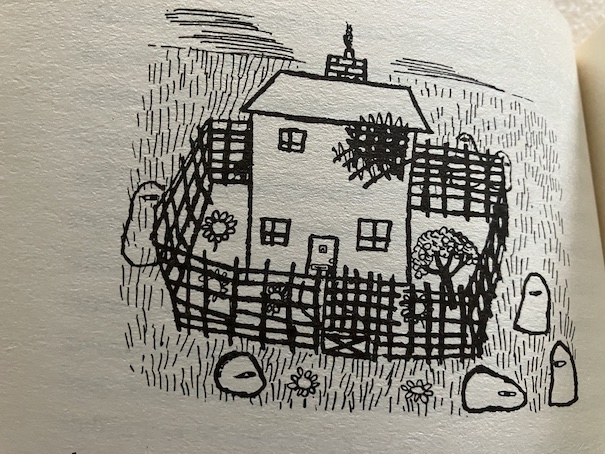
Raggedy Ann and Andy tie a handkerchief around the camel’s eyes and climb on his back. At first, the camel just goes around in circles, but Raggedy Ann and Andy realize that he needs to run backward to retrace his steps, and then, they start getting somewhere.

Along the way, they meet a girl named Jenny who is trapped in a patch of snap dragons. The snap dragons won’t let her go. When they try to help her, Raggedy Ann and Andy get trapped by the snap dragons, too. They don’t know what to do until a tired old horse comes and rescues them.

Jenny explains that she was searching for her brother, Jan, who was kidnapped by a magical creature called a Loonie. The tired old horse says that he knows where Jan is now, so they decide to rescue Jan before continuing their quest to find the French doll.

The Tired Old Horse leads them to the tree where the Loonie lives, and the Camel recognizes it as the place that he escaped from. They discover that the Camel as the ability to get inside the magical tree when he’s blindfolded, and he carries the others inside. From there, they find a trap door that leads to Loonie Land.

In Loonie Land, they are captured and brought before the king of the Loonies, who is a very silly king. The king insists that they won’t let Jan go until they answer three riddles. The riddles are very silly and make little sense, but Raggedy Ann and Andy figure out that the king doesn’t know the answers himself, so as long as they give him some kind of answer, they will be answering the riddles. The king is astonished that they are able to come up with answers and tries to insist that he has to ask them three more riddles, but Raggedy Ann and Andy insist that they’ve fulfilled the bargain already and that they’re going to take Jan. Raggedy Andy tweaks the king’s nose, and the king summons his looniest knight to fight them.
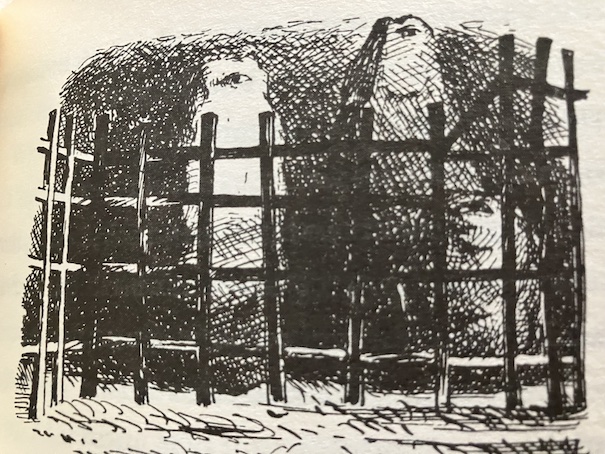
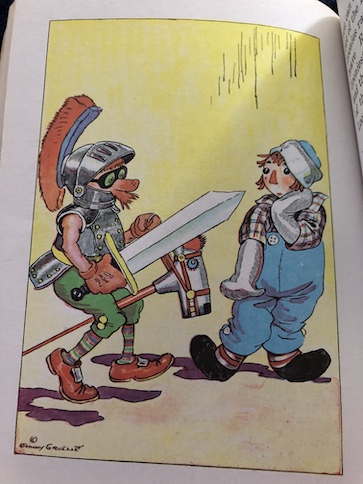
The looniest knight comes riding up on a hobby horse, but he’s afraid of Raggedy Andy and pretends that his hobby horse is acting up and that it has thrown him off. Since Raggedy Andy has “vanquished” the looniest knight, the king decides that they can take Jan and go.

With Jan rescued, they are able to resume their quest to find the French doll. Going further, they meet Winnie the Witch. The witch says that the man with the French doll bought some magic medicine from her, but he gave her a lead dime. Since he cheated her, the witch says that the magic medicine she made for him won’t work. The tired old horse asks if she has some medicine that will make him less tired. When he has her medicine, he becomes more energetic.

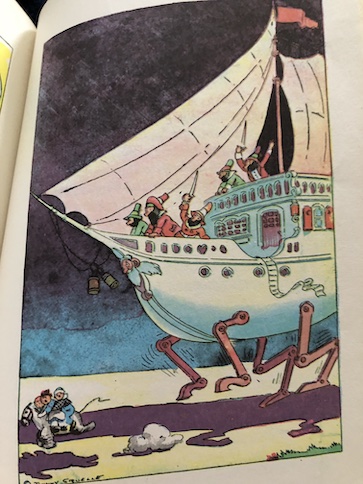
When they ask the witch how to find the man with the doll, she has them close their eyes and count to ten. When they open their eyes, they find themselves outside the tent of the man who took the doll. It turns out that Babette, the French doll, was kidnapped by pirates! Getting away from them is also going to be difficult because the pirates have a jumping house boat!

The book is available to borrow and read for free online through Internet Archive (multiple copies – including an audiobook). The LibriVox audiobook is also available on YouTube.

My Reaction and Spoilers

This story is cute, and I’m sure that it would be amusing for young children. Actually, I found it amusing as an adult because there are some silly jokes in the book that adults can enjoy, like how Raggedy Andy keeps talking while trying to tell the camel that he shouldn’t talk because Raggedy Ann is trying to think. At one point, the camel also gets confused about why the French doll is French when she has a china head. (Ha, ha. Groan!) One of my favorite parts was the part with the king of the Looneys and his nonsense.

The ending is also pretty silly. The tired old horse convinces the pirates to reform by offering them lollipops. It turns out that the pirates are actually a bunch of girls in disguise! These girls apparently had a deprived childhood, but they always liked to read stories about pirates and pretend that they were pirates. When they had a chance, they bought this magical jumping ship and started playing out their pirate fantasies, trying to get all the things that they didn’t have when they were younger, which is why they’ve stolen toys and are easily bribable with candy.

The story has a happy ending where the pirates help Raggedy Ann, Raggedy Andy, and the French doll get home. They reunite Jenny and Jan with their parents, and it turns out that the camel once belonged to Jan’s father. Jan’s father is happy to see his old toy and gives the camel to Jan.

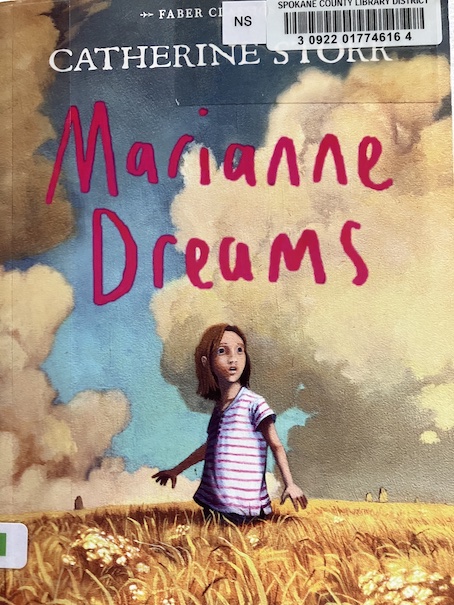
Marianne Dreams

Marianne has been looking forward to her birthday because her parents have promised her that when she is ten years old, she will be old enough to have riding lessons. She and her family live in town, so she doesn’t have easy access to horses, like children in the country do. Her special birthday present is going to have her first lesson at the local riding stable. Her birthday is wonderful, and the riding lesson goes very well, even if some of the more spectacular things that she had imagined before didn’t happen. Marianne would be perfectly happy except, at the end of the lesson, she is more tired than usual and feels achy. By lunchtime, she is feeling definitely ill, and she has a fever.

Marianne’s birthday illness quickly turns into the worst illness she’s ever had. Because of her illness, Marianne has to be confined to her bed for weeks, and she loses track of time. About three weeks after her illness began, she begins to feel a little more like herself and has more awareness of time and what’s happening around her. When she was at her worst, it was hard for her to be interested in anything or focus on anything, but now, she can think clearly enough to be bored and look for something to entertain herself. Marianne’s mother allows her to look through her grandmother’s old workbox, which mostly contains old needlework tools and an array of buttons, ribbons, beads, and other odds and ends that are interesting to look through and sort.

Among the things in the workbox, Marianne finds an old pencil. She immediately likes the look of the stubby old pencil and has the sense that it would be fun to use for drawing, so she picks up her drawing book and begins to draw a picture of a house with a fence around it and some flowers. Marianne’s drawing isn’t particularly great, not as good as what she pictured in her mind’s eye when she started it, but it is the start of something very special.

Although she is starting to feel better, Marianne’s doctor tells her that she is going to miss the whole rest of this term at school. He prescribes strict bed rest for her for the next six weeks. The doctor doesn’t actually say what’s wrong with Marianne, but he tells her that if she doesn’t rest, she could harm herself in a way that would last for the whole rest of her life. Even though she’s bored and says she’d rather be harmed or permanently ill than have to spend more weeks in bed, her doctor is firm with her that this is the way things are. He’ll see that she follows his instructions and recovers whether she likes it or not. Her condition is not contagious, so she can have visitors, but she must remain in bed and rest.

Marianne is sure that these weeks of bed rest are going to be horrible and boring, but soon, something strange begins to happen. She starts having dreams about the house that she drew with that special pencil. When she finds herself in the country with the house, the house is a little misshapen, and it unnerves her. The house is located on an empty, windy prairie, and Marianne can’t even get into the house because she didn’t draw a door handle on the door or put anyone inside the house who could let her inside.

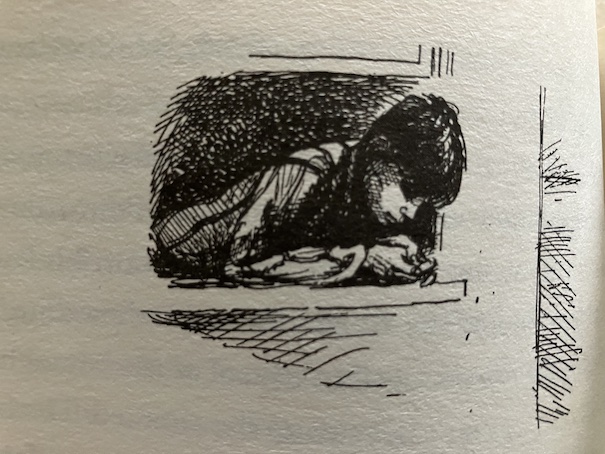
Marianne realizes that she could easily remedy these things by adding more to her drawing, so when she wakes up, she adds a knocker and handle to the door. She also draws a boy looking out one of the windows of the house. The boy seems a little sad when she draws him, but she isn’t sure how to fix his expression, so she just leaves it. Although Marianne isn’t sure whether she’ll ever dream of the house again, she does. In her next dream, the door has the knocker and handle, just like she drew, and there is a sad-looking boy at one of the windows of the house. Marianne waves to the boy and asks him to let her into the house, but he can’t. The boy is upstairs in the house, and there aren’t any stairs down to the ground floor. Marianne asks the boy how he got up there without any stairs, but he says he doesn’t know. Marianne insists that she needs to get into the house, and the boy says that he needs to get out. Marianne gets angry at the boy and the situation, which seems impossible. However, this is not the end of the dreams, and the boy isn’t just a figment of her imagination.

Marianne’s mother hires a temporary governess to tutor Marianne at home so she doesn’t fall too far behind in school. Marianne doesn’t like the idea of the governess at first, but Miss Chesterfield turns out to be friendly, and her visits and lessons add variety to Marianne’s days. When Marianne asks Miss Chesterfield about her career as a governess, she learns that, unlike governesses in books, Miss Chesterfield doesn’t live with her clients. Instead, she tutors different children in their homes, visiting each for a couple hours at a time. All of the children she tutors are children who are behind in their studies or who are studying special subjects that aren’t covered at their school or whose circumstances prevent them for going to school for a time, like Marianne. One of the other children being tutored by Miss Chesterfield is a boy named Mark, who has been left partially paralyzed from a severe illness and can’t walk. Marianne asks Miss Chesterfield if Mark will be able to walk again someday, and she says that it’s likely he will if he takes care of himself in the next couple of months and does what his doctor says.

However, as with Marianne, obeying the doctor’s orders isn’t easy for Mark. While Marianne wishes that she could just be up and about instead of resting like she should, Mark is just the opposite. He loves being at home with his books, and he has trouble pushing himself to start getting up and moving again, which is what his condition really requires. Mark needs to do physical therapy to strengthen his body and retrain his muscles, but it’s difficult and painful. Marianne is sympathetic to Mark because she knows what it’s like to be ordered to do something she doesn’t want to do even though it’s for her own good. She wishes that the two of them could switch places for a time so he could do at least some of her bed resting for her, and she could have the chance to get up and move around. Miss Chesterfield says that she thinks the two of them are better off being themselves and doing what each of them needs to do.

Marianne continues to feel the urge to draw in her spare time. She discovers that she’s unable to erase anything that she’s drawn, but she can continue to add to the picture. She adds more to the background so the house won’t seem to be in such an empty void, and on the opposite page in her drawing book, she draws the interior of the house, adding the stairs that the boy said were missing. This time, when Marianne dreams of the house, she finds herself in the interior, which is mostly empty because she hasn’t drawn furniture yet. She explores the house and finds the boy sitting on a window seat, looking outside, like he did before. The boy has noticed that the world outside the house has changed since Marianne drew hills and a tree. The two of them talk about their situation, trying to understand how they came to be in the house, and Marianne tells the boy that, now that there are stairs, he can go outside. The boy tells her that he still can’t because he can’t walk. He explains to Marianne about how he’s been ill for a long time, and he has special exercises he’s supposed to do to help his muscles, but it still isn’t definite whether he’ll be able to walk again or not. That’s when Marianne realizes that she’s talking to Mark, the same Mark that Miss Chesterfield told her about.

The two children could be dream companions for each other, but Marianne becomes more temperamental the longer she’s cooped up. One day, in a fit of anger because Mark made Miss Chesterfield late to see her and ruined her special surprise present for Miss Chesterfield’s birthday, Marianne turns the house in her drawing into a prison and the rocks outside into monsters that watch the house. Marianne thinks it would be a fitting punishment for Mark to be a prisoner in their dream house, but the problem with that is that Marianne still goes to the house when she’s asleep, too. Whenever she’s there, she’s also in a scary prison, surrounded by rock monsters.

It takes Marianne an embarrassingly long time to realize that everything she adds to her drawing changes the environment of the dreams that both she and Mark share, and even when she realizes that’s the case, Mark has a difficult time accepting it. It seems like, when the kids are in the dream world, they have some trouble remembering the waking world and making connections between the two, although Marianne has more memory of her waking life than Mark does, probably because Mark is more seriously ill. While Marianne has control of the special pencil and more ability to alter the world of their dreams, she can’t change everything, and the two children will have to work together to overcome their obstacles and escape the house. The house is useful for them during their recovery, but they quickly realize that it’s also a dangerous place, and they can’t stay there forever. Although Marianne didn’t draw a way for the rocks with the eyes to move, they are moving, and they’re getting closer all the time.

The book is available to borrow and read for free online through Internet Archive (multiple copies). In 1988, the story was made into a movie called Paperhouse. Paperhouse is a much darker version of the original story, though. There was a much earlier television mini-series from 1972 based on the book called Escape Into Night, which was much more faithful to the original story, although in that version, Marianne had a broken leg from a riding accident instead of being ill. All six episodes of Escape Into Night are currently on YouTube. I don’t know of any other way to watch it if you live in the US. There are dvds available on Amazon, but they’re region coded. For sci-fi fans, I swear that the rock monsters in Escape Into Night also sound like Daleks from the original Doctor Who. The book was originally published in Britain, and the movie versions are also British. There is also a sequel to this book called Marianne and Mark, where the two children from this book meet as teenagers in real life instead of in the dream world.

My Reaction and Spoilers

To begin with, I’d like to explain that, while the concept of a drawing coming to life somewhat reminds me of Harold and the Purple Crayon, this is definitely a more serious book with greater depth. The children in the story are dealing with some serious and frightening problems, both in the real world and the dream world.

I love the way that the pictures in the book alternate between Marianne’s drawings and the children’s “real” experiences. First, we get to see what Marianne draws, and then, we get to see how her drawing comes to life in the children’s dreams. Marianne’s drawings are child-like, with crooked houses, misplaced windows, and stick figures. The dream drawings are as misshapen as Marianne’s drawings, but at the same time, they are more three-dimensional, as the children perceive them when they’re inside them in their dreams.

The book never explains exactly why Marianne is sick or what might happen to her if she doesn’t rest, although I have a couple of ideas. There are illnesses which can leave people severely weakened for long periods of time, and they have to rest or suffer lasting organ damage. When my aunt was young, she was extremely ill with valley fever. That’s probably not the illness Marianne has because valley fever comes from a fungus found in the soil in certain parts of the Americas, but I don’t think it’s found where Marianne lives in Britain. I mention it because I think that it’s similar in severity to Marianne’s illness. Most people who get valley fever don’t have it severely. In fact, most long-term residents of the area where I live have had it at some point in their lives, and it’s often mistaken for a mild flu. However, once in a while, someone has a much more serious case, like my aunt did. My aunt had to spend weeks at home, resting, and a tutor came to the house to help her with her schoolwork until she recovered enough to return to school. Even then, she had certain restrictions. Valley fever is hard on the lungs, so she couldn’t over-exert herself. For a period after she returned to school, she still tired quickly from ordinary activities, she could not take physical education classes, and she even had to use the elevator at her school (which was reserved only for those who needed it) instead of taking the stairs to classes like most of the other students. If my aunt had pushed herself too hard before she had fully built back her strength and stamina, she might have damaged her lungs permanently. I think that the doctor in this book is warning Marianne that her condition is similar, that she might cause herself some form of lasting organ damage if she doesn’t rest and let herself fully recover.

In Marianne’s case, I suspect that Marianne’s illness could potentially damage her heart because her doctor is concerned that she not get angry or over-excited, but that’s just a guess. Illnesses like that are relatively uncommon, but they do happen in real life. Depending on the condition she has, it’s possible that Marianne’s extended bed rest might also be shortened by more modern treatments, if this story happened during the 21st century. It’s difficult to say without knowing what her ailment is, but I think it’s worth pointing out that this story was written during the 1950s, which is also coincidentally the time period when my aunt had her illness in her youth.

In the movie version of the story, Paperhouse, they say that Marianne had glandular fever, but since the book never specifies, some readers have speculated that she might have had rheumatic fever, since the symptoms fit the description of her illness. I tend to think rheumatic fever is more likely because it can potentially cause a risk to the heart, and that seems to be the concern in the book, the reason why Marianne has to rest and be careful to avoid long-term damage to herself until she is fully healed. In Paperhouse, Mark is described as having muscular dystrophy, but the book actually says that Mark has polio. The first polio vaccine was developed by Jonas Salk in the early 1950s, although it took a few years for it to come into widespread use, so it’s plausible that Mark could have caught the disease before he had a chance to be vaccinated.

My parents were both in elementary school during the 1950s, and they remember getting their polio vaccinations and the boosters that they gave to kids in an edible form on sugar cubes. Other people who were young around that time period may have similar memories. Although I never saw a child or young person with polio when I was a kid, probably because all the kids I knew were vaccinated, my parents say that it was a real menace when they were young, and the serious consequences of the disease were a real fear. While my mother was still young, her aunt contracted polio as an adult. Her aunt survived having polio, but there were lasting effects. Even people who recover their strength after having polio while young or relatively young can have it come back on them when they’re older as post-polio syndrome. My mother remembers her aunt before she became ill, but by the time I met my great-aunt, she was an elderly lady in a wheelchair because of the condition. That’s part of the reason why my family believes in the benefit of vaccines in general. We’ve noticed definite improvements between generations because of them.

The characters in the story experience some personal growth from their ordeals. I liked it that, in the beginning of the story, Marianne considers some of the old-fashioned stories she’s read where girls suffer from severe illnesses or ailments that keep them in bed for long period of time. It is a common trope of 19th century and early 20th century books that characters’ lives and personalities are changed by illness because dealing with the illness and the restrictions imposed on them because of it teaches them patience and understanding. (See What Katy Did in the Carr Family series from the late 19th century for an example.) Marianne wonders if she’ll experience the same type of transformation or if she’ll still be the same Marianne she always was after her ordeal is over. Both Marianne and Mark have things they need to learn in order to overcome their respective problems. Miss Chesterfield’s belief that it’s best for them both to learn to manage their problems rather than envying each other is the correct one.

Marianne has to learn about emotional control. During her period of forced rest, Marianne’s temper gets worse because she’s frustrated with her situation, and her doctor warns her that she’s going to have to learn to keep calm because fits of temper are as bad for her health as physical over-exertion. Marianne needs to learn to relax, to not try to push herself or situations to move faster than they need to go, and to keep her temper even when she’s frustrated. When she realizes that the things she draws on paper with the special pencil have real consequences for Mark, who is also struggling through his illness, Marianne also becomes more compassionate and considerate, trying to find creative ways to help Mark through her drawings. It takes some trial and error, but Marianne does become a more thoughtful person. When it’s finally time for Marianne to get out of bed and start to strengthen herself again, she experiences some of what Mark has been struggling with, and it increases her understanding of his situation.

Meanwhile, Mark has to learn to push himself a little harder and to persevere even in the face of hardship. Miss Chesterfield has noticed that, while Mark will work and study hard at things he likes or things that are easy for him, he has a tendency to give up too soon or only make half-hearted efforts at things that are difficult or don’t come naturally to him. While his body is getting the the medical attention it needs, his spirit needs some stirring so he can find the inner strength to keep going with his efforts to restore and improve his physical health. He explains to Marianne how he feels, being physically weak and dealing with the uncertainty of whether or not the exercises he’s been given to do are even going to make a real difference or not. Because his condition is serious, even things that his doctor says are likely to help aren’t completely guaranteed to help. These feelings of uncertainty are a heavy burden for Mark to bear and another obstacle that he has to overcome. He finds it hard to continue making an effort when he knows that it might not make a difference in the long run. He needs to remind himself that, while trying his best may not be enough to help him walk again, doing nothing at all guarantees that he will lose that ability. A chance at improvement is better than no chance at all. Marianne provides support and encouragement for Mark, and seeing the results they experience from their efforts in the dream world encourages the children to do what they need to do in the waking world.

Although the book has fantasy themes, I thought that the descriptions of the children’s struggles in the real world and Marianne’s feelings about her illness were very realistic. Mark and Marianne have to use some different tactics when battling their illnesses because they have different problems. I think the book makes a good point that what’s necessary for one person’s situation isn’t always the same for another’s. Some people need to push themselves a little harder and tackle problems head-on while others need to develop a little more creativity and patience to work around their problems. In the end, Marianne and Mark do both. The children are an inspiration to each other, helping each other every step of the way.

Mary Poppins Opens the Door

Mary Poppins Opens the Door by P. L. Travers, 1943.

This Mary Poppins book was written during World War II, and the author has an acknowledgement in the first chapter that things have changed because of the war. Like other Mary Poppins books, each chapter is its own short story, and the first one takes places on Guy Fawkes Day. A note at the beginning explains what Guy Fawkes Day is, and it also mentions that people haven’t celebrated it since the war began. However, the author says that she is sure that the situation is only temporary and that people will celebrate it once again after the war is over.

Sadly, people reading older versions of Mary Poppins books also have to be warned about the racial language. The stories are magical, but at the same time, one of the most grating things about the original printing of this book is that characters have a tendency to use racial language or racial terms as insults. When characters, even Mary Poppins, are irritated with each other, they’ll call people things like “Hottentot“, “black heathen”, “Blackamoor“, and similar things, implying that these people are behaving like “savages.” Some of the words the books use would be considered offensive by themselves, but it’s worse when they’re specifically used as insults. These incidents don’t take place in every story, but they happen throughout the original printing of this book, and they’re also found in other old Mary Poppins books. On a somewhat lighter note, I liked the character of Mrs. Clump, even though she’s an antagonist in one of the stories, because she used “vampire” and “pirate” as insults. If someone is going to use insults, I like them imaginative and funny like that. Fortunately, later reprintings of this book revised or removed the inappropriate racial language, so some people who grew up with the revised versions may not have even been aware that they were ever there.

This is the third time that Mary Poppins returns to the Banks household to be the children’s nanny. In the previous two books in the series, she came suddenly and left suddenly, without warning. Mrs. Banks finds it upsetting that Mary Poppins comes and goes so unexpectedly because she never knows if she can count on her to be with the children or if she will disappear suddenly. All the same, Mrs. Banks is always grateful when Mary Poppins comes because she’s so good at putting the household in order.

The book is available to borrow and read for free online through Internet Archive (multiple copies).

Stories in the Book:

The Fifth of November – Mr. Banks is in a bad mood and declares that he won’t be home for dinner that night, upsetting his wife and children because it’s Guy Fawkes Day, and the family wants him to help set off fireworks. He won’t even shake hands with the chimney sweep, even though that’s supposed to be good luck. Part of the trouble is that the family is missing Mary Poppins, and they haven’t found anyone to replace her, leaving the house in disorder. Mrs. Banks considers hiring Mr. Banks’s old governess, but the children beg her not to because they know how strict she is. The discussion is interrupted by the chimney sweep. Mrs. Banks doesn’t remember scheduling the chimney sweep for the day, and the household staff panic at the idea of having to clean up after the chimney sweep. The chimney sweep offers to take the children to the park and set off some fireworks to give the household time to prepare for him, and the children eagerly accept. The chimney sweep and the park keeper set off fireworks with the children. For some reason, though, there are no sparks from the last rocket, and they can’t figure out why. As everyone else starts heading home, the children see something odd in the sky, a strange spark. It gets larger, and the children recognize it as Mary Poppins.

The children are overjoyed to see Mary Poppins again, and she takes them home. Mrs. Banks is also glad to see Mary Poppins again even though she’s still irritated at the way that Mary Poppins comes and goes suddenly without word or warning. Mr. Banks’s mood improves as well. Mary Poppins immediately starts making herself at home and putting things in order. She measures the children, but instead of learning their heights, she learns about bad habits they’ve developed. The children ask Mary Poppins if she’s going to stay with them this time, and she says that she’ll stay “until the door opens.” Jane is upset because the nursery door opens all the time, but Mary Poppins tells her that she means “the other door” without explaining what that means.

Mr. Twigley’s Wishes – When Mrs. Banks says that she needs to find a piano tuner, Mary Poppins recommends her cousin, Fred Twigley. She takes the children to Mr. Twigley’s house to see him. Mrs. Clump, the housekeeper, tries to send them away, but Mary Poppins pushes in anyway. Mr. Twigley has locked himself in a room. When Mr. Twigley finally lets Mary Poppins into the room with the children, they can’t see him at first. When Mary Poppins asks him what’s going on, Mr. Twigley explains that he’s been “wishing” and that he’s hiding from Mrs. Clump. He makes himself visible again and explains that, at certain times and under certain conditions, he has the ability to make seven wishes that come true. It’s a tricky business because it’s easy to waste wishes on whims and random thoughts. Mrs. Clump is scheming to marry him because she wants him to use his wishes to give her what she wants, and Mr. Twigley doesn’t want to marry her. When Mrs. Clump tries to come see him, Mr. Twigley suddenly wishes that he was somewhere safe, and he finds himself on one of the music boxes that he’s been making. Then, suddenly, the children also find themselves on music boxes. Mrs. Clump brings a policeman to deal with the chaos, and Mr. Twigley also traps Mrs. Clump and the policeman on music boxes. Mrs. Clump promises that she won’t try to force Mr. Twigley to marry her anymore if he lets her go. What Mrs. Clump had wanted Mr. Twigley to wish for her was a golden palace, so he shrinks her, turns her into a mechanical woman, and puts her into a music box golden palace.

The Cat that Looked at a King – Michael has a toothache the day after his birthday, and Mary Poppins says that it’s because he’s eaten too many sweets. Michael angrily tells Mary Poppins not to “look at him like that.” Mary Poppins says that “Even a cat may look at a king,” and the children and Mary Poppins talk about what the phrase means and if it’s true. A china cat from the mantelpiece comes to life and runs off. Mary Poppins tells the astonished children that the cat has gone to see the queen.

Mary Poppins begins telling the children a story about a king who thought that he knew practically everything, but he kept wondering about all sorts of random things that he doesn’t know. He would think of all sorts of random questions and then send his subjects out to find the answers for him. He kept everyone so busy with finding out random information and writing it down that ordinary tasks would be neglected. The queen feels neglected by the king, the kingdom is poor, buildings are crumbling because they aren’t being maintained, and the castle is infested with mice. Then, a cat comes to the castle and hunts the mice. Then, it sits on the king’s desk and stares at him. The king asks him what he’s doing, and the cat says that he wants to look at him. The king says the cat can look at him, and when the cat has had a good look, the king asks the cat what he thinks. The cat doesn’t think much of the king, and the king is offended because he thinks that his great knowledge deserves more admiration than that. The cat says that it knows everything, and the king says that’s impossible because even he doesn’t know everything. The cat says that cats know everything, and the king challenges the cat to prove it. The cat agrees to the challenge but sets the condition that whichever of them wins gets to govern the kingdom. As the king asks questions, the cat replies as if they’re all riddles. The king says that he’s not being serious and is missing the point, and the the cat says that all questions must have a point and his ridiculous questions don’t have one. The king is unable to answer any of the cat’s questions, but the queen, a page, and the prime minister can, so the cat says that he has the right to rule the kingdom with the help of the people who could answer the questions.

However, the queen, the page, and the prime minister all refuse to serve the cat because they are all dedicated to the king. The king repents of his foolish pride in his supposed knowledge and says that he’s not sure of who he is really anymore. The cat tells the king to look at him, and the king sees his own reflection in the cat’s eyes. When he sees himself, the king remembers that he’s actually King Cole, a merry old soul, and that he has no need of all these useless facts he’s been obsessing about. The cat says that he will let King Cole have the kingdom back if he can be allowed to visit the queen sometimes, and they agree.

The Marble Boy – Mary Poppins takes the children to the park, and although she doesn’t want to admit it, she is irritated that an old man is sitting in her favorite seat, reading a book. When the man closes the book and gets up, a statue of a boy with a dolphin suddenly leaps down from its pedestal and begs him not to stop reading yet because he’s been reading over the man’s shoulder and wants to finish the story. The shocked man apologizes but says that he has to get home to tea. The marble boy asks him if he can have the book, and the man is reluctant to part with it because he’s been wanting to read it for years, but he finally hands it over and leaves.

Jane and Michael ask the marble boy who he is and how a statue can read and jump off its pedestal. The boy says that his name is Nelius. He is an ancient statue from Greece that was separated from the rest of his family. He is often lonely, but he likes observing people in the park and reading over their shoulders. Mary Poppins, who Nelius says he knows because she’s an old friend of his father, tells Nelius to get back on his pedestal, but Nelius begs her to let him play with Jane and Michael awhile longer. Mary Poppins agrees that he can play with the children for the afternoon, but then, he has to get back on his pedestal before he’s missed.

Nelius enjoys spending time with Jane and Michael and going to the book stall with them. However, he does attract unwanted attention. Mrs. Lark sees his dolphin and thinks that he’s cruelly removed a fish from the water, and she says that she’s going to report him. Various people worry because Nelius is running around naked, so Mary Poppins gives him her jacket to wear. At the end of the afternoon, Nelius gives Jane the book the man gave him, asking her to let him read it over her shoulder, and he gives Michael some money that the man at the book stall gave him to buy clothes. By now, people have noticed that the statue is missing, and the mayor is demanding that the park keeper explain the situation.

Peppermint Horses – Jane and Michael take their father’s walking sticks because they want to play horses with them, like they’re riding hobby horses. Mary Poppins gives the the walking sticks back to Mr. Banks and takes the children and Robertson Ay, who works for the Banks family, on errands. The children get tired of walking and start getting cross. Then, they see a woman named Miss Calico with what looks like a bunch of large candy canes and a sign that says she has horses for rent. The children are confused because they don’t see any horses. It turns out that Miss Calico’s candy canes are magical mounts that people can ride. Mary Poppins rents some of these peppermint horses for the children and Robertson Ay, and they ride them home through the sky, along with other people they know. Mary Poppins rides on her umbrella instead because she never uses walking sticks. The children want to keep their magical candy canes forever and continue to ride them, but they’re only rented. Miss Calico comes around at night and collects them.

High Tide – Mary Poppins takes the children to visit Admiral Boom and his wife because their parents want to borrow a bottle of port from them. They give them the port and a seashell for the children to enjoy. Michael is curious about what port tastes like, and Jane is fascinated by the seashell. She says that she would like to go see the sea.

That evening, while Mary Poppins is still having her half day out, the children hear a voice from the seashell telling them to dive in. They do and find themselves under the sea. The voice from the shell was a trout, and the trout introduces them to other sea creatures and takes them to a garden party that the creatures are having to celebrate high tide. Of course, Mary Poppins turns out to be the guest of honor.

Happy Ever After – It’s New Year’s Eve, and Michael wants to know what happens between the first chime at midnight and the last chime because he’s been told that the old year ends at the first chime and the new one starts at the last chime. Mary Poppins refuses to answer. She takes the children’s toys away from them, lines them up, and puts open books in front of them, also without explaining why, just telling the children to go to sleep.

The children wake up at the first chime of midnight and see their toys come to life. The toys lead the children to the park, where they see all sorts of storybook characters. (Friday from Robinson Crusoe is a rather uncomfortable character.) They explain that the period between the first chime and last chime of midnight on the New Year is called “the Crack”, and it’s the only time of year when characters can come out of their books, provided that they’re left open, and all be friends with each other, even if they’re enemies in their stories. It’s the only time when they truly have Happily Ever After. So, they all have a party to celebrate the Crack, and naturally, Mary Poppins is the guest of honor.

The next day, Michael asks Mary Poppins if they’ll ever have happily ever after themselves, and she says that depends on him.

The Other Door – Mary Poppins’s friends show up to say goodbye to her, although they try not to let the children know that Mary Poppins is about to leave. They all have a dance together, and Mary Poppins takes the baby home from the park before the other children. Jane and Michael realize that Mary Poppins is about to leave when her friends talk about “the door.” They rush upstairs to the nursery, but they don’t see her until Jane spots her in the reflection of the nursery in the window. The door in the reflection is the “other door” that she’d been talking about, and that’s the door that Mary Poppins goes through to leave. The children’s parents come into the room, and the children tell them that Mary Poppins is gone. Mrs. Banks is upset, but Mr. Banks dances because he likes the music from her goodbye party, which is still going on. The family thinks that they see a shooting star, but that’s Mary Poppins leaving. Still, they make a wish not to forget Mary Poppins.