Lady Margaret’s Ghost

Felicity, An American Girl

This book is one of the mystery stories published to accompany the American Girl series of historical books. The main character of this book, Felicity Merriman, lives in Colonial era Williamsburg, Virginia, around the beginning of the American Revolution.

Felicity’s mother is going on a trip to visit a relative, along with Felicity’s younger siblings. As the oldest girl in the family, Felicity will be in charge of the household while her mother is gone and her father and his apprentice, Ben, are working in the store her father owns. It’s a big responsibility and an honor that Felicity’s mother considers her capable of managing the household, but because Felicity is still young and some household tasks involve heavy work that is difficult for her to do alone, her mother has hired a temporary cook, Mrs. Hewitt, to help her. Because Felicity is known as a daydreamer who doesn’t always pay attention to what she should be doing, her mother reminds her to focus on the task at hand while she’s minding the house, although she has faith in Felicity and is sure that she will do a good job.

Soon after her mother leaves, a crate arrives at the house for Felicity’s father, along with a letter. The letter explains that a cousin of Felicity’s father has died and that the crate contains some family heirlooms that his cousin left to him. These heirlooms once belonged to a common ancestor of theirs, Sir Edward Merriman, a wealthy nobleman and the first member of their family to live in the colonies, more than 100 years earlier. Felicity’s father didn’t know his cousin well because they never lived very close, and his cousin was much older, but he does know the history of the heirlooms. The heirlooms include a lady’s silver vanity set and a silver cup and rattle for baby. The story is that Sir Edward’s wife, Lady Margaret, owned the vanity set, and the rattle and cup were for their infant son. Unfortunately, the baby was stillborn, and Lady Margaret died shortly after the birth. After her death, her husband and the household servants believed that she still haunted the house. The haunting may have been part of the reason why Sir Edward decided to leave his home in England and go to America, but even though he later remarried and had other children, he could never bring himself to part from the things that belonged to his first wife and child. Even before Felicity’s father tells her about the ghost story, Felicity gets a strange feeling from the vanity set, and she wonders if the objects could be haunted.

However, Felicity soon has to turn her attention to household issues. Mrs. Hewitt, the temporary cook arrives, and she is a brusque and unpleasant woman. She is rude and condescending to Felicity when they are working in the kitchen together. Because Mrs. Hewitt is so rude, Felicity is nervous and makes mistakes, making her look like more of a fool to Mrs. Hewitt. They can’t easily replace her because cooks are in demand right now because this is Publick Times in Williamsburg, and there are many visitors to the city. Everyone is busy tending to them. Mrs. Hewitt was the best they could find available. Felicity’s father does speak to her about her rudeness to Felicity. After that, Mrs. Hewitt is sullen and resentful, and she is even more pleased whenever she sees Felicity doing something wrong.
There is also an exciting event taking place. Felicity has entered her horse, Penny, in a horse race at the fair in town! Ben, her father’s apprentice, will ride her. The day of the race, Penny seems to be doing well, but then, she suddenly develops a problem during the race. When Felicity and Ben check her out to see what was wrong, they discover that someone put burrs under Penny’s saddle! Worse still, the wounds caused by the burrs become infected. Felicity is very upset and worried about Penny, and she wonders who would have hurt her horse. There were a couple of men looking at her before the race. There was also a boy named Dawson and a girl called Anne.

Dawson turns out to be a runaway, but he also has some knowledge of horses. Although Felicity is a little suspicious of him at first, Dawson helps to heal Penny’s wounds. He also says that he saw Anne gathering burrs, but it was probably on behalf of someone else.

When Felicity realizes that her treasured coral necklace, which her mother also wore as a girl, has disappeared, Felicity questions whether she carelessly lost it or if someone has stolen it. Felicity has been doubting herself and her ability to manage the household because of all the mistakes she has made since her mother left, and the clasp of the necklace was a little loose. This could just be another disastrous mistake, but it is suspicious that Anne seemed so friendly to her at the race and then ran away from her later. Anne also literally bumped into Felicity at the race. Could she have taken the necklace? Dawson seems to think so, but then again, can Felicity really trust everything he says?

Felicity still gets an odd feeling from Lady Margaret’s heirlooms, and she thinks that she sees something white moving around at night. At first, she thinks that it could be Lady Margaret’s ghost, but then, strange things begin happening around the house. Things disappear, and Felicity worries that maybe she carelessly mislaid them. Then, her necklace unexpectedly turns up, and Lady Margaret’s vanity set vanishes! Are these strange things part of the haunting of Lady Margaret or the work of a thief? If it’s a human thief, is it the work of the runaway Dawson, mysterious Anne, unpleasant Mrs. Hewitt, or the mysterious person who arranged for Penny to be hurt?

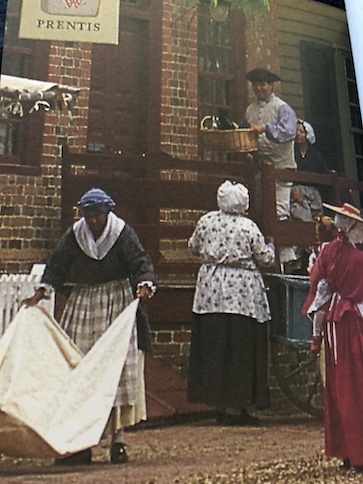
The book ends with a section of historical information about Colonial era Williamsburg. The story is set during Publick Times, which was when court was in session in Williamsburg. People would gather in Williamsburg during Publick Times to see the trials in court and attend a public fair in Market Square. The fair offered various kinds of entertainment, games, and races, like the horse race in the story.

The story leaves it a little ambiguous at the end about whether Lady Margaret’s ghost exists, but if she does, she is not harmful and has nothing to do with the thefts in the story or what happened to Penny at the horse race. As the section of historical information explains, there are many new visitors in Williamsburg during Publick Times. This was a good setting for the story because there are many strangers to the city with unknown pasts and motives, and crowds at the fair might harbor thieves.

Part of the story and part of the section of historical information in the back focuses on the subject of orphans. Both Dawson and Anne are orphans, and neither of them is really being cared for. Dawson admits that he used to steal to support himself after his father died, but he is seriously looking for work. Anne technically has a guardian, but her guardian is abusive and uses her as a servant rather than taking care of her.

When the thefts occur and mysterious things start happening around the Merriman house, both Dawson and Anne look like the best suspects, but there are also possible adult suspects. Even after Felicity realizes Anne’s situation, she isn’t entirely sure which of the men at the fair that day is Anne’s guardian. Mrs. Hewitt also looks suspicious because she is so unpleasant and seems to be trying to make trouble for Felicity. I though the book did a good job of supplying an array of suspects to consider. The solution to the mystery was one of the possibilities I thought was most likely, but there were enough other possibilities to make the story interesting.

Steal Away

StealAwaySteal Away by Jennifer Armstrong, 1992.
Most of this story is framed as a flashback, actually two of them.  In the beginning, during the late 1800s, a girl named Mary is taken by her grandmother, Susannah, to visit an old friend of hers who is dying.  The friend, Bethlehem, is a black woman who is a teacher in Canada and has a student living with her, a young black girl named Free, who is about the same age as Mary.  At first, Mary doesn’t completely understand who Bethlehem is and why they are there to see her, and Free is somewhat aloof and suspicious of these white people, but together, Bethlehem and Susannah explain to both the girls about their unusual friendship and a shared history that changed both of their lives forever.  As they explain, Mary writes down their story.

Years ago, before the American Civil War, Susannah was a young teenage orphan.  She traveled from her home in Vermont to the home of her aunt and uncle in Virginia, her new guardians.  Homesick, missing not only her deceased parents but the friends she left behind, especially a boy who is her best friend (and who eventually becomes her husband, Mary’s grandfather), Susannah finds life in Virginia strange and unpleasant.  Her aunt and uncle own slaves, which is something that makes Susannah uneasy.  She was raised not to believe in slavery, but her aunt and uncle give her a slave of her own to take care of her, a girl about her age named Bethlehem.  Susannah is extremely uncomfortable with the situation, not really being the kind of person to get others to do things for her or order anyone around, and Bethlehem isn’t happy about being saddled with this sad, somewhat weak and clueless, white girl.

Bethlehem already has serious problems.  Susannah’s older, male cousin has taken a liking to Bethlehem and pursues her, trying to force his attentions on her.  Bethlehem resists but knows that one day she might not be able to stop him because she’s in his family’s power.  They own her and have authority over her.  Susannah is unaware of this situation at first, being a rather naive girl.  However, Susannah’s unhappiness at her new home increases, and more and more, she longs to return to her real home in Vermont, and her desire to escape also becomes Bethlehem’s ticket to freedom.

Both of the girls long for freedom, although each craves a different kind of freedom and has in mind a different kind of life they long to live elsewhere.  Together, they team up to run away in disguise as boys, although Bethlehem does not trust Susannah at first because she resents white people and the slavery that has been forced on her for her entire life. However, with their common interest in escape, they learn to rely on each other.  They come to trust and understand one another much better during the course of their journey.  It is an eye-opening and life-changing experience for both of them.  Then, when it comes time for them to say goodbye and go their separate ways, it is one of the hardest things that either of them have had to do.

It is a story about lives with separate directions but which crossed in unexpected ways to the benefit of both of them.  Because Susannah and Bethlehem have different destinies and different things that they want in life, they cannot live their lives together and do not see each other again for many years after their adventures, but because of their shared experiences, they still share a bond that lasts across time.

After Bethlehem’s death, Mary becomes concerned about the young student of Bethlehem’s, Free, who was living with her as a part of her family, but Free doesn’t want their help.  Susannah tells Mary that they have to let her live her life and establish her own independence in the way she wants, just as Susannah had to let Bethlehem go her own way years before as a strong, independent young woman who only wanted the freedom to choose her own course in life.

In the end, Mary, as an adult looking back on the one and only time she met her grandmother’s old friend, just before her death, realizes that she has also learned much from the experience, not just about her grandmother’s history, but about herself, other people, racial differences and attitudes, and some of the realities of the world, absorbing vicariously some of the lessons her grandmother learned years ago through her story and Bethlehem’s.

This isn’t really a happy story.  The ending kind of leaves readers with an unsettled feeling because there are many things left unanswered and unresolved.  The book does explain a little about what happens to the characters at the end, but for the most part, they all kind of go their separate ways.  Although they’ve had an effect on each other, nothing is clear-cut, and they share moments together more than lives.  I have to admit that I felt like some of the story dragged in places and others were downright depressing, making this a difficult book to get through.  However, it is interesting for showing a part of history, a life-changing event from different points of view, and some poignant thoughts about caring but letting go.

The book is available to borrow and read for free online through Internet Archive.

Felicity’s Surprise

American Girls

FelicityChristmas

Felicity’s Surprise by Valerie Tripp, 1991.

FelicityChristmasBenProtestThis is part of the Felicity, An American Girl series.

Christmas is coming, and Felicity is excited. She and Miss Manderly’s other students, Elizabeth Cole and her older sister, Annabelle, have all been invited to the Christmas party at the Governor’s palace! Miss Manderly is a friend of the dancing master who has been giving the governor’s children dancing lessons, so she was able to get invitations for her students. There will be a special dance lesson for all the children who come. With food, music, and dancing at the party, Felicity and Elizabeth are looking forward to dressing up like grown-up ladies going to a ball.

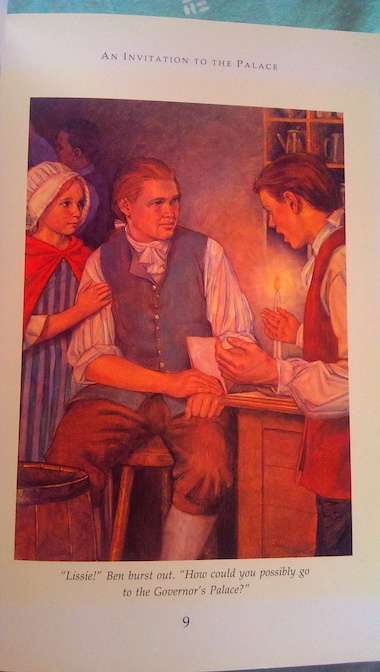
However, Ben, her father’s apprentice is against the idea of Felicity going because the Governor sides with the King and the Loyalists against the Patriots. He can’t understand why Felicity would want to attend a party with people who have treated the colonists so badly and have even boycotted her father’s store because he refuses to sell the taxed tea. However, Felicity’s father understands that the invitation was meant kindly and that it would be a special event for Felicity, so he tells her that she can go if she likes. Christmas should be a time for peace and enjoyment.

FelicityChristmasMotherIllAt Miss Manderly’s the girls start having dancing lessons, and Felicity wishes for a new gown, like the one on the elegant doll at the milliner’s shop. Since Felicity is usually not very interested in clothes, her mother decides to grant her wish.

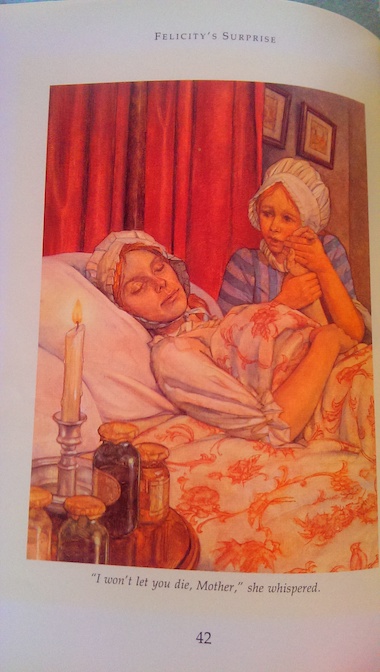
When Felicity’s mother falls ill, not only do Felicity’s Christmas dreams seem dashed, but she worries about whether her mother will recover from her illness. Everything that Felicity was concerned about before, the dress, the dancing, the party, all suddenly seems unimportant and silly in the face of something more serious. However, miracles come to those who work for them, and Felicity receives some unexpected help from friends.

There is a section in the back with historical information about how Christmas was celebrated in Colonial America.

The book is currently available online through Internet Archive.

Happy Birthday, Felicity!

American Girls

FelicityBirthday

Happy Birthday, Felicity! by Valerie Tripp, 1992.

FelicityBirthdayGuitarThis is part of the Felicity, An American Girl series.

It’s Felicity’s birthday, and her grandfather has given her a very special present: a guitar that once belonged to her grandmother, who is now dead. Felicity’s grandfather has heard Felicity singing and thinks that she shares her grandmother’s gift for music. He also thinks that Felicity is old enough to take proper care of the instrument, stressing the need for her to be responsible with it. Her mother tells her that she should keep the guitar safely in the parlor since she isn’t quite old enough for proper music lessons, like the ones Miss Manderly is giving Elizabeth’s older sister, Annabelle. Annabelle has been getting on Elizabeth and Felicity’s nerves by bragging about how they are still to young to even hold her guitar, although Annabelle really has no musical talent and struggles in her lessons.

Although Felicity knows that she should leave the guitar at home, she can’t resist taking it to Miss Manderly’s so that Miss Manderly can tune it for her and so that she can show it off to Elizabeth and Annabelle. Miss Manderly does tune the guitar for her and compliments her on owning such a fine instrument.

FelicityBirthdayGunpowderHowever, on the way home, something frightening happens. Felicity sees Elizabeth’s father, a known Loyalist, talking to a British soldier. She ducks into a bush so they won’t see her, and she hears them talking about the governor removing the gunpowder from the Williamsburg arsenal so the colonists can’t use it in the rebellion that has been threatening to come for some time.
Felicity hurries home to tell her family what she has heard, but when her mother and grandfather see that she has taken the guitar out of the house and gotten it wet and dirty while she was hiding, they refuse to listen to her. Her grandfather, also a Loyalist, particularly thinks that she’s making up stories to cover her irresponsibility about the guitar.

But, Felicity knows what she heard, and the situation is serious. What can she do to prove it to everyone?

In the back of the book, there is a section with historical information about how children were raised in Colonial America.  Another good book on the same topic is Going to School in 1776.

The book is currently available online through Internet Archive.

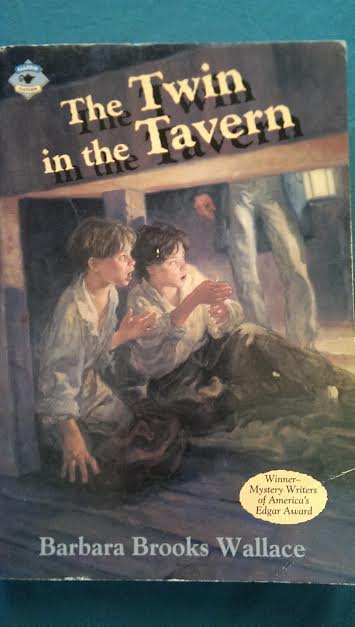
The Twin in the Tavern

TwinTavernThe Twin in the Tavern by Barbara Brooks Wallace, 1993.
Young Taddy has lived with his Aunt and Uncle Buntz in Virginia ever since he can remember. When they die during an epidemic, he is left completely alone and afraid that he will be sent away to a work house. Before his uncle dies, however, he tells Taddy something that gives him even more reason to be afraid. He tells Taddy that nothing is how it seems and that Taddy is not really their nephew. He says that Taddy will only learn the truth when he finds his twin, but he must beware because he is in danger. Unfortunately, he never says where Taddy’s twin is or what kind of danger he is in.

Before Taddy can decide what to do, a couple of thieves, Neezer and Lucky, come to rob the house because they heard that Mr. and Mrs. Buntz were dead. When they discover Taddy in the house, they bring him with them to Alexandria and make him work in their tavern. Taddy is only given scraps to eat and he must sleep under a table in the kitchen with another boy who works for Neezer called Beetle. However, by coincidence, Neezer and Lucky may have brought Taddy to the very place he needs to be to find the answers about his past and his true identity.

Danger seems to lurk around every corner in the city, and Taddy doesn’t know who to trust. Even when Neezer hires him out to work in the home of the wealthy Mrs. Mainyard and her two daughters, sinister characters surround him, from the suspicious Professor Greevy to the stern John Graves, who visits the family.  At one point, Taddy thinks that he’s found his twin, but the boy mysteriously vanishes. Will Taddy find his twin and the secret of his past, or will the danger that his uncle warned him about find him first?

This book was a BOOKLIST Editors Choice Book in 1993 and won the 1994 Edgar Allan Poe Award.  It is available to borrow and read for free online through Internet Archive.

My Reaction

This was one of my favorite mystery stories when I was a kid!  Orphans with mysterious pasts are staples of children’s literature and make for compelling mystery stories, and the addition of a secret twin makes it even better!  Secret twins can be somewhat cliche in stories, but this one is good because there’s an unexpected twist for Taddy that he never considered until the truth is finally revealed.

Many of Barbara Brooks Wallace’s mystery books involve sinister characters with hidden agendas and children who don’t know who to trust because they don’t fully understand the plot they’re caught up in.  This book is like that because Taddy doesn’t know the real source of danger to him.  Like other children in stories of this type, Taddy frequently depends on the help of other children because he doesn’t know which adults to trust.

The story is set at an unspecified time in the past, although it appears to be sometime in the 19th century.

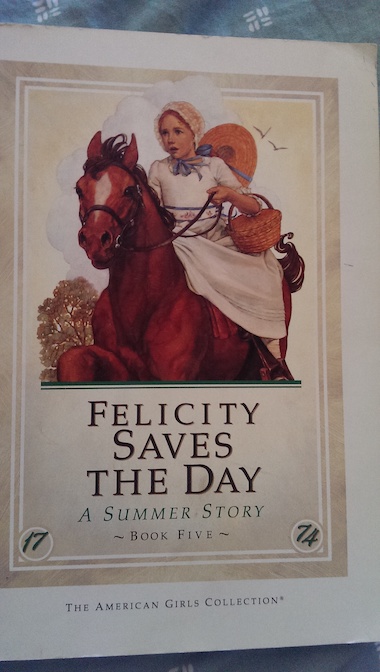
Felicity Saves the Day

American Girls

FelicitySummer

Felicity Saves the Day by Valerie Tripp, 1992.

This is part of the Felicity, An American Girl series.

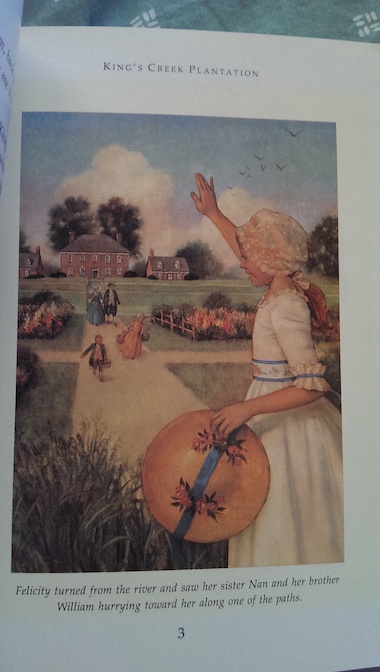
FelicitySummerPlantationFelicity’s grandfather is a wealthy man who owns the Kings Cross Plantation.  Every summer, Felicity and her family go to visit him there, and Felicity loves it.  Her grandfather teaches her a lot of things, like which plants can be used for food and medicine, and takes her for horse rides around his estate.

This year, while Felicity’s father and his apprentice Ben are minding the store at home,  Felicity has a special surprise.  As her grandfather inspects a group of horses that a friend wants to sell him, Felicity is stunned to recognize Penny, the horse she freed from an abusive owner in the first book of the series.  Penny is a little thin and dirty but otherwise well, to Felicity’s relief!  Her grandfather purchases Penny for Felicity and promises to keep her safely at his plantation so that Felicity can visit her and ride her regularly.

Felicity is happier than she’s been in a long time and writes an enthusiastic letter home to tell her father and Ben, but soon, she learns that Ben is not at home with her father.  Felicity and her siblings have set up a bird bottle, a special bottle that acts like a bird house for birds to nest in, and she checks it daily to see if there are any birds to show to her little brother.  One day, she finds a message in the bottle from Ben, pleading for help, along with a map to a place in the woods and Ben’s whistle.  When Felicity goes to the spot in the woods and blows the whistle, Ben comes out of hiding.

FelicitySummerBountyHuntersBen tells Felicity that he ran away from his apprenticeship to join the revolutionary army.  He wants badly to fight for the colonies’ freedom from England, but he had a bad fall while traveling and hurt his leg.  Felicity tries to convince Ben to let her get help for him and to return to her father to finish his apprenticeship, but Ben doesn’t want Felicity’s grandfather to find out that he’s there or why he ran away because he knows that he disapproves of the revolutionaries.  Because Ben kept her secret when she used to sneak out to see Penny, Felicity reluctantly agrees to keep Ben’s presence a secret for awhile, sneaking him some food and supplies.  She tells Ben that, while she thinks that standing up for what he believes is good, he’s going about it in the wrong way because breaking his apprenticeship was dishonest.

Then, Felicity learns that her father has placed an advertisement in the newspaper with a reward for anyone who can find Ben, and some rough-looking bounty hunters show up at the plantation to inquire about it.  Felicity knows that she must try to convince Ben to return on his own before he gets hurt worse than he already has!

A large part of the Felicity books is about taking responsibility and whether or not it’s right to break rules in the name of a good cause.  Felicity herself broke the rules to befriend Penny and later free her from a master who would probably have killed her.  This story raises the question of whether Ben’s form of rule-breaking is similar to what Felicity did or not.  Their situations and the reasons for their rule-breaking are different.  In her situation, Felicity had tried to behave as lawfully as she could until it became apparent that the only way to save Penny’s life was through rule-breaking.  In Ben’s situation, although he wants to help what he sees as a good cause, his rule-breaking isn’t strictly necessary, and he never tried to discuss his feelings with Felicity’s father and to work out an arrangement before running away because he thought that he already knew what Mr. Merriman would say.  Felicity points these things out to Ben, along with the fact that Ben is not in any real position to help the cause that he supports because he is injured, wanted, and in hiding.  He started on this venture ill-prepared and inconsiderate of the other people who depend on him back home and his own future, and while his belief in the revolutionary cause is genuine, he is also afraid of admitting his mistakes and needs to be urged to make things right.

In the back of the book, there is a section that talks about what people in Colonial America would do during summertime.  The weather in Virginia is hot and humid during the summer, and not everyone would get a chance to travel to the countryside, like Felicity’s family did.  The book talks about various ways colonists would use to cope with heat (keeping the kitchen with its fire separate from the house, eating in an open breezeway in the house, wearing lighter clothes, boys would go swimming although girls didn’t, etc.).  It also talks about life on Virginia plantations, including slavery.

Felicity Learns a Lesson

American Girls

FelicityLesson

Felicity Learns a Lesson by Valerie Tripp, 1991.

FelicityLessonGirlsThis is the second book in the Felicity, An American Girl series.

So far, Felicity has mainly been taught at home, learning to read and write and take care of basic household tasks, like cooking and sewing, from her mother.  However, Felicity’s parents have decided that it’s time for her to begin furthering her education.  Felicity fantasizes about studying Greek, Latin, and geography, like boys do in college, but girls of her time do not receive that kind of education.  Some girls take on apprenticeships, learning professions such as seamstress, which Felicity thinks might be exciting, but her father is a wealthy merchant, which means that Felicity will be educated as a gentlewoman, not as a girl preparing herself for a trade.  A gentlewoman’s education involves lessons in penmanship, fine stitchery, dancing, manners, and hostess skills.  Felicity doesn’t find that prospect as exciting.

Felicity starts taking lessons from Miss Manderly, a respected gentlewoman, in manners and the practical arts that girls from well-off families of her era were expected to know. Two other girls, a pair of sisters who have recently arrived from England, are also taking lessons from Miss Manderly, and at first, Felicity worries that they will know more than she does.  However, they are also young and have lessons of their own to learn.  The younger of the sisters, Elizabeth, becomes Felicity’s best friend.  However, Annabelle, the older girl, is disapproving.  She misses her old life in England and doesn’t think that anything in the colonies is good.

FelicityLessonAnnabelleThen, Felicity’s father declares that because of the tax on tea, he will no longer carry it in his shop. It leaves Felicity feeling conflicted about Miss Manderly’s lessons, which include the proper way to serve tea. She has started enjoying the lessons and doesn’t want to lose Elizabeth’s friendship, but she wants to support her father, too. Then, Annabelle criticizes Felicity for what her father said at one of the lessons, prompting Felicity to storm out angrily. She is doubly angry and hurt that Elizabeth didn’t try to defend her, making her doubt Elizabeth’s friendship.

At first, Felicity thinks that there is no way she can return to the lessons, but her mother convinces her that if there’s something that she really cares about (the lessons, Elizabeth’s friendship, supporting her father, etc.) she will find a way to work through the conflict rather than give up on it.  She also points out that some people aren’t as brave as others and find it more difficult to speak their minds and that Felicity should give Elizabeth another chance at friendship.  In the end, Felicity works out a compromise for her lessons using what Miss Manderly has already taught her, and Elizabeth finally finds the courage to tell Annabelle how she really feels about her behavior and the way she treats both herself and Felicity.

Each of the girls in the American Girls stories has her own personality, including strengths and weaknesses. Felicity is a spirited girl, but at first, she has a tendency to be too impatient and impulsive. Part of what she learns is the need take responsibility for her choices and to think things through before she acts.  Elizabeth, who is shy and easily intimidated by her older sister, learns that nothing will improve until she makes her true feelings known and that she has as much right as anyone else to be treated with respect.  Annabelle is a rather self-centered individual and is genuinely surprised when Elizabeth finally stands up to her.  In some ways, Annabelle is unfortunate because she does not find a friend at Miss Manderly’s like her sister does, but readers will recognize that Annabelle’s lack of friends is partly her own fault because she is deliberately antagonistic and does not try to earn Felicity’s friendship.

In the back of the book, there is a section that explains more about how children were educated in the American colonies around the time of the Revolutionary War.  Other good books on this topic are Going to School in 1776 and Colonial Crafts.

This book is currently available online through Internet Archive.

Meet Felicity

American Girls

MeetFelicity

Meet Felicity by Valerie Tripp, 1991.

MeetFelicityPennyThis is the first book in the Felicity, An American Girl series.

Felicity, or Lissie as her family sometimes call her, is the daughter of a prominent store owner in Williamsburg, Virginia in 1774.  Sometimes, her father allows her to help in the shop, which is something that she enjoys.  However, that has happened less since her father took on a new apprentice named Ben Davidson.  Ben is fairly quiet and shy, and Felicity is only just getting to know him.  She sometimes envies boys for the more exciting opportunities they have while she has to help with more routine chores, like sewing, at home.

One thing that Felicity loves more than anything else is horses.  One day, she goes with Ben while he makes a delivery to Jiggy Nye, the tanner.  Jiggy Nye has a new horse that he says he won at gambling.  However, Jiggy Nye is cruel to any animal he gets, and Felicity fears for the beautiful horse he now has.  When Felicity tries to see the horse, which she calls Penny because of the color of its coat, Jiggy Nye drives her away.

That the horse is a fine animal and that Jiggy Nye is treating it badly are obvious, but at first, there doesn’t seem to be anything that Felicity can do about it.  Then, Jiggy Nye shouts at the horse one day that it’s worthless because he can’t handle it and that he’d give it to anyone who can ride it.  Taking Jiggy Nye at his word, Felicity sets out to tame Penny.

MeetFelicityRidingEvery morning for about a month, Felicity sneaks out of the house early, dressed in a pair of breeches that she borrowed from Ben without his permission.  She goes to visit Penny and gradually gains her trust.  When Penny finally allows her to ride her, Felicity thinks that she has won ownership of her, but Jiggy Nye accuses her of theft and takes back the horse.  He denies that he ever promised to give her to anyone who could ride her, although Felicity’s younger siblings agree that they heard him say so.
Felicity fears more than ever that Jiggy Nye will kill Penny, but now that she no longer has a chance of getting her from Jiggy Nye for herself, can she find another way to give Penny her freedom?

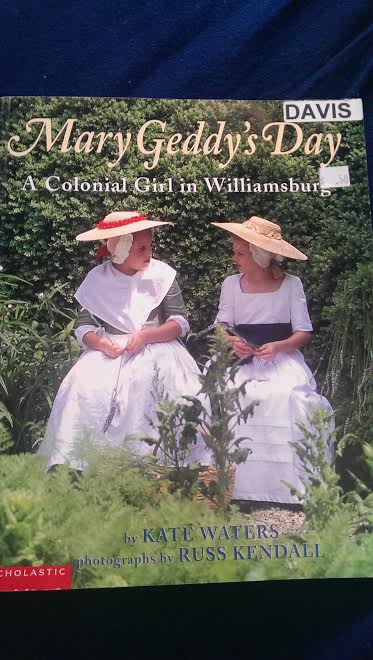
There is a section in the back of the book that describes life in Colonial America, particularly in Williamsburg, Virginia.  It also mentions the Colonial Williamsburg living history museum.  Another book about life in Colonial Williamsburg, with photographs from the living history museum, is Mary Geddy’s Day.

This book is currently available online through Internet Archive.

Mary Geddy’s Day

MaryGeddyMary Geddy’s Day: A Colonial Girl in Williamsburg by Kate Waters, 1999.

This book is part of a series of historical picture books about Colonial America.

Mary Geddy was a real girl living in Williamsburg in 1776. In this book, she is reenacted by Emily Smith, a young interpreter at the Colonial Williamsburg living history museum. The story follows her through a single day in her life as it would have been typically experienced by girls around the beginning of the American Revolution (lessons, chores, shopping, and visiting with her friend) up until the moment when the vote for independence at the Fifth Virginia Convention was announced.

Mary Geddy’s father was a silversmith, which put them in the middle class for the times.  They had a comfortable house with a shop next door where Mr. Geddy sold his silver work.  The Geddy family also had slaves to take care of household chores.

At the beginning of the story, Mary knows that the Fifth Virginia Convention is voting on the subject of independence from Great Britain.  Mary is concerned about the prospect of war, and she knows that if the vote is for independence, she will probably lose her best friend, Anne.  Anne’s family are loyalists, and her family plans to return to England if the colonies decide to break away.

All through the day, people are speculating and worrying about what is going to happen as they go through the typical routines of their day.  Mary explains the clothing that colonial girls would wear as she gets dressed in the morning.  Then, her mother sends her out to buy eggs at the market.  Although she can see Anne there and hear some of the talk about what’s happening, Mary is kept at home for most of the rest of the day, practicing her sewing, learning to bake a pie with her mother, helping in the garden, and having her music lessons. She is learning to play the spinet.  She envies her brothers, who are allowed to help their father in his shop and therefore able to hear more of the talk than she is.

I particularly liked how they showed the coins that Mary uses when she goes shopping.  Even though Mary’s family lives in an English colony, she’s using pieces of eight, which is Spanish money.  The book doesn’t explain what currency she’s using or why, but that’s why the coins are those little triangular shapes, like little pieces of pie. Let me explain.

First, the American colonies had a currency problem.  They actually had a shortage of English currency because England didn’t want wealth to leave the English economy and go out to the colonies.  One of the measures they took to prevent wealth from leaving England was to make it illegal to export higher-value pieces of currency to the colonies.  People in the colonies needed something to replace the pieces of currency that they didn’t have or had in too short supply, so they resorted to other methods of exchange such as barter, IOUs recorded in ledgers, and currency from other countries.  They had some standard units of exchange for converting different currencies into British money because that was the way people in British colonies thought about money.  One of the most popular coins in use was the old Spanish dollar or piece of eight, which was worth eight reales (unit of Spanish currency).  However, sometimes, people wanted to use a smaller piece of currency for small purchases and transactions (like buying eggs), so they physically cut one coin into eight pie-shaped pieces (hence, “pieces of eight”), each worth only one real.  They had to do the coin cutting very carefully because the value of this type of money was based on the amount of silver in the coins themselves, and if they cut a coin unevenly, it would impact the value of the sections.  Each section of a piece of eight was called a “bit“, and two bits would be worth one-quarter of the value of the original coin, which is why some people in the US refer to a US quarter as “two bits.”  That’s what Mary is holding in her hand in the picture.  For more information, see the YouTube video from Townsends about The History of Money in America.

When they discover that the Convention voted for independence, there is celebrating in the streets, and Mary goes with her parents and brothers to see everything.  Her little sister is afraid of the noise and stays at home with the slaves.  Everyone is excited, but Mary is worried because she knows that her friend will leave and nothing will be the same again.

Throughout the book, you can see that the slaves are always a part of the family’s activities.  They do chores together, and when the family is not doing housework, the slaves are still working in the background.  Having slaves didn’t mean that the family never had to do any chores themselves, but they had to do less of them, giving them more time for other things, like music lessons and visiting with friends.  When the celebrating starts, the boy slave, Christopher, who is about the age of the Geddy children, wants to go and see what is happening himself, but he has to stay and help look after the younger girl in the family.  Although the slaves live as part of the household and seem to be on friendly terms with the Geddys (Mary speaks of them fondly, wishing that Christopher could join in the celebration and is happy that Grace, the slave who mainly works in the kitchen as the cook, seems proud of her for learning to make a pie), they have no say in making decisions and are expected to follow the orders they are given, even when they don’t want to or larger events are taking place.

In the back, there is more historical information about the period and the Geddy family.  There are also instructions for making a lavender sachet like the kind Mary and her friend Anne make and a recipe for apple pie that was used in Colonial Williamsburg, like the one that Mary learns to make in the story.

The book is currently available online through Internet Archive.

Meg and the Disappearing Diamonds

MegDisappearingDiamondsMeg and the Disappearing Diamonds by Holly Beth Walker, 1967.
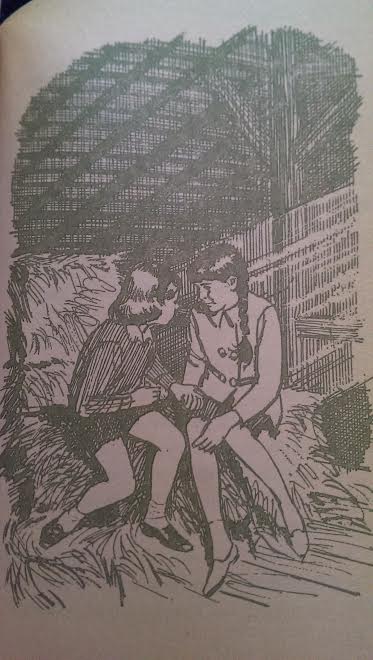
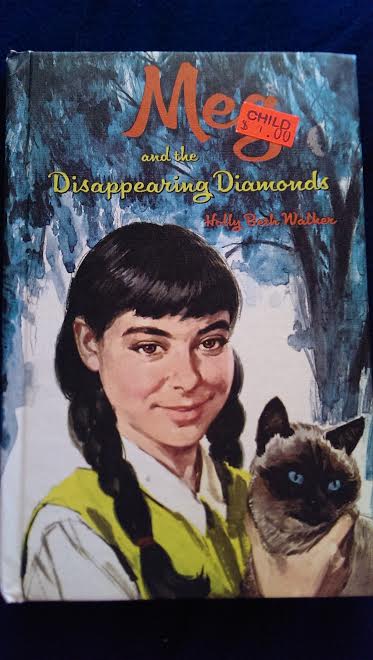
Margaret Ashley “Meg” Duncan lives in a small town called Hidden Springs in Virginia, not too far away from Washington, D.C., where her father works.  Her mother is dead, and she has no brothers or sisters. When her father is away in Washington, working, Mr. and Mrs. Wilson, the gardener and housekeeper, take care of her.  For company, Meg has her beloved cat, Thunder (who doesn’t like anyone but Meg), and her best friend, Kerry.

People in Hidden Springs have been talking lately about Mrs. Partlow and her diamond jewelry.  Mrs. Partlow is the wealthiest, most important woman in town.  Usually, she keeps her jewelry in a vault at the bank, but recently, she brought it to her house so that she can wear it at her niece’s wedding.  Then, someone attempts to break into Mrs. Partlow’s house.  Nothing is taken, but everyone can guess what the thief was after.

MegDisappearingDiamondsPicMrs. Partlow invites a few friends to her house for tea to show them her jewelry and thoughtfully invites Meg and Kerry to join the women.  Meg and Kerry are excited at the chance to attend a grown-up tea party and to see Mrs. Partlow’s fabulous jewelry.  However, the party is crashed by Mrs. Glynn, a new woman in town.  Mrs. Glynn has three trained dogs that she dotes on.  She dresses them up in fancy costumes, and she can’t resist the opportunity to show them off when she wanders into the gathering in Mrs. Partlow’s garden.  The dogs cause a disruption, and after it’s over, everyone realizes that Mrs. Partlow’s diamond jewelry is missing!

Could the dogs have been an intentional distraction?  What about the person who tried to break into Mrs. Partlow’s house earlier?

Kerry’s much younger cousin, Cissie, is visiting her family and has a habit of taking things that catch her eye and hiding them in her secret “playhouse” which changes locations from time to time.  So far, the girls know that she’s taken Meg’s ballet slippers. Cissie also slipped into Mrs. Partlow’s party, uninvited and unnoticed by the other guests.  The girls don’t know for sure that Cissie took the jewelry, but the theft is a serious crime, and they don’t want to see little Cissie get into trouble.  They have to either find Cissie’s new “playhouse” and search it for the jewelry or to discover who else might have taken the diamonds before anyone else realizes that Cissie might be the thief.

My edition of the book has drawings that are done in kind of a gray green color.

The book part of the Meg Duncan Mysteries.  It is available to borrow and read for free online through Internet Archive.