Stonestruck

It’s WWII and Jessica knows that she will be evacuated from London soon, along with other children from her school. She doesn’t want to leave London and her mother, even though the bombings have gotten increasingly worse and frightening. Her father has already gone away to the front, and she has no idea if he will ever return. Then, one night, the unthinkable happens: their house is destroyed in a bombing. Jessica and her mother survive the bombing by sheltering in their basement, but Jessica’s pet cat is nowhere to be found. She doesn’t know if he survived the bombing and ran away somewhere or if he is buried somewhere in the rubble of their house. Jessica is traumatized, but with their home gone, her mother makes the decision to send Jessica away from London early. Jessica’s mother has decided that she will volunteer for service as an ambulance driver.

Jessica is terribly upset and worried about what will happen to her when her mother sends her away to Wales alone, but her mother assures her that she will be fine and that she will soon be joined by the other children from her school. They are being sent to a Welsh castle, where they will have classes together. Jessica’s mother tries to tell her that it will be fun and exciting, going to school in an old castle, but Jessica is too frightened and traumatized to think that this will be a fun adventure.

When Jessica’s train arrives at the station in Wales, she is met by Mr. and Mrs. Lockett, the gardener and housekeeper at the castle. They are friendly and welcoming to her, but on their arrival at the castle, Jessica hears a frightening scream. The Locketts don’t explain to her what the sound is and act like they haven’t heard a thing. When Jessica wakes up early the next day, she is relieved to see a peacock on the castle grounds, who gives the same strange cry that she heard the night before.

She is satisfied that the weird scream she heard has a logical explanation, but then, something else frightening happens. Although the morning is clear, there is one, strange, dense patch of mist on the castle grounds. Jessica thinks that it’s strange to see such a dense patch of mist in only one spot when there’s no mist anywhere else. Then, she hears a voice calling her name from the mist and the sound of children’s laughter. Jessica is confused because she’s only just arrived and hasn’t met anyone else there except the Locketts, and the rest of her classmates from her school in London aren’t there yet. It gives her an uneasy feeling, and when she sees a hand reach out of the mist and beckon to her, she becomes terrified and runs away.

At breakfast, Mrs. Lockett is cheerful and behaves in a perfectly ordinary manner. She expresses sympathy to Jessica over her ordeals during the bombings in London and the loss of her house and asks her what she plans to do before the other children arrive. She confides that she and her husband are not accustomed to children because they have none of their own, confirming that Jessica should be the only child in the castle right now. Jessica assures her that she can entertain herself. She asks Mrs. Lockett about the peacock that made the screaming sound, but Mrs. Lockett says that there are no peacocks on the ground and that she didn’t hear any scream. Mrs. Lockett is very disturbed by Jessica’s mention of a peacock. She says that the family that owns the castle won’t have peacocks on the grounds because they’re bad luck, and she sternly tells Jessica not to imagine things. Then, Mrs. Lockett gets a call that a train with 30 evacuees will be arriving, and she needs to help arrange accommodations for them. She leaves Jessica to entertain herself, but she warns her to stay out trouble and to stay away from the pond.

Jessica explores the grounds of the castle and meets Mr. Lockett again. Mr. Lockett, who prefers to be simply called Lockett, is kind to her, and she asks him about the peacock. Lockett seems to believe Jessica that she saw a peacock and finds it worrying. He says the same thing that Mrs. Lockett said, that peacocks are bad luck. He says that, for most people, a peacock’s cry means coming rain but that it means tears at the castle. He says that he knows that Jessica is sad right now, but he says that she should remember that she won’t always be sad. Some day, she will be happy again. He also cautions her to be careful what she wishes for.

When Mrs. Lockett returns, she says that she’s made arrangements for the evacuated children who are coming. She is sympathetic to the evacuees. Arranging housing for them is a hassle, although she says it’s for their own good to be evacuated. Lockett says that it’s good up to a point. He doesn’t speak much, but he observes that, while it’s necessary for the children to be sent away from the bombings, it isn’t so good that they’re being separated from their parents. He says that he’s sure that Jessica would rather be with her mother. Jessica is surprised that he understands how she feels. She says that, while the castle is nice and definitely safer than London right now, she really misses her her mother. Mrs. Lockett doesn’t want to dwell on that. Instead, she encourages Jessica to come with her to meet the evacuees’ train. She says that these new children from London will be friends and company for her. Jessica isn’t so sure because these children are strangers to her, not friends from her school, but she does go to meet the train with Mrs. Lockett.

People from the village have gathered to meet the other evacuated children. Some of the women have prepared food for children’s arrival, and some are talking about how many children they’ve been told to accept into their homes and their fears that some of them will have lice. When the children get off the train, Jessica can see that they are all hesitant and scared. Among the crowd, Jessica sees a boy she recognizes from the night of the bombing, standing outside of a burning house. She doesn’t know his name, but she feels a kinship with him because he also lost his home. Unlike the other children, he has no bags with him. Then, suddenly, the boy vanishes in the steam from the train. No one else seems to notice that he was there or that he’s now missing. Jessica wonders if she just imagined him.

The children’s teacher is checking the children’s names off a list as they are assigned homes, but Mrs. Lockett stops her, saying that she’ll see to it herself. However, Jessica notices that Mrs. Lockett puts it off. Jessica asks Mrs. Lockett how many evacuees there are, and she vaguely says about 20 or so, when she had said 30 before. When Jessica asks her again exactly how many there are, Mrs. Lockett says that it’s an old superstition in their town, that no one should ever count children twice. Jessica asks her why that is, but she brushes off the question. Later, Jessica sees Mrs. Lockett burning the list of evacuees. With the list gone, no one will be able to count how many evacuees there are.

After her mother calls the castle to check on her and tries to pretend that things are fine when Jessica knows they’re not, Jessica feels the need to go for a walk by herself. Mrs. Lockett lets her go, warning her to be back before dark. As Jessica explores the castle grounds, she experiences more strange phenomena. She sees the peacock and the mist again and hears a voice calling her name. She sees a boy on a horse vanish into the mist. Then, a troop of phantom children charge past her, laughing and calling her name, and Jessica is shocked to see that one of them looks like her!

Jessica knows that she’s not just imagining the things that she’s been seeing, and she struggles to understand what’s happening and what it means. She realizes that, every time something strange happens, she either sees the peacock or hears its cry. She also remembers that, the first time she heard its cry, she had the strange feeling that, while she went into the castle, a part of herself stayed outside. Is that other part of her the phantom girl that she saw, being chased by the other phantom children? It looked like her, but it also felt alien, like it isn’t really her.

Jessica discovers that the boy who vanished at the train station ran away and has been hiding out on the castle grounds. He was afraid to let himself be sent to a strange home with the other evacuees because he’s heard that evacuees are treated horribly. Jessica tells him that she’s been treated kindly at the castle. Before she can learn the boy’s name, he runs away again, frightened by a strange old woman.

The old woman is frightening and seems to know who Jessica is. She says that she’s going about her rounds, leaving food out for the children. She knows about the phantom children, who run around in the mist with their hands linked. She refuses to tell Jessica her real name, just telling her to call her Priscilla, and she warns Jessica to keep repeating to herself that things aren’t always what they seem.

Jessica asks Mrs. Lockett if she ever played chain tag, the type of tag game where children join hands whenever they’re caught and then continue chasing other children. Mrs. Lockett says that the children around here call that game Fishes in a Net. When there are four or more children in a chain, they surround other children to trap them. She says that she played it in another place as a child, but not here because their mothers would never allow them to. Jessica asks why, and Mrs. Lockett hesitates to answer, but she makes a reference to a boy she knew when she was young, who apparently played the game too many times and disappeared. Before he disappeared, he talked about the peacocks, which was why they decided to get rid of the peacocks on the grounds. Mrs. Lockett says that the Green Lady wanted him for her own. When Jessica asks her about the Green Lady, Mrs. Lockett suddenly brushes it off as an old legend that doesn’t mean anything. Lockett the gardener says that some stories build power with the telling, and that’s why people don’t want to tell them.

However, Jessica realizes that there is truth to the legend that Mrs. Lockett doesn’t want to explain. Mrs. Lockett knows that there’s enough truth to it to destroy the list of evacuated children so it will be harder to keep track of who’s there and who isn’t. The people of this town don’t count children twice because something that lurks in the mist vanishes children away, and no one wants to notice it or admit it’s happening, that it’s been happening for generations. As long as they don’t count children twice, they can tell themselves that no one is missing and nothing is wrong, even when it is. Jessica begins writing about all of her strange experiences in the journal that her mother gave her, trying to solve the mysteries of the castle and the mist. Something in the mist is after her, beckoning her to come to it, and like the others before her, if she goes to it, she will never come back.

At Jessica’s urging, Lockett tells Jessica what he knows about the story of the Green Lady. The Green Lady isn’t human. She’s a shapeshifter with a heart of stone. Years ago, she kidnapped the young lord of the castle, Harry, because he was a beautiful boy, and she wanted him for her own son. However, Harry was desperately lonely, living only with someone who had a heart of stone. He refused to speak aloud again until he had a human playmate. So, the Green Lady began stealing playmates for him, but it was never enough. There is one playmate in particular that Harry is waiting for, the one whose name he calls in the mist. That’s Jessica. Because only Jessica, frightened and lonely in a strange land, has the ability to break the spell.

The book is available to borrow and read for free online through Internet Archive (multiple copies).

Some reviewers on Goodreads have pointed out that this book is very similar in plot to an earlier book by the same author, Moondial. In Moondial, as in this book, there is a young girl who is sent away from home and encounters mysterious phenomena that involves children in past times who are suffering and need her help to free them. However, the two stories are not identical, and I like the way this particular book is framed around WWII child evacuees from London.

It is important to the plot that the child evacuees from London are scared because of the war and have been wishing that they can go home, but that they haven’t been raised in the atmosphere of fear and superstition that the children in Wales have been. They have worries, but they’re not the same worries as the Welsh people have. Jessica learns from Lockett that it is the wishing themselves away that splits the children’s spirits and leaves them vulnerable to being captured by the trapped spirit children. Lockett understands what is happening better than anyone and how the unhappy children from London feel because he was also once an unhappy child. He was abused at home when he was young, and he also wanted to get away. However, when confronted by the spectral children whose hearts have also turned to stone, he changed his mind and escaped their clutches. He explains to Jessica what she has to do to reclaim that part of her that split off from her when she wished that she could go home, and from there, Jessica realizes what she needs to do to end this ghostly game of tag and free the other trapped children. The first step is reconciling herself to her situation as it exists and no longer wishing herself away. In doing so, she is doing what all of the adults around her have been failing to do, both about the supernatural phenomena and about the current war – facing up to the situation and not trying to pretend like it is less serious than it really while no longer wishing it away. Then, she realizes that the only way to end the spectral children’s game is to beat them at it, and for that, she needs help from other children.

When one of the other child evacuees from London has been captured and spirited away, Jessica and the boy who has been hiding out convince the other child evacuees to help them get him back and free the other children who have been taken across the generations. They have some work convincing the other evacuees of what is happening, but when they do, they form their own team for chain tag or Fishes in a Net and face off against the team of spectral children. It has to be the evacuee children who end this curse because the Welsh children are too afraid to do it, and the Welsh children’s parents would never risk them in the attempt. The Welsh people aren’t as careful about the evacuee children, and some of them have been bullying and abusing some of the evacuees. There is some concern when they realize what the evacuee children are going to do, but no one stops them.

It isn’t entirely clear what happens when the evacuee children free children who were taken from previous generations because these older children simply vanish. Even Jessica isn’t entirely sure whether the children returned to their own times or if they’ve simply passed on. However, the people of the Welsh town realize that the children have finally been freed and that the spell is broken, and they are grateful.

Parts of the story were stressful to read. First, I found the loss of Jessica’s cat upsetting. They never learn exactly what happened to the cat during the story. Then, Jessica finds out that the other boy who lost his home also lost his mother and siblings in the bombing, showing her that her own losses, while serious, aren’t the worst ones. There are also instances where the local children bully the London children, and the Welsh parents blame the London children for it. Some of the Welsh people are kind to the evacuees, but some also bully and abuse them, seeing them as only rough, poor children who are troublemakers and an inconvenience to them.

Even Mrs. Lockett says that she feels lucky that she got Jessica as an evacuee because she is gentle and well-behaved, not like the other London children. Jessica realizes that this is an unfair prejudice. Although she does not consider herself a brave person, she finds her courage when she begins to confront some of the adults around her about the way they look at the London children and how they treat them. She asks the adults directly if they realize that the London children also don’t want to be there and that no one asked them if they wanted to be sent away from their parents. The adults, confronted with the reality of the the children’s feelings and the reasons for their being there, entrusted to their care, are embarrassed. They don’t have real reasons for their prejudices against the evacuees, only their unfair feelings and bad behavior, and they realize that when they are confronted directly with the realities of the situation and their own behavior. Really, I think that facing up to realities, even ones that are strange and scary, is one of the major themes of the book. It is Jessica’s realization that she can do that, when even the adults around her can’t or won’t, that gives her the courage to do what she needs to do to end the spell and save herself and other children.

Carrie’s War

Carrie’s War by Nina Bawden, 1973.

The story begins with an adult Carrie reflecting on her youth during World War II, taking her children to see the place where she stayed as a child evacuee and remembering an incident that has haunted her for the last 30 years. Adult Carrie is a widow who was married to an archaeologist who died only a few months before the story begins. In some ways, Carrie says that her husband was very much like a boy she used to know during the war, Albert Sandwich. The family trip and Carrie’s memories take them back to a small mining town in Wales and an old house called Druid’s Bottom, now a ruin, that used to house a mysterious skull … and what Carrie regards as the worst mistake of her life. Although adult Carrie knows that, logically, what happened couldn’t have really been her fault, there are some things in life that are difficult to prove or disprove, and she’s always blamed herself for what happened.

When Carrie Willow was eleven years old, she and her younger brother, Nick, were evacuated from London along with other children to avoid the bombings. All of the children were told to report to their schools with a packed lunch and a change of clothes, and none of them had any idea where they would be taken after that, only that their parents wouldn’t be going with them. Their mother tried to frame it all as a great adventure that they would enjoy, but the children were understandably worried. They had to wear labels on their clothes with their names on them, and they had to carry gas masks, which is never a reassuring thing to be told you might need. (Young Carrie thinks to herself that her mother is such an optimist that, if they found themselves in Hell, she’d look on the bright side and say, “Well, at least we’ll be warm.”)

The children’s teacher takes them aboard a train, and they head off into the countryside, ending up at a coal-mining town in Wales that doesn’t look like much. That’s where Carrie meets Albert, another boy who rode with them on the train. Albert is tall and serious and wears glasses. His first concern is that the town isn’t big enough to support a proper library. Carrie is mostly concerned about keeping her brother with her and making sure that someone will be willing to take them both together. (Hosts for WWII evacuees were told how many children they were expected to take in, but they were given the opportunity to choose which ones they would host from among the children available. Sometimes, siblings were split up if they couldn’t find accommodations that could house them together.)

Carrie and Nick are eventually chosen by Miss Evans, a woman who lives with her brother. Originally, Miss Evans had been hoping for two girls so they can share the one spare room that she and her brother have, but Carrie persuades her that she and Nick sometimes share a room at home because he has bad dreams. Miss Evans is a shy and nervous woman, and her brother, Samuel Evans, is ultra-strict and fussy. Everything in their house is super neat, and they have special rules to keep it that way. Carrie and Nick aren’t even accustomed to picking up after themselves because their family has a maid who does all the cleaning. The house has a bathroom with running hot and cold water, but if they have to go to the bathroom in the middle of the day, Mr. Evans wants them to use the outdoor one in the yard to avoid messing up the new carpet on the stairs with too much “traipsing” up and down. Even Miss Evans uses the outdoor bathroom, although Samuel Evans never does because he thinks it’s unseemly because of his position in the community as a store owner and town Councillor. So, for starters, Mr. Evans makes strict rules for others to follow that he doesn’t follow himself.

Carrie can tell right from the first that Samuel Evans is a bully who pushes people around, especially his sister. He’s much older than his sister and helped to raise her after their parents died. Really, Miss Evans was raised with Mr. Evans’s son, Frederick, who is now in the army, being more like her brother than her nephew. Now that Mr. Evans’s wife is dead, there’s no one else in the household but the two of them. When Miss Evans and Frederick were young, Mr. Evans used fear, intimidation, and harsh physical punishment to keep them in line. However, Mr. Evans can’t really bully the children because Carrie is careful not to show that she finds him intimidating, and Nick just isn’t intimidated because he refuses to be impressed by anybody with false teeth. Still, Carrie realizes that they should try to keep out of his way and not make him angry.

Samuel Evans is also very strict about religion. One day, when Nick eats some biscuits in his shop, Mr. Evans declares that he’s been stealing and that he’s going to get the strap for it. Carrie is horrified because their parents don’t use physical punishment, and Nick is terrified. Miss Evans is too afraid to intervene, so Carrie steps in and defends Nick, just saying that he didn’t understand that it was stealing to eat the biscuits. Mr. Evans says that’s not a good excuse, but Nick says that if he whips him, he’ll go to school and tell the teacher that Mr. Evans beat him for taking food because he was hungry. Mr. Evans realizes that, while other adults might not fault him for punishing a thief, they would if it looked like he was starving and neglecting his charges as well as beating them. Instead of giving Nick a beating, he prays out loud for Nick to turn from his “evil ways.” It’s difficult for Carrie to listen to because she realizes that Nick hasn’t been starved, wasn’t really hungry, and should have known better than to take the biscuits, and now, he’s made an enemy of Mr. Evans. They don’t have much choice other than staying in the Evans house because they can’t go back to their parents yet, and there just aren’t any other places in town for them to stay. The kids become fond of Miss Evans, who they start calling “Auntie Lou”, but they always have to be wary of Mr. Evans.

When their mother comes to visit, Mr. Evans acts extra nice to the children and tries to be charming to their mother. The children’s mother has some misgivings about how the children are being treated, but the children don’t complain about some of the harder aspects of living with Mr. Evans because they don’t want their mother to worry. She’s been working as an ambulance driver in Glasgow because her husband’s ship makes port there, and she can see him sometimes. She needs to know that her children are safely settled somewhere to continue her work, and the children have also grown attached to Auntie Lou and don’t want her to get into trouble, even if they don’t like Mr. Evans.

Shortly before Christmas, Auntie Lou explains to the children that she and Mr. Evans have an older sister named Dilys, and she’s giving them a goose for Christmas dinner. The reason why the children haven’t met Dilys before is that Auntie Lou and Mr. Evans don’t really get along with her and hardly ever see her. Mr. Evans in particular resents Dilys because, years ago, she married into the Gotobed family. The Gotobeds owned the mine nearby where their father was killed in an accident. Mr. Evans always blamed the Gotobeds for their father’s death because they didn’t have adequate safety measures, and he felt like Dilys was turning her back on the family by marrying Mr. Gotobed’s son. Now, Dilys is a widow, and she’s not in very good health, which is another reason why she doesn’t get out much. She lives in the old house known as Druid’s Bottom, at the bottom of Druid’s Grove, where the yew trees grow. A woman named Hepzibah Green looks after her and the farm where they raise poultry. Local people are rather superstitious about Druid’s Grove, but Carrie thinks it sounds wonderfully spooky and exciting. Auntie Lou and Mr. Evans send Carrie and Nick to Druid’s Bottom to pick up their Christmas goose from Hepzibah Green because Auntie Lou gets sick and can’t go herself.

On the way to Druid’s Bottom, Carrie and Nick are scared because they think they hear something chasing them, making odd sounds. It turns out that it’s only Mister Johnny, a cousin of Mr. Gotobed, Dilys’s deceased husband. Mister Johnny has developmental disabilities and can’t talk very well or understandably to most people, which is why he lives with Dilys in Druid’s Bottom and is cared for by Hepzibah. Hepzibah has been Johnny’s nurse since he was a baby, and she now cares for the elderly and ill Dilys as well.

Albert Sandwich has been staying at Druid’s Bottom, also in Hepzibah’s care, since Carrie and Nick last saw him. Albert tells them that Hepzibah is a kind of witch who knows some kind of healing magic. Albert hasn’t been to school with the other children because he was very sick after they last saw him, and Albert thinks that he only survived because Hepzibah gave him herbal medicines. Albert loves Druid’s Bottom because of Hepzibah and also because the old house has an impressive library. In the library, Albert also shows Carrie a strange curiosity – an old skull. The story surrounding this skull is that it’s the skull of an African slave boy who was brought to this house years ago. (Albert explains to Carrie that he doesn’t believe that because he’s examined the skull. He explains that the number of teeth suggest that the skull was from an adult, not a boy, and the size and shape suggest that it’s the skull of a woman. Albert suspects that some local person actually found the skull at the site of an Iron Age settlement nearby.) According to the legend of this skull (or what people say the legend is), the young slave boy died of a fever, and on his deathbed, told the Gotobed family that they must keep his skull in the house or the walls would fall. Hepzibah says that one of the Gotobeds’ ancestors tried removing the skull from the house once, and during the night, all the crockery in the kitchen broke and the mirrors in the house cracked for no apparent reason. When they brought the skull back into the house, they didn’t have any further problems. Albert is skeptical of this story, but it’s captivating for Carrie.

Carrie finally meets Dilys Gotobed one day when everyone else is busy and Hepzibah asks her to take tea up to Mrs. Gotobed. Dilys is a sad and weak old woman who doesn’t have much time left to live. She lives mostly in her memories, spending each day wearing the fancy ball gowns that her husband bought for her years ago one last time before she dies. All of her talk of death gives Carrie the creeps, but Dilys makes her promise to take a message to her brother after she dies. She insists that the message must be delivered only after her death because it’s sure to make Mr. Evans angry and Dilys isn’t up to dealing with his anger. The message is somewhat cryptic. Basically, Mrs. Gotobed wants Mr. Evans to know that she hasn’t forgotten him and she remembers that they’re still brother and sister, but she feels like she owes more to others than she does to family. Dilys has done something that is sure to make Mr. Evans angry, but she wants him to know that she did it only because she thought it was the right thing to do and not just to spite Mr. Evans. Carrie reluctantly agrees to deliver the message after Dilys is dead.

The meaning of the message becomes clear when Dilys finally does die. Dilys’s only relatives are Mr. Evans and Auntie Lou, but she wanted to provide for Hepzibah and Johnny because of their companionship over the years. At first, Carrie thinks that Mr. Evans will be reassured that his sister thought of him near the end, but Carrie hasn’t fully grasped Mr. Evans’s reactions. Mr. Evans flies into a rage at the suggestion that Hepzibah might inherit from Dilys instead of him. He storms over to Druid’s Bottom to search for a copy of Dilys’s will to establish who is going to inherit. Mr. Evans later says that he couldn’t find one, and even Dilys’s lawyer says that Dilys’s didn’t make a will or leave one with him. If that’s true, and there is no will, Dilys’s estate would go to her nearest relatives, which basically means Mr. Evans. But, is that the truth?

While Dilys may have meant to provide for Hepzibah and Johnny, she was so ill near the end of her life that she may have forgotten about making a will. Her mind wasn’t entirely there, so she may have thought that she’d already done it when she hadn’t. However, there is another explanation. What if Mr. Evans did find something in writing from Dilys about her last wishes for her estate? What if he stole or destroyed Dilys’s will or something she left behind? That’s what Albert believes. He’s ready to believe the worst about Mr. Evans because he is unquestionably a mean, bitter, and vindictive man, but Carrie still has trouble believing that Mr. Evans could do something so deliberately evil. Albert somewhat blames Carrie for delivering the message Mrs. Gotobed gave her for Mr. Evans, alerting him to the possibility that there might be another heir to the estate, depleted though that estate is. Carrie was only doing as Mrs. Gotobed asked as one of her final wishes, but Carrie does feel responsible, especially if Mr. Evans did what Albert suspects.

In the midst of Carrie’s guilt that Mrs. Gotobed’s wishes are not being honored and her anger at Mr. Evans for wanting the house all to himself and kicking out Hepzibah and Johnny, Carrie decides that there’s only one thing left to do in order to make sure that Mr. Evans never takes possession of the house. It’s a terrible, impulsive decision, and it’s only after she’s done it that Carrie realizes that she also may have misjudged the situation yet again. It’s also only when she returns to Druid’s Bottom as an adult that she comes to see the full truth of the situation and that what she’s done may not have been as bad as she thinks.

This book is very well-known, and it was made into a television mini series in 1974 (you can sometimes find clips or episodes on YouTube) and a movie in 2004. The book is available to borrow and read for free online through Internet Archive (multiple copies).

My Reaction and Spoilers

I saw the 2004 movie before I read the book. The movie follows the book very well, and after I looked up the television mini series, I decided that it also follows the book well. The section in the back of the book about the author explains that Nina Bawden was also a child evacuee from London during World War II, so the book was partly inspired by her experiences.

In real life, when children were evacuated from London to be safe from the bombings during World War II, they went through some of the same feelings of homesickness and unfamiliarity that the children in this story also go through. First, they’re worried about being far from home. They don’t even know where they’re going and who they’re going to be staying with when they get there. During the scene where they’re being selected by foster families, they worry about who will choose them and what will happen to them if no one wants them. It’s all very realistic, and people who were among the child evacuees of the time describe going through a similar process.

There’s also the adjustment that the children have to make living in a household with unfamiliar people and different rules and circumstances from what they’re used to in London. London at the time was a large cosmopolitan area, like it is today, but back in the 1940s, small towns and houses in the countryside had far fewer amenities than in modern times. Real life child evacuees were accustomed to indoor plumbing in London, but they didn’t always find that in the places where they had to stay during the evacuation. The characters in the story find a mixture where they’re staying. The fussy head of the Evans household has indoor plumbing, but he doesn’t allow everyone to use it during the day because he doesn’t want everyone constantly going up and down his wonderful carpet on the stairs, so they also have to use the outdoor privy.

Mr. Evans’s fussiness and anger issues are also, sadly, true to life. The real life evacuees came from a variety of backgrounds and were accustomed to different styles of home and family life, and what they encountered in their foster homes during evacuation could be wildly different from the life they had at home, both for better or for worse. Some foster families could be warm and welcoming to the child evacuees, but sadly, many were not, resenting the new obligations that had been thrust on them because of the war. (Households were told that they had to accept evacuees if they had room for them, and there was no option to refuse.) There were foster families who ended up keeping or adopting children they took in during the war because they were orphaned or abandoned by their parents by the time the war ended. Some children ended up drawing closer to their foster families than their birth families because they came from an unhappy home life in the beginning, and they found themselves liking the new life they found. Others had a very unhappy experience, feeling unwanted, unwelcome, or even abused by their temporary foster families. Unhappy children could try to reunite with their parents, transfer to a different household, or even just run away, and some did all of these things. (To hear about the experiences of real life evacuees in their own words, listen to this documentary or this interview series on YouTube.)

In the story, Carrie and Nick seem to come from a happy home life with close-knit family. Their family is not poor because they could afford a nice house with a maid, and their parents seem kind and understanding and do not use physical punishment of any kind with the children. The Evans household is a step down for them. The fact that Mr. Evans, as a shopkeeper, doesn’t seem to have as much money as their family did when they lived in London isn’t so much of a problem as Mr. Evans’s personal issues and bullying nature. Mr. Evans is a troubled person, twisted by anger and resentment, and rather than dealing with these issues himself, he takes them out on other people, even people who are not the source of his anger and resentment.

As the story unfolds, the children learn about Mr. Evans’s sad history with his older sister, Dilys. He and Dilys were once rather close, but their relationship unraveled when she married Mr. Gotobed, the son of the man who owned the mine where their father was killed in an accident. Not only did it seem like a betrayal, to marry into the family of the man Mr. Evans blamed for their father’s death, but Dilys also suddenly became a wealthy woman by marrying into a wealthy family, while the rest of her family was still poor working class. There were apparently even times when Dilys rubbed it in, making the situation worse. Mr. Evans had to work his way up from the son of a miner to becoming the local shopkeeper and a prominent member of the community, and even then, he’s still not as well-off as his sister, who simply married into money and has never had to work herself. Instead of just taking pride in his achievements, Mr. Evans can’t get over the injustice of his relative position with his sister, that she has it all easy, and he’s had to work and scrimp for everything he has. That’s why’s he’s ultra-protective of things he owns, like the biscuits in the shop or the new carpet on the stairs, and why he’s so controlling of the people in his life. In spite of his accomplishments, he feels “small” next to his sister who married wealth and always has more than he has. He’s constantly trying to assert his authority to avoid feeling “small”, but it never really works because he can’t change who his sister married, he’s never going to be rich, and he can’t internalize the idea that he can still be somebody worthwhile even if he’s not the guy who has the most money and power. He’s tied his sense of self-worth to what he has and the amount of control he has over everyone, so he can’t give up any part of it. He’s had all of these resentments for so many years that they’ve all been brewing inside him and explode out whenever any little thing in his tightly-controlled world goes wrong or he thinks he stands to lose something he regards as his. This life hasn’t been healthy for his younger sister, Auntie Lou, who has lived with Mr. Evans and his controlling nature and temper tantrums since she was young, and it’s not really healthy for Carrie and Nick, either.

Carrie becomes sympathetic to Mr. Evans, although Nick can’t understand why, because she sees the sadness and loneliness at the core of his bad behavior. Carrie is a very sympathetic/empathetic person, but one of the questions of this story is how far should someone go with sympathy/empathy when they’re dealing with a person who is causing harm to people around him. Mr. Evans is a toxic person. He is causing harm to others, and before the story is over, Auntie Lou runs away from the house to marry an American soldier she met, leaving her brother to live alone. By this point, the children know that they won’t be living with Mr. Evans much longer because their mother has sent for them to join her in Glasgow because she’s found a place for them to all live together. Carrie and Nick won’t be living with Mr. Evans or facing his temper problems, stinginess, or selfishness anymore. Carrie feels sorry for for Mr. Evans, an aging man who is now left alone. His only other living relative, his son, has already said that he isn’t planning to come back and run his father’s store after the war, although Mr. Evans doesn’t know it yet, so he’s going to be even more alone than he knows. Carrie sees the sadness of Mr. Evans’s situation and feels badly for him, even though at least part of this situation is his own making. However, Nick and Albert don’t like Carrie’s sympathy for Mr. Evans because her attempts to reach him emotionally put everyone else in a vulnerable position to Mr. Evans’s wrath because he’s never as sympathetic, understanding, or rational as Carrie expects him to be.

When the question arises of whether or not Mr. Evans could have stolen or destroyed Dilys’s will in order to get her house and get rid of Hepzibah and Johnny, Albert is prepared to believe that he did. He is a vindictive man, driven by his bitterness, and does not always behave rationally. Nick says he sometimes cheats his customers in petty ways, like giving them 97 saccharine tablets instead of the full 100 he owes them, but other times, he has Carrie give someone the correct change when she’s made a mistake. Sometimes, he extends extra credit or provides free groceries for people in need. Mr. Evans is definitely flawed, but he does still seem to have a system of ethics. Would he really commit a crime, like inheritance fraud?

For all of her sympathy for the sad Mr. Evans, Carrie doesn’t really understand him. For much of the story, she expects him to react to situations as she would and thinks that she can reach him through her own kindness and understanding. By the end of the story, she is partially successful, and she ends up getting to know him better than other characters do, but at the same time, she can’t control Mr. Evans, and it must be acknowledged that Mr. Evans doesn’t control himself. He has a long-standing habit of lashing out at other people that he doesn’t fully confront until he finds himself completely alone with no one else to lash out at but himself. As hard as Mr. Evans works at his professional life, his personal life is a mess because of the way he’s treated the people who should have been close to him, and Carrie can’t solve that for him. While Mr. Evans recognizes the kindness and sympathy that Carrie offers him and becomes fond of her for it, she’s still a child, and Mr. Evans is an adult who has control issues and temper tantrums and long-standing personal issues that have gone unaddressed for far too long. Perhaps Mr. Evans realizes that toward the end, partly through Carrie’s kindness, but it’s hard to say because he’s been wrapped up in feeling resentful and sorry for himself for so long.

Apparently, Mr. Evans wasn’t lying when he said that his sister didn’t leave a will. During a rare moment of candor, Mr. Evans reveals to Carrie that he was deeply hurt when Dilys didn’t even leave him a note or letter on her death. All he found in her jewelry box when she died was a single envelope with his name on it, and all it contained was an old photograph and a ring that he had bought for her as a present years before, when they were still close. Carrie thinks that it’s a hopeful sign, that Dilys remembered how much the present meant to both of them and how much it reminded them of better times, but Mr. Evans says that there wasn’t even a word of farewell with it. This candid moment reassures Carrie that Mr. Evans didn’t find a will and steal it, and more than just being greedy for the property, he is feeling hurt and abandoned by the final loss of his sister and the relationship they once had. What he really craved in the end, more than authority, control, money, or property, was a genuine connection with his sister that he realized he would never have again.

It’s sad, and much of it is still Mr. Evans’s fault, although Dilys also deserves some of the blame because there were times when she rubbed salt into Mr. Evans’s wounds by flaunting the difference in their wealth and social status. A death can make people rethink the relationships they had with other people, but those relationships were forged and maintained (or not) when the person was alive. Death can’t change the way people lived when they had the chance. Mr. Evans and Dilys both had chances to fix things between the two of them in the years leading up to the end, and they never took them. Not only that, but Mr. Evans’s bitter feelings and vindictiveness also poisoned the other relationships in his life. So, in the end, it seems that Mr. Evans isn’t evil, even though he can’t really be called “good”, either. Mr. Evans isn’t out to steal his sister’s estate. If he had found a will and an explanation from his sister, he probably would have honored it, even though it would have hurt to do so. What hurts him the most is not finding anything, only the ring, probably because Dilys wasn’t really in her right mind toward the end and couldn’t get her thoughts together well enough to leave anything in writing, which is why she asked Carrie to talk to her brother instead. There also isn’t as much money connected with the estate as there once was. Since Dilys’s husband died, Dilys hasn’t had any income, she hasn’t been able to keep the house up or retain a staff other than Hepzibah, and she has very little money left. She was living in prideful, genteel poverty while Mr. Evans was feeling resentful of what he thought she still had. In the end, Mr. Evans was the victim of his own pride and bad relationships.

The worst mistake that Carrie ever made in her life was trying to sabotage Mr. Evans’s attempt to take the house away from Hepzibah and Johnny by removing the skull from the house. Caught up in the stories about the skull and its supposed curse that would destroy the house if it was ever removed from the house, Carrie comes to believe that the stories are true and decides to use the legend of the skull to destroy the house and keep it out of Mr. Evans’s hands since he won’t let Hepzibah and Johnny live there. As Carrie and Nick leave Wales, they see that the house is on fire from the train, and Carrie comes to believe that the fire was her fault because of the skull. For years, she believes that Hepzibah, Johnny, and Albert were killed in the fire and blames herself for their deaths. But, again, Carrie still doesn’t understand the full situation.

So, does Carrie end up changing anything for Mr. Evans? I think she touched his heart a bit because she cared about him in ways few other people did (mostly because Mr. Evans himself didn’t have much caring for other people), but as far as Mr. Evans’s life and behavior goes, it’s hard to say whether she would have had any long term effect because (spoiler), she later learns that he died not too long after she and her brother left Wales to rejoin their mother in Scotland. He was under stress when Carrie last saw him, full of unresolved grief and anger at Dilys’s death and feeling abandoned by Lou because of her elopement. Then, while he was in the midst of taking control of what was left of his sister’s estate, Dilys’s house caught fire and burned, and then, Mr. Evans received word that his son was killed during the war. The shock of it all was too much for him, and he had a heart attack and died. Sad as that is, Mr. Evans’s death ends up changing things for the better for Hepzibah, Johnny, and Albert.

In spite of her sense of guilt, Carrie does grow up, get married, and have children. The return to Wales with her children when she’s an adult leads her to confront the past and her feelings about it, but it also reveals the truth (also a spoiler): Hepzibah, Johnny, and Albert are all still alive. The house was damaged by the fire but not completely destroyed. In fact, not only were Hepzibah and Johnny allowed to stay on the property after Mr. Evans died, but Albert has saved up enough money to buy the property and restore it. Albert has never married, and there are hints that he might marry the widowed Carrie and become her children’s new stepfather.

Silver on the Tree

The Dark is Rising Sequence

Silver on the Tree by Susan Cooper, 1977.

This is the final book in The Dark is Rising Sequence, and it focuses on the epic battle between the forces of good (the Light) and the forces of evil (the Dark). Like the other books in this series, it uses and references folklore and Arthurian legends. At the end of the previous book, the characters used a magical harp to wake “the Sleepers” in Wales. The man that the children know as Merriman Lyon is actually Merlin from the Arthurian legends, and Will Stanton has discovered that King Arthur had a son named Bran who was brought into the 20th century by Guinevere and Merlin to protect him from his parents’ troubles in their own time.

Twelve-year-old Will Stanton is spending some time with his brothers at Midsummer because his oldest brother, Steven, has come home for a visit from his service in the navy. While the boys are out fishing, Will begins having visions of the distant past. He sees people who seem to be fleeing from something, and these people are talking about the terrible things that their pursuers would do to them if they caught them. Will watches as they bury something, some kind of treasure. He sees smoke on the horizon and has a sense of fear that tells him these people are right to be afraid. Then, suddenly, Will is back with his brothers in modern times, and a strange black animal, probably a mink, is sitting there, staring at Will. His brothers run the mink off, commenting on how oddly it was behaving.

Steven talks to Will in private about some odd things that have been happening that have let him know that Will must be involved in something strange. Strangers in other countries that Steven has visited have approached him and, with no explanation, have asked him to tell Will that the Old Ones of different regions are “ready.” Steven wants to know who these people are, how they know Will and know that Steven is will’s brother, what Will is involved in, and what they mean when they say that they’re “ready.” Will doesn’t want to answer at first because he knows that Steven won’t understand, but Steven insists that he wants an explanation. Will explains to him, as best he can, about the Old Ones, the magic of the world and the universe, and the opposing forces of the Dark and the Light that are fated to battle with each other. (This is the most complete and concise explanation of how magic works in these stories and how their universe is ordered.) As Will expected, Steven doesn’t believe him and insists that he can’t be an “Old One” because he is only twelve years old and Steven remembers when he was born, but Will asks him whether it’s any more plausible that a twelve-year-old boy would be involved in smuggling or other suspicious activities. Steven doesn’t know what to think, but then, some white moths come, and Will recognizes them as creatures that are reputed to carry away memories. After they leave, Steven doesn’t remember their conversation at all and is no longer interested in the idea of the “Old Ones.”

On the way home, Steven deals with a young local bully who stole an instrument case from a smaller boy. The bully threatens to send his father after Steven, and Steven, being a tough member of the navy, says that he’d be happy to talk to his father about the bully. The father does come to talk to Steven eventually, and the Stantons see that the young bully’s bad behavior is fueled by racist things that his father thinks and says. The father of the bully has no self-awareness. The Stantons are disgusted by him, but Will’s father says to his kids that they know that such disagreeable people exist and “You can’t convince them, and you can’t kill ’em. You can only do your best in the opposite direction—which you did.” (The part of the observation about not killing people sounds a bit violent, but I think I understand. You might not like certain people, and you might find them a hardship to have around, but you can’t just get rid of them, out of the world, anymore than the racist bully has either the right or the ability to get rid of all the people he doesn’t like. All people are a part of the world and all have a right to be there … no matter how much of a trial and hardship some of them make themselves to other people because they either don’t understand that other people are making allowances for them on a daily basis that they don’t make for others or deny knowing it to preserve their self-image and justify their bad behavior. Yeah, I’m a bit fed up with some people myself, but we’re all stuck with each other, so we all have to make the best of it.) Will finds himself evaluating this man as an Old One, trying to decide if he is also an agent of the Dark. He seems to be an ordinary human, but it has already been established that even ordinary humans can also serve the Dark, even unknowingly. Will finds himself thinking that people have multiple sides to their personalities, indicating that this obnoxious man may have a role to play in the upcoming struggle, either for good or evil, and whichever role it is will be his personal choice. On the other hand, there is a concept in this story that there are people and things outside of the battle between Light and Dark, people who are either neutral or a mixture of Dark and Light. In other words, this jerk could simply be just a random jerk and hold no other significance but that. (Spoiler: He doesn’t appear again in this story, and the jerk isn’t significant. He’s just a rude guy with a nasty son and some personal issues that are causing him to be a bad example. On the one hand, I’m was a little disappointed because I thought they were setting something up with this incident, but on the other hand, the character was so oblivious and full of himself that saying that he’s insignificant in the grand scheme of things actually pleases me.)

Later, the mink shows up again and kills some of the Stanton family’s chickens, not even carrying them off. It seems like the mink is merely killing for the pleasure of killing, not to eat. Will recognizes that the animal is another creature of the Dark and almost kills it, but he decides not to because it wouldn’t do any good. He knows that the Dark is rising, and killing this small creature won’t stop what is about to happen.

Will continues to have visions of the past and a sense that he is sometimes between time periods. Old Ones can travel between time periods, and even Will has done this before. The rising of the Dark that is happening in the 20th century is actually the Second Rising. The First Rising of the Dark was during the time of King Arthur, about 1500 years earlier. Will travels to that time with Merriman/Merlin and witnesses that struggle. There is a connection between the First Rising and the Second Rising. They are both part of the same, larger battle. Old Ones aren’t bound by time like normal humans, and the struggle between Light and Dark also transcends time.

To protect the six signs that Will had to gather in the second book of the series, he and Merriman hid them in the past, during Roman Britain. Now, Will has to retrieve them because they will be needed for the upcoming struggle. Will and Merriman have to go through multiple time periods to get the signs, and then, they have to summon the other Old Ones for the final battle. However, one of the Old Ones, a vital one, is missing. Will realizes that he must go to Wales once again to find the Old One known as The Lady.

In Wales, Will is reunited with Bran from the previous book and with the three Drew children from previous books, whose parents are staying at a local golfing hotel at Merriman’s suggestion. All of them will be needed for the battle is coming. They will each have to face their own tests of character and courage, and when it’s over, their futures will be in their own hands. They all go on their own trips through time, and Will and Bran visit the Lost Land, where Bran was actually born.

The book is available to borrow and read for free online through Internet Archive (multiple copies).

My Reaction and Spoilers

I often find myself feeling a little disappointed at the ends of books or tv shows that have a long wind-up to some kind of epic battle or revelation because what happens rarely meets my expectations. When a single event or plot point has been built up over a long time, the imaginations of readers and viewers sometimes have such high expectations that the final resolution of it can feel a little like a let down. With this one, I had some mixed feelings.

I liked it that all of the major characters had roles to play in the final events. I would have been disappointed if some of the major characters had fallen away. I didn’t want Bran to replace the Drew children in the story, for example. However, everyone has a role and at least one major test of character or bravery. There is a twist toward the end where a minor character but someone we’ve seen before in a sympathetic role turns out to have been secretly evil all the time. It’s a terrible blow to one of the other characters, but he comes to accept that this person deceived him about who she really is and the attachment he felt was to the facade not the person as she actually is.

One of the aspects of this series that interests me the most is that it’s pretty thorough in the way it addresses the problem of evil in human beings. Throughout the series, it has shown what the agents of evil in the form of agents of the Dark are like. Some of them are deceptive about who they really are and what they really want, like the secretly evil character in this book, shocking even people who are close to them when they learn the truth. It’s true that many of us have been shocked by someone in our lives who wasn’t quite what we thought they were or had something unsavory about them or their behavior that we never suspected because they were careful to hide it. In the first book of the series, there was a betrayal of trust that led someone to turn to the Dark side. In other books, we’ve also seen neutral people or natural forces, people who choose a side by accident and aid the causes of good or evil unwittingly because they’re wrapped up in their own issues and don’t see the bigger picture, and as mentioned about the bully and his father, there are also people who are a mixed bag, with the potential go to either way, shift back and forth, or just hover somewhere in the middle. The series covers quite a lot of the nuances of the choices people make about their behavior and the choices they make between good and bad.

That being said, even though this book explains the background to the battle between Light and Dark in a more straightforward way than other books, I felt like I never completely understood the motives of the Light and the Dark. It seems like the two of them are just naturally opposing forces. They don’t seem to have any specific over-arching goal that they’re trying to accomplish other than defeating each other. What their exact plains are once they’ve achieved victory isn’t clear.

Of course, readers know that the Light will win, and when it does, Merriman says that there won’t be further battles between Dark and Light. Merriman and other Old Ones move on to another world, where they say they have work to do, although Will Stanton will remain as “the Watchman” to continue watching over the world. Merriman says that the two of them will see each other again someday. Merriman says that the future of this world is in the hands of the children and other people of the world, referencing man’s ability to destroy the world. This book, and the rest of the series, was written during the Cold War, when people were particularly afraid of the threat of nuclear weapons. It seems like the legends and prophecies are over. Bran remains in the present although his father, Arthur, invited him to the past because he has become part of the 20th century and is bound to his friends and adoptive father by affection.

I enjoyed all the references to old legends during the course of the story. The Lost Land is a legendary country off the coast of Wales. They don’t use the name Lyonesse, but I think that’s what they’re referring to. Accord to the book, people can still hear the bells of the lost city, a legend that’s been applied to other lost towns in legends, and a phenomena that has a scientific explanation, When Bran and Will go there, they meet a bard named Gwion (Taliesen).

The Grey King

The Dark is Rising Sequence

The Grey King by Susan Cooper, 1975.

This is the fourth book in The Dark is Rising Sequence, and it picks up not long after the previous book ends.

Will Stanton has been very ill with hepatitis, and the doctor ask advised his parents to send him somewhere to rest for a while and recover his strength. In the previous book, his sister Mary had gone to stay with relatives in Wales after she had the mumps, so his parents agree to send him there. Even after he recovers, Will has a nagging feeling that he’s forgotten something very important. What he’s forgotten are the clues that he and his friends discovered at the end of the previous book, but little by little, they come back to him.

Will calls his relatives Aunt Gem and Uncle David, but really, they’re distant cousins. On his way to stay with them on their farm, Will sees a mountain that locals call “the Grey King”, which begins bringing back Will’s memory of the clues to the next item of power that he and his friends are supposed to find. An encounter with a strange dog with silvery eyes brings back the rest of Will’s memory, reminding him that he is the youngest of the Old Ones and it is his mission to find a magical harp in Wales.

The owner of the dog is an albino boy named Bran, who surprisingly knows the clues that Will had been struggling to remember. Bran reveals that Merriman visited him before Will arrived, told him to keep an eye out for Will and help him, and taught him the first part of the clue rhyme as a show that he can be trusted. The boys talk about what the clues in the rhyme mean. Will is supposed to find the harp on “the Day of the Dead”, which Will thinks means Halloween and which is coming soon, but he’s confused because the rhyme also refers to the end of the year. Bran says that Halloween might have once been regarded as the time of the New Year (which is true, and I discussed it in the History section of my Halloween Ideas site), and the two of them discuss some old traditions and superstitions about Halloween.

On Halloween, Bran and Will go into the mountains, and Will’s knowledge and abilities are tested before they are given the harp. Yet, Will is not the one to play it because he doesn’t know how. Bran is the harper. He also seems to have a strange connection to one of the lords who guarded the harp in the mountains. On the way down, the boys have a frightening encounter with a fox who has been killing sheep in the area, but weirdly, nobody else else can see the fox but the boys. A disagreeable farmer shoots poor Bran’s brave dog because he thinks that the dog is the one killing the sheep, and Bran is inconsolable. (I hate books where the dog dies.)

However, their work is not yet done. Will has to use what he’s learned from Bran about playing the harp to wake the Sleepers, who will aid the Light in the upcoming battle against the Dark. Bran also comes to learn his true identity and that of his mother. Although he is not one of the Old Ones, Bran is special and will play a pivotal role in the battle between Light and Dark.

The book is a Newbery Medal winner. It is available to borrow and read for free online through Internet Archive (multiple copies).

My Reaction and Spoilers

Even though this book is the Newbery Medal winner in the series, I didn’t like it as well as the earlier books. It’s partly because the dog Cafall dies, and I always hate books where the dog dies. I love dogs, and also, I realize that it’s often a cheap way to give readers and emotional wrench, to kill off a beloved animal. Also, I missed the familiar characters from the earlier books. The Drew children are not in this story, and even Merriman doesn’t play much of a role. For most of the story, Will is alone, although he does make an important friend in Bran, whose past is more mysterious than most people know.

Although, Cafall also represents one of the innocent sacrifices in the name of the battle between good and evil. Bran is angry at Cafall’s death and says that neither he nor his dog were part of Will’s battle or quest, and it wasn’t fair for them to be dragged into it or for Cafall to be killed. He’s partly right, although he is actually much closer to the center of this battle than he knows. Another character in the book talks to Will about the apparent callousness of the Light for those who end up being sacrificed in the struggle. Will’s answer is that some things cannot be helped. They might want to protect everyone and make things work out well for everyone, but circumstances don’t always make it possible, and there are times when trying to save someone or make someone happy could cause something else to happen that would be worse for everyone. I’m not completely satisfied with that explanation because, in this particular instance, I don’t see why this sacrifice was necessary and I feel like it could have been avoided, like I felt that another tragedy in The Dark is Rising could have been avoided. I suppose the principle that avoiding one sort of bad thing could lead to something worse could be true, but I just don’t feel it in these stories.

I was more convinced and intrigued by the concept of people who aid the dark without knowing that they’re doing it. In the previous book in the series, the author addressed the idea of neutral parties in the struggle between good and evil, but this book introduces the idea of ignorant or deluded people who do bad things without realizing. In the story, they aren’t regarded as true agents of the Dark because they haven’t consciously joined the Dark side and don’t even know that there’s any Light/Dark struggle happening around them, but they are doing what the Dark wants them to do and hurting people and the cause of the Light either because they are being tricked and manipulated into doing it or because they have some other motive that allows them to do bad things because they don’t care as much about the concept of good and evil as much as accomplishing their own goal.

In this case, the unwitting helper of the dark is the farmer who shot Bran’s dog. He genuinely did think that the dog was killing his sheep, so he thought that he was just protecting his property by killing the dog. That could be seen as a good motive gone astray, but when Bran’s real history is revealed, it is also revealed that the farmer also has darker motives for his bad behavior that he has been trying to keep hidden. It’s not just about protecting his sheep but also his resentment against Bran and Bran’s father, so he enjoyed hurting them by killing their dog. The farmer’s resentment goes back to when Bran’s mother, Guinevere, brought him out of the past to be raised by his adoptive father in the 20th century. Bran’s real father is King Arthur, but by the time Bran was born, Guinevere had already betrayed Arthur and feared that he would reject his son because of what she did. She wanted Bran to grow up in a safe place, away from his parents’ struggles. At her request, Merlin (which is Merriman Lyon’s real identity), brought her forward in time to the 20th century to find a new home for Bran. Bran’s adoptive father is a good man, and Guinevere knew that her son would be safe with him. He loved her in return and wanted her to stay and marry him, but Guinevere knew she couldn’t stay, so she left secretly, leaving Bran behind. Her departure might have been hastened because the farmer was jealous of Bran’s adoptive father for having Guinevere. Although he didn’t know Guinevere’s true identity, she was a beautiful woman, and the farmer wanted her for himself. He apparently tried to attack her or maybe even force himself on her, and he was fought off by Bran’s adoptive father and a friend of his. Although the farmer is a married man, he still harbors possessive feelings about Bran’s absent mother and resentment toward the men who stopped him from taking her. By extension, he also resents Bran. In the end, he is driven mad by his obsessions and his manipulation by the forces of the Dark.

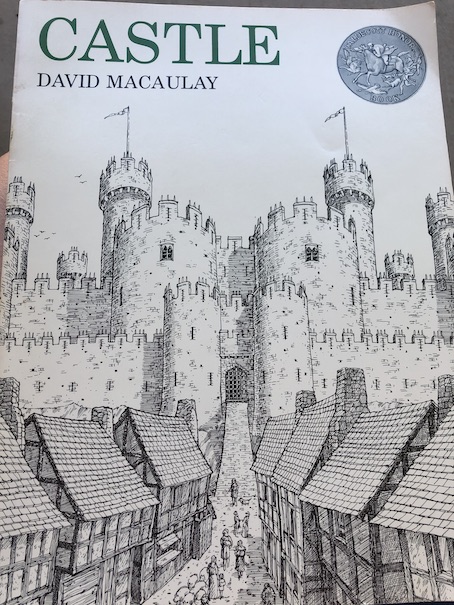
Castle

Castle by David Macaulay, 1977.

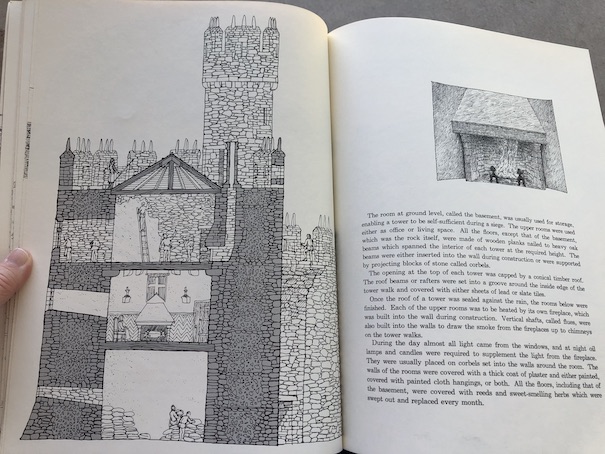
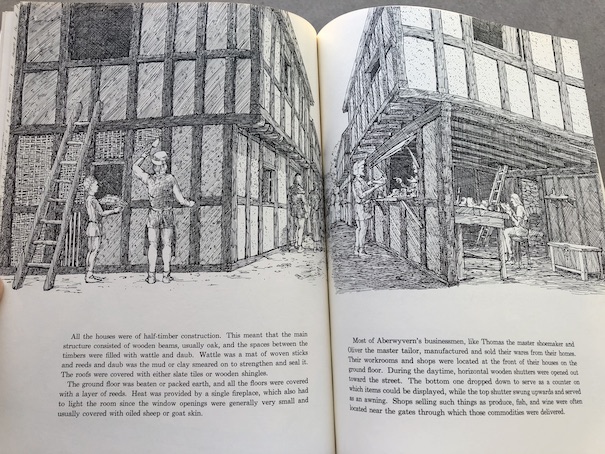
Castle is one of David Macaulay’s books about historical architecture, and like his earlier book, Cathedral, it has detailed and realistic drawings to explain each step in the building process.

The castle in the story is fictional, but it’s based on real castles built by English lords during the conquest of Wales, circa 1277 to 1305. The process for constructing the castle and the military strategy behind it are historically accurate. The English, under King Edward I, used a strategy of establishing permanent towns and castles in Wales to dominate the Welsh. The construction of these castles and their accompanying towns took years, but it was part of a long-term political and military strategy that actually aimed at avoiding direct armed conflict. The purpose of the castles and towns was not only to support the occupying English forces and settlers, but also to provide economic centers that the Welsh would also find beneficial. The idea was that the Welsh, while initially opposed to the interlopers, would eventually come to rely on the presence of the new towns for business and trade and not want to force the newcomers out. This strategy is in keeping with the nature of castles themselves because they are defensive structures, designed for holding off attackers in order to maintain territorial control, shielding the people within the castle so they cannot be forced out. The fictional castle in the story is built with a fictional town called Aberwyvern and belongs to a fictional nobleman, Lord Kevin.

The beginning of the book explains the military strategy of Edward I and how he appointed noblemen to build castles in Wales. When choosing the site for a castle, they would take into account the natural landscape and its defensive capabilities. For example, Lord Kevin’s castle will be built on a high outcrop on the edge of a river. The high ground and the surrounding water will make the castle harder to attack.

The book shows a plan of the castle that will be built and explains the different craftsmen who will be working on the construction, along with the tools they will use. The book then describes the various stages of construction, beginning with the preparation of the site and the digging of a moat that will separate the section of rocky outcropping where the castle will be built from the land around it, where the town will be located. The moat is important because it provides an extra defensive feature.

My favorite parts explain the living quarters of the castle. People think that castles must have been uncomfortable with bare stone walls, but actually, the walls are only bare in ruined castles that were exposed to the elements over time. When a castle was inhabited, the walls were covered with plaster. The plaster would be painted and/or hung with tapestries for decoration. Reeds and nice-smelling plants would cover the floors as a kind of carpeting, and the plants would be swept out and replaced regularly.

The castle and town take years to finish, and the pictures show how they look at each stage of construction, both in aerial view and up close.

Toward the end of the book, King Edward visits the castle and warns Lord Kevin that there have been some Welsh uprisings. Lord Kevin and his people make sure that they have enough food and supplies to last through a siege, and the following year, the castle’s defenses are put to the test when they do have to withstand a siege.

Eventually, the Welsh attackers are forced to retreat when they are unable to take the castle and they receive word that more English forces are coming.

Over time, the community includes people of Welsh and English descent, living side-by-side, and the town extends beyond the original town walls. The town walls are no longer necessary for defense. By that point, the castle itself is mostly neglected, and people sometimes scavenge stones from it for other buildings.

This book is a Caldecott Honor Book. It is available to borrow and read for free online through Internet Archive (multiple copies). There is also an animated film version of this story, which is available online through Internet Archive.

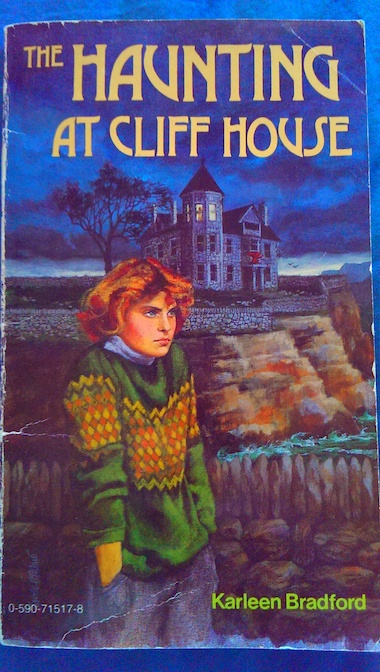
The Haunting at Cliff House

HauntingCliffHouseThe Haunting at Cliff House by Karleen Bradford, 1985.

This is a relatively short chapter book, but suspenseful, thoughtful, and well-written.

When her father inherits an old house in Wales from a distant relative, Alison, a young teenager, finds out that he plans for the two of them to spend the summer there.  Alison’s father is a university professor and is writing a book, and he thinks that the house in Wales sounds like a great place for him to get some writing done while he and Alison have a look at his new inheritance.  Alison isn’t enthusiastic about the trip, but she and her father are very close, especially because she lost her mother at a very young age.  Besides, the only place she could stay in Canada would be with her grandmother, and her grandmother didn’t seem enthusiastic about having her.

From the moment they arrive at the old house, called Pen-y-Craig or Cliff House by the locals, Alison has a bad feeling about it.  It stands on a lonely cliff by a small town.  The carved dragon over the door gives her the creeps, and there is something disturbing about a particular room in the house.  Sometimes, she can almost hear a voice calling out to her, and she has visions of another girl, about her age.  At first, she tries to tell herself that it’s all her imagination, but it soon becomes obvious that it’s not.

Some of the local people know that the house has an unhappy history, and Alison eventually learns that the great-aunt that her father inherited it from even refused to live there during her last years because it disturbed her too much.  A little more examination of the room that had disturbed her helps Alison discover the reason why.  After having a vision of a young girl hiding something behind a brick in the fireplace of one of the bedrooms, Alison searches the spot and finds a diary dating from 1810, written by a girl named Bronwen, who was the same age as Alison.  Like Alison, Bronwen was brought to the house by her widowed father and was unhappy about it, but those aren’t the only parallels between Bronwen’s life and Alison’s.

Alison becomes uncomfortable with her father’s new friendship with a Welsh neighbor, Meiriona.  Alison likes Meiriona’s younger brother, Gareth, but when it looks like her father’s friendship with Meiriona is turning into romance, Alison becomes jealous and fears changes in her close relationship with her father, a situation that mirrors Bronwen’s life when her father falls in love with her governess, Catrin.  Although Meiriona tries to be nice to Alison, Alison can’t bring herself to like her, and she argues with her father about it.

The only person who seems to understand her feelings at all is Gareth, and Alison confides her worries in him, both about Meiriona and about Bronwen, whose spirit keeps calling out to Alison to help her, although Alison doesn’t know how.  She struggles to read through the diary, whose pages are not all legible anymore because they’re damaged with age, to learn what happened to Bronwen and what Bronwen wants her to do now.  Gareth tries to reassure Alison that her father’s relationship with Meiriona will not be as bad as Alison thinks.  He thinks that the relationship would be good for both Alison’s father and Meiriona because they are both lonely, and he doesn’t think that Alison should worry about losing her father because he’s not worried about losing his sister, even if she goes to Canada to study and spend more time with Alison’s father.  At first, Alison isn’t comforted by these reassurances.  However, Gareth agrees that the matter of the ghost is serious, and he can feel her presence as well. Gareth warns Alison to be cautious about the ghost but to try to help if she can and to call out to him if she’s ever in danger.  Alison would really rather just go home to Canada, run away from her father and Meiriona, and forget the whole thing about Bronwen, but history seems to be repeating itself, and Bronwen’s voice calls out to her insistently for help that only Alison can give.

It’s a bit of a spoiler, telling you this, but although Alison at first thinks that the diary ends with Bronwen killing herself in despair, thinking that her father only loved Catrin and not her and that there was nothing left for her to live for, the truth is that Bronwen’s suicide attempt didn’t succeed and that she made another mistake that she wants Alison to help her to change.  Bronwen attempted to kill herself by going to a cave by the sea during a terrible storm, planning to allow herself to drown, but when the water started rising, she became too frightened and decided to leave by a secret entrance to the cave.  Not knowing that Bronwen was safe, Catrin attempted to save her and drowned in the cave herself.  As Bronwen was climbing to safety, she heard Catrin calling for her but was too frightened of the storm and angry at Catrin to go back for her.  Although Bronwen lived on after the incident, she could never get rid of her guilt at Catrin’s death, realizing that, even in the middle of her resentment toward Catrin, Catrin loved her more than she knew, even to the point of giving up her own life while attempting to save hers.

Now, the anniversary of Catrin’s death is approaching, and so is a storm very much like the one that killed her.  At the top of the cliff by the cave, Alison finds her time merging with Bronwen’s, and she will only have one chance to help Bronwen make the right decision the second time around.  Helping Bronwen to prevent the worst mistake of her life and to make a better choice also helps Alison to reconsider her own choices and future.  Just as Bronwen misjudged Catrin, Alison may have also misjudged Meiriona. Instead of losing her father or being forced to accept a poor substitute for her mother, Alison may be gaining a kind of sister who will love her more than she realizes.