The Secret is Out

SecretIsOut

The Secret is Out: True Spy Stories by Teri Martini, 1990.

This is a non-fiction book about famous spies in history.  It begins with a discussion of spies in general and asks the question of whether spies are heroes or villains.  The answer depends on which side they’re on and which side you’re on.  Spies around the world and throughout history have been engaged in similar work, using similar tactics, although technology has changed the profession in modern times.  Even spies on opposite sides of a conflict use the same skills and tactics, they just employ them for the benefit of different countries or causes.

The book is currently available online through Internet Archive.

The stories contained in the book:

SecretIsOutPic1The Gentleman Spy — This is the story of Captain John Andre and General Benedict Arnold during the American Revolution.  John Andre was a British officer who was executed for his role in helping Benedict Arnold defect to the British side.

Abraham Lincoln’s Personal Spy — The famous Pinkerton detective agency, the first detective agency in the United States, played an important role in the American Civil War.

The Spy with “the Delicate Air” — Spies were not always part of an official organization.  Even a civilian could turn spy in the name of a cause she believed in as Belle Boyd did during the American Civil War.

The Black Chamber — In the early 1900s, agents of the Austro-Hungarian Empire tracked down a mysterious agent in the pay of Russia and discover that the person they were looking for was the man who had once been in charge of their own organization.

The Eye of the Morning — Mata Hari was one of the most famous spies of all time, although she wasn’t really successful.  It was more her reputation as a dancer and the manner of her death that made her famous.

SecretIsOutPic2The Phantom of the Desert — Lawrence of Arabia was actually Thomas Edward Lawrence, a British army Captain.  He helped the Arabs to fight against the Turks during WWI.

The Spy without a Country — A poor young man from Hungary with a habit of telling tall tales left home to seek his fortune and eventually ended up becoming a Member of Parliament in Britain under the name of Trebitsch Lincoln.  However, when Trebitsch Lincoln was in need of money during WWI, he decided to turn to spying.

Mincemeat Swallowed Whole — This is one of my favorite true spy stories!  During WWII, the British concocted a scheme to give false information to the Germans using a dead body that supposedly was a drowned British marine carrying important documents.

The Clenched Fist — Fritz Kolbe spied for the Allies from within Hitler’s foreign office during WWII.

The Third Man — Harold “Kim” Philby was a spy for British intelligence during the Cold War, but he was secretly working for the Soviet Union.s

The Spy Next Door — Colonel Rudolf Ivanovich Abel was a Russian spy who posed as an ordinary American, Emil Goldfuss, in New York City.  After he was captured, the Americans decided not to execute him, although that was the usual punishment for espionage.  Instead, he was held prisoner until he could be used for the famous prisoner exchange where he was traded to the Russians for the captured U-2 pilot, Francis Gary Powers.
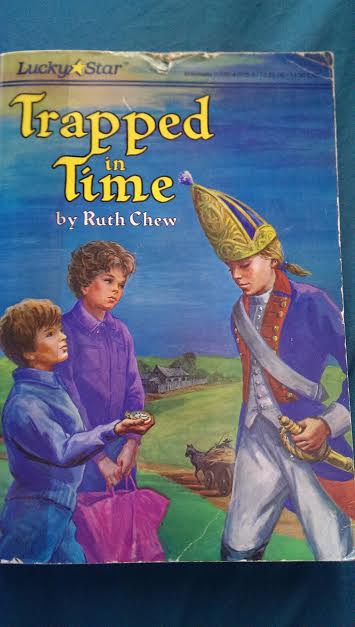
Trapped in Time

TrappedTimeTrapped in Time by Ruth Chew, 1986.

Audrey (called Andy) and her younger brother Nathan are having a picnic in Prospect Park in Brooklyn, New York, when Nathan falls and knocks over an old tree stump. They spot something shiny in the deep hole under the old stump, and Nathan climbs down to get it.  It turns out to be an old pocket watch, the kind that needs to be wound with a key.  Nathan has a small key in his pocket, made for a toy, and decides to try it on the watch.  He manages to wind it, but suddenly, the hands of the watch move backwards, the children feel strange, and everything around them seems different.  Although it takes the children a little while to realize it, they’ve traveled back in time about 200 years, back to the Revolutionary War.

They meet a boy named Franz and become friends with him.  Franz is a drummer boy for the Hessian soldiers, Germans hired by the British to help them fight against the rebelling colonists.  Franz’s superior orders his men to commandeer food and supplies from the people living in the area.  Franz is supposed to take a family’s cow, but the family desperately beg him not to because they have nothing left and will need the cow to support themselves.  Andy persuades Franz to leave the family and their cow alone.  However, disobeying the order means that Franz will be in trouble with his superior.  He decides that the only thing to do is to desert the army.

TrappedTimePicFranz had only joined the army in the first place because his parents were dead, and he didn’t know what else to do.  Now, he has to find a new place to live, somewhere where there won’t be other Hessians who would recognize him as a deserter.  Andy and Nathan also have problems because they’ve now realized what time they’re in, and they don’t know how to get home.  The watch no longer seems to work.
The children travel together, meeting others who help them and seeing the effects that all of the armies, British, Hessian, and American, have on the ordinary people as the war continues around them.

When they finally find a place where Franz can stay safely and someone he can call family, who can also use Franz’s help, Andy and Nathan realize who the watch really belongs to and how they can return to their own time.

The watch’s real owner is the person I thought it would be, and it took the kids unexpectedly long to realize it.  There is a hint of what happened to Franz when the kids finally return to their own time, but I kind of wished that they learned more about what Franz’s life turned out to be like.  From what the kids see, it seems that things went well for Franz and that he continued living in the house where they left him.

The book is currently available online through Internet Archive.

The Keeping Room

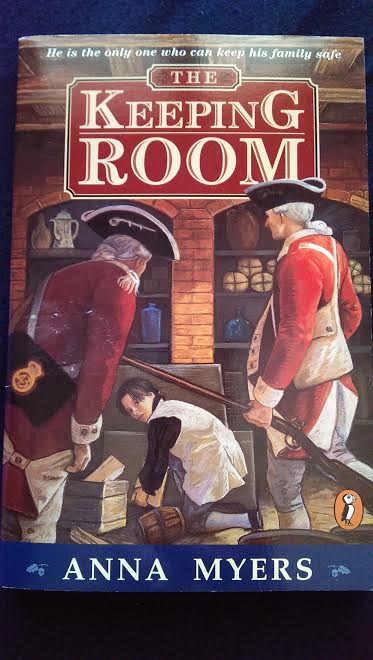
KeepingRoomThe Keeping Room by Anna Myers, 1997.

Joey was named after his father, Colonel Joseph Kershaw, a wealthy businessman in Camden, South Carolina during the Revolutionary War.  Joey is like his father in many ways.  He idolizes him and does everything as his father wishes.  When his father marches off to fight on the side of the revolutionaries, he tells twelve-year-old Joey that he must be the man of the house while he is away and look after his mother and the younger children.  Joey takes pride in his new position as man of the house, but he is soon to undergo hardships that will turn him into an older and wiser person.

Joey’s father and his troops lose their battle and are captured by the British.  Soon, the whole town is taken by the British troops, and they commandeer the Kershaw house, the biggest house in town, as their headquarters, keeping Joey and his family as prisoners.  Joey can only watch in helpless anger as the British set up gallows in his family’s garden and hang rebels, his father’s surviving troops.

Joey’s mother was a Quaker before her marriage, and so is Joey’s tutor, Euvan.  They do not believe in the violence of war or harboring hate.  Although Joey seethes with anger at his father’s imprisonment, his family’s captivity in their own home, and the death and destruction he sees around him, they make efforts to remind him that British soldiers are human too, some good, some bad, and not all monsters.  However, how can Joey see the British as anything but monsters when he has seen their cruelty, when he and his family have suffered at their hands, and when he has watched them put many good men to death?

Before the British captured the house, Joey managed to hide away his father’s pistol.  It isn’t enough to fight an army, but Joey knows that he will use it to fight if he gets the chance.

Throughout the story, Joey undergoes a transformation, not just from a boy to a man, but from his father’s little copy into his own person.  From the beginning, Joey identifies himself mainly as his “father’s son.”  He loves his father and truly idolizes him.  He wants to be just like him, and his father is grooming him to take over his businesses one day, to do everything the way he does.  Joey loves how respectful everyone is toward his father, a wealthy and successful man, and how respectfully they treat him when he is with his father.  He hangs on his father’s words and adopts all of his beliefs.  But when his father is gone, things are different.  People who were respectful of him because of his father now regard him as just a boy, a little spoiled and not really knowing or understanding much.

Joey struggles to grow into his new role as man of the house, to really be a man as his father would have wanted.  But along the way, he comes to realize that there are many things that his father didn’t really understand himself and that he was wrong about many things.

Joey’s father didn’t believe in educating women beyond basic reading and writing.  His sister Mary has defied their father’s wishes before by borrowing Joey’s books, and although he didn’t want to tattle on his sister, Joey could never bring himself to support her studies openly because he didn’t want to go against what his father wanted.  However, during their captivity, Joey comes to appreciate his sister Mary’s courage and intelligence.  She gives him great support through their harrowing circumstances. He is proud of her and realizes that she is worthy of the studies she craves.

Similarly, Joey comes to question his father’s beliefs about slavery. Although his father railed against British tyranny, claiming that he would never be a slave to them, he kept slaves of his own.  When Joey had previously questioned him about that, his father told him not to worry about it because it was part of “the order of things.”  But, Joey’s own experiences in captivity make him think differently.  He also comes to appreciate the two slaves who stood by the family to help them through their captivity, learning more about their lives and history.  Because of his experiences, he decides that he will never be a slave owner himself.

Most of all, Joey finally sees the truth of what his mother, Euvan, and even Biddy and Cato (the two slaves who remained with them) tried to tell him about hate and killing when one of the British soldiers gets killed while saving Joey’s life.

As Joey reacts to the frightening circumstances around him, doing what he can to protect his mother and younger siblings, he realizes that he must rely on himself and his own judgement, not his absent father’s, to handle the situation.  In the end, he decides that, although his still loves his father and eagerly waits his return home, he does not really want to be like his father anymore.  He has truly become his own man and is ready to stand up for the man he has become, even though his father may no longer want him to run his businesses.

This book is currently available online through Internet Archive.