Barbie and the Missing Wedding Dress

The Missing Wedding Dress Featuring Barbie by Karen Krugman, illustrated by Laura Westlake, 1986.

This Little Golden Book is a cute mystery with Barbie and her younger sister Skipper.

Barbie’s friends, Tracy and Todd, are getting married, and Barbie and Skipper are helping Tracy to get ready. Barbie is going to be Tracy’s maid of honor, and Skipper will be the flower girl for the wedding.

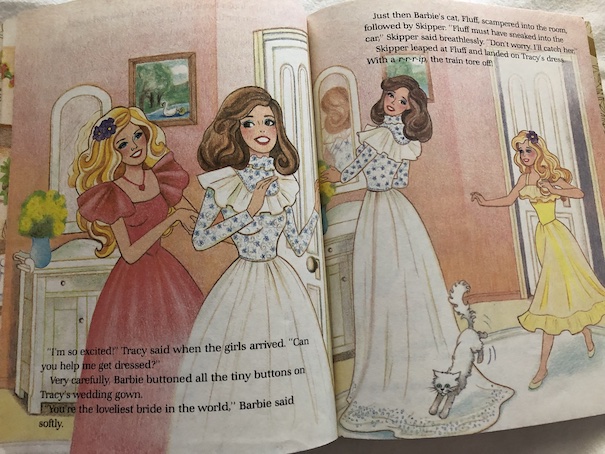
However, when they’re helping Tracy to get dressed for the wedding, Barbie’s cat gets loose and Skipper accidentally tears Tracy’s dress trying to catch the cat. The three of them take the dress to the dressmaker to be fixed.

After the dress is repaired, they stop at the shoe store to pick up Barbie’s shoes. However, when they leave the store, they suddenly realize that they no longer have the box with the dress in it. Instead, they have a box that contains several pairs of jogging shoes! Somehow, the boxes were switched, but how are they going to find the person with the right box?

Barbie, Skipper, and Tracy track the person with the dress across town, using the clues that the jogging shoes belonged to a woman in a floppy straw hat with a red van that says “Flo” on it.

The book is available to borrow and read for free online through Internet Archive.

My Reaction

I read this book when I was a kid and I liked to play with Barbies, and I thought that having them solve a kind of mystery was fun, although it’s a very simple sort of mystery, chasing down a lost object. I liked this book a lot when I was little.

Barbie fans might notice that Skipper doesn’t have her 2000s look, basically looking like a smaller version of Barbie herself, which was how she looked in the 1980s and 1990s, when I got my Barbie dolls. Since then, Mattel has changed Skipper’s hair. However, people who are younger than I am might not be aware that Tracy was also a doll from the 1980s, a friend of Barbie who came in a wedding dress. This 1982 commercial on YouTube shows bride doll Tracy with her groom, Todd. The Tracy and Todd dolls existed before this book was written, so the book was written to give the dolls a story, and the dolls weren’t created based on the book.

A Meeting of Minds

A Meeting of Minds by Carol Matas and Perry Nodelman, 1999.

This is the final book in the Minds series. Each book in the series begins shortly after the previous book ends, and this one starts only three weeks after the last book.

Princess Lenora and Prince Coren are still in Andilla for their impending wedding when, while simply walking down a hallway of the castle, they suddenly find themselves transported to a land of snow. The world in which they now find themselves is our world (which, I guess would be distant past of their world, the late 20th century). Disoriented and cold, Lenora and Coren go inside a shopping mall to get warm. At first, Coren thinks that Lenora has caused their present predicament (because, usually, she does, either consciously or unconsciously), but Lenora denies having anything to do with it.

At the time they’d been walking down the hallway, they’d been discussing the exhibition at the castle in honor of their upcoming wedding and Lenora’s desire for a better world. The exhibition was called “A Meeting of Minds” and designed to showcase the ways that different groups of people in their world live and what they envision as a perfect world. The entries in the exhibit were chosen as entries in a contest, and a panel of judges from different countries would choose winners from among them. The winning entries would be adopted as real laws in the hope of fulfilling Lenora’s wish of making the world a better place for everyone. What could go wrong? (Seriously, things in this world always go wrong when people try to enforce some vision of perfection, so what’s it going to be this time?) Could the exhibition have something to do with their present predicament?

Lenora and Coren briefly consider different possibilities, including the possibility that some unknown enemy has sent them to this strange place, but nothing really makes sense. Lenora has the uncomfortable feeling that something she’s done may have cause this problem after all, although she can’t think what it is. Either way, they are stuck in a strange land.

They stop a passing girl and ask them where they are, and she tells them that they’re in a mall called Portage Place. That doesn’t really explain much to Lenora and Coren, so the girl tells them to buy a map. Lenora and Coren don’t understand the concept of “buying” (in the last book, they didn’t know the word “economy”). When they try to ask her the name of her “world”, it turns out that the girl is an alien conspiracy theorist, wearing a shirt with a picture of an alien on it and the words “The Truth is Out There” (the slogan from the X-Files tv show). The girl is very excited, thinking that Lenora and Coren are space aliens. She tells them that they’re in Winnipeg on Earth and asks them where they’re from. Coren recognizes the name “Earth” as the old name for their world. This confirms that, although there are fantasy elements in these stories, Lenora and Coren are actually from the distant future of the Earth, although the three of them work out that they might actually be from a parallel universe of our Earth. However, her helpfulness ends when she suddenly seems to suspect them of being “Mindies” and making fun of her. Lenora and Coren don’t know what she’s talking about.

The two of them explore the mall, getting into trouble when they try to stop two girls from taking another child’s toy and end up having security called on them and not having money to pay for food in the mall food court. Fortunately, a couple of other young people in line offer to pay for their food. These young people, Barb and Thomas, seem to recognize them as Princess Lenora and Prince Coren, but strangely, Lenora and Coren learn that they think that they’re in costume and only pretending to be themselves. It slowly comes out that the authors of the book series live in Winnipeg and that there’s a fan convention in town for the books in which Lenora and Coren are fictional characters. (I’ve never actually heard of a convention specifically for this series of books, but I don’t live in Canada, so I can’t swear that it never happened. However, the characters later meet someone dressed as Spock at the convention, so it’s possible that this is supposed to be part of some larger book or sci-fi/fantasy-themed convention.)

Lenora and Coren don’t fully understand the concept of the fan convention, but Lenora sees it as a possible lead to what’s happening, so she insists on going to the convention center. At the convention center, Lenora and Coren encounter other people who are apparently trying to dress like they do and pretend to be them. Some of them even criticize what Lenora and Coren are wearing because their real outfits don’t agree with the fans’ interpretations of the characters. (Fandoms are like this in real life. The more someone likes something and spends time with it, the more they consider themselves an authority on it. They kind of are, but sometimes, fans get wrapped up in their own vision of what they’d like characters to be like that they kind of depart from the original story or get out of sync with the vision of the original authors. It’s almost like they mentally create an alternate reality of a world that was already fictional, which fits very well with the themes of this entire series.) Lenora and Coren think that they’re all very rude for criticizing the way they dress, telling them how they should talk to be in character, and thinking that Coren is a wimp or geek or that Lenora is annoying or arrogant, which some of them say right in front of them.

At this point, someone comments that Lenora sounds just like she does in the books, and the people at the convention start talking about all of the books in this series, which I’ve already reviewed. Finally, Lenora and Coren understand that these people know about them and are imitating them because they have read books about them. Coren is embarrassed when these fans start talking about some of his more embarrassing moments like they’re common knowledge. Lenora gets angry and decides that they need to talk to the authors. (Which seems to have been the goal of this book.)

Coren and Lenora get in line to talk to the authors of the books, but when they meet them, the authors also just think they’re fans of the books who are putting on a little skit for them. There’s some banter with the authors (including some inside jokes that Carol and Perry seem to have with each other, like how bad Perry’s handwriting apparently is), and the authors remark how much Lenora and Coren sound like their characters, although they don’t think they really look like them (which is interesting, as if they have a completely different vision of them in their minds). Lenora gets angry with them and accuses them of stealing from their lives to write their books, so she grabs some of the books the authors and signing and runs away with them.

As Lenora and Coren hide from security with their stolen books, they start reading about themselves. They find that the books do describe their previous adventures together, and they seem to capture some of what they were thinking and feeling at the time, but not everything is correct. In a twist that makes this book a little more interesting than it started out, not everything in the books they read is like the real-life Minds books. Lenora and Coren start noticing that Sayley plays a very prominent role and is described in glowing terms and that her favorite word, “scrumptious” appears frequently. Then, Lenora and Coren discover that one of the events at the convention is a worship service for the “Divine Sayley.” One of the other convention attendees tells them that the Sayley in the books was named after the Divine Sayley, who is a real figure in their world, an angelic-looking girl with divine powers, who seems to be a glowing version of their Sayley.

It seems that Lenora and Coren have discovered the source of this strange world and everything that has been happening to them, but how and why did Sayley do it? Or, did she really do it at all? And how can Lenora and Coren get home when their powers no longer work?

The book is available to borrow and read for free online through Internet Archive.

My Reaction and Spoilers:

First, I’d like to talk about why the authors wrote this book. It’s somewhat of a departure in theme and tone from the rest of the series, and because of that, it annoyed me. At first, I guessed that this book was just the authors’ excuse to have their own characters meet them in the story, to show off a few inside jokes for their own amusement, and to kind of toot their own horns. That sort of story annoys me. I don’t like it when authors do that. When I read a series that I like, I want to do it for the sake of the characters and the stories, not for the sake of the fandom, and any inside jokes the co-authors have with each other are not jokes I am personally in on, so I’m just not going to get the same charge out of them. (There’s an in-joke in this book about Perry Nodelman having some kind of special underwear. I don’t know what it is because it isn’t described, but I’ve seen lots of funny undershorts in those catalogs that come around Christmas, and I don’t really care which pair he owns. Younger readers would probably get more of a kick out of that bit of trivia than I do.)

However, I looked it up, and I found this explanation, written by one of the co-authors, Carol Matas:

Why We Wrote A Meeting of Minds

In thinking about the imaginative powers of the people of Gepeth, it suddenly struck us that they could have imagined us. After all, the Gepethians have the power to make whatever they imagine real, so why not this entire world of ours, including the city of Winnipeg and everyone who lives there–including us? Lenora and Coren are figments of our imaginations–but we might also be figments of theirs. In A Meeting of Minds, that is exactly what happens. Lenora and Coren and the authors Carol M and Perry N come face to face, as Lenora and Coren find themselves stuck without their powers in the city of Winnipeg and unable to get out. Who created whom? And will Lenora and Coren ever manage to escape this frightening city, worse than their worst nightmares? You’ll have to read the book to find out!

That explanation did make me feel a little better about the book, that more thought went into it than just a bunch of inside jokes for fans. The Minds books all focus on the power of the mind and the imagination and the nature of reality. A meta plot, like trying to decide if the authors created the characters or the characters created the author does fit with the theme of the theme of the series, almost like the end of Through the Looking Glass, where the reader is left to decide whether Alice dreamed the Red King or if Alice was just part of the Red King’s dream. However, by the end of this book, the question is resolved, as far as people in Lenora’s world is concerned. According to the story, Sayley really did create Winnipeg and everything in it, including the authors of this book and their books and fandom. There is something a little unsettled about the end of the book, but that’s not what it is.

I can’t talk about my full opinion of this story without some spoilers, though, so get ready: The current problem is actually a plot by Leni and Cori, the annoying doubles of Lenora and Coren created two books ago in the series, although it also turns out that their plot is part of the machinations of someone else.

It’s important to remember that Leni and Cori are basically Lenora and Coren themselves, sharing all of their memories up to the point in time when Lenora created them as separate people, but with twists to their personalities. She created Leni on purpose as a double of herself so she could go off and do what she wanted and people wouldn’t know she was missing, but she made Leni a distinct personality, who would like all of the boring things she didn’t like about managing a household and planning a wedding, so Leni would be happy to stay home and do those things while Lenora herself went adventuring. Cori was an accidental creation, when Lenora’s powers where acting erratically. She was in trouble and wished that Coren was there to help her, but she also wished that Coren was a braver, more action-oriented person, so Cori appeared as a kind of white knight figure to rescue her. Once Lenora created Leni and Cori, she didn’t have the heart to un-imagine them into non-existence because they are now distinct people and personalities by themselves.

Unfortunately, while Leni and Cori are pretty well-suited to each other, they both come with their annoying defects. Leni is frivolous and vapid, getting too wrapped up in petty details, like hair, clothes, and makeup, to care about larger issues. Cori is brave but reckless. He doesn’t have the real Coren’s thoughtfulness and rushes right into danger because his only solution to anything is fighting. Lenora and Coren come to appreciate each other more after seeing what their doubles are like and experiencing their annoying sides. Coren realizes that he doesn’t want Lenora to be like Leni, and Lenora stops complaining that Coren thinks too much. They don’t like their doubles, but the feeling is actually mutual. Because Leni and Cori have personalities that are almost opposite to Lenora and Coren, they find Lenora and Coren as annoying as Lenora and Coren find them, just for different reasons. Cori thinks that Coren is a wimp, and Leni thinks that Lenora is irresponsible and tasteless.

Part of the problem is that, while everyone knows that Leni and Cori are recently-created doubles instead of the real Lenora and Coren, Leni and Cori are still real people with all of the memories of Lenora and Coren. So, while the public and their royal parents acknowledge Lenora and Coren as their real children and the real princess and prince, Leni and Cori are angry and dissatisfied because they are no less “real” and have all the memories of being princess and prince. They are not treated as equals to Lenora and Coren, and their own parents don’t really consider them their children. Leni resents being treated like she’s secondary to Lenora, especially since Lenora made her to be the embodiment of all of the qualities that her parents wished she had. Leni is (for the most part) quiet and obedient, focused on spending all of her time looking the part of a princess, and rarely uses her powers in order maintain the Balance. While all of the preparations are going on for Lenora and Coren’s grand wedding, preparations that Lenora and Coren themselves don’t even find particularly interesting because they just don’t like all of the fuss and pageantry, Leni and Cori are also engaged to be married and actually want the pageantry of a grand wedding instead of the quieter ceremony being planned for them. With Lenora and Coren put out of the way, they can take over the wedding themselves, and Leni thinks that, once people get used to her instead of Lenora, they will think of her as an improvement and forget about Lenora.

Sayley did create the little world of Winnipeg that Lenora and Coren are trapped in as a display, her entry in the A Meeting of Minds contest, but Leni is the one who trapped Lenora and Coren in that world. In another twist, it turns out that Sayley created Winnipeg not as her example of the best world possible but as her example of the worst world possible, which she created for contrast. (Sorry, real world Winnipeg. It turns out that Sayley thinks snow is dreadful, but on the bright side, none of you will ever have to worship the Divine Sayley, which by itself makes real world Winnipeg immediately a better place for everyone.) When Sayley discovers what Leni and Cori have done, she wants to tell Coren’s parents, but Cori reads her mind and Leni banishes Sayley to her own exhibit along with Lenora and Coren.

By Sayley’s logic, what really makes her version of Winnipeg so bad is that nobody there believes in the power of the imagination. Everyone there likes to imagine things and they enjoy hearing about the power of imagination, which is why they are fans of Lenora and Coren, but none of them believe that imagination is real or that they can actually create the things they imagine. Their lack of belief in the powers of the mind is what prevents Lenora and Coren’s powers from working. Even though they worship Sayley as “divine”, Sayley says that they don’t really believe in her, they just consider her to be a symbol. Because of that, nobody there respects the real Sayley or listens to her. Sayley is unable to get the authors, Carol and Perry, to listen to them even though she tries to prove to them that she actually made them because she knows all about the embarrassing pair of underwear that Perry owns. Carol and Perry are still unconvinced and think that Sayley needs “help.”

Fortunately, there is one person in this world who Sayley allowed to have the power of imagination, Michael, and he believes that Sayley, Lenora, and Coren are all who they say they are. Michael figures out how to help them all to escape from the exhibit, but when they do, they still have to face down Leni and Cori and the evil force that is controlling them – Lenora’s old alter-ego and nemesis, Hevak.

The evil way that Leni behaves in this book is a clue that she isn’t quite herself. Normally, being well-behaved is a part of her personality, and her scruples would prevent her from doing any of the things she did, even though she secretly wanted to in the back of her mind. Hevak explains that, because Leni is another version of Lenora, he a part of her as well as Lenora. When Leni was feeling jealous and resentful about the wedding, it awakened him in her mind, and he used his influence to force her to overcome her normal inhibitions and do what she was thinking of doing. At first, I was thinking that having Hevak come back seemed like a bit of a cop-out and seemed a little like those cliched scenes in anime where the villain changes into their “final form” and reveals their “true power”, but that explanation actually does make sense for the way this world functions.

Just as Hevak and Lenora are poised for their ultimate battle, however, it all just kind of comes to an end. Defeating Hevak proves easier than it seems like it should because Hevak himself has changed, even though it doesn’t really seem like it from the rest of the book. What Hevak decides is that he’s been through just about everything – he tried to create perfection and failed, people have called him evil (because he does evil things), he tried to be perfectly good, and for a long period, he was stuck in a state of nothingness. Now, he wonders what it’s all for. He hasn’t really accomplished much, and he doesn’t really see the point in continuing on this way. He’s thought about it so much that he’d really rather return to nothingness and not have to think about anything. It’s a little anti-climactic for how much of a nemesis Hevak is.

However, Lenora can’t bring herself to imagine him as not existing permanently because he was always an extension of herself, so instead, she takes Michael’s suggestion and sends him to Winnipeg, which gives the authors a chance to make a few more jokes about life in Winnipeg. Michael says that there are many unimaginative people there who spend time not doing much or thinking much, so without his powers, Hevak will fit in nicely and feel comfortable. Sayley promises to make Winnipeg a little nicer than it is now without changing its character completely, giving it other seasons besides winter and making it part of a much larger world, so people in Winnipeg won’t feel trapped there if they don’t like the climate and can experience some variety. Unfortunately, she also says that, since Winnipeg was supposed to be her worst world, she’s going to give the other seasons a downside, too, which is why she decides to invent mosquitos for Winnipeg’s summer. (So, now we all know who to blame.) Michael isn’t worried because he says that people in Winnipeg are tough. I kind of liked Hevak’s banishment to Winnipeg for the humor value, even though it felt like a rather easy wrap-up to the story.

This is the final book in the Minds series, and from the way it ends, I think there could be room for another one after it, even though one was never written. The book ends with Lenora and Coren’s actual wedding, stopping just as the ceremony ends. It appears that they are going to live happily ever after with the form of perfection they’ve selected taking effect as the ceremony ends, but exactly what that means is never clarified, probably because perfection is a difficult thing to imagine and maybe complete perfection is impossible to achieve. Lenora and Coren are both happy, although Coren does have some slight misgivings about whether the perfection is going to be too perfect in some way. (Remember, this series is all about Balance.) However, he brushes his worries aside to complete the ceremony. Then, we don’t know what happens after that. Is their new perfect world everything they’ve ever wanted and keep everyone happy forever, or will there be new, unforeseen complications after their marriage? Would new, unforeseen complications actually make Lenora happier than a completely settled world because she actually likes excitement and new problems to solve? Could that actually be her version of perfection? Is there a chance that Hevak will return from Winnipeg or has he finally found his true niche there, shoveling snow? There are no answers to these questions because the series is over, so we’ll never know, but I’ll leave you with a final thought – this world is all about imagination and the power of the imagination to create, so if you imagine something after this, that’s what you’ve created.

Ramona Forever

Ramona is in third grade now, and there are new changes coming in her life. At the beginning of the book, she and her sister Beezus still go to Howie’s house every day after school so Howie’s grandmother can look after them because both of their parents work, although lately Beezus has been finding other places to go after school, like her friend’s house and the library. That’s how Ramona knows from Howie that his rich Uncle Hobart, who has a job in the oil industry, will be coming to visit soon from Saudi Arabia. Ramona mentions it one night at dinner when her Aunt Beatrice is visiting. Aunt Beatrice says that she remembers Hobart from when they were kids and went to the same school, but she hasn’t seen him in years.

When Uncle Hobart comes, he brings a couple of small camel saddles for Howie and Willa Jean to play with. He also gives Howie a unicycle and Willa Jean a small accordion. When he meets Ramona, he embarrasses her by calling her Howie’s girlfriend and singing a verse from an old song about a woman named Ramona (links repaired Nov. 2023), and Ramona takes an instant dislike to him. She flat out tells him that she doesn’t like adults who tease (Neither do I, and I’m in my 40’s.), and he promises to reform, although Ramona thinks that he’s still joking around and isn’t satisfied.

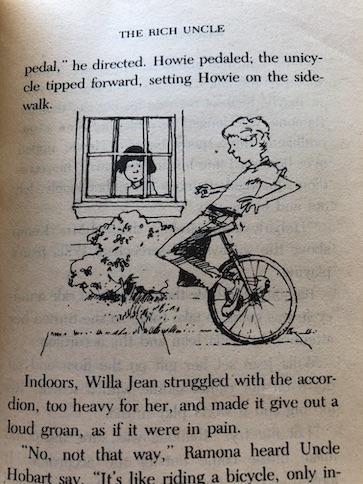
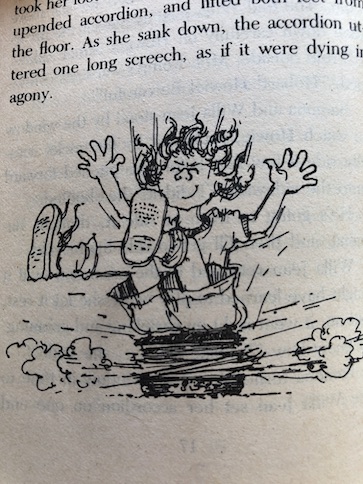
Uncle Hobart takes Howie outside to learn to ride the unicycle, and Willa Jean and Ramona try the accordion. When neither of them can figure out how to use it, little Willa Jean gets frustrated and sits on it, breaking it. Howie’s grandmother, Mrs. Kemp, gets angry at the girls, and Ramona thinks that the accordion was a dumb present to give to a little girl who wouldn’t be able to use it properly for years. Mrs. Kemp tries to shame Ramona to Uncle Hobart, blaming her for the incident. (As if Ramona was the babysitter instead of Mrs. Kemp, who incidentally, is being paid by Ramona’s parents to watch her as well as watching her own grandchildren. Ramona didn’t think of this, but I certainly did.) Ramona never really liked being watched by Mrs. Kemp, but the blaming and shaming makes her realize that Mrs. Kemp actually doesn’t like her and wants to make her feel bad, which is a disturbing feeling from someone who is supposed to be taking care of her. Ramona decides right then that Mrs. Kemp will never look after her again.

When the family talks about the situation at dinner that night, Beezus supports Ramona’s assertion that Mrs. Kemp doesn’t like them, saying that’s the reason why she’s been trying to find other places to go after school. Ramona’s mother asks her if she ever thought that maybe Mrs. Kemp would rather not be a babysitter at all, for either her grandchildren or Ramona, but women of her generation were only brought up to take care of their homes and children, and that’s all she knows how to do, whether she likes it or not.

Personally, I think this is true, but also irrelevant. Mrs. Kemp has a job to do, one that she’s being paid for, and if she’s taking the money, she also needs to take responsibility. Mrs. Kemp blames Ramona for not watching Willa Jean when that was her job, not Ramona’s, and Mrs. Kemp also has a responsibility to Ramona herself because that’s what she’s being paid for. Ramona is Mrs. Kemp’s babysitting charge. She’s a child, the child of paying customers who are specifically paying Mrs. Kemp for childcare. Ramona is not Mrs. Kemp’s personal servant or the babysitter for her granddaughter. Ramona is especially not Mrs. Kemp’s personal therapist or caregiver, who needs to help her manage her emotions or life decisions. Ramona is a child who is only with Mrs. Kemp for the purpose of being cared for by her, so let’s keep it straight who has a responsibility to whom in this situation. Besides not liking adults who tease like bratty children, I also don’t like adults who try to make kids be responsible for things that they should be responsible for themselves. Seeing Mrs. Kemp accepting money in exchange for irresponsibility and a bad attitude about her own general life choices that she takes out on her childcare charges is that much worse. Mrs. Quimby’s insights, while probably true, are also completely unhelpful to the situation. Mrs. Kemp is what she is, and what she is does not make her a good caregiver. Ramona and Beezus are correct to call her on it. Mrs. Quimby is concerned about hurting Mrs. Kemp’s feelings, but I think that should be the least of her concerns in this situation since Mrs. Kemp doesn’t seem to care about the children’s feelings and she’s in a position of trust over them. She is demonstrably not doing the very thing she is supposed to do, which care for the children she is paid to provide with childcare. You have one job, Mrs. Kemp, just one job! Mrs. Kemp is an adult, more than old enough to know better about how to behave and take responsibility for herself and the young children in her care, and she should choose to act like it or be prepared to face the consequences, not continue to get paid and thanked for work she’s not even willing to do, making her young charges miserable every single day. She’s taking advantage of the Quimbys’ desperation for child care, and that’s not right. I wished Mrs. Quimby would step up and support her daughters’ efforts to stand up for their well-being instead of enabling Mrs. Kemp’s bad behavior and making excuses for it, as if it were somehow Ramona’s fault that Mrs. Kemp doesn’t like being a babysitter and that eight-year-old Ramona actually has the power to solve Mrs. Kemp’s life problems. I can only suppose that the reason why Mrs. Quimby doesn’t is that she just doesn’t know where else to find someone willing to watch the girls after school.

Mr. Quimby asks Ramona what she thinks she should do about the situation, and Ramona hates being asked that because she wanted help from the grown-ups, not the responsibility of figuring out the problem with her adult caregiver by herself. Again, I really have to side with Ramona here. It’s not her job to be the adult in this situation, and the older I get, the less patience I have for irresponsible adults. I hated them when I was a kid Ramona’s age (and I ran into plenty of them, too), and I don’t feel any better about them 30 years later. If you want the authority of saying that you’re an adult, you have to take the responsibilities that come with that authority, taking the adult actions and making the adult decisions, not expecting the kids to do your job for you. That’s my attitude. I honestly don’t know what response Mr. Quimby was even looking for from Ramona, either. What can Ramona do if Mrs. Kemp is unhappy about her life choices and doesn’t treat her well because she doesn’t want to be her babysitter? Get some books on psychology from the library and turn into a therapist or career counselor at the age of eight to help Mrs. Kemp work through her emotional issues? Invent a magic potion that will age her to 58 so she can be Mrs. Kemp’s new best friend and they can go out for champagne brunches together instead of Mrs. Kemp babysitting her? What solution are you imagining here, Mr. Quimby? Ramona is an eight-year-old, and what what she thought she should do about this bad situation was talk to her parents, who hired Mrs. Kemp to take care of her in the first place, and get their help. How was she supposed to know that you didn’t want to help her, either? If I were one of the parents in this situation, I’d say that I understood the problem and that I’d think over some other after school possibilities for the girls, maybe look into some temporary care for the girls, possibly in the form of some kind of after school lessons in art or music or sports, paid for with the money that I would have given Mrs. Kemp for babysitting, especially since I already know that the Quimbys are already considering some coming changes for their family that will change their childcare situation. Of course, all of this is setting the stage for what happens next in the story.

Ramona asks if she can just stay home alone after school because some kids do, but her parents don’t like that idea. Beezus says that she could stay with Ramona because she’s in middle school and old enough to babysit. Ramona worries a little that Beezus will be bossy and that they’ll fight with no adults around, but Mr. and Mrs. Quimby agree to let the girls try it for a week while Uncle Hobart is visiting so Mrs. Kemp can spend more time with her son. If the arrangement works and the girls behave themselves, they can keep doing it after Uncle Hobart leaves.

Ramona asks Beezus why she’s so willing to look after her after school, and Beezus explains that things haven’t been to pleasant at her friends’ houses lately. Mary Jane needs to spend a lot of time practicing her piano lessons, and she got into a fight with Pamela because Pamela was acting like a snob and giving her a hard time about her dad’s work situation. Mr. Quimby has had a series of different jobs, and now, he is working only part time and going back to college to train to become an art teacher. Pamela has been bragging to Beezus that her father has a real job and that Mr. Quimby should “stop fooling around and really go to work.” (This is one of those snide kids’ comments that you can tell really came from Pamela’s parents and that she’s just repeating what they say to sound big. Pamela’s parents have probably been bad-mouthing the Quimbys behind their backs to talk themselves up because their employment has been more stable and some people need to look down on someone in order to feel good about themselves. I’ve seen that type before, too. By this point in the story, I had the feeling that the Quimbys seem to know a lot of people who are real jerks in one way or another, and I think it’s time that they made some new friends.) Beezus can’t take it anymore, so she’s stopped speaking to Pamela, which is about all you can do in a situation like that.

Beezus worries about their family’s future because she’s heard that schools are laying off teachers, and she fears that her father might not find a job when he’s done with his degree. She also think that their mother is probably pregnant because of the way that Aunt Bea keeps asking her how she’s feeling and a few months ago, she seemed to be suffering from morning sickness. If that’s true, she probably won’t be able to work much longer because she’ll have to take time off to have the baby and look after it. It make things difficult when the family is already concerned about money, although Beezus says that she wouldn’t mind helping to look after a baby because she likes babies. Ramona worries about the new baby and why their parents would want another child when they already have her and her sister, and she doesn’t like that the adults seem to be keeping important secrets.

The girls try to be extra good and responsible when they’re home alone together so they’ll be allowed to continue staying home alone, but they get into a fight one day when Howie comes over and offers to let Ramona ride his bike because he’s going to practice riding his unicycle. Beezus is afraid that Ramona will get hurt riding the bike and she’ll be considered responsible, but Ramona wants to go ahead and do it anyway because she’s been waiting for Howie to agree to loan her his bike. Ramona likes riding the bike, but she does fall off and scrape her elbow. Beezus refuses to help Ramona clean up afterward because Ramona insulted her before she went bike riding, and Ramona is angry with Beezus. In spite of that, the girls decide not to tell their parents about what happened because they don’t want to go back to Mrs. Kemp and their father specifically tells them not do anything to worry their mother, another sign that she’s probably expecting a baby.

Then, one day after school, the girls discover that their cat, Picky-picky has died, probably of old age. At first, they don’t know what to do, but remembering that they’re not supposed to upset their mother, they decide to bury the cat themselves. The girls are upset, but they manage to bury the cat, and they also make up with each other after their earlier fight. When their parents come home and find out about the cat, they feel badly that the girls had to handle the situation on their own. Mrs. Quimby says that, after they handled this difficult situation, she knows that they can be trusted on their own and that there’s no need for them to go back to Mrs. Kemp.

The girls’ mother finally admits that she’s going to have a baby, and the family begins talking about the new changes that they’ll have to make when the baby comes. The girls wonder who will have to share a room with the new baby, and they come up with ideas for names. Ramona worries about being a middle child now and not the youngest, but her mother reassures her that she still loves her. The Quimbys also consider that they may have to move in order for Mr. Quimby to find a teaching job, although Beezus and Ramona don’t like the idea of moving.

However, there are still more changes to come. Aunt Bea and Uncle Hobart announce that they are getting married! Ramona still doesn’t like Uncle Hobart and doesn’t really want him for an uncle, and after they’re married, they’re planning to move to Alaska because Uncle Hobart will be working in the oil industry there.

Changes aren’t always easy, but the girls enjoy taking part in their aunt’s wedding, and at the end of the book, their mother has the new baby, who turns out to be a girl. They call her Roberta, for a twist on her father’s name. Ramona begins to feel happy and comfortable with the changes in her life because she realizes that she’s growing up.

The book is available to borrow and read for free online through Internet Archive (multiple copies).

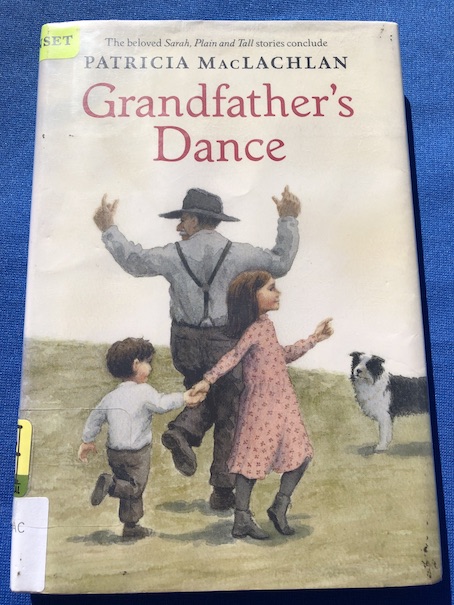
Grandfather’s Dance

Grandfather’s Dance by Patricia MachLachlan, 2006.

This is the final book in the Sarah, Plain and Tall series.

Cassie is now in the fourth grade, and things are changing in her family. Cassie has come to love her little brother, John, called Jack, who is now a young child who likes to follow their grandfather around and imitate him. Caleb has gone away to school, and Anna is getting married, which is the major event of the story. Through the planning and anticipation that precedes the wedding, Cassie still keeps her journal, with its occasional flights of fancy.

Anna’s wedding brings new excitement to the family farm and thoughts of both the future and the past. Cassie, unlike her older half-siblings, has never been to Maine or met her relatives there, but Sarah’s brother and aunts are coming to the farm for Anna’s wedding. The others remember the last time they saw these relatives, and Cassie looks forward to seeing them.

Cassie wonders about why people get married, and she can’t imagine anyone she loves enough to marry and spend her life with, except maybe her dog. She tries to picture her own future wedding, with a dog as the groom, but it bothers her that she can’t picture her grandfather at her wedding. At first, she can’t quite figure out why she’s having trouble picturing him in the future, but the more she thinks about it, the more she realizes how old her grandfather is. He even comments on his age, saying that he’s getting older every day. Her grandfather seems to be increasingly feeling his age and his heart condition. Before Anna’s wedding, Cassie and her grandfather talk about her future wedding, and her grandfather tells her that he might not be there when she is married. Cassie tries to convince him that he will be, but he says, just in case he can’t, maybe they should have a wedding for Cassie now. He has Cassie put on the nice dress that she will wear to Anna’s wedding, and they stage a mock wedding for Cassie and their dog, Nick, so her grandfather can say that he was at Cassie’s wedding, too.

Anna’s wedding is beautiful, and Cassie and the others enjoy having Sarah’s brother and aunts visit. After the wedding, they have a picture taken of the whole family together. Sadly, it is the only picture of all of them together. Soon after, Cassie’s grandfather dies. All of the wedding guests are still visiting, so they attend the funeral. Jack is still a little boy and upset and confused by their grandfather’s death, but Cassie assures him that their grandfather loved them and that they won’t forget him. The title of the book comes from a little dance that their grandfather did for Jack earlier in the story, which Jack later imitates after his death.

In the back of the book, the author explains how her family was the inspiration for the family in the book. The grandfather in the story was based on the author’s father, and part of the dedication is to him. The author’s father died two years before this book was published. The farm and landscape around it are kind of a combination of the places where her family has lived in North Dakota, Kansas, and Wyoming, which is probably why the books in the series never specify which state they’re in.

The book is available to borrow and read for free online through Internet Archive (multiple copies).

Fudge-A-Mania

FudgeAManiaFudge-A-Mania by Judy Blume, 1990.

Peter is horrified when he finds out that his family is going to spend their vacation in the same place as bossy know-it-all Sheila Tubman and her family.  Even worse, the two families are going to be staying to be staying right next to each other.  Really right next to each other.  They’re staying in the same house, which has been split into two halves.  As far as Peter is concerned, the only thing that might save his summer is that his friend Jimmy will be coming up to stay with them part of the time.

The arrangement turns out to be a little better than Peter thought it would be at first.  Sheila finds a way to make some extra money by baby-sitting Peter’s five-year-old brother Fudge.  Fudge says at first that he wants to marry Sheila, although it turns out to be mostly because he’s afraid of monsters in his room at night, and he thinks that if he gets married and shares a room with Sheila, it will keep the monsters away.  Then, he decides that marriage may be unnecessary when he makes friends with a little girl named Mitzi, who is staying with her grandparents nearby.  Mitzi’s grandmother makes a special monster spray for her to keep monsters away, so Fudge decides that he might not have to marry Sheila after all.

Peter is happy when he discovers that Mitzi’s grandfather is Big Apfel, his baseball hero, and that he holds baseball games that are open to the public, so he and Jimmy can also play with him.  He also gets a crush on Isobel (“Izzy”), a girl who works at the local library, although Isobel is a few years older than he is.  The baseball game goes well enough, but the crush, not so much.

Then, comes the most shocking news of the summer: Peter’s grandmother and Sheila’s grandfather decide to get married!  If that happens, Peter and Sheila realize that they’ll be related by marriage!

Big Apfel and his granddaughter Mitzi are fictional characters, but the book that Mitzi claims is about her, Tell Me a Mitzi, is a real book.

This book is part of the Fudge Series.  It is available to borrow and read for free online through Internet Archive.

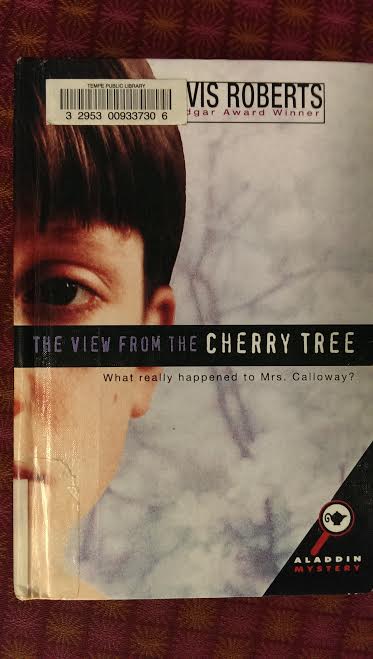
The View From the Cherry Tree

viewcherrytreeThe View From the Cherry Tree by Willo Davis Roberts, 1964.
Things have been difficult around Rob Mallory’s house since preparations for his sister’s wedding began, but things are about to get a whole lot worse. While his mother and sisters are rushing around, making last minute arrangements for the wedding guests and finding a replacement for a sick bride’s maid, Rob’s father is trying to help Uncle Ray stay out of jail after he stole some money from his boss. To make matters worse, old Mrs. Calloway, their unpleasant, eccentric next door neighbor, has been causing trouble again, spying on people with her binoculars and provoking arguments with everyone in the neighborhood.

The only peaceful place Rob can find to escape all the chaos at his house is the cherry tree that stands between his house and Mrs. Calloway’s. While he is up in the tree, Rob witnesses an argument between Mrs. Calloway and a man Rob can’t see inside her house. Then, Rob sees the man shove Mrs. Calloway out of her window. Her binoculars get tangled on a tree branch, and she is strangled to death. Rob runs to his house to get help, and the authorities come and take Mrs. Calloway’s body away. However, no one believes Rob when he says that Mrs. Calloway was pushed. Everyone thinks that her death was an accident. Then, a series of strange “accidents” happen that seem to threaten Rob’s life.

Rob’s family is too caught up in the wedding plans and family troubles to realize what is happening, but Rob is convinced that Mrs. Calloway’s murderer is trying to silence him forever.  Can he outwit the murderer and learn his identity?  More importantly, can he survive until the evening when his father is supposed to return home and can help him convince the police that he’s in real danger?

I have to say that I really hated the mother in this story.  She struck me as being a very silly and shallow woman, obsessed (and that is not too strong a word) with the trappings of her daughter’s wedding.  She speaks of the wedding as an “opportunity” that she doesn’t want spoiled, a word that seriously bothers me in this context.  “Opportunity” implies some kind of expected benefit, not just a momentous “event” in their lives or a rare “celebration.”  I kept wondering, and still wonder what kind of gains she was anticipating from her daughter’s marriage and why.  The only thing I can think of is a selfish desire to be at the center of attention, or as close to it as she can get.  As a married woman, she can no longer be the beautiful, blushing bride on her special day, but she might get a vicarious thrill from being the mother of the beautiful, blushing bride, reliving her own glory “day” from the past.

Maybe I’m getting a little too psychological with her, but that was the vibe I got, a grown-up mother-of-the-bride-zilla who can’t see past the champagne and pretty dresses to anything more important, whether it’s her own brother’s serious brushes with the law or the attempts on her young son’s life.  When Rob tries to tell his mother what’s happening, she almost slaps him because she’s so “overwhelmed” by everything that she has to do, but I’m not buying it because it seems like everyone else is really taking care of pretty much everything for her.  She has plenty of people around her and plenty of support if she wanted to recruit more.  She freaks out about any problems that happen, no matter how big or small, and wants to sweep every bad thing under the rug as much as she can because, apparently, weddings should be perfect at all costs and she wants nothing to invade that lovely bubble in her mind.  I didn’t like her when I read this story as a kid, and I’ve discovered that I hate her even more now.  Her motives have become less understandable and her personality less sympathetic now that I’ve grown older instead of more so, and that’s not a good sign.  As an adult, I would have urged her prospective son-in-law to reconsider marrying into this family on the basis of the mother’s behavior, although the bride’s offer to call off the wedding until her brother is found when he goes into hiding shows that she might have her priorities more straight than her mother’s in the end.

The book is currently available online through Internet Archive.

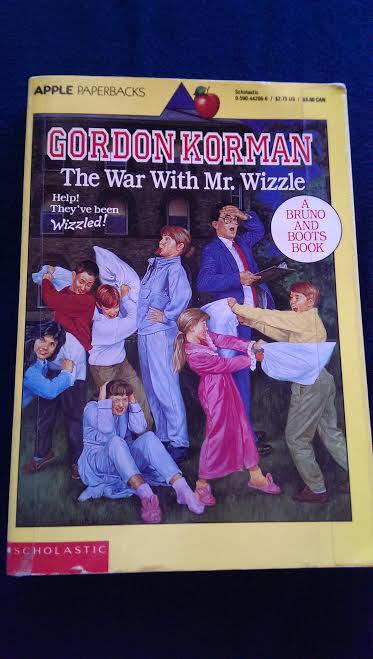
The War with Mr. Wizzle

warwizzleThe War with Mr. Wizzle by Gordon Korman, 1982.

MacDonald Hall hasn’t been the same since Mr. Wizzle came.  He’s obsessed with computers and analyzing and categorizing everyone and everything.  He uses his computers to analyze the boys’ personalities, making changes to their schedules and activities based on the results.  But, no computer could ever understand the wacky and complex personalities of the students at MacDonald Hall.

Mr. Wizzle thinks he can understand everything with his computer, but he doesn’t understand the boys at all.  The boys soon get sick of being tested and analyzed and ordered around and told that they should consider changing their last names because the length is too inconvenient for the computer.  Even Mr. Sturgeon and the other faculty members are getting fed up with Mr. Wizzle, but they can’t do anything about it because the school’s board of directors are still hoping that Mr. Wizzle will modernize the school.

Meanwhile, the boys’ friends across the street at Miss Scrimmage’s Finishing School for Young Ladies are having personnel problems of their own.  Miss Scrimmage’s new athletics teacher, Miss Peabody, used to be a U.S. Marine, and she’s trying to train the girls like they’ve signed up for boot camp.  Like the boys, they would do just about anything to get rid of this new nuisance!

What ensues is a series of hi-jinks in the usual spirit of McDonald Hall as the students at each school attempt to drive out the new faculty, but along the way, the kids are forced to acknowledge that they don’t really want anything bad to happen to these new people.  It’s not that they’re bad people, they’re just not right for the types of schools and the students they’re trying to teach.  Then, a thought occurs to them: Is it possible that Mr. Wizzle and Miss Peabody might be right for . . . each other?

This book is part of the MacDonald Hall Series (or Bruno and Boots series). It is currently available online through Internet Archive.