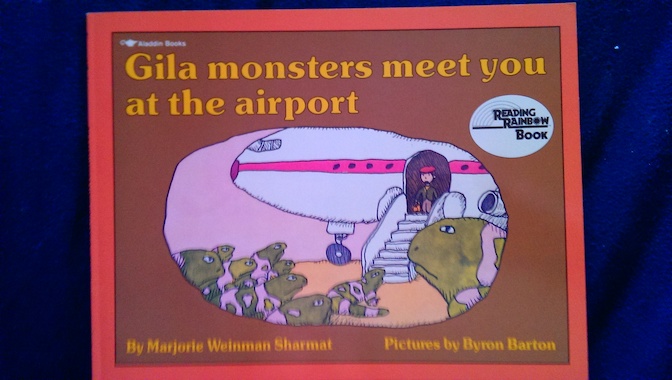
Gila Monsters Meet You at the Airport by Marjorie Weinman Sharmat, pictures by Byron Barton, 1980.
This is a humorous picture book about a boy moving from one side of the United States to the other and his misconceptions of what he’s going to find when he goes west.
At the beginning of the story, the boy lives in an apartment in New York City. As far as he’s concerned, he could live there forever, but his parents decide that they’re going to move “Out West.” (The book never really says what state they’re moving to, but it seems to be somewhere in the Southwestern United States, like Texas, New Mexico, or Arizona.)

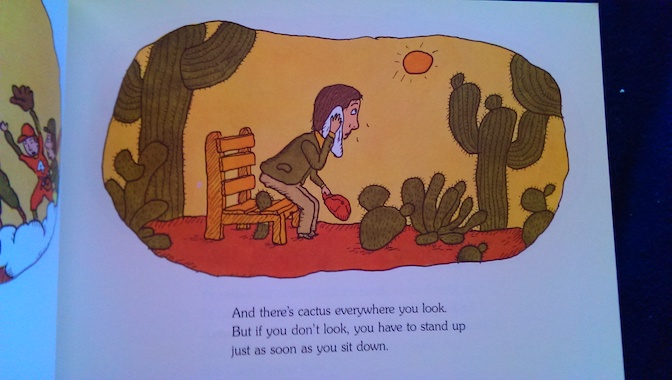
The boy thinks he’s going to hate his new home. He thinks of all the things that he’s heard about the West, like there’s cactus everywhere so you hardly know where to sit down, everyone dresses like a cowboy and rides horses everywhere, all he’ll ever get to eat is chili and beans, and he’s bound to die of heat exhaustion in the desert. His best friend in New York, Seymour, told him that Gila monsters would meet him at the airport.
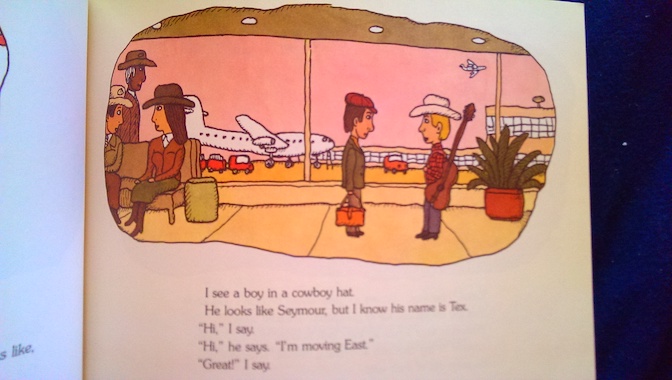
Of course, there aren’t any Gila monsters at the airport when the boy gets there. Instead, he meets another boy whose family is moving East. The two boys talk to each other for awhile, and the Western boy starts telling him that he’s not looking forward to heading East because he’s heard that it’s always cold there, the cities are overcrowded and full of gangsters, the buildings are so tall that airplanes fly through the apartments, and there are alligators in the sewers. He expects to find alligators waiting for him at the airport.
Of course, things aren’t as bad as either boy is expecting. The boy from New York realizes that Seymour and his other friends back East don’t know much about the West, and he starts realizing that things in his new home are actually pretty good, some of them not all that different from home.

This book was featured on Reading Rainbow.
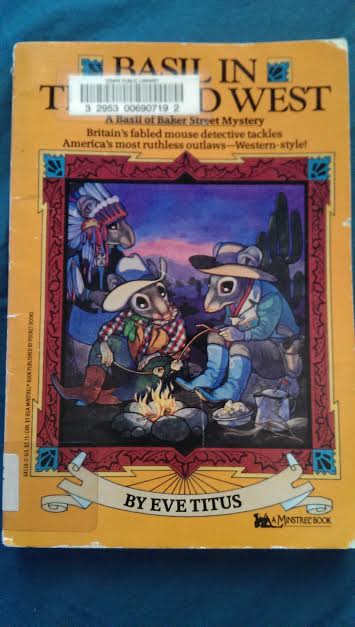 Basil in the Wild West by Eve Titus, 1990.
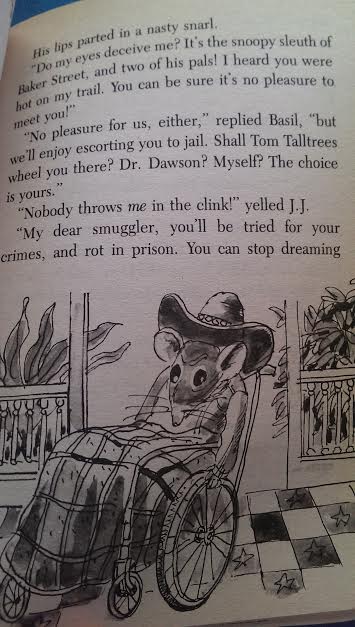 Although J.J. escapes, Basil and Dr. Dawson decide that the smuggling ring has been defeated and it’s alright to continue their sight-seeing. However, their adventures are not over!
 Jestress's Forgotten Books and Stories