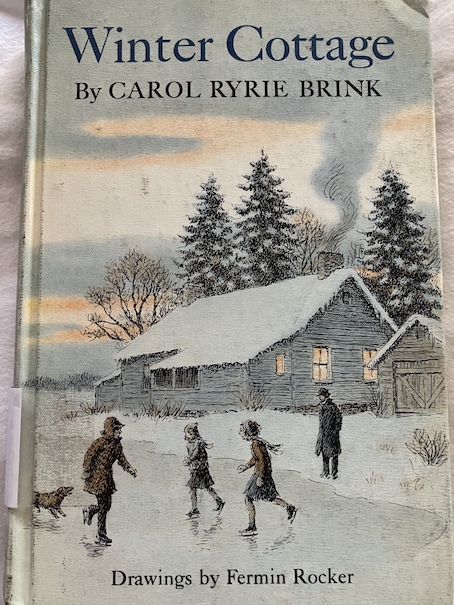
Winter Cottage

The Vincents own a summer cottage in Wisconsin. It was once an old farmhouse, so it is well-insulated and can be heated during the winter, but the Vincents only use it for about 2 or 3 months in the summer. The rest of the time it is empty and used by animals, like mice and woodchucks. However, that’s about to change.
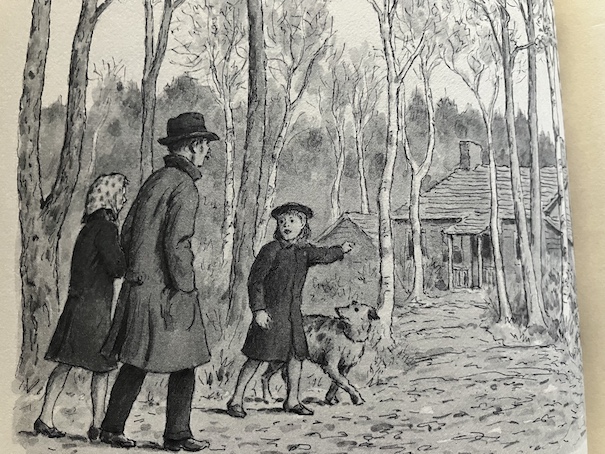
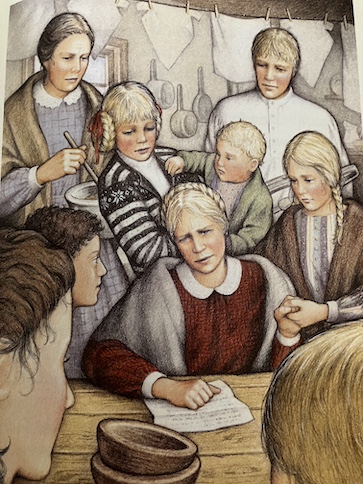
The year is 1930, the Great Depression has started, and many people are out of work and desperate to provide for their families. One such family, a father with his two daughters, happens to be passing near the Vincents’ empty summer house in the middle of October, when the Vincents have already long left the house, when their car suddenly breaks down. They were originally on their way to an aunt’s house to stay with her, but with their car broken down, they’re unable to continue their journey. Mr. Sparkes is a pleasant and easy-going man but impractical and a failed plumber. His eldest daughter, Minty, tends to deal with the practical aspects of things. Minty’s younger sister, Eglantine, called Eggs as a nickname, is the first to notice the empty summerhouse and suggests that, if they could get in, they could make some food. Needing a place to stay for the night and finding a window unlocked, they decide that they’ll go ahead and stay in the house. Although Minty has some reservations about staying in a house that belongs to someone else without their permission, she doesn’t have any better options, and she soon gets caught up in the excitement of exploring this unfamiliar house.
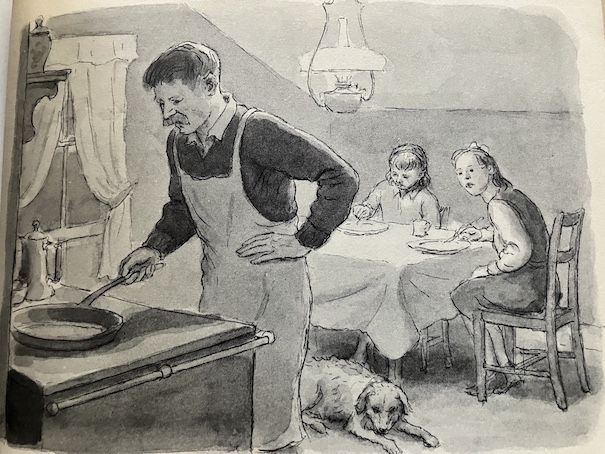
Mr. Sparkes feels like a failure because he’s been in and out of work, and typical jobs just don’t seem to suit him. Their Aunt Amy, the sister of the girls’ deceased mother, thinks that Mr. Sparkes is a failure and a silly, impractical man because he’s always quoting poetry, and his main talent seems to be making his special pancakes. There is some truth to what Aunt Amy says, and Mr. Sparkes acknowledges it. It seems like his only real talent is for making incredible pancakes, although his daughters reassure him that they love him and don’t see him as a failure. They were traveling to stay with Aunt Amy because they have no one else to stay with, but it’s clear from Aunt Amy’s letter that she isn’t looking forward to their arrival, and she also would not welcome their dog, Buster. Eggs says that she wishes they could just stay in this lovely cottage all winter, and Minty wishes the same thing, although she knows it isn’t really right for them to stay in this house without the owners’ permission. Mr. Sparkes likes the cottage, too, because it has a wonderful collection of books, including books of poetry.

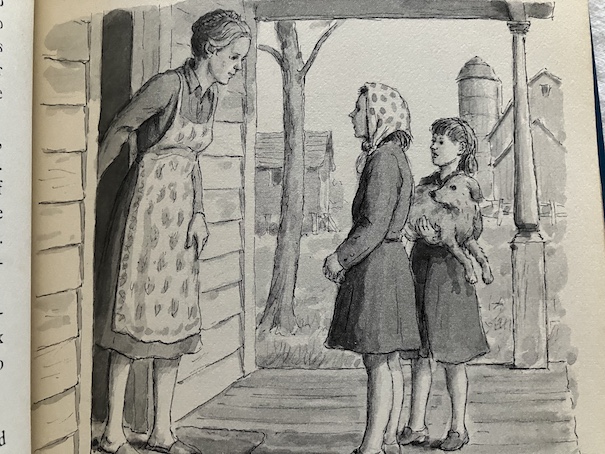
The next day, Mr. Sparkes tries to fix the car, but he’s a terrible mechanic. He takes the engine apart and doesn’t know how to put it back together. The girls go to a neighboring farmhouse and ask if anybody there knows anything about cars. Mrs. Gustafson sends her son Pete with the girls to look at the car, and he manages to put the engine back together again, but he isn’t skilled enough to figure out how to fix the original problem. He says that they had better call a mechanic in town to tend to it and that it would likely cost them about $10. The girls are worried because they know that’s about how much money they have left, and if they spend it all fixing the car, they won’t have enough left to buy more supplies and travel all the way to where Aunt Amy lives.
When they explain the situation to their father, Mr. Sparkes says that he thinks they should just stay in the cottage for the winter. Minty says that isn’t right because the house doesn’t belong to them, but their father says that it isn’t doing the owner any good to leave it empty all winter. To make it right, he suggests that they could rent it, so the owner would profit from their stay. The girls ask where he would get the money to rent the house, and their father says he doesn’t know, but he’ll have all winter to think of something. When they leave the cottage in the spring, he plans to leave the money in the cottage with a note, explaining why they stayed there. The girls are relieved that they don’t have to go to Aunt Amy’s house, but Minty is concerned that, by spring, her younger sister and impractical father will have forgotten all about the rent money for the cottage, and she makes up her mind that she will think of a way to get the money herself.

Eggs comes up with a possible way to make some money when she shows her father a contest magazine that she found at the last place where they camped. There are various contests in the magazine that offer prizes, like prizes for solving puzzles or adding the last line to a limerick. Mr. Sparkes is intrigued by the contests, and he says that they can pass the winter by trying them. He’s particularly interested in the contest to write a poem to advertise butter because he loves poetry and the prize is $1,000, which is an enormous sum to them.

Life in the cottage is idyllic. They have some groceries with them to get themselves started, and their father enjoys fishing in the nearby lake for more food. The girls find nuts and cranberries, and their father cuts wood for the stove in the cottage. Minty takes charge of the house, making sure that they keep it neat for the Vincents. The girls learn that the Vincents are the ones who own the house and that they have a daughter called Marcia when they find some of Marcia’s belongings. Sometimes, Minty and Eggs think of Marcia as a friend, and Minty sort of idealizes her in her imagination. Minty likes to imagine the comfortable life she thinks Marcia lives, wherever her family lives in the winter, and she is determined that they won’t let her down by not taking care of the cottage or finding a way to pay the rent.

Then, Mr. Sparkes gets sick, and the girls are frightened because they don’t have much medicine and don’t know what to do. They try to get help from Mrs. Gustafson, but she’s away from home. As Minty is leaving the Gustafson farm, she happens to meet a boy who’s been hunting partridges, and in her desperation, she begs him for help. At first, he is surly and suspicious with her, but when he begins to understand the situation, he agrees to come have a look at her father. The boy, whose name is Joe Boles, is carrying a professional-looking medical kit and seems to know what he’s doing as he attends to Mr. Sparkes. The girls are grateful for his help, and they invite him to spend the night in a spare room in the cottage.

It turns out that Joe is also down on his luck. His father was a doctor, and the medical kit Joe carries used to belong to him. He gets his basic knowledge of medicine from his father and from his grandmother’s home remedies. Joe also wants to be a doctor, but he’s alone now and doesn’t know how he’s going to manage to get the medical training he really wants. Although he’s initially reluctant to explain how he came to be alone, he explains that his father was killed in a car accident. His mother is still alive, but she remarried to a man Joe can’t stand. Eventually, Joe just couldn’t take living with him anymore, so he ran away from home. Joe tells the family that he’s been camping in the woods. Running away from home may not have been the best decision Joe could have made, but he’s determined not to go back, and the family can’t criticize him too much because they’re also sort of running away and hiding out right now.

Joe seems to know what to do to help prepare the cottage for winter, and Mr. Sparkes says that they could use his help around the place. However, Mr. Sparkes admits to Joe that he can’t do much more for Joe than just give him a place to say for the winter, and a borrowed place at that. Joe says that’s fine, and he would like to stay with them for the winter, and he would be willing to pay for his room and board with his labor. The Sparkes family is thrilled to have Joe stay with them and help them. The only point that Mr. Sparkes insists on is that Joe write a letter to his mother to tell her that he’s safe so she won’t worry about him. He says that Joe doesn’t have to be specific about where he’s staying right now, but he knows that Joe’s mother will feel better, knowing that he has somewhere to stay for the winter.
With Joe, Minty and her sister explore the area more and visit the nearby Indian (Native American) reservation. Eggs is a little nervous about the Indians (the term the book uses) at first, worrying about scalping, but Joe tells her not to worry and that the locals are just curious about them. Joe worries less about people recognizing him as a runaway in the reservation village than in the town nearby because it’s a little more remote, although they do accidentally meet the local sheriff in the reservation store, who recognizes Minty from an earlier shopping trip to town. Joe does his best to stay inconspicuous.

While they’re in the reservation store, they learn that the reason why the sheriff is there is that the storekeeper’s son is in trouble. The son, who is a young man in his 20s, got drunk, broke into somebody’s house, ate some of their food, and fell asleep in their bed. The young man’s father argues with the sheriff that the son didn’t actually steal anything from the house, but the sheriff says that what he did was trespassing and that it’s illegal to break into someone’s house, stay there, and use their things without permission. He says that, for that charge, the son will have to spend a week in jail. This incident is troubling to Minty because she knows that she and her family also don’t have permission to use the house where they’re staying, and they’ve been there longer than this young man was in the house where he trespassed. When the sheriff points out that the weather is getting bad and offers to take the kids home, Minty panics at the idea of him finding out where they’re staying and tells him that they plan to spend the night at the reservation.

Of course, the kids don’t really have a place to stay on the reservation, and the weather is bad for camping. They are rescued by the village priest, who says that Joe can stay with him, and the girls can stay with Sister Agnes, one of the nuns who runs the mission school on the reservation. (“Indian schools” like this have a rather scandalous reputation these days for reasons I can explain below.) Minty says that they don’t have any money to pay for a place to stay, but Sister Agnes says that doesn’t matter because “God is your host.” In other words, they’re offering the children a place to stay out of kindness and Christian charity and don’t expect payment. There are some Native American children who also board at the school, some because their houses are too far away for them to travel back and forth between home and the school daily and a couple of children who are orphans and live at the school full time.

There is a scene where some of the Indians are playing drums and dancing, but not the ones living at the school. One of the nuns says that the dancers are “heathen Indians” and that “our Christian Indians don’t dance,” although Minty can tell that the Indian students at the school are feeling the rhythm of the song and enjoying it. Joe takes Minty and Eggs to see the dancers, and they find it fascinating. I didn’t like the “heathen” talk (although I think it’s probably in keeping with the historical setting of the story), but I did appreciate an observation that Minty makes, “Indeed it seemed to be a not entirely un-Christian gathering, for here and there among the gaudy beads was the gleam of a cross on the neck of some forgetful dancer.” That observation contradicts the idea that the dancers aren’t Christians because at least some of them seem to be. That and Minty’s observation that the girls at the school were interested in the dancing and drumming but were being careful not to show it hints at more complex feelings and social dynamics in this village. The people who run the school have some strong opinions about how proper Christians should act, but the Native Americans are still maintaining some traditional practices, and some people are walking a fine line in what they practice and believe.

One of the Indian girls at the dance invites Eggs to join in, and she does. Minty finds that amusing, and Joe tells her to let Eggs have fun because she’s enjoying herself. Sister Agnes asks them later if they enjoyed the dance, and Eggs says she did. Eggs later says that it seems like they don’t have much to do on the reservation, with no “picture shows” (movies) to see and not many toys, so she thinks that the dancing is part of their entertainment. Sister Agnes says, “They are heathen, but God will forgive them.” Minty isn’t too concerned about whether or not the dance might be “heathen” or sinful, but what Sister Agnes says makes her think about what God must think of her family for living in someone else’s house. She hadn’t given it much thought before, but she knows God must know what they’re doing, even if nobody else does, so she prays that He will forgive them, too, and thanks Him for being their host. Before they leave the reservation the next day, a girl Eggs befriended gives them a basket of wild rice, and Eggs give the girl her doll in trade.

When the kids return to the Vincents’ cottage, Mrs. Gustafson is there, visiting with Mr. Sparkes. Mrs. Gustafson seems to accept the idea that they’re renting the house from the Vincent family, although Minty is nervous when she mentions that she writes to them sometimes. Mrs. Gustafson also warns them to beware of strangers because, sometimes, gangster and criminals hide out in the isolated cottages in the area when things get too hot for them in Chicago. Joe has heard stories about that, too.
When the family starts getting replies to their contest entries, the results are disappointing. Many of the contests have catches because they expect entrants to buy things or subscribe to things. There is another contest that they hear about on the radio from a flour company, offering a large cash prize for the best breakfast recipe. Minty thinks that sounds better than any of the other contest options because of her father’s wonderful secret pancake recipe, although her father has become disillusioned with contests. They don’t have much time left to enter that contest, and Mr. Sparkes is reluctant to share the secret recipe. The kids end up spying on Mr. Sparkes to learn his recipe so they can enter the contest on his behalf.

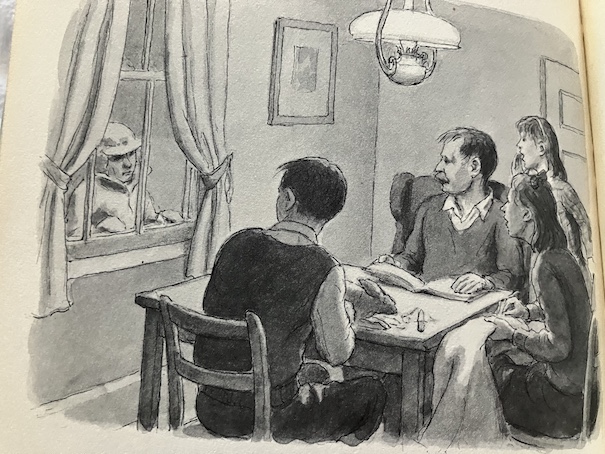
Then, one night, they see a man lurking outside the cottage in a blizzard. Minty warns her father not to let the man in, remembering Mrs. Gustafson’s warnings about criminals hiding out in the area and how they shouldn’t open the door for strangers. However, Mr. Sparkes worries about anyone who might be lost in the blizzard, and he has the children invite the man in. The man has a young girl with him, who is half-frozen and dressed as a boy, for some reason. When Minty realizes that the child is a girl and not a boy, the girl asks her not to tell anyone right away. Minty can tell that there’s something strange about this father and daughter pair, and it makes her uneasy. Then, Minty hears a report on the radio about a stolen car and a reward for information leading to the thieves. Is it possible that this man and his daughter are the ones who stole the car? Minty might consider turning them in for the reward money that her family badly needs, but with the blizzard, they’re now trapped in this cottage with this strange man and the girl. The girl, who goes by the name Topper, is fun and good at planning entertainment, but can she or her father really be trusted?

The book is available to borrow and read for free online through Internet Archive.
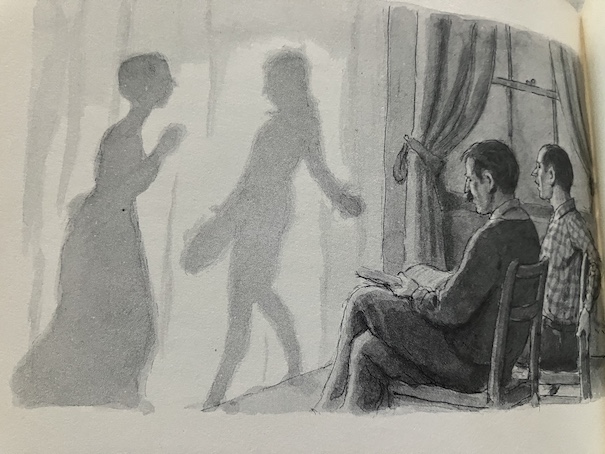
This book isn’t a Christmas story, although the title and some of the themes would have set it up well to be a Christmas story. It fits well with cottagecore themes, with the family, down on their luck, staying the winter in a cozy cottage and getting by as well as they can, enjoying simple pleasures. There’s a line in the story that I particularly liked, toward the end of the book, when the children put on a shadow play for their fathers:

“What a lot of fun you could have, Minty discovered, if you made unimportant things seem important and went about them with enthusiasm!”

I think that sentiment embodies the spirit of cottagecore. To really enjoy some of the simple pleasures of life, you do have to put yourself into the mindset that you’re going to enjoy them to the fullest! I read a book about Victorian parlor games that said something similar. A lot of old-fashioned entertainment and games are quite silly when you analyze them, but if you just throw yourself into them whole-heartedly, they can be great fun!
The family in the story is down on their luck and has their troubles, but their stay in the winter cottage is still an adventure, and they enjoy it. Their consciences do trouble them throughout the story because they’re aware that they’ve been using the cottage without permission of the owners. Minty in particular considers the morality of their actions and has a desire to make things right with the owners of the cottage. Fortunately, the story ends happily for the family, with their lives changed for the better. The people who own the cottage find out about them staying there, but they forgive them, and Minty finds a way to repay them for letting them stay.

The part of the story that I think is most likely to cause controversy for modern readers is the part where the children visit the reservation and the mission school. “Indian schools” have a sinister reputation in modern times because of their harsh treatment of their students and deliberate attempts to eliminate Native American culture. In the book, the nuns at the school make it clear that they don’t approve of traditional Native American practices, like the dance the children watch, because they don’t consider them to be Christian. They call such practices “heathen.” Their focus on discouraging their students from participating in traditional cultural practices is based on religious differences and a desire to convert people strictly to Christianity. However, I appreciated that Minty and the other children see both sides of the story and that Minty observes that some of the Native American dancers are wearing crosses, showing that the actual beliefs among the Native Americans are more nuanced than the nuns’ attitudes suggest.

This part of the story has some use of the word “squaw“, which is problematic because it has vulgar and derogatory connotations. The exact definition of the word varies in different Native American languages, but because it is considered vulgar and derogatory, modern people avoid it. At the time this story was first published, in the mid-20th century, many white people had the idea that “squaw” was sort of a generic word for women among Native Americans and didn’t realize the more vulgar side of the word, which is why it appears in some old children’s books, like this one. The word isn’t meant to be intentionally insulting here, although modern readers should understand that this word isn’t polite or appropriate. Apart from that, I appreciated how the main characters, especially Minty, see some of the prejudiced ways people, especially the nuns at the school, look at the Native Americans and their traditions and their realization that there are sides to their culture and practices that the adults have overlooked.

The Log Cabin Quilt

Elvirey’s granny loves quilting, and she always saves scraps of cloth from old clothes in a flour sack for her quilts. After Elvirey’s mother dies, her father moves the family to Michigan, traveling by covered wagon. When Elvirey tries to pack some of her mother’s things to bring with them, her father insists that they leave them behind, saying that they don’t have room for them. However, Granny insists on bringing her sack of quilting scraps, saying that she will sit on them in the wagon.

When the family finally reaches their destination, it’s just a clearing in a wooded area. They camp near a spring, and Elvirey’s father and brother begin building a cabin for the family. Elvirey and her sister add the chinking to the log walls of the cabin, packing the gaps with a mixture of mud and grass to keep out the wind.

However, the cabin still doesn’t feel like home to Elvirey. They don’t have her mother’s books, and there aren’t any flowers growing nearby to decorate the house like her mother would.

Then, one cold day, Elvirey’s father goes out hunting. He says that he will back before dark, but he doesn’t return. The night is very cold, and Elvirey and her family suddenly realize that it’s more than unusually cold in the cabin. The chinking they put in the walls of the cabin has frozen and fallen out, and the cold is getting in. Worse still, it’s starting to snow.

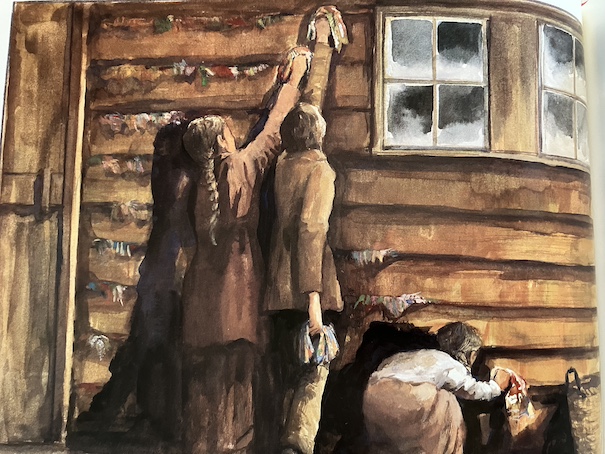
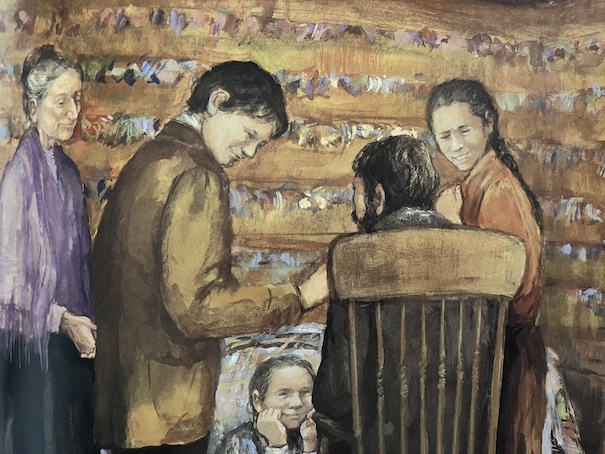
They’re worried about what happened to their father, and they’re worried about what they will do with the cold getting into the cabin. Then, suddenly, Elvirey has an inspiration. There is something they can use to fill the cracks in the cabin walls: Granny’s quilting scraps. With scraps from everyone’s clothes suddenly decorating the walls of the cabin, the cabin begins to look like it has turned into a quilt itself. When Elvirey’s father returns, he tells her that her mother would be proud of her, and for the first time, the cabin starts to feel like home to Elvirey.

The book is available to borrow and read for free online through Internet Archive.

There’s a pun in this story that people who don’t know the names of quilting patterns might miss. There are many patterns that the squares of a quilt can have, and Log Cabin is a traditional quilting pattern. When Elvirey and her siblings stuff the quilting scraps into the walls of their cabin, their Granny laughs about them creating a “log cabin quilt”, and it’s not just that she’s amused that they’ve made their cabin walls look like a quilt with all the scraps; it’s a pun on the name of the quilting pattern.

Although the story is about a family of pioneers, the focus of the story isn’t really their journey by covered wagon or the building of their cabin. It’s about loss and change and about what makes a new place feel like home. At first, Elvirey doesn’t feel like their cabin is their home because they no longer have the familiar things that belonged to her mother, and she can’t do some of the things that her mother used to do, like decorating the home with flowers. Even the quilt scraps and their associated memories don’t quite make her feel like home, although they do add a needed touch of color and hominess to the cabin. What finally makes Elvirey feel like home is when her father mentions her mother. Since her mother died, her father hasn’t smiled and hasn’t talked about her mother at all. When he sees what they did with the quilt scraps, he does both, and that makes Elvirey finally feel like they’re home. She really needed that sense of her mother’s presence or her memory to really get a feeling of home.

Elvirey is an unusual name, but I think it’s a nickname or variation of Elvira. Elvira is an unusual name in modern times, and in the United States in modern times, it usually reminds people of Elvira, Mistress of the Dark, a character portrayed by Cassandra Peterson and known for hosting horror movies since the 1980s. That reference has no relation to the story. Elvira/Elvirey is just an interesting and unusual name.

Noel

Noel by Tony Johnston, art by Cheng-Khee Chee, 2005.

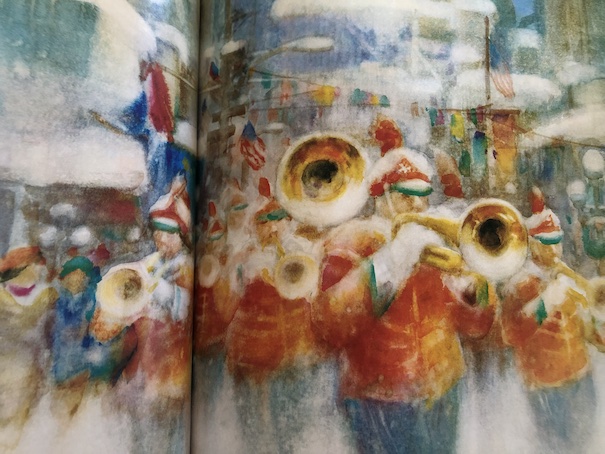
This lovely Christmas picture book reads like a Christmas carol!

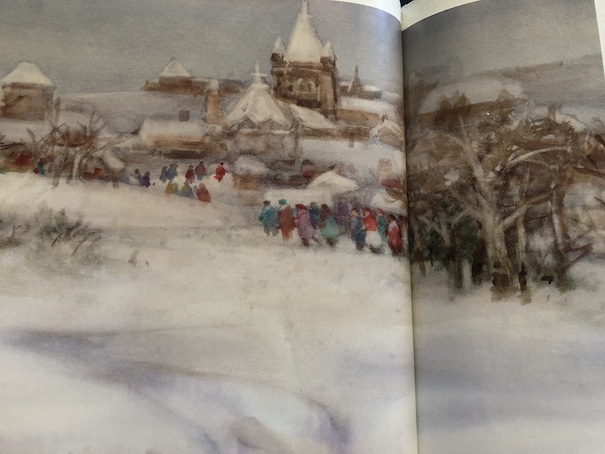
There is no story in the book. The text is poetry that celebrates the atmosphere of Christmas, the feelings in nature as anticipation builds and in cities as people gather to celebrate.

“Noel” is described as the sound of Christmas, like a bell, that people and animals all listen to hear.

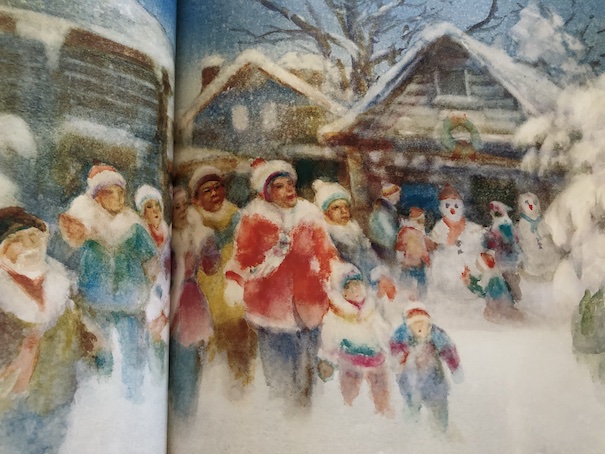
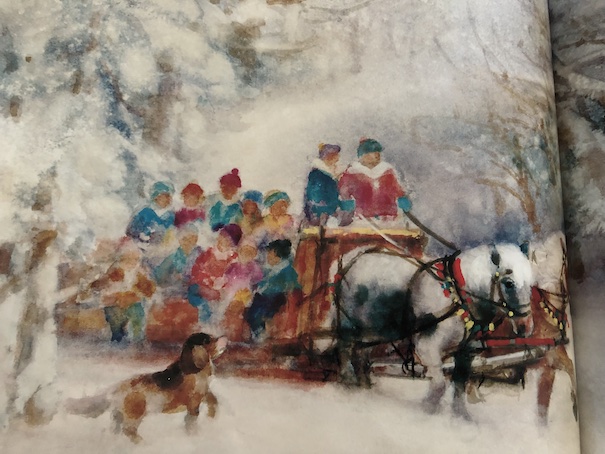
The artwork is beautiful, and there are scenes of people participating in classic Christmas celebrations, with a Christmas parade, snowmen, a public Christmas tree, and a sleigh ride.

The pictures really make the book beautiful and dreamlike. In the back of the book, there is a section that explains the art style. The artist used watercolors and a technique called “saturated wet-paper technique.” This technique is what gives the illustrations their fuzzy, dreamlike quality

The book is available to borrow and read for free online through Internet Archive.

Changes for Kirsten

Kirsten, An American Girl

It’s winter, and Kirsten’s brother, Lars, is going to set animal traps in the woods with his friend, John Stewart, who lives nearby. Kirsten is friends with John’s sister, Mary. Trapping animals for their pelts is one of the ways that the boys make some extra money. The local men are all away, working at a logging camp for the winter. Kirsten isn’t really interested in trapping animals so much as she just wants to get out of her family’s little cabin because she’s been cooped up due to the winter weather, so she persuades the boys to let her come along on their trapping expedition.

As they go through the woods, Kirsten spots an animal snare that someone else set out, and John explains that there’s an old trapper called Old Jack who lives by himself in the woods. He has no family and often prefers to be by himself and avoids meeting many people, although he sometimes helps locals with their own traps. The snare is probably one of his traps. When they find a trap that has a baby raccoon caught by the tail, the boys say that it’s too small for them to kill it for its pelt, and Kirsten feels sorry for it. She persuades them to let her take it home and nurse it back to health, like she did with an injured bird, before releasing it into the wild again.

Kirsten is supposed to leave the little raccoon in the barn because, as her family tries to explain to her, wild animals are wild and uncontrollable. However, Kirsten feels sorry for the little thing because the barn is cold, so she brings it into the cabin. It turns out to be a terrible idea. The raccoon gets loose and knocks over an oil lamp that sets the cabin on fire! Kirsten makes her her little brother and sister get out safely, and when she realizes that the fire is spreading too fast for her to stop it, she manages to save the painted trunk with some of her family’s most important belongings. Unfortunately, the cabin is completely destroyed.

Kirsten’s aunt takes in Kirsten, her mother, and her siblings. It’s a little crowded in her house, but at least, they have a place to go. Everyone is understandably upset, although they are not too hard on Kirsten for causing the disaster. However, her mother says that they had been hoping that maybe they could buy a little land with the money Kirsten’s father is making at the logging camp, but she doesn’t see how they can now. They’re going to have to build a new cabin and replace some of essentials that they lost in the fire.

Then, John and Mary Stewart tell the Larsons that their family will be moving to Oregon because their father has found a new job managing a logging camp there. Kirsten is sorry to see the Stewarts leave because they’ve been good friends, but Aunt Inger points out that the Larsons’ problems will be solved if they can manage to buy the Stewarts’ house. The Stewarts’ house is much bigger than the little cabin where the Larsons lived, and the Stewarts will have to sell their home before they can move anyway. The problem is that the Larsons just don’t have the money to afford the Stewarts’ house.

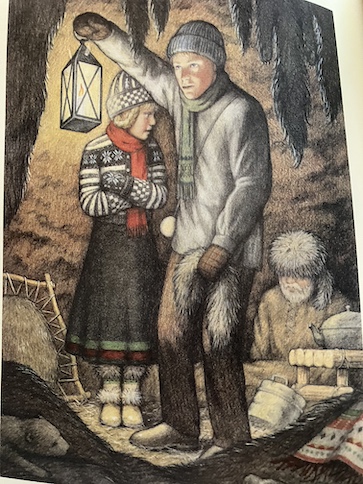
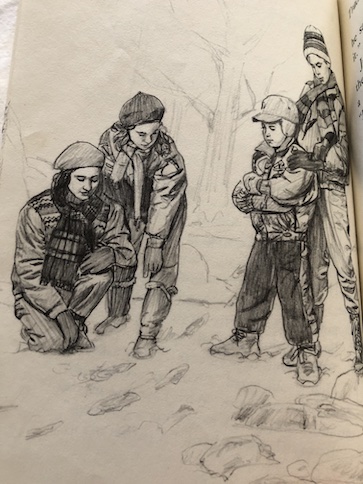
All Lars can think to do is try to make more money through trapping. Kirsten goes along to help him, and one evening, they stay out much later than they mean to and get lost in the dark woods. When the spot some human tracks in the snow, they think that they are probably the tracks of Old Jack, the trapper hermit. Kirsten thinks that Old Jack sounds frightening, but with no one else to turn to for help and shelter, they decide to follow the tracks to where Old Jack lives. When they find Old Jack’s home in a cave that he has turned into a rough house, they make an important discovery that changes everything for the Larsons.

The book ends with a section of historical information that explains how new settlers moving westward turned frontier areas like the area where Kirsten’s family lived into more settled towns. The farms where people lived became less isolated, and railroads connected cities and rural areas across the country. The first transcontinental railroad in the United States was completed by the time Kirsten would have turned 24 years old, changing the ways that people and goods traveled.
The book is available to borrow and read for free online through Internet Archive (multiple copies).
This was one of the books that I remember I didn’t like in the Kirsten series when I was a kid because it’s just so painful when the family’s cabin burns. Reading the book again, I appreciated how the family wasn’t overly hard on Kirsten about bringing the raccoon into the cabin that caused the fire. I couldn’t really blame the others if they were upset with Kirsten because it’s a major disaster that destroys their home and leaves them in a very precarious position. However, even though they’re understandably upset at the situation, it is nice that they don’t lay a guilt trip on Kirsten about it because that would have made it a much sadder story.

It also helps that the situation works out for the best in the end. When they hear that the Stewarts are moving, they do want the Stewarts’ house, but they just don’t think they will be able to afford it. What changes for the Larsons is that they receive an unusual sort of inheritance from Old Jack. When Kirsten and Lars are lost in the woods and seek shelter from Old Jack, they discover that Old Jack has died. There doesn’t appear to be any foul play. Old Jack was an elderly man, and he seems to have died from natural causes in his house. It’s a grim discovery, but while Kirsten and Lars shelter in his house with the body overnight, they also realize that Old Jack has a hoard of fine animal pelts. Since Old Jack has no family and no one to inherit his property, there is no dispute that the Larsons can claim his pelts because they found his body and plan to arrange for his burial. With the money that Old Jack’s pelts bring, they are able to afford the Stewarts’ house, which is much better than their old cabin. The Stewarts also leave them some furniture and household supplies.

I do like it that the story worked out for the best, although I wasn’t fond of the theme of trapping animals for pelts. I remember that this was an aspect of other books that I read as a kid, like Where the Red Fern Grows, but I never liked hearing or reading about it. I understand hunting for food, and I know the family in the story traps animals for fur because they badly need money, but it’s not a subject that I enjoy hearing about. The metal traps the boys use for trapping animals are considered inhumane in modern times, and their use is now banned or restricted in many countries and states.

The Mystery in the Snow

The Boxcar Children

Boxcar Children Mystery in the Snow cover

The Mystery in the Snow by Gertrude Chandler Warner, 1992.

Boxcar Children Mystery in the Snow  arrival

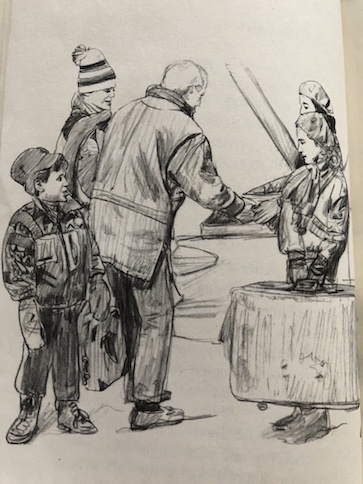
The Alden children are disappointed because there is still no snow this winter, and they’ve really been looking forward to snow. Their grandfather tells them not to worry because, soon, they’ll have all the snow they want. A friend of his, Mr. Mercer, owns a ski lodge and has been urging him to visit and bring his grandchildren. There’s going to be a winter carnival there. The children are eager to go and have fun in the snow!

Boxcar Children Mystery in the Snow choosing teams

At the ski lodge, the Alden children meet a boy named Jimmy. Jimmy is a regular visitor to the lodge, but for some reason, he says that his parents never stay. There is also a girl called Freddie, which is short for Fredrica. Her parents aren’t at the hotel, either, because they’re visiting her sister, but she says that they will come later. Freddie could have gone to visit her sister, too, but she didn’t want to miss the fun at the ski lodge. She and Jimmy are both team captains for the winter games, which include skiing, skating, sledding, snow sculpting, and ice carving. Strangely, when the team captains get the box where kids are supposed to submit their names to join the teams, they can’t find the keys. The loss of the keys is worrying because, if they can’t find them, they won’t be able to get into the equipment shop for the equipment they need for the games. They still manage to put together the teams, and the Alden children also join.

Boxcar Children Mystery in the Snow  skates

Then, Mr. Mercer discovers that all four of the tires on his truck are flat. Grandfather Alden offers to drive him into town to get a pump for the tires and to talk to a locksmith about getting into the equipment shop.

While the adults tend to that, the kids talk about the try-outs for different events. The Aldens are all excited about different events. Violet notices that one girl, Nan, isn’t enthusiastic about the events at all and doesn’t want to try out for anything. Violet asks her why, and Nan says that joining in the games was her parents’ idea, not hers. They say it will be fun, but she never really enjoys herself at these things. She doesn’t think there are any events she can do, and she’d hate to be the one to lose an event for her team. To encourage her and build up her confidence, Violet suggests that they both sign up for the ice carving event, which doesn’t require a try out. Violet says that she doesn’t know how to do ice carving, and Violet says that’s fine because she doesn’t, either. She says that it would just be fun to try it out together. Nan points out that they would be competing against each other because they’re on opposite teams, but Violet says that doesn’t matter because they’re both equals, neither one of them knowing what they’re doing. Nan is cheered by Violet’s friendliness and signs up for ice carving.

Boxcar Children Mystery in the Snow  Watch the dog

Nan isn’t the only unhappy child involved in the games, and the Aldens begin to feel that the focus on competition instead of simply having fun in the snow is partly to blame. A boy named Pete is upset that he didn’t get selected for any of the events he tried out for, and he says he doesn’t want to be the time team’s time keeper, which is the default position. Pete says he no longer wants to be involved in any of it. Freddie is angry because she and Jimmy drew names for their team members at random, and she thinks that Jimmy ended up with most of the really good team members. She wants a way to even things out. When the Aldens ask Jimmy if his parents will come to the awards dinner at the end of the games, he seems upset and doesn’t want to talk about it much. They’re not sure if Jimmy is more upset about his parents not being there than he pretends or if he’s worried about the awards ceremony in general.

Boxcar Children Mystery in the Snow  smashed sculpture and footprints

It soon becomes apparent that someone is intentionally trying to sabotage the winter games. Someone smashes the snow sculptures that the Aldens made for their team. Then, someone steals a skier’s skis and ruins the ice sculpture made by the other team. The entire skating event has to be postponed when someone ruins the ice.

Who is doing these things and why? It could be someone who’s trying to make their team win the competition, but the sabotage has been aimed at both teams and at the event in general. Is it a kid who is unhappy with the contest or their position on their team? Jimmy seems eager to cancel events every time something goes wrong. Can the Boxcar Children figure out who is responsible?

The book is available to borrow and read for free online through Internet Archive (multiple copies).

My Reaction

Boxcar Children Mystery in the Snow  skis

There are themes in the story about competition and family. The Aldens aren’t accustomed to thinking competitively about other people because they’re used to doing things with each other cooperatively, as a team. Because they’re accustomed to thinking cooperatively, they are friendly with people on the other teams, like Nan, and they’re more focused on the fun of the events than on winning. That makes them different from some of the other kids, who are concerned about winning, but there are other issues in the book besides competition that matter more.

Boxcar Children Mystery in the Snow  knocking on the door

There are indications in the story that the parents of the children in the competition don’t always want the same things that their children want. Nan, for instance, didn’t even want to join contest, but her parents urged her to do it. Also, some of the children aren’t as good at others at conveying to their parents what they really want. When the most troubled child in the group finally manages to say what they really want, many things get straightened out.

I feel like there are many stories where the conflicts revolve around people who don’t really communicate with each other. In this story, there’s a character who blames others for not understanding how they feel, but even they have to acknowledge that they haven’t actually explained their feelings. They’ve just been expecting everyone else to know what they’ve been feeling. Some honest communication straightens out the problem, and that’s a good life lesson for kids and families.

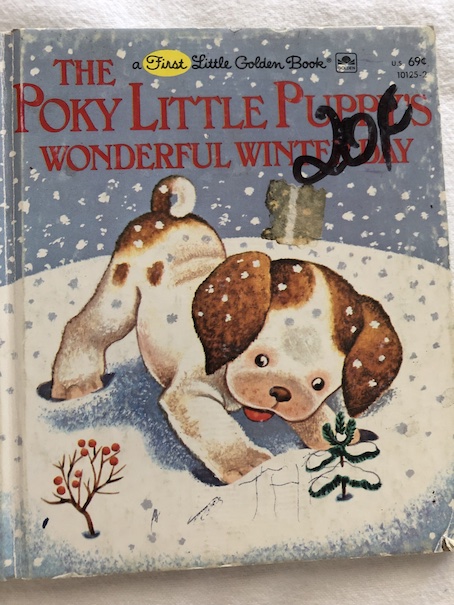
The Poky Little Puppy’s Wonderful Winter Day

The Poky Little Puppy’s Wonderful Winter Day by Jean Chandler, 1982.

This book is part of the Poky Little Puppy series of picture books from Little Golden Books.

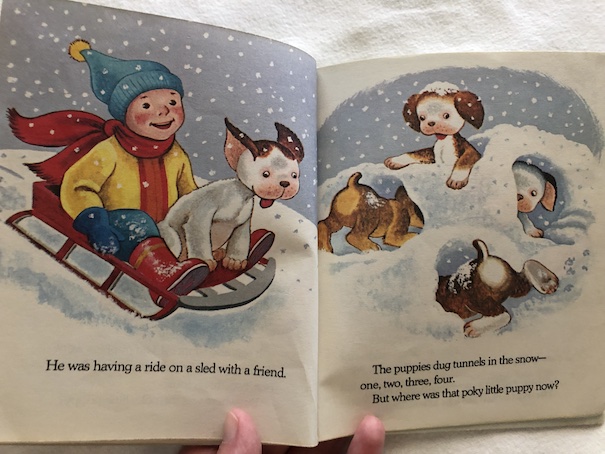
The Poky Little Puppy is the last to wake up on this snowy day, seeing his brothers and sisters rushing outside to play as he starts his breakfast. When he finishes his breakfast and goes outside, he doesn’t see the other puppies, but there are children playing in the snow.

The Poky Little Puppy follows the puppy paws through the snow and finds his siblings. The other puppies go sliding now a hill together, but the Poky Little Puppy gets a ride on a child’s sled.

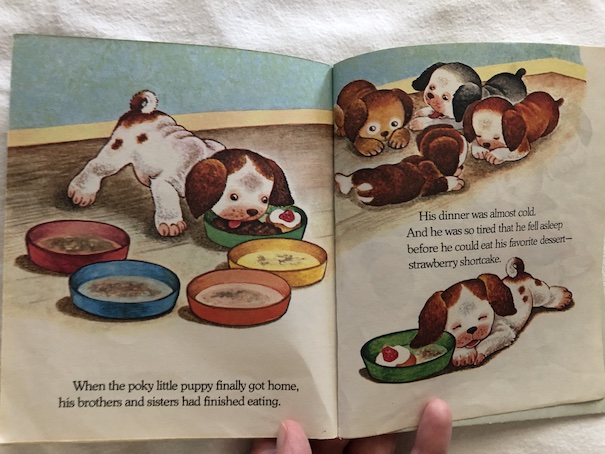
The Poky Little Puppy also tries to make a snow angel with a child and chases snowballs the children throw. He was the last puppy to start playing and the last to make it home to dinner because he is “poky” and arrives late to everything, but in the process, he had the most fun of everyone! (Although, he does fall asleep before eating his dessert.)

The book is available to borrow and read for free online through Internet Archive.

My Reaction

This is just a cute little story about the fun that a puppy has on a snowy day. I liked the message that the Poky Little Puppy has fun going through the day at his own pace and doing his own thing. Even though he isn’t always doing what his brothers and sisters are doing and sometimes trails behind them, he makes the most out of this fun, snowy day!

Ruth Fielding at Snow Camp

Ruth Fielding

Ruth Fielding at Snow Camp or Lost in the Backwoods by Alice B. Emerson (the Stratemeyer Syndicate), 1913.

It’s shortly after Christmas, and Ruth and her friends, the Cameron twins, Helen and Tom, are home from boarding school. They’re excited because the twins’ father has purchased a snow camp, a kind of winter retreat in the woods, with a nice cabin that has enough room for the twins, Ruth, and some of their school friends. In fact, Mr. Cameron is allowing the young people to take a party of their friends there soon, before school starts again.

However, before they leave on their trip, Ruth and the twins have an unexpected confrontation with a neighbor’s bull that causes a boy hiding in a hollow log to be knocked into a freezing creek. They manage to rescue the boy and take him back to the Red Mill to warm up.

The boy reluctantly explains that he is Fred Hatfield and that he has run away from home, which is in Scarboro, New York, close to the snow camp. His father is dead, and he says that he has plenty of other siblings to help his mother at home. He is evasive about why he felt the need to run away, just saying that he was tired of where he was, and he’s sure his family won’t miss him. None of the adults are impressed by that explanation, saying that they’re sure that a mother would miss any of her children, no matter how many others she might have.

Ruth spots a newspaper clipping that Fred dropped, and when she picks it up and reads it, she realizes that Fred’s situation is more serious than anyone else thinks. At first, she doesn’t tell anyone else about the clipping, not sure how much she should reveal about what she knows (even to the readers). However, knowing that Fred might try to run away, she hides his trousers so he can’t leave in the middle of the night.

The next day, they tell Fred that the young people are going to the snow camp near Scarboro, and that Mr. Cameron will take Fred there on the train when he escorts his children and their friends there. As Ruth anticipates, Fred doesn’t want to go back to Scarboro. He tries more than once to run away, and one of his attempts to run and Ruth’s attempt to stop him cause them both to be separated from the rest of the party, lost in the winter woods. Fred isn’t happy with Ruth for tagging along with him and interfering in his business, and Ruth says that she’s not going to let him abandon her in the woods.

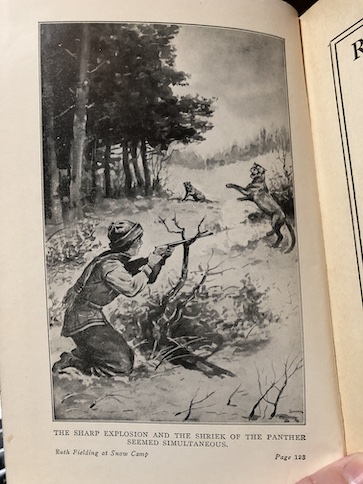
Together, they have a frightening encounter with a with a panther and get help from a hermit living in the woods. The hermit is a strange man who keeps rattlesnakes as pets, although the poison sacs have been removed. He teaches the Ruth and Fred to walk in snow shoes, and he helps them to reach the snow camp. They actually manage to get there before the rest of their party does, but Fred disappears just as they arrive.

When Ruth calls her friends in town to let them know that she’s all right and that she’s reached the snow camp, Mr. Cameron shocks her by telling her that the boy she’s known as Fred can’t possibly be the real Fred Hatfield. Mr. Cameron has learned from the local authorities that Fred Hatfield was killed in an apparent hunting accident months ago, although some people wonder if it was actually a murder. Fred’s half brother is being held by the authorities for Fred’s death. Did Fred just fake his death and run away? Or is the boy they know as Fred someone else entirely?

The book is now public domain and is available to borrow and read for free online through Internet Archive (multiple copies) and Project Gutenberg.

My Reaction and Spoilers

When we’re first told that Fred Hatfield was supposedly killed in a hunting accident, they mention that the boy’s body apparently rolled into a river after being shot, making it seem like Fred could still be alive, but then we’re told that the boy’s body was recovered from the river. That means that either Fred is actually dead and this new runaway Fred is an imposter or some other boy has been killed and Fred is just letting everyone think that the dead boy is him. Either way, there is a runaway boy whose identity needs to be established and a dead body whose identity also needs to be confirmed, and the circumstances of that death also need to be established. What really happened during that fateful hunting trip?

I liked the premise of this book because it’s much more of a mystery than the previous two books in the series. However, as an early Stratemeyer Syndicate book, there isn’t much deliberate investigation of the mystery. Most of the story is more adventure-oriented, and the characters learn the truth of the mystery almost by accident and through Fred’s eventual confession. In between, the characters have some outdoor winter fun. The girls make some homemade candy, which the boys spoil with a prank, causing some boy/girl rivalry. The girls get lost in a bad snow storm while trying to prove that they can be as daring and innovative as the boys when it comes to having fun and end up having to rescue Fred as well, which is when the solution to the story is revealed.

The solution is pretty much what people thought it was, which is a bit of a let down. At first, I thought that there might be more of a plot twist. Even the true identity of the dead body isn’t very exciting. Fred was labeled as a bad boy in the beginning, and that turns out to be true, but his half brother also admits that he was pretty hard on Fred at home because he’s smaller and not as physically strong as his older half brothers. They criticized Fred for not keeping up with the physical work they were doing and called him lazy, but realistically, Fred can’t do all the things they do, and his half brothers realize that they have to acknowledge and accept that. They say that they’re going to try to find him a different kind of work that he can do.

It’s not a bad ending, but I’d like to see a little more deliberate investigation from Ruth Fielding. I would have liked to see Ruth Fielding talk to other members of Fred’s family and maybe have one of them produce a picture of Fred to help establish his identity. Then, I’d like to have Ruth and her friends find Fred more deliberately than accidentally. The story isn’t bad the way it is, and there’s plenty of adventure, but as a mystery fan, I usually prefer more deliberate detective work.

The Hidden Message

Adventures in the Northwoods

The Hidden Message by Lois Walfrid Johnson, 1990.

The story, like the others in its series, is set on a farm in Wisconsin during the early 20th century.

One night, Kate McConnell wakes up to hear her mother and stepfather talking. The family needs money for the new planting season, so Papa Nordstrom has decided to take a job in a lumber camp over the winter. It will keep him away from home for a couple of months. He doesn’t really want to leave his family, but there’s a new baby on the way, and they really need the money. His absence on the farm means that the children will have to take on extra chores to help out. Kate also worries because conditions in lumber camps can be dangerous. Her birth father was killed in an accident in a similar camp, and she doesn’t want the same thing to happen to Papa Nordstrom.

Before Papa Nordstrom leaves for the lumber camp, he butchers a pig so his family will have meat while he’s gone. With winter setting in, it’s important to make sure that food supplies are secure. That’s why Kate knows it’s serious when her friend Josie tells her at school that someone stole her family’s steer, the one they were planning to butcher for meat this winter. Her family has no other source of meat, and they might go hungry if they can’t find the steer. Josie asks Kate for help because she and Anders solved a mystery involving a mysterious stranger who took things before.

One of the possible suspects is an older boy who has recently returned to school, who the others call Stretch. Kate has never met Stretch before because he’s been gone from school, doing farm work, since before she arrived in the community. Anders knows him, though, and he tells Kate that Stretch is trouble. Part of the reason they call him “Stretch” is that he has a habit of stretching the truth. Kate finds Stretch handsome at first, but Anders warns her not to get involved with him. Kate thinks Anders is exaggerating about Stretch because other people at school seem to like him. Anders says that if Kate wants to like someone, she should like Erik instead. Kate has a kind of rivalry going with Erik since he dipped her braid in his inkwell, and it permanently stained her dress. Anders says that Erik didn’t really mean to ruin her dress, but Kate is still unhappy about the incident. So, although Kate can tell that Erik is more responsible in other ways and is a bright and dedicated student, and they go to the same church, she has reservations about liking him.

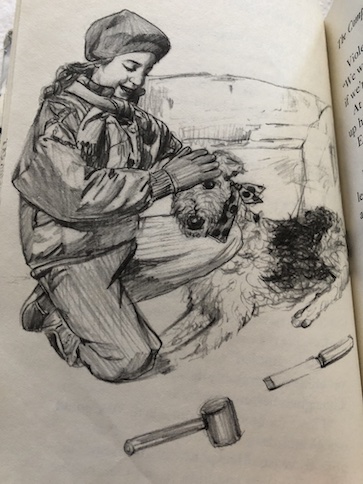
However, Kate soon comes to realize just how dangerous Stretch is. Their teacher warns them all away from the frozen lake because the springs in the lake make the ice unpredictable. While the others play on the playground, Stretch talks Kate into walking by the lake with him. He says that he knows it’s safe because he was out on the lake earlier that morning, although Kate has her doubts about it. Then, Kate spots Anders’s dog out on the ice. Worried about the dog, Kate tries to call to him, but the dog doesn’t come to her like he usually does. Kate steps onto the ice to get the dog, and the ice breaks. Kate nearly drowns in the icy water, but Erik saves her. Kate realizes that, when she was in danger because of Stretch, Stretch actually abandoned her to drown. Later, he won’t even admit that he was the reason why Kate went down to the lake in the first place. When Kate is warmer and able to think better, she also begins to realize that the reason why Anders’s dog wouldn’t come to her when she called was because she was with Stretch, and the dog is afraid of Stretch, indicating that Stretch has been cruel to the dog in the past.

Kate’s brush with death opens her eyes to what Stretch is really like. It also creates a problem because the teacher writes a letter to Kate’s mother about the incident, letting her know that Kate did something very dangerous. Kate doesn’t want her mother to know what happened because it would upset her, especially with Papa Nordstrom being away and the children supposed to be behaving responsibly to help her on the farm. Kate wants to hide the teacher’s letter and not tell her mother, although Anders and Lars try to persuade her to be honest about what’s happened. They argue about it, and Kate accuses them of wanting to tattle on her, threatening to tell on them if they do something wrong. She feels sorry for upsetting them, especially young Lars, but she’s afraid of how her mother might react when she finds out what happened. Anders warns her that her mother might still find out what happened from someone else and that by being dishonest and fighting with Lars, she’s starting something that she’s going to regret. But, Kate can’t even bring herself to confide in anyone that Stretch was the reason she went down to the lake. Even though he almost got her killed and didn’t even try to help her, she can’t bring herself to tattle on him. (That’s dumb, on several levels. I’ll explain why below.)

After the incident with Kate falling through the ice, Stretch avoids going to school for awhile. Then, one day, Kate sees him stealing candy at the general store. Even though Kate knows what she saw, she still can’t bring herself to tell on him, and she even begins making excuses for him in her mind to make him seem less bad. When he offers her a ride home, she’s a little hesitant, but she decides to accept to avoid the long walk home. On the way, she asks him why he didn’t help her when she fell through the ice, but he never answers her. She also notices that his hand is oddly blue, and when she asks about that, he says that he must have just worked that hand too hard when he was cutting wood. However, he doesn’t have wood in the back of his wagon. He’s hauling boxes of something. This time, she decides to tell Anders about Stretch stealing, but she doesn’t mention the boxes in the back of Stretch’s wagon because she still doesn’t know what to think about them.

The secret about the ice incident comes out when Kate’s step-siblings, feeling uncomfortable about her deception, play a prank on her to get her to tell on herself. Knowing how afraid of mice Kate is, they put a dead one in a box with the label, “Pretty on the outside, like this on the inside,” on top. When Kate opens it, she screams, and her mother comes running. Knowing why they played this prank on her, Kate explains the truth to her mother. Her mother gives her a punishment for lying to her before, and Kate sees how upset she is that Kate didn’t tell her the truth earlier.

However, Kate hasn’t quite learned her lesson about lying. She sneaks out when she’s supposed to be grounded in her room by climbing down the tree outside the window. While she’s outside without permission, she spots a loose cow belonging to Josie’s family and guides it back to them. It’s a good deed, but she was still out without permission, and Tina spots her. Kate is angry and accuses Tina of “spying” on her and tries to persuade her not to tell. Kate can tell that Tina is upset and worries about lying to her mother and making her mad. Kate feels badly, but she can’t seem to stop herself from doing these things. She still continues to sneak out during her period of being grounded. When little Tina tries to imitate her by climbing down the tree herself and gets stuck, Kate has to rescue her. Her mother spots them once they’re down on the ground, and Kate confesses everything.

Kate feels like an awful person because Tina could have been badly hurt or even killed by following her example. Her mother says that everyone is awful in the sense that humans are all imperfect, and that’s why they commit sins. That is why God sent His son to redeem human sins. It’s good to be sorry when you’ve done something wrong and ask for forgiveness because forgiveness will be granted, and if you accept Jesus as your Savior, he will take away your sins. (I’ve heard this before, the part about everyone being “awful”, or words to that effect. This is kind of a Protestant way to phrase this. When I’ve heard it before, it usually seems to be from Protestants with a more Evangelical outlook, although that might vary. I don’t disagree with the principles, but Catholics would say it differently, and I may include a little more about it in my reaction.)

Meanwhile, there are still more thefts occurring in the community. Someone robs Erik’s family of all of the vegetables and fruit they’ve canned for the winter. Having food stores stolen at the onset of winter puts the family in a precarious position, and everyone else in the community worries about their foods stores, too.

One day, when Erik is at Windy Hill, Anders starts teasing Kate about her organ playing. He takes it too far, and both Kate and Erik tell him to stop. To Kate’s surprise, Erik hits Anders when he refuses to stop when asked, and the boys start to fight. Kate’s mother comes in, stops the fight, and makes the boys clean the room as punishment, which leads to several revelations. Kate comes to realize that Anders is a major reason why Erik has been teasing her. Anders has been urging Erik to tease her and also using Erik as an excuse for his own teasing. Now, Erik is getting as tired of it as she is. Erik confides in Kate that he knows that Stretch was the reason she went down to the lake when she fell in, and the only reason he hasn’t told anyone else is that he can’t prove that Stretch was there or that he abandoned Kate when she got into trouble.

As the kids move Kate’s organ back into position from the cleaning, Anders almost drops his end, and he accidentally opens a secret hiding place in the organ, knocking a hidden book onto the floor. The book contains church hymns in Swedish, but there’s also a torn part of a note in English. Unfortunately, they don’t have enough of the note to really understand what it means. (This is the “hidden message” of the title, and it doesn’t enter the story until about the final third of the book. I suspected it was a Biblical quotation, but I couldn’t place it from the fragment.) The note fragment contains the word “fear”, which makes the children worry that someone might be in trouble and asking for help. Erik asks them when and where they got the organ, but Kate explains that they bought it a few months ago at a fair in Grantsburg, and she doesn’t even know the name of the man who sold it. Papa Nordstrom might know, but since he’s away, they can’t ask him.

Stretch still seems like the likely suspect for the food thefts. Kate has seen him do some suspicious things, and he’s been telling some obvious lies, but she and Anders have difficulty finding any positive proof to get the authorities to intervene. Then, the thief takes the pig that Papa Nordstrom left for his family and the lid from their stove, rendering the stove useless until it’s replaced. With the stakes that much higher, Kate knows that they have to catch the thief, fast!

Kate also manages to figure out who originally owned the organ and who left the book and the message in the secret hiding place. The original owner is someone Kate already knows who used to play the organ. As I guessed, the message is actually part of a Biblical quotation (Psalm 118, Verse 6). The message is part of the theme of the story, but it doesn’t have anything to do with the theft directly. However, some strange things that the former owner of the organ has observed help to provide Kate and Anders with the proof they need to get back everything that was stolen. The story ends at Christmas.

The book is available to borrow and read for free online through Internet Archive.

Themes and My Reaction

In some ways, I was disappointed in this book. The identity of the thief isn’t really a surprise. Most of the mystery concerns how to prove it. Also, even though the title of the book refers to the hidden message, the mystery doesn’t center around the hidden message, and the hidden message doesn’t contribute directly to the solving of the mystery. Its main contribution to the story is to provide a theme: “The Lord is on my side; I will not fear. What can man do to me?” This quotation does give Kate the courage she needs to confront the thief.

Honesty in Relationships

I don’t blame Kate for having reservations about liking Erik at first. I know that things end up improving between them as the series goes along and even during this book, but he really did do something dumb and started off on the wrong foot with her. He’s not the first to do it, and frankly, it’s become a rather sad cliche. (It’s not unlike Gilbert in Anne of Green Gables and the way he started off wrong with Anne by making those “carrots” comments about her hair.) I’ve heard people say that boys will do mean things like that because they like girls and just don’t know how to say it, but you can’t just let people keep causing problems without some feedback about it because it doesn’t lead to good relationships. You don’t want to give someone the impression that you’re okay with teasing or rough play when you’re not because, if they don’t know it bothers you, they’ll never stop doing it, and it will drive you crazy. We all teach people how to treat us through the feedback we give. If Erik really cares about Kate, he’ll learn to give her the kind of attention she wants instead of the kind she doesn’t.

I started feeling better about Erik when he started standing up to Anders because Anders was going to far and wouldn’t stop even after both Erik and Kate telling him to stop. I appreciated that, while Erik may have initially felt compelled to join Anders in teasing Kate, Erik seems to have developed a sense of when to stop teasing and is willing to draw a hard line when necessary, even standing up to a friend and telling him “no.” Toward the end of the story, Anders finally has an honest talk with Kate, asking her why she didn’t tell him that Stretch was with her at the lake and abandoned her when she got in trouble. The answer is that Anders teases Kate all the time about everything. His constant teasing prevents her from confiding in him about things that they really should discuss. His teasing shuts down conversations before they even start. Anders finally tells Kate that he is her brother and wants to help her when she needs it, and he says that he wouldn’t tease her about anything really important. That attitude sounds promising. Unfortunately, he still insists that he’ll be the judge of what’s important, so I think that relationship still needs some work.

I’ll never understand people who say that teasing helps build relationships. Never. I’ve never seen it work that way in real life, not for building relationships of any depth, at least not unless the relationship has already been established on another basis first. It usually goes the other way, preventing relationships from developing or getting deeper than being shallow because relentless teasing does tend to shut down conversations and prevent people from opening up to each other. Why should someone tell you anything at all if they know that’s the reaction they’re going to get from you and that you don’t care that they don’t like it? The only times when teasing seems tolerable in real life is when the people involved already have built solid relationships with each other based on other qualities, really know each other well, and trust each other. Relationships are frequently based on trust, and you simply can’t trust someone who’s not really listening to what you say so much as trying to figure out how to use any and every little thing you say as a punchline for a dumb and hurtful joke for their own amusement or so they can score a few points off someone else and feel clever about it. I see it more as using other people than building a relationship with them. I just don’t feel endeared to anyone who only seems to be using me to score points to impress some third party onlookers. You can’t build a relationship based on teasing by itself. At least, I know I can’t. It just doesn’t work. What I’m trying to say is that Anders has not built a relationship with Kate and is both oblivious or resistant to feedback. He does not know when to take a hint and shut up even when people tell him plainly and not even when someone physically tackles him to the ground over it. So far, Kate has been doing all the heavy lifting in her relationship with Anders, trying to win him over, and he’s not really giving her much in return, although he’s slowly starting to show some signs of being helpful.

The characters in the story also alternately worry about being thought of as tattle-tales or criticize others for “tattling.” I’ve always thought all that “tattling” stigma was dumb. I know sometimes “tattling” means complaining about really petty things to one-up someone else, which is truly annoying (as I think all forms of one-upmanship are). However, people also use that word to try to shame people for talking about problems that really do need to be discussed. The way I look at it, if you’re going to be either mean or an idiot in a way that hurts other people, you forfeit your rights to complain about those other people talking about your meanness or idiocy. It’s not like the person talking about you made you do what you did, they didn’t ask to hurt by you, and if you did what you did in public, where other people could see it, it already counts as public knowledge anyway.

In 1906, when the story takes place, the Kate’s biggest worry is that her mother will hear about things she’s done from a neighbor at church because that’s their biggest opportunity for seeing and talking to other people. Every kid at school knows that she almost drowned, and since that was the big event of the day, they all no doubt told all of their parents about it. It’s common knowledge, not tattling. In the early 21st century, news of Kate’s brush with death at the lake would be all over social media before the end of the day because an entire classroom of people is aware of what happened and will be excited to talk about it. Even in cases where something happened that wasn’t serious enough for the school to immediately call the parent and tell them directly, any usual incident at school will get around fast. Usually what irritates people about “tattling” is that it can be pointless, petty nitpicking. However, the lake incident in this book was a matter of life and death, so I think complaining about anybody “tattling” is pretty dang petty itself. I think there needs to be a distinction between petty complaining and serious discussion. I think the anti-tattling attitudes people have teach bad morals, including dishonesty, self-delusion, and excuse-making, all issues that Kate has to confront in herself during the course of the story.

By choosing not to “tattle” on Stretch, which actually wouldn’t be “tattling” so much as just giving an honest answer to questions people were directly and specifically asking Kate about how she happened to be out on the frozen lake, Kate has also left Stretch open to doing similar things in the future to other innocent victims. She isn’t helping herself or the next person who could use some honest warnings. She didn’t initially trust Anders’s warnings about Stretch because he wouldn’t answer her questions about Stretch in specific terms (perhaps for fear of being thought a tattler), but Kate is now in a position to describe Stretch’s behavior in very specific terms herself, from first-hand knowledge. Anders was trying to be honest with Kate in his warnings, but he wasn’t fully honest and is already known for being an annoying teaser, which is why he didn’t seem believable. For all Kate knew, it just might have been another of his dumb jokes to embarrass her. (Another problem with too much teasing – no one knows when you’re actually trying to be honest and sincere about something, and few people are prepared to believe it because those are not a teaser’s default modes. If the teaser has already built a relationship based on qualities other than teasing alone, I suppose those close to him might be able to tell the difference, but no one else will, and Anders hasn’t built that kind of relationship with Kate yet.) If Anders had simply said why he didn’t trust Stretch, maybe Kate would have believed him and been more careful in the first place. Kate had to learn the hard way that Anders was telling her the truth about Stretch, and now, she’s going to have to learn the hard way that she also needs to drop her “tattling” hang-ups and be fully honest with herself and other people. Again, we teach others how to treat us, and Stretch could use some fully honest lessons from various people in his life. Don’t worry; he does get some help at the end of the book.

I was interested in what Anders said at the part of the story where he and Kate are talking about whether it’s better for her to like Stretch or Erik. Anders says that Papa Nordstrom has said that liking people is a choice, and people can make good choices or bad choices about who to like, which leads me to a few comments I have about the religious themes in the stories.

Sin and Forgiveness

I’ve explained before that I came from a family of mixed religions, although I was raised Catholic, and my religious education has also been somewhat mixed from childhood, although mainly Catholic. The only reason why I mention it is because, although Catholics and Protestants have similar ideas about the flawed nature of humanity, the causes of sin, and the role of Jesus in redeeming humanity, they have different ways of phrasing these concepts, which can sometimes give people wrong impressions and make it seem like their views are more different from each other than they actually are. When I see it, the differences are partly on where each puts the emphasis and the words they use.

A friend of mine (Mormon) was taking a college religious studies course and she was irritated by the way the teacher talked about original sin and about human beings as being “awful.” I can’t remember the exact phrasing she said that the teacher used, but it was something similar to what the mother says in this book about everyone being “awful.” My friend told me about it because she knows I’m Catholic and don’t mind discussing these things, and she thought her teacher was Catholic. I said that didn’t sound like a Catholic speaking. I looked it up, and it turns out that the teacher was specifically speaking from an Evangelical viewpoint, which is what I expected would be the case because, as I said, I’ve heard this before. I get the concept, but I don’t like that phrasing. It seems like it implies that all humans are inherently “bad” (which is what got on my friends’ nerves), but that’s not really the concept, not in real life or in this book.

The article that I linked in the first paragraph of this section explains it very well, but as a quick overview, the real issue is not that humans are inherently “bad” or “awful.” Not completely. (That’s what some people call the doctrine of “total depravity“, although even some of its adherents say that’s still a misunderstanding of the concept of “total depravity.”) It’s just that human beings are not perfectly good. Humans are inherently imperfect, which is different from just being flat-out “awful.” We’re not completely good or completely bad, just imperfectly between the two. Since we have elements of each in us, neither side can be ignored to get the full picture, and we can make choices about which of our sides we favor and try to maximize. Because we are imperfect as humans, we all sometimes have impulses, desires, and lapses in judgement that lead us to sin. That’s a part of who we are, but at the same time, we also have other desires for relationships with God and our fellow human beings that lead us to self-improvement and a desire to do good for others.

As Papa Nordstrom observed, we all have the ability to make choices. (This is part of the concept of “free will.” Catholics believe strongly in the concept of free will and reject any concept that original sin renders people unable to use their free will to make good decisions and consciously reject flawed impulses. I think that helps make “original sin” seem less of a tragedy because, while there’s always a struggle, knowing that there are still things you can do about it helps. Nobody’s doomed just for being human.) People can make good choices or bad choices. They can choose to give in to their worst impulses or practice mindfulness and self-discipline to resist them and strive for improvement. Understand that there are times when anyone could potentially do the wrong thing or have the impulse to do it. It happens to everyone from time to time, in varying degrees, throughout their lives. But, having the impulse to do something doesn’t mean you have to give in to it every time. Because human beings are imperfect, we often need some help and support to make the right choices when we’re struggling, and that’s the help that Christians look for when they turn to Jesus, accepting Him as their Savior, the example of what to do when they’re not sure how to control their feelings and impulses. People just need to make the choice to seek out that help when they’re struggling with bad habits or a crisis of conscience because there is help available, both spiritual help and help from other human beings. People can choose to say they’re sorry for bad decisions they’ve made and ask for forgiveness and guidance for making better choices, both from God and their fellow humans. (Kate should have been honest with her mother because she’s there to help and guide her and needs to know when something serious happens.) I prefer that description to saying that “we are all awful.” We’re not “awful.” We’re imperfect, and even if we’ll never be perfect in our human state, we can improve. That doesn’t sound as bad, does it?

The part where Kate rescues Tina from the dangerous situation she was in because of Kate’s bad example sort of reminds me of the end of Disney’s Freaky Friday from 1976, when the mother and daughter are talking about what they’ve done and what they’ve learned from being each other for a day:

“I am so much smarter than I thought. And so much dumber.”
“Oh, my darling, aren’t we all?

Other Interesting Topics

I thought the part of the story where Kate was talking to her organ teacher, Mr. Peters, about the difference between playing by ear and learning the notes was interesting. Mr. Peters points out that Kate is in the habit of playing songs by ear but she hasn’t really learned to read music. He tells her that she’ll learn more if she gets in the habit of reading the music for herself instead of depending on someone else playing a song for her to learn it. She later uses her new knowledge of reading music to learn to play one of the songs in the Swedish book of hymns. Musical notes are the same even if the songs are written in other languages.

Clifford's Christmas

Clifford

Clifford’s Christmas by Norman Bridwell, 1984.

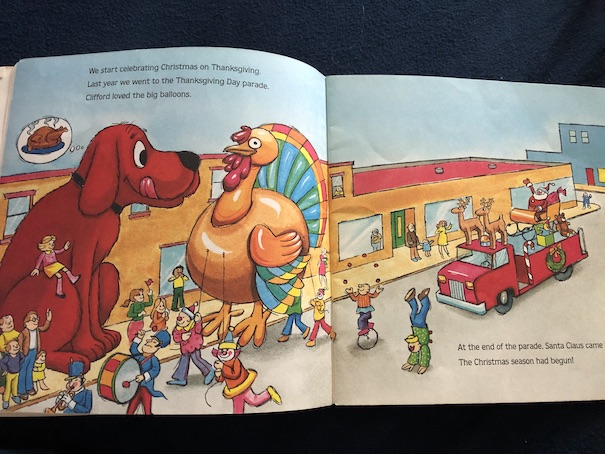
Christmas is coming, and Emily Elizabeth and Clifford are ready to celebrate! Emily Elizabeth talks about how the Christmas season begins with Thanksgiving. (That’s not how everyone regards it, but it is a common way to mark the season in the United States. The day after Thanksgiving, Black Friday, is considered the start of the Christmas shopping season, with people looking for bargains on Christmas presents.)

When it starts to snow, Emily Elizabeth, Clifford, and their friends have fun playing in the snow. They get a Christmas tree, prepare their stockings, and participate in other holiday activities leading up to Christmas. Clifford even gets a kiss under mistletoe!

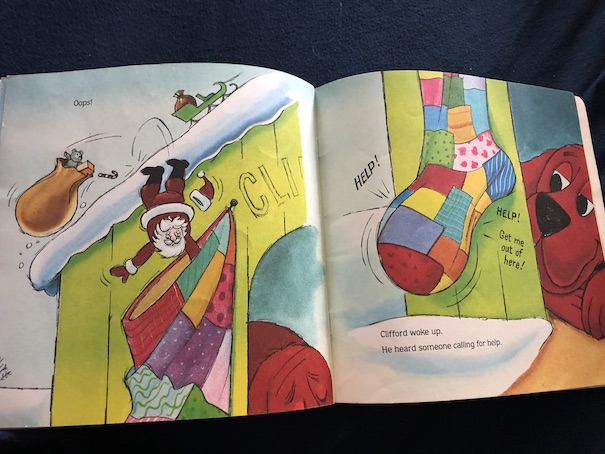
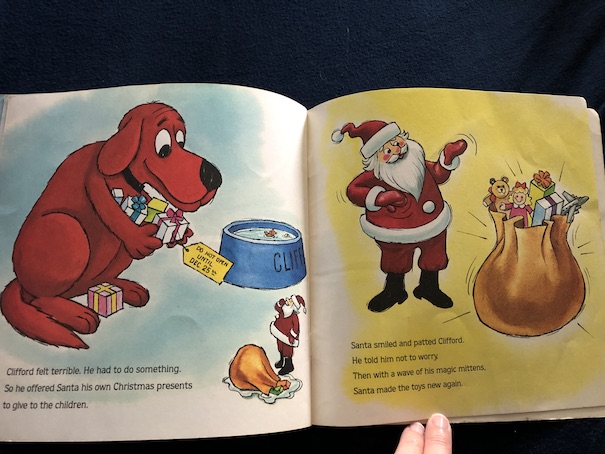
When Santa comes, he lands on the roof of Clifford’s dog house and accidentally falls into Clifford’s stocking, dropping his sack of toys. Clifford has to rescue him.

The toys fall into Clifford’s water bowl, but Santa fixes them with his magic. No harm done, and it’s a Merry Christmas after all!

This is just a cute Christmas story with a popular children’s books character. I loved the Clifford books when I was a kid, but I have to admit that they don’t look as good to be now as an adult. The entire plot of Clifford books revolves around Clifford’s enormous size, which is the very idea of the series. However, the plot of this is light, the problem is both caused and immediately solved by Clifford’s large size, and I think I’m just not interested in the usual trope of Famous Character Saves Christmas In Some Way anymore. I think that some Christmas stories with popular characters are still good, but for them to work, they usually have to have deeper, more clever, more interesting plots. This book isn’t bad, but I just didn’t think it was particularly great.

The book is available to borrow for free online through Internet Archive.

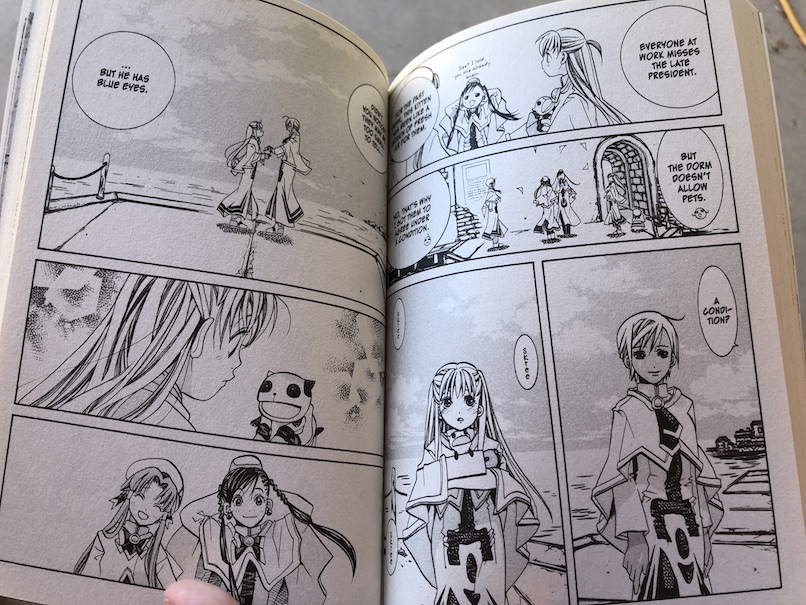
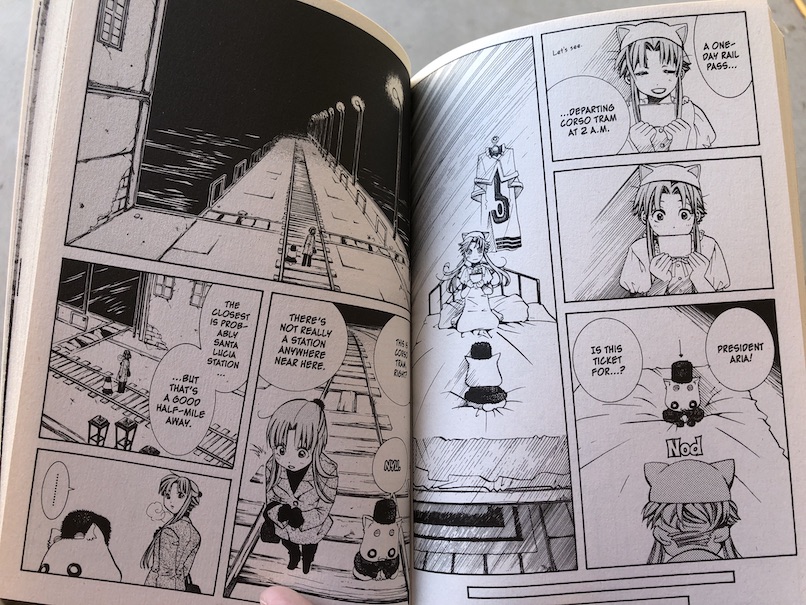
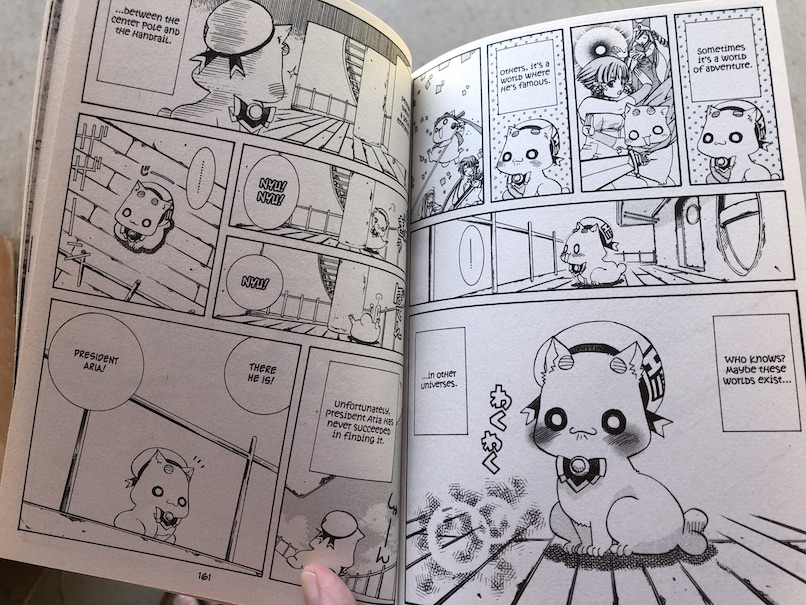
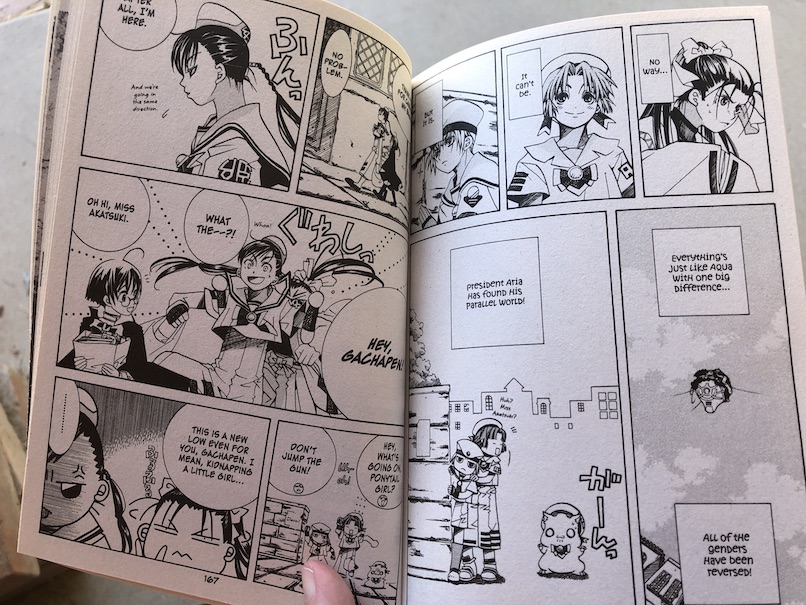
Aria Volume 6

Aria Volume 6 by Kozue Amano, 2005, English Translation 2011.

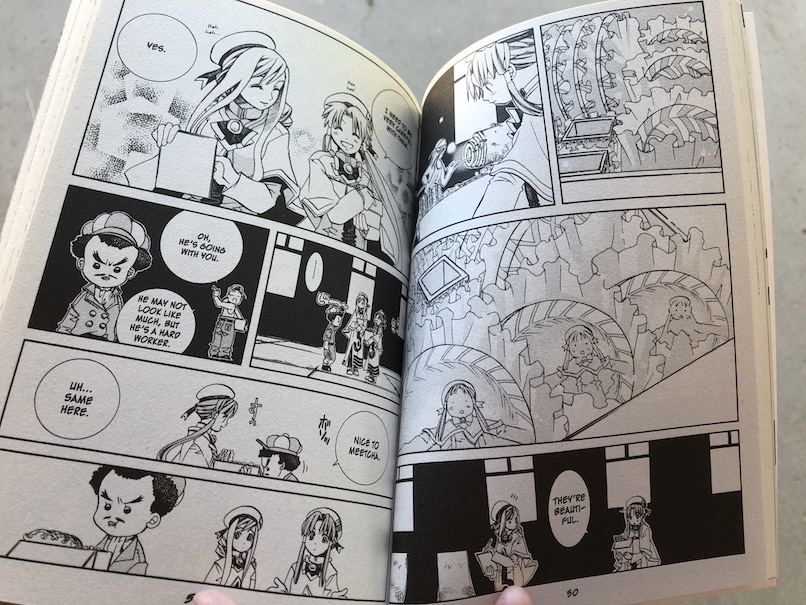
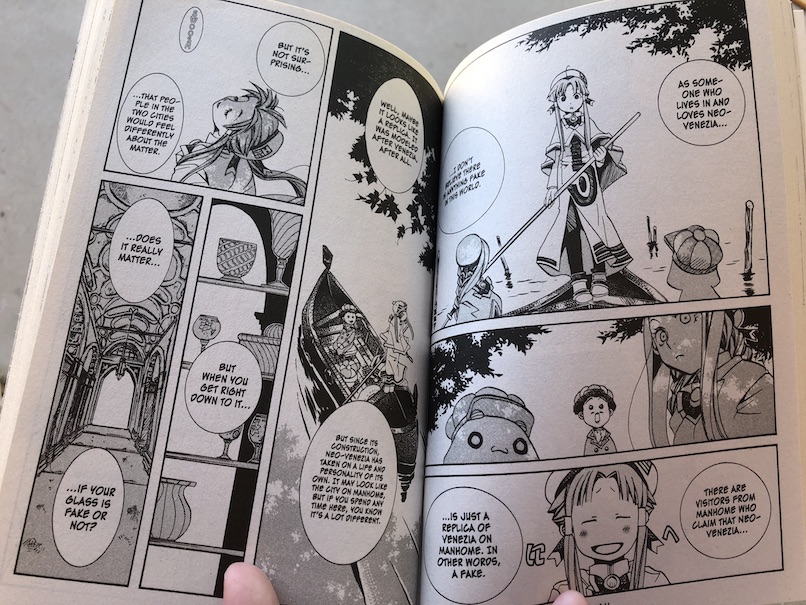
This is the sixth volume of the second part of a fascinating manga series that combines sci-fi, fantasy, and slice of life. The series takes place about 300 years in the future, when Mars has been terraformed and renamed Aqua (because of all the water on its surface). The human colonies on Aqua are designed to resemble old-fashioned cities on Earth (called Manhome here). The people of Aqua prefer a much slower pace of life than people on Manhome, and aspects of life on Aqua more closely resemble Earth’s past.

The series is divided into two parts. The first two books are the Aqua volumes and introduce Akari Mizunashi, the main character, a young girl who came to Aqua to learn to become a gondolier in the city of Neo Venezia (which resembles Venice). Female gondoliers, called Undines, give tours of the city, giving Akari plenty of time to admire the beauty of her new home and meet interesting people. The two Aqua books are the prequel to the main series, Aria. Aqua covers Akari’s arrival on the planet, her introduction to life on Aqua, and the beginning of her training. The main Aria series show Akari’s continuing training, her progression to becoming a full Undine, her evolving relationships with her friends, and as always, her delight in learning more about her new home and admiring its beauty.

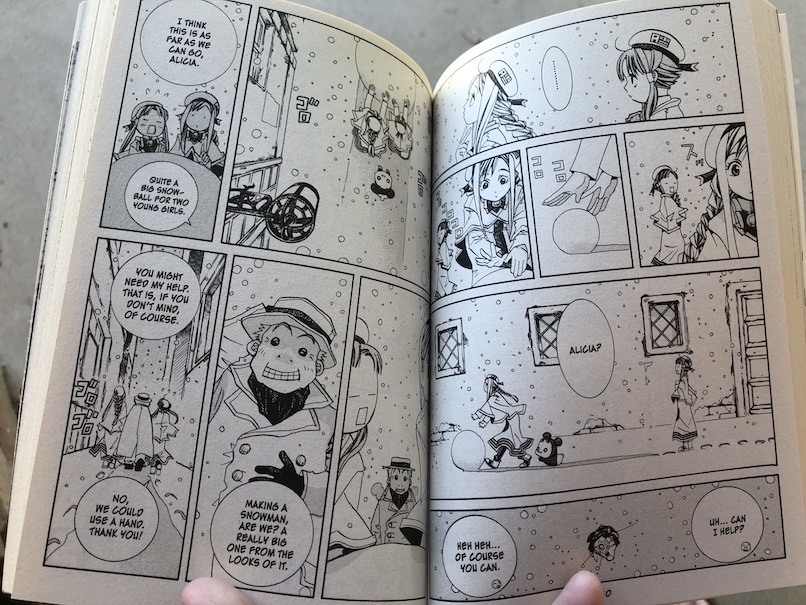
The series has received some criticism for being slow and lacking danger and adventure, but that is not really the point of the series. The main purpose is to show people how to appreciate the small pleasures of life. The sci-fi and fantasy elements (the spaceships, advanced environmental controls, intelligent Martian cats, and even the occasional appearances of the legendary Cait Sith) are mainly background to the stories about the magic of friendship and simple pleasures. Each volume contains a few short stories about Akari and her friends and the little adventures they have on a daily basis and the life lessons they learn. It’s a great series for relaxing when you’re stressed out.

Unfortunately, although this book is only about halfway through the series, this is the last book of the series that I actually own because the others haven’t been printed in English yet, although I think that additional volumes will be published in English.

The stories included in this volume are:

Orange Days

Athena comes to visit Alicia at Aria Company, and the trainees’ mentors reminisce about how they first met when they were trainees.

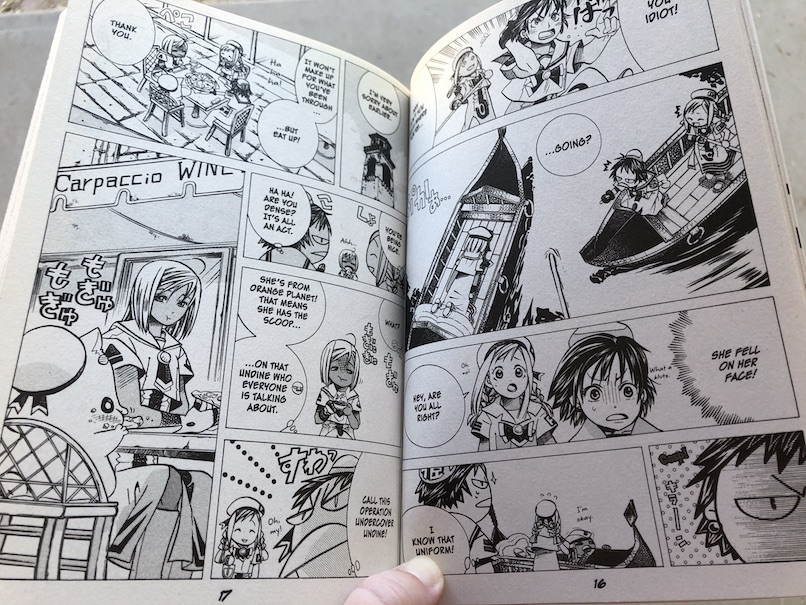
Akira was just as prickly and competitive when she was young as she is as an adult. Although trainee Akira said that she was just observing the “losers” at Aria Company, she kept coming around and became friends with Alicia. When she heard about a new trainee at Orange Company with an amazing singing voice, Akira wanted to seek her out, worried about the competition.

While she was telling Alicia about it, the two of them accidentally had a collision with young Athena’s gondola, which is the first time either of them had seen her. Athena was knocked over by the collision, so the other two girls treated her to lunch, partly to make it up to her and partly because Akira wanted to pump her for information about the new trainee at Orange Company, not knowing that Athena herself was the new trainee.

However, Athena didn’t answer their questions about the new trainee. Even back then, she was a person of few words, and she just made a drinking straw crawly snake to amuse President Aria. Still, Athena became friends with Alicia and Akira, joining them in their practice sessions, like Akari, Aika, and Alice share their practices together. Alicia and Akira only discovered that Athena was the trainee with the amazing voice when they decided to practice singing canzones one day.

The mentors end their reminiscences by saying that it seems hard to believe that, now that their training is over, they are so busy that they hardly have time to see each other. When they were trainees, it felt like they would always practice together every day, but now, their lives are different. These comments make the present trainees uncomfortable because they realize that the same thing is likely to happen to them when their training is complete. Alice, Aika, and Akari have come to value each other’s friendship and companionship, and they find it difficult to imagine being without each other.

However, Alicia and Athena tell the girls to not worry too much about it. Time is always moving forward, and it’s true that things will change for them, but that’s not entirely a bad thing. Even though they sometimes miss their training days when they spent so much of their time together, they are also happy with their current lives. They enjoy their careers, and they like helping to train new Undines. In fact, helping to train the next generation of Undines helps them to connect to their own pasts because the young Undines remind them of their own training days. Alicia’s advice is to enjoy where you are and what’s currently happening around you as much as you can. Life will eventually move on, and things will change, so you might as well make the most of where you are now and enjoy it to the fullest, so you will be ready to move on to the next stage of your life and enjoy that as well. Athena says, “Fun times really aren’t meant to be compared. Just enjoyed.”

The young trainees are still affected by the story of their mentors’ friendships and the changes in their lives. Aika points out to Akari that their lives aren’t changing just yet, but the girls have come to a greater realization that their lives will eventually change.

It’s just like how, when people are young and in school, surrounded by the same other students every day, it can be hard to imagine that there will come a day after you graduate when you won’t all be working at the same place and you won’t all be eating lunch together every day. As you get busy building careers and families, it will be harder to see each other and keep in touch. However, that’s not entirely a bad thing. As some people like to say, “You can’t begin the next chapter of your life if you keep rereading the last one.” There are many things in life to enjoy and accomplishments to be made, and like Alicia and Athena explain, you might as well enjoy where you are right now and make the most of it so you won’t look back with regret when it’s time to move on.

Venetian Glass

Akatsuki’s elder brother comes to Aria Company to hire Akari to transport some delicate Venetian glass. Akari is excited because this is the first time that anyone has specifically hired her, although, because she isn’t a full Undine yet, Alicia will have to accompany her on her errand.

When they go to pick up the glass, Akari sees glass-blowing and Venetian glass for the first time.

One of the workers from the glass factory seems kind of surly, but he accompanies them while they transport the glass and explains the history of Venetian glass and what makes it so special.

The reason why the glass worker is so surly is that he feels like a lot of people don’t appreciate his craft. He and his master put their heart and soul into their work, but people say that their “Venentian glass” is fake because it’s made in Neo-Venezia, not in the real Venice, which sank beneath the ocean years ago. The worker laments that the craftsmen who left the sinking city were scattered across Earth before making their way to Neo-Venezia and that details of their craft have been lost over time. Neo-Venezian glass will never be quite the same as the original Venetian glass, and people will never look at it the same way, which the worker finds depressing.

However, one of Akari’s great strengths is finding the beauty in everything and bringing it out for other people to see. She tells the worker that the glass is kind of like Neo-Venezia itself. It’s true, it’s not the original Venice, only re-created in its image. Some aspects of it are the same, but it’s also a different place, on another planet. To some people, that might make it seem like a fake city, just an imitation of the original, but Akari doesn’t think that the real vs. fake concept matters because she loves the city for the beautiful treasure it is. Similarly, Akari thinks that Neo-Venezian glass is a treasure by itself and likes it for what it is, regardless of what the original was or what others say about it.

The worker finds Akari’s viewpoint inspirational and is enchanted by Akari herself, remarking that she’s also a unique treasure. Akatsuki’s brother jokes that Akatsuki might have a rival now for his affection for Akari. Akari knows that Akatsuki has had an unrequited crush on Alicia, so she doesn’t think too much about it. Although it’s true that Akatsuki has a crush on Alicia, Akatsuki’s brother is also correct that Akari inspires greater feelings in others than she realizes and Akatsuki values Akari more than he lets on, maybe more than even he realizes himself. Akari is unique because of her unusual way of looking at things, and her optimistic point of view influences others.

Snow White

One day, while they’re practicing together, Akari asks Aika what kind of adult she wanted to be when she was a kid. Aika, who has admired and even hero-worshipped Alicia ever since Alicia was kind to her when she was a young child, says that she’s always wanted to be an elegant woman like Alicia. Akari says that she wants to be like Alicia, too, but Aika criticizes her for wanting to copy her ambition and says that it’s not likely that Akari would ever be as elegant as Alicia because she still does kid-like things, like collecting stuffed animals.

Their discussion causes Akari to wonder what sort of adult Alicia wanted to be when she was a little kid, and she asks Alicia about it while they’re out walking one day. Instead of answering her directly at first, Alicia demonstrates by starting to build a snowman and pointing out how the people around them react to it.

Each time Alicia and Akari start to make a large snowball for the base of the snowman, different adults stop and help them to make it a bit bigger.

Alicia says that she noticed people like this when she was a child. There are always adults who, when seeing a young girl making a snowman, feel compelled to help her because she can make a much bigger snowball with their help. That’s the type of adult Alicia always wanted to be.

Alicia genuinely enjoys not only her career as an Undine but her role as a teacher and mentor in Akari’s life and in the lives of her friends, helping them to develop in their trade and to become better Undines because of her influence.

Stray Cat

Alice finds a tiny stray Martian cat one day while waiting for Akari and Aika to meet her for practice. The cat’s mother doesn’t seem to be around, and Alice doesn’t know whether the little cat is lost, orphaned, or abandoned. When Aika arrives for practice, she finds both Alice and Akari lying on the ground next to the cat because it looks so happy lying in the sun that Alice thinks they should also try it.

Although Aika warns Alice that she won’t be able to keep the cat because she lives in a dorm at Orange Company and isn’t allowed to keep pets, Alice becomes attached to the cat, names it Maa, and hides it in her room.

At first, she is afraid that her mentor, Athena, will be angry with her, and Aika scares her by saying that Athena will probably kill the cat because she doesn’t like cats. However, Alice loves Maa because she misses the previous president cat of Orange Company, who recently passed away, and Maa reminds her a little of him.

When the secret gets out, and Alice is confronted by Athena about the cat, Alice is scared because Athena is holding a knife for slicing fruit and runs away to leave the tiny Maa where she found him, thinking that it might be the only way to save his life. However, she finds herself unable to abandon Maa and returns to get him, only to find him missing from the box where she left him. In a panic, she spends all night searching the city with her friends to try to find Maa.

However, when they finally give up the search, they discover that Athena has Maa. When she had tried to talk to Alice before, she wasn’t angry. She followed Alice to the place where she left Maa and retrieved him and has been waiting for Alice to return to Orange Company. In Alice’s absence, Athena has persuaded Orange Company to keep Maa as their new company president. Like the other cats used as the presidents/mascots of gondola companies, Maa also has blue eyes.

A Night on the Galactic Railroad

When Akari hears the sound of a train at night, she imagines that it’s a magical train like one she read about in a book, A Night on the Galactic Railroad by Kenji Miyazawa.

Aika has a more practical explanation for what it is, that the sounds of freight trains are more noticeable at night, when everything is quiet, but Akari discovers the truth when President Aria gives her a special train ticket.

It turns out that the mysterious train is a train of cats. (Guess who the conductor is?) Akari could use the ticket from President Aria to ride the train, but instead, she gives it to a sad little kitten who lost his ticket.

Because Akari doesn’t board the train, she never finds out where the train was going. The next morning, it all seems like a strange dream, except both Akari and President Aria have the stamps on their foreheads that Cait Sith gave them.

A Parallel World

President Aria accidentally finds a parallel world in which all the people he knows who are girls are boys and vice versa. Frightening!

President Aria has always wanted to find a gateway to another world, but everything seems so strange that all he wants to do is get back to his world.

He ends up returning to the world he knows when someone tosses him too high in the air while playing with him. Did any of it really happen, or was he just dazed from when he fell?

This one isn’t one of my favorite stories in this series because I think that the premise is kind of goofy. The characters don’t really look all that different when their genders are switched. Most of the difference is in hair styles, and the uniforms of the Undines have pants when they’re normally just long dresses.