Christmas Farm

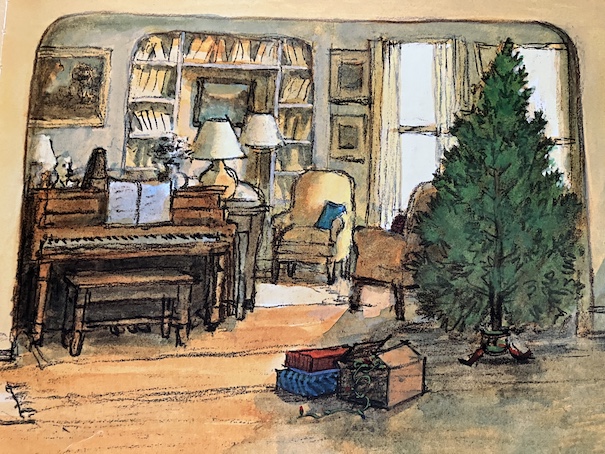
Wilma has grown flowers for years, but now, she’s decided that she wants a change. She thinks about what she would like to do with her garden next spring while she’s getting ready for Christmas. Going out to cut a Christmas tree makes her think that maybe she would like to grow Christmas trees instead of flowers.

She starts by ordering 62 dozen small balsam trees (744 trees, for those who are counting), and she gets the boy from next door, Parker, to help her prepare the site for them. They use string to lay out rows for planting the trees.

Wilma knows that it will take longer than a year for the trees to grow big enough to be Christmas trees. As the trees grow, Wilma has to mow around them and take care of them, with young Parker helping her more as he also grows bigger. Wilma loses some trees to pests and weather conditions every year, but by the time the trees are big enough to sell, she has 597 left.

In the months leading up to Christmas that year, people reserve trees, and they also get a buyer who owns a Christmas tree lot in the city. Most of the trees are sold, but there are still some left. They know that the trees that were cut down will sprout again, but they’re also going to order some new ones.

In the back of the book, there is a section that explains more about growing Christmas trees with a chart showing how long it takes the trees to grow.

I thought this book was a sweet and fun look at Christmas tree farms. It takes years to grow trees big enough for Christmas trees, so there is a considerable time investment, and farmers know that they will lose some of their trees to pests or bad weather condition during that time. It’s a project that requires long-term planning and investment.
I always feel a little sorry for the trees when they’re cut down, but I liked how this book explains that, because the stumps of the cut trees are still there with their roots, even cut trees will regrow. The end of this book touches on the cycle of replanting and regrowth, with Wilma and Parker planning for their next phase of planting and cultivating new trees.
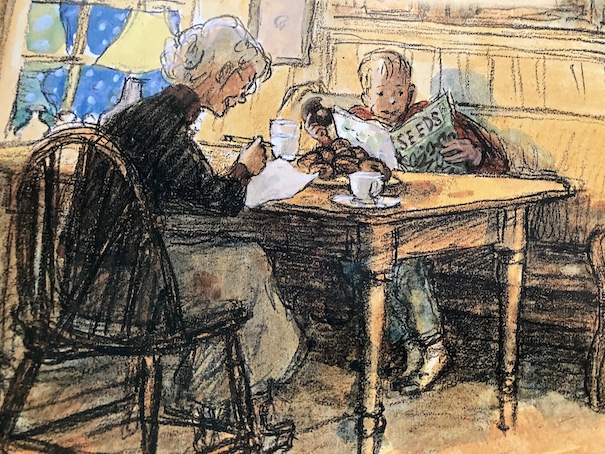
I also thought the addition of Parker to the story helps to show the passing of time and the growth of the trees because the boy grows a few years older during the time when they’re letting the trees grow bigger. By the time they’ve sold their first crop of Christmas trees, Parker is getting old enough to take more of an active role in planning the next crop.

Whose Garden Is It?

This is a cute picture book, told in rhyme, about who is the real owner of a garden.

One day, Mrs. McGee goes for a walk and passes a beautiful garden. She wonders aloud whose garden it is. Of course, the owner of the garden, who is tending the plants speaks up, but he’s not the only one.

A small rabbit also tells Mrs. McGee that the garden belongs to him because he’s lived there his whole life, and he eats the vegetables. Then, a woodchuck says that’s nothing because he eats everything that grows in the garden. A bird chimes in, saying he eats the worms from the garden. Then, a worm says that worms are there to make the soil in the garden better, so he’s the real owner of the garden.

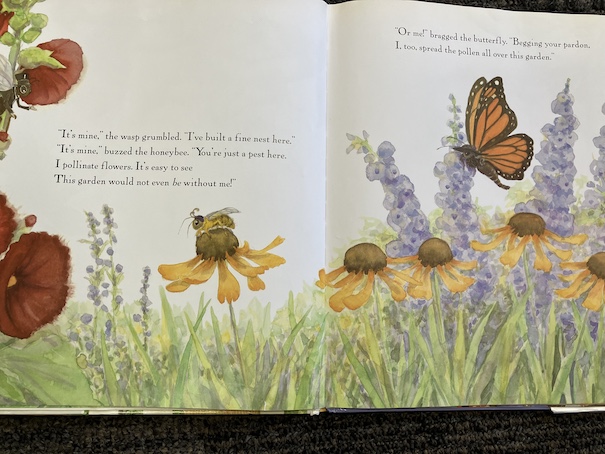
Various other creatures, big and small speak up, each of them pointing out that they live in the garden, what they’ve done for the garden, and what the garden has done for them. The bees and butterflies pollinate the flowers.

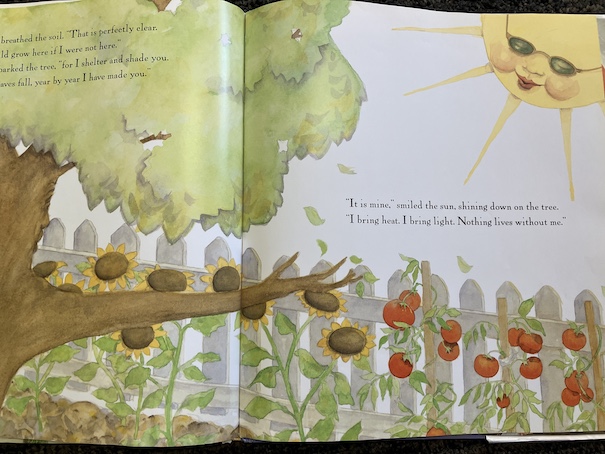
But what about the plants in the garden? They have a strong argument that they are what makes the garden a garden. Then again, the soil is where the plants grow, and the plants need the sun and rain to grow. Also, all plants grow from seeds, so the garden exists for the seeds that will be the future plants.

It seems that the answer to Mrs. McGee’s question isn’t as easy as she might have thought.

This is a charming story about how various plants, animals, creatures, and forces of nature are interconnected. The book doesn’t use the word “ecosystem“, but that’s the concept being described here. The garden’s ownership and the reason for its existence is much more than the gardener who owns the land and planted and tended the garden; it’s everything that’s growing in it, everything that contributes to its growth, and everything that depends on the garden. Without all of these creatures and natural forces put together, the garden wouldn’t be what it is.

The book doesn’t attempt to get scientific about the details of this garden ecosystem, and the animals wear clothes and talk, so the story isn’t meant to be entirely realistic. However, it is thought-provoking about how many different parts of nature affect each other. It could be a good book for introducing the topic to young children before teaching them about the science of ecosystems later. The rhyme scheme makes the story fun to read.

Miss Pickerell Goes to Mars

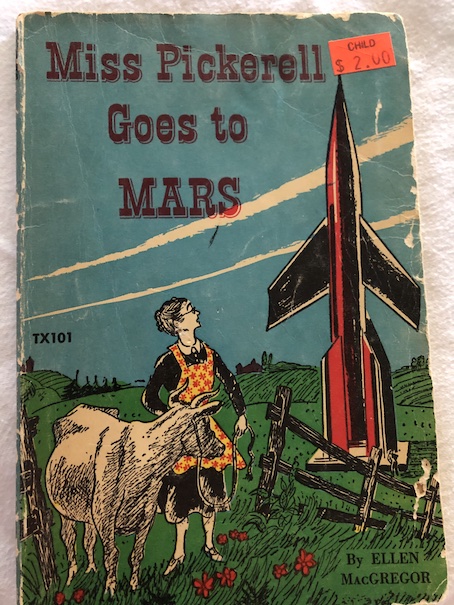
Miss Pickerell Goes to Mars by Ellen MacGregor, 1951.

This is the first book in the Miss Pickerell series, which was written to introduce scientific concepts to children in an entertaining way.

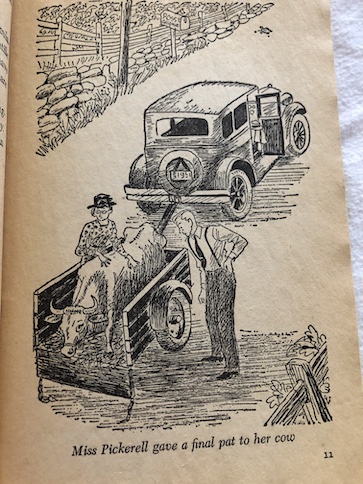
The story begins when Miss Pickerell is visiting her brother and her nieces and nephews. She takes the children to ride on a ferris wheel, but she refuses to get on it herself because she’s afraid of heights. Really, all she wants to do is take her pet cow home and start getting her rock collection ready for the exhibition at the state fair.

As she leaves, she offers a ride to a man when the bus he was waiting for didn’t stop for him. Although she isn’t anxious for conversation and would prefer silence after her visit with her noisy nieces and nephews, she does make a comment about the sound of a jet overhead. She explains that airplanes are her nieces’ and nephews’ newest obsession, and she’s glad because they were obsessed with flying saucers before, and at least airplanes actually exists. The man riding with her, Mr. Haggerty asks Miss Pickerell if she believes in flying saucers and space travel. Miss Pickerell says that she doesn’t believe in flying saucers and doesn’t think any intelligent person would, but Mr. Haggerty tells her that he will soon be traveling to Mars. At first, Miss Pickerell doesn’t believe him. He says that he works for a scientific expedition whose headquarters is nearby, but the captain in charge of the expedition wouldn’t want him to say too much about it too soon, just in case it doesn’t work out well.

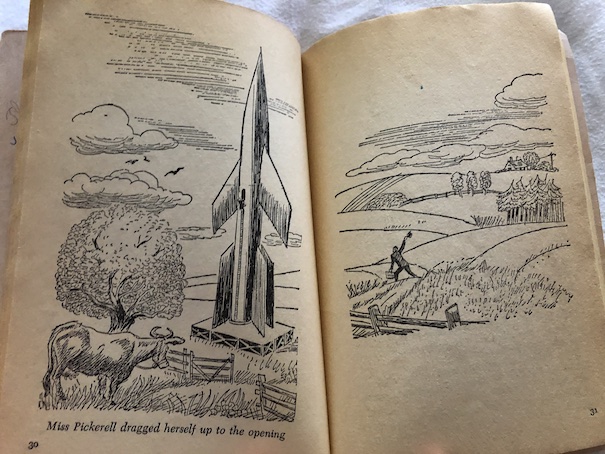
However, Miss Pickerell can’t help but get involved in the project, considering that they’re doing it on her land. Miss Pickerell lets Mr. Haggerty out of the car in front of her farm, but when she enters her own house, she can tell that someone else has been there in the weeks that she’s been gone. Then, she spots the space ship at the end of her cow pasture.

Miss Pickerell marches up to one of the people working on the expedition and demands to know what they’re doing on her property. The man says that they thought that the house was abandoned because it had been empty for weeks and they wanted a quiet place to work on their project. Miss Pickerell threatens to call the governor and report them. She picks the governor to call because, since she lives in the country, there are no police nearby, and she’s met the governor before at the state fair, where he’s given her prizes for her rock collection.

When she calls the governor, he isn’t there, so she leaves a message with his wife and decides to talk to the men at the space ship again while she waits for the governor to call her back. Although she’s afraid of heights, Miss Pickerell climbs into the space ship to talk to the men – right before it launches.

Soon, Miss Pickerell is in outer space and headed for trouble because it turns out that, not only was she not supposed to be there but they’ve accidentally left Mr. Haggerty behind. Mr. Haggerty is important because he’s the one who’s supposed to do the calculations for the flight.

The book is available to borrow and read for free online through Internet Archive.

My Reaction

I vaguely recalled my mother reading us one or two of the Miss Pickerell books from the library when we were kids. I think I liked them at the time, but it had been so long that I’d really forgotten what they were like.

I can definitely see the educational lessons in the book. After the ship launches, it takes awhile to impress on Miss Pickerell the seriousness of their situation and why they can’t just turn around and go back, during which they talk about Mars as a planet and how the ship’s course is programmed into the computer. A young man on the crew, Wilbur, shows Miss Pickerell how to drink water in outer space, and they talk about what gravity is and why there isn’t any in space. By accident, Miss Pickerell has caused further problems by bringing her hammer with her onto the ship because the hammer is magnetic, and the magnet is interfering with the ship’s equipment. Miss Pickerell’s first instinct is to throw the hammer out a door or window, but there are no windows, and Miss Pickerell is treated to an explanation about atmospheric pressure and oxygen in the space ship. Each event on the ship and on Mars itself requires explanation.

Fortunately, they do make it safely to Mars and back, and Miss Pickerell turns out to be surprisingly helpful and is actually glad that she made the trip. On their return, she finds out that Mr. Haggerty has been taking care of her cow, and the governor has invited her for a visit. The governor gives her an award, and she even brings back rocks from Mars with her and gives some to her nieces and nephews.

Mrs. Armitage, Queen of the Road

ArmitageRoad

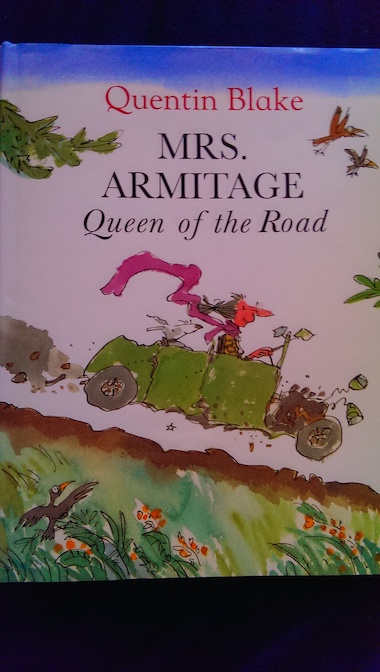
Mrs. Armitage, Queen of the Road by Quentin Blake, 2003.

When Mrs. Armitage‘s Uncle Cosmo decides to get a new motorcycle, he lets her have his old car.  However, it isn’t in very good condition.

ArmitageRoadCar

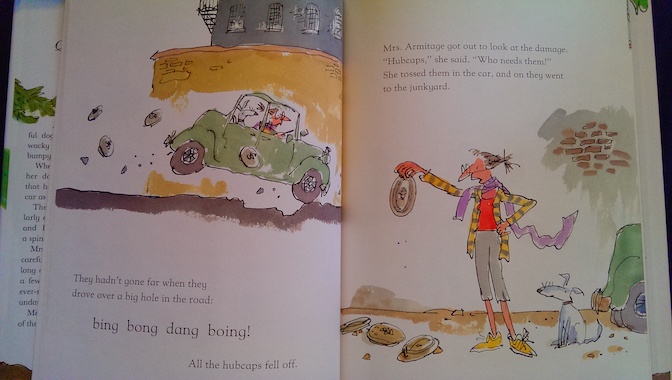
Mrs. Armitage and Breakspear decide to try it out, but as they drive along, pieces of the car fall off.  Some of it is because the car is in bad repair, and some is due to accidents Mrs. Armitage has.  First, the hubcabs, then the fenders fall off.  Mrs. Armitage shrugs it off , saying, “Who needs them?”

ArmitageRoadHubcaps

Eventually, the car goes almost entirely to pieces, but who needs it all?

ArmitageRoadWreck

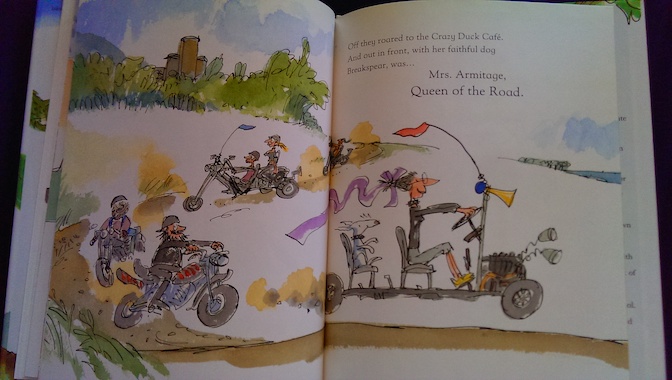
When Uncle Cosmo shows up with his friends and their motorcycles, they help her fix up what’s left of the car into one amazing machine!

The book is available to borrow and read for free online through Internet Archive (multiple copies, including one in Spanish).

ArmitageRoadMachine

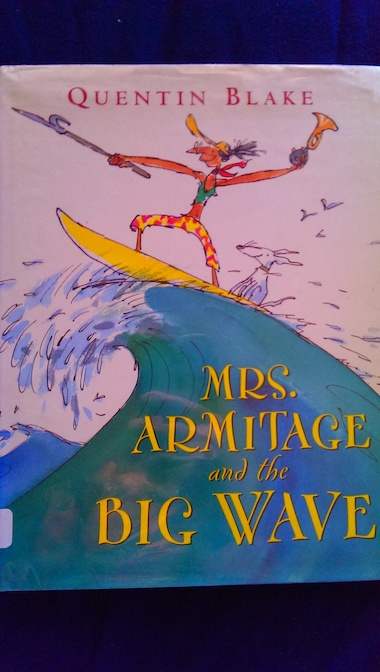
Mrs. Armitage and the Big Wave

ArmitageWave

Mrs. Armitage and the Big Wave by Quentin Blake, 1997.

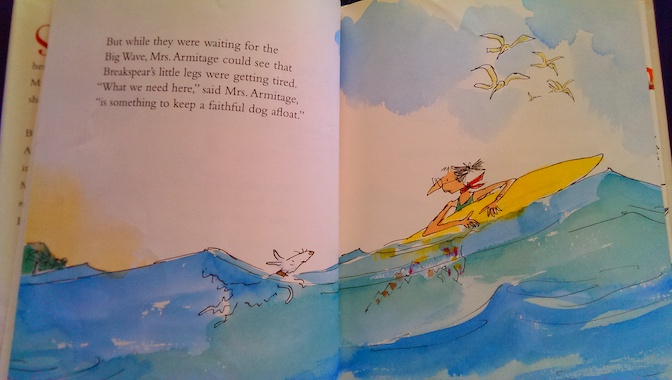
Mrs. Armitage goes the beach with Breakspear in order to go surfing.  She explains to Breakspear that they have to swim out and wait for the “Big Wave.”  But, waiting takes longer that Mrs. Armitage expected, and soon Breakspear is tired, and they’re both hot.

ArmitageWaveDogTired

Of course, Mrs. Armitage finds a solution for everything.  With an inflatable toy for Breakspear to ride on and some protective gear, they wait some more.  Needless to say, Mrs. Armitage doesn’t stop there.  As they wait for the perfect wave, there are plenty of other things that they need to keep themselves busy and make themselves more comfortable.

ArmitageWaveFloaties

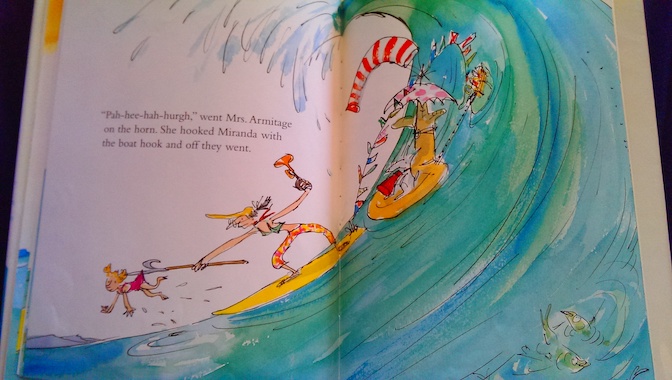
When the Big Wave finally comes, Mrs. Armitage not only makes an incredible show, but she also has what she needs to save a little girl who swam out too far and needed to be rescued.

The book is available to borrow and read for free online through Internet Archive (multiple copies, including one in Spanish).

ArmitageWaveRescue

Mrs. Armitage on Wheels

ArmitageWheels

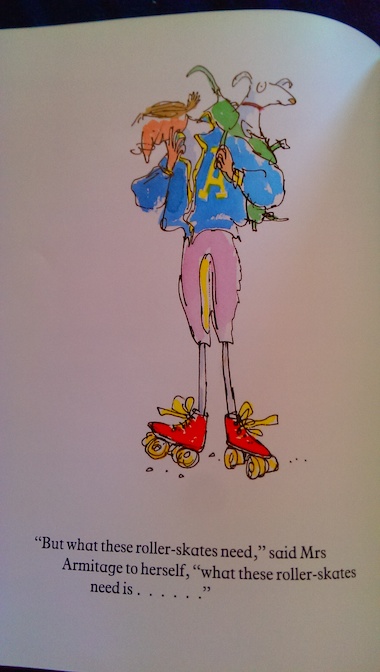
Mrs. Armitage on Wheels by Quentin Blake, 1987.

Mrs. Armitage loves to ride her bicycle with her dog, Breakspear, running alongside.  However, she sometimes runs into difficulties that require some minor repairs to her bike, and she can’t resist the urge to tinker further.

The more she thinks about it, the more ideas for improvements she has.  Each idea starts with the words, “What this bike needs . . .”

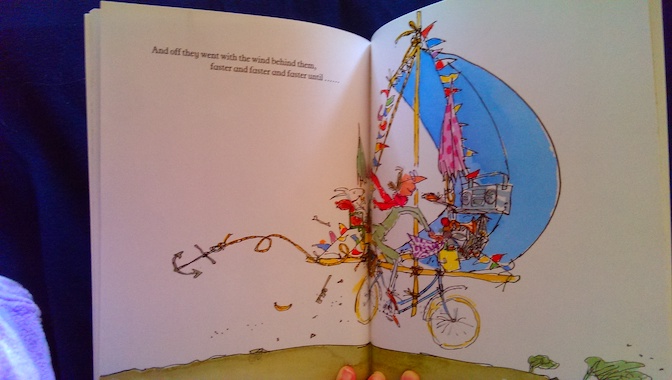
But, Mrs. Armitage goes well beyond what the bike really needs.  Beyond adding a seat for her dog and room for her lunch, she gradually turns her bicycle into a crazy, unwieldy contraption.

ArmitageWheelsSail

Was adding the sail and anchor where she went too far, or did she reach that point long before?  Even after she trades what’s left of her bike for some skates, one has the feeling that her tinkering is far from over.

The book is available to borrow and read for free online through Internet Archive.

ArmitageWheelsSkates

The Little Old Lady Who Was Not Afraid of Anything

OldLadyNotAfraid

The Little Old Lady Who Was Not Afraid of Anything by Linda Williams, 1986.

“Once upon a time, there was a little old lady who was not afraid of anything!”

This is a cute picture book based on word and sound repetition.

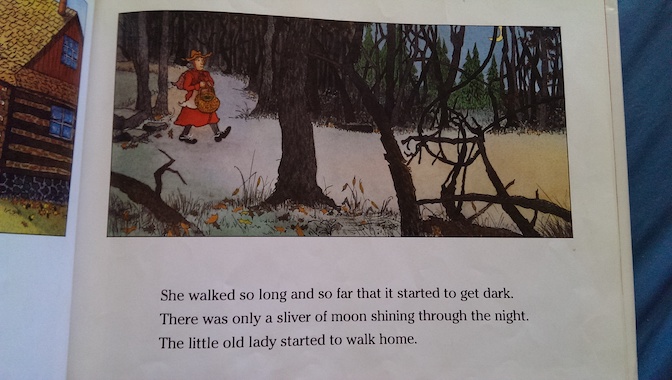
A brave lady ventures out into the woods one day, and as she makes her way home again when it gets dark, she begins to encounter some strange things.

OldLadyWoods

First, a pair of shoes with no one in them begin to follow her.  Then, she meets a part of pants with no one in them, and a shirt joins the parade of  clothes.  But, as weird as it is, nothing frightens the lady, not even the addition of a living jack o’lantern.

OldLadyClothes

OldLadyRun

When everything fails to frighten the woman (although she does look a little scared at one point), she has to help this strange collection of living clothes and pumpkin head to find a new purpose for themselves.

The book is currently available online through Internet Archive.

OldLadyScarecrow