It’s summer, and for a frontier family, the summer chores can be the most fun! Kirsten and her younger brother, Peter, are going fishing. They’re hoping to get enough fish for their family and their Uncle Olav’s family to have for supper. There is plenty of trout in the stream, and they should be able to get enough fish, although sometimes, disasters happen on their fishing trips. Once, Peter chased a skunk, and their mother also warns them to be careful of snakes and bears. Kirsten wears a whistle around her neck that she can blow if they get into trouble. Kirsten thinks her mother worries too much.
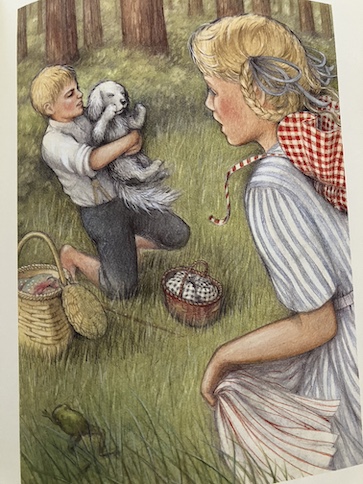
The children take their dog, Caro, fishing with them. Kirsten is a little concerned because Caro likes to chase things, but Peter insists that he can watch the dog and fish at the same time. When they don’t seem to have much luck getting big enough fish in the stream, they decide to go upstream to the pool. The fishing goes well, but Caro is stung by a bee.
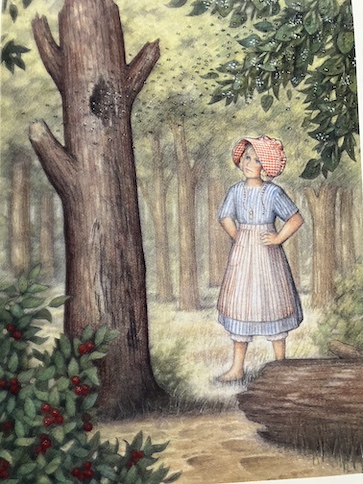
Kirsten realizes that Caro must have found a “bee tree”, a tree where bees have built their hive. Kirsten is interested in finding the tree because it’s a source of honey and honeycomb that their mother can make into special treats. If they can collect enough honey, their father might even be able to sell some and buy some of the things the family needs. They need to be careful while looking for the tree, though, or they might get stung themselves. Kirsten is pleased when she finds the tree, but she notices that there are marks on it from a bear’s claws, so it looks like a bear was trying to get the honey, too. Kirsten could ask her father how to get the honey and get him to help, but she wants to figure out how to do it herself and surprise everyone. She asks Peter to keep the bee tree a secret while she tries to figure out how to get the honey, and Peter reluctantly agrees.
Meanwhile, Kirsten’s cousins tell her about the town’s Fourth of July celebration. Kirsten’s family hasn’t lived in America for very long, so her cousins have to explain the significance of the holiday to her. Every year, the nearby town holds a parade and picnic with music and games. A lot of the local farmers also bring things to sell, like pies, butter, or preserves, and they use the money they make to buy things they need. Kirsten thinks again about the honey tree and the things her family could buy. She really wants a straw hat, like her cousins wear.
Later, when Kirsten is picking berries with her cousins, she sees a little black bear cub. She thinks it’s adorable, but Lisbeth says they have to leave the area immediately. If the baby is near the berries, its mother is sure to be somewhere nearby, and mother bears get dangerous if they think someone might hurt their cubs. Kirsten doesn’t really take the warning seriously until she tries to take Peter and Caro back to the bee tree with her to get the honey, and they meet the mother bear face-to-face!
The book ends with a section of historical information about the wilderness on the American frontier in the 1800s. Wild plants and animals were sources of food, but they were also sources of danger, like the bears in the story. The attempts of the pioneers to control the land were about securing sources of food and reducing sources of danger. There is information in the book about how pioneers cooked and how they dealt with changing seasons and weather. It also discusses the Fourth of July and how trips to town were rare treats for pioneer farming families.
The book is available to borrow and read for free online through Internet Archive (multiple copies).
My Reaction and Spoilers
It’s a good story about the difference between bravery and being foolhardy. From the beginning, even young Peter reminds Kirsten that being brave and being foolish are not the same thing. After their hair-raising encounter with the bear, in which the children have a narrow escape and their dog is injured (but fortunately not killed), the children’s father lectures Kirsten about putting both her life and her little brother’s life in danger. When Kirsten explains what she was trying to do with the bee tree, her father also tells her that she doesn’t really know what she’s doing. She took his equipment, but if she had carried out her plan the way she was thinking of doing it, she would have both destroyed the hive and ruined the honey as well as getting badly stung. Kirsten should have just gone to her father as soon as she found the tree and got his help from the beginning. Kirsten is ashamed for getting their dog hurt and putting herself and her brother in danger and almost ruining her special find, and she apologizes.
Because Kirsten’s father now understands the situation, he gets Kirsten’s older brother, Lars, to help him move the colony of bees to their farm. He knows how to set up hives and keep bees long term, so instead of this being just a one-time find and honey harvest, they will be able to get honey from the bees regularly. Kirsten goes with her father and Lars to watch them move the bees. She does it because she’s been having bad dreams about the traumatic escape from the bear, and she thinks it will help her to recover if she goes to the area again and sees it with her father and brother, when it’s safe.
Kirsten still feels bad that she wasn’t able to get the honey all by herself and that her attempt to do it was a disaster, but her mother consoles her. She says that she and Kirsten’s father understand that Kirsten was just trying to help and that her discovery has helped them. She just needs to learn to be careful as well as being brave. I thought that it was also a lesson in learning to share the glory instead of trying to take all the credit by going it alone and risking the success of the project, but the book didn’t quite say that. Kirsten wanted to be the one to say that she did it all herself, but because she couldn’t really do it all herself, everything went wrong. She could have accomplished her goals by talking to her father in the beginning and still been the heroine who found the bee tree, as her mother pointed out. She still gets credit for what she did without needing to take credit for what she couldn’t do alone.
The book ends with the family enjoying the Fourth of July celebration. Thanks to the discovery of the bees, they are able to buy the things they need.
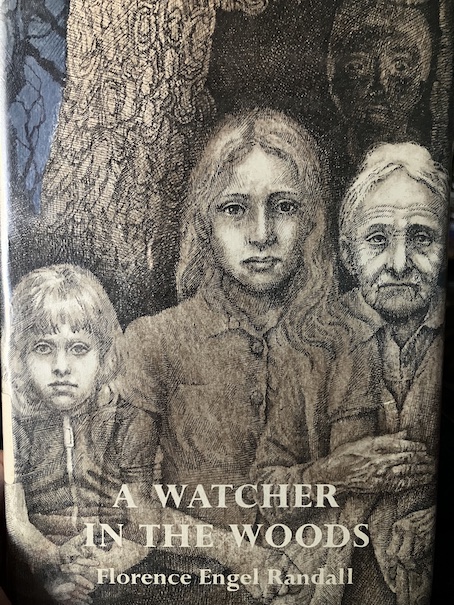
A Watcher in the Woods by Florence Engel Randall, 1976.
The Carstairs family is moving from Ohio to a small town in Massachusetts because Professor Carstairs will be taking a new job as head of the English department at the local college. Fifteen-year-old Jan knows that she will find the move harder than her parents or her younger sister. Her father will be busy with his work, and her mother will make friends with the wives of other faculty at the college. Jan knows that her little sister, Ellie, is still very young and in elementary school, and she won’t find changing schools as difficult as she will. Jan isn’t looking forward to trying to fit in at the local high school.
The family’s first difficulty in moving is finding a house in this new town that they like. Because it’s a small town, their options are limited, and it seems like there’s something wrong with each of the houses they see. Then, their realtor suggests that they view the old Aylwood place outside of town. Living there would mean a longer distance to drive to the college and the girls’ schools, but it’s a nice, big house with some land attached to it. The land includes woods and a pond. Elderly Mrs. Aylwood can’t afford to maintain the place anymore, but she has been reluctant to sell the house. She is very attached to it and she wants to make sure that, if she sells, that she will sell it to the right kind of people, who will take care of the land and woods.
From the first time that Jan and her family visit the house, it gives Jan a strange feeling. She has the oddest feeling that someone (or something) is watching them from the woods, and it frightens her. However, when she tries to explain her uneasy feelings to her mother, her mother thinks that it’s her imagination. Jan can’t deny that the house and wood give her the feeling of a fairy tale and that Mrs. Aylwood reminds her of a fairy tale witch.
For some reason, Mrs. Aylwood becomes more welcoming to the Carstairs family after she sees Jan, and she begins asking Jan some rather odd questions about herself. Mrs. Aylwood admits that Jan reminds her of her own daughter, Karen, who she lost 50 years ago when she was only 15 years old. Jan begins to understand that Mrs. Aylwood’s attachment to the house is because it’s a link to her daughter’s memory, but she soon begins to realize that there’s more to it than that. Mrs. Aylwood asks Jan what kind of person she is and makes a cryptic comment about how Jan is a human but there are other things besides humans.
Jan’s uneasy feeling of being watched continues, and mirrors in the house are inexplicably broken in an x-shaped pattern. When she befriends a neighbor, Mark, and talks to him and his mother about the house, she learns that Karen did not die but that she disappeared 50 years ago. She apparently went out for a walk to the pond in the woods one summer morning and simply vanished with no explanation. Searches for her never lead anywhere. Most of the local people believe that Karen ran away from home, although it would have been out of character for her to do that. Jan begins to wonder if the watcher she senses in the woods could be Karen, somehow hiding out or having returned after all these years, although Mark says that doesn’t make sense. Then, remembering Mrs. Aylwood’s comment about things that aren’t human, Jan wonders if the watcher could be Karen’s ghost. What if she died all those years ago, and her spirit haunts the woods?
It seems like someone or something is communicating with Ellie. Ellie seems to hear something speaking or humming when Jan can’t. Something even suggests to Ellie that she name her new puppy Nerak, which Jan realizes is “Karen” spelled backwards. Is Karen trying to communicate with them, or is it something else?
The book is available to borrow and read for free online through Internet Archive. This book has been made into movie versions twice, but the Disney movie from 1980 is more faithful to the original story. I’ll explain why below, but it involves spoilers.
My Reaction and Spoilers
When talking about my opinion of this book, I really need to include some spoilers. This is a very unusual book because it isn’t obvious until about halfway through what kind of story it really is. From the beginning, it’s set up like a ghost story, with Karen’s mysterious disappearance, the sense of something watching the house and family from the woods, and something trying to communicate through Ellie. It’s very suspenseful and mysterious, but this is not actually a ghost story. It’s really science fiction.
Karen isn’t dead, but she has been trapped in an alternate dimension since she disappeared 50 years ago. A being from that other dimension has also been trapped in our world since then. This other being is the mysterious watcher in the woods. Jan correctly senses that this other being is also female and a child, although beings of its kind live extraordinarily long lives because time works differently in their dimension. What has been 50 years for everyone else has only seemed like a day to her. She wants to return home, but she has had to wait for conditions to be right. She also wants to help Karen, and she has been struggling to communicate with Mrs. Aylwood and Jan and her sister so she can tell them what they need to do.
In the Disney movie, there are a couple of major changes from the original book. The first is that the location is changed from the US to England, although Jan and her family are Americans. It also features a kind of initiation ritual that Jan was undergoing just as her switch with the creature from the other dimension happened, adding an element that seems supernatural, although it is still science fiction. At the very end of the Disney movie, Jan brings Karen back from the other dimension, but in the book (Spoiler!) Mrs. Aylwood goes to join Karen in the other dimension instead.
In the book, Jan’s mother worries about what life would be like for Karen if she returns, aged 50 years in what must have seemed like only a day, having lost most of her life, or what it would be like if she has not changed at all but her mother has aged 50 years, and the world has been through so many major changes since she left. It isn’t clear whether or not Karen has aged in the other dimension, but Jan’s mother’s point is that the world she came from has definitely changed. Karen can’t go back to her old life, and there is some sadness about that and about what Mrs. Aylwood has been going through since Karen disappeared. However, Mrs. Aylwood decides to join Karen in this other world, where she’s been. We don’t really know what Karen’s condition is in the other dimension because we don’t see her. She may have aged very fast there, although I think they imply that she has not aged at all because time works differently in the other dimension. Since time works differently there, it seems like they either won’t age further there or will do so much more slowly than they would on Earth.
Between the two movie versions, the Disney movie version of this book from 1980 is more faithful to the original story because it maintains the concept that this is a science fiction story and that the watcher in the woods is a being from another dimension. The movie version from 2017 turns the story into a ghost story with no science fiction elements. In the ghost story version, Karen is also still alive and hasn’t aged after being gone for many years, but the watcher in the woods is a ghost who is holding her captive. It’s a spookier version, but I think the logic of the original book, with its science fiction theme, makes more sense.
The premise of the ghost story didn’t make as much sense to me because the ghost’s motives seem confused. First, the ghost takes Karen captive because she was staging a stunt for some friends where she appeared to be mocking the way he died. Then, he seemed to want to keep a girl for company, which is weird because it doesn’t seem like he interacts with Karen while he has her. He tries to make a bargain where he would be willing to release Karen in exchange for Ellie, but in the end, it turns out that human company isn’t really what he wants. (Spoiler!) He wants a ritual for his death that he was deprived from having when he was killed. The story just seemed to be all over the place with the ghost’s motives and desires. Is he out to punish Karen for her disrespect, lonely without human company, or just trying to get attention from the living to fulfill his final wishes? Even he doesn’t seem clear about that, which is why I prefer the sci-fi version.
I also thought that the premise of the sci-fi story was more original, and I enjoyed the twist of a story that seems like a ghost story but really isn’t. If any sufficiently advanced technology might look like magic to someone who had never seen it before, as Arthur C. Clarke said, it makes sense that any being who was sufficiently different from the human experience might appear to be some kind of supernatural creature to human beings who didn’t know what they were perceiving.
The Disney version from 1980 actually has multiple endings because the first endings they filmed didn’t quite work and didn’t get a good reaction from audiences. If you’re curious about what the three endings are like, Jess Lambert explains them in her YouTube review of the movie.
Snowbound Mystery by Gertrude Chandler Warner, 1968.
The school that most of the Alden children attend is closed temporarily because there was a fire and the building needs to be repaired. Henry is in college (this is one of the books in the early part of the series where the children age), but he doesn’t have to go back for another week, so the family is talking about what they’d like to do. Benny says that he wants to go up to the hunter’s cabin in the Oak Hill woods. Grandfather Alden belongs to the sportsman’s club that owns the cabin, but the hunters in the club don’t use it during the fall. It’s early for there to be snow, so Grandfather Alden thinks it will be okay. Grandfather Alden isn’t eager to go himself, but he thinks that it’s okay if the kids want to spend a week there.
The kids bring some food with them to the cabin, but they plan to buy more from the nearest store, which is a five-mile hike away. On their arrival, they choose the places where they’re going to sleep in the cabin, and they look through the cabin’s guest book for names they recognize. One name they recognize is the Nelson family. The Nelsons are the ones who own the store, and they kids wonder why they’ve visited the cabin three times recently because they wouldn’t have come there to hunt. They decide to ask the Nelsons about it when they go to the store.
The Nelsons are friendly and helpful at the store. When the kids ask about their trips to the cabin, Mr. Nelson just says that they sometimes like a change of scene. The cabin used to belong to the Nelson family before the sporting club bought it. However, the Nelsons’ young son, Pugsy, says that whenever they go to the cabin, they “look and look.” His parents stop him from saying more, but the Aldens wonder what the Nelsons could be looking for at the cabin.
The Nelsons give them useful advice about dealing with the squirrels at the cabin and about cooking. Mr. Nelson loves cooking and baking. In particular, he likes to make buns, but he makes an odd comment about how they’re not as good as they could be.
Back at the cabin, the Aldens find a hidden broom closet and a strange message that seems to be in some kind of code. They can’t understand what it means, and they wonder if this message could be what the Nelsons are looking for. Because they don’t understand the significance of the message, they’re not sure what to do about it. The Nelsons are nice, so the kids don’t want to think that they might be involved in anything bad, but if there’s an innocent reason for them to have this message, why are they being so secretive about it?
Although it is early for snow, a bad snow storm comes that leaves the Aldens snowbound in the cabin. Fortunately, they have plenty of supplies, and they can use their radio to hear about weather conditions. There are messages on the radio for people who have been separated from family members, and one of them is from the children’s grandfather, telling them to remain in the cabin and wait for help because he will get to them as soon as he can.
However, the Nelsons were also worried about the Aldens and made their ways through the snowy woods to check on them. The snow was worse than they thought, so now, the Nelsons are also stuck at the cabin with the Aldens. While they wait for their rescuers to arrive, the Aldens and Nelsons discuss the secret message and what the Nelsons are really looking for.
The book is available to borrow and read for free online through Internet Archive (multiple copies).
My Reaction and Spoilers
The Nelsons are actually a nice family, and there is an innocent reason for their behavior. Mr. Nelson’s father and grandfather also loved baking, and they had a special recipe that they used for making buns. Their recipe had a secret ingredient, but unfortunately, they both died before passing on their secret. Mr. Nelson thinks that, if he could make the buns like they did, he could become famous or at least earn more money for his family. He is a good baker, but the recipe is something special. The secret message is part of the recipe, but there’s still a missing piece of the puzzle. The Aldens and the Nelsons use their time when they’re snowbound in the cabin to look for the rest.
This story is equal parts adventure and mystery. Fans of the Cottagecore aesthetic will appreciate how the Aldens make do with the primitive conditions at the cabin, use plants as decoration, and gather nuts in the woods before the snowstorm.
Years after this book was published, another author wrote a cookbook based on food references in the Boxcar Children series, and she included a recipe for the buns in this story. The story never reveals the secret ingredient, and the author uses some shortcuts in preparing them, but it’s an easy recipe that kids can learn to make.
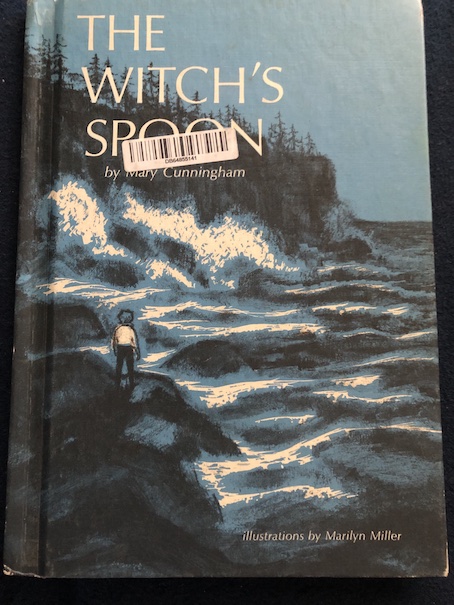
The Witch’s Spoon by Mary Cunningham, illustrated by Marilyn Miller, 1975.
Tom and Lauren are spending a week with their grandmother at her beach cottage during the summer. They have visited the cottage many times before, and they love revisiting all their favorite places, the bunk beds on the cottage’s sleeping porch, like the tree where they always see baby owls (which they call the owl tree), and the place where they once found some lost coins (which they call the money spot). They know the cottage well, inside and out. This summer, though, there are a few things that are different.
The first thing that the kids notice that is different is that their Grandma has added a new item to her curio cabinet: a big silver spoon with a long handle. They ask their grandmother about the spoon, and she explains that it’s a witch’s spoon. She recently inherited it from the children’s Great-Aunt Hannah (that would be their grandmother’s sister), who used to live in Massachusetts. The spoon is a family heirloom from the time of the witchcraft trials in Salem (“when witches were thought to be as much of a problem to people as air pollution is now” – this is from the mid-1970s). Their grandmother says that there are good witches and bad witches, and good witches would use spoons like this one to stir love potions. Tom doesn’t believe in witches, but Lauren is fascinated by the spoon and the idea of love potions. She is sure that she senses magic from the spoon.
The next thing that will make the children’s visit here different from previous years is that their grandmother has decided that they’re old enough to have a June Day. June Days are a family tradition, and it’s not just because it’s June. During a June Day, the usual household rules are suspended for one day, and the children are allowed to go wherever they want and do anything they want, all on their own. Grandma says that she will prepare meals at the usual times, but for that day, it’s up to the children whether or not they show up for them, so they don’t need to interrupt their adventures. If the children aren’t there to eat their meals, Grandma will share the food with their nextdoor neighbor, Mr. Bunby. There are only a few safety rules that the children have to follow: they are expected to by careful when attempting any activity that might have an element of danger, and they have to leave their grandmother a note about the general area where they are going, like the beach or the nearby woods, so if they’re not back by dark, she’ll know where to look for them. The June Day ends when it gets dark, and the children must be home by then.
The grandmother understands that there is a certain element of risk in letting the children go off by themselves, and she reminds them that “every box has its pill.” That means that, while their children can choose what they’re going to do, they have to face the consequences of their choices, no matter what they might be, good or bad. “If you open the box and find a bitter pill, you have to swallow it.” Getting to make their own rules and decisions for a day doesn’t get them out of taking the consequences of whatever they do. If they get hurt or get into serious trouble, not only will they suffer the hurt or trouble they cause, but their parents may not let them come back next summer, so they need to keep that in mind when making their choices. Freedom still comes with responsibility, and that’s what the children need to be old enough to understand before they can have a June Day. Tom says that they understand, and that they won’t do anything too wild. Their grandmother tells them that they can have their June Day in two days, so they will have time to look forward to the treat and plan for it.
Tom and Lauren have different interests, so each of them decides to make up their own plans for a private adventure. Tom already knows what he wants to do for his June Day. There is a cave near the beach where the children usually aren’t allowed to go, but there are rumors that there is a giant cavern inside where pirates have hidden their treasure. Getting inside the cave will be difficult and involves an element of risk, but he is determined to spend his June Day hunting for pirate treasure. He doesn’t want to persuade Lauren to join him because he thinks she’ll be too scared to do it.
Meanwhile, Lauren thinks how she’s always wanted to hold a baby owl in her hands. She loves animals, and she decides that she’ll try to hold a baby owl on her June Day. She decides she won’t tell Tom about it, because he would probably think that was a silly thing to do. Lauren thinks that she even might try to make a baby owl a pet, just for the rest of the week.
There is one other thing that is different about this year, though. Their grandmother informs them that their cousin, Elizabeth, will be joining them at the cottage this year. Elizabeth’s father is the brother of Tom and Lauren’s father. Years ago, he moved to Italy and married a woman there, and they had only one daughter, Elizabeth. Unfortunately, Elizabeth’s parents died in a car accident, and Elizabeth has been living with her three aunts in Rome. She has never been the United States before and has never met either her grandmother or cousins, so the children’s grandmother has decided to invite her to visit this year.
Tom and Lauren aren’t thrilled at the idea of meeting their Italian cousin. It’s partly jealousy at sharing their grandmother with a girl they don’t really know. Elizabeth was named after their grandmother, and Lauren worries that Grandma will like her better because of that. Tom complains that she’ll probably be fat and smell like garlic because people in Italy eat a lot of spaghetti. It’s a mean thing to say, and even Lauren thinks it sounds ridiculous, but the children’s negative attitudes are also because they realize that Elizabeth’s presence will complicate their secret plans for their June Day. In order to have their secret adventures by themselves, they will also have to avoid their cousin trying to tag along.
In spite of their negativity and thoughts about playing pranks on Elizabeth so she won’t want to stay, Lauren realizes that she is also curious about this cousin and seeing what she’s like. When Elizabeth arrives the next day, she is a slim girl with dark hair, who doesn’t smell like garlic at all. Elizabeth speaks fluent English as well as Italian because she goes to an international school in Rome, so the children are able to talk to each other easily. Lauren feels jealous about the attention that their grandmother showers on Elizabeth, but Elizabeth is nice to Lauren. Elizabeth likes to knit, and she says that she would like to make a sweater for Lauren. Lauren asks her if she’ll have enough time because she’s only visiting for a week, and Elizabeth says that if it’s not finished by the time she has to leave, she will mail it to her. Lauren begins to feel a little sorry that she thought bad things about Elizabeth, but she also still feels jealous because of all the things Elizabeth knows how to do. Elizabeth can play the flute and wears pretty clothes as well as knitting and speaking multiple languages. Then, their grandmother announces that Elizabeth will be allowed to choose one item from her curio cabinet to take back to Italy with her. Tom and Lauren aren’t even allowed to open the curio cabinet without permission!
Their grandmother tells Tom and Lauren that they will each have a chance to choose something from the cabinet when they’re older. The only reason why Elizabeth is choosing now is that she lives far away and can’t come very often. Tom and Lauren each have favorite items in it that they tell Elizabeth to definitely not take before they get a chance to choose, and Lauren suggests that Elizabeth take the witch’s spoon. The witch’s spoon hasn’t been in the cabinet long enough for Tom or Lauren to have developed an attachment to it. Elizabeth is intrigued by the story that witches used it for making love potions, and their grandmother says that, in times of trouble, you can look into the bowl of the spoon and see answers. Elizabeth says that it’s an Italian tradition that a good witch gives children presents on January 6th (see The Legend of Old Benfana). She tries to see her deceased father in the spoon and is disappointed when she can’t. Their grandmother says that it might not be magical anymore or maybe people only saw in the spoon what they wanted to see.
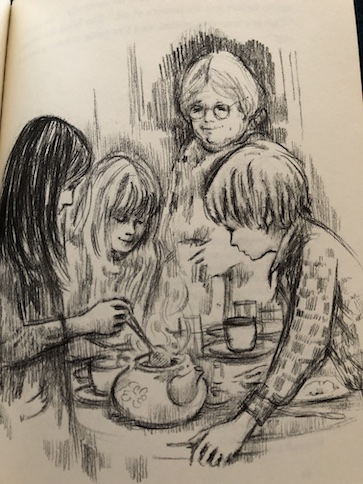
Tom and Lauren continue making their secret plans for their June Day, each kind of wondering what the other is planning to do. When the day arrives, they each get up early and put their plans into action before anybody can ask them what they’re going to do. Of course, their plans don’t turn out the way they thought. Lauren’s attempt to hold a baby owl and maybe make one a pet don’t take into account how the mother owl would feel about that. In the cave, Tom accidentally falls and drops his flashlight, so he’s trapped and unable to find his way out. Neither one of them was specific enough in their notes for anybody to find them quickly when they get into trouble. Fortunately, Elizabeth turns out to be not only a tag-along but a helpful partner in their adventures. Through their various adventures and disasters on this special June Day, the three children come to feel like they really are cousins. At the end of the story, the grandmother makes a special tea blend, and Elizabeth stirs it with the witch’s spoon, turning it into a love potion, but for family love.
I bought my copy of this book through Amazon. I haven’t found a way to read it online.
My Reaction and Spoilers
The book doesn’t say exactly where the story takes place, but I think it’s supposed to be the California coast because that’s where the author lived. The descriptions of the pine forest near the cottage and beach fit the California coast, and the same author wrote another book called The Rescue that takes place at a cabin in California.
The story has some nice cottagecore vibes, with the children having fun and adventures in nature. There are times that they reminisce about past summers at the cottage as well as enjoying the current summer. They once kept a lost, wild baby ferret as a pet temporarily one summer before releasing it back into the woods, and they always have to look for baby owls in the owl tree when they arrive at the cottage. They spend time at the beach, swimming, wading, sunning themselves, and looking for seashells. Lauren has a favorite type of seashell, called angel’s toenails. When Tom explores the cave, he likes seeing the stalactites, and he sees bats and a type of blind fish in the stream of the cave.
Few children these days have the same level of freedom that these children have at their grandmother’s seaside cottage, although for somewhat obvious reasons. Their grandmother speaks to them honestly and sincerely about the nature of risk-taking and accepting the consequences of their actions, but adults will realize that there are obvious problems with each of their plans for June Day. Even as a kid, I would not have tried to pick up a baby owl or keep one as a pet. Wild animals do not want to be made into pets, and they don’t want their babies to be picked up and held by humans. Owls are cute, but they are also birds prey with sharp beaks and talons and will fight back if they feel like someone is intruding on their personal space. Even my child self would have thought of that long before Lauren tries her June Day experiment. Of course, that’s mostly because my elders impressed on me that nobody should mess with wild animals. The reason why we know that certain things are bad ideas is that people actually tried them and found out from personal experience. Maybe some people have to try things themselves before they understand or believe why they’re bad ideas. I have to admit that I once tried to pick up a dead cactus pad when I was about four years old because I had the idea that dead things couldn’t hurt me, so I figured out that it wouldn’t hurt to touch dead cactus. That’s the Arizona version of this type of experimenting with interacting with the natural world, and I was very, very wrong. One benefit of this kind of hands-on experimenting is that the lessons you learn stay with you forever, but as the grandmother of this story says, you have to accept the results of your experiments, whether it’s a clawed head or a handful of cactus spines.
Tom is the one who takes the greatest risk in this story. When he first considers using the June Day to explore the cave, he knows that they’re not usually allowed to go there. The question that immediately came to my mind was why, and the obvious answer is that the adults know that the cave is too dangerous. Tom considers the difficulties of getting into the cave but not the dangers he can encounter inside. Just because the rules have been suspended for the day doesn’t mean that the dangers have also been suspended for the day, which was what their grandmother was trying to get the children to understand. It’s not unlike learning that cactus spines are just as sharp when the cactus is dead as when it was alive. Fortunately, Lauren and Elizabeth manage to rescue Tom without anyone getting hurt.
The adventures that Tom and Lauren end up sharing with Elizabeth help them bond as cousins. They also learn that, while Lauren has some unique skills and lives a very different kind of life in Rome that is exciting in its own way, she isn’t perfect and neither is her life. Elizabeth is an orphan who still misses her parents. The skills that she has are ones that she’s learned from her aunts, who each have their own standards for what Elizabeth should learn and do. Elizabeth’s aunts love her and care for her, but she isn’t always allowed to do what she wants. This summer represents an unusual amount of freedom for her, too.
I think Tom and Lauren might have taken Elizabeth’s sudden arrival better if their grandmother had prepared them for it instead of springing it on them without warning or discussion of how it would affect their summer plans. The grandmother might have also prevented some hard feelings by talking to all of the children about the gift for Elizabeth from the curio cabinet. I understand why Tom and Lauren wanted to prevent Elizabeth from suddenly taking things that they were attached to. If she had, it would have caused some hard feelings among the cousin. If I were the grandmother in this situation, I think I would have sat all three children down and told them that I wanted to give each of them a special gift from the cabinet. Tom and Lauren would have to leave their gifts in the cabinet for the present, partly because the heirloom Tom values most is a pearl-handled gun, and I think he’s too young to have that unsupervised. However, it would be understood that each of the children would own a special heirloom, and they could discuss their choices among themselves so there wouldn’t be hard feelings or the impression that one child was given more choice than the others.
There aren’t really occult themes in the story. The witch’s spoon only does one thing that appears like magic at one point, and there is a logical explanation for that. The love potion tea really just caps off the children’s day of adventure, when they bond over helping each other. The children know that the spoon probably really isn’t magic. The real magic in their imaginations and the time they spend together as family.
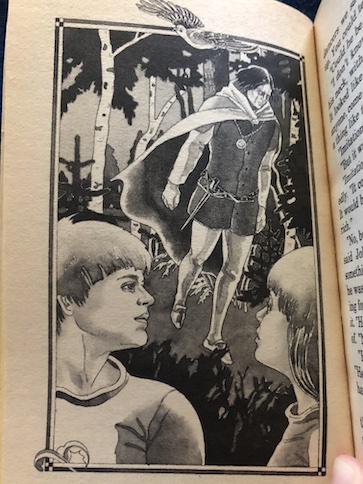
John and Margaret Begbie are traveling with their parents through Germany, and the family stops to have a picnic in the Black Forest. From their picnic spot, they can see the old castle on the hill that they visited earlier that day. The children’s parents doze off after lunch, but the children stay awake and see a strange man. The man walks by their picnic spot wearing an old velvet costume and a dagger in his belt, and the children see that he’s crying. The kids worry about the man because he seems so deeply distressed. They decide to leave a note for their parents and follow the man to be sure that he’s alright.
As they go after the man, they spot what looks like the tracks of a large dog, but the man didn’t have a dog with him. The kids realize that these are actually wolf tracks, and John remembers that their father told them that this area is called Wolfenwald, which means Wolf Wood. Then, they find the man’s gold medallion lying on the ground. Going a little further, they find an old cottage. The cottage looks abandoned, but they decide to explore around it anyway, just in case the man went inside. No one answers their knocks on the door, but they see the man’s clothes on the bed inside the house. They decide to leave the medallion with the man’s clothes and go back to their parents, but they suddenly notice that it has become night, and when they try to leave the cottage, they are confronted by a large wolf!
John frightens the wolf away by flinging the medallion at it. When the wolf is gone, the children decide that they have no choice but to risk going through the woods in the dark to find their parents. However, when they arrive at the picnic spot again, their parents aren’t there. The children find the note they left and a bar of chocolate. They eat the chocolate and lie down to wait for their parents to return for them, but the next thing they know, they are woken by the sound of a horn and the horses of a group of hunters. The hunters are pursuing the wolf. When they wave down one of the horsemen, he offers them a coin to tell him where the wolf is. Margaret points the man in the wrong direction to get the hunters off the trail of the wolf. The children aren’t really sure whether it’s a real wolf or just a dog that resembles one, but Margaret has the sense that the wolf needs their help.
The children also need help. They notice that the horsemen are dressed strangely, like people out of the past, and the coin that the man gave them is stamped with the year 1342 although it looks new. Even more strangely, the children suddenly realize that they understood what the man said even though neither of them can speak German. Is this is a dream, or have they gone back in time?
Not knowing what else to do, they decide to return to the cottage and see if the man who owns the medallion is there and can explain things. The man does have an explanation. He explains that he was the wolf. The man, whose name is Mardian, is a werewolf, and Margaret saved his life when she diverted the hunters. Mardian says that he and his family served the dukes who have ruled this land, and he and the current duke grew up together and were best friends for years. However, after suffering a terrible injury at the hands of an enemy and losing his wife, Duke Otho became a changed man, angry and bitter. In a fit of temper, he even accused Mardian of plotting against him. A real enemy in Otho’s circle, an enchanter called Almeric, used Otho’s suspicions to try to eliminate Mardian. When his plots to kill Mardian failed, Almeric used sorcery to turn him into a werewolf. Now, Alermic has promised a reward to the hunter who kills the wolf, and in the meantime, he has disguised himself as Mardian and taken his place in the duke’s castle. So far, the duke hasn’t even noticed that Mardian has been replaced by an imposter. Mardian believes that Alermic will use his position to kill both the duke and his young son so he can take the dukedom for himself. Can the children help Mardian expose the imposter and break the spell?
The book is available to borrow and read for free online through Internet Archive (multiple copies).
My Reaction
In order to reach the duke and get his help to expose the imposter, the children must disguise themselves as other children from this time period and join in the life of the duke’s castle. Mardian gives them a plausible cover story, in case anyone asks them who they are. They carry off the charade very well, and there are so many people and children in the castle that two more aren’t questioned. John is even mistaken for another boy, called Lionel. John doesn’t know who or where the real Lionel is, although he theorizes that the real Lionel might have died young because many children of this time period did. While real-life castles were full of many different types of people of all ages, I do find it a little difficult to believe that so few people are surprised by children who suddenly appear without any introduction. There does seem to be the implication that people do come and go from this castle, making it difficult to keep track of everyone.
Margaret and John also experience the different expectations people of this time have for girls and boys. John is immediately put to work as a servant, waiting on the noblemen of the duke’s court as a page along with the sons of the nobles. He also has to dodge the rough games that the other boys play that are meant to prepare them for war. On the other hand, Margaret is taken to the nurseries with the other young girls of the castle and lectured about how she should be quiet and modest. The girls are much more closely supervised than the boys, although she finds a way of slipping away from the others to meet with John.
I liked some of the descriptions of the Medieval food in the book. At one point, Margaret thinks she’s eating turkey (a bird native to the Americas and not found in Europe during this time period), but John tells her that it’s actually swan and peacock, birds which were eaten around this time. There are a few instances where alcohol is mentioned because people during this time period drink wine and small beer. The duke also insists that a boy bring him his favorite posset, a drink I discussed in my earlier review of the The Box of Delights.
Ruth Fielding at Snow Camp or Lost in the Backwoods by Alice B. Emerson (the Stratemeyer Syndicate), 1913.
It’s shortly after Christmas, and Ruth and her friends, the Cameron twins, Helen and Tom, are home from boarding school. They’re excited because the twins’ father has purchased a snow camp, a kind of winter retreat in the woods, with a nice cabin that has enough room for the twins, Ruth, and some of their school friends. In fact, Mr. Cameron is allowing the young people to take a party of their friends there soon, before school starts again.
However, before they leave on their trip, Ruth and the twins have an unexpected confrontation with a neighbor’s bull that causes a boy hiding in a hollow log to be knocked into a freezing creek. They manage to rescue the boy and take him back to the Red Mill to warm up.
The boy reluctantly explains that he is Fred Hatfield and that he has run away from home, which is in Scarboro, New York, close to the snow camp. His father is dead, and he says that he has plenty of other siblings to help his mother at home. He is evasive about why he felt the need to run away, just saying that he was tired of where he was, and he’s sure his family won’t miss him. None of the adults are impressed by that explanation, saying that they’re sure that a mother would miss any of her children, no matter how many others she might have.
Ruth spots a newspaper clipping that Fred dropped, and when she picks it up and reads it, she realizes that Fred’s situation is more serious than anyone else thinks. At first, she doesn’t tell anyone else about the clipping, not sure how much she should reveal about what she knows (even to the readers). However, knowing that Fred might try to run away, she hides his trousers so he can’t leave in the middle of the night.
The next day, they tell Fred that the young people are going to the snow camp near Scarboro, and that Mr. Cameron will take Fred there on the train when he escorts his children and their friends there. As Ruth anticipates, Fred doesn’t want to go back to Scarboro. He tries more than once to run away, and one of his attempts to run and Ruth’s attempt to stop him cause them both to be separated from the rest of the party, lost in the winter woods. Fred isn’t happy with Ruth for tagging along with him and interfering in his business, and Ruth says that she’s not going to let him abandon her in the woods.
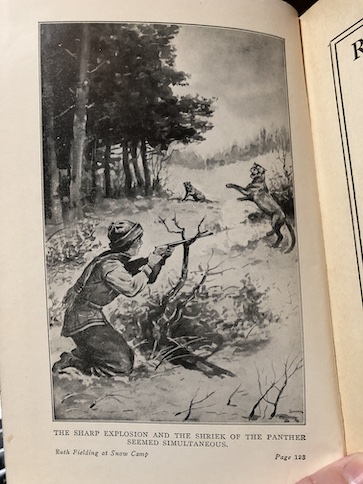
Together, they have a frightening encounter with a with a panther and get help from a hermit living in the woods. The hermit is a strange man who keeps rattlesnakes as pets, although the poison sacs have been removed. He teaches the Ruth and Fred to walk in snow shoes, and he helps them to reach the snow camp. They actually manage to get there before the rest of their party does, but Fred disappears just as they arrive.
When Ruth calls her friends in town to let them know that she’s all right and that she’s reached the snow camp, Mr. Cameron shocks her by telling her that the boy she’s known as Fred can’t possibly be the real Fred Hatfield. Mr. Cameron has learned from the local authorities that Fred Hatfield was killed in an apparent hunting accident months ago, although some people wonder if it was actually a murder. Fred’s half brother is being held by the authorities for Fred’s death. Did Fred just fake his death and run away? Or is the boy they know as Fred someone else entirely?
The book is now public domain and is available to borrow and read for free online through Internet Archive (multiple copies) and Project Gutenberg.
My Reaction and Spoilers
When we’re first told that Fred Hatfield was supposedly killed in a hunting accident, they mention that the boy’s body apparently rolled into a river after being shot, making it seem like Fred could still be alive, but then we’re told that the boy’s body was recovered from the river. That means that either Fred is actually dead and this new runaway Fred is an imposter or some other boy has been killed and Fred is just letting everyone think that the dead boy is him. Either way, there is a runaway boy whose identity needs to be established and a dead body whose identity also needs to be confirmed, and the circumstances of that death also need to be established. What really happened during that fateful hunting trip?
I liked the premise of this book because it’s much more of a mystery than the previous two books in the series. However, as an early Stratemeyer Syndicate book, there isn’t much deliberate investigation of the mystery. Most of the story is more adventure-oriented, and the characters learn the truth of the mystery almost by accident and through Fred’s eventual confession. In between, the characters have some outdoor winter fun. The girls make some homemade candy, which the boys spoil with a prank, causing some boy/girl rivalry. The girls get lost in a bad snow storm while trying to prove that they can be as daring and innovative as the boys when it comes to having fun and end up having to rescue Fred as well, which is when the solution to the story is revealed.
The solution is pretty much what people thought it was, which is a bit of a let down. At first, I thought that there might be more of a plot twist. Even the true identity of the dead body isn’t very exciting. Fred was labeled as a bad boy in the beginning, and that turns out to be true, but his half brother also admits that he was pretty hard on Fred at home because he’s smaller and not as physically strong as his older half brothers. They criticized Fred for not keeping up with the physical work they were doing and called him lazy, but realistically, Fred can’t do all the things they do, and his half brothers realize that they have to acknowledge and accept that. They say that they’re going to try to find him a different kind of work that he can do.
It’s not a bad ending, but I’d like to see a little more deliberate investigation from Ruth Fielding. I would have liked to see Ruth Fielding talk to other members of Fred’s family and maybe have one of them produce a picture of Fred to help establish his identity. Then, I’d like to have Ruth and her friends find Fred more deliberately than accidentally. The story isn’t bad the way it is, and there’s plenty of adventure, but as a mystery fan, I usually prefer more deliberate detective work.
The Little Old Lady Who Was Not Afraid of Anything by Linda Williams, 1986.
“Once upon a time, there was a little old lady who was not afraid of anything!”
This is a cute picture book based on word and sound repetition.
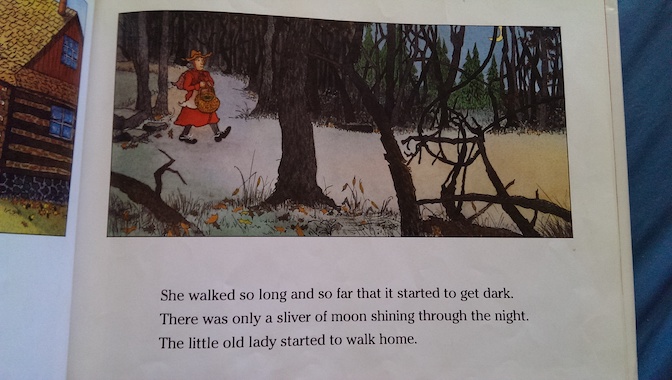
A brave lady ventures out into the woods one day, and as she makes her way home again when it gets dark, she begins to encounter some strange things.
First, a pair of shoes with no one in them begin to follow her. Then, she meets a part of pants with no one in them, and a shirt joins the parade of clothes. But, as weird as it is, nothing frightens the lady, not even the addition of a living jack o’lantern.
When everything fails to frighten the woman (although she does look a little scared at one point), she has to help this strange collection of living clothes and pumpkin head to find a new purpose for themselves.
The book is currently available online through Internet Archive.
















 Jestress's Forgotten Books and Stories