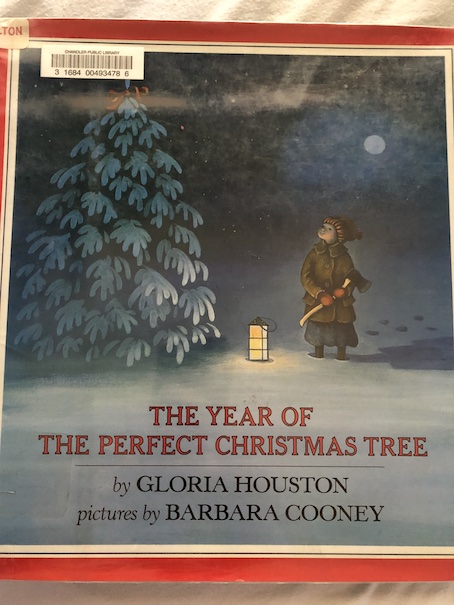
The Year of the Perfect Christmas Tree by Gloria Houston, pictures by Barbara Cooney, 1988.
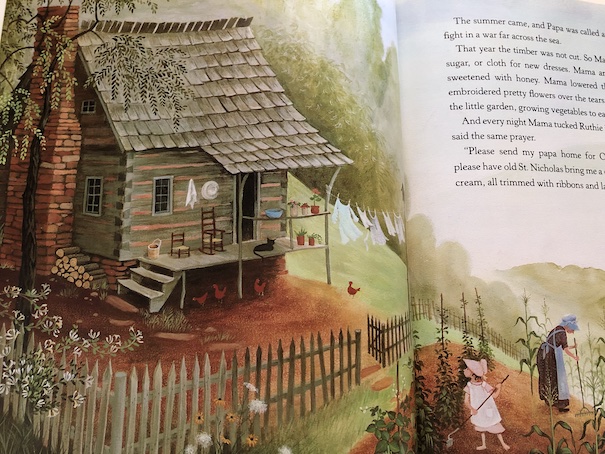
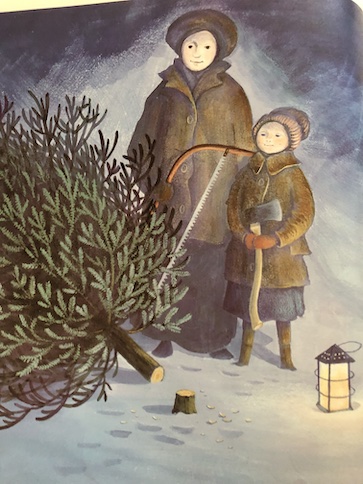
Ruthie is a little girl living on a farm in Pine Grove in the Appalachian Mountains during World War I. (The story calls it The Great War because that was its name before WWII.) During the spring, Ruthie’s father selected a tree for the village church’s Christmas celebration. The local families take turns providing the tree, and it’s their family’s turn. Ruthie goes with him to pick out the right tree and mark it with a red ribbon.
However, during the summer, Ruthie’s father has to go away to be a soldier overseas. Ruthie and her mother tend the farm while her father is away, but money is tight. Ruthie thinks ahead to Christmas and prays for her father to come home and for a special Christmas present for herself – a pretty doll with a cream-colored dress with ribbons and lace.
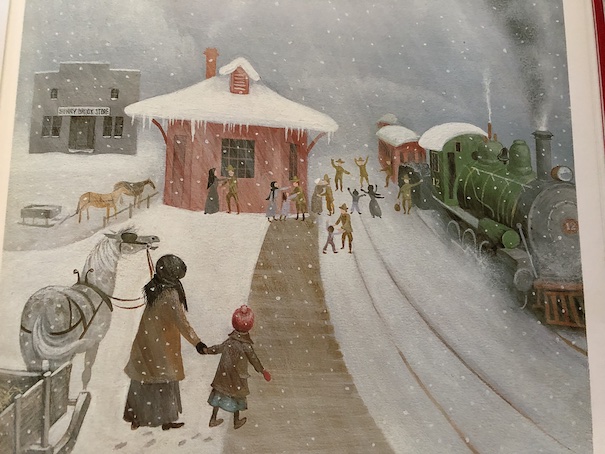
In the fall of that year (1918), Ruthie’s father writes a letter, saying that the Armistice has been signed, meaning that the war is over, so he’s sure he’ll be home for Christmas. Ruthie and her mother keep waiting for him to arrive any day, but he doesn’t seem to come, and they don’t know exactly when to expect him.
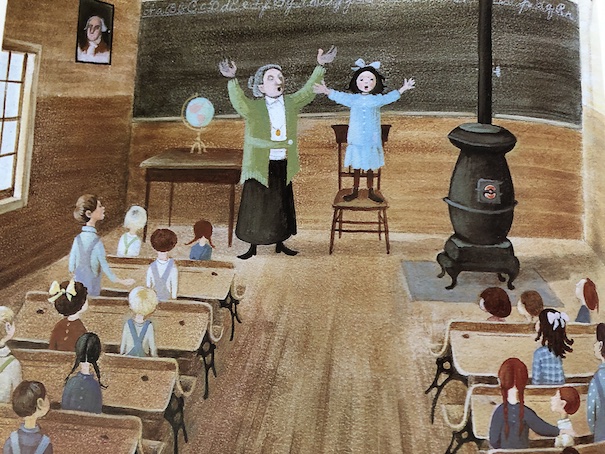
At school, Ruthie is told that she will have the role of the heavenly angel in the Christmas play and that they are still expecting Ruthie’s father to supply the Christmas tree. Ruthie is looking forward to it, but Ruthie and her mother don’t have enough money for a new dress for the angel costume, and there is still the worry about when her father will return home, and if he will make it in time to cut the Christmas tree and take it to the church.
The local preacher tells them that the person who is due to provide a Christmas tree next year is willing to do it this year instead, if Ruthie’s father can’t get home in time, but Ruthie’s mother is still sure that their family can manage the tree. Ruthie’s mother decides that she and Ruthie will go get the tree themselves. It isn’t easy, but they manage it, and Ruthie’s mother also finds a way to make a dress for Ruthie’s angel costume.
However, there are two more things that would make this Christmas perfect for Ruthie – if her father returns home in time for Christmas and if she somehow receives the doll of her dreams.
The book is available to borrow and read for free online through Internet Archive (multiple copies).
My Reaction
This is a sweet, old-fashioned Christmas story about wishes coming true. Wishes coming true at Christmas is a popular theme in Christmas stories, and in this book, they come true because Ruthie’s mother and Ruthie do what they need to do to make everything work out the way they want it to. They could have let someone else provide the Christmas tree, and no one would have thought less of them for doing it because the father of the family was still away, but they were determined to see their family’s promise to provide the Christmas tree through. The mother also uses her old wedding dress for the material for Ruthie’s angel costume, and it’s implied that she also made the angel doll for the top of the Christmas tree that becomes Ruthie’s special Christmas present.
The pictures are charming, and they fit well with the Cottagecore aesthetic that’s been popular in recent years.
I couldn’t find a copy with its dust jacket intact.
Jessamy is a British orphan who is being raised by her two aunts, Millicent and Maggie. The two aunts aren’t really raising her together, though. Jessamy lives with Aunt Millicent during the school year, and she goes to stay with Aunt Maggie during school holidays. Truth be told, Aunt Millicent (her mother’s sister) and Aunt Maggie (her father’s sister) don’t really like each other, and they have different priorities and goals for Jessamy’s future. Aunt Millicent is doing her best to help Jessamy be pretty and popular, making sure that she wears a retainer to straighten her teeth and only allowing her to associate with “nice” children (apparently meaning ones from “good” families in the sense of social connections, who mostly don’t like Jessamy – Jessamy is usually not allowed to play with the children she actually likes and who like her). On the other hand, Aunt Maggie doesn’t care about beauty or popularity and just wants Jessamy to be well-behaved. Jessamy is confident that she is disappointing both of her aunts in all of these qualities. Her aunts are fond of her, but they are also occupied with their own lives. Aunt Millicent has her work, and Aunt Maggie has two children of her own, so Jessamy really has only half of their attention at any particular time.
However, Jessamy’s usual bouncing between her aunts is interrupted one summer when Aunt Maggie’s children, Jessamy’s older cousins Muriel and Edgar, catch whooping cough. Jessamy hasn’t had whooping cough herself, so she wouldn’t have any immunity. Rather than bring Jessamy into the household and have her end up sick, too, Aunt Maggie realizes that she has to find another place for her to stay until the other children are better. Jessamy can’t go back to Aunt Millicent because Aunt Millicent is leaving on a business trip, so Aunt Maggie arranges for Jessamy to stay with Miss Brindle, who is the caretaker of a large old house known to locals as Posset Place.
Miss Brindle is an older woman and is not used to spending time with children. Although Jessamy doesn’t really get along with her cousins, she isn’t sure if she’s going to like staying with Miss Brindle. However, Miss Brindle isn’t bad. She isn’t fond of Muriel or Edgar, either, and she says right up front that she’s glad that Jessamy seems different from her cousins. She also says that she’s going to treat Jessamy like an adult because she doesn’t know much about children, which suits Jessamy fine.
Miss Brindle tells Jessamy a little about the history of the old house. Posset Place was built in 1885 by a man named Nathaniel Parkinson, who made his money from producing a cough syrup called Parkinson’s Expectorant Posset. The house is largely empty now, except for the housekeeper’s quarters, where Miss Brindle now lives. Miss Brindle spends her time making sure the rooms are kept clean and well-aired.
Miss Brindle lets Jessamy explore the house a little before supper, and in particular, Jessamy is fascinated by the empty nursery. She finds herself imagining the children who used to live there and the toys and books the nursery once held. Then, she notices markings on the wall where the children’s heights were recorded, and she sees that one of the children was also named Jessamy. She tries to ask Miss Brindle about it, but Miss Brindle isn’t aware that there were any names written on the nursery wall.
During the night, Jessamy wakes up, still thinking about seeing her own name written on the wall of the nursery. She could have been mistaken, but it bothers her to the point where she feels like she has to go look at it again. Taking her flashlight, she goes upstairs again to look at the names. However, this time, the nursery is not empty, like it was before. There are clothes hanging on the wooden pegs on the wall and a line of shoes on the floor. When she checks the old measuring marks, she sees that there are fewer marks than she remembered before, but one of the names is definitely Jessamy, and the year next to that name is 1914. Jessamy lives in 1966 (contemporary with when the book was written), but the day in 1914 is the same day that she came to stay with Miss Brindle – July 23rd.
Then, to Jessamy’s surprise, she suddenly realizes that she is holding a lit candle instead of her flashlight. At first, Jessamy thinks that she must be dreaming, but then, an angry young woman comes and tells her that she should be in bed because she’s ill, not running around with a candle. The woman threatens to tell her aunt about this. When the woman lights her lamp, Jessamy sees that the nursery is now fully furnished.
It seems that Jessamy has gone back in time to 1914 and has been mistaken for the Jessamy who lived in the house in the past. The woman, who is Miss Matchett, the parlor maid, says that the other children named in the height markings – Marcus, Fanny, and Kitto – are all asleep and that it’s nearly midnight. The Jessamy of the past is the niece of the cook-housekeeper, which is why she is allowed to be with the children of the house. Jessamy’s head hurts, and she realizes that there is suddenly a bandage around it. Miss Matchett says that she fell out of a mulberry tree.
Jessamy realizes that the housemaid is only awake at this late hour and fully dressed because she had just returned from slipping out of the house secretly. When she points it out, Miss Matchett admits that she sneaked out to see her gentleman friend, and she says that if Jessamy doesn’t tell on her for doing that, she won’t tell her aunt that she was out of bed. Jessamy agrees, and Miss Matchett leads her back to her bed in the housekeeper’s quarters.
When Jessamy wakes up in the morning, she expects to find that everything that happened in the nursery during the night was a dream, but it isn’t. The room is the same one Miss Brindle gave her in the housekeeper’s quarters, but the bed and furnishings of the room are different. Jessamy is woken by a woman she’s never met before, not Miss Brindle.
This woman is the past Jessamy’s aunt, who tells her that she has had approval to stay on as the cook-housekeeper for the Parkinson family with Jessamy living with her. Not every household would accept a housekeeper with a young niece to raise, but as Nathaniel Parkinson himself says, the Parkinsons are not an ordinary family. Nathaniel Parkinson is a self-made man, from a humble background in spite of his current fortune, so he doesn’t put on airs, like other men of his current class. His granddaughter, Miss Cecily, at first disapproves of Jessamy, thinking that she might be too “common” (like the friends Jessamy’s Aunt Millicent disapproves of) and that she might not be a good influence on the children of the house, her younger siblings, who she is helping to raise. However, past Jessamy’s aunt defends her, and Nathaniel Parkinson says that she might actually be good for other children. He thinks Fanny has been acting too fine, and Kit could use the company of another child his age.
Jessamy is happy when she learns that past Jessamy has made friends with the Parkinson children and has really become part of the household. She is told that Fanny still thinks of her as being just the niece of a servant, but Kit (aka Kitto) is her special friend. Jessamy also likes this 1914 aunt better than her 1966 aunts because she seems nicer and more her kind of person. The realization that this is not a dream but that she has really traveled back in time is worrying, but Jessamy tells herself that she will somehow find her way back to her own time and that she should enjoy 1914 as much as she can while she can.
From the housemaid, Sarah, Jessamy learns that the Parkinson children live with their grandfather because their parents were killed in a carriage accident. Miss Cecily, the oldest girl in the family, takes care of her younger siblings and tries to manage the household while her oldest brother is away at Oxford. Miss Cecily is still learning about the running of a household, so past Jessamy’s aunt, Mrs. Rumbold, has to help her.
Jessamy also learns that she fell out of a tree house that she and Kit built together and that Fanny, who was also in the tree house at the time, was particularly upset by her accident. Fanny confesses to Jessamy that the reason she fell was because she pushed her. She hadn’t meant to push her out of the tree house or for her to fall, but the two of them were having an argument at the time. Fanny felt guilty about her getting hurt, but she’s still angry that Jessamy will be staying on at the house. She thinks that her grandfather and older sister decided to let her and her aunt stay partly because they felt badly about her getting hurt. Although Fanny is grateful that Jessamy didn’t tell on her for causing her accident, she still isn’t happy that Jessamy will be living with them. Fanny does put on airs, but she openly admits that she does it because everyone seems to be against her. Girls at school teasingly cough around her all the time because her grandfather made his money with his cough syrup, and since Jesssamy came, she feels like her brothers always side with Jessamy instead of her. Fanny has been in trouble before for bad behavior, and her brothers know that their grandfather has said if she does it again, he’ll send her to boarding school. Jessamy thinks that the idea of boarding school sounds exciting, but her brothers say that Fanny would hate it.
In spite of the drama with Fanny, Jessamy enjoys her time in 1914 and the other people there. She has the feeling that something important happened in 1914, and she remembers what it was when Nathaniel Parkinson and Kit talk about the possibility of war with Germany. Jessamy realizes that the coming war is going to be World War I and that it is going to start soon. Harry, the oldest boy in the Parkinson family, is back from Oxford, and he talks about how exciting it would be to be a soldier if there is a war, but Nathaniel Parkinson isn’t excited, understanding more about the nature of war than his grandchildren. Harry’s grandfather wants him to finish college, but Harry is in debt and wants to take his future into his own hands. Harry runs away, and at the same time, a valuable antique book belonging to his grandfather disappears. Jessamy doesn’t like to think that the pleasant young man stole his grandfather’s book, but what other explanation is there?
Just when Jessamy is getting caught up in the events in the Parkinson household and is concerned about the future of the past Jessamy and her aunt, Jessamy finds herself once again in 1966. Is it still possible for her to return to 1914 or learn what happened to the people she’s grown so fond of? Jessamy also begins to wonder who is the current owner of this old house and Mrs. Brindle’s employer? Learning the answers to those questions also explains a few things about Jessamy’s own family and past and gives her the one thing she really wants most.
The book is available to borrow and read for free online through Internet Archive (multiple copies).
My Reaction and Spoilers
This story is a combination of fantasy and mystery, a combination that I always like. In some ways, this story reminds me of Charlotte Sometimes because the time switching takes place between similar eras, but there are some notable differences between the two books. Charlotte Sometimes took place at a boarding school, and Charlotte went back in time to the end of WWI, not the beginning. There was also no mystery plot in Charlotte Sometimes beyond Charlotte trying to figure out how and why she is switching places with a girl in the past. Also, in Charlotte Sometimes, it isn’t clear whether Charlotte influenced or changed anything in the past, but Jessamy definitely does. The modern Jessamy had to be the one to solve the mystery because she has access to information that the past Jessamy didn’t have.
In the past, Jessamy begins investigating the mysterious theft of the valuable book. Although she knows that Harry isn’t the type to steal from his grandfather, it takes a second visit back in time for her to discover who the real thief is and to clear Harry’s name. Unfortunately, she is unable to actually find the stolen book in the past to return it to its first owner. It is through a new friend that she makes in 1966 that she learns what really happened to the book and is able to return it to the current owner of the house … an old friend of hers from 1914.
Along the way, Jessamy also learns a few things about the history of her own family. She realizes at the beginning of the story that Jessamy is an unusual name, which is why she is surprised that the girl in the past is also called Jessamy. It turns out that Jessamy is a name that is passed down through her family. She is not a direct descendant of the past Jessamy, as I first suspected, but the past Jessamy is a relative of hers. She also comes to understand that her family used to be more grand, but during the past, they fell on hard times. This is also important to the story because class differences figure into the plot.
Everyone in 1914 is concerned about class differences, but in different ways. Nathaniel Parkinson is actually the least concerned with class because he has actually shifted to a higher class during his lifetime, making him aware that people from different classes are really just people, only in different circumstances. His granddaughters are more class conscious, although both of them also soften on that after getting to know Jessamy better. Even the servants are also class conscious, with some of the servants putting on airs because they’re above other types of servants.
Something that surprised me in the story is the realization, toward the end of the book, that class differences are partly the reason why Aunt Millicent and Aunt Maggie don’t get along. Aunt Millicent’s efforts to make Jessamy more pretty and popular and have her be friends with certain people are social-climbing efforts, partly because Aunt Millicent is aware of their family’s past and wants the family to climb up from their humbled circumstances. Aunt Maggie’s disapproval of Aunt Millicent seems to come somewhat from her disapproval of Millicent’s efforts at social-climbing or trying to act like she’s more grand than she actually is. It isn’t stated explicitly, but it is heavily implied. We don’t meet Millicent in the book, but from her description, I suspect that she disapproves of Aunt Maggie because she thinks of her as being too “common.” From the characters’ descriptions of Maggie’s children, it seems like people who don’t like them think of them as being “common” or uncreative, indicating that this branch of Jessamy’s family is rather prosaic, being typical in a rather dull way.
The objective reality is probably that Jessamy’s two aunts are not very far apart in their social status, but they have different attitudes toward their social status. Aunt Maggie doesn’t care much about it. She fits in well where she is, she doesn’t care about moving up in society, and she just focuses on the children behaving well within their social status. Aunt Millicent, however, has a high opinion of who she is and where the family ought to be in society, and she is focused on moving up. Jessamy doesn’t really fit with either of her aunts’ philosophies of life. What she really wants is the chance to make real friends and fit in somewhere with people who like her and who like the sort of things she likes. She gets the opportunity at the end of the story when the current owner of the old house becomes her benefactor and arranges for her to attend boarding school, which she has said is something that she’s always wanted to do. At boarding school, Jessamy will be out from under the direct supervision of both of her aunts and will have the opportunity to develop independently and make new friends who suit her, rather than her aunts.
Even Fanny finds boarding school beneficial. We don’t know exactly how her life ended up in the 1960s, but when Fanny realizes that she’s caused problems for the past Jessamy in more ways than one and that she needs to admit the truth to her grandfather and older sister, her character develops for the better. She begins to develop empathy and compassion for the past Jessamy, looking beyond feeling sorry for herself to feeling something for another person she has directly harmed, and she reforms her character. She accepts the consequences for her actions, even though she was afraid to do so before, and it leads her to better things because the consequences are not as bad as she thought and actually help her. Although she was initially afraid of being sent away from her family, when her grandfather decides that she needs the discipline and sends her to boarding school, she discovers that she actually likes it. Going to boarding school allows her to get away from the girls who were bullying her at her local school and make new friends, and she develops some self-confidence from the experience, turning into a young lady who helps her older sister in her volunteer work for the war effort.
One final thought I had is that every time I’ve ever read a book with a sickness like whooping cough in it, I feel like it really dates the book. I know this book does have a specific date by design, and I know people still catch whooping cough in the 21st century if they haven’t been vaccinated (get your tetanus shot – in the US, the tetanus shot includes the whooping cough vaccine), but to me, this type of illness feels like a time travel back to my parents’ youths by itself. My parents and their siblings had whooping cough when they were young, but I’m almost 40 years old and have never seen a case of it myself.
Charlotte Mary Makepeace is a new student at a boarding school in England. The school is big and confusing, and there are so many new people to meet that she immediately feels overwhelmed. Starting life at a new school can be intimidating for anyone, but things are about to get particularly strange for Charlotte.
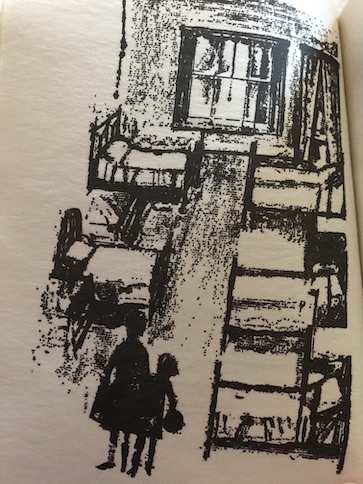
An older girl, Sarah, helps Charlotte to find her room and choose a bed, recommending a bed by the window. Charlotte is a little puzzled at why Sarah singled her out and helped her, and the other girls are jealous that she got to the room first and got first choice of the beds. Still, Charlotte is grateful. She is exhausted, and she feels like she isn’t herself. When she wakes up in the morning, she really isn’t herself.
The room where Charlotte sleeps is called the “Cedar” room, and when she first enters the room, the name puzzles her because there are no cedars nearby. However, when Charlotte wakes up in the morning, there is suddenly a large cedar outside the window. The tree did not grow during the night. In Charlotte’s time, the cedar is gone, but Charlotte is now back in the past, when the cedar was still there. Things in the room are arranged differently, although Charlotte’s bed is still in the same place, and instead of seeing her roommates, Charlotte finds herself alone with a girl she has never seen before, who calls her “Clare.”
Charlotte is very confused. Earlier, she was feeling like she wasn’t herself, and now she has the sense that maybe she has really become someone else. Charlotte doesn’t notice any differences about herself in the mirror, but the other girl doesn’t seem to notice that she’s not Clare, whoever Clare is. The girl just keeps talking to Charlotte as if they already know each other. The other girl’s name is Emily, and it turns out that she is Clare’s younger sister. Charlotte finds herself feeling toward Emily the way that she feels toward her own sister, Emma.
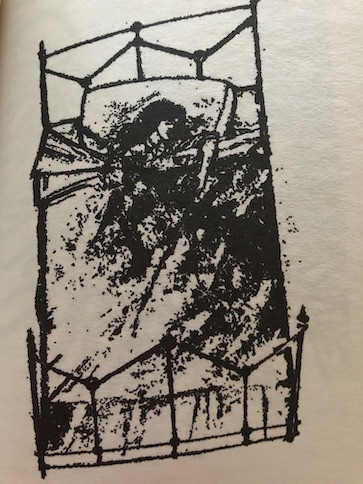
Charlotte is forced to go through the rest of the day, her first at boarding school, as Clare. People keep talking about “the war,” and Charlotte doesn’t know what war they mean at first. When she went to bed, it was the 1960s. At the end of a very confusing day, she returns to bed in the Cedar room, where she finds a diary with the name “Clare Mary Moby” written on it and the date, September 14, 1918. The diary really makes Charlotte realize that she has spent the entire day in the past, and she further realizes that the war everyone was talking about is World War I. However, there is nothing else for Charlotte to do but go to bed. When she wakes up in the morning, she is once again Charlotte. Emily is gone, and Charlotte is back in her own time with her regular roommates. However, it quickly becomes clear that this was not just a dream, and this strange incident repeats itself each day, after Charlotte sleeps in the same bed.
Whenever Charlotte shifts to take Clare’s place in the past, she loses a day in her own time, which helps to convince her that she is not dreaming when she is Clare. Every other day, Charlotte switches places and times with Clare, and she sees the school as it was in the past, toward the end of World War I. Apparently, Clare is living Charlotte’s life whenever Charlotte is living hers, and nobody around them seems to have noticed the switch. Charlotte has no idea why this is happening, other than the fact that she and Clare happen to be sleeping in the same bed, in the same room.
Charlotte
is fascinated by her trips to the past, but they are disorienting. She now has two sets of names to learn, the
people in the past and the people in the present. There are different school rules in the past,
too, and she was still getting used to the rules in her own time. Charlotte and Clare also need to do some of
each other’s homework for classes, and there are some things they can’t
do. Charlotte can’t write an essay about
Clare’s holidays because she has no idea what Clare did on her school holidays,
and Clare is very bad at arithmetic, giving Charlotte bad grades.
The next time she makes the switch, Charlotte learns that Clare and Emily do not usually sleep in the Cedar room. Because of the Influenza Epidemic of 1918, girls have been shifted around as the sick ones are quarantined. Meanwhile, in the 1960s, Clare has created a new diary in an exercise book with Charlotte’s name on it. In the book, Clare has written a letter to Charlotte about their situation. She asks Charlotte to look after Emily when they’re together and to write messages back to her. Clare doesn’t think they should tell Emily about what’s happening. Clare worries that Emily will be confused and frightened.
However, Emily soon discovers the truth, and Charlotte comes to rely on her as the only person in the past who knows who she really is. Emily notices differences between the way Charlotte behaves and the way that Clare behaves, but they are uncanny in their resemblance and behavior in other ways. In many ways, Emily is bolder than both Charlotte and Clare, although her boldness is often to the point of being brash or callous. She is sometimes impatient with Charlotte and Clare’s softer natures, but their apparent softness is due to their greater sense of life’s consequences and their sense of responsibility for Emily. Emily finds talk of the war and bombings exciting, but Charlotte and Clare are both aware of the dangerous reality. As Emily gets to know Charlotte, she points out the ways that she and Clare are similar yet different, and she says that the more time Charlotte spends in 1918, the more like Clare she is becoming. Charlotte worries about the resemblance between her and Clare and how natural it is becoming for her to act like Clare.
In the present, Charlotte is initiated into the usual pranks of a British boarding school by her new roommates, and in the past, she sees soldiers in World War I uniforms. In 1918, students whisper about whether a classmate with a German father could actually be a German spy, and Charlotte is introduced to air-raid alarms. In the 1960s, Charlotte’s roommates wonder about her funny moods, her odd need to be alone, and her reluctance to be friends and join them in activities. In both time periods, Charlotte is constantly afraid of giving everything away by saying something that would be out of character for the person she’s supposed to be or asking questions that she should already be able to answer if she were living every day in one time period. The one element that seems constant throughout these shifts is the bed that she and Clare share in the Cedar room. However, Clare and Emily will soon be sent to board with a family in town, only returning to the school as day pupils. When the Cedar room is turned into another quarantine room for the sick, Charlotte is trapped in the past as Clare, and she worries that she may never return home again. What will happen to her, and will she lose her identity as Charlotte, becoming Clare forever?
This book is a modern classic in children’s literature! I decided that I had to read it because so many people have nostalgic memories of this book and have written positive reviews about it. The Cure even did a song and music video inspired by the book. The song even contains words from the book in the lyrics. This is the original music video that goes with the song. (It’s also on YouTube.)
The book is the third book in the The Aviary Hall trilogy. It is available to borrow for free online through Internet Archive (multiple copies). The other two books in the trilogy are also available on Internet Archive, but Charlotte Sometimes is often regarded as the best of the three and is the best known.
Note: Strangely, this book has three different ending, depending on the edition of the book. Older editions (the original and printings from the 1970s) contain the full text, and newer editions are cropped in two different places. The copies on Internet Archive are different editions and have different endings. This one contains the full text of the original. This one and this one have the endings that include Emily’s letter but not the final scene with Charlotte going home from school. The others don’t have the part with Emily’s letter at all. In order to learn the difference between these endings and the significance of Emily’s letter, you’ll have to read the part of my review that includes spoilers.
Further Thoughts
I was amused by the part where Emily laughs at the name Charlotte because she thinks that it’s kind of old-fashioned in 1918, yet Charlotte is from the future. Names often go in cycles of popularity, and certain classic names have comebacks at regular periods. Right now, in the early 21st century, the names Charlotte, Emma, Emily, and Clare (or Claire) are all pretty popular. In fact, Charlotte has seen a recent resurgence in popularity in the United States. Modern children reading this would actually find many of the names very familiar, thanks to a trend of reviving vintage and classic names. In fact, some of the 1918 names are more popular these days than some of the 1960s names, like Janet and Susannah. Don’t worry, they’ll have their turn again.
I also liked the part where Charlotte tries to consider whether she and Clare really look alike. Emily is a little vague about whether Charlotte and Clare really resemble each other, saying that she might have just seen “Clare” in her because Clare was who she expected to see and that she never really looked at her properly until she realized that she was actually Charlotte. Charlotte thinks about a time where she tried to draw herself by studying her own features in a mirror, but the longer she stared at herself, the more disconnected that she felt from the features she was seeing. This is actually a real phenomenon, and I’ve read other books where people have mentioned it. You can get some odd feelings by staring at yourself in a mirror for too long. I’ve tried it myself, and it can get a little eerie, especially if you look yourself right in the eyes and try not to blink. The longer you look, the more eerie it gets. That’s how that old sleepover trick, Bloody Mary, works. This is sometimes called the “strange-face illusion.” Although Charlotte is having a kind of identity crisis from switching places with Clare, this mirror phenomenon is something that anyone can experience.
Further Note: At the time that I first published this review, January 1, 2020, I hadn’t yet heard of the coronavirus, and I had no way of knowing that there was going to be an outbreak that would eventually turn into a pandemic. Now, in February 2020, I’d like to point out some things to anybody who is as creeped out as I am about this disease. (I had the images of the influenza in this story in my mind when I first started hearing about the coronavirus outbreak, and it didn’t do a lot for my peace of mind.)
Coronavirus and the 1918 influenza have some similarities and differences. Normal seasonal influenza has a death rate of approximately 0.1%. The influenza epidemic of 1918, colloquially called “Spanish Flu“, had a death rate of approximately 2.5%, and it was frightening because many of its victims had been young and apparently healthy before infection, and they died fairly quickly after becoming ill, in a matter of days. (I have more information about that down below.) It spread remarkably fast because of the mass movements of people between countries due to World War I and soldiers returning home toward the end of the war, to the point where it’s never been firmly established exactly where the virus originated.
The coronavirus (as of February 2020, estimates may change later) has a death rate of approximately 2.3%, and most of those deaths have been people who are very old and/or had underlying health problems. It’s bad, but oddly, also somewhat hopeful because, unlike the 1918 influenza, where it wasn’t always obvious who was the most as risk, we can tell ahead of time with the coronavirus who is most at risk, which is helpful for protecting people who are the most vulnerable. We know where the coronavirus started, and although it has spread to countries around the world, public health officials have been taking steps to quarantine people who have contracted the disease or who have been to regions with known infections. It has spread, but perhaps not as rapidly as the Spanish Flu because the 1918 public health officials didn’t understand what they were dealing with at first and didn’t take the steps that we are taking now. If there was any good side to the 1918 influenza epidemic, it was probably that it taught us a few things about how to handle pandemics, including what not to do when one is occurring. The two viruses aren’t precisely the same, but being aware of what we have learned from past experience may help us to stop the situation from becoming worse than it might be otherwise. I know that what is happening and what is probably about to happen is not going to be good because this is just not a good situation, and that can’t be helped, but what can be helped is how we respond to it and make use of what we already know. This current situation is not going to last, but what we do while the situation still exists is going to determine how well we come out of it.
This is not a good time for international travel, and if you can avoid traveling until this crisis is over, I would recommend doing that. If you are in a safe place, I recommend staying there until the crisis passes, and wherever you are, follow the instructions you are given by your public health officials. Before this is over, you may actually get the coronavirus. (I might, too, and I know that as I type this. I live in Arizona, and we’ve only had a few cases so far, but that’s so far.) Health officials are working on a vaccine, but that takes time, and it may not be widely available until next year. However, if you are not in one of the at-risk groups, you will likely survive the experience if you get it, and if you do what your health officials tell you to do, you can help yourself to recover from the disease and avoid spreading it to others. If you think you may be in one of the at-risk groups, follow the instructions that your doctor gives you and seek help (by telephone first) if you think that you may be ill. Try not to be too afraid because, although I know this all sounds scary, one of the first steps to handling difficult situations is believing that it is possible to handle them and taking the steps you know how to take. Take care of yourselves, and consider others as much as possible, too.
Further update: I am now fully vaccinated as of May 2021! I got the reaction that a lot of people got from the Pfizer vaccine; I felt like I had the flu for about a day after getting the second shot. But, after that, I was fine, and I recommend it to other people (provided that you aren’t allergic to anything in the shots – that seems to be the one real caveat to getting them). If you’re a conspiracy theorist, I have not experienced any weird mind control, and I don’t feel any different than I did before. I’m still reading and reviewing children’s books, making various random craft projects, listening to the same YouTube videos, and getting irritated with people I think are jerks, so my version of normal is still basically what it was before. I wouldn’t say that the pandemic is completely over yet because many people are still getting sick and haven’t had their shots, but having more people vaccinated is a good sign. My home state ended up being hit pretty hard during the worst of it, and we have seen some improvement since then because more people are being vaccinated. With vaccinations now open to people age 12 and over, I’m hopeful that there will be more improvement by the end of summer.
Themes and Spoilers
There is a lot more that I’d like to discuss about this book, but I wanted to save this discussion for the end because discussing this story and my opinion of it in depth reveals some major spoilers.
The 1918 Influenza Pandemic
First, I love stories with historical background! When I was in school, my teachers didn’t cover World War I and the 1918 Influenza Pandemic in detail. My high school history teacher, for example, was a major Civil War buff, and she spent so much time going over the major battles of the American Civil War and making us watch Gone with the Wind (which I had already seen and didn’t like because I never liked the character of Scarlett O’Hara) that she kind of rushed through the early 20th century with us, charging onward to World War II. If she said anything about the Influenza Pandemic, it wasn’t much, and it didn’t make much of an impression. In fact, I think that the first time I ever heard about the 1918 Influenza Pandemic (although I can’t remember exactly when I first became aware of it) was through fiction, even though one of my own family members died in that pandemic. However, this was an important, worldwide event that came right at the end of the First World War, and it was shocking because the people who were frequently hit the hardest by the disease were people who were normally young and strong, the people who would usually have been the ones most likely to survive under normal circumstances.
No one knows precisely where and how the pandemic began, although people have attempted to go back through the records and isolate the first cases. This is more difficult than it sounds because the earliest cases of the influenza were lighter, not fatal, and people didn’t think that much about them at first. Also, because of World War I, the mass movement of people across countries due to the war, and the masses of troops returning from the front, the disease was spread farther and faster than it might have been otherwise. Charlotte Sometimes shows some of that real-life pattern. Early in the story, when Charlotte first begins switching places with Clare, a member of the school’s faculty in the past talks about how Clare and Emily were shifted from their old room to the Cedar room because they needed a room for the sick children at the school. At this point in the story, people don’t seem to be panicking about the illness because this was the first phase of the epidemic, when people were getting the earlier, less serious form of the disease, but it’s foreshadowing later events. At one point, Charlotte in the past is blocked from entering the Cedar room and returning to her own time because the disease has spread further through the school and the Cedar Room is also turned into a sick room.
This is a major spoiler, but after Charlotte finally returns home to her own time to stay, she learns that Clare is not alive in her time because she also became ill with influenza, the more deadly form, and she died not long after the end of the war and the end of their time-traveling adventures. At the time of her death, Clare was about thirteen years old and apparently healthy otherwise, which is in keeping with the way this particular illness affected many of its victims. There were a couple of factors which made younger people more vulnerable:
Unprepared immune systems and the body’s overreaction – Young people may have had less exposure to less serious forms of the same disease from earlier years that would have primed their immune systems to respond appropriately when they encountered this influenza. The human body has certain natural defenses against diseases, like the way it can raise a fever to kill off invading germs with higher temperatures, but sometimes, a disease can strike so hard that the body overreacts to fight it (the technical name for this reaction is “cytokine storm“), causing more damage to itself. Sometimes, this can even happen to the point where the body’s own defenses damage the body itself so much that the person dies or develops a secondary problem, such as pneumonia, that could potentially lead to their death. This is an important factor to consider when evaluating why this form of influenza tended to kill otherwise healthy young people – their immune systems were the strongest and also less primed than older adults, so they were the most likely to overreact. This is where modern vaccines can help, providing the priming the body’s immunity system needs to properly cope with serious diseases it has never seen before.
Secondary infections – The people who died of the influenza tended to die of the pneumonia that set in as a secondary infection in their damaged lungs, possibly partly as a result of the body’s overreaction. This was before the development of antibiotics like penicillin, which we use to treat such infections now. This is also where vaccines come in handy because people who can avoid getting sick also avoid developing secondary problems from the illness. Unfortunately, there was no vaccine available in 1918. It wasn’t even obvious to the medical professionals of the time what they were really dealing with, and they lacked medicines that could have helped because they were developed later.
This is basically what happened to Clare, an otherwise healthy teenager, when she caught the influenza. Clare, of course, is a fictional character, but her life and fate were based on real people of the time. This was part of what made the pandemic so scary. People of the time noticed that even people who otherwise seemed young, strong, and healthy were dying of this disease, and it was happening fast. If you read grown-up Emily’s letter to Charlotte in the longer endings to the book, Clare died in a matter of a few days after becoming ill. (This still sometimes happens, but in this particular epidemic, it was happening on a massive scale.) It was happening all over the world, in small towns as well as big cities, and there was nowhere anyone could go to escape it.
Because of the shocking spread of the disease and the tragic youth of many of its victims, the event has found its way into fiction, even children’s literature. Before it was depicted on the television show, Downton Abbey, it was named as Edward Cullen‘s impending cause of death if he hadn’t been turned into a vampire in the Twilight young adult series (he was also a teenager, although older), and it was also described in one of the books of the Sarah, Plain and Tall series, set in the American Midwest. (None of the main characters die in that story, although Anna becomes a nurse and the others fear for her safety, and they witness the burial of a baby who died from the disease, as one of my grandmother’s younger brothers did in real life.)
I added a note above, discussing some of the ways the coronavirus and the 1918 influenza were similar and different. What I’ve described regarding the 1918 influenza’s effects on younger people does not seem to be the case with the current coronavirus (as of February 2020). There may be exceptions, just like more typical seasonal forms of influenza occasionally become serious even in cases of normally healthy young people (I’m not an expert, so I can’t say what the chances of that are, it seems that an overreaction of the immune system is still a primary concern with the coronavirus), but the pattern for the coronavirus so far is that it is most dangerous to the very old and those with underlying health problems. In this situation, we can do a lot to help them by protecting those we already know are most vulnerable.
World War I (or, The Great War)
There are many other historical nuggets in this book besides the influenza epidemic. As I mentioned before, Charlotte learns about life in British boarding schools in the past, finding the discipline harder and the food not as good (possibly due to war rationing).
Some of her 1918 classmates are suspicious of another classmate, Elsie, whose father is German, and they talk about how their parents think that Germans living in England should be interned in camps to isolate them from the rest of the population because some of them might be spies. Emily asks what kind of information a schoolgirl like Elsie could possibly find to pass on to harm the war effort, and one of the other girls says that if one of them comments about a letter they’ve received from their father, saying that he is with the troops in France, Elsie could pass that to her parents, and they could pass it along to Germany. Emily says that’s silly because everyone knows that there are British troops in various places in France, and even Charlotte knows that all British mail is read and censored during this time. In other words, nobody could say anything specific enough in a letter to their children that would be a risk if little Elsie happened to hear about it. Elsie is also plainly uncomfortable with the other girls’ suspicions. Modern adults would see Elsie for what she is: a little girl, very much like the others, born and raised in England, with little personal connection to the country where her father was born. She’s been caught up in the circumstances of the wider world against her will, suddenly finding herself labeled as an outsider in the only home she’s ever known. As a child, there’s not a lot that Elsie can do about this situation, and one wonders if the adults would do anything to help if they knew about it. This was the level of wartime paranoia, and the children were getting it from their parents. It’s difficult for children to learn to behave calmly and reasonably when the adults in their lives are not doing so themselves.
The war is always present in the lives of the 1918 children. Charlotte is also forced to take part in an air-raid alarm at school. When she and Emily board with the Chisel Brown family, they talk about Arthur, their son who was killed in the war, and at one point, they hold a seance to try to contact him. This is also based on real life. There was a rise in spiritualism and spiritualist practices because of the war, just like there was after the American Civil War. When society has been through something traumatic and lost loved ones, they sometimes turn to practices like this for comfort and the hope of reaching out to the people they’ve lost. When Charlotte and Emily witness the seance, they hear Clare’s voice calling to Emily. The girls are not able to communicate with Clare further than that, and there’s no real explanation for why this happened. It’s before Clare dies in her time, and we never hear from Clare’s perspective at any point in the book.
The family, especially Mr. Chisel Brown, have bitter feelings about the war because of Arthur’s death. The bitter feelings are reflected in the way they speak. At one point in the story, Mr. Chisel Brown says, “Damned peace-talk, damned conchies (conscientious objectors – people who refused to fight for moral reasons), hun-lovers (German sympathizers). Should all be hanged, I say.” This is about the strongest language in the book. The girls’ bedroom at the Chisel Brown house has a rather horrifying anti-German poster in it called “Mark of the German Beast,” and when Mr. Chisel Brown thinks that the girls aren’t behaving themselves, he says that they have “hunnish manners,” using references to Germans as derogatory terms.
Different Editions, Different Endings
Charlotte Sometimes, 1970s Cover This edition of the book has the full ending.
Another reason to explain about the fate of the characters is so I can explain how different editions of this book are different from each other. There are three possible endings to the book, depending on which edition you have. In all versions, the reader learns that Emily is Sarah’s mother, and that is the reason why Sarah singled out Charlotte and guided her to that particular bed at the beginning of the book, because her mother asked her to be nice to Charlotte and to help her, knowing what was going to happen with Charlotte and Clare.
Some of the more modern printings of the story omit sections at the end of the book that were part of the original story in which Charlotte hears from the adult Emily in modern times and where Charlotte heads home for Christmas at the end of the term. Even books that say they are unabridged (including the one that I have from Vintage Classics) sometimes include the letter and package from Emily but omit the part where Charlotte goes home on the bus with the other children, for some reason. I’ve seen all three ending formats, and each time one of these sections is cropped off the end of the book, it changes the tone of the ending and some of the subtle meaning of the story.
In books without the letter from Emily or the bus ride home, the ones with the shortest ending, the story ends with Charlotte finding Clare’s old diary hidden in the bedpost of their bed with her last message to Clare and no reply, and the book simply ends. It’s just kind of a sad reflection that Clare is now gone, and the adventures are over. Charlotte is just left with the memory of what happened with no further reflection on what’s it’s going to mean for her life in the future. I find this ending rather stark and unfulfilling, and I don’t know why this was done to the book.
In the first section of the book that is sometimes omitted, Emily writes a letter to Charlotte and sends her some toys that they were given as children in 1918: a bag of marbles, a solitaire board (the board game played with marbles as pieces), and some toy soldiers. Charlotte puts the marbles in a glass of water on her dresser (like Emily once did in the past because the marbles look bigger and shinier in water), the first personal touch that she’s given to her place in the dorm because she’s really only spent about half her time there, and she reflects on how her experiences as Clare have become part of her personal identity. She compares her experiences as Clare and the impact that it has had on her to the country’s experiences of the war and how it has changed life for all of them, far after the events were over. World War I changed the world and will remain part of history, just as Clare is now a part of Charlotte’s personal history. I thought it nicely summed up Charlotte’s feelings about how aspects of Clare have become part of her own personality, although there is one further point to be made about Charlotte’s future.
In the final section of the book, which is omitted the most often and is apparently only found in the oldest editions of the book, pre-1980s, Charlotte takes the bus home from school at the end of term after getting the letter and package from Emily. Charlotte is looking forward to Christmas, and she and other children chant a variation of the “No more pencils, no more books” rhyme. (Their variant doesn’t actually use that phrase, although it has the same format.) Charlotte reflects that the countryside doesn’t really look any different in modern times than it did in 1918 and remembers that this is Sarah’s last term at school, so she may never see her (and, consequently, may never hear from Emily) again. The ending that ends just after Charlotte receives the letter from Emily and displays the marbles leaves Charlotte considering how Clare and her experiences in 1918 will always be a part of her, but the bus ride ends with her feeling more comfortable that she is truly Charlotte again, even after these experiences, and will be heading back to her family and her life in the present day. She is changed, but she is now sure of who she is, without her earlier quandaries about her own identity.
Each time a little piece is left off the end of the story, it changes the tone of the ending, but I like the full ending that includes the bus ride the best because, while Clare and the past will always be a part of Charlotte, Charlotte has regained her sense of identity as herself. She is a changed person because of her experiences, but she is still her own person, and her life is going to continue in the present, not stuck in the past. I also think that the part with Emily’s letter is important for settling unanswered questions for both Charlotte and the reader about what happened after the time travel ended and Clare died. In older Emily’s letter to Charlotte, she says that she knows that Charlotte is the worrying type, like Clare was, and she wants her to know that there is no reason to worry about her or her younger self because of Clare’s death. Emily reassures Charlotte that, although she was upset at Clare’s death, her life has turned out well. After Clare died, Emily continued attending the school, staying with her aunt on school holidays. Her father rejoined her and her aunt later when he was finally discharged from the army. When she grew up, Emily got married and had four children, even though she had said as a child that she didn’t want children at all. Emily also tells Charlotte that she has decided to keep the doll among the toys they were given for herself because it reminds her of another that her family used to own, which is another change in her attitude. When she was a child, she pointedly preferred the toy soldiers to the doll.
I like the versions that included the letter from Emily because, otherwise, her story seems incomplete. I also liked the idea that Emily got married and had children even after saying that she wouldn’t. When she was young, Emily didn’t like the idea of having children because of the way she and Clare were bounced around to different homes and schools after the death of their mother. Young Emily didn’t think it was fair to have children and then die, leaving them alone and at the mercy of other people, but as adult, we can suppose that Emily came to realize that dying isn’t the expectation of most parents. Her mother’s death wasn’t something that her mother could have anticipated any more than Clare’s was, and people can’t live their lives based solely on what might happen. Presumably, Emily eventually met and fell in love with a nice, stable man who helped to convince her that they could manage to raise a family together. Emily doesn’t describe her husband to Charlotte in her letter or go into detail about what he’s like, but she says that attitudes change as people grow up and her life has been generally happy. Life often takes people in directions that they never predicted when they were young. Some people who want to get married and have children never do, for one reason or another (there is a teacher at the school whose fiance was killed in WWI in 1918, and she is still unmarried in the 1960s, having devoted her life to teaching), and some who never thought that they would do anyway. As long as a person can be satisfied with their life, even if it’s not the one they originally imagined when they were young, they’re doing pretty well. Knowing that Emily is satisfied with her life as it turned out gives the readers as well as Charlotte a sense of completion at the end of the story.
The Vintage Classics copy that I have also had an extra section in the back with a list of the characters in the book (helpful for the time jumps) and additional information about the author and World War I.
Magic or Psychic Phenomenon?
This brings us to the reason why Charlotte and Clare were switching places, another factor that is impossible to discuss without considering Clare’s ultimate fate. The book never gives an exact reason why it all happened in any version of the story, although the characters speculate about and draw a few conclusions. Their speculations appear in all of the books , even the ones with the shorter endings. Charlotte and Clare have some similarities in their names (they share the same initials and the same middle name) and lives (they are of similar age, their mothers are both dead, they each have a younger sister with similar-sounding names, and they just recently started going to the same boarding school in their respective times). They might possibly look alike since most people don’t seem to notice many differences between them. It’s possible that the physical resemblance might be a product of whatever magic or psychic phenomenon is causing them to switch places, but I don’t think so or at least not entirely because they are definitely physically switching places and not just transferring into each other’s bodies. We know that they are physically switching places with each other instead of moving into each other’s bodies because, in the final switch at the end, Charlotte accidentally goes to bed while wearing Clare’s bathrobe, and when she wakes up in her own time, she’s still wearing it, causing her to wonder what people will think in 1918 because Clare’s bathrobe has inexplicably disappeared. (This is not Freaky Friday, which was about a body swap.)
However, Clare and Charlotte never meet face-to-face and apparently never see pictures of each other, so Charlotte is entirely dependent on other people’s descriptions of how much she and Clare look alike. It seems that they look enough alike to fool people who aren’t really paying attention, but the people who know them the best and are the most observant can spot which of them is which, even if they can’t exactly articulate how. In real life, the author of this book was one of a set of twins, so some of this seems to be based on her own experiences with her twin and how one person’s identity can be tied to another. According to a blog the author kept, the school in the story is based on the boarding school that she and her twin sister attended in Kent. She does not identify this school by name, but she provides pictures, including one of the cedar tree on the campus that provided the inspiration for the cedar tree in the book, and the pictures are of The New School at West Heath, the school that Princess Diana also attended as a child but at a later date than the author. The school used to be called West Heath Girls’ School and is now called simply West Heath School (this page contains a virtual tour of the school that also shows the cedar tree by the playground – link repaired May 13, 2022). It now accepts both girls and boys and provides special help for children suffering from emotional disorders, learning difficulties, and other personal problems.
What I suspect is the final key to the switch, aside from their odd similarity, is that Charlotte and Clare also may have been in a similar state of mind at the time the switches began taking place that made them more vulnerable to losing their identities. This is speculation, but in the beginning, Charlotte was feeling out-of-place and not quite herself in her new school, and it’s possible that Clare was in a similar emotional state, putting them even more in sympathy with each other.
One of Charlotte’s 1960s roommates, Elizabeth, learns the truth of the girls switching places and comes to be friends with Clare, helping Clare in the present as Emily was helping Charlotte in the past. At the end of the book, Charlotte and Elizabeth become better friends and discuss what made the time switch possible. They discuss the similarities in Clare and Charlotte’s lives and the common dates when the switching began taking place, drawing a few conclusions about the switching and how it was able to happen. Part of what they conclude has to do with the similarities between Charlotte and Clare, but they also take into account the fact that Clare is dead in their time. Although they don’t use these exact words to describe it, it all seems to revolve around two souls that are kindred spirits, but also the idea that human souls cannot be duplicated or divided.
Personal identity is an important theme in the story. Charlotte often finds herself worrying about losing her identity as she is forced to pretend to be Clare and to keep up the pretense of being something like Clare even when she’s in her own time so that her personality won’t seem to shift too abruptly. She and Clare seem to have some similarities in their personalities, but Emily and Elizabeth, the only two people who ever know about the switching, both say that Charlotte and Clare aren’t exactly alike. When Charlotte worries that she’s losing her own identity, she tries hard to look for ways that she and Clare are different, which is difficult for her because, again, while Charlotte is living Clare’s life, she never actually meets Clare and has to rely on others’ descriptions of her personality. Even Emily and Elizabeth never see Charlotte and Clare side-by-side to compare. Charlotte is pleased whenever Emily comments that something she says or does isn’t exactly what Clare would have said or done in the same situation. Toward the end of the book, Charlotte tries to press Elizabeth more about the differences between herself and Clare, trying to clarify her own personality by what makes her different from Clare. Elizabeth tries to explain it by comparing the two of them to another pair of girls in their dorm at school. Those two girls are best friends and often like the same things and do similar things, but they are still very distinct people, like Charlotte and Clare are. It’s not an explicit answer, but it does show that Elizabeth can recognize Charlotte and Clare as different people, independent of each other, in spite of what happened and even though others didn’t notice the differences between them. Yet, the similarities between Charlotte and Clare, and perhaps their similar states of mind, seem to be central factors that allowed them to switch places with each other. Two very similar girls in sympathetic states of mind, happened to be occupying the same physical space (the bed at school) at the same time of year (the beginning of the school year), just years apart.
There is also the matter of Clare’s early death. Both Charlotte and Elizabeth are sad when they learn that Clare died back in 1918, but Elizabeth reasons it out, saying that it makes sense that Clare died and that Emily was Sarah’s mother all along. As Elizabeth explains, Charlotte couldn’t have remained in 1918 and grown up there to become Sarah’s mother (as Charlotte feared might be the truth) because, by the time she was an adult, she would also have been born into their time as Charlotte, and there would have been two Charlottes alive at the same time. If Clare had lived to adulthood and become a mother, there would also be two Clares alive at the same time when the girls started switching places. Both of those situations would have been a logical impossibility because no single person can be two different ages, child and adult, in the same period of time. Even if they were in two different bodies, it would be the same soul because it would be the same person, and there could not be duplicates of a unique, individual soul or personality.
I like it that the book takes the fascinating premise that, even if human souls can swap places with each other or be accidentally confused for one another, they are still unique, individual, and whole, separate from each other, indivisible, and impossible to duplicate. As Elizabeth puts it, Clare was the only one who even could have made the journey through time to swap with Charlotte (or anyone else occupying that bed) because there was no living Clare in the 1960s to create a paradox, just as there was no Charlotte in past because she hadn’t been born yet. If Clare was not already fated to die young, the time journey would have been completely impossible. This is also the reason why nobody else switched places while sleeping in that particular bed. Not only did they not happen to have a similar counterpart occupying the same space at a different point in time, as Clare and Charlotte did, but everyone else who slept in that bed survived and was present in both the past and the future. Elizabeth says that it’s like Clare was a kind of ghost, although she was very solid and alive throughout the switching and her death from influenza took place after it was over. The idea bothers Charlotte because that would have made her a kind of ghost when she traveled back in time, too. Is it possible for someone to be a ghost before they’ve died?
There is no complete answer to that. Part of what makes the book fascinating is the possibilities it raises and allows the reader to consider. There are no magic spells in the book. There is a seance scene, as I mentioned in the section about WWI information, during which Emily and Charlotte hear Clare’s voice instead of the young soldier killed in the war that the family was attempting to contact. However, the main phenomenon of the story doesn’t seem to rely on magic so much as some kind of psychic phenomena – kindred spirits who happened to be sharing a particular space and ended up sharing each other’s lives across time.
This book is part of the Sarah, Plain and Tall Series, but while the first two books are narrated by Anna, this book is narrated by her brother, Caleb.
When
the book begins, Caleb says that Anna is now going to live in town, finishing
school and working for the local doctor.
Her boyfriend, Justin, is the doctor’s son, and he has gone to Europe to
fight in World War I. Sarah worries
about Anna because of the influenza epidemic. Anna has given him a journal in order to write
about the things happening on the farm while she’s away. Caleb isn’t as much of a writer as Anna, and
he can’t imagine what he’ll find to write about, but Anna assures him that he’ll
find something.
While
Caleb is play hide and seek with his little half-sister, Cassie (who is now
four and a half years old), Cassie says that she saw a man behind their barn
who asked her about their father. At
first, Caleb thinks that Cassie imagined the whole thing, but she insists that
she didn’t. However, Caleb later finds
the man in the barn, suffering from cold.
The family brings him inside to warm up, and he says that his name is
John. They try to ask John about who he
is and where he came from, but he is evasive at first. He says that he used to be a farmer, and he
starts to help a little with farm chores.
The
truth about John comes out when Jacob returns from taking Anna to town. John is actually John Witting, Jacob’s
father. For years, Jacob believed that
his father was dead. It comes as a terrible
shock to see him suddenly, after all this time. Jacob is angry that John apparently abandoned
his family and left him to believe that he was dead.
The
children have many questions about their grandfather and where he’s been all
these years, but John remains evasive for some time. Sarah tries to encourage Jacob to talk to his
father and learn what he needs to know about him, but Jacob resists because he’s
too angry. Caleb notices his grandfather
taking pills, and Sarah discovers that it’s heart medicine.
The
imagery in the story is pretty bleak, compared to the other books, even the
drought descriptions from Skylark. It’s
winter, and people are dying during the influenza epidemic. People have black wreaths on their doors,
some because of influenza deaths and some because they have relatives who died
fighting in World War I. At one point,
they see a bonfire in the cemetery because the ground is frozen, and they need
to thaw it enough to dig a new grave.
When they get closer, they see that it’s a baby’s coffin, which upsets
Sarah.
When
Jacob finally demands that his father explain himself and his presence there,
John says that he wanted to see how things turned out. The two men argue and push each other, and
Jacob accidentally falls over a plow and breaks his leg. John sets the broken leg, saying that he’s
done it before, but Jacob is still angry with him.
Eventually, John talks to Caleb about his past, admitting that he was wrong to leave years ago and saying that he can’t really blame Jacob for how he feels about it because his bad decision has affected Jacob’s whole life. John quarreled with his wife years ago, and he felt like the two of them couldn’t live together anymore. (I have to admit that, after John had earlier tried to tell Jacob that things weren’t the way he thought they were, I was really disappointed because this explanation is exactly the way I figured it was.) Jacob keeps saying that John could have at least written, but the truth is that John can’t read or write until Caleb begins teaching him. (If this is what John meant by things not being the way Jacob thought they were, it’s a little less disappointing.) When Sarah is accidentally lost in a snow storm outside, and John helps Jacob save her, the father and son finally make peace with each other.
The movie version of this book is called Winter’s End, and it is the last of the series to be made into a movie. Actually, I think that the movie may have actually been made before the book (I’m a little confused by the movie’s date, but it looks like it was first). The movie and the book are pretty close to each other. The book is available to borrow and read for free online through Internet Archive.
The Secret is Out: True Spy Stories by Teri Martini, 1990.
This is a non-fiction book about famous spies in history. It begins with a discussion of spies in general and asks the question of whether spies are heroes or villains. The answer depends on which side they’re on and which side you’re on. Spies around the world and throughout history have been engaged in similar work, using similar tactics, although technology has changed the profession in modern times. Even spies on opposite sides of a conflict use the same skills and tactics, they just employ them for the benefit of different countries or causes.
The book is currently available online through Internet Archive.
The stories contained in the book:
The Gentleman Spy — This is the story of Captain John Andre and General Benedict Arnold during the American Revolution. John Andre was a British officer who was executed for his role in helping Benedict Arnold defect to the British side.
Abraham Lincoln’s Personal Spy — The famous Pinkerton detective agency, the first detective agency in the United States, played an important role in the American Civil War.
The Spy with “the Delicate Air” — Spies were not always part of an official organization. Even a civilian could turn spy in the name of a cause she believed in as Belle Boyd did during the American Civil War.
The Black Chamber — In the early 1900s, agents of the Austro-Hungarian Empire tracked down a mysterious agent in the pay of Russia and discover that the person they were looking for was the man who had once been in charge of their own organization.
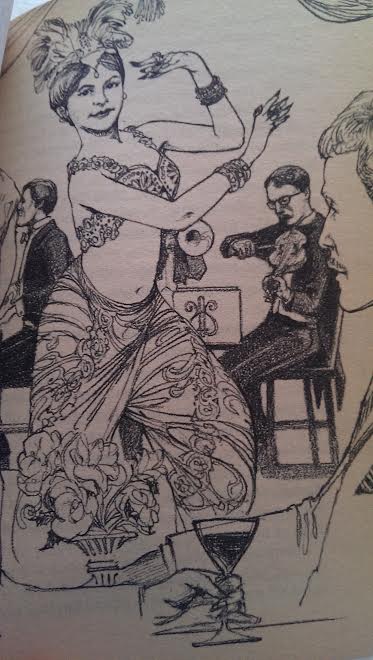
The Eye of the Morning — Mata Hari was one of the most famous spies of all time, although she wasn’t really successful. It was more her reputation as a dancer and the manner of her death that made her famous.
The Phantom of the Desert — Lawrence of Arabia was actually Thomas Edward Lawrence, a British army Captain. He helped the Arabs to fight against the Turks during WWI.
The Spy without a Country — A poor young man from Hungary with a habit of telling tall tales left home to seek his fortune and eventually ended up becoming a Member of Parliament in Britain under the name of Trebitsch Lincoln. However, when Trebitsch Lincoln was in need of money during WWI, he decided to turn to spying.
Mincemeat Swallowed Whole — This is one of my favorite true spy stories! During WWII, the British concocted a scheme to give false information to the Germans using a dead body that supposedly was a drowned British marine carrying important documents.
The Clenched Fist — Fritz Kolbe spied for the Allies from within Hitler’s foreign office during WWII.
The Third Man — Harold “Kim” Philby was a spy for British intelligence during the Cold War, but he was secretly working for the Soviet Union.s
The Spy Next Door — Colonel Rudolf Ivanovich Abel was a Russian spy who posed as an ordinary American, Emil Goldfuss, in New York City. After he was captured, the Americans decided not to execute him, although that was the usual punishment for espionage. Instead, he was held prisoner until he could be used for the famous prisoner exchange where he was traded to the Russians for the captured U-2 pilot, Francis Gary Powers.
After their father’s death during World War I (then called The Great War), the Dalton twins’ mother started supporting their family by writing. It’s the summer of 1918, and Dorothy Dalton is now writing the scripts for a silent movie serial starring the fifteen-year-old twins, Nelly and Fitzhugh. Times have been tough for them without their father’s support, but the serial means steady work and salaries for all three of them for the entire summer, enough to support them and buy school supplies for the fall, and maybe even enough to buy back some of the things that their mother pawned to keep their family going when they had to move out of New York to a less expensive town in New Jersey.
The movie serial, called In the Kaiser’s Clutch, is about a pair of wealthy American twins (played by Nelly and Fitz) who find themselves battling German spies. The serial is part adventure story, part American war propaganda. It’s also a subject that hits close to home. The Dalton twins’ father wasn’t killed while fighting overseas. He was in charge of the security force for the piers of Black Tom Island, just off the coast of New York, the port where most of the weaponry destined for the war in Europe was being shipped. However, a massive explosion destroyed the port at Black Tom and killed Mr. Dalton. Fitz wishes that he were old enough to fight directly in the war, but failing that, he wants to find the people who killed his father because he is sure that his father’s death was due to deliberate sabotage, not an accident. However, it’s possible that the saboteur himself is looking for the Dalton family.
Strange things start to happen which the twins realize may have some bearing on their father’s death. Someone has been spying on the family, listening by the window of their apartment. Then, the director of their movie serial hires a new, part-time actor to play one of the villains, and this man is oddly similar to the fleeing figure of the man who was spying on them. This new actor is German, and he seems to have some weird grudge against the twins, muttering insults in German and taking advantage of the stunts they have to perform in the movies to hurt and frighten them. There are plenty of opportunities for the twins to get hurt on the movie set because each episode of the series has to end with a cliff-hanger scene, and there are no stunt doubles. (Early silent movies in real life typically didn’t have stunt doubles, and the stunts were difficult and dangerous for the actors themselves. This YouTube video explain how Buster Keaton, a famous silent film actor, performed his own stunts.) From fist fights to car chases to quicksand to a cave-in to a giant pendulum with a mysteriously sharpened edge to sudden explosions, the Dalton twins are constantly teetering on the edge of disaster, not all of it planned by their writer mother.
Mrs. Dalton admits to the twins that, shortly before their father died, he told her that he was close to uncovering something that would be a much better story than anything she could make up. Unfortunately, he never told her what it was. He did tell her that he was making notes about it, but those notes were never found and may have also been destroyed in the explosion. The only odd thing that Mrs. Dalton found after her husband’s death seemed like an ordinary shopping list: “cigars, eggs, dumplings, coal, pencils.” However, Mrs. Dalton realized later that it has to mean something else because her husband didn’t smoke.
Could this somehow be the clue to what her husband was investigating before his death? Are there real spies operating in the area? Is there some other clue to their identity that they are now searching for, something that the Daltons still have in their possession? Will the Dalton twins manage to find the spies before the spies eliminate them? Will the family finish the serial and collect their salaries? Find out in this exciting installment! (There’s only one installment here because this is just a single book, not part of a series, but you get the idea.)
My Reaction
World War I books aren’t quite as common in children’s literature as World War II stories, so I found this interesting, and movie serials are also a fascinating thing of the past. The movies that the kids are acting in are black-and-white silent films, so there are interesting discussions of the techniques they use to make things show up properly on black-and-white film (makeup, dyeing the water black for Nelly’s near-drowning scene, etc.) and conveying emotion when the actors’ voices will not actually be heard. It’s a fun and fascinating story with spies, government agents, and the kind of movie stunts that I’m sure a lot of kids wish they could do for their summer jobs!





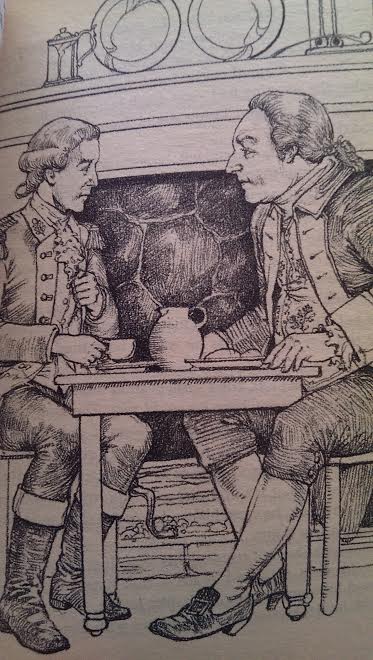 The Gentleman Spy — This is the story of Captain John Andre and General Benedict Arnold during the American Revolution. John Andre was a British officer who was executed for his role in helping Benedict Arnold defect to the British side.
 The Phantom of the Desert — Lawrence of Arabia was actually Thomas Edward Lawrence, a British army Captain. He helped the Arabs to fight against the Turks during WWI.
 In the Kaiser’s Clutch by Kathleen Karr, 1995.
 Jestress's Forgotten Books and Stories