When Clay Sings

This children’s picture book is a salute to the ancient makers of Native American pottery, dedicated to these makers and the museums that preserve their work. It’s written as free form poetry with images of the American Southwest and designs from Native American pottery.

The story sets the scene on a desert hillside, where pieces of ancient pottery are buried. Sometimes, Indian (Native American) children dig up pieces of old pottery, and their parents remind them to be respectful of what they find because they are pieces of the past and of lives that went before. Sometimes, they’re lucky enough to find pieces that fit together or even a bowl that isn’t broken.

They reflect on the time and skill that went into making the pottery and how strong the pottery would have to be to last well beyond the lives of the people who made it. They think about the people who painted the beautiful designs on the pots and what their lives were like. Could their own children have requested favorite pictures painted on their bowls?

Some designs show animals or bugs or hunters, but others show bizarre creatures that might be monsters or spirits. Others show a medicine man trying to cure a child, ceremonies, dancers in masks and costumes, or the traditional flute player. People can reflect on the lives of those long-ago people and how they compare to the lives of people today.

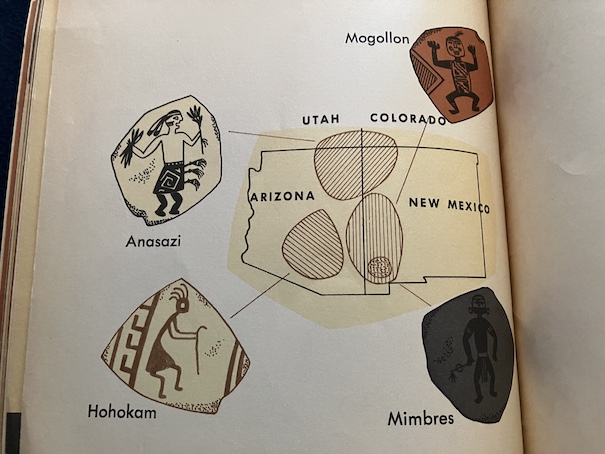
There is a map in the back of the book which shows the areas of the American Southwest (Arizona, New Mexico, Utah, and Colorado) where the pottery designs the book uses originated from and the tribes that used them.

This is a Caldecott Honor Book. It is available to borrow and read for free online through Internet Archive (multiple copies).

I grew up in Arizona, and I remember our school librarian reading books by Byrd Baylor to us in elementary school during the late 1980s or early 1990s. She wanted to introduce us to this author because she wrote about the area of the United States where we lived. In fact, this book about pottery was fitting because, when they were building our school in the 1970s, they found some ancient pottery. They used to have it on display in the school library. Even to this day, it’s common for people creating buildings in this area to have the site surveyed by archaeologists. Finds are fairly common, and the usual procedure is to thoroughly document everything that gets uncovered before burying it again in the same location and constructing the building over it. One of the reason why they usually rebury finds is that, in this dry, desert climate, putting them back into the ground will actually preserve them very well. It’s possible that later generations will find them again (especially with the location documented) when the building is gone or no longer necessary, but they may have better instruments or techniques for analyzing them.

I’m a little divided on how much I like this book, though. On the one hand, I like books about folklore and traditional crafts, and this book focuses on a geographical area that’s very familiar to me. On the other hand, the free verse poetry that reflects on the feelings of people about the pottery doesn’t appeal to me quite as much as books which show the process of making it, like The Little Indian Pottery Maker. I like to see the process and learn more of the known background legends of some of the designs than just try to imagine what things might have been going through the minds of the designers. Toward the end of the book, they show the legendary humpbacked flute player, but they don’t tell you that this figure is called Kokopelli and that there are legends about him. It’s a nice book, but I just felt like there was potential to include more background information.

This book uses the word “Indian” for “Native American” or “America Indian”, which is common in older children’s books.

Happy Haunting, Amelia Bedelia

Amelia Bedelia

When Amelia Bedelia arrives at the Rogers’s house just before Halloween, she is appalled by all the cobwebs. The house looks like a run-down haunted house, and Amelia Bedelia thinks someone wrecked it. Mr. and Mrs. Rogers reassure her that the house is just decorated for the Halloween party they are having that night. Amelia Bedelia almost forgot what day it was because she’s been busy, helping the local children make their costumes.

When Amelia Bedelia tries to help the Rogers get ready for the party, she demonstrates that she still takes everything way too literally. When Mr. Rogers asks her to both get the hammer and to crack a window, Amelia Bedelia assumes that he means her to use the hammer on the window and actually breaks it. When they ask Amelia to add an extra leaf to the table for the guests, she assumes they mean a tree leaf, and when Mr. Rogers asks her to hand him a witch, she asks him “Which what?”

Amelia Bedelia is enough to drive anyone batty, but she really does her best work in the kitchen. She is a good cook, and she and Mrs. Rogers have fun making a bunch of traditional Halloween goodies. Then Cousin Alcolu arrives with a bunch of pumpkins and a scarecrow for the party. They ask Amelia Bedelia what costume she will wear for the party that night, but she doesn’t have one. Mrs. Rogers says that she has an idea for her and for Cousin Alcolu.

The Rogers’s party that night is a success, and Amelia’s influence is obvious in the literal nature of some of the treats and the costumes she helped the children make. However, nobody can figure out where Amelia Bedelia is. At first, Mr. Rogers thinks that maybe Amelia is offended because he mistakenly called her normal outfit a costume, but then, he is sure that he recognizes Amelia Bedelia in her Halloween costume. Is he right? It certain seems something strange is going on! But, then again, Amelia Bedelia is there.

The book is available to borrow and read for free online through Internet Archive (multiple copies).

This is one of the newer Amelia Bedelia books, written after the death of the original author. Parts seemed a little cheesy to me, like Amelia Bedelia seeming confused about the Halloween decorations after helping the children make Halloween costumes. Amelia Bedelia is often a little mixed-up, but getting confused about the nature of the holiday just seemed to be overdoing it. Then again, even in the original books, she was confused about ordinary things associated with holidays, like what kind of “star” goes on top of a Christmas tree. It might be more in character than I thought at first, and it just seemed like overdoing it in this book because I read the original books when I was a kid wasn’t thinking that deeply about it back then.

I did like it that Amelia Bedelia’s tendency to be overly literal is going strong in this book. Besides the mistakes she makes while helping Mr. and Mrs. Rogers get ready for their party, I enjoyed seeing the costumes that Amelia helped the children make. They’re all puns and literal interpretations of common expressions. Amelia Bedelia’s own costume is a fun twist!

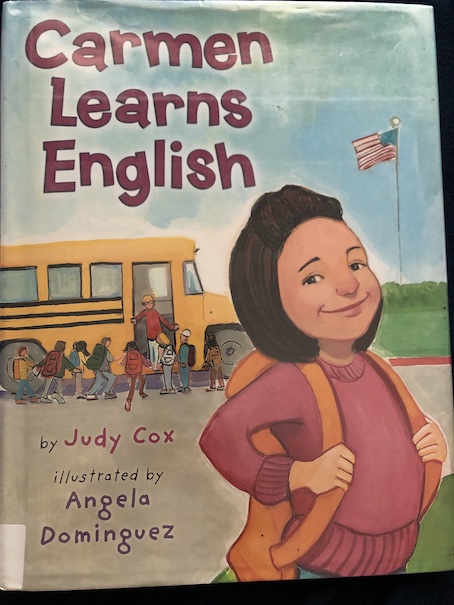
Carmen Learns English

Carmen is in kindergarten and has been learning English at school. Her little sister, Lupita, will start school next year, and Carmen thinks about how she wants Lupita to learn English before she starts school. The family is from Mexico, and the girls speak Spanish at home.

School hasn’t been easy for Carmen because the other kids don’t speak Spanish. They all speak English, and they speak fast, which makes it difficult for Carmen to follow their conversations. It helps that her teacher knows some Spanish. Her teacher’s Spanish isn’t very good, but in a way, Carmen finds that comforting because her teacher will understand if her English isn’t very good, either. People who are learning another language understand what it’s like when someone else is learning, too.

Carmen gradually learns new English words at school. When she gets home, she draws pictures of what she’s learned and teaches her mother and little sister the English words. At first, Carmen is too shy to say the words out loud at school because she isn’t confident about how she’s saying them, but she practices at home.

Sometimes, kids at school give Carmen a hard time. Some kids think that she talks funny. When she counts in Spanish instead of English, they think that she’s saying the numbers wrong. Her teacher helps by teaching all the class to count in both Spanish and English, so all the students will learn both languages. Carmen helps to teach the other students words in Spanish, and when she gets home, she teaches Lupita the English words that she has learned.

Because Carmen has been helping Lupita to learn English, Lupita will have an easier time at school than Carmen had when she started. Carmen realizes that she really likes teaching, and she thinks that she might like to be a teacher herself someday.

I thought this was a good story about a child starting school while having to learn a new language at the same time. My mother used to teach English language learners, and she liked the story, too. She said it reminded her of some of the students she used to teach.

I thought that the teacher’s approach, having Carmen teach the other kids some Spanish while she was learning English was a good idea. Some of the other students find Carmen a little strange and confusing at first because they don’t understand the way she speaks, but when they start trading words in different languages, they all start to understand each other better. The other students begin to understand the concept that people can speak in different languages and that there can be different words that mean the same thing, depending on the language they’re speaking. I think it also helps them start to identify with Carmen because, like her, they are also starting to learn an unfamiliar language. As I said, people who are learning a new language or who have studied another language before can understand the difficulties of now always knowing all the words they want to say or exactly who to say them and can sympathize with other people who are also learning new languages.

I also liked it that Carmen realizes that, if she helps her sister to learn some English before she starts school, her sister will have an easier time. She has compassion for her sister because of her own experiences and wants to make things easier for Lupita. By helping both her sister and her fellow students, she also learns that she likes sharing what she knows with other people. She discovers that she likes teaching and might want to be a teacher herself someday.

I read this book as an adult because it’s a relatively new book that didn’t exist when I was a kid, but it reminds me of another book that I did read as a kid, I Hate English, which is about a girl from China learning English. The Chinese girl has some similar troubles learning English and feeling uneasy around people who don’t understand her, although she also struggled with the fear that she would lose her native language or cultural/personal identity by learning a new one. Carmen doesn’t mention that in this story, but some of my mother’s old Spanish-speaking students had that worry when they were learning English, too. Perhaps part of the reason why Carmen doesn’t feel like that is because her teacher encourages her to teach the other students some Spanish, giving her the opportunity to keep speaking it from time to time and share the language with others. In a way, this story was closer to my experiences when I was younger because Carmen is like the kids my mother used to teach and because Spanish is what I studied in school myself.

Mystery of the Strange Traveler

This book was originally published under the title The Island of Dark Woods.

Laurie Kane and her older sister, Celia, are traveling by train without their parents to visit their Aunt Serena in New York. Aunt Serena has invited the girls to come stay with her while their parents are traveling in Asia for one of their father’s newspaper assignments. In her letter to the family, Aunt Serena hints at exciting things that are happening. She used to be a schoolteacher, but she says that she’s starting a new business, and the girls can help her with it, although she won’t say what it is until they arrive. Also, Aunt Serena has recently moved to a new house. When their father sees where she’s living now, he’s intrigued because it’s the location of their “ancestral mystery.” He would tell the girls the story himself, but Aunt Serena says in her letter that she would like to be the one to tell them about it. There father says that Aunt Serena loves being tantalizing and mysterious. Laurie, who loves mystery stories, wonders about it all the way to New York.

Aunt Serena lives in a wooded area on Staten Island, near Clove Lakes Park. She has a small red brick house with another outbuilding on her property that she says used to be an old cobbler’s shop. Her new business idea is to turn it into a small bookshop. Laurie loves it immediately because she loves books. She wants to be an author herself, and Aunt Serena says that she might even get a chance to meet her favorite author, Katherine Parsons, because she lives in the area. Celia is the practical one, and she asks Aunt Serena all the practical questions about how she plans to get people to come to her little shop when there are no other stores around them to draw customers in. Aunt Serena says that she’s not expecting her shop to turn into a big business. It’s more of a small hobby business to bring in a little extra money and also be a fun activity.

Laurie and Celia begin unpacking some of the books that Aunt Serena will sell in her small shop, and Laurie is pleased to see a collection of books by Katherine Parsons. On the back of one of the books, there’s a picture of the author and a short biography. Laurie is pleased to note that Katherine Parsons is left-handed, like herself. There are times when Laurie has difficult with things because she’s left-handed, and she feels a kinship toward the author because she shares that trait.

Meanwhile, Celia has noticed that there is a boy next door, moving the lawn. Laurie is more interested in books than boys, so she doesn’t find this exciting news. Celia tries to get the boy’s attention, but he seems to be ignoring her. When he does seem to notice the girls, he turns away quickly, like he wants to avoid them. Celia points out to Laurie how the house where the boy is looks very different from the rest of the houses around it – big, old-fashioned, dark, and creepy. Laurie comments that it looks haunted, and their Aunt Serena surprises them by saying it is.

The boy, Norman, lives with his grandfather, Mr. Bennett, in the old house. Mr. Bennett is a difficult man, and Aunt Serena admits that she got on his bad side when she first moved to the area by asking him if she could buy his house. Aunt Serena admits that she didn’t actually want to buy Mr. Bennett’s house; she was only using her inquiry as an excuse to talk to him and maybe get a look inside the house. However, Mr. Bennett took offense at the inquiry.

There is another boy in the neighborhood called Russ Sperry, and he’s friendlier. His mother sends him to bring a cake to Aunt Serena, and Aunt Serena says that she hopes he will be friends with the girls and show them around. Russ stays awhile to have some cake and chat, and he mentions that Norman Bennett’s father is in South America because he has a job there, which is why he’s staying with his grandfather. Aunt Serena says that Norman’s mother is dead and that his father rarely comes home. She doesn’t approve of the lonely way Norman’s grandfather seems to be raising him because it seems like Norman doesn’t have any friends. Laurie thinks that Norman’s loneliness is at least partly his own fault because he seems to avoid contact with people when she and Celia try to approach him. Celia decides that Russ is cute, but Laurie finds herself intrigued by Norman, not because she wants to flirt with him but because there’s an element of mystery about him.

The girls try to ask Aunt Serena more about what she means when she says that the Bennett house is haunted, but she says that she would rather talk about that later. She gets the girls busy unpacking their belongings, arranging things in her shop, and talking to Russ about the area. Russ helps to explain the geography of Staten Island, and Aunt Serena tells the girls more about the history of the area. Aunt Serena mentions that there are dances in the park on Wednesday nights, which sounds exciting to Celia. When Laurie spots Norman passing by, wearing riding clothes, Russ explains that there are a couple of stables in the area, where people can rent horses. There are plenty of things for the girls to do in the area, and Aunt Serena begins planning an opening party for her bookshop, with Katherine Parsons there as a special guest to sign her books.

Laurie is excited about the party and the opportunity to meet Katherine Parsons, but she continues to think about the mystery of why Norman seems so unfriendly. Soon, other strange things start happening. One night, she sees a light in Aunt Serena’s bookshop, as if someone were sneaking around in there. However, when Laurie goes to wake Aunt Serena to show her, the light is gone, and the next day, there aren’t any obvious signs that anything in the shop was disturbed.

When Laurie has a chance encounter with Mr. Bennett, where she asks him if he’s ever seen the ghost that haunts his house, he says, no he hasn’t seen it. The ghost is supposedly a phantom stagecoach, but Mr. Bennett doesn’t believe it exists. Once Laurie knows that there’s supposed to be a phantom stagecoach, she tries to press Aunt Serena for more details, but Aunt Serena refuses to tell them the rest of the story until she can tell them on a gray, stormy day, when the atmosphere is right.

When a stormy day comes and Aunt Serena agrees to tell the story, she allows Celia and Laurie to invite Russ and Norman over to hear it, too. Norman comes to hear the story without his grandfather’s permission because he’s always known there was some story about the house, but his grandfather hasn’t wanted to talk to him about it. When Aunt Serena tells the ghost story, the connections between the Kane family and the Bennett family become clear.

About 100 years before, there was a stagecoach route that ran through this area. One stormy day, a stagecoach was passing through the area, and one of the passengers, a woman with an infant daughter, was seriously ill and had become delirious. The stagecoach driver sought help at the Bennett house. The Bennetts brought the sick woman inside the house, along with the infant daughter. The stagecoach driver sent a doctor to tend to the woman, but she died in the Bennett house. They had no idea who the woman was and were unable to trace her origins or family. If the woman had a husband or the infant girl had a living father, the man never showed up to inquire after his wife or to claim the baby. All the Bennetts had do go on were the meager possessions the woman was carrying with her, and the little girl herself, whose last name was unknown but the mother had called “Serena.”

At this point, Serena explains that this Serena was the ancestor of the Kane family, the great-grandmother of Celia and Laurie. Since nobody was able to discover where she and her mother came from or locate any relative, the Bennetts adopted the first Serena and raised her until she grew up, got married, and moved away from the island. However, local people still tell stories about the terrible day when the first Serena and her ill mother were brought to the area, claiming to have seen a ghostly stagecoach pull up to the Bennett house and a ghostly woman get out.

Laurie is intrigued by the mystery surrounding her family’s origins. Aunt Serena shows them some of the belongings that the first Serena’s mother had when she died, which have been passed down as heirlooms. There was a doll with doll clothes, a woman’s dress with bonnet and gloves, a sewing kit, a fan, an old novel the woman must have been reading at the time, and a purse containing a very old coin. The old coin is another oddity about this strange situation because it dates from before the Revolutionary War and would have been long obsolete by the time the woman died during the 19th century. Is it still possible to solve a mystery that’s about 100 years old? Will Laurie and her family ever learn who their ancestors really were? Why does Mr. Bennett not want them to visit his house or talk about the old mystery or the ghost story? Does he know more about them than he wants to admit?

The book is available to borrow and read for free online through Internet Archive.

The mystery in the story unfolds slowly, which might make people who are used to faster-paced modern stories a little impatient. Aunt Serena takes quite a while from the time when she first mentions that the house next door is haunted until she actually explains what the ghost is supposed to be and what the mystery surrounding their family is. However, Aunt Serena values atmosphere, so the story could appeal to people who don’t mind a slower-paced mystery as long as it has a good atmosphere.

When the mystery does begin, some parts are resolved quickly and others are more of a puzzle. The idea of an orphan with an unknown identity and a hidden past is always intriguing. The light in the bookshop at night, on the other hand, turns out to be less of a mystery, and Mr. Bennett’s reluctance to discuss the ghost story and the old mystery turns out to be nothing sinister. Mr. Bennett doesn’t really have any hidden knowledge about the orphaned child or her dead mother. It’s just that he’s a very reclusive person who craves peace and quiet so he can work on his private projects. He also has some resentment toward the Kane family because, while they used to be very close, Laurie’s grandfather was the one who inspired Mr. Bennett’s son to take a job in another country, which is why Mr. Bennett and Norman rarely see him. By the end of the story, though, things get patched up between them.

Every time the matter of the mysterious orphan and the question of whether or not the house is haunted by her mother is raised, Mr. Bennett has had to deal with a bunch of people and reporters stopping by his house, harassing him with questions and asking for tours of the place, and he’s sick of it. He doesn’t want Aunt Serena or the kids raising the issue again because he doesn’t want to deal with everybody’s questions anymore, and he has no more information to give anyone. As far as he’s concerned, the mystery is unsolvable because he thinks whatever trail there might have been has long since grown cold, and if it were ever possible to learn the dead woman’s identity or the real origins of the child, someone else would have figured it out a long time ago. However, Laurie tells Mr. Bennett that she thinks that there’s still a chance to figure it out, and that plays into one of the major themes of the story.

The atmosphere of the story is pleasant, with Aunt Serena’s cheery little house decorated with bowls of wildflowers and her little bookshop. Aunt Serena greatly believes in establishing atmosphere, creating scene, and setting a mood. On the stormy day when Aunt Serena finally tells the girls the local ghost story, she makes it a point to set the atmosphere for the story by making popcorn and lighting candles.

Like other books by Phyllis Whitney, this story is set in a real location and uses some of the history of that location. The original title of this book came from the original Native American name for Staten Island, Monocknong, which the fictional author in the story, Katherine Parsons says means “The Island of Dark Woods.” Mr. Bennett disagrees, though, saying that it actually might mean, “The Place of the Bad Woods,” and they debate about different possible translations and meanings of the phrase. The history of the Staten Island plays directly into the story because it turns out that Laurie’s ancestors were involved with the historical events of the area, particularly Santa Ana’s stay on Staten Island after the Battle of the Alamo in Texas that was part of the Texas Revolution against Mexico.

A couple of other points I’d like to make regarding history are about race in the story. Toward the end of the book, Mr. Bennett hires “a young colored woman” as a housekeeper. “Colored” is a dated term in the 21st century, but this book was written in the 1950s, when that was considered one of the more polite ways to refer to black people. The popular terms we use now (“black” as the informal generic term and “African American” as the formal term specific to black people of African descent who live in the United States) came into use after the Civil Rights Movement as people tried to distance themselves from older terms as a way to shed the emotional baggage associated with them. The housekeeper, Anna, becomes friendly with Laurie, and she offers her a new perspective and some helpful advice about a different approach to tracing her family’s roots. Anna enters the story late, so she doesn’t appear much, but she is helpful, and I didn’t notice anything particularly stereotypical about her, although I suppose the idea of a black person in domestic service might be kind of cliche.

The other thing I wanted to mention is that American Indians are referred to multiple times in the story when the characters discuss the island’s history. The characters always refer to them as just “Indians” instead of “American Indians” or “Native Americans”, which is typical of the 1950s. At one point, Celia and Laurie are discussing their role in the island’s history. Celia talks about how she was glad that she wasn’t around then because there were massacres and “the Dutch kept buying the island from the Indians and the Indians kept taking it back.” However, Laurie says that was “because the white men cheated them.” I appreciated that Laurie acknowledged that, and I think that this exchange not only highlights some of the stereotypical views people had in the 1950s about Native Americans and history, but also differences between the ways Celia and Laurie look at other people. I have more to say about that below, but Celia tends to cling toward accepted views and the general social rules of society while Laurie has a talent for empathy and looking at situations from another person’s perspective. I’ve noticed that the author, Phyllis Whitney, has used this technique in other books of hers to subtly challenge stereotypes, pointing out that different groups of people have their own perspective and their own side of the story.

This book is fun for book lovers. Laurie’s favorite author, Katherine Parsons, is fictional, but the story captures the spirit of book lovers. It turns out that Norman is a book lover, too, and Laurie is able to draw him out and bond with him over their shared love of books. Aunt Serena also praises Laurie for her ability feel empathy for other people, a quality that she believes comes partly from Laurie being a book lover. After all, readers are accustomed to the idea of seeing circumstances through the eyes of someone else and experiencing their thought processes when they read a story. Aunt Serena believes that one of the benefits of reading it that it helps to cultivate a person’s skills in using empathy to understand other people and that readers carry that technique over into the real world.

I will say, though, that Laurie’s story took an unexpected turn. Laurie is a book lover, but through her association with Katherine Parsons, she unexpectedly realizes that, while she’s always dreamed of writing stories and being published, she doesn’t actually like the writing process. She enjoys the stories other people have written, and she has a knack for understanding characters, whether real or on the page, but she’s surprised to realize that the routine of writing doesn’t appeal to her. She feels a little sad at the realization because it means giving up an old dream but also a little relief because her life is now open to more possibilities that she might like better.

I also enjoyed the relationship between the two sisters in the story. They get on each other’s nerves and fight with each other sometimes, but they also care about each other and make up with each other after fighting. Celia, as the older sister, is more interested in boys than Laurie is, and she has all kinds of social rules about how to talk to boys and how to get their attention. Laurie knows that Celia and her friends talk about these things a lot, but Laurie doesn’t really understand all of their little rules and thinks a lot of them sound silly, like the idea that girls can’t invite boys to things but have to wait for the boys to ask them or that they should pretend like they’re not too interested in a boy so the boy will approach them first. This book was written in the 1950s, so a lot of Celia’s social expectations about how girls and boys should act around each other sound dated, but I enjoyed Laurie questioning Celia’s rules.

Laurie thinks it more important to know about what specific people like and how to appeal to them as individuals than to adhere to more general social rules. This is especially apparent when the girls try to get Mr. Bennett to let them in his house and talk to him. When the sisters compete to ingratiate themselves to Mr. Bennett so they can get access to the house and talk to him about the mystery, their different approaches play on their concepts of social rules and human empathy. Celia tries a very conventional approach, trying to appeal to Mr. Bennett in a general way, but Laurie decides that “Mr. Bennett was too much of an individual to be governed by rules that worked for most people” and tailors her approach to him as an eccentric individual.

Celia’s idea is to make some homemade cupcakes and take them to Mr. Bennett as a gift because she believes in the old axiom that the way to a man’s heart is through his stomach. As Laurie suspects, though, this approach falls flat because Mr. Bennett isn’t interested in baked goods. Laurie has a better idea of what Mr. Bennett really likes because she has talked to Norman about him, and she decides that the way to get his attention is to demonstrate a shared interest in something he likes. Knowing that he likes nature more than anything else, she starts putting together a collection of interesting leaves and asks Mr. Bennett if he can help identify them. Mr. Bennett isn’t really impressed by her collection because she didn’t mount the collection properly, most of her collection is very common leaves that he thinks she should be able to identify if she knew anything about trees, and she also included a sample of poison ivy, which she should have known better than to touch. However, he is sufficiently amused by her efforts and her mistake to talk to her for a few minutes.

One of the major themes of the story is that “No man is an island”, meaning that people do need other people. Aunt Serena is concerned that Mr. Bennett’s obsession with solitude is hurting his grandson because he’s making it difficult for Norman to make friends. Mr. Bennett has forbidden Norman to bring any other kids to the house because he doesn’t want to deal with the noise and disturbance. Because she’s been a teacher, Aunt Serena knows that Norman needs more opportunities to socialize with his peers. Mr. Bennett doesn’t even seem to pay much attention to Norman himself because he’s too absorbed in his own work.

What Laurie points out to Mr. Bennett when Mr. Bennett tries to tell the kids that the old mystery is unsolvable is that a group of people working together can accomplish more than any one person, working alone. They don’t have many clues to the past, but just because they don’t all make sense to any one of them doesn’t mean that parts of them wouldn’t make sense to different people. By pooling their knowledge and consulting other people, they could still put together the pieces of the past.

Along the way, Laurie also makes Mr. Bennett realize that there are many things he doesn’t know about Norman. Even though he and Norman have been living alone together for a long time, Mr. Bennett hasn’t paid much attention to Norman or things Norman has been doing. Norman has felt lonely and neglected, although he hasn’t wanted to admit how much. When Mr. Bennett realizes that Norman is an artist and has been developing his skills to an impressive degree without him even seeing any of Norman’s projects, he realizes that he has been too absorbed in his own concerns and starts to make an effort to learn more about what’s happening in the lives of the people around him. This is a similar situation to a grandmother in another of the author’s books, Mystery of the Angry Idol.
The Mystery of the Silly Goose

Three Cousins Detective Club

As soon as they arrive home from their trip to the powwow in the previous book, the cousins are approached by Timothy’s neighbor, the snobby 13-year-old Lyddie, with another mystery. While they were out of town, someone went around the neighborhood, stealing lawn ornaments. Lyddie is concerned because her grandmother has come to live with her and her parents, and her lawn geese were stolen. One of the geese was the mother goose with a silly-looking bonnet on her head, and the others were her goslings. Lyddie’s grandmother is rather attached to the geese because they were a present from someone.

The three cousins don’t really like Lyddie because she and her friends are usually unfriendly and too concerned with being “cool” all the time. However, they feel sorry for her grandmother and agree to take the case. To their surprise, most of the lawn ornaments are actually pretty easy to find. They were hidden in some obvious places around the neighborhood. The only ones that are difficult to find are the geese. Who hid the lawn ornaments and why?

The theme of this story is Proverbs 24:3-4, “It takes wisdom to have a good family. It takes understanding to make it strong. It takes knowledge to fill a home with rare and beautiful treasures.”

The book is available to borrow and read for free online through Internet Archive (multiple copies).

Part of the mystery has to do with image, but it also has to do with sentimental attachment. Lyddie is very obsessed with image because she and her friends try so hard to maintain their cool image. Although she calls in the cousins to find the missing lawn ornaments, she only does it because her grandmother takes the loss of the mother goose so hard. Lyddie doesn’t see why the goose is so important, although she knows that her grandmother is attached to it because it was a present from someone.

The situation changes when Lyddie’s grandmother reveals the full story behind the lawn geese and her own understanding of the situation. Lyddie cares for her grandmother, and she comes to see the geese in a new light once she understands why they matter to her grandmother. It’s not the value of the geese, and it’s not about how the geese look. It’s all about the person her grandmother associates with them. Fortunately, Lyddie’s grandmother is a very understanding woman, and when the lawn ornament thief explains the issue, they work things out to everyone’s satisfaction.

Maria’s Comet

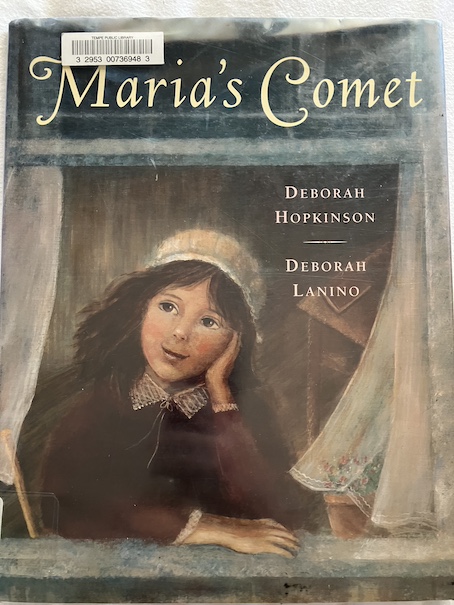
This picture book is a fictional story about a real person, Maria Mitchell. (She pronounced her first name “ma-RYE-ah”, not “ma-REE-ah”.) Maria Mitchell was born into a Quaker family on Nantucket Island, Massachusetts in 1818, and she became the first female astronomer in the United States. She is known for discovering a comet only viewable through a telescope in 1847, and she also became the first astronomy professor at Vassar College. She is the namesake of the Maria Mitchell Association, a science center on Nantucket. She was also an abolitionist, although this topic is not touched on in the book. Maria’s father taught her about astronomy when she was young and encouraged her interests and career at a time when not many women were encouraged to pursue careers or higher education.

Maria’s papa is an astronomer. At night, he goes up on the roof their house to use his telescope, and he explains how the telescope works, gathering and focusing light to make distant objects look larger and closer than they would with just a person’s eyes. He especially likes to look for comets. In their time, they’re not entirely sure what comets are made of, and that’s part of what makes studying them interesting. Maria imagines what it would be like to travel across the sky with a comet, encountering the different planets.

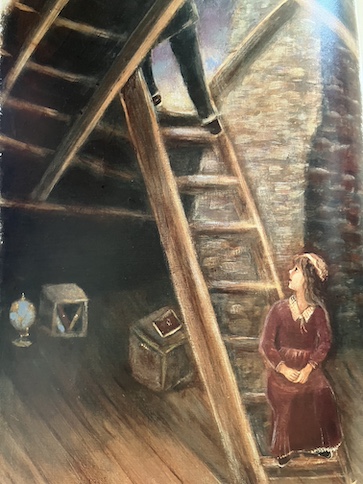
Most of Maria’s life centers around their house and family in Nantucket. There are nine children in the family, so Maria helps with chores and tells her siblings bedtime stories. Sometimes, she and her brother Andrew go into the attic and use an old atlas to pretend that they’re explorers. When they read books, Maria likes books about astronomers, but Andrew likes books about sailors. He wants to be a sailor himself.

When Andrew gets older, he runs away from his family to go to sea on a whaling boat. The entire family is sad that he is gone, and Maria soothes her siblings by telling them stories about all of the amazing places their brother will go. That night, after supper, Maria asks her father if she can come with him to look through his telescope or “sweep the sky” as she thinks of it. For a moment, Maria thinks they will say no, but they agree. Maria wants to be an explorer of the sky, like her brother wanted to explore the seas.

Maria’s father points out Polaris, the North Star, to Maria and says that sailors use it to navigate. Maria wonders if Andrew might be looking at the same star right now. Then, she sees a comet streak across the sky.

There’s an Author’s Note in the back of the book that explains about the real life of Maria Mitchell. It has some comments about what people of her time knew and didn’t now about the planets. When she was young, people only knew about seven planets in the solar system. Neptune was discovered during her lifetime (although not by her), and Pluto wasn’t discovered until 1930, after she had died. There is also a section about the astronomy terms used in the story and famous astronomers.

I enjoy books about historical people, although the author admits in the Author’s Note that this particular story about Maria Mitchell is fiction. I have mixed feelings about that. I don’t like to fictionalize real people, and I’m not entirely sure whether there’s any truth to the story about Maria’s relationship with her brother and how she felt when he left to become a sailor. On the other hand, I did appreciate how the book showed Maria becoming interested in astronomy by watching her father and joining him in his studies of the sky, which is apparently true. Overall, I did enjoy the story.

The pictures in the book are wonderful. They capture the coziness of an old-fashioned 19th-century home and also the wonderment of looking to the skies and imagining exploring the big, wide world and the stars beyond it.

Noel

Noel by Tony Johnston, art by Cheng-Khee Chee, 2005.

This lovely Christmas picture book reads like a Christmas carol!

There is no story in the book. The text is poetry that celebrates the atmosphere of Christmas, the feelings in nature as anticipation builds and in cities as people gather to celebrate.

“Noel” is described as the sound of Christmas, like a bell, that people and animals all listen to hear.

The artwork is beautiful, and there are scenes of people participating in classic Christmas celebrations, with a Christmas parade, snowmen, a public Christmas tree, and a sleigh ride.

The pictures really make the book beautiful and dreamlike. In the back of the book, there is a section that explains the art style. The artist used watercolors and a technique called “saturated wet-paper technique.” This technique is what gives the illustrations their fuzzy, dreamlike quality

The book is available to borrow and read for free online through Internet Archive.

The Silver Nutmeg

It’s late summer, and it’s very hot. The well is dry, so Anna Lavinia has to go to the spring whenever they need water, and the paw-paws are falling off the trees even though they’re not ripe yet. Anna Lavinia is spending most of her time outside, singing songs from her favorite book Songs from Nowhere, because her mother is making the green paw-paws into preserves, and it’s a smelly process. Nothing seems like it’s going right, and even Anna Lavinia’s animal friends are grumpy because of the heat.

Anna Lavinia looks at Dew Pond Hill through the hole that her father recently made in the garden wall. He made it because he’s been thinking that Anna Lavinia has been too cooped up, and he wants to “broaden the horizon for her” and give her a new “point of view” in a very literal sense. Anna Lavinia thinks that she already has many points of views on many issues, but she does like the new vista that her father has opened up for her.

Things seem to improve on this very hot day when Uncle Jeffrey comes to visit. Uncle Jeffrey deals in spices, and he brings herbs and spices with him to replenish the family’s supply. Uncle Jeffrey also likes to collect samples of flowers and leaves, which he keeps pressed in a book with labels of their names (if he knows them) and the places where he found them. This time, Anna Lavinia notices a special purple flower in his book that she has never noticed before. There are no notes about it in the book, but she is sure that it is something special.

Then, she notices three men digging for something by the dew pond on the hill and decides to go see what they’re doing. Uncle Jeffrey warns her against going to the dew pond because he says that dew ponds are always bewitched. However, her mother thinks that’s nonsense and sees nothing wrong with Anna Lavinia going to look at the dew pond. When Anna Lavinia talks to the diggers, they joke with her at first that they’re digging a hole to go to exotic places on the other side of the world, but then, they admit that it’s just a ditch for water. They want to drain the dew pond! Anna Lavinia is upset about that, and they explain that they need the water to grow their parsnips. They say that this won’t be the end of the dew pond because they plan to fill in the ditch, and the pond will eventually fill up again. However, they really need the water now.

Anna Lavinia goes to look at the dew pond and enjoy it while she can, thinking how awful it is that it’s going to be drained just when her father created a new view of it for her. While she thinks about it, she tosses a few acorns in the water. Then, suddenly, one of them jumps back out of the water at her! Strangely, the acorn also seems completely dry. Curious, Anna Lavinia tosses in another acorn. This time, when it flies back at her, it has a note pinned to it that says, “Please don’t throw acorns at me.” When Anna Lavinia looks into the water, she doesn’t see her own face reflected back at her. Instead, she sees a blond boy in a green sweater. She looks around, but she doesn’t see anyone else by the dew pond but herself. When she calls out to the boy to ask where he is, he says that he’s on the other side of the pond – the underside!

The boy says his name is Tobias, and he’s playing with a boat on the pond. Anna Lavinia asks if he can come up to her through the pond, and he says he could but he promised his mother that he wouldn’t. However, she can come through the pond to him, if she likes. He says that, for her to get through, the water must be completely still, no ripples, and that she must jump in as hard as she can. Anna Lavinia asks what will happen if she doesn’t do it right, and Toby tells her that she’d probably just get all wet and get a scolding from her mother. Anna Lavinia debates about it because Toby is upside down compared to her, and she’s not sure how gravity will work on the underside of the pond. Toby says that the right side up depends on your point of view and there is no gravity where he is. He shows her a net in a tree where she can jump and teases her about being afraid. Deciding that it’s a small risk, Anna Lavinia jumps in along with her pet lizard, which she calls a thobby.

It works just like Toby said it would, and Anna Lavinia lands safely in the net. Once in Toby’s land, she experiences a strange sensation that they call “the tingle.” (It’s not a dirty thing, although I did raise an eyebrow at first.) This sensation is a kind of force that Toby says flows through the ground in his land, and it’s what keeps objects from just floating around all the time in the absence of gravity. If you lift an object off the ground, it will float around in the air because there is no gravity, but once it’s in contact with the ground or in contact with another object that’s in contact with the ground, it will stay where it is, held in place by this force, until someone or something else causes it to move. Toby describes it as being like a kind of magnetism.

With Toby’s help, Anna Lavinia experiments with this lack of gravity. Toby explains that people can’t fly in his land, although birds can fly through the air with their wings. People do lose contact with the ground if they skip or jump, but it’s usually not a big deal because they can sort of maneuver themselves in the air until they can get back down to the ground or grab hold of something that’s grounded. It’s impossible to fall.

All of Toby’s world is the underside of our world, and the ground they’re walking on is the inside of the ball that is the Earth. Because it’s the inside of the Earth, it’s dimmer than the outside world. The light that comes through comes through bodies of quiet water, like the dew pond. Toby says that, while people from this inside world can go to the surface area through any still pond, they typically don’t. For one thing, they find it difficult to deal with the gravity of the outside world, and it will turn them bandy-legged if they stay too long. For another, people who left used to be banished by their own people if they returned, so those who have gone to the outside world have often stayed. Toby’s Aunt Cornelia still misses the man she had planned to marry. After the two of them quarreled about his desire to see the world, he vanished, and Aunt Cornelia thinks that he probably went to the outside world, never to return. Things have changed now so that people who left are now allowed to return, so Aunt Cornelia hopes maybe her sweetheart will come back, but Toby doesn’t think there’s much hope of that.

When the children hear a baby crying, Anna Lavinia insists on finding the baby and seeing why nobody seems to be tending to him. It turns out that the donkey pulling a gypsy wagon has pulled the wagon over a cliff, which isn’t as dire as it sounds, since nothing in this land can fall. However, the wagon is now stuck sideways on the side of a cliff, and things from the wagon have been tossed around and are hanging in mid-air, including the baby in his basket. Toby and Anna Lavinia rescue the baby, and his grateful mother offers them a reward for their help. She gives Toby a tambourine, and she tells Anna Lavinia’s fortune. The fortune comes out strangely backward because Anna Lavinia is from the outside world, but from what they gypsy sees, it looks like Anna Lavinia is going to do something to make an old man happy.

Anna Lavinia has a lovely visit with Toby and Aunt Cornelia, but then, she suddenly remembers that the men are going to drain the dew pond today! By the time she and Toby return to the dew pond, it’s dry! With the pond dry on her side, Anna Lavinia can’t get home … unless still waters run deep.

This book is the sequel to an earlier book called Beyond the Pawpaw Trees, which first introduced the character of Anna Lavinia.

The book is sweet and would probably appeal to fans of Cottagecore. The characters sing songs and recite rhymes throughout the story, which might appeal to young children. I was a little divided over whether I liked having the story interrupted by the songs and rhymes, but the songs and rhymes really are a part of the story and add to its charm. It’s a little like Alice’s Adventures in Wonderland, where a girl goes to a magical land, where things don’t work as they do in the ordinary world.

In Alice’s Adventures in Wonderland, there’s a lot of random nonsense, and that’s fun, but I liked that this particular story uses a kind of pseudo-scientific focus on magnetism and gravity. Neither the magnetism nor gravity works the way it does in the real world, and it adds a kind of science-fiction twist to the fantasy world in the story. Even with this almost science-fiction twist, we still have that old-fashioned, cottagecore style fantasy atmosphere that’s charming and whimsical rather than technical. I haven’t read the first book in this series, but I understand that it uses similar concepts. Nothing really stressful happens in the story, and it would make a nice bedtime story.

My one complaint is that there are some stereotypical gypsies and comments about gypsies in the book. They are always referred to as “gypsies” and not Romany or any other name, and for some reason, they make a point at the beginning of the story that gypsies always go barefoot. I’m not sure what the point to that was except to establish that gypsies have eccentric habits. It’s not unusual for children’s books from the mid-20th century to have stereotypical gypsies as characters, although it might rub people from the 21st century the wrong way.

Lowly Worm Sniffy Book

Sniffy books or scratch-and-sniff books were a new development during the 1970s, and they remained popular through the mid-1980s, along with scratch-and-sniff stickers. This particular book features characters from Richard Scarry‘s Busytown series, especially Lowly Worm. The first part of the book has Lowly and his friend Huckle Cat looking at a sniffy book and teaching readers how to use the scratch-and-sniff parts of the picture.

The rest of the book takes readers through the four seasons: spring, summer, fall, and winter. In each season, there are different objects and foods associated with the season for readers to scratch and sniff. In the spring, the characters smell violets and bananas that they eat at the circus.

During the summer, there are lemons for making lemonade and chocolate ice cream sticks that they eat at the beach.

During the fall, there are apples and pumpkin pie at Thanksgiving.

The winter parts focus on Christmas, with pine-scented Christmas trees and gingerbread pigs.

Sniffy books and stickers were common features of my early childhood in the 1980s. I think they still exist, although I don’t know if they’re as popular in the 21st century as they were back when they were relatively new developments. This particular sniffy book was a favorite of mine and my brother when we were little kids.

One of the interesting things about finding some of these older sniffy books decades later is seeing which of the scratch-and-sniff patches have held up over the years. They do wear out over the time, especially the ones that have been scratched more than others, meaning that favorite scent patches will wear out faster. Milder scents are also harder to detect years later than the ones that were always strong. In our old copy of this book, I can’t smell the lemon, chocolate ice cream, pumpkin pie, or gingerbread any more, but the violet, banana, apple, and pine are still fine. I think those scents were always the strongest.

Two Are Better Than One

Two Are Better Than One by Carol Ryrie Brink, 1968.

This is a gentle coming-of-age story about two thirteen-year-old girls in Idaho during the early 1900s, but it’s told in a interesting format, as the reminiscences of one of the girls as an old woman and focusing on a story that the girls were writing together as teenagers. It’s like a story about a story within a story.

One Christmas, elderly Chrystal Banks receives a special present from her old friend, Cordelia Crump. The package contains two miniature dolls (she calls them “pocket dolls”) that Chrystal gave to Cordelia 60 years before. At first, Chrystal doesn’t remember giving her friend Cordy” these dolls but admits that her memory is starting to fail her. As she studies the little china dolls and their exquisite details, she begins to remember them and when she gave them to her friend. The dolls’ names are Lester and Lynette, and Chyrstal remembers how Cordy used to say that the little dolls were magical because any day she carried them seemed to become special and exciting. Even when Chrystal and Cordy grew older, supposedly too old for dolls, they still continued to love and believe in the magic of their special pocket dolls.

Before young Chrystal Reese (as she was known before her marriage) gave the dolls to Cordy, they were a Christmas present to Chrystal from her Uncle Dick. That was the Christmas when the girls were in seventh grade and were early thirteen years old. Uncle Dick had acquired a number of interesting presents for Chrystal on his trip to Europe. He doted on his niece because she had no parents or siblings, living only with her grandmother and Aunt Eugenia and their dog, Rowdy. All of the presents are wonderful, but the little dolls are something special. As she unwraps them, they are hidden within a small box inside another box inside of another box (not unlike the story itself). Chrystal loves the elegant, detailed, jointed dolls immediately and names them Lester and Lynette because they just seem like the right names for the dolls.

Immediately, she goes to see if the little dolls will work well in the dollhouse that she’s made out of orange crates. She has spent considerable time and most of her allowance money putting paint and wallpaper into the little house and making furniture for it. She made all of the dollhouse furniture to fit two small dolls that she already has, Elsie and Eileen. However, Elsie and Eileen are four inches tall, and Lester and Lynette are only about two-and-a-half inches tall, so they won’t work in the house. At first, Chrystal is unsure what to do with the tiny dolls. She loves them, but she’s going to have to figure out where to put them and how to play with them if they won’t fit into the doll house. Then, she gets the idea to give the little dolls to her best friend, Cordy. It’s a sacrifice to part with such a lovely present so soon after getting it, but she wasn’t satisfied that the little bottle of perfume she was going to give Cordy was really a good present. Besides, the girls are so close that they already share everything with each other, and as they like to say “Two are better than one.” Giving the dolls to Cordy won’t be like giving them so much as sharing them with someone who can help to make them even more fun.

Cordelia Lark (her maiden name) grew up in a well-off family with mostly boys. Her father was president of the local bank and president of the school board and a civic leader in other ways, and Cordy had four brothers and no sisters. Cordy and Chrystal are kind of like the sisters neither of them ever had. They like to call each other “Tween”, which is their special pronunciation of “Twin.” They justify being twins because their birthdays are only two weeks apart, so they’re almost exactly the same age.

On the way to Cordy’s house to give her the special Christmas present, Chrystal passes by the courthouse. When she and Cordy pass the courthouse, they can see the barred windows of the jail, and they make up stories to spook each other about how one of the prisoners might escape. On this particular day, Chrystal sees one of the prisoners gripping the bars of his window and looking out. He’s the first prisoner Chrystal has ever actually seen. She’s a little afraid of him, and when he starts talking to her, she doesn’t know what to say at first. The man first asks her what she’s staring at, and then he wishes her a Merry Christmas, even though he’s not having one. Not knowing what else to do, Chrystal murmurs “Merry Christmas” back and hurries on.

When Chrystal gets to Cordy’s house, the two girls exchange presents. It turns out that each of them almost got the other some perfume, but each of them changed their mind at the last minute and decided on something better. Cordy’s present to Chrys (as she sometimes calls her) is a book, which makes Chrystal happy because she loves books and didn’t get any for Christmas this year. But, it’s not just any book. This is Chrystal’s first grown-up novel instead of a children’s book. (They mention the Oz books, the Little Peppers, and the Little Colonel series as books they’ve read.) It makes Chrys feel grown-up. It’s a romantic story about a Southern girl during the Civil War who falls in love with a Northern soldier and eventually marries him. Chrys says that Cordy shouldn’t have told her the ending before she’s read it, but she’s still thrilled at having her first grown-up book.

Chrys worries that, since Cordy gave her a grown-up present, she’ll think that the little dolls are babyish, but Cordy loves Lester and Lynette immediately. She says nobody gave her a doll this year, and she felt disappointed because she loves dolls, and it just didn’t seem like Christmas without one. Chrys explains that these are pocket dolls, and they’re meant to be carried around in pockets, so they can go everywhere with the owner. Cordy says that they’re so tiny and perfect that they must be magic, and she decides to keep the names that Chrys gave them, Lester and Lynette. Cordy thinks that the little dolls are perfect to take along on adventures.

When Chrys tells Cordy about the prisoner, the two of them are nervous, although they don’t really think he can escape. Chrys asks Cordy to walk her home, but after they pass the courthouse, Cordy realizes that she’d have to walk past the courthouse alone on her way home. So, Chrys and Cordy turn around and walk the other way again, but then, they realize that they still have the same problem. No matter which way they go, they have to pass the courthouse, and no matter who walks who home, one of them will have to go alone at least partway. After they go back and forth a couple of times, they pause in front of the courthouse, and Cordy has an idea. She gives Chrys the Lester doll, keeping the Lynette doll for herself. That way, each of them will have someone to keep them company, and it will be like they aren’t alone. It gives each of them enough courage to go the rest of the way home, and it’s the beginning of their adventures with the dolls.

Chrys is inspired by her first grown-up book, and she thinks that maybe she’d like to write novels when she grows up. When the girls are in school, they like to write notes and funny poems with each other when they’re supposed to be studying, and Chrys suggests to Cordy that they start writing a novel together. Cordy agrees, and they decide to take turns writing chapters. They decide that the story will be about Lester and Lynette, and Chrystal writes the first chapter. Chrystal calls the story “The Romantical Perils of Lester and Lynette.”

However, the girls get in trouble for goofing off and not paying attention in class. Their strict teacher, Miss Hickenlooper, decides that the two girls can’t sit together anymore, and she confiscates Lester and Lynette and locks them in her desk. The girls are devastated. If the teacher wanted them to move desks, that was disappointing but justified, but she had no right to just take the dolls. The girls think that they’ll have to wait until the end of term to get them back, but they continue writing the story about the dolls. Chrystal had been going to write the first chapter about an elopement, but because the dolls are now imprisoned in the teacher’s desk, she decides to write it as a prison escape instead.

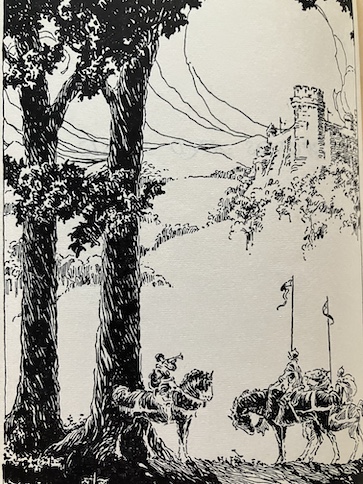
In the new version of the first chapter of the story, Lester and Lynette are brother and sister, and they are imprisoned in a castle overlooking the Rhine river in Germany (part of the the girls’ geography lesson in school) by their evil guardian, Baron von Hickenlooper. Lynette is rescued/kidnapped by a Viking pirate named Oskar, who carries her away from her brother, who still remains in the castle.

From this point on, the events in Chrys and Cordy’s lives alternate with new chapters of their tandem story about Lester and Lynette. Pieces of the girls’ lives work their way into the story. When the girls are ready to trade turns writing the story, they give each other what they’ve written so far and say “Muggins!” (The word comes from playing games like Dominoes and Cribbage where, if one player spots that another has missed a score or failed to count something properly, they can call “Muggins!” and add the overlooked points to their own score. I think what they’re implying is that this story is a game where one person picks up whatever the other one has left unfinished.) The girls also continue adding verses to an unflattering poem that they started writing about their teacher.

By accident, the girls loose track of the mean poem about their teacher, and Miss Hickenlooper finds it. At first, the girls are terrified that Miss Hickenlooper is going to be furious with them and do something horrible in punishment, but to their surprise, she starts crying. Miss Hickenlooper end up having a heart-to-heart talk about the girls’ experiences in Miss Hickenlooper’s class, what Miss Hickenlooper hoped for when she started teaching, and why she took Lester and Lynette from them. Miss Hickenlooper had wanted to be a teacher for a long time and was looking forward to it, but she had been away from it for a long time because she had to take care of her mother during a lengthy illness. Since she started teaching again, she can tell that her students haven’t been happy with her, but after reading the poem, she realizes that it’s worse than she thought. Even strict teachers can be respected by their students as long as they’ve taught their principles well and the students are learning valuable lessons. Miss Hickenlooper feels like she’s failed as a teacher because she hasn’t managed to connect with her students at all, and she’s making them miserable. The girls come to the surprising realization that their teacher really does care about her students and what they think of her.

The talk between the girls and Miss Hickenlooper was a little uncomfortable because the girls realize that they’ve done an injustice to Miss Hickenlooper by writing the mean poem about her, but I actually liked this part of the story because it’s the kind of honest communication that I often find missing in stories. Rather than anyone blustering or dodging or trying to save face, the girls and their teacher honestly discuss what happened and how they feel, and everyone involved learns something from the experience. The girls appreciate having this “human” communication with their teacher, and it earns their respect, more than any angry tirade or show of strength on their teacher’s part ever would have. It’s this very kind of open honesty and humanity with real feeling behind it that’s been missing from the class so far, and it’s what has prevented Miss Hickenlooper from really connecting with her students.

The girls apologize to Miss Hickenlooper about the poem, and Miss Hickenlooper admits the justice of some of their complaints. Miss Hickenlooper admits that maybe she went a little far in making Cordy turn out her pockets and taking her dolls from her for an extended period of time. Getting into someone’s pockets and taking personal possessions is a kind of invasion of privacy, and Miss Hickenlooper says that she only did it because the girls weren’t paying attention in class, which is true. In return, Chrys and Cordy acknowledge that they only wrote the poem to blow off steam because they were angry, but they also went too far, and they really should have considered their teacher’s feelings. The girls promise not to write any more poems like that, and Miss Hickenlooper gives Lester and Lynette back to them. Miss Hickenlooper says Cordy can keep the dolls in her pocket if she wants as long as the girls pay attention in class from now on. To further apologize, the girls make cards for their teacher and give her the two bottles of perfume that they almost gave each other for Christmas (“Two are better than one.”), and they start going out of their way to be nicer to her.

The girls’ talks with Miss Hickenlooper through the rest of the school year give her feedback that helps her to improve as a teacher. Later, when the girls are watching a lightning artist (someone who paints pictures very fast, not the more modern definition of someone who works in animation) at work and happen to see Miss Hickenlooper in the store as well, they point out that one of the artist’s pictures reminds them of the Rhine that they studied in class. Miss Hickenlooper doesn’t think much of the quality of the painting, but she admits that it does look like the Rhine and that another painting the artist did reminds her of Switzerland when she was there. The girls are amazed that Miss Hickenlooper has been to Europe because, other than Chrys’s Uncle Dick, they don’t know anyone who has. They ask her why she never talked about it in their geography lessons because that would have made them much more exciting, hearing about other countries from the perspective of someone who was actually there. Miss Hickenlooper is surprised. She says that she was only focused on teaching the lessons that she was assigned to teach and just never thought about including anything personal because she didn’t think her students would be interested in her personal stories. Again, it’s that personal element that Miss Hickenlooper needs if she wants to connect with her students on a personal level.

As the story continues, the girls also start to consider their attitudes about boys and men and future husbands. So far, most of their knowledge of boys has come from the boys at school and Sunday school and Cordy’s brothers, all pretty immature and rowdy. But, the girls are growing up, and so are some of the boys. New young men also come into the girls’ lives.

A friend of Chrystal’s grandmother asks her if she would be willing to rent a room to her 19-year-old son, who is looking for a place to stay as he takes his first teaching job at the local college. (That sounds young for a college teacher. In modern times, a nineteen-year-old would be a college student himself. Remember, this is the early 1900s, and education in the United States was very different then. Back then, teachers didn’t need to have the advanced degrees that they do now, and Mr. Banks later explains that he skipped grades when he was younger to get through school faster.) Chrystal’s grandmother agrees, although Chrystal isn’t anxious to have a teacher living in her house after her problems with her own teacher at school. Chrys also isn’t sure what to expect from a man living in the house because there’s never been a man in this house before. Cordy’s brothers are pretty rowdy. However, their new lodger, Mr. Banks, turns out to be quiet, polite, and very nice. (His last name is an indication that he’s going to be Chrystal’s future husband. There’s six years’ difference in their ages, but as times goes on, and Chrystal gets older, that’s not going to seem like as much of a gap.) He is the first person to ever address Chrystal as “Miss Reese”, which makes her feel grown-up.
Cordy’s family also has a boarder, Mr. Crump, who is attending the local college (obviously, Cordy’s future husband, based on her future last name). Mr. Crump is working his way through college by selling pots and pans, and Cordy goes with him to help carry things, bringing along Chrys because “Two are better than one.” The girls end up giving him some advice on his sales patter that helps him make more sales.

Meanwhile, the girls’ Sunday school class, which calls itself the Dorcas Club, decides to host a masquerade party with the boys’ class (who have dubbed themselves the Armored Knights) as their guests. Chrys and Cordy think of the boys as immature and uncouth and roll their eyes at the older girls who are boy-crazy. Then, because the party is on Presidents’ Day, all of the girls in the group want to go dressed as Martha Washington, and there’s a big argument about it. Originally, Chrys and Cordy wanted to be Martha Washington, too, but since that’s what all the others want, they decide that they want to do something completely original. Inspired again by the dolls, they decide to go dressed as dolls. However, because they don’t want to be like the prissy girls trying to be pretty and impress the boys, they decide not to go as elegant dolls but as old rag dolls in patched clothing.
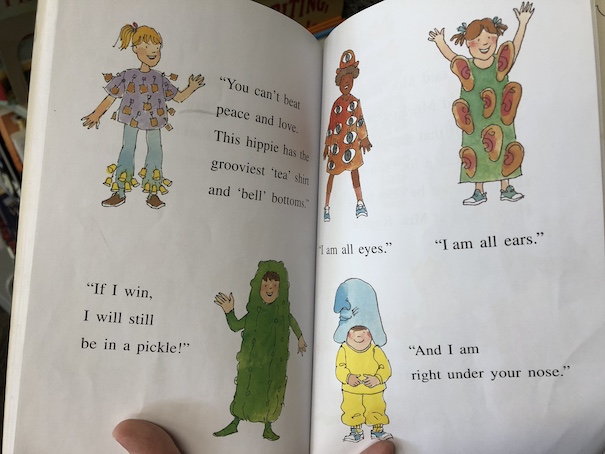
The girls do win prizes for both the funniest and most original costumes at the party because they’re the only girls who don’t show up as some version of Martha Washington. However, the triumph turns against them because the girls who are in charge of the main entertainment for the evening have decided to turn it into the girls’ very first dance party with the boys, something that Cordy and Chrys weren’t expecting. Rag doll costumes are good for fun and games, but not so much for serious dancing and the possibility of budding romance. While all of the boys are wearing various fanciful costumes themselves, like pirates and clowns and cannibals, it turns out that they’re only interested in the girls who dressed in pretty clothes as Martha Washington, and none of them want to dance with the rag dolls. Chrys and Cordy were proud of themselves for being more original than the other girls, but it seems that the boys prefer “pretty” to “original.” At the end of the evening, none of the boys even want to walk Chrys and Cordy home. Chrys and Cordy feel embarrassed because their efforts to be “original” seem to have strayed a little into the outlandish at a time when the other girls and boys are starting to seriously get interested in each other.

Fortunately, their families guessed that something of the sort might happen and asked the young men boarding with them to go to the house hosting the party and walk the girls home if they had no one else to walk with them. Mr. Crump confirms to the girls that boys would prefer to walk with girls who made an effort to look pretty instead of girls who look like rag dolls. Mr. Crump says that there will be other parties, and next time maybe they’ll go as something more elegant, like Martha Washington, but the girls aren’t too thrilled about doing this type of party again. Mr. Banks takes a different view and says that he actually thought that the rag doll costumes were rather clever and that it was really better for the girls to be different instead of trying to be like every other girl in order to not stand out. “Sometimes it may hurt, but I think it’s better to be original.” Mr. Banks the college teacher is more mature than Mr. Crump the college student, and I think he has the right idea. Looks and clothing styles change, and people have different priorities when they get older, but original thinking and an interesting personality are hard to replace and never go out style. When Chrystal says that she doesn’t even know how to dance, Mr. Banks offers to teach her, so she can be more confident at future parties.

Having the boarders walk them home actually turns out to be an unexpected victory for Chrys and Cordy because, while the other girls were making fun of them for not having any of the boys dance with them or walk them home, Chrys and Cordy ended up being escorted by young men. Getting boys is all well and good for young girls, but being escorted by young men makes Chrys and Cordy look like young women, putting them on a higher level than mere girls. Chrys and Cordy don’t see it that way at first because Mr. Crump and Mr. Banks are just their families’ boarders and friends and treat them like younger sisters (at this point in their lives, anyway), but the other girls notice that the young men are more mature than the Sunday school boys, and it causes them to look at Chrys and Cordy with a little more respect for having their attention. In some respects, Chrys and Cordy might seem less mature than the girls who are excited about wearing makeup and getting boys because they’re into outlandish costumes and dolls and “romantical” stories, but in other respects, they may actually be a little more mature than the other girls for being confident in their individuality and the new awareness they’re acquiring of other people’s feelings. In the end, girls want to marry men, not little boys, anyway.

Through the spring, the girls have other adventures and continue writing their story with their dolls. Along the way, there are other signs that the girls are growing up. They notice that this is the first year when they’re more interested in getting new Easter bonnets than they are in their Easter eggs. Cordy’s family is heavily involved in the social life of the local college because two of their boys are students there, and Cordy even gets to go to some of the campus parties. She helps to serve punch there and sometimes gets to dance. She eventually arranges for Chrys to come with her to help with serving and have her first dance, too. Miss Hickenlooper also discusses the girls’ future with them, suggesting that they take exams to see if they can skip the eighth grade and go straight into high school because she thinks they’re smart enough to pass. The girls are uncertain if they want to go on to high school so quickly. They know they’re growing up, but they haven’t thought about high school yet (and this is a time period when not everyone even attended high school). There is also the horrible thought that one of them might pass the test while the other didn’t, and they might end up going to different schools and being in different grades. Miss Hickenlooper says that they don’t necessarily have to go on to high school yet, if they feel that they’re not ready, even if they’re offered the opportunity, but she urges them to take the tests anyway to see if they have the option. It makes the girls start questioning their future lives, what they really want, and where their education will take them.

At one point, Cordy’s brothers find their unfinished novel in Cordy’s room, steal it, and use it to make fun of the girls. The story isn’t really very well written because Chrys and Cordy are only thirteen years old. As readers will have noticed, there are spelling mistakes all through the story, and the girls also get mixed up about geography because they’re just focused on making the story exciting instead of really thinking about the setting. After their characters’ adventures on the Rhine, the girls send them floating in a boat to a tropical island with coconuts and palm trees because they don’t think about just how far away the tropics actually are. (Being shipwrecked on an island is also a common trope of vintage and antique children’s books, so they’ve probably read this type of story themselves. Just scroll through my lists of children’s books from the 1900s and earlier, and you’ll see what I mean.) Although Mr. Crump was laughing at the girls, too, he rescues the story from Cordy’s brothers and gives it back to them when he sees that the joke is going too far. However, the girls are somewhat dispirited, thinking that their story might be deeply flawed. At first, they don’t know if they really want to continue writing it, but in their desperation, they turn to the one person they know will be honest with them about what they’ve written and can not only tell them whether or not the story can be fixed but how to do it – their teacher, Miss Hickenlooper.

The book is available to borrow and read for free online through Internet Archive (multiple copies).

Themes, Spoilers, and My Reaction

The story is one of those gentle, calm stories with a few funny episodes and some genuinely touching moments. Fans of slice-of-life historical books like the Betsy-Tacy series will like this book. It is a coming-of-age story for Chrys and Cordy, as they begin to develop new attitudes and come to a deeper understanding of themselves and other people and start thinking about the future. However, the girls’ adventures also teach other people around them some lessons.

One of the themes of the book involves how people let their personalities show. Although the girls were originally thought silly for their outlandish rag doll costumes at the party, they were more bold and creative than the girls who just wanted to look like everyone else. Even though their creativity wasn’t fully appreciated at first, it ends up working in their favor in the long run.

One of the biggest developments in the story is the relationship between the girls and their teacher, and the keys to that relationship are learning how to see other people as people, how to be open about showing their personal sides, and how to appreciate people with different personalities. The girls begin as thoughtless students, and their teacher is a strict disciplinarian with little patience for their goofing off, which is why the girls see her as their antagonist. However, the girls’ eventually realize that, through their mean and complaining poem, they’ve hurt their teacher’s feelings as much as she’s hurt theirs, maybe more. It leads them to see her in a new light, as a person and just just their jailer (the role of her alter ego in the girls’ story). The honest talks between the girls and their teacher not only helps the girls to become more thoughtful and considerate of others’ feelings but also show their teacher that the key to improving her teaching and developing a better relationship with her students is to be a little more personal with her students. She gradually learns that letting her students see her as a person with interesting life experiences earns their respect more than just acting like an unfeeling drill sergeant enforcing discipline. Inspired by the girls’ interest in her travels when she was younger, Miss Hickenlooper starts bringing postcards and souvenirs from her travels to class to show during geography lessons. The students are fascinated by her souvenirs and stories and start thinking of her as an a kind of intrepid explorer or sophisticated world traveler instead of a dull woman who focuses on dry memorization and gets mad at them for daydreaming in class. As she tries new ways of approaching her lessons and adding in personal experiences, Miss Hickenlooper takes on a whole new role in the children’s lives and sparks all of their imaginations. All of the students, not just Chrys and Cordy, start behaving better because they become genuinely interested in what Miss Hickenlooper has to say and show them. They don’t want to make her angry because she’ll stop telling the interesting stories if they don’t get their work done. Just because she’s gotten more interesting and personal doesn’t mean she’s gotten soft. Don’t be afraid to be interesting and different!

The girls never actually show Miss Hickenlooper their story because they’re a little embarrassed by what they’ve gotten wrong, but they ask her questions about some of the things that they put in their story to find out what’s right. They do end up finishing the story and giving Lester and Lynette a grand wedding, but they also acknowledge that they are getting too old and busy with other things to continue playing with dolls, even Lester and Lynette. They plan to put Lester and Lynette away for now as souvenirs of their childhoods. Later, they do tell Miss Hickenlooper about their novel, and while she hasn’t read it, she has the feeling that she knows what it’s like from knowing the girls and their writing. (The girls wrote about scenes from their novel when asked to describe places they know for their high school entrance exams.) She tells them that she appreciates their imaginations but that they should remember to focus on the real world around them and gaining real experiences to write about in the future.

There are also themes that focus on what growing up and maturity mean. Because the story focuses on one school semester in the girls’ lives, there are many questions that the book leaves unresolved about what happened in the girls’ later lives, but it seems that their lives turned out well, and they look back on their experiences with Lester and Lynette as a turning point when they really started growing up. Toward the end of the story, the girls begin appreciating some of the possibilities of life and the wider world that they never considered before. Through it all, there is also the girls’ constant friendship. At the very end, elderly Chrys writes a letter to elderly Cordy, thanking her for sending the dolls and reminding her of this special time in their lives.

The author of this book, Carol Ryrie Brink, was also a child around the time that Chrys and Cordy were children. There is a picture of her as a child above her biography on the dust jacket of the book. She is also the author of Caddie Woodlawn, which is better known than this book.

I love books that contain details about life in the past, and there are a lot of fun details included in this story. I’ve mentioned some above, but that’s just scratching the surface. At one point, Chrystal says that the only paper she has that’s good for painting pictures is the pieced of paper that separate pieces of Shredded Wheat in the box. The lined paper from the notebooks she uses for school isn’t as good. When she’s out of those pieces of paper, she has to eat more Shredded Wheat to get more. I don’t remember seeing any similar kind of paper in shredded wheat boxes in my lifetime, so this must be something that existed before modern packaging.

At the college dances, the girls have dance cards for the young men to write their names and initials in to secure spots for dances. There are also occasional mentions of food, and Chrys mentions having floating island pudding for dessert, which I’d never heard of before. It’s a kind of meringue that floats on a base of vanilla custard.