
Happy Holidays and Other Fun Days Around the Year by E. C. Reichert, illustrated by Suzanne Bruce, 1953.
This book explains a little about the origins of various holidays and how they are commonly celebrated. It was written during the 1950s, and the illustrations clearly show it in the style of the people’s clothes. The style of one of the illustrations is one of the charming aspects of the book.
For each holiday in the book, different children talk to their parents or friends about what different holidays mean and how they are planning to celebrate. Many of the explanations are rather simplistic, and I’ve seen books that explain the history of holidays better, but I have some nostalgia for this book because I read it and liked it when I was a young child.
The Holidays:
New Year’s Day — January 1
Sandra talks to her parents about what they’re going to do on New Year’s Day, and her mother explains the purpose of New Year’s resolutions.

Valentine’s Day — February 14
Sally and Billy open valentines they’ve received and talk about Saint Valentine and other Valentine’s traditions.
Washington’s Birthday — February 22
Stevie’s father tells him about George Washington and the famous cherry tree story.
St. Patrick’s Day — March 17
Rickey’s friends explain to him why they’re wearing green on St. Patrick’s Day and his mother tells him a little more about the holiday and what shamrocks are.
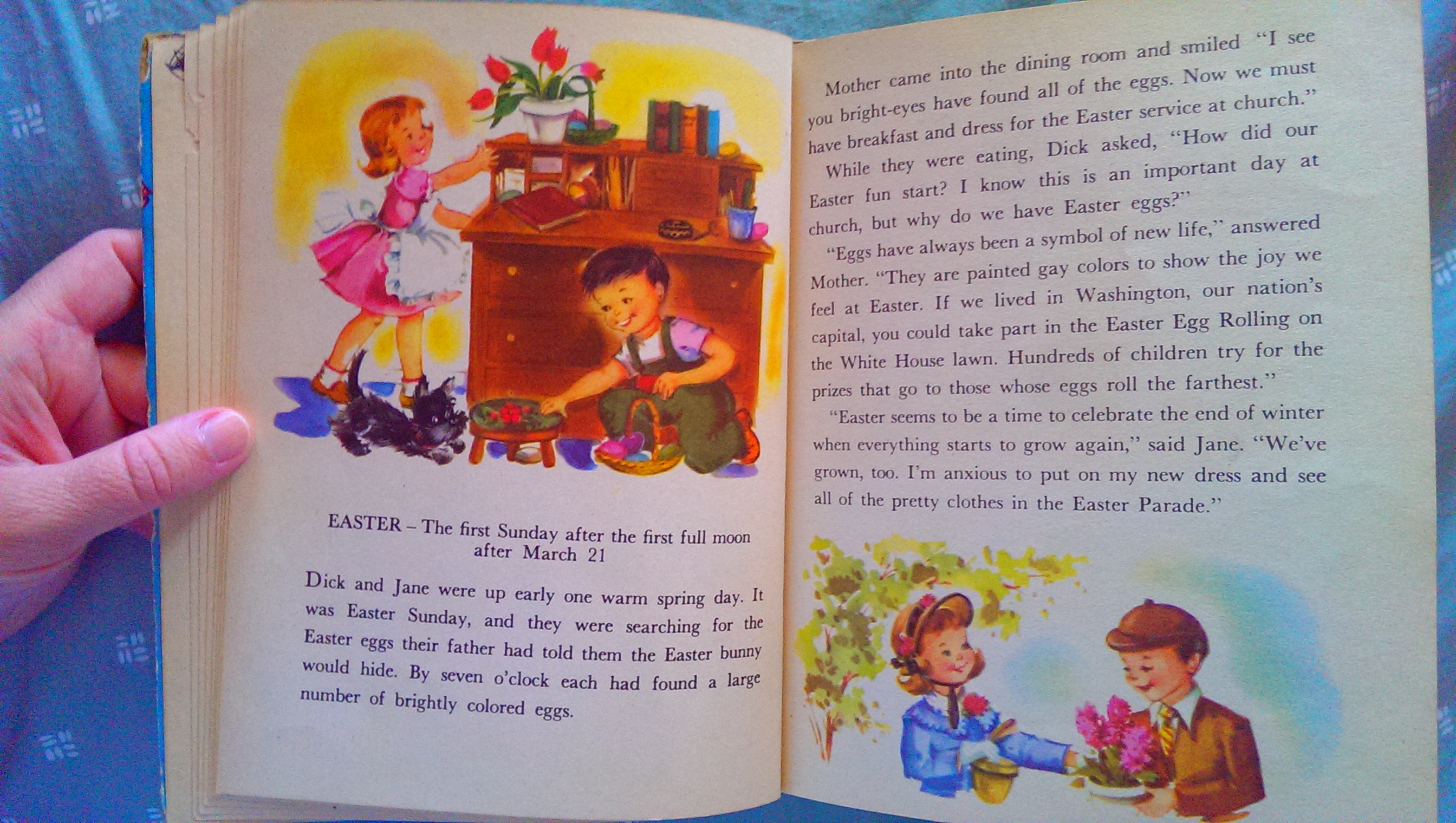
Easter — The first Sunday after the first full moon after March 21
Dick and Jane (not the Dick and Jane from school readers, but yes, those names) hunt for eggs on Easter. They don’t explain the religious reasons behind the holiday, but they talk about popular Easter traditions, like colored eggs and the Easter Egg Rolling at the White House. Congratulations to the book for explaining how to calculate the date of Easter!
April Fool’s Day — April 1
When Artie plays a practical joke on Kathy, their father explains the tradition of April Fool’s Day. (My parents wouldn’t have let my brother give me fake candy because of the choking risk. Just saying. Actually, I never celebrated April Fool’s Day as a kid because both of my parents hated practical jokes because they both resented jokes their parents played when they were kids, coincidentally around the time this little book was published. My knowledge of April Fool’s Day as a kid came from this book and from things I heard at school.)
Independence Day — July 4
Susie and Johnny go to a parade, have a picnic, and watch fireworks on the Fourth of July. Their father explains the significance of the holiday.

Columbus Day — October 12
Miss Nelson’s class at school learns about Christopher Columbus. (This holiday isn’t celebrated as much today as it was when this book was written. I have to admit, I wasn’t that enthusiastic about it as a kid, either. Columbus Day had no costumes, candy, or presents, and I didn’t get the day off school, and thus, it seemed pretty boring to me when I was young.)
Halloween — October 31
Robin and Judy come back from trick-or-treating, and their mother explains a little about the origins of the holiday.

Armistice Day — November 11
Terry and Jimmy watch a parade, and their father explains that November 11 was the day that World War I officially ended in 1918.
Thanksgiving Day — The fourth Thursday in November
Ann and Johnny (a different Johnny from the earlier one, I think they either forgot they’d used that name or just couldn’t think of another – they could have called him Jack to be a little different) have dinner with their family at their grandmother’s house. Johnny talks a little about what he learned in school about the pilgrims and the first Thanksgiving.
Christmas — December 25
Tim and Debbie hang up their stockings, and their mother tells them that it’s Jesus’s birthday and explains the origins of some Christmas traditions.


