
I Hate English! by Ellen Levine, 1989.
When Mei Mei’s family moves from Hong Kong to New York, she finds herself forced to go to a school where no one else speaks Chinese. She is expected to learn English and to read, write, and speak in English, and she hates it! To her, English is a very strange language, and the writing system is nothing like Chinese. For a time, Mei Mei refuses to speak in English, even when she understands what is being said around her, because she hates it so much.

The only part of New York that Mei Mei really likes is Chinatown and the Chinatown Learning Center. Mei Mei likes it because she is surrounded by people speaking Chinese. There, she can relax and be herself because people there understand her.
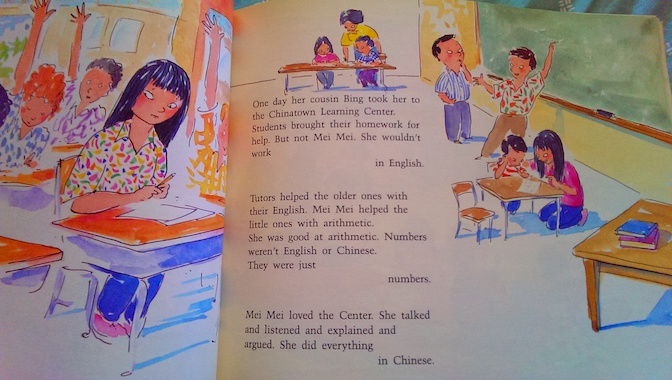
However, Mei Mei’s refusal to speak English isn’t helping her at school or anywhere else. It’s keeping her from speaking to anyone outside of Chinatown, and it can’t continue. When an English teacher, Nancy, comes to the Learning Center to help Mei Mei with her English, she resists learning at first. She feels like she’ll lose her Chinese and part of her identity if she uses English.
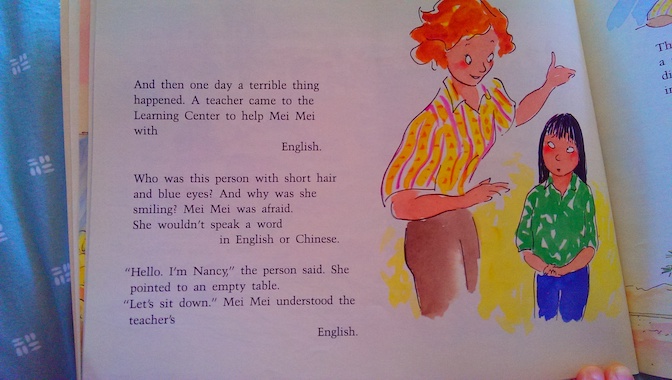
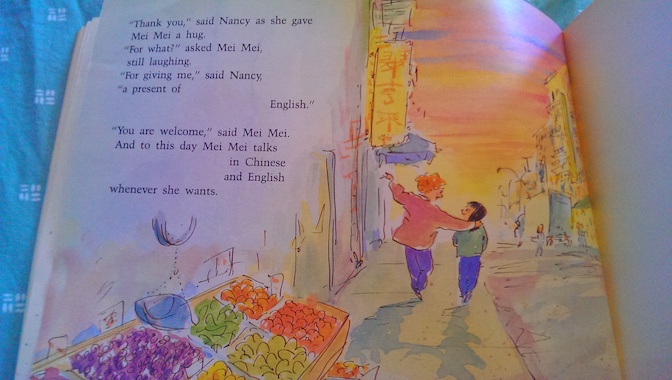
At first, Mei Mei’s worries about speaking English intensify with Nancy’s lessons. It disturbs her how English has words that would be difficult or impossible to translate into Chinese and English words seem to be coming more easily to her, even when she doesn’t really want to speak the language. Nancy explains to Mei Mei that English is necessary for her because she will need it to talk to many people in America, and there are many people who also want to talk to Mei Mei and be her friend, including Nancy. It’s only when Nancy overwhelms her by constantly talking in English and Mei Mei becomes desperate to talk about herself and be understood in English that Mei Mei realizes that speaking a new language doesn’t mean losing her identity. It’s just another way of expressing herself, and she can go back and forth between the two any time she wants.


Mei Mei’s feelings of strangeness in her new home and the difficulties of learning a new language are relatable. The hardest part of the experience for Mei Mei is feeling like she might be giving up a part of her past, her culture, and herself by switching from Chinese to English. But, refusing to speak English puts Mei Mei in the position of being someone who can only listen, never talk, limiting her ability to be understood and to make friends. In the end, she comes to realize that speaking a new language is not a matter of giving up anything, just adding to what she knows and making herself understood in a new way. It’s the beginning of expanding her horizons and building relationships with new people.
My favorite part as a kid was the part where Mei Mei and her friends went to the beach and cooked shellfish that they found. It was interesting to me because I never lived near a beach when I was young. The lifeguard at the beach tells Mei Mei and her friends that they can’t eat the shellfish, and they realize that he thinks that because he doesn’t know how to cook them. I never did either and still don’t, but I liked hearing about it.
The book is currently available online through Internet Archive.
 Jestress's Forgotten Books and Stories