
Monster Slayer retold by Vee Browne, illustrated by Baje Whitethorne, 1991.
This is a retelling of a Navajo folktale. An Editor’s Note at the beginning of the book explains a little about the original legend. It is actually part of a much longer story. The book only focuses on the Walking Giant part. The Walking Giant threatened the villages of the Anasazi. The author and illustrator of this book are both Navajo.
Changing Woman, who created both humans and monsters, had twin sons, but they did not know who their father was until they were twelve years old, when their mother told them that their father was the Sun.
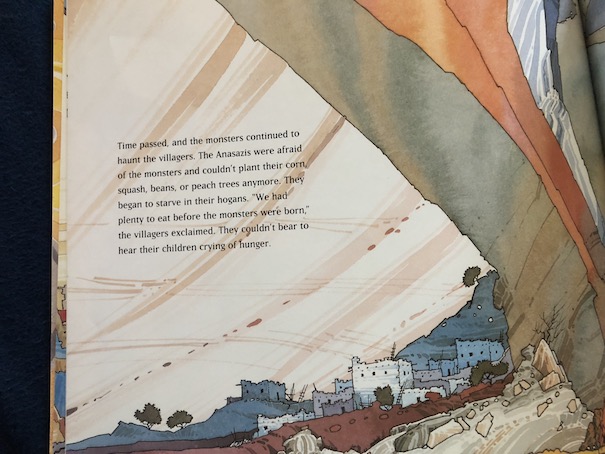
The twins went to see their father, but they were returned to Earth to help their people to fight the monsters which plagued the land. The monsters prevented the Anasazi from planting their crops, and people were starving. The people appealed to Changing Woman and her sons for help. The twins’ father gave them his lightning arrows to use in the fight.

Hearing the sound of thundering footsteps, Changing Woman told her sons that it was the sound of the Walking Giant. The twins took their armor, sacred magic feathers, and lightning arrows and set out to find the giant. Eventually, they found him by a lake. The twins hid behind a rock, but the giant could smell them.

As the fight began, the twins let the giant shoot the first arrow at them because their father told them to, since Walking Giant was older that they were. However, their magic feathers helped them to evade the giant’s boomerang. Then, one of the twins used a lightning arrow to finish off the Walking Giant. To commemorate their victory, Changing Woman named this twin Monster Slayer. (The other boy was already named Child Born of Water.)

This story is interesting but felt a little disjointed to me. That may be because it is a shortened version of the legend. I wish that the beginning note explained a little more about the context of the story. This book won the Best Juvenile Book Western Heritage Award from the National Cowboy Hall of Fame.
The book is available to borrow and read for free online through Internet Archive.
 Jestress's Forgotten Books and Stories