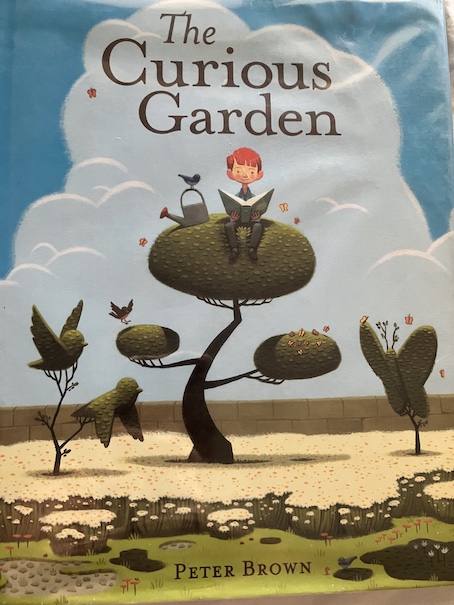
The Curious Garden

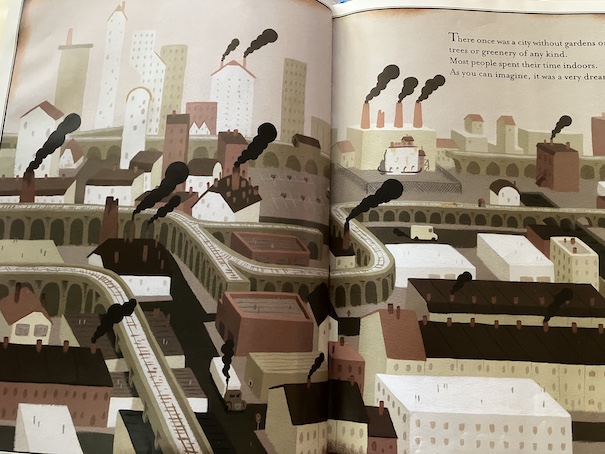
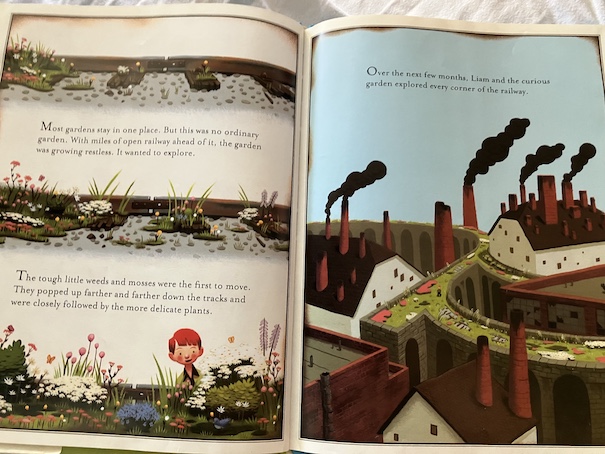
A boy named Liam lives in a dreary city where there aren’t any gardens or green spaces. Most people in the city spend most of their time inside. However, Liam likes to explore outside.

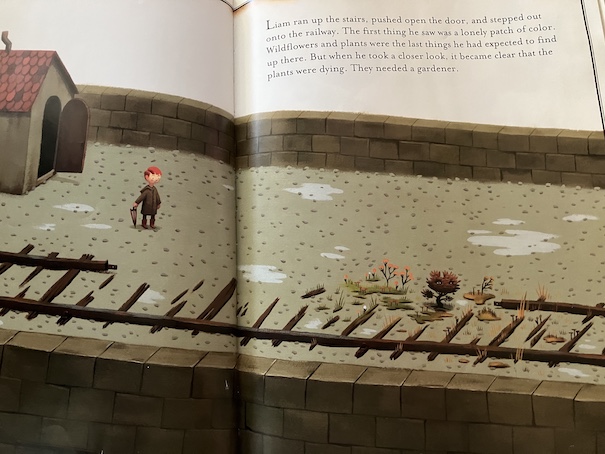
One day, while exploring some disused train tracks, he finds a few plants struggling to survive. Liam doesn’t know much about plants, but he decides to help them by giving them water. Gradually, he begins to learn more about what will help the plants, and they begin to grow and spread into a small garden.

As Liam helps the plants, they begin to spread all along the old railroad tracks. During the winter, the plants are covered in snow, and many of them are killed or have suffered badly from the cold. However, because Liam spent the winter studying about plants and gathering some gardening tools, he is able to restart the garden.

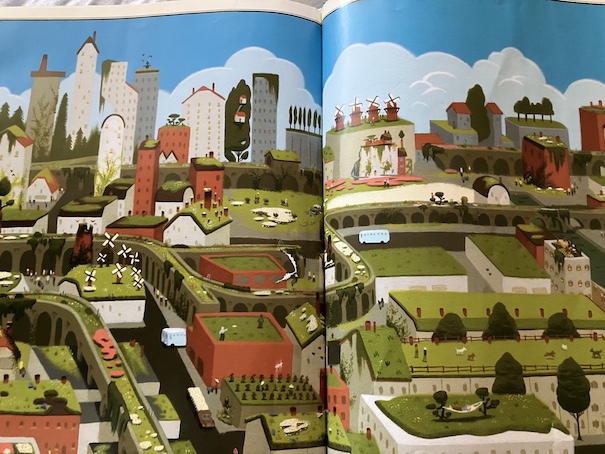
As the garden spreads through the city, other people begin to notice, and they start joining Liam in tending the garden. Greenery begins taking over places and things that are disuses and abandoned, and people encourage the plants to grow where they can enjoy them. Because of their efforts, the city is transformed!

There is an author’s note in the back of the book about the inspiration for the story. There was an elevated train in Manhattan that was shut down in 1980, and plants took over the abandoned tracks. The author, Peter Brown, considered what it would be like if the phenomenon took over an entire city.

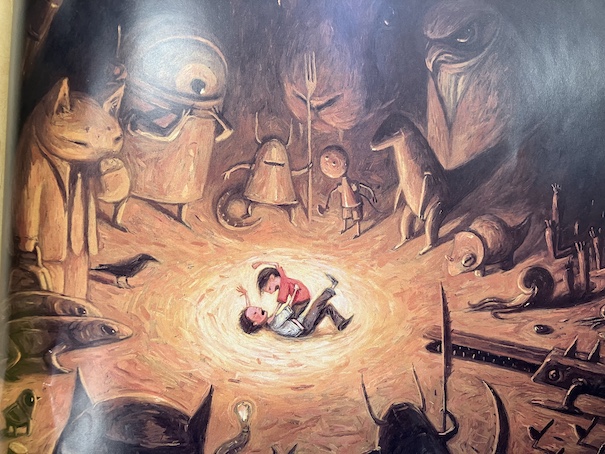
The pictures in the book are great, and some pages are full pictures with no text, just showing how the garden grows and spreads through abandoned places in the city. I love how this story was inspired by the way plants take over abandoned places in real life. Plants can grow in some unlikely places, when nothing interferes with them, and in the story, the boy discovers that they can spread further with a little help.

By the end of the story, his entire city is completely transformed into a greener, more eco-friendly place. It’s not just that there are more plants and green spaces in his city, but the factories that we see in early scenes are no longer putting out all that smoke by the end, and we see windmills in the pictures as alternative forms of energy production. We aren’t told exactly why some things are changed about this city, but it seems like the increasing presence of the green spaces has caused people to change aspects of their lives and businesses to accommodate and preserve them. It’s an idyllic solution that doesn’t show a lot of the conflict that occurs in real life, when some people are ready for a change and others just don’t want to change. Still, I like this mage of a hopeful future because it comes as an antidote to the dystopian quality that we see in many forms of modern entertainment.

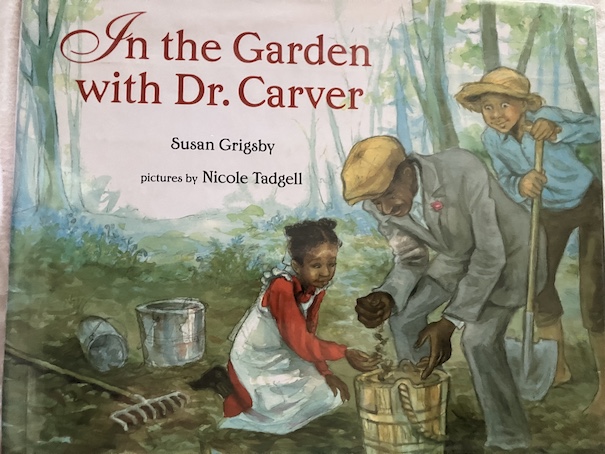
In the Garden with Dr. Carver

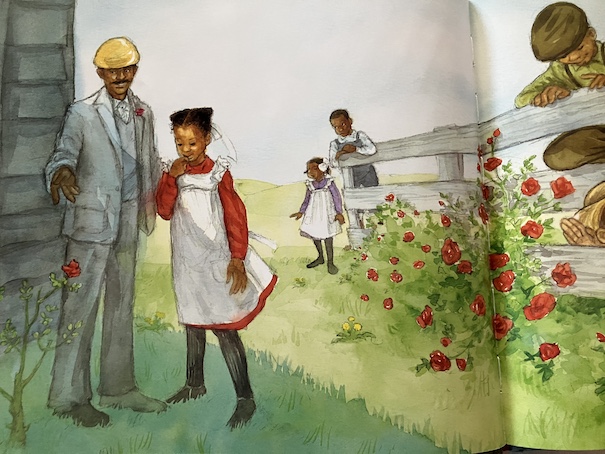
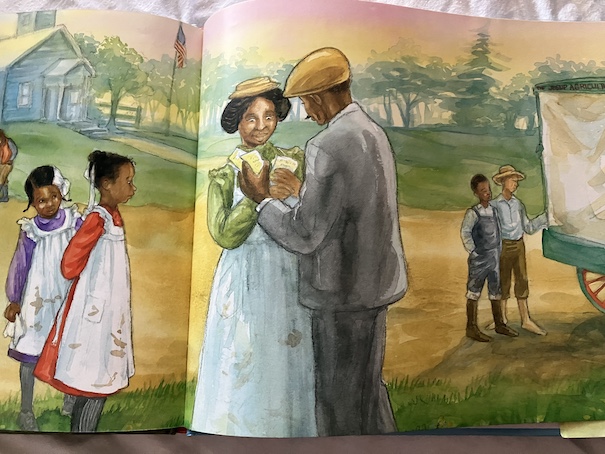
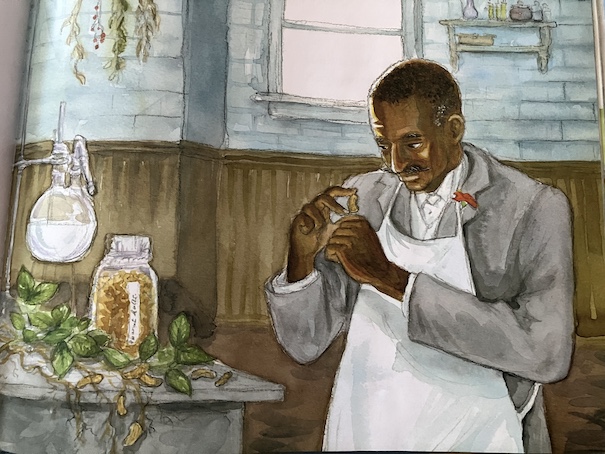
This picture book is about George Washington Carver, as told by a young girl named Sally.

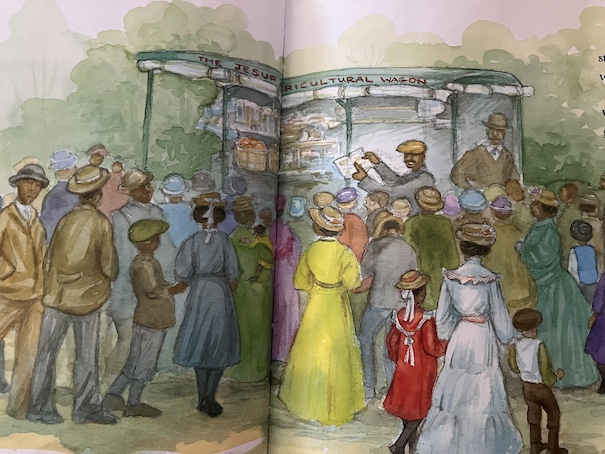
The first time Sally sees him is when he’s traveling with his wagon, pulled by a mule. Sally knows that Dr. Carver is a famous plant scientist from Tuskagee and that he uses his wagon as a kind of mobile school. It contains seeds, plants, and gardening tools, and people come to Dr. Carver for advice about growing plants. The nutrients in the soil of this area have been depleted by growing cotton, and Dr. Carver has been advising them about how to restore the soil. He also advises them about new ways to use common crops.

Dr. Carver visits Sally’s school to help the children with their garden. He teaches them how to use observation to notice the conditions that benefits plants and figure out how to help plants that aren’t doing well. When a boy is about to kill a spider, Dr. Carver stops him, pointing out that the spider helps their garden by eating bugs that are pests for the plants. He teaches the children that everything is part of an ecosystem (although he doesn’t use that word) and that they need to observe and understand the roles each plant and creature has in the ecosystem before deciding to eliminate or change anything. The reason why they remove weeds like dandelions is that their presence doesn’t help the other plants, and they take resources the other plants need. Although, he also shows them that dandelions are edible, so they are not wasted.

Dr. Carver teaches the children about restoring the nutrients in depleted soil using fertilizer and compost made from decaying plant matter and organic materials that most people simply throw away. Dr. Carver teaches them not to waste anything, helping them to make a scarecrow and markers for their plants from scraps of wood and other things people have thrown away.

Eventually, Dr. Carver has to return to Tuskagee, but the lessons he teaches the children stay with them.

There is a section at the back of the book that explains that Sally and her school are fictional, but George Washington Carver was a real person and the story is based around his life and writings. He was born as a slave in Missouri about a year before the abolition of slavery, so he grew up as a free person. He began learning about agriculture and botany from an early age, and as he grew older, he sought out schools that would help him further his knowledge and share it with others. He taught at Iowa State College before Booker T. Washington (see More Than Anything Else for a picture book about his youth) recruited him to be the head of Tuskagee‘s Department of Agriculture in 1896. He also believed in bringing education to people who couldn’t come to a college to learn by sending out bulletins about farming techniques and booklets for teachers in lower grades to use in their classrooms. His mobile school in a wagon was another form of outreach that has been imitated in other places.

I enjoy books about historical figures, and I found this story about George Washington Carver gentle and fascinating. There are some parts that I think I appreciate more as an adult than I would have as a child, making this a book that I think would appeal to readers across different ages and something that parents and teachers would enjoy sharing with children.

Although Sally wasn’t a real person, the lessons she and her classmates receive from George Washington Carver help to illustrate Carver’s real-life work and the lessons that he shared with people of his own time. I appreciated the level of detail the story provided about how people can use observational skills to diagnose and fix possible issues with ailing plants, the importance of understanding that plants exist as part of an ecosystem and that gardeners and farmers need to understand how all parts of the ecosystem interact, and how nutrients can be restored to depleted soil. I can’t remember whether I had heard before about how cotton farming depleted soil nutrients, but I appreciated how that explanation helped explain a real problem facing farmers of Carver’s time and how Carver was helping them to solve it.

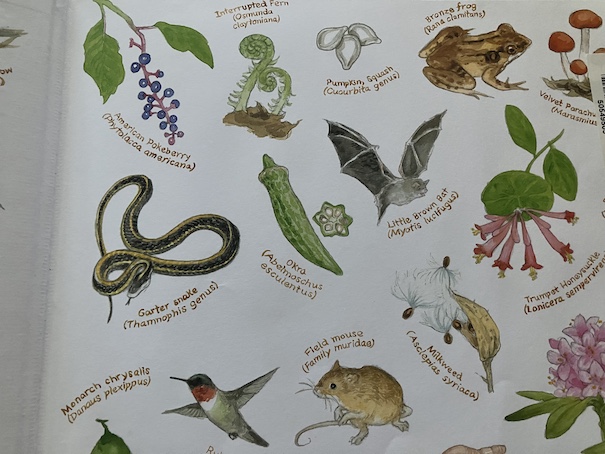
I think this book would appeal to fans of cottagecore as well as people interested in American history. The illustrations are beautiful, and even the inner covers are lovely, with small, labeled pictures of plants and creatures. As the book explains, George Washington Carver himself used drawings of plants and creatures in his work, and in the story, he teaches the children to make their own drawings to help themselves study details of the natural world.

Jam

Mr. and Mrs. Castle have three children and live in a house with a plum tree in the backyard. When Mrs. Castle gets a new job, Mr. Castle is proud of her and decides that he will stay home and look after the children. Mr. Castle likes being home with the children, and he does all sorts of useful things around the house.

One day, he realizes that he’s been so efficient at getting things done around the house that he’s run out of things to do. While he’s thinking about what to do next, he hears an odd sound. It turns out that the sound is ripe plums from their plum tree, hitting the roof as they fall off the tree.

Mr. Castle gathers up the ripe plums and makes plum jam. His family loves it, so the next day, when many more plums have fallen, he gathers those up and makes even more plum jam. As more and more ripe plums fall from the tree, Mr. Castle can’t stand to see them go to waste, so before long, the family has far more plum jam than they have jam jars.

Then, comes the real challenge: eating all the jam. As the weeks go by, the family eats jam with everything, and Mr. Castle makes many recipes involving jam, but there’s still plenty of jam left. They try everything they can think of to use up all the jam, including using it to re-tile the bathroom, but there’s just too much jam! It gets to the point that family members are starting to have jam-related nightmares!

Will they finish all of their plum jam before the plums are ripe again? Will they ever be able to eat anything without jam ever again?

The book is available to borrow and read for free online through Internet Archive. The book also includes a simple recipe for plum jam.

This story is funny, especially because it’s supposed to be “a true story.” I have the feeling that the author’s family had a similar incident where an experiment in jam-making went too far and became overwhelming. The family in the story eats jam in various ways to use it up, and Mr. Castle even uses it for handyman projects, like fixing a leaky roof or gluing down bathroom tiles. They never mention the idea of selling the extra jam or giving it away as gifts, probably because those ideas would make too much sense and would help solve the problem, and the story is meant to be silly.

Besides how overwhelmed the family feels about the amount of jam they have to eat, there are plenty of other funny things happening in the story. Mrs. Castle’s new job is with some scientists who are “developing an electronic medicine to cure sunspots.” It doesn’t make any sense, but the story emphasizes how proud Mr. Castle is that his wife is so clever, and the topic of sunspots appears throughout the rest of the story as a running gag. I also thought it was cute how Mr. and Mrs. Castle refer to their children, the little Castles, as being “Cottages.”

There is minor mention of alcohol in the story. There are a couple of points in the story where the parents are mentioned as drinking sherry, which isn’t very common the US. I checked, and the author, Margaret Mahy, was from New Zealand.

Home for a Bunny

It’s springtime, and a little bunny is searching for a new place to call home.

As he looks for a place that might suit him, he asks the other animals about their homes. However, most of the homes of other animals wouldn’t work for him. The bunny knows he couldn’t live in a nest like the birds or in a bog like a frog.

There is a point when the bunny thinks another animal’s home might suit him, when he talks to a groundhog who lives in a log, but the groundhog is not willing to have him as a housemate.

The bunny finally finds his home when he meets another bunny, who invites him to stay!

The book is available to borrow and read for free online through Internet Archive (multiple copies).

This vintage Little Golden Book is a calm and sweet story about a little bunny finding a home that’s just right for him. I liked how the bunny looks at other animals’ homes to figure out if any of them would be right for him because it shows young children how each animal’s home has conditions that are right for that animal but wouldn’t be right for a different type of animal. The bunny realizes that a nest in tree wouldn’t work for him because, unlike birds, he can’t fly and would fall out of the nest. Similarly, he can’t live in a bog with a frog because he’s not amphibious and would drown. (The book doesn’t use the term amphibian or amphibious, but I think kids would get the idea that some animals are better able to live in and around water than others.)

The story also includes the idea is that what makes a home is also who shares that home. The bunny thinks that the place where the groundhog lives could work for him, but he’s not a groundhog and the groundhog doesn’t want to share his home with the bunny. The place where the bunny eventually finds is rabbit hole he can share with another bunny, who is happy to have him as a companion. It’s a calm story with a happy ending because there is a home for everyone and someone for everyone.

The Golden Egg Book

One day, a little bunny finds a blue egg. He knows there’s something inside the egg because he can hear it moving, but he doesn’t know what kind of egg it is. He imagines all the different creatures that could be inside the egg.

He tries to figure out how to get the egg open. He shakes it, kicks it, jumps on it, rolls it down a hill, and throws nuts and small rocks at it. Nothing he does causes the egg to open.

Eventually, the bunny falls asleep next to the egg, and while he’s asleep, the egg hatches! The animal that hatches out becomes the bunny’s best friend!

This is a vintage Little Golden Book, originally printed in the 1940s, about two young animals trying to figure each other out. The bunny apparently knows that some things hatch from eggs, but he’s not sure exactly how that happens or what sort of things might come from an egg. Even little kids will know that the things that the little bunny thinks might come from an egg are silly, like a little boy or an elephant, but that’s part of the fun of it.

There’s some repetition in the story, which young children enjoy, because when the duckling hatches out of the egg and finds the bunny asleep, he tries some of the steps that the bunny tried on his egg to get the bunny to wake up, like pushing the bunny with his foot, jumping on him, or rolling him down the hill.

Fortunately, neither animal hurts the other in their attempts to hatch the egg or wake up the bunny, and the two become friends. It’s just a cute little picture book that might be fun for springtime or Easter!

The Little House

A family builds a strong little house in the countryside, dreaming of their descendants living in her. The little house is happy in the countryside, watching the changing seasons as the years come and go.

Over time, things begin to change, though. Other farms are built around the little house, but then, a big road is built, and the little farms gradually give way to suburbs.

Eventually, the houses around the little house turn into bigger houses and apartment buildings. As time goes on, the little house is no longer in the countryside or even the edge of the city, but it’s actually engulfed by the city itself.

The city becomes more and more crowded with taller and taller apartment buildings, more roads and trains, and crowds of peoples. The little house stands empty and becomes run-down. She can hardly see the sky and can’t feel the changing of the seasons the way she used to because there isn’t much nature around her to sense changing.

Fortunately, the little house is rescued from this terrible situation. One day, the great-great-granddaughter of the man who built the house spots the little house in the city and recognizes it as the one her family owned. When she and her husband look into it, they verify that this is her family’s old house, and they decide that they want to move it to the countryside, like when her family lived there.
Because the little house was built so strongly, they’re able to move it intact to the countryside. The little house is happy to once again live in the countryside with the family who always loved her!

The book is available to borrow and read for free online through Internet Archive.

This vintage picture book is about the nature of change. Growing cities do expand into the countryside around them, so a house that was once outside of the city is gradually touched by and then engulfed by the nearby city as it expands. Readers get the feelings of the house as the world around her changes. At first, she’s a little intrigued by the city and isn’t sure if she likes it or not, but as the city becomes overcrowded, the house is neglected, and she can no longer sense the seasons, she decides that she doesn’t like it. When things change for the house again, she is relieved.

I remember this story from when I was a kid, and I remember feeling sad when the poor house was run-down and neglected in the city, surrounded by the towering apartment buildings. However, the book has a good ending. Houses can be moved, and the family that once owned this house remembers it and rescues it from the city, moving it to the countryside, where they all feel more at home. Things change, but sometimes, they change for the better. The house can’t move itself when it isn’t happy, but the family gives it the help and attention it needs.

When I reread this book as an adult, it suddenly occurred to me that this book was originally published during WWII, when the world was changing in some very scary ways. I think a book like this might have been reassuring to children of that time. Life is full of changes, but sometimes, things can change for the better again.

The House of Four Seasons

A family is searching for a house to buy in the countryside. They find one they love, but it needs some fixing up. Along with the repairs, the house needs a new coat of paint.

Different family members have different ideas about the best color to paint the house. Little Suzy likes the idea of painting it red with green shutters because she thinks that would look wonderful in the spring. Billy likes the idea of making it yellow with purple shutters, which would be great in summer. Their mother like the idea of a brown house with blue shutters because she thinks that would look great in autumn. Father suggests a green house with orange shutters because he thinks that would be colorful in the winter, when it snows.

They talk over the different possible color combinations, and Billy suggests that each of them could have their colors on a different side of the house. He says that they could call it the House of Four Seasons. However, when they go to the hardware store, they learn that the store only stocks three colors of paint – red, yellow, and blue.

At first, the children in the family think they can’t have their House of Four Seasons with only three colors, but their father buys some of each color and shows them how the colors combine to make different colors. By mixing two colors together, they can also make orange, green, and purple. If they mix all three together, they can get brown.

That covers all of the colors they originally thought of using, but there’s one more thing that Father points out. Although mixing all three colors of paint gives them brown, white is also the sum of all colors. That gives them a color they can all agree on!

I liked how the book demonstrated color combinations and how mixing primary colors make secondary colors. It is true that, when you mix all the primary colors of paint, you typically do get a brown color. Technically, according to an art class I once took, you’re supposed to get black by mixing all colors, but it usually doesn’t work out that way because the colors aren’t entirely true hues.

I’ve thought before that it’s interesting how, when it comes to paint, black is supposed to be the sum of all colors and white is often considered blank, the absence of color, but the opposite is true when it comes to light. These two ways of mixing colors are called “additive” and “subtractive” – mixing colors of light is additive and mixing physical colors, like paint, is subtractive. That’s really what the father in the story demonstrates, how different colors blend to form white visually with light, although he doesn’t really explain the additive vs subtractive color systems concept. If you’ve ever done web design, you’ve used the additive color mixing method with hexadecimal colors. Black in hexadecimal is #000000, the complete absence of all colors, while white is #FFFFFF, the full amount of all colors.

As fascinating as that is, though, I have to admit that I wasn’t entirely satisfied with the choice to paint the house white. Part of it is that it won’t stand out in the snow when it’s white, and part of it is that they just paint the shutters green without any discussion about it, but mostly, it’s because … the hardware store doesn’t sell white paint. They clearly stated that the hardware store only has three colors of paint – red, yellow, and blue – no white. They also can’t combine those colors to make white because they already demonstrated that combining those three colors makes brown. Combining colors to make white works with light but not paint.

It’s still a fun story that has some educational quality, but yeah, I realized that the proposed plan to use white paint actually wouldn’t work. Unless, of course, they just go to a different hardware store, one that has a wider paint selection.
The pictures really make this story stand out as being from the 1950s. The father is smoking a pipe, which is uncommon these days and almost never depicted in 21st century children’s books. Even in the late 20th century, when I was young, people were cracking down on depictions of tobacco use in children’s books and movies to discourage children from normalizing tobacco and using it themselves. The overall art style of the book is typical of the mid-20th century, but it has a full range of colors, in keeping with the theme of the book. Some other mid-20th century books were printed with limited color range.

I liked seeing the house depicted with the different color combinations that members of the family imagined, and I enjoyed how they associated the color combinations with different seasons of the year. Some of their color combinations are very unusual, like yellow and purple together on the house. Few people would choose such a combination in real life, although yellow and purple are complementary colors on the color wheel. So are red and green, the color combination that the daughter of the family would have chosen. I thought that it was interesting that the color combinations the family considered were all either complementary colors or leaned in that direction, although they never mentioned it in the book or explained what complementary colors are. Complementary colors are directly opposite each other, and they can be used to create contrast and visual appeal.

One of the things I like about seeing the different color combinations is that it invites children to consider what color combinations they would choose themselves. It reminded me a little of Katy Comes Next, where readers get to see the wigs, doll eyes, and doll clothes that Ruth chooses among for her doll, Katy, and imagine which ones they would choose. I think kids like to see different possibilities and consider their choices and favorites.

Basket Moon

An eight-year-old boy lives in the countryside with his parents, and his father makes baskets to sell in the town of Hudson in New York. The boy has never been to town before, and he wants to go, but his father always says he’s too young.

His father has taught him which trees are best for wood to make baskets, and he watches his father and the other men who live in the area gathering it. He’s also watched his father weaving baskets, and he starts to weave baskets of his own. When he turns nine years old, his father decides that he’s old enough to go to town with him to sell the baskets.

They sell their baskets to a hardware store, and they buy some supplies their family needs. The boy marvels at all the new sights around him. However, as he and his father are heading home, a man teases them about being hillbillies who only know how to make baskets. The boy’s father ignores them, but the boy is bothered by what the man said.

For a time, the boy no longer wants to make baskets, thinking that it’s something that only hillbillies do, like the man in town said. However, when the boy kicks over stacks of his father’s baskets in anger, they don’t break when they fall, and he sees that his father makes strong, high quality baskets. His mother and one of the other men who works with the boy’s father talk to him about how they learned the art of basket making from the trees and the wind. The trees and the wind never seemed to talk to the boy before, but when he really listens, he begins to understand what the men mean.

The book is available to borrow and read for free online through Internet Archive.

I like books about traditional crafts and lesser-known pieces of history. In the back of this book, there’s an author’s note about the history of making baskets among the country people around Hudson, New York. Sometimes, these country people came into town to sell their baskets, but the townspeople were also somewhat leery of them. The wooded countryside around the town was spooky to the townspeople, and there were a lot of stories about frightening things that lurked there. The author points out that this is the area where the stories of Rip Van Winkle and The Legend of Sleepy Hollow were set. The time period of the story is indefinite although it looks like it might be set around the late 1800s or early 1900s. The author’s note says that the art of making baskets in the area started dying out in the mid-20th century because people were using different types of containers, such as paper bags, plastic containers, and cardboard boxes. However, the traditional baskets were made very study, and surviving examples of this functional folk art still exist in collections and museums.

One of the themes of book is being in touch with nature, which is what the adults in the story really mean when they talk about hearing the wind and the trees speak to them. In the end, the boy thinks he literally hears the wind calling to him, but I think it’s supposed to be a metaphor for him getting in touch with nature and with his craft. His family and the others around them are country-dwelling people, and some of the townspeople look down on them for living out in the countryside, away from the society, amenities, and business of the town, but the country-dwelling adults are comfortable with themselves and with their lives. They realize that they know things about nature and about their craft that the townspeople don’t know.

It did occur to me that the townspeople probably wouldn’t know how to make their own baskets if they had to do it themselves. We don’t think that much about baskets today, although we still use them sometimes, frequently as a form of decoration. In those days, though, the baskets were functional home necessities for carrying and storing food and other items. The townspeople in the story buy their baskets from these makers in the countryside because they are the ones who have necessary skills and knowledge to make strong, high-quality baskets that the people in the town need, whether or not the townspeople truly appreciate the work and skill that went into them. Part of what the author’s note points out is that the baskets were of such high quality that some of them have long out-lived their original makers and users. Things of quality last.
The Whispering Cloth

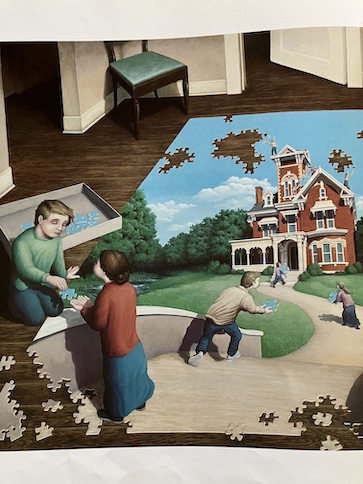
Mai and her family are Hmong refugees from Laos, living in the refugee camp of Ban Vinai in Thailand. Some of her relatives have gone to the United States, but Mai and her grandmother are still waiting in the refugee camp. Mai’s parents are dead, and Mai doesn’t really remember her family’s life in Laos. Almost as far back as she can remember, she’s always lived in the refugee camp. She only has vague memories of her parents’ deaths and how she and her grandmother fled to the refugee camp.

Mai’s grandmother teaches her how to do embroidery, and she begins helping her grandmother make pa’ndau, a kind of tapestry that tells a story. Together, she and her grandmother pa’ndau to sell to traders for money. They hope to use the money to get out of the refugee camp and join their relatives in the United States.

Their pa’ndau tapestries have beautiful floral borders and images that tell a story. Mai asks her grandmother if she can do one all by herself and if he grandmother will tell her a story she could use. Her grandmother says that she’ll be ready to do a pa’ndau of her own when she has a story of her own to tell.

As Mai thinks about how much she misses her parents, she realizes that she does have a story to tell in her own pa’ndau. She begins embroidering a pa’ndau that tells the story of her parents’ deaths and how her grandmother carried her away in a basket, fleeing as soldiers shot at them. She embroiders their arrival at the refugee camp, and the people and things she sees there.

When she asks her grandmother how much money they can get for her pa’ndau, she says that they cannot sell it because it isn’t finished yet. At first, Mai thinks that there isn’t anything more to tell because they’re still living in the camp, and she hasn’t experienced life beyond it. Then, she realizes that she can embroider the life she hopes to have when they finally join her cousins, based on the things they’ve told her in their letters.

The book is available to borrow and read for free online through Internet Archive.

The foreword to the story explains that the Hmong people of Laos were driven out by the Lao Communist government, and many of them were killed before they had a chance to leave. The government drove them out because they sided with the Americans fighting in Laos and Vietnam. Many people, like Mai’s family, found refuge in refugee camps like Ban Vinai, waiting until they could find another country willing to take them on a permanent basis. However, at the time this story was published in 1995, the Ban Vinai camp was set to close. The refugees there were set to be either transferred to different refugee camps or sent back to Laos, to face whatever the government there had in store for them. Understandably, many of them didn’t want to be sent back to the country they had escaped from. This article explains more about the generation of children who, like Mai, grew up in the refugee camp, disconnected from the lives their parents knew in Laos, and with ambitions to go to other places, like the United States, to start new lives.

Although this is a picture book, there are violent themes of war in the story, so I wouldn’t recommend it for very young children. The pictures in the book are beautiful, an unusual combination of paintings and actual embroidery. The artist who did the embroidery, bringing Mai’s tapestry to life, was also a refugee in camps in Thailand before coming to the United States in 1992.
I thought this was an interesting way to introduce readers to part of the history of the Hmong people and the fallout of the Vietnam War through a traditional Hmong artform/craft that tells stories in a unique way.

The Travels of Ching

A dollmaker in China makes a little doll named Ching. Ching is a high-quality, handmade doll, and the dollmaker sells him to a toy shop.

Ching sits in the window of the toy shop for a long time, waiting for someone who wants him. There is a little girl who sees him in the shop, and she wants him badly, but all the toys in the shop are expensive, and she can’t afford him.

One day, a wealthy tea merchant buys Ching, but he doesn’t want Ching himself. He plans to send Ching to someone else overseas. Ching begins a long journey by donkey, boat, and steamship to America. When he gets to America, he travels even further by train, eventually arriving at the apartment of a wealthy girl.

However, the wealthy girl doesn’t really want Ching. She already has many dolls, and she doesn’t find Ching interesting. She is careless with him, and one day, he falls off the balcony of the apartment and lies outside, forgotten.

One day, an old man finds Ching and brings him inside, but he doesn’t really want Ching, either. He gives Ching to his cook, but she doesn’t really want him, so she throws him in the trash, and Ching ends up in a junk yard.

Fortunately, Ching’s story doesn’t end there. A man who works for a Chinese laundry happens to pass the junk yard and spots Ching. Although Ching is dirty from his time outside, the Chinese man recognizes Ching’s quality and is pleased that the junk yard owner is selling him cheaply. The man buys Ching and cleans him up because he knows someone who will really appreciate him.

Thus, Ching is sent on another long journey … back to the person who always wanted him the most.

The book is available to borrow and read for free online through Internet Archive.

This is a vintage children’s book, and the illustrations of the Chinese people have the slits for eyes that are considered stereotypical now. However, there doesn’t seem to be any disrespect meant by the story. The basic theme of the story can be summed up by the saying, “One person’s trash is another person’s treasure.”

Ching travels a great distance from China to the United States, passing through the hands of various people along the way, and at times, he’s actually given or thrown away because the people who have him don’t really want him. There’s nothing wrong with Ching. He was always a high-quality doll, which is how he survived his time outside in the elements. It’s just that the people who have him don’t really appreciate him. Fortunately, there are people who recognize his quality, and there is one person who definitely wants him. It’s a happy ending when Ching finds his way back to her. All he really needed was for someone to want him, and in the end, he is happy to be with the person who does want him.