
The Gullywasher written and illustrated by Joyce Rossi, 1995.
This is a tall-tale story, told by a grandfather to his young granddaughter about how he came to be an old man. The grandfather was a vaquero (Spanish for cowboy, the origin of the work “buckaroo”) in his younger days. The book is written in both English and Spanish.
When the story begins, Leticia and her grandfather are watching a passing storm. The grandfather calls it a “gullywasher” and says that they should wait before going on a walk.

Leticia asks her grandfather to tell her about when he used to be a vaquero. After some coaxing, he begins to tell her about a big gullywasher that he was caught in when he was younger.
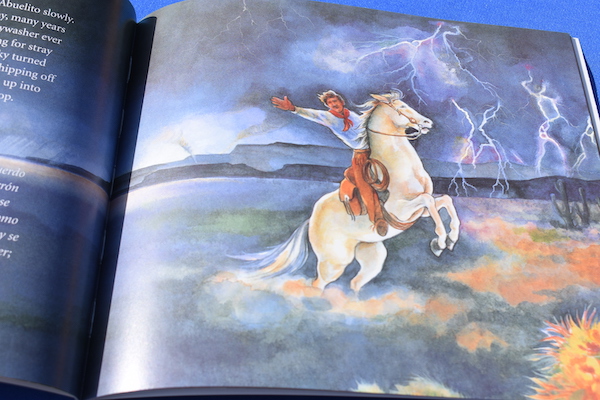
By the time the storm was over, the water had wrinkled his skin. Then, when he was napping under a palo verde tree, a hummingbird took some of the hairs on his head to make a nest. It took all of the dark ones, leaving only the white ones.

After that, he came to a village, where he looked for food. An old woman gave him some corn kernels, but he made the mistake of eating some chili peppers immediately afterward, so the corn popped in his stomach, giving him the pot belly he has today. Also, his horse was so tired that he had to carry the horse all the way home on his back, making him bent over. That is how he got to be the old man that he is.
When the tall tale is over, Leticia asks her grandfather if it makes him sad to be bent over. Her grandfather tells her that it doesn’t because he’s closer to her this way.

The note from the author in the beginning explains a little about the tall tales that cowboys liked to tell. One of the keys to telling a story like this is to try to keep a straight face during the telling. Keeping a straight face can make the outrageous story seem more convincing, but it can also make it seem funnier. There is also a glossary in the back of the book with the definitions of some of the key Spanish words. It also reminds readers that Leticia’s name is pronounced differently by Spanish speakers than English speakers (“leh-TEE-seeya”).
 Jestress's Forgotten Books and Stories