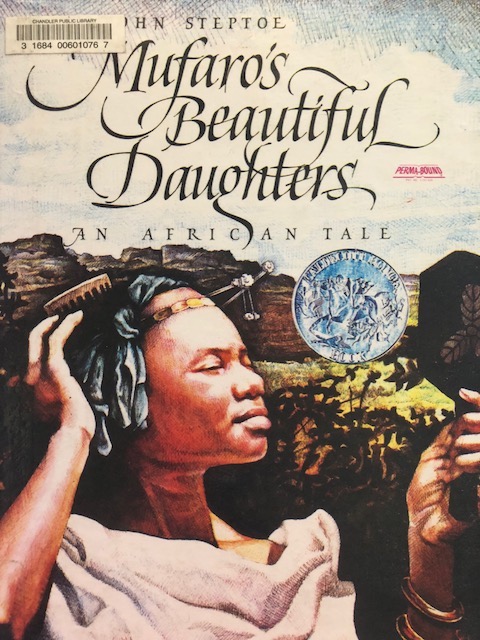
Mufaro’s Beautiful Daughters by John Steptoe, 1987.
This story, based on an African folktale, is somewhat similar to other folktales and fairy tales from other parts of the world such as Cinderella, Mother Holle, and Vasilisa the Beautiful, where a girl with a kind, hard-working nature triumphs over a mean sibling because someone in authority recognizes her good nature and rewards it.
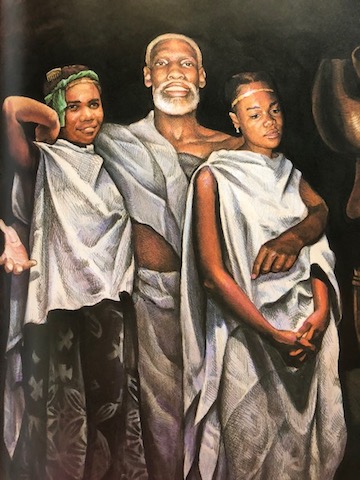
In a small village in Africa, a man named Mufaro has two daughters, Manyara and Nyasha. Both girls are beautiful, strong, and clever, but they have very different natures. Nyasha is kind, gentle, and patient. Manyara is bad-tempered, jealous, and self-centered. She frequently taunts Nyasha about how, one day, she will be the queen and her sister will be her servant. When Nyasha asks her why she is so mean, Manyara says that she hates the way people praise Nyasha for her kindness. She thinks that Nyasha is their father’s favorite child, and she wants to prove that Nyasha’s “silly kindness is only weakness.”

Since there is nothing that Nyasha can do to change her sister’s mind or attitude, she just continues doing her usual chores and being kind to people and animals. In particular, she makes friends with a small garden snake, knowing that his presence in her garden will keep away pests.
Manyara is sneaky and always behaves herself when their father is present, so Mufaro doesn’t know about the troubles between his daughters. When a messenger arrives, saying that the Great King is seeking a wife and that beautiful, worthy girls are summoned to his city so that he can choose from among them, Mufaro is proud and eager to present both of his beautiful daughters. Manyara tries to persuade her father to send only her, but Mufaro is firm that both girls must present themselves for the king’s decision.

Manyara decides that the only way to get the better of her sister is to be the first to arrive and present herself to the king, so she slips out in the middle of the night and begins the journey alone. However, both the journey and the king are not what Manyara thinks they are. Along the way, Manyara encounters various strange characters who ask for help or offer advice, but thinking that a queen doesn’t need to pay attention to others or do anything she doesn’t want to, Manyara ignores them all.
Nyasha, on the other hand, gets ready to leave at the appointed time in the morning. Everyone worries about Manyara but decides that the best thing to do is to follow her to the city, since she seems to have gone on ahead. As Nyasha travels with the rest of their friends and family, she listens to the people Manyara ignored and shows them kindness.

When they finally reach the city, Nyasha encounters a terrified Manyara, who hysterically insists that when she went to meet the king, she found a horrible monster instead. However, like everything else, it’s just another part of the test, and Nyasha is the one who passes because she, like her sister, has actually met the king before, but unlike her sister, she actually paid attention to him.

The pictures in the book are beautiful and colorful. A note in the front of the book says that the buildings in the illustrations were based on an ancient city in Zimbabwe that is now ruins. The note in the book also explains that the names of the characters in the story come from the Shona language. The meanings of the names are clues to the characters’ natures. Manyara means “ashamed”, and Nyasha means “mercy.”
The book is a Caldecott Honor Book. It is currently available online through Internet Archive.

 Jestress's Forgotten Books and Stories