American Girls

Felicity’s Craft Book by Rebecca Sample Bernstein and Jodi Evert, 1994.
This is a companion book to the Felicity, An American Girl series. It explains about the types of crafts that people would do in Colonial America and gives instructions for projects that readers can make at home.

In the beginning of the book, there is a brief history of crafting in America. It explains that, in the earliest days of the American colonies, people had to get most of their goods from Europe because they had to spend their time and energy on building homes and establishing farms in order to survive. However, as the colonies became more established, people were more able to make goods for themselves, both in their own homes and as professional craftspeople. By the time that Felicity lived, during the late 1700s, there were many skilled craftspeople, and those craftspeople also trained new people in their professions in apprenticeships.

Before presenting craft projects that readers can make, the book also offers a few tips for safety and neatness while making things. The crafts are also divided into sections relating to topics like writing, sewing, games and toys, and scented objects that you can make with plants.
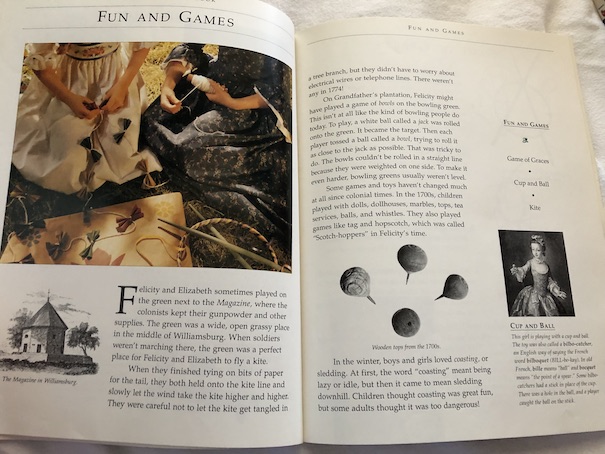
The projects explained in this book include:
A quill pen and two types of ink – The book gives instructions for making ink from different types of berries (such as raspberries, strawberries, and blackberries, which make red or purple ink) and walnut shells (which makes a brown ink).
A wax seal – To be used with sealing wax or wax from a candle. These were used to seal letters before the invention of envelopes with glue. (I know that there are people and companies that still make these because I have one myself and the sealing wax to use with it.)
Game of Graces – A hoop with a pair of sticks that were used for a tossing game.
Cup and Ball Game – A common toy in which a cup is attached to the end of a short stick and a ball is tied to it. Players have to move the toy around and make the ball swing into the cup.
Kites – Made with lightweight paper.
Folding Fan – Made with poster board and ribbon.
Fancy Straw Hat – Explains how to decorate a hat with flowers and ribbon.
Fruit Pyramid – Used as a table centerpiece.
Cross-Stitch Sampler – A basic sampler using only the cross-stitch. (Colonial girls would create more elaborate samplers to show off the range of stitches they could make.)
Sachet – A small bag of potpourri (sweet-smelling dried plants). Colonists would put sachets into trunks and wardrobes where they were storing their clothes to make them smell nice. (Some people still do this in modern times.) In a later part of the book, they also give instructions for making potpourri with herbs and flower petals.
Friendship Pincushion – An embroidered pincushion.
Tussie-Mussie – A small bouquet, like the kind that bridesmaids and flower girls might carry. (The book says that people in Colonial times might carry one or maybe a pomander ball if they went to visit a sick person because they had an idea that breathing bad air would spread sickness and they were trying to freshen the air with fresh scents. That’s not quite how sickness is spread, but they were partly correct about sicknesses being airborn.)
Pomander Ball – An orange scented and decorated with spices and cloves. Besides freshening the air, they can also make nice decorations.

In the sections about different types of projects, there is additional historical information about life and crafts in Colonial America. Because, in the books, Felicity’s grandfather owns a plantation and one of the books takes place there, the craft book also has a section about plantations that includes a brief description of plantation life and slavery, noting that the lifestyle and pastimes that plantation owners enjoyed would not have been possible without their slaves to take care of the plantation chores for them.
The book is currently available online through Internet Archive.
 Jestress's Forgotten Books and Stories