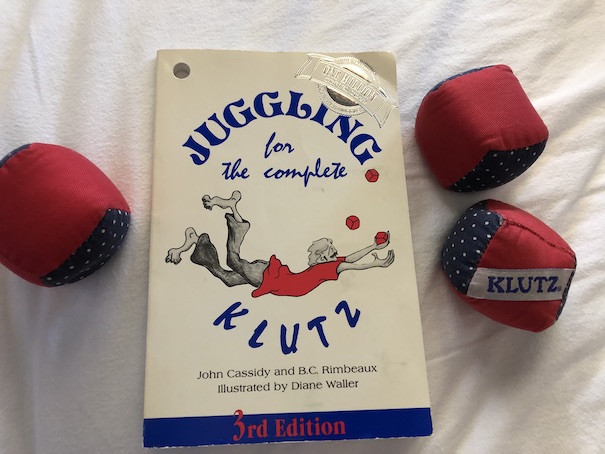
Juggling for the Complete Klutz by John Cassidy, 1977.
This is the book that started the Klutz Press publishing company as well as the book that inspired the name that I often use online, Jestress. The term “jestress” (which even I have never been sure is proper English) refers to a female jester. Back when I was in high school, I learned how to juggle from this book. In fact, I became obsessed with juggling and jesters (I often become obsessed about odd and random topics), and I started giving myself that nickname. (I’m not the only one who uses that handle, so not every “Jestress” on the Internet is another incarnation of me, but I have used it in several other settings.) However, the Klutz books in general were a regular feature of my youth, as they have been for many people from about the 1980s onward.

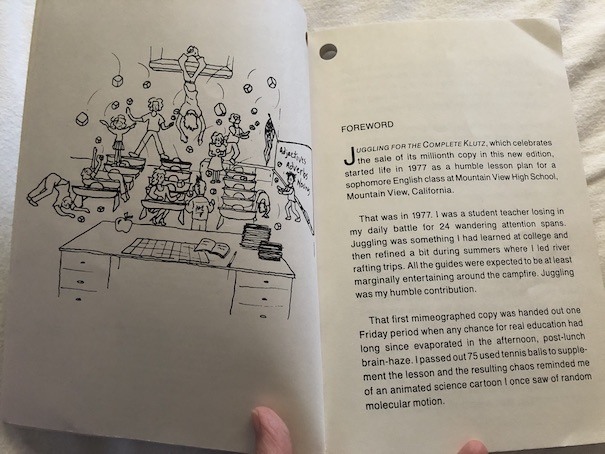
Klutz Press began as a small outfit, and the very first book they offered was this guide for learning how to juggle. The author of the book used to teach English, and as the intro to the book explains, he started teaching his students how to juggle as a fun exercise in class. John Cassidy learned how to juggle in college and used it to entertain guests on rafting trips. The author and his friends printed up more copies of his guide to juggling and began selling them. Their company branched out from there.
By the time I bought my copy of the book in the 1990’s, it came with 3 cube-shaped bean bags to use for juggling. The hole in the upper left corner of the book is where the bag holding the bean bags was originally attached. The bean bags are one of the best features of the book. They are weighed well for juggling, which makes them easier to control than other small juggling balls I’ve tried. A friend of mine got a later edition of the food from the 2000s, and the bean bags are a little different – the cloth is more velvety, and they have a different feel to them, like they’re slightly lighter. I prefer the ones I own.

The very first step for learning to juggle in the book is to master “The Drop” – throw all of the bean bags in the air and just let them fall to the ground without trying to catch them. The goal of mastering this is to get used to the idea of dropping things because it’s going to happen a lot while you’re learning. The cube shape of the provided bean bags helps to keep them from rolling too far when you drop them, which happens a lot when you’re learning to juggle. When I was in high school, I started teaching a friend to juggle, and we both agreed that the learning process actually gave our leg muscles a good workout; you really feel them when you have to bend over that many times to pick up dropped bean bags. (The book mentions this later in the section called “Special Problems”, but we considered this a bonus. It’s like doing a bunch of toe touches with more exciting moments in between when you’re throwing stuff in the air.)

From there, the book guides you through mastering the scooping motion of juggling tosses and how not to panic when you realize that the hand that is going to catch a tossed bean bag is already holding one. Successful juggling is largely a matter of timing, maintaining even motions, and eventually, letting muscle memory take over. You toss one ball (or bean bag), and then you toss the next one with the other hand when the first one reaches the top of its arc, freeing that hand for catching. Then, you keep doing that, over and over, to keep all of the juggling balls in motion.

It might feel impossible at first, when you’re still dropping everything, but speaking as someone who learned how to do this about 20 years ago, muscle memory is very strong, and if you build the right habits and keep at it consistently, you will not only eventually master it, but it will feel as natural as riding a bicycle. I don’t even have to look at my juggling balls or my hands while I’m juggling, and I can comfortably carry on a conversation with someone else while juggling, because my hands know what to do with minimal instruction from my brain.

The book has tips for getting around difficulties in learning to juggle, and when you’re feeling more confident, instructions for going even beyond basic juggling. The book explains different types of juggling cycles, how to juggle four or five balls, how to juggle other items besides balls and bean bags, and how to juggle with a partner. The section about clubs is particularly interesting because it not only describes the techniques of club juggling but how to make your own set of juggling clubs from plastic bottles and wooden sticks or dowels.

The book is available online through Internet Archive (multiple copies).
 Jestress's Forgotten Books and Stories
2 thoughts on “Juggling for the Complete Klutz”