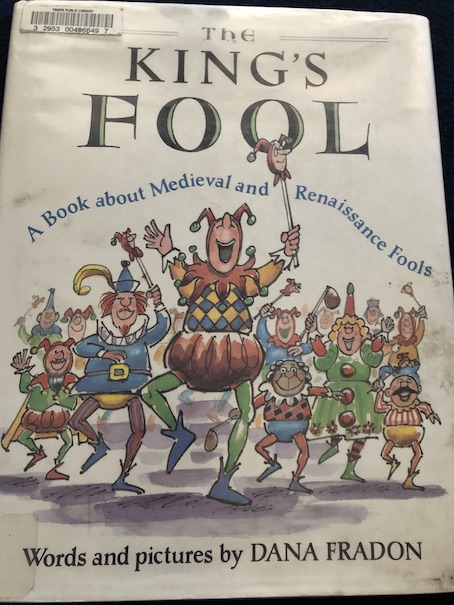
The King’s Fool by Dana Fradon, 1993.
I love nonfiction books about unusual and very specific topics! This is a non-fiction book about fools and jesters throughout history. The book begins in a museum, where a class of schoolchildren are being shown a collection of jester statues. One of the statues, Frambert, comes to life and tells the children about his life and the lives other other jesters.

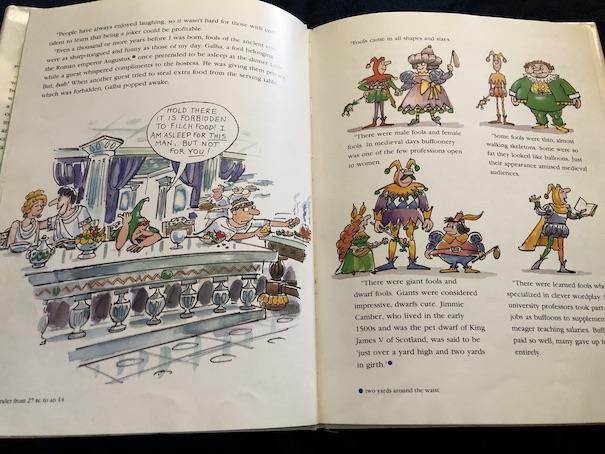
Fools and jesters were the comedians of the past. It was a job for women as well as men. There were different types of professional fools. Some of them were people with unusual appearances, such as dwarfs or people who were unusually tall. Sometimes, university professors took part-time jobs as jesters to supplement their income (teaching has always been a notoriously under-paid profession), using their public speaking skills and knowledge to make intellectual jokes or jokes based on wordplay. Some of them were very successful and made so much money as entertainers that they gave up their teaching jobs. (So, if you’ve discovered that you make more money producing humorous YouTube videos about history than you would as a history teacher or at least find it a useful supplement to your teaching salary, understand that this is just the modern equivalent.)
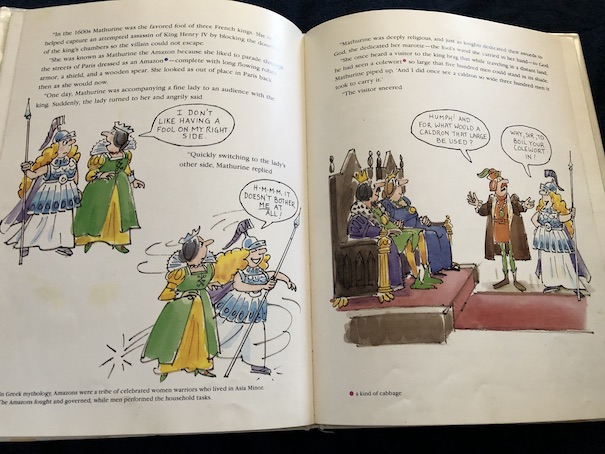
Among the individual jesters described in the book was Mathurine, a French jester from the 1600s. She liked to dress like an Amazonian warrior from Greek legends as part of her act.
Frambert is a fictional jester, but he describes how he became a jester to demonstrate what a jester’s life was like. According to his fictional biography, his talent for mimicry and making jokes was noticed when he was young, and he was selected for training as a professional fool. When he was 19 years old, he officially became a jester. His children also became jesters after him. Because he was well-loved by his king, he was given a generous pension: a village of his own to govern, which sometimes did happen to favorite jesters.

The book is available to borrow and read for free online through Internet Archive.
 Jestress's Forgotten Books and Stories