
Dancing with the Indians by Angela Shelf Medearis, illustrated by Samuel Byrd, 1991.
I love books with historical background, and this is a fascinating picture book that is based on the history of the author’s family. Like the author’s earlier book, Picking Peas for a Penny, it is told in rhyme, from the point of view of the author’s mother as a child in Oklahoma during the 1930s.
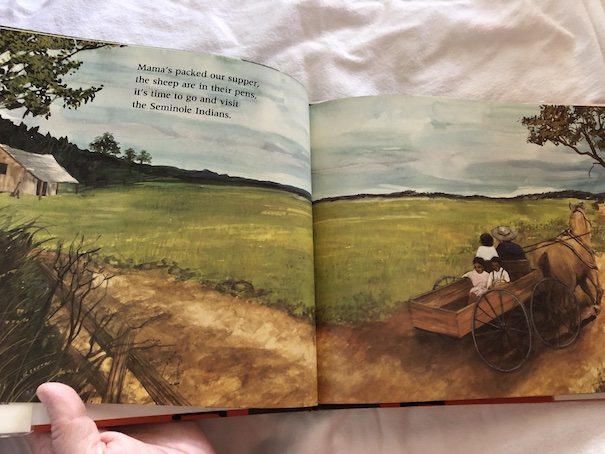
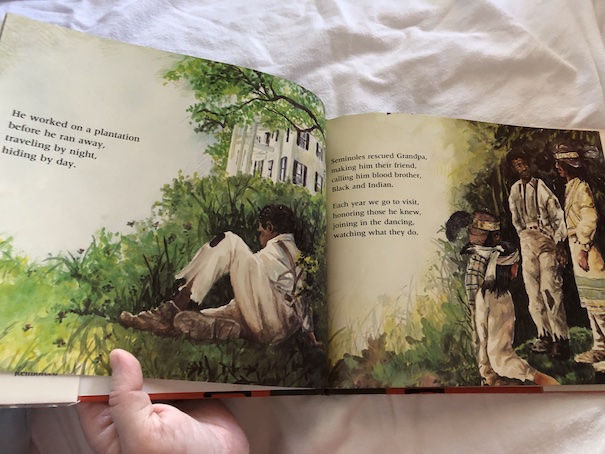
The girl and her brother are going with their parents to visit the Seminole American Indians. As they travel in their wagon, the parents explain to the children the history of their family. Many years before, the girl’s grandfather (the author’s great-grandfather) escaped from slavery and ran away to Oklahoma, where he was accepted by the Seminole tribe. Ever since, his descendants have continued to visit the tribe and join in Seminole celebrations and ceremonies as part of their extended family.
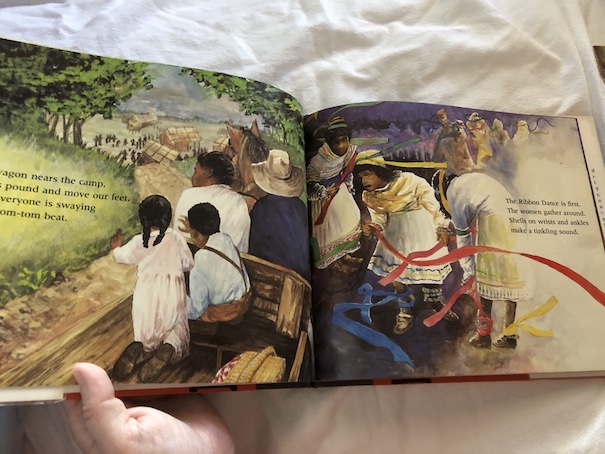
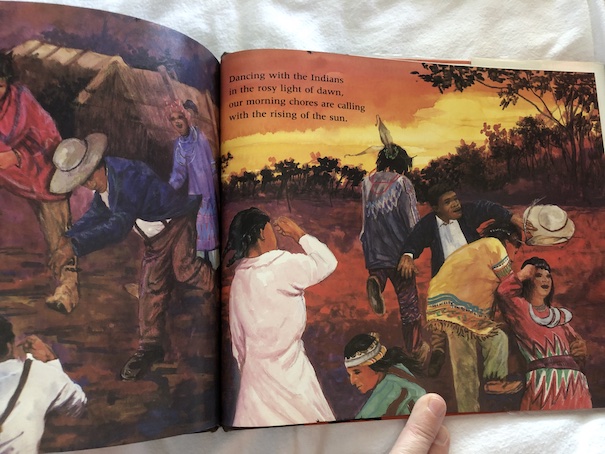
The night is an exciting celebration with dancing, drumming, and songs and stories of past triumphs.
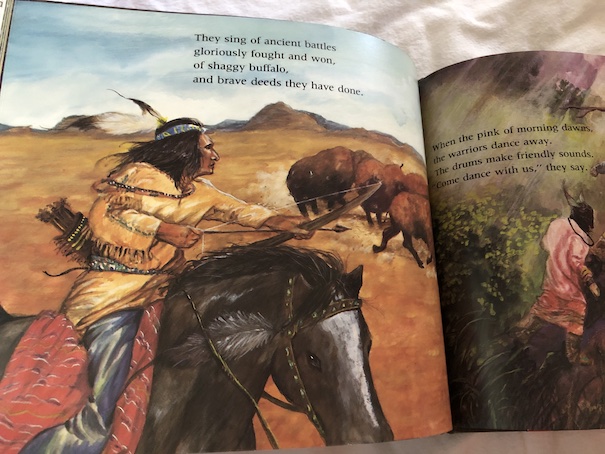
They all dance and celebrate through the entire night, until morning. As the family returns home to tend to their farm, the father promises them that they’ll return to dance with the Indians again.
I liked this book because it explains an aspect of American history that I don’t remember being discussed much when I was in school. In fact, I think that the first time I saw anything that explained that escaping slaves sometimes headed west instead of north before the Civil War was in a Disney Adventures magazine, where they were talking about cowboy, specifically mentioning black cowboys. However, another option was for escaped slaves to join up with Native American tribes. The Seminole tribe of Florida and Oklahoma was one group that was known to accept escaped slaves and adopt them into the tribe, starting in the early 1700s continuing into the 1850s. Some of the escaped slaves married into the tribe. The African Americans who joined the Seminoles and their descendants came to be called Black Seminoles. Parts of the two cultures intermingled. Black Seminoles adopted Seminole traditions, and they also introduced Seminoles to aspects of their traditions. The relationship has had complications as well, and even in modern times, there are debates about how much Black Seminoles count as part of the tribe and how much they should be entitled to certain benefits
This is a Reading Rainbow Book. The book is available to borrow and read for free online through Internet Archive (multiple copies).
 Jestress's Forgotten Books and Stories