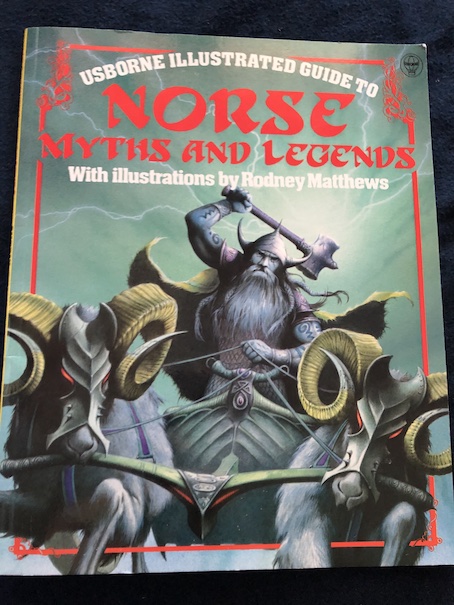
Usborne Illustrated Guide to Norse Myths and Legends by Cheryl Evans and Anne Millard, illustrated by Rodney Matthews, 1986.
I like this book because, before it begins telling the myths and legends, it first gives an introduction to the history, territory, and religion of the Norsemen. By “Norsemen“, the book means not only people living in Norway but Scandinavians and people of Scandinavian descent speaking related languages and living in various areas across Europe. The Norsemen include, but are not limited to, the Vikings, who were specifically seafaring traders, mercenaries, and pirates/looters as opposed to farmers and fishermen.

There is still much about the history of the ancient Norsemen that we don’t know because, for much of their history, they did not have their own system of writing and relied on oral stories for passing down historical and cultural knowledge. The Norse myths were originally oral stories before they were written down. The introduction also explains that there is one myth in the book, the story of Sigurd and the Nibelungs, that was originally a German legend but was later adopted by Scandinavians.

Norse mythology is somewhat unusual because, while Norsemen were polytheistic, like other ancient groups, and their gods and goddesses had human emotions and relationships, like the gods and goddesses in Greek and Roman mythology, Norse gods were not immortal. Norse gods could be killed, like human beings, which meant that any risks they took had genuinely serious stakes for them. In fact, the legends predict that, at a future, world-ending event known as Ragnarok, most of the gods will be killed.
Although this particular book doesn’t mention it, the qualities of Norse gods being able to perform incredible deeds while still being mortal makes them rather like our modern concept of a superhero. Thor and Loki were both made into comic book characters by the time this book was written, and characters and events in Norse mythology have helped to form the 21st century Marvel Cinematic Universe.
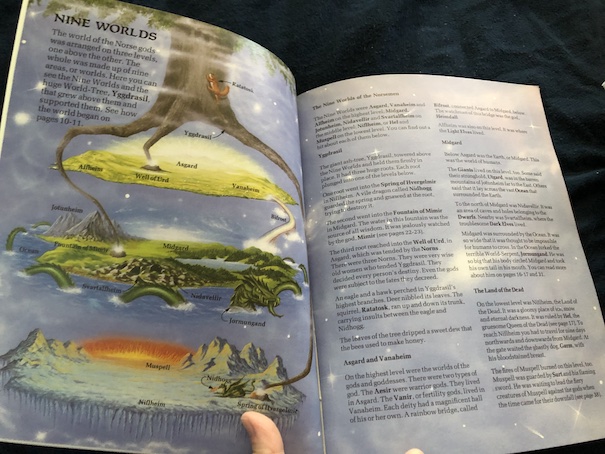
In Norse mythology, the gods and goddesses lived in a multilevel universe made up of nine lands or “worlds.” The highest level of their universe contained Asgard (home of the warrior gods), Vanaheim (home of the fertility gods), and Alfheim (home of the light elves). The middle level contained Midgard (our world, where humans live, connected to Asgard by a rainbow bridge), Jotunheim (home of the giants), Nidavellir (home of the dwarves), and Svartalfheim (home of the dark elves). The lowest level held Niflheim (land of the dead, dark and icy, ruled by a fearsome queen named Hel) and Muspell (where the creatures who will attack the gods at Ragnarok live). All three levels of this universe were kept in place by the roots of a giant ash tree called Yggdrasil.
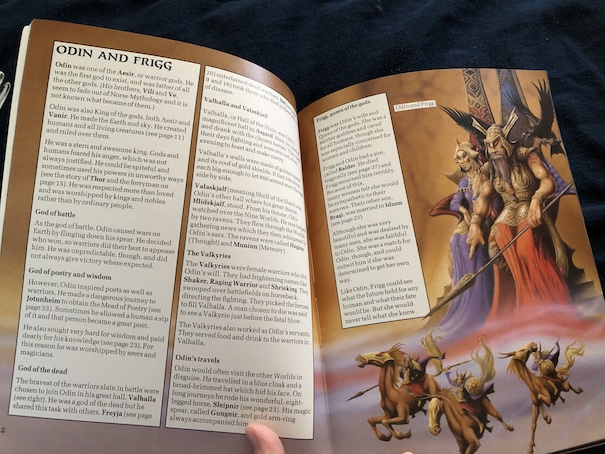
The book has pages dedicated to specific gods and goddess, explaining their histories and roles in Norse mythology. Odin, for example, was the king of the gods, who created the world and humans and was the father of the other gods. His wife’s name was Frigg, and she was a mother goddess figure. Thor was the thunder god and the god of law and order. Unlike other gods, he mostly relied on his strength instead of magic or tricks, but he did have magic weapons, including his hammer, Mjollnir, which would always strike its intended target and return to Thor after. Freyja was one of the fertility gods, and she was the goddess of love and beauty. She later also became a goddess of death and was responsible for starting wars among humans. Loki technically wasn’t a god because his parents were fire-giants, not gods, but he was a close friend and sworn brother to Odin, so he was able to live in Asgard, too. Loki is known for being a trickster figure.

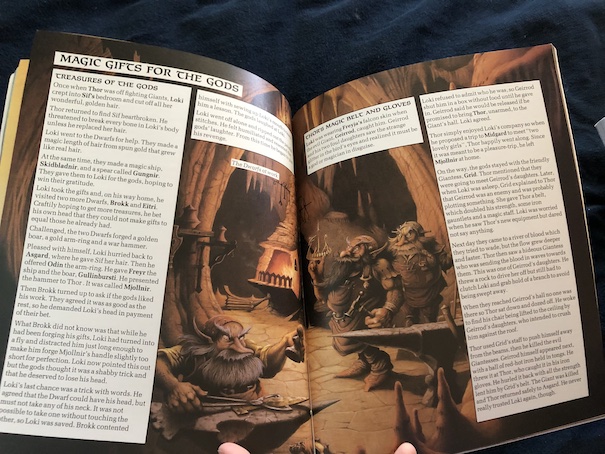
After the book profiles some of the gods and goddesses and other notable figures in Norse mythology, it tells some of the myths and legends associated with theses figures. One story that particularly interests me is “The Curse of the Ring” because this story and other aspects of Norse mythology provided some of the inspiration for Tolkien’s Lord of the Rings. Before it inspired Tolkien, this same story was also made into an opera by Wagner.

In “The Curse of the Ring”, Odin, Loki, and Honir kill an otter who turns out to be the son of a magician who sometimes turns one of his sons into an otter to go fishing for the family. (Maybe not the safest choice of fishing methods.) The gods offer to compensate the magician with enough gold to fill the otter skin. Loki goes to get the gold from a dwarf named Andvari, who has a famous hoard. Andvari has no choice but to give Loki the gold he wants, but Loki notices that Andvari also has a gold ring on his finger, and Loki demands that Andvari give him the ring, too. Angry at having his ring stolen, Andvari curses the ring so that it will bring misery and destruction to anyone who wears it. When Loki brings the promised gold to the magician, the magician also sees the ring and wants it. Loki warns him about the curse on the ring, but the magician insists that he wants it anyway.
The curse on the ring comes true when one of the magician’s other sons, Fafnir, kills his father for his gold. Fafnir takes all of the gold instead of giving his other brother, Regin, a share of the inheritance and turns himself into a dragon so he can protect his hoard of gold from anyone who tries to take it. Regin raises their nephew, Sigurd, to kill Fafnir and avenge his grandfather. However, the curse of the ring and the gold doesn’t end there. Regin tries to kill Sigurd so he won’t have to share the gold with him, and Sigurd has to kill him in self defense. After Sigurd rescues a Valkyrie named Brynhild, and they fall in love, they both fall victim to treachery from Queen Grimhild of the Nibelungs. Wanting Sigurd’s gold, she gives him a love potion that makes him fall in love with her daughter, forgetting about Brynhild. Queen Grimhild’s son also wants to marry Brynhild. Abandoned by her lover, Brynhild marries him, but driven mad with by Sigurd’s abandonment of her, Brynhild arranges for Sigurd to be murdered and then kills herself, setting off a continuing chain of murder and revenge after her own death that destroys the royal family of the Nibelungs.
The book ends with a “Who’s Who” section with information about various characters and creatures in the Norse myths.
The book is available to borrow and read for free online through Internet Archive.
 Jestress's Forgotten Books and Stories