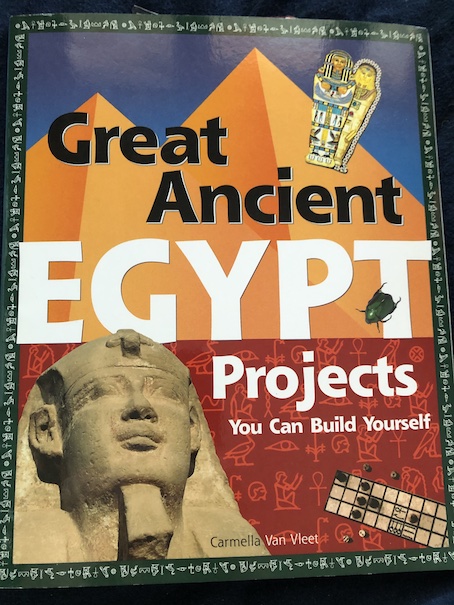
Great Ancient Egypt Projects You Can Build Yourself by Carmella Van Vleet, 2006.
I love this book because it combines lessons about history with hands-on projects and craft activities!
The book starts with a general timeline of Egyptian history, a brief introduction, and then a chapter about The Foundations of Ancient Egypt, which explains about the climate of Egypt, the role of the Nile in Egyptian civilization and farming, jewelry and other products produced by Egyptian artisans, pyramids and mummies, and forms of entertainment that the Ancient Egyptians enjoyed, like games and music. After this first chapter provides a general overview of Egyptian civilization, the other chapters go into more detail on different subjects related to Egyptian civilization with accompanying activities and projects. Each of the activities or projects comes with a list of materials needed and an estimate of the amount of time needed to finish.

Below is a list of the chapters in this book and descriptions of the types of projects that you will find in each section:
Boats
Boats were an important form of transportation of people and goods up and down the Nile. This chapter explains how the Ancient Egyptians made boats and has instructions for making your own miniature boat out of drinking straws in a similar manner as the Egyptians made papyrus boats.

Farming
This chapter describes the Egyptian flooding, growing, and harvesting seasons and the types of crops the Ancient Egyptians planted. The project for this chapter is how to build a shaduf, which is a device the Ancient Egyptians used for irrigating their crops.
Papyrus
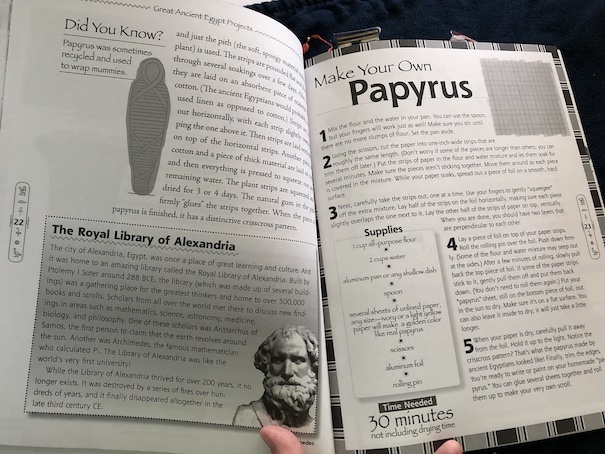
The Ancient Egyptians found many different uses for papyrus plants, including boats, baskets, mats, ropes, sandals, food, medicine, perfume, and paper. This chapter discusses how the Ancient Egyptians made papyrus paper and formed it into scrolls. The activity is to make your own papyrus-style paper using strips of regular paper instead of papyrus. It also has a recipe for a berry-based ink. It mentions that the Egyptians would have used different colored minerals, but the berry ink is easy for a beginner.
Homes
I always like books that discuss the lives of ordinary people and their homes. This chapter explains how Ancient Egyptian homes were made, how the homes of common people and wealthy people differed from each other, how homes were decorated, and the arrangement of rooms for sleeping, storing goods, and cooking. There are three activities for this chapter: making your own mud bricks, making a cat statue, and making a “soul house” – a miniature house or layout of rooms out of plaster of Paris.
Bread
This chapter is about what people ate in Ancient Egypt, and it particularly describes how the Ancient Egyptians made bread. An interesting fact in this chapter is that people in Ancient Egypt typically bartered for food instead of using money. This chapter includes two recipes, one for bread and one for date (fruit) candy.

Games
This is one of my favorite chapters! It’s about toys and games played by children in Ancient Egypt. It also describes board games that could be played by people of all ages, like Mancala, Hounds and Jackals, and Senet. The book provides instructions for making your own Senet board game and rules for playing.

Tunics and Fashion
This chapter is about what people wore in Ancient Egypt. Clothes at the time weren’t as much about modesty as in modern society. Clothing in Ancient Egypt could be pretty minimal, and it was common for Egyptian children to simply go naked. This chapter also discusses clothing accessories and wigs. The activities for this chapter are to make your own simple tunic, sandals (basically decorating a pair of flip-flops), and nemes (head covering).
Jewelry
This chapter explains the decorative and religious aspects of jewelry and the types of gems and minerals included in Egyptian jewelry. The projects are making paper beads and a wesekh collar (type of necklace).
Amulets
This chapter is about how Ancient Egyptians used amulets that they believed had the power to protect them from illness and other dangers. It describes different types of amulets and what they were supposed to do for people who had them. Part of this chapter covers The Book of the Dead, which was a collection of texts that provided a guide to funeral rituals and the afterlife. (You can actually get copies of this book today, translated into English.) The activity for the chapter is to make your own amulet out of a dough made from water, flour, and sawdust.
Kohl and Perfume
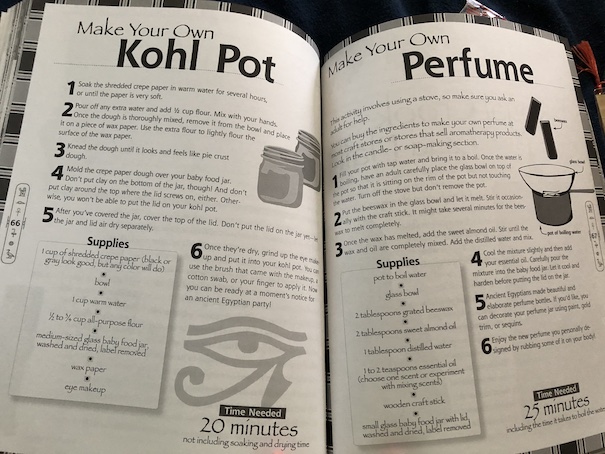
This chapter is about the makeup that people used in Ancient Egypt. Kohl is the substance that Egyptians used around their eyes. It was made from the mineral galena, and it may have helped the Ancient Egyptians protect their eyes from eye infections or provided some shielding from the sun’s glare. This chapter includes instructions for making a simplified version of kohl using black crepe paper, water, and flour and for making perfume out of beeswax, almond oil, and different essential oils. (The perfume activity looks the best of the two. Health food stores that also carry cosmetics, like Sprouts, probably have all or most of the ingredients, and if they don’t, you could probably get whatever’s missing from Amazon.)
Royal Crook and Flail
Pharaohs are often depicted holding a symbolic crook and flail. This chapter explains the meaning behind these symbols (the crook resembles a shepherd’s staff and was meant to represent the ruler of the king because he was supposed to look after his people like a shepherd looks after his sheep, and the flail is the same design as one that was used in harvesting and may have represented the pharaoh overseeing the fertility and prosperity of the land) and also discusses the duties of an Egyptian king or queen and what their subjects expected of them. The chapter also gives information about famous kings and queens and the crowns they wore. The activities for the chapter are making your own crook and flail and your own throne (by decorating an old chair, like one you might find at a garage sale).
Pyramids
This chapter covers Ancient Egyptian tombs and pyramids, how they were built, and how they were decorated. The activities for the chapter are building your own pyramid out of poster board and building a sledge of the type that the Ancient Egyptians used to transport stone blocks.
Temples
This chapter discusses Ancient Egyptian gods and their temples. It explains how the Ancient Egyptians would worship their gods. The activities are making your own foam obelisk and a miniature temple sanctuary scene in a box.
Mummies
This chapter explains how Ancient Egyptians made mummies and what they believed about the afterlife. The activities are making your own shabti (little figurines that were supposed to perform tasks on behalf of the deceased) out of a bar of soap and making your own funeral mask (like Tutankhamen’s famous mask).
Hieroglyphs
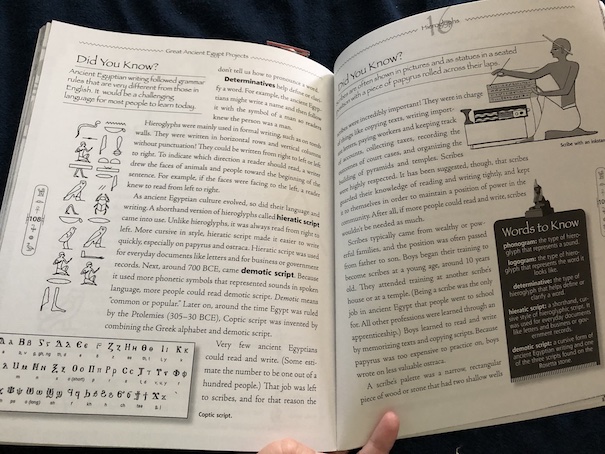
This chapter explains how the Ancient Egyptian systems of writing worked and how modern people learned to read hieroglyphs by studying the Rosetta Stone. Th activities are making your own ostraca (piece of pottery used as a writing surface), mural, and cartouche.
I haven’t seen this particular book available to read online, but there’s a very similar by the same author on Internet Archive.
 Jestress's Forgotten Books and Stories
